Aluminum Shredder Maintenance Starts With the Failure Mode
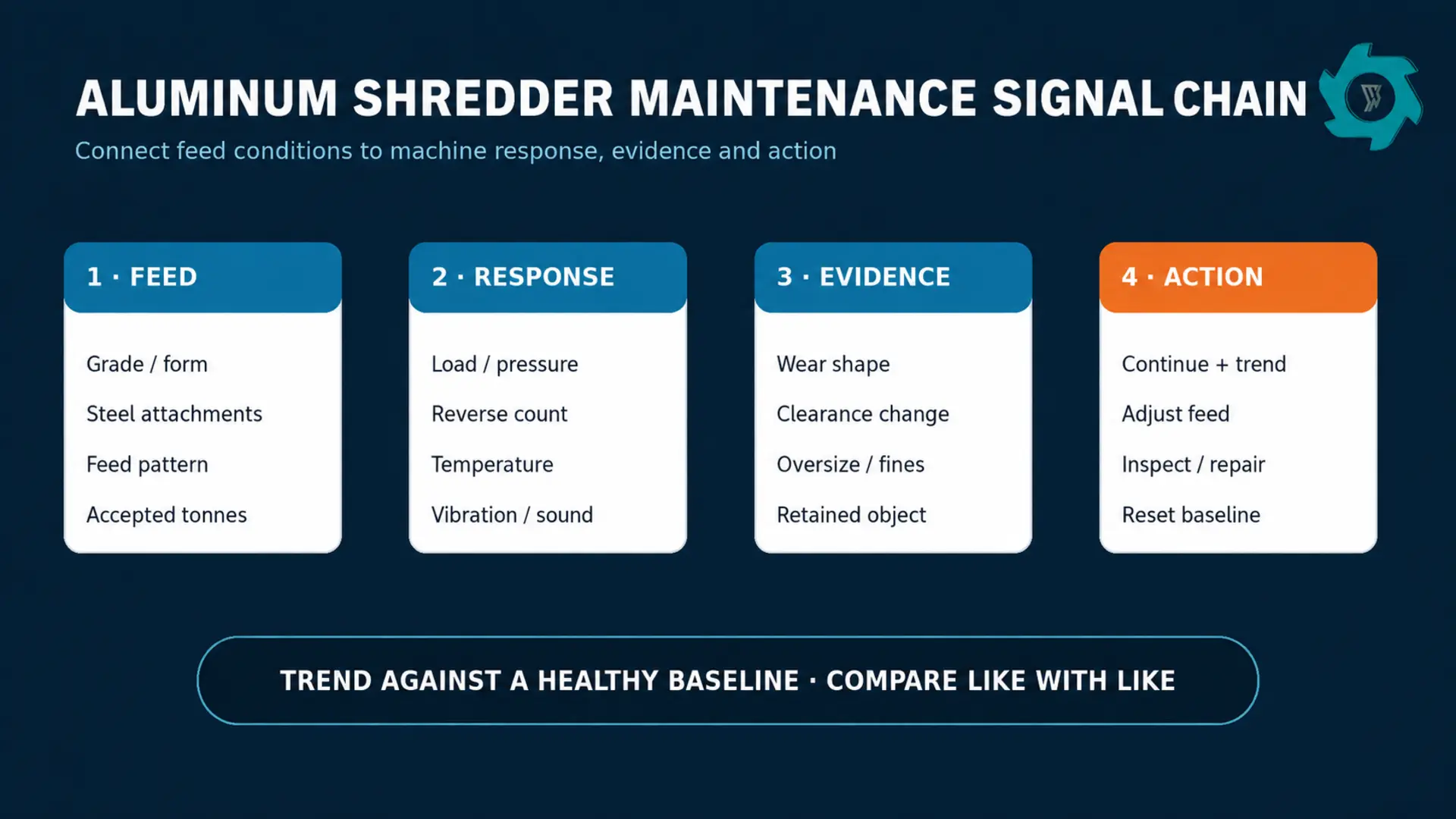
An aluminum shredder rarely goes from healthy to failed without leaving clues. Cutter edges round off, load per accepted tonne rises, reversals become more frequent, bearing temperature moves away from its normal band, or a familiar feed begins producing an unfamiliar sound. A useful maintenance plan turns those changes into inspection triggers.
The difficult part is separating normal wear from a damaging event. Clean extrusion offcuts mainly create repeated cutting load. Mixed demolition profiles add screws and brackets. Cast housings can conceal shafts, races and hardened inserts. The machine may process all three, but their maintenance cost should never be blended into one vague “hours run” number.
Maintenance decisions improve when the team connects the feed, machine response, physical evidence and corrective action.
1. Define the Maintenance Boundary Before Setting Intervals
The shredder is one part of the scrap aluminum recycling line. A conveyor that dumps bundles in slugs, a blocked discharge, or a downstream separator that repeatedly stops can make the cutting chamber look like the problem. Map the boundary from receiving and metering through discharge. Then attach each event to the equipment state that existed at the time.
Begin a baseline after commissioning, a cutter rotation, a rebuild or any material change large enough to alter the duty. For a representative stable run, record feed category, processed input, accepted output, running and elapsed time, average and peak load, reversals, bearing and gearbox temperatures, vibration points, cutter clearance, and the mass of oversize or return material. A single number cannot describe machine health.
Do not borrow another plant’s alarm number. Motor current, torque, pressure, temperature and vibration limits depend on the specific drive, sensor position, operating speed, ambient conditions and manufacturer settings. Use the supplier’s limits for protection and your own healthy-machine data for trend detection.
2. Wear Shape Tells You More Than Wear Age
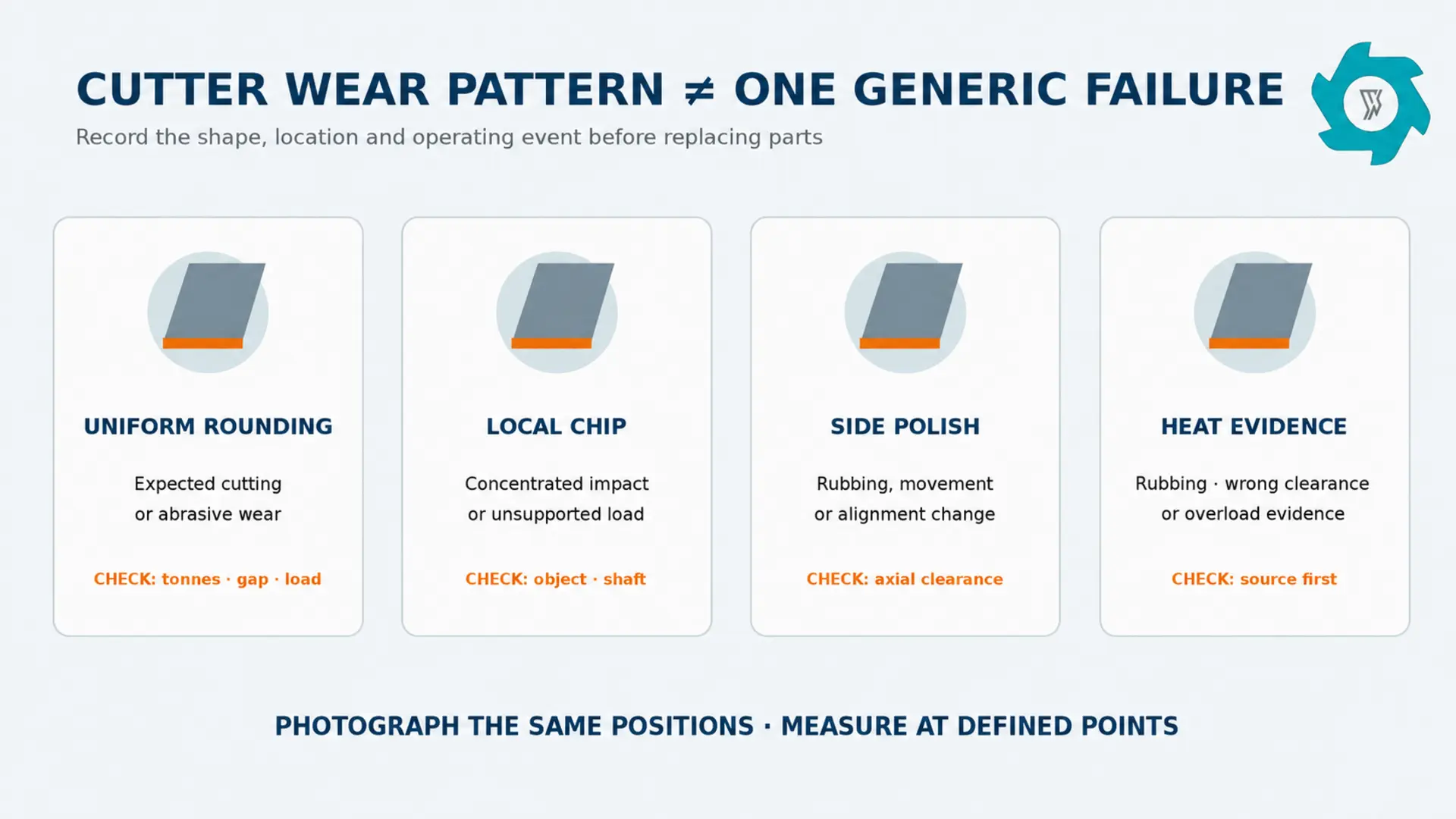
Uniform edge rounding suggests accumulated cutting and abrasion. A localized chip, rolled corner or cracked tooth points toward impact or an unsupported load. Polished side faces can indicate rubbing or clearance loss. Material packed around spacers may alter axial clearance. A blue or heat-discolored surface deserves investigation before the cutter is returned to service.
Use the aluminum shredder blade and cutter guide for material and geometry selection; maintenance begins after that choice. Photograph the same cutter positions at each inspection, with a scale and consistent lighting. If cutters are reversible, keep each position’s tonnage and feed history. Rotation should restore a known edge—not hide cracked hardware or incorrect clearance.
Different wear patterns call for different checks; replacing a cutter without finding the cause can repeat the failure.
Edge profile, counter-cutter gap, grate/screen and downstream flow
Temperature or vibration step-change
Bearing, alignment, lubrication or impact damage
Compare matched operating points; inspect per OEM procedure
3. Treat Steel Inserts as a Load Class, Not a Yes-or-No Contaminant
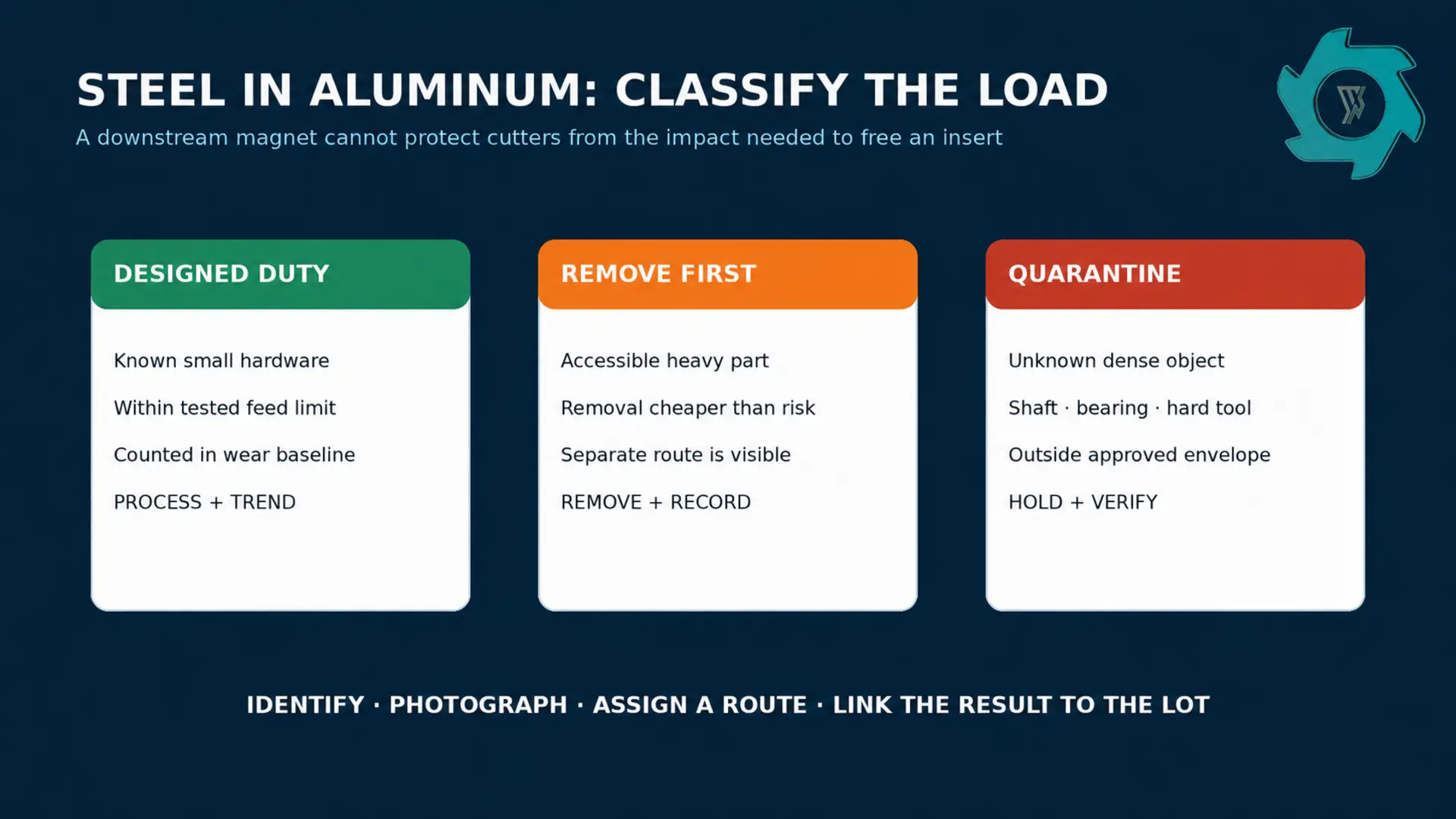
Steel in aluminum scrap ranges from small screws to bearing races and solid shafts. Ferrous separation after shredding does not mean every steel object is safe to put through the cutters. The magnet removes liberated steel; it does not protect the shredder from the impact required to liberate it.
Create three receiving categories. Designed attachment covers known hardware included in the tested duty. Remove-before-shredding covers accessible heavy components whose removal costs less than their wear risk. Quarantine covers unknown dense objects, closed assemblies, hardened tools, shafts, springs or components outside the agreed limit. The scrap aluminum preparation checklist explains the receiving controls; the maintenance record should then show what actually passed the hold point.
The useful question is not simply whether steel is present, but what it is, how it is attached and whether it was included in the tested duty.
Track steel-bearing lots separately. For each lot, note the attachment type, estimated frequency, any impact events, cutter inspection result and recovered ferrous mass. Over time, the plant can compare the removal labor with the wear and downtime avoided.
4. An Overload Is an Event Record, Not Just a Reset Button
A controlled reverse is part of many low-speed shredder designs. It protects the drive and may release a temporary bite. Repeated reversals on the same grade can signal blunt cutters, an unstable feed layer, a trapped insert, wrong clearance, material wrapping, a blocked discharge or a downstream stop.
Classify events by evidence:
Feed surge: load rises as a large bundle enters, then returns to baseline after metering improves.
Persistent obstruction: repeated trips occur at the same rotor position or the material will not release normally.
Impact event: a sharp acoustic or vibration change accompanies the load spike; cutter and drive inspection is warranted.
Progressive resistance: baseline load climbs across shifts, often alongside dulling, rubbing, packing or discharge restriction.
False machine diagnosis: the shredder is full because downstream equipment stopped or accepted material cannot leave.
If the feed itself is highly variable, apply the lot controls described in the mixed aluminum scrap shredding guide. Do not compensate by continually widening current or torque limits. Protection values belong to the machine’s approved control philosophy and should only be changed with the manufacturer’s engineering review.
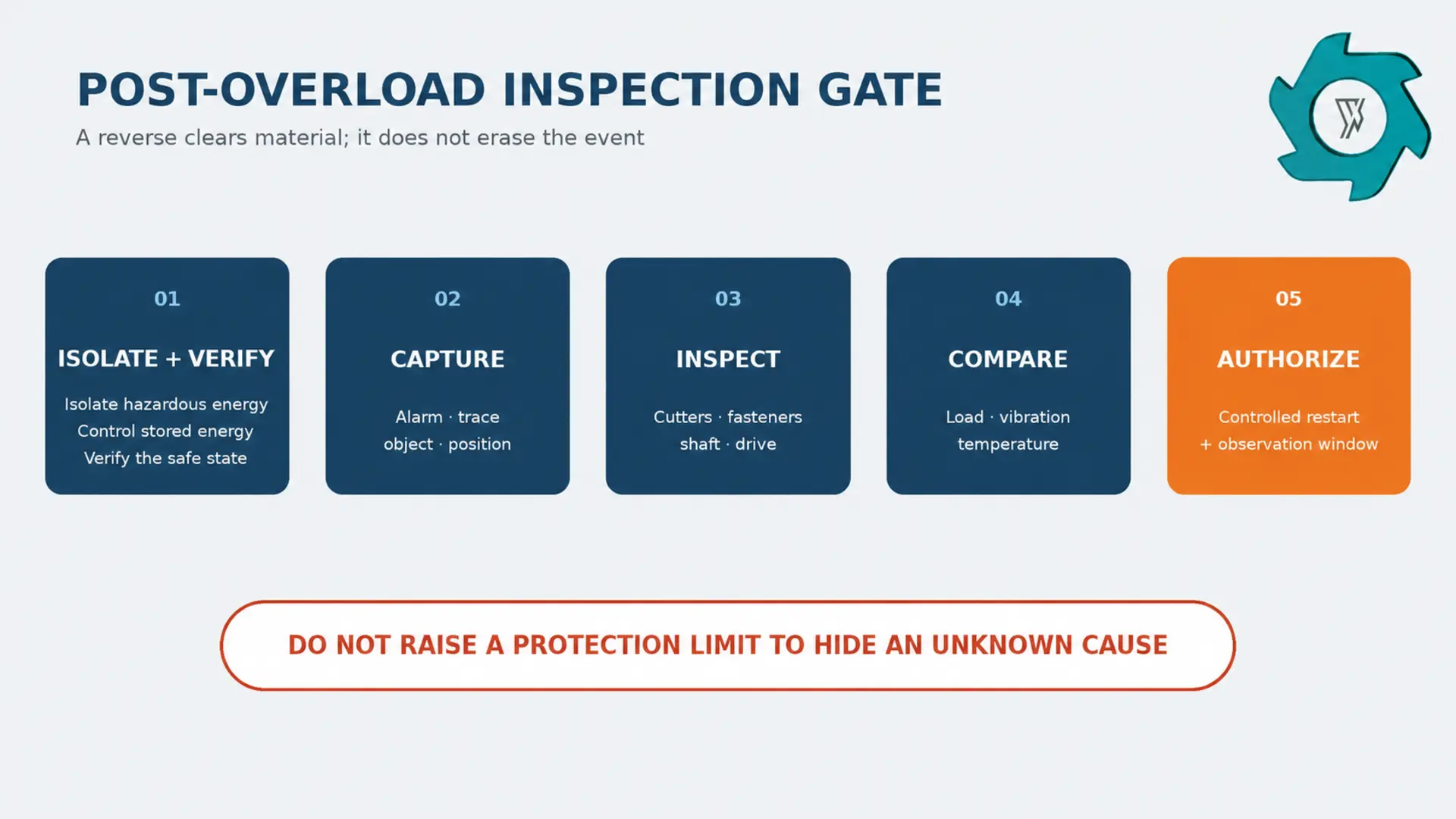
Post-overload inspection gate
After a severe, unusual or unexplained event, stop and apply the site’s hazardous-energy procedure. OSHA’s control-of-hazardous-energy standard covers servicing where unexpected energization, startup or stored-energy release could injure workers.1 Verify the safe state before anyone enters or reaches into a danger zone.
Restart authorization should follow isolation, evidence capture, component checks and comparison with the previous baseline.
Preserve the control record: timestamp, alarm, current/torque trace, reverse count and operating state.
Identify and retain the trapped object if safe to do so; photograph its position and damage surfaces.
Inspect cutter edges, fasteners, spacers, shafts, seals and grate or screen.
Check bearings, coupling and gearbox according to the manufacturer’s procedure.
Compare vibration, temperature, no-load behavior and loaded trend with equivalent pre-event conditions.
Authorize restart at a controlled feed rate and define the observation window.
5. Build Intervals From Exposure and Condition
The pre-shift check catches loose hardware, leakage, foreign objects, blocked discharge, abnormal residue buildup and guarding defects. A planned condition check adds measurements and photographs. An event-triggered inspection begins after an impact, unexplained trip, temperature step-change, vibration shift or sudden product-quality change.
Normalize wear to exposure. Report millimeters of edge loss, clearance change, reversals and maintenance labor per 100 accepted tonnes for each feed class. Also keep running hours because lubrication and rotating components still age with time. The combination prevents clean-profile campaigns from masking a short but damaging cast-scrap campaign.
Edge and gap measurements, fastener check, temperature, vibration, oil/grease status, photos
Performance check
Stable representative run
Accepted t/h, load profile, reversals, oversize/return and fines by agreed method
Event inspection
Impact, severe trip or step-change
Alarm trace, trapped object, damage map, restart authorization and new baseline if repaired
Condition data should be collected at repeatable measurement points and under comparable operating states. Process indicators such as accepted throughput and power demand serve a different purpose from machine-condition measurements such as bearing vibration.2 Compare like with like: use the same sensor location, feed class, rotor speed and loading state.
6. Use Four Derived Metrics—Not a Bigger Checklist
Raw logs become useful only when they answer a decision. Four simple plant-specific metrics expose changes that calendar maintenance can miss. They are not universal acceptance limits; establish each baseline from healthy runs on a named feed class.
Metric
Plant calculation
What a worsening trend may show
Overload recurrence
Overload or auto-reverse events ÷ accepted tonnes
Feed surges, a growing obstruction, dull cutters or discharge restriction
Specific maintenance labor
Hands-on maintenance hours ÷ accepted tonnes
A feed grade consuming more intervention than its sales margin supports
Steel-insert exposure
Count of defined heavy inserts ÷ input tonnes, or insert mass ÷ input tonnes; keep the selected basis unchanged for each feed class
A receiving-specification change that total ferrous recovery alone would hide
Accepted-output yield
Accepted aluminum product ÷ weighed input
More return, fines, retained material or unexplained difference; investigate before blaming cutters
Use a rolling window large enough to contain several representative lots. A single difficult casting can distort one shift; a monthly average can bury the event. Keeping both the event record and a rolling feed-class trend shows whether the problem was exceptional or is becoming normal.
Example: suppose a clean-profile baseline records 3 automatic reversals over 60 accepted tonnes, or 0.05 reversals/t. A later comparable window records 14 over 70 accepted tonnes, or 0.20 reversals/t. The fourfold increase is an inspection trigger even if every reversal clears automatically. It is not proof that the cutters are worn; feed presentation, inserts and discharge must still be checked.
Separate wear cost from lost-production cost
A low-cost cutter can be expensive if it requires frequent stops. For each maintenance campaign, record parts, hands-on labor, consumables, lifting or contractor cost, and lost accepted production during the outage. Keep planned and unplanned stops separate.
Maintenance cost per accepted tonne = (parts + maintenance labor + consumables + attributed outage cost) ÷ accepted tonnes since the previous equivalent service.
Use the result as a comparison within the same plant and accounting boundary. It should not be presented as a universal cost benchmark. If one steel-bearing feed class carries a much higher figure, the commercial decision may be to reprice the material, remove inserts, change the route or renegotiate the receiving specification.
7. Create a Decision Rule Before the Next Inspection
Continue and trend: wear is uniform, fasteners and clearances remain within approved limits, no crack-like indication is found, and load, reversals and output remain inside the plant’s healthy band.
Plan intervention: two or more condition or performance indicators are moving unfavorably, but there is no evidence requiring immediate isolation. Schedule rotation, gap correction, cleaning or component replacement at a defined production break.
Hold for engineering inspection: a crack-like indication, missing material, loose or shifted hardware, unexplained impact, abrupt vibration/temperature change, persistent obstruction or protection-system anomaly is present.
The decision should refer to manufacturer wear limits and site safety procedures. A trend rule does not authorize operation beyond an OEM limit, and an apparently normal current trace does not overrule visible damage.
A maintenance log that can support root-cause review
Record group
Required fields
Why it matters
Feed identity
Lot ID, grade/form, source, input mass, largest recurring item, attachment class
Stops unlike feeds from being averaged together
Operating state
Start/stop time, running time, accepted output, settings revision, downstream availability
Distinguishes machine resistance from line starvation or blockage
Preserves evidence before clearing or repair changes the scene
Inspection result
Named cutter positions, measurements, fastener status, bearing/drive observations
Makes the next inspection comparable
Disposition
Continue, planned intervention or engineering hold; approver and observation window
Closes the loop instead of leaving an open fault note
Assign stable names to cutter locations and measurement points. “Left knife damaged” becomes ambiguous after a rotor turns or a cutter set is moved. A position map, photograph orientation and serialized or batch-traceable wear parts make failure review much faster.
8. Plan Spares Around Downtime Risk
A spare-parts list should link each item to lead time and consequence. Cutter sets, counter-cutters, fasteners, spacers, seals, bearings, screens or grates, coupling elements and critical sensors deserve a review. Some parts are consumables; others are insurance against a long stoppage. Store cutters so their edges and reference surfaces cannot be damaged, identify matched sets, and preserve material certificates and tightening instructions.
Ask for service access, lifting points, safe cutter-handling methods, required tools, torque values, wear limits, lubrication specifications, alarm philosophy and recommended commissioning spares before shipment. The factory test should also include representative steel-bearing feed within the agreed limit. Record reversals and inspect cutters after the run.
Output condition still belongs in the maintenance record. More oversize, altered particle shape or rising fines can reveal a change in cutting behavior, but the result must be interpreted using the aluminum shredder output-size trade-offs. Finer is not automatically better, and extra recirculation can itself increase wear.
Minimum maintenance handover data
Approved feed envelope and steel-attachment examples
Spare-part numbers, lead times and storage requirements
LOTO/isolation points and stored-energy controls
Post-event inspection and controlled-restart form
Turn Maintenance Data Into a Purchasing Specification
The best maintenance plan begins before the machine is ordered. Send representative feed photos, examples of steel inserts, the largest recurring part, required accepted output, shift pattern and downstream arrangement. Ask the supplier to state what the cutter warranty assumes, which contaminants are excluded, how overload protection works, and which inspection evidence controls rotation or replacement.
Need an Aluminum Shredder Maintenance Review?
Send representative feed photos, steel-insert examples, wear records, overload history and target output. YUXI can review your operating conditions and define a representative trial, inspection plan and maintenance handover for the actual duty.
Frequently Asked Questions
How often should an aluminum shredder be inspected?
Use a short pre-shift check and a deeper inspection interval based on processed tonnes, feed class and event history. Reset the baseline after a cutter change, major repair or feed change rather than relying on one calendar interval.
Are steel inserts acceptable in aluminum scrap?
Only within the machine and contract limits. Small, known attachments may be part of the designed duty, while shafts, bearings, hardened tools and dense unknown steel can create concentrated impact loads and should be removed or quarantined.
Does an automatic reverse solve overloads?
No. Reverse can clear a temporary torque spike, but repeated reversals are diagnostic evidence. Check feed surges, trapped steel, cutter condition, clearance, discharge restriction and downstream stoppages before increasing trip limits.
What should be checked after a severe overload?
After isolation, control or restrain stored energy and verify that the energy-isolation measures are effective. Then inspect the trapped item, cutter edges and fasteners, spacers, shafts, seals, screen or grate, bearings, coupling and gearbox. Record the event and compare vibration, temperature and motor-load behavior with the pre-event baseline.
Should cutters be replaced at a fixed number of hours?
Hours alone are a weak trigger because one hour of clean extrusion is not equal to one hour of dirty cast scrap. Combine edge condition, clearance, current or torque trend, reversals, accepted throughput, output quality and processed tonnes by feed class.
David focuses on industrial shredding and recycling equipment,including material evaluation,shredder selection,process configuration,and recycling line planning.
Speak To Our Shredder Machine Expert
Get in touch with our nice team today to get a price estimate for a shredder machine.

 English



 Fast Delivery
 Reliable
 Certified
 Experienced