The best aluminum shredder output is not the smallest piece the machine can make. It is the coarsest controlled size distribution that releases the required attachments and still feeds the next separator or furnace reliably. The specification must include oversize and fines limits, not only a nominal size.
Why a Single “Target Size” Is Not Enough
Requests for “50 mm aluminum” or “two-inch output” sound precise, but they leave the most important questions unanswered. Does 50 mm describe a screen opening, a maximum dimension, or the most common piece? How much material may be larger? How much may pass 10 mm? Are long, thin strips acceptable? A shredder can meet a nominal number while delivering a bed that is difficult to screen and unstable on an eddy-current separator.
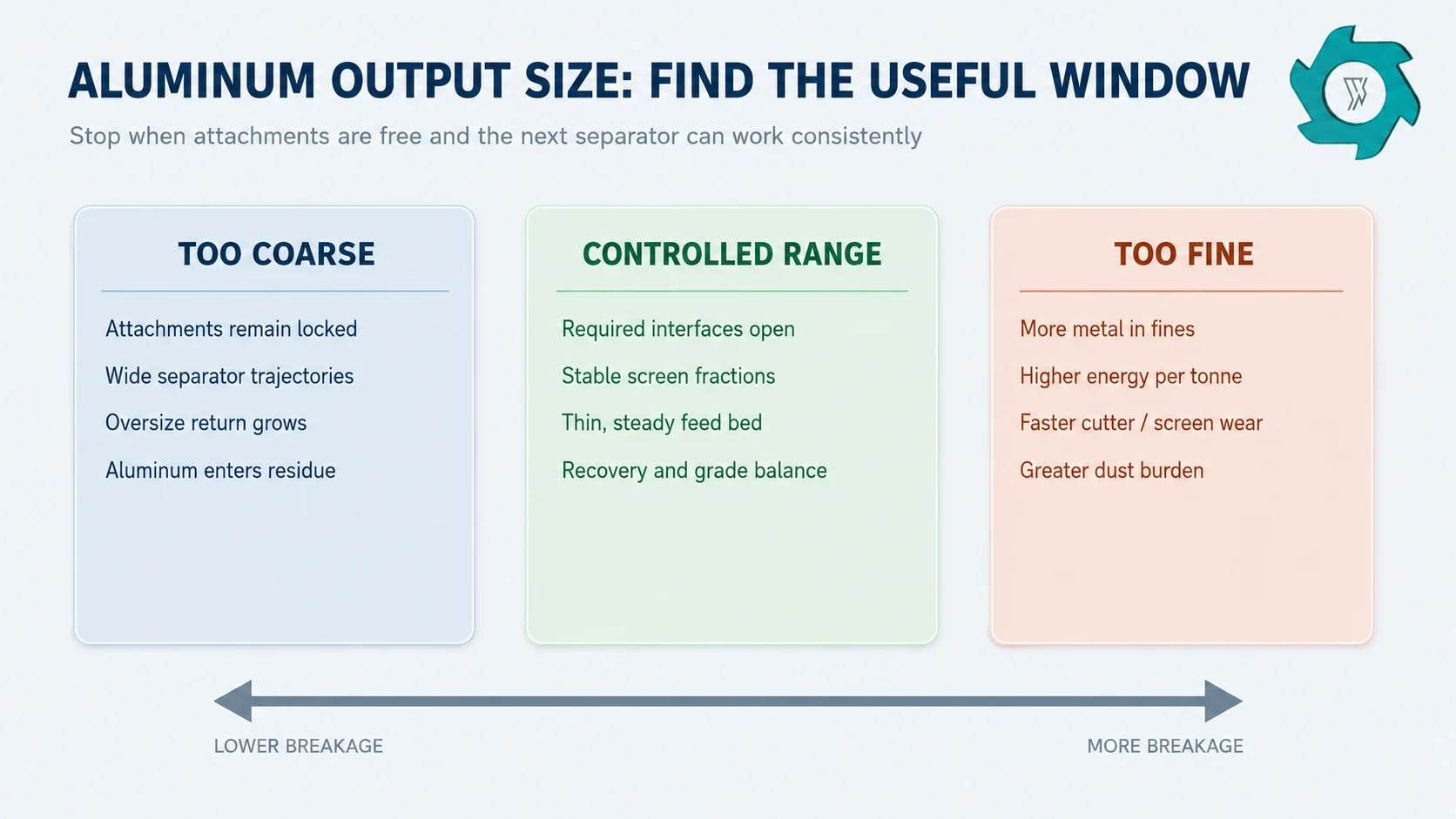
Output size is therefore a system decision. Coarse treatment normally saves power and wear, but attachments can remain locked. More breakage can expose steel, plastic and rubber, yet the same extra work may turn saleable aluminum into fine particles. The correct stopping point depends on the feed and the buyer’s next operation, not a universal millimeter value.
This article narrows the question to the trade-offs after feed preparation. For inspection rules covering sealed items, dense foreign parts and prohibited feed, use the scrap aluminum preparation guide. For a complete view of the equipment used from shredding through separation, explore our scrap aluminum recycling line.
Output size should be chosen between inadequate liberation and unnecessary breakage—not at either extreme.
Start With Liberation, Then Stop Breaking Material
Liberation means releasing aluminum from something that should report to another stream. On window frames, that may be screws, thermal-break polymer or rubber. On wheels and housings, it may be weights, valves, bearings or steel inserts. A coarse first pass is successful when those attachments are already free enough for the intended separator.
Operators often judge liberation from the aluminum product alone. That misses the useful evidence. Open samples from the ferrous discharge and non-metal residue. A large aluminum piece still fixed to rubber indicates under-processing. Small, clean aluminum particles in residue point in the opposite direction: liberation occurred, but the line kept crushing or the downstream separation setting is losing fines.
Stop size reduction when the required interfaces have opened. Further breakage after that point rarely improves magnetic removal, and it may reduce the recoverable yield. Thermal-break profiles illustrate this clearly; the purpose is to release the polymer, not grind both materials. The thermal-break aluminum recycling guide discusses that material-specific boundary.
How Size Distribution Changes Separation
Magnetic separation needs release, not extreme fineness
A magnet cannot remove steel that remains enclosed by aluminum or trapped in a compact assembly. Once steel fasteners and inserts are exposed, however, making the aluminum much smaller does not automatically improve capture. Magnet position, burden depth and the distance from the material bed become just as important.
Eddy-current separation works within an operating window
Eddy-current performance depends on more than conductivity. Piece mass, shape, belt speed, rotor setting, trajectory and the thickness of the feed bed all interact. Long strips, ordinary chips and dust-like fines do not leave the belt in the same way. Feeding all three together forces one splitter position to handle incompatible trajectories.
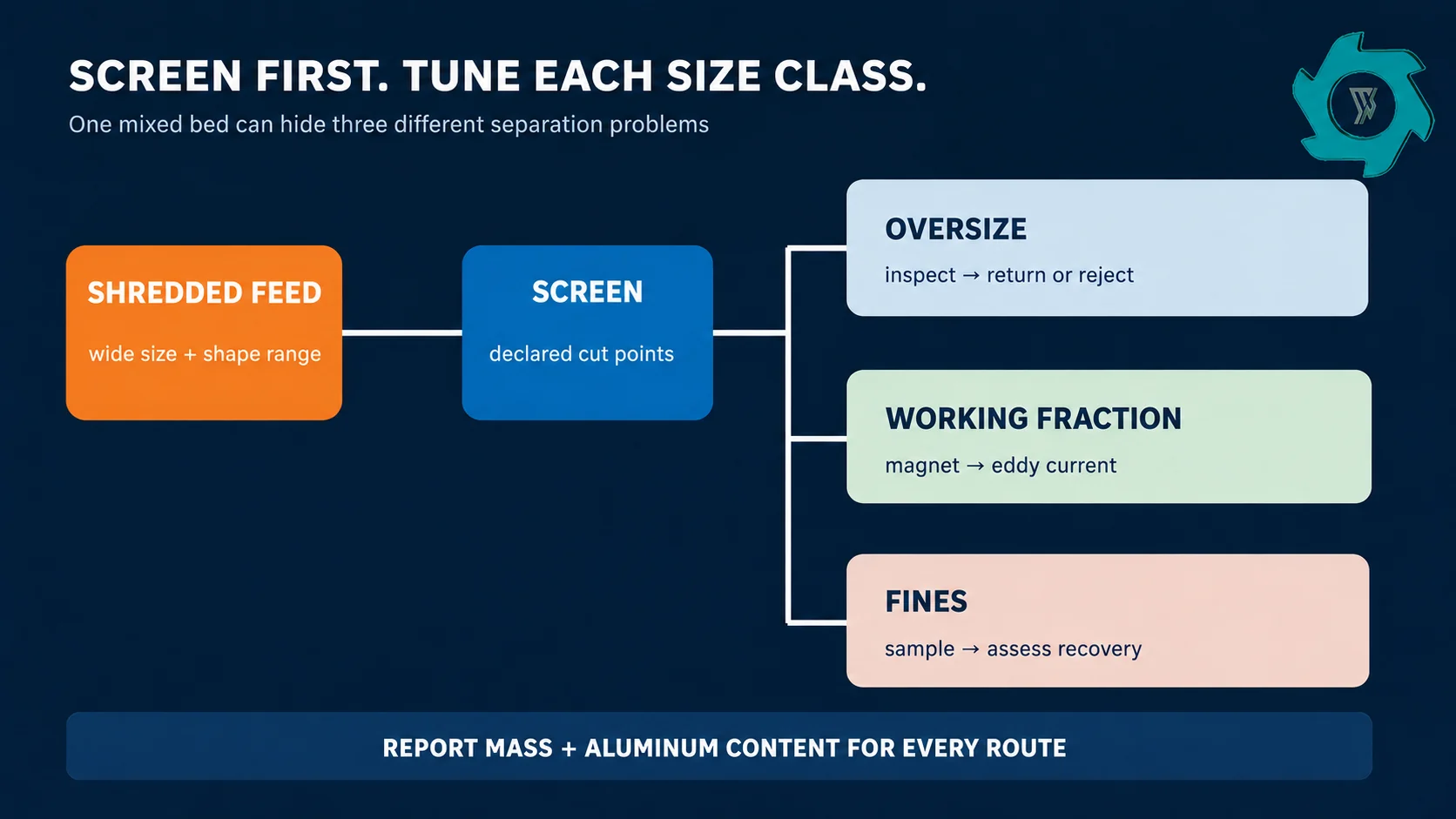
Screening into two or three usable size classes often creates more value than another crushing stage. Each class can be fed at a stable depth and tested with its own belt and splitter settings.
Air separation becomes more sensitive as aluminum gets lighter
Air can remove film, foam and light residue, but thin aluminum flakes may travel with them. First isolate the fraction by size, weigh the lost metal and adjust airflow against recovery as well as cleanliness.
Separate incompatible size classes before asking one separator setting to recover them all.
The Hidden Cost of Fines
Fines are not automatically waste. Some may be recoverable aluminum, while other fine material may be coating, dirt, glass, oxide or fragmented non-metal attachments. The mistake is treating the entire minus fraction as one undefined loss. Screen it at a declared cut size, sample it and determine how much metallic aluminum it contains.
Excess fines can increase:
aluminum reporting to dust collection or light residue;
screen blinding and housekeeping frequency;
surface oxidation per unit mass;
material handling loss at transfers and stockpiles;
power and wear without a corresponding gain in liberation.
OSHA warns that aluminum can become explosible in finely divided form.1 Whether the generated material presents a combustible-dust hazard, and what controls are required, must be determined through a site- and material-specific hazard evaluation. OSHA’s technical manual notes that combustible particulate can include fines, chips, flakes and particles below 500 μm, while actual explosibility depends on material properties and conditions.2 NIOSH research comparing aluminum dust sizes found the finest tested fractions to be the most hazardous.3 A production screen cut is not a safety threshold. Dust testing, extraction, housekeeping and explosion protection must be designed by qualified specialists for the site.
Why Smaller Output Raises Wear and Energy Demand
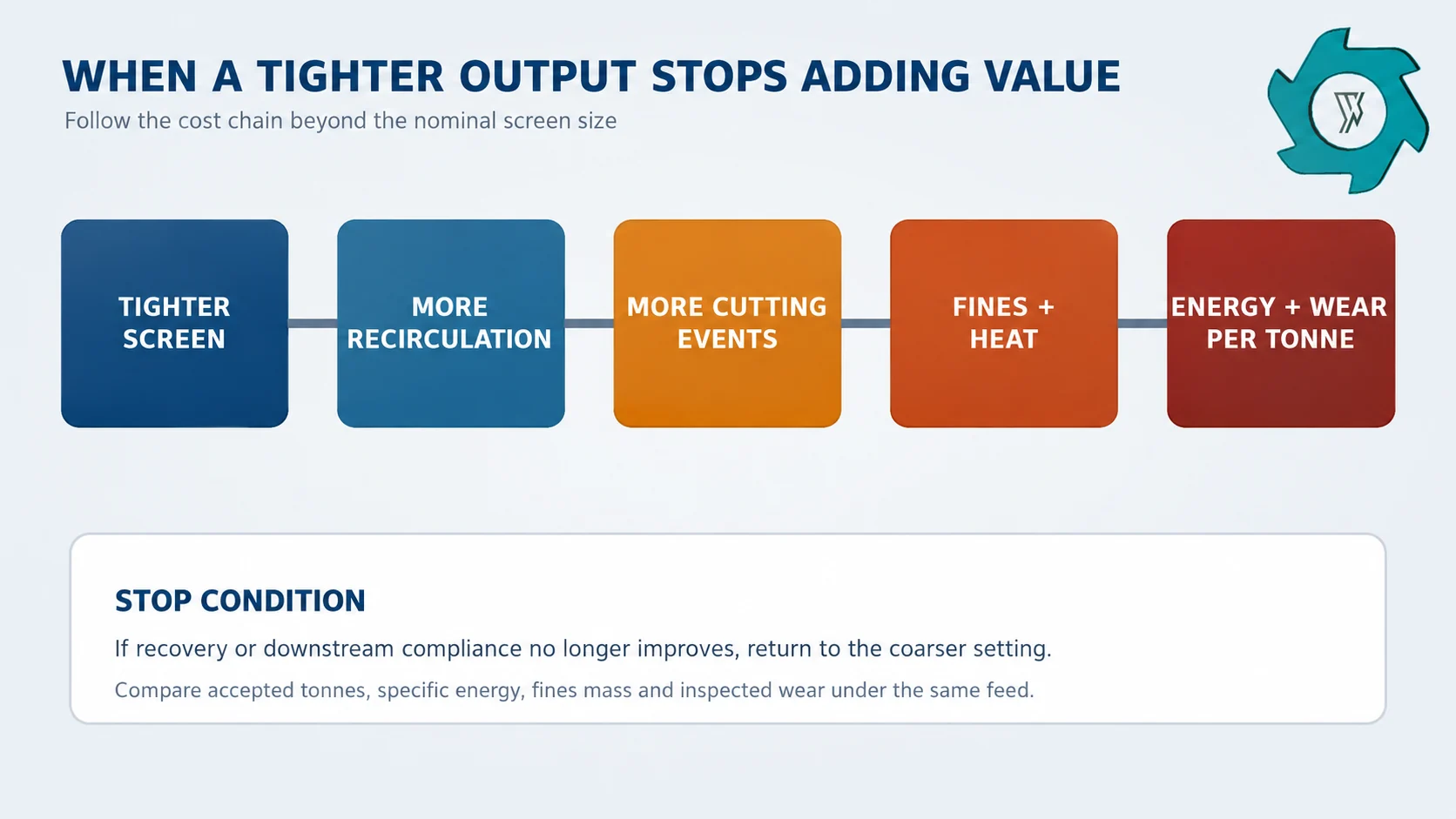
Reducing the same tonne through more cutting events increases contact between scrap and wear surfaces. A tighter screen can also hold material in the chamber longer, causing recirculation until pieces pass. The result may include higher absorbed power, more heat, faster edge rounding and additional screen wear.
Feed composition can overwhelm the effect of nominal size. Clean profiles and cast housings with hidden steel may pass through the same screen but impose very different loads. For this reason, record cutter, screen and bearing inspections against accepted tonnes and feed category.
A tighter screen may create a chain of recirculation, extra cutting, metal loss and maintenance cost.
Build a Particle-Size Passport, Not a One-Number Claim
A screen opening is a machine setting. It is not a complete description of the material leaving the line. For commissioning, create a particle-size passport for each important feed recipe. It should show the retained mass on a short stack of agreed screens, the maximum recurring piece, the amount of long flat material and the composition of every size class.
Do not borrow D10, D50 and D90 language from powder testing unless the measurement method suits irregular scrap. A thin strip can pass diagonally through an opening smaller than its length, while a curled profile of similar mass may remain above it. For shredded aluminum, a retained-mass table plus a separate shape audit is often easier to reproduce on site.
Passport field
Minimum record
Diagnostic value
Retained mass by screen
Mass and percentage on every declared deck
Shows whether the working fraction is stable or drifting
Longest recurring pieces
Length and count in a fixed sample mass
Finds strips that may pass a screen but upset conveyors or trajectories
Flat / curled / compact shape split
Simple count-based categories with reference photos
Separates a shape problem from a nominal-size problem
Free and attached aluminum
Mass in each size class after manual inspection
Locates the fraction where another breakage step may add value
Metal in fines
Metallic aluminum recovered from the declared minus fraction
Turns “dust loss” into a measurable recovery opportunity
Measure Liberation by Size Class
A single liberation percentage can hide the exact place where value is being lost. Divide the sample into the same size classes used by the production screen. Within each class, separate free aluminum, aluminum still attached to another material, free contaminants and composite pieces that cannot be assigned cleanly.
Apparent aluminum liberation (%) = free aluminum mass ÷ (free aluminum + aluminum contained in composite pieces) × 100
The aluminum contained in composites must be measured or estimated with a documented method. Use the result to compare two settings on the same feed, not as a universal guarantee.
Poor liberation concentrated in oversize supports a controlled return loop. Poor liberation in the working fraction may justify a different cutter or secondary stage. High liberation accompanied by aluminum-rich fines says the line has passed the useful breakage point. Research on eddy-current separation likewise shows that particle size interacts with material type, rotor conditions and magnetic-pole arrangement, which is why one separator setting should not be generalized across a broad distribution.4 A comprehensive review also identifies particle size, shape and feed presentation among the variables governing non-ferrous recovery.5
Write an Output Specification That Can Be Tested
Specification field
What to declare
Why it matters
Basis
As-produced, dry, or after removal of free dirt
Prevents moisture and contamination from distorting mass results
Nominal working fraction
Lower and upper screen cuts
Defines the range sent to the chosen separator
Oversize
Mass percentage above the upper cut
Reveals incomplete reduction or the return load
Fines
Mass percentage below the lower cut
Quantifies possible metal loss, dust and extra breakage
Shape exceptions
Maximum length, flatness or tangled strips
Two pieces can pass a screen differently despite similar mass
Composition by stream
Aluminum, ferrous and non-metal content
Connects size control to grade and recovery
Sampling method
Increment timing, sample mass and sieve method
Makes supplier and site results comparable
For long profiles, the first shredder may be asked only to create pieces that feed consistently. A second stage should be justified by measured attachment release or a downstream size limit. For dense wheels and castings, shock load and foreign steel may control the route more strongly than a fine target; see the wheel and cast aluminum equipment comparison.
Use a Three-Stream Test to Find the Economic Cut Point
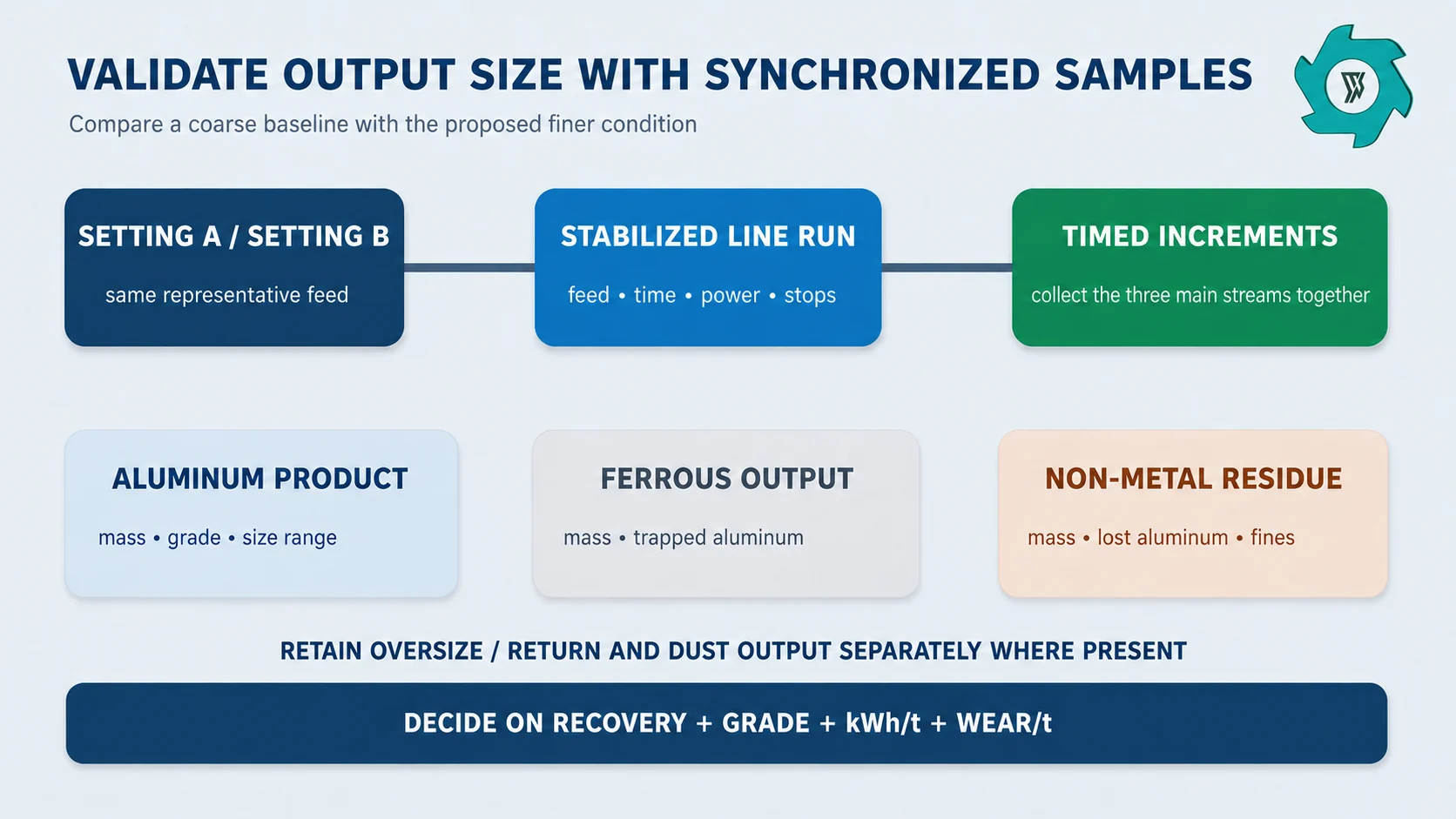
Run at least two practical settings on representative feed—normally a coarser baseline and the proposed finer condition. Allow the line to stabilize. At the same timed intervals, collect increments from the aluminum product, ferrous output and non-metal residue. Separately retain oversize or return material and dust-collection output where those streams exist.
For each condition, record accepted feed mass, running time, power, reversals, stoppages, screen fractions, stream masses and aluminum content in every stream. Then calculate:
Aluminum recovery (%) = aluminum in saleable product ÷ aluminum in accepted feed × 100
Specific energy = electrical energy used ÷ accepted tonnes
Wear allowance per tonne = (estimated fraction of usable wear life consumed × wear-part replacement cost) ÷ accepted tonnes
Estimate the consumed-life fraction from a repeatable inspection method, such as cutter dimensions, edge profile, screen-opening measurements or measured mass loss. A short test should be reported as an estimate rather than a confirmed lifetime wear cost.
If the accepted-feed aluminum cannot be measured directly, reconcile all weighed output streams and document the sampling uncertainty. Do not substitute product purity for recovery. A cleaner product can be achieved simply by rejecting more aluminum.
Keep the comparison fair
Change one major variable at a time. Hold the feed recipe, loader practice, separator settings and sampling duration as steady as practical while comparing shredder settings.
Use several increments across the stable part of the run rather than one grab sample from the top of a pile. Start and stop collection for the aluminum, ferrous and residue streams together. Record material still inside the line at the test boundary; otherwise retained inventory can appear as unexplained loss.
Put a value on the extra breakage
Net value change per accepted tonne = added value of recovered/saleable aluminum − added electricity − added wear − added labor and dust handling − disposal cost change
Use actual contract prices and site costs. Do not think that a higher grade always receives a proportional premium, or that every kilogram recovered from fines can be sold through the same route. This economic boundary is often where a technically cleaner product stops being the better operating decision.
Feedstock-Specific Signs That the Target Is Wrong
Dominant feed
Too coarse usually looks like
Too fine usually looks like
Thermal-break profiles
Polymer remains trapped inside profile sections
Clean aluminum slivers follow plastic into the light fraction
Wheels and cast housings
Steel inserts remain enclosed; large assemblies return repeatedly
Sharp fines rise without a comparable improvement in steel removal
Mixed demolition aluminum
Rubber, fasteners and folded composites remain attached
Dirt, coatings and glass dominate the minus fraction while aluminum recovery falls
Clean sheet offcuts
Pieces are still awkward for the agreed furnace or handling system
More surface area and handling loss appear without a separation benefit
Foil and light gauge
Loose material bridges or will not meter consistently
Collected fines increase and light aluminum follows extraction
Compare settings with synchronized stream samples, recovery, specific energy and wear.
A Practical Selection Matrix
Observed result
Likely meaning
Next check
Large aluminum remains attached to rubber or plastic
Liberation is incomplete
Target the attachment interface or add a controlled second stage
Clean aluminum fines appear in residue
Over-processing or separator loss
Screen fines separately; reduce breakage or retune that fraction
Wide trajectories and unstable splitter result
Bed contains incompatible size or shape classes
Screen before the separator and stabilize feed depth
Purity rises while recovered aluminum falls
More valuable metal is being rejected
Judge grade and recovery together
Power and wear rise with little recovery gain
The line has passed the useful liberation point
Return to the coarser setting or remove unnecessary recirculation
Commissioning Questions Buyers Should Ask
Which downstream machine or buyer requirement creates the size limit?
What are the agreed upper and lower screen cuts?
How will oversize, fines and long flat pieces be reported?
Will every output stream be sampled at the same time?
Is product grade reported together with aluminum recovery?
How will power, cutter wear and screen wear be normalized per accepted tonne?
What happens to the oversize return and collected dust?
Which result would justify stopping after primary shredding?
Aluminum Shredder Output Size FAQ
What is the best output size for an aluminum shredder?
There is no universal best size. Use the coarsest controlled distribution that releases the required attachments and works with the next separator, handling step or furnace requirement.
Does smaller aluminum always separate better?
No. Smaller pieces may improve liberation, but excessive breakage creates fines and mixes particles with different trajectories. Screening into controlled size classes can be more effective than further crushing.
How should fines be specified?
Declare a lower screen cut, the permitted mass percentage below that cut, the sampling basis and the metallic aluminum content of the fine fraction. Do not use “minimal fines” as an acceptance criterion.
Can a screen opening guarantee maximum piece size?
No. Long or flat pieces can orient themselves and pass an opening even when one dimension is larger. Specify oversize by mass and include shape or maximum-length exceptions where they affect downstream equipment.
Should purity be the main acceptance figure?
No. Record product purity and aluminum recovery together. A clean product is not a good result if recoverable aluminum is leaving in the ferrous, residue, fines or dust streams.
Set the Output Around Your Real Material
Send representative feed photos, largest dimensions, attachment types, target throughput and the downstream requirement. YUXI can propose a test plan that measures size distribution, recovery, fines, energy and wear together.
David focuses on industrial shredding and recycling equipment,including material evaluation,shredder selection,process configuration,and recycling line planning.
Speak To Our Shredder Machine Expert
Get in touch with our nice team today to get a price estimate for a shredder machine.

 English



 Fast Delivery
 Reliable
 Certified
 Experienced