





“We need three tons per hour” sounds like a useful starting point. Often it is not. Three tons of dry, flattened warehouse OCC is a different job from three tons of wired bales containing wet board, plastic film and mixed paper. The number is the same; the receiving system, usable output and operating risk are not.
That is why a waste cardboard recycling machine should not be chosen from motor power or nominal capacity alone. Start with the material that arrives and the product that must leave. Then decide which equipment functions are actually required between those two points.
Quick answer: Choose a waste cardboard recycling machine by confirming six items in order: the downstream buyer’s acceptance requirement, the incoming cardboard grade and form, sustained accepted output, contamination controls, site and safety constraints, and test evidence. A baler, shredder and complete dry recycling line solve different problems. For an industrial OCC project, compare the entire material path—from unloading and feeding to separation, dust control and final baling—not only the main shredder.
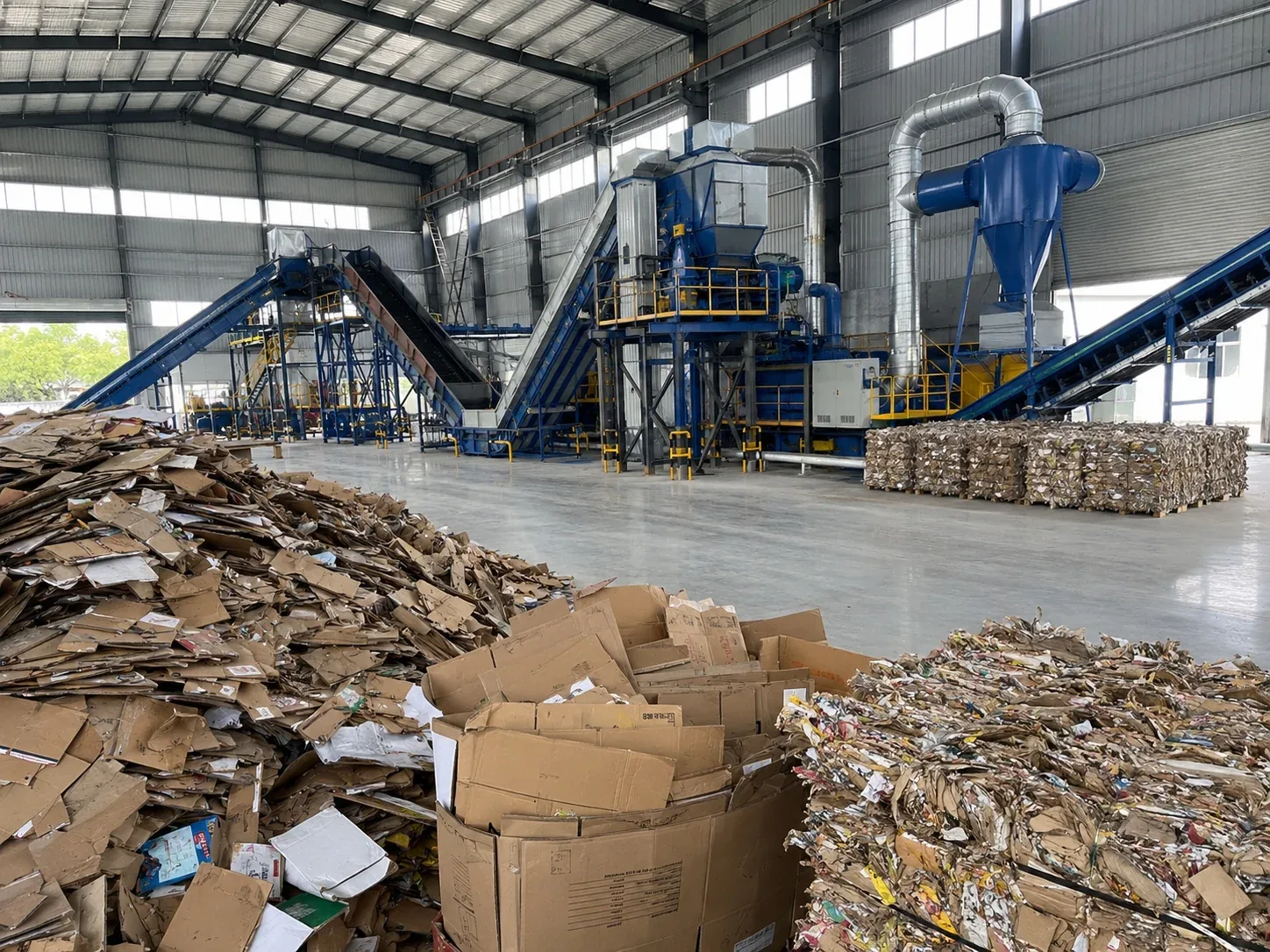
First Decide What Kind of Cardboard Recycling Equipment You Need
The phrase waste cardboard recycling machine is used for several very different machines. Search results often mix small packaging shredders, vertical balers, horizontal balers, compactors and complete OCC preparation plants. They are not interchangeable.
| Equipment type | Main job | Best fit | What it does not solve |
|---|---|---|---|
| Vertical baler | Compresses loose cardboard into manually tied bales | Retail, small warehouses and moderate source-separated volume | Does not open dense OCC bales, remove contamination or create a dry fiber-rich output. |
| Horizontal baler | Produces larger bales with continuous or semi-continuous feeding | High-volume distribution, manufacturing and recycling operations | Still depends on suitable feed size, sorting and material quality. |
| Compactor | Reduces storage volume in a container collected by a hauler | Operations prioritizing fewer pickups rather than a traded bale | Does not create a mill-spec bale or prepared fiber material. |
| Cardboard shredder | Reduces bulky boxes or sheets to a more manageable size | Pre-baling, controlled handling or specific packaging-reuse applications | Shredding alone does not remove film, moisture, food, coatings or all metals. |
| Complete dry preparation line | Connects receiving, shredding, metal removal, metering, dry opening, dust control and baling | Industrial OCC and selected paper waste requiring more than simple compaction | It is not a conventional wet pulper or complete paper-making plant. |
YUXI’s current waste cardboard recycling machine and plant belongs to the last category. It is presented as a modular dry mechanical line for old corrugated containers, waste boxes, kraft paper and suitable paper-mill waste. That distinction should remain clear throughout the quotation.
Selection boundary: When the requirement is only to flatten clean boxes and ship a dense bale, a complete line may be unnecessary. When the feed is bulky, baled, variable or requires dry fiber opening and separation, buying only a baler can leave the difficult part of the job unresolved.
Define the Accepted Output Before Selecting the Machine
A surprising number of projects begin with the waste and never define the buyer. The line is then asked to make “recycled fiber” without a written acceptance target. That is backwards.
EPA separates recycling into collection, processing and remanufacturing. Processing facilities sort, clean and prepare material for transport; remanufacturing happens later at facilities such as paper mills.[1] AF&PA describes the wet mill stage separately: recovered paper is mixed with water in a pulper, contaminants are screened out, and the cleaned fiber slurry is formed into new paper.[2]
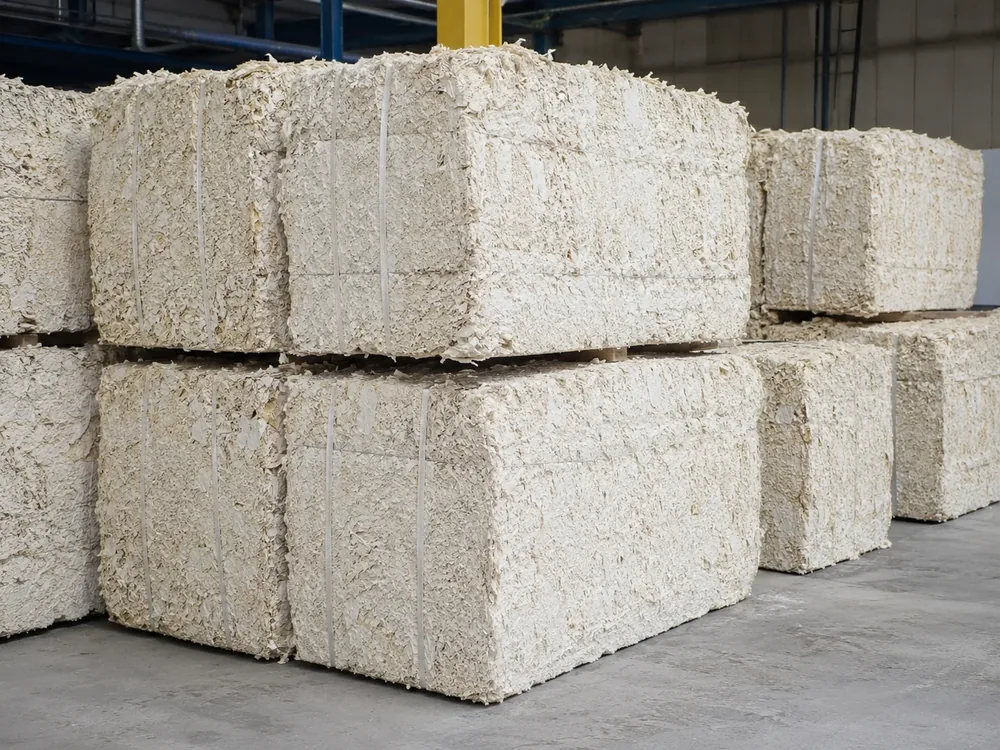
This matters because a dry preparation line should not be sold or purchased as though it produces finished wet pulp. Its output may be loose, mechanically opened fiber-rich material or a compressed bale of that material. The downstream mill, board producer or other user decides whether that output is acceptable.
Loose prepared material
Useful when the next process is nearby and can accept low-density fiber-rich material. Storage, dust and transfer arrangements become important.
Baled prepared material
Chosen when dense, stackable output is needed for warehouse handling and transport. Bale dimensions, density and tying method must match the buyer and logistics.
Standard OCC bale
When clean source-separated cardboard already meets the buyer’s grade, sorting and baling may be enough. Extra shredding or fiber opening can add cost without adding value.
Ask the downstream buyer for a written material description, allowed moisture, prohibited materials, sampling method, bale requirements and rejection rules. ReMA’s January 2026 paper-stock guidelines make the commercial principle explicit: quality deviations should be agreed in the purchase or sales agreement, and the packing unit—bales, boxes, bundles or loose material—should also be specified.[3]
Audit the Incoming Cardboard as It Actually Arrives
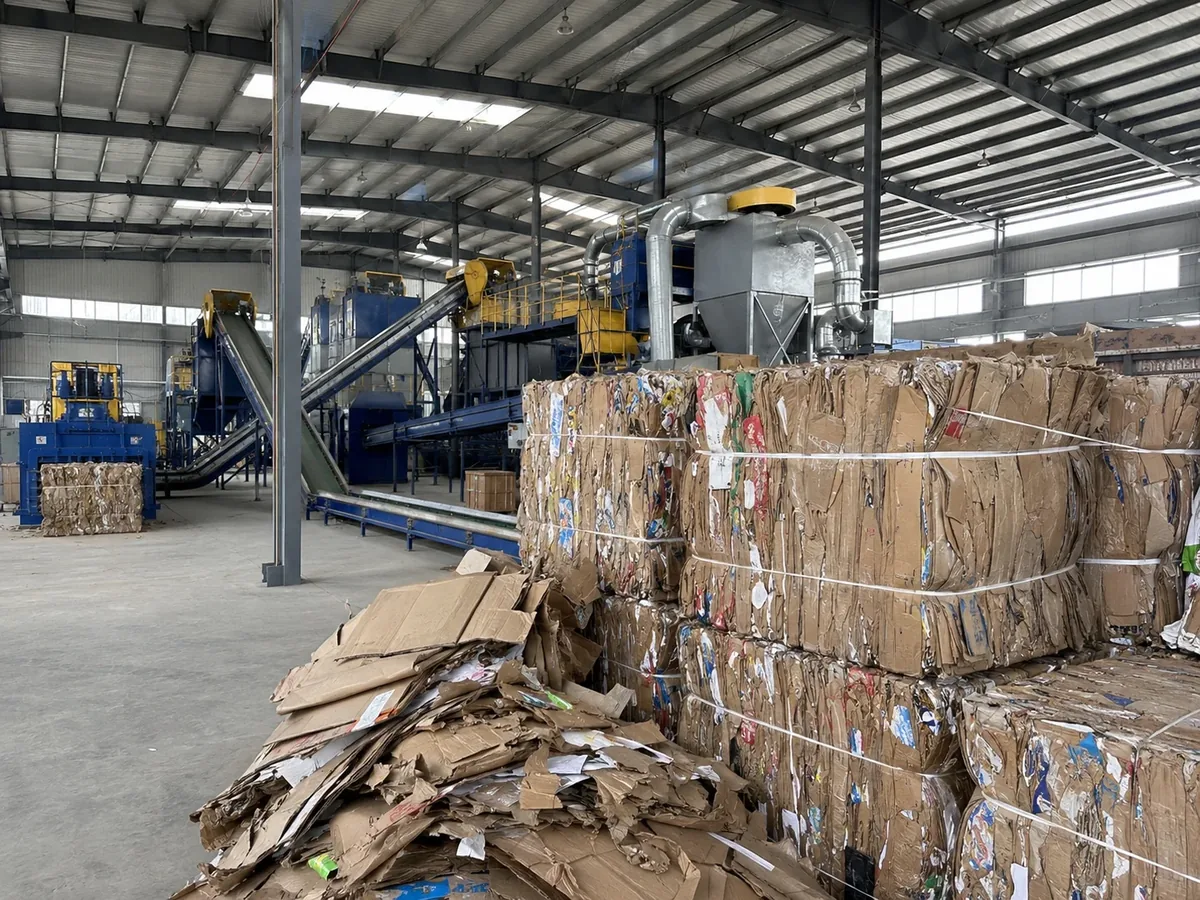
The machine does not process a keyword. It processes physical material. “OCC” may arrive as clean flattened sheets, dense export bales, wet supermarket boxes or mixed commercial paper. For grade definitions and quality limits, the separate guide to OCC cardboard grades and standards provides the commercial background. For machine selection, focus on the properties that change feeding, wear and output.
| Feed variable | What to record | Why it changes the equipment choice |
|---|---|---|
| Paper grade | OCC, double-sorted OCC, kraft trim, boxboard, mixed paper or paper-mill waste | Grade affects expected fiber quality, sorting intensity and whether dry opening adds value. |
| Feed form | Loose boxes, flattened sheets, rolls, wired bales, strapped bales or production trim | Determines unloading, bale opening, hopper geometry, conveyor type and surge control. |
| Largest dimensions | Box size, sheet width, roll diameter, bale length and irregular items | Controls loading opening, chamber width, anti-bridging design and whether pre-cutting is needed. |
| Bulk density | Loose and baled density, plus how the material expands after opening | Mass flow through a conveyor depends on volume as well as weight. Light cardboard can fill a hopper before the drive reaches its power limit. |
| Moisture | Normal range, rain exposure, wet loads and storage condition | Moisture changes weight, feeding, dust behavior, opening efficiency and saleable fiber yield. |
| Contamination | Film, straps, bale wire, metal, foam, wood, glass, food, waxed board and composite packs | Each contaminant needs a control point. A magnet cannot remove plastic, and a shredder cannot turn wet food-soiled board into clean fiber. |
| Variability | Best, normal and worst load—not only a clean sample | The line must survive ordinary variation without constant manual intervention or excessive reject. |
ReMA’s 2026 guidelines state that paper should be packed dry with 12% as the maximum moisture limit unless buyer and seller agree otherwise. They also define zero-tolerance material to include medical, organic, food, hazardous, poisonous, radioactive or toxic waste and harmful substances or liquids.[4] Those are trading guidelines, not a complete plant design code, but they show why moisture and contamination must be measured before equipment is frozen.
Compare Sustained Accepted Output, Not a Catalog Peak
Capacity is where quotations look easiest to compare and are often least comparable.
A shredder may process a short batch quickly while the conveyor, sorting station, dry opener, dust system or baler becomes the real bottleneck over a full shift. Light boxes may bridge in the hopper. Opened bales may release a surge that trips the next stage. Wet board may move more slowly while making the input weight look higher. A line rated from one machine’s nominal figure can therefore miss the buyer’s daily target.
Use one capacity sentence in every inquiry: “Required sustained accepted output is ___ kg/h or t/h from ___ feed, measured over ___ operating minutes, excluding planned breaks and nonconforming reject, with output meeting ___ condition.”
Then ask the supplier to state:
- whether the quoted rate is input mass, dry paper mass, accepted output or baled output;
- the feed grade, moisture, bulk density and loose/baled condition behind the estimate;
- the assumed contamination and reject rate;
- the loading method and number of operators;
- the screen, opening and separation configuration used;
- the run duration and allowed stops during a test;
- the normal operating availability used to convert hourly output into shift output.
Sometimes the correct machine is not a larger shredder. A buffer conveyor, wider transfer point or better bale-opening arrangement can produce more stable net output at lower installed power. The complete industrial cardboard recycling process article explains where those stages sit; this buying guide concentrates on how to specify them.
Choose Modules by Function, Not by Copying a Fixed Equipment List
There is no universal OCC line. A clean box-converting plant and a commercial recycling yard may use the same core machine but need very different receiving, sorting and dust-control sections.
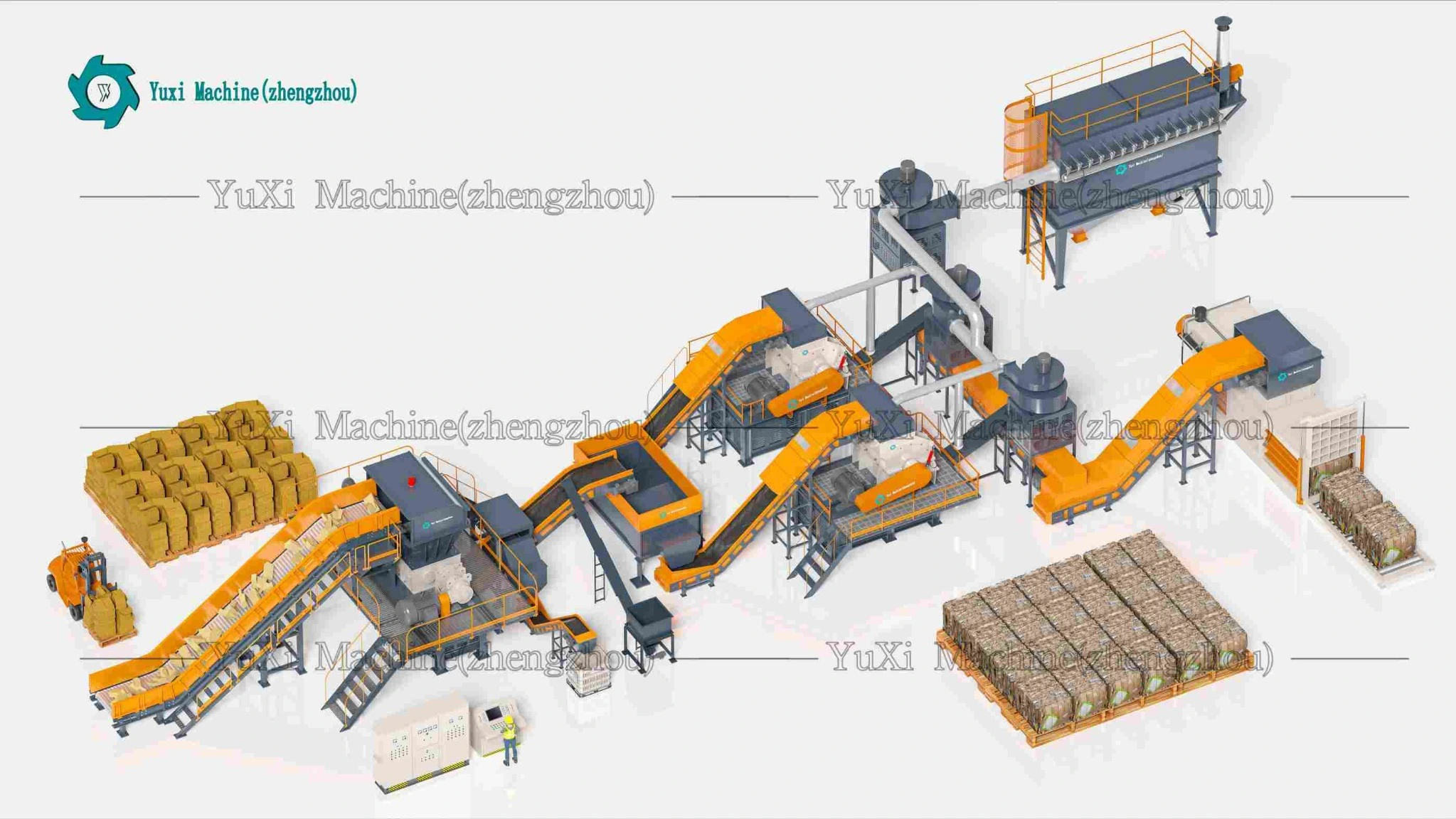
| Module | Include it when | Questions to ask |
|---|---|---|
| Receiving conveyor | Material is loaded by forklift, loader or multiple operators | What is the loading height, usable width, speed range, side-wall design and emergency-stop coverage? |
| Bale opener and pre-sort | Wired or strapped OCC bales, mixed loads or hidden contamination are expected | How are wires removed? Where can operators inspect safely? What happens to a partly opened bale? |
| Primary shredder | Boxes, sheets or opened bales are too bulky or irregular for stable downstream feeding | What feed dimensions were tested? How does the machine reverse after overload? Which wear parts are replaceable? |
| Magnetic separator | Staples, wire fragments or small ferrous pieces may enter after size reduction | Where is the magnet installed, how is captured metal discharged, and how is access protected? |
| Buffer and metering conveyor | Feed arrives in surges or the dry opener needs a steady bed depth | What live volume is provided? How is level sensed? Can speed coordinate with upstream and downstream machines? |
| Dry fiber opener | The required product is mechanically opened fiber-rich material rather than simply shredded cardboard | What output condition is expected from the actual feed? How are wrapping, wear and oversize handled? |
| Light-reject separation | Film, labels or other lightweight non-paper content is commercially significant | Which reject is targeted, where is it collected, and what good-fiber loss is acceptable? |
| Dust collection | Shredding, opening and transfers generate airborne or settled paper dust | Which pickup points are enclosed? What air volume and filtration basis is used? Who supplies ducting, fire protection and discharge handling? |
| Automatic baler | Dense stackable output is required for storage or transport | Required bale dimensions, density, tying material, ejection direction, cycle basis and buyer limits? |
| Controls and interlocks | Always required for a connected line | How are overloads sequenced? Are transfer delays, level sensors, emergency stops and remote diagnostics included? |
For primary size reduction, a slow-speed double shaft shredder is commonly selected when bulky cardboard must be grabbed and torn before downstream handling. It should still be evaluated as part of the line. A strong cutter does not compensate for a narrow transfer chute or an unstable feed conveyor.
Check the Details That Decide Whether the Line Runs Calmly
Two proposals can show the same sequence of machines and behave very differently in production. The important differences are often in the interfaces.
Feeding and anti-bridging
Flattened boxes can overlap into a light, springy mat. Folded cartons can sit above the cutter instead of falling into it. Ask how the hopper angle, pressing device, conveyor speed and chamber opening were chosen for the largest real box—not a hand-torn demonstration sample.
Overload recovery
Cardboard is not hard like metal, but bale wire, wood, dense cores and foreign objects can still stop a machine. Confirm automatic reversal logic, torque or current protection, jam-clearing access and the lockout procedure. “The machine reverses” is not enough; the entire connected line needs a defined recovery sequence.
Wear and service access
Ask which cutters, counter-knives, screens, liners, conveyor flights and seals are wear parts. Request replacement procedure, expected access space, lifting points and a recommended spare-parts list. A component that is easy to replace in an isolated machine may be difficult to reach after platforms and ducts are installed.
Output consistency
The required result may be a stable conveyor feed, a target opening level or a bale accepted by a buyer—not a precise particle size. Define how output will be sampled and judged. Visual photographs are useful, but a representative mass sample and written acceptance rule are better.
Plan the Workshop, Utilities and Safety Before the Order
A line drawing is not only a sales illustration. It should show how people, forklifts, bales, rejects, dust and finished material move without crossing each other unnecessarily.
| Layout item | Minimum information to confirm |
|---|---|
| Building envelope | Length, width, clear height, columns, roof restrictions, doors and floor loading. |
| Material traffic | Truck unloading, bale storage, loader turning radius, forklift lanes and finished-bale removal. |
| Maintenance access | Space to open guards, remove shafts or screens, pull motors, clean ducts and reach lubrication points. |
| Utilities | Voltage, frequency, installed power, cable routes, compressed air, dust discharge and any hydraulic service needs. |
| Reject handling | Bins or conveyors for wire, ferrous pieces, film, oversize and floor sweepings. |
| Fire and dust controls | Enclosures, pickup points, housekeeping access, detection or suppression scope and local authority requirements. |
| Expansion | Space and control capacity for an extra separator, larger baler or alternative output route. |
OSHA warns that paper-recycling machinery used for transporting, compacting and baling can be fatal, and highlights moving parts, unexpected startup, crushing hazards and combustible materials.[5] OSHA also lists paper and pulp among materials that can be explosible in dust form and includes recycling operations among the affected processes.[6]
For selection, that means safety cannot be reduced to an emergency-stop button on the main machine. Review guards, interlocked access, lockout/tagout points, bale-opening work, platforms, pull-cords along conveyors, dust enclosures, housekeeping access and the site’s fire-protection design. Final compliance belongs to the installed site and applicable jurisdiction, but the quotation must make each supply boundary visible.
Write the Material Test Before the Supplier Runs It
A machine test is most useful when it can disprove the proposal. A polished video of dry, hand-selected boxes proves only that the machine can process that demonstration material for the recorded time.
Representative feed
Use normal production material and include a controlled portion of the difficult feed—larger boxes, ordinary tape, expected moisture and typical non-hazardous contamination.
Defined mass and duration
Agree on sample mass, continuous run time, warm-up treatment and which stops count against throughput.
Measured output
Record accepted output, reject mass, unprocessed oversize and material retained in the line. Do not report only input loaded.
Documented configuration
Record machine settings, conveyor speeds, screen or opening setup, operator count and installed modules used during the test.
A practical factory acceptance test should also verify sequence controls, overload recovery, emergency stops, access interlocks, abnormal noise, leaks, bearing temperature trend, baler operation and the accuracy of the agreed documentation. Site acceptance can then check installation, utilities, dust connections and integrated performance under the buyer’s real operating conditions.
Do not change the test material after the performance target is agreed. A capacity guarantee based on dry loose boxes cannot be transferred silently to wet wired bales. When the feed basis changes, the target and configuration should be reviewed together.
Compare the Complete Quotation, Not the Equipment Subtotal
A low equipment price can become an expensive project when conveyors, platforms, ducts, controls or commissioning are treated as later additions. Normalize every quotation into the same scope table.
| Quotation section | What should be explicit |
|---|---|
| Design basis | Feed description, output requirement, sustained capacity basis, daily hours and environmental conditions. |
| Equipment list | Each machine, model or design duty, drive, usable dimensions and included accessories. |
| Interfaces | Chutes, conveyors, supports, platforms, walkways, guards, sensors, cables, panels and interlocks. |
| Dust scope | Pickup hoods, ducting, collector, fan, discharge, electrical controls and exclusions related to fire protection. |
| Baling scope | Bale size, tying system, wire or strap supply, discharge conveyor and sample output basis. |
| Installation | Foundation data, supervision days, labor responsibilities, cranes, tools, travel and accommodation. |
| Documentation | General arrangement, foundation drawing, electrical drawings, manuals, spare-parts list and maintenance schedule. |
| Testing | FAT procedure, material responsibility, acceptance criteria, report and site commissioning test. |
| After-sales support | Warranty scope, response route, remote support, technician availability and replacement-part lead times. |
| Commercial exclusions | Freight, duties, taxes, civil work, building modifications, utilities, local permits and third-party fire systems. |
We normally recommend comparing three totals: machine supply, installed project cost and expected operating cost. Installed power, labor, consumables, reject disposal, wear parts, dust-filter service and planned downtime all belong in the decision. Avoid universal payback claims. Cardboard value, freight, labor and electricity differ too much by location and contract.
Common Waste Cardboard Recycling Machine Buying Mistakes
Choosing by motor power
A larger motor does not define usable capacity. Chamber geometry, feed control, cutter condition, downstream restriction and material bulk density can matter more.
Buying the shredder and leaving the interfaces undefined
The line later receives improvised chutes, manual feeding and disconnected controls. Production then stops at the handover between machines rather than inside the machines themselves.
Using monthly tonnage without peak-flow data
Two facilities may process the same monthly mass. One receives an even daily stream; the other receives large return loads on two days each week. Buffer and storage needs are completely different.
Expecting the line to create a higher paper grade
Dry equipment can improve handling and remove selected contaminants, but it cannot convert unsuitable coated, wet or hazardous material into compliant OCC. Grade begins with source control and sorting.
Leaving dust control until the end
Adding a collector after the layout is finished often produces long ducts, weak pickup points and poor maintenance access. Dust hoods and enclosures should be designed with the processing machines.
Accepting a capacity statement without a test basis
“Up to” figures are not shift plans. Ask what material, run time, output definition and operator method produced the number.
Information to Send Before Requesting a Proposal
A useful inquiry is not long, but it is specific. The following package usually tells an equipment engineer more than a generic request for “the best cardboard recycling machine.”
- clear photos and short videos of normal and difficult feed;
- paper grade names and source of the material;
- loose, flattened, rolled or baled condition;
- bale dimensions, mass, wire or strap and unloading method;
- largest box, sheet, roll or foreign object expected;
- moisture range and storage condition;
- estimated percentages of film, metal, wood, food residue and other non-paper material;
- required sustained accepted output and daily operating hours;
- downstream buyer specification and required bale or loose-output condition;
- workshop plan with dimensions, columns, doors and traffic routes;
- power supply and local electrical requirements;
- requested FAT, documentation, spare parts, installation and training scope.
In practice, representative samples settle difficult questions faster than adjectives. “Mostly clean” can mean very different things to a warehouse manager, a recycler and a paper mill. Photographs of several opened bales, plus a simple sorting audit by weight, make the proposal far more defensible.
Choose the Cardboard Recycling Line Around Your Real Feed
Send material photos, bale data, contamination, required accepted output and workshop dimensions. YUXI can review the receiving, shredding, separation, dry fiber opening, dust-control and baling scope as one connected system.
Waste Cardboard Recycling Machine FAQs
What machine is best for recycling waste cardboard?
The correct machine depends on the required output. A baler is suitable when the goal is only to compact clean boxes. A shredder is used for primary size reduction. A complete dry preparation line is appropriate when the project also needs controlled feeding, metal removal, dry fiber opening, dust collection and automatic baling.
How should cardboard recycling machine capacity be compared?
Compare sustained accepted output on a defined feedstock, not a short peak or the nameplate capacity of one machine. The test basis should state whether the feed is loose or baled, its moisture and contamination, operating time, reject rate and final output condition.
Can one line process both loose boxes and OCC bales?
The same downstream line may process both, but the receiving section is different. Wired or strapped OCC bales normally need safe unloading, wire removal, opening, inspection and buffering before continuous feeding. Loose boxes need hopper and conveyor arrangements that prevent bridging and surging.
Does a dry cardboard recycling line produce finished paper pulp?
No. A dry line can reduce, clean and mechanically open cardboard into a fiber-rich recovered material, then bale it. Finished paper pulp is made later in a wet stock-preparation system using water, pulping, screening and cleaning.
What contaminants should be checked before selecting equipment?
Check moisture, bale wire, metal, plastic film, tape, foam, wood, glass, food residue, waxed or coated board and non-paper packaging. Different contaminants require different controls; shredding alone does not remove all of them.
What should be included in a factory acceptance test?
Use representative feed and agree on the sample mass, run duration, feed method, stoppage rules, accepted output, reject measurement, output sampling, safety checks and report format before the test. A short demonstration with hand-selected dry boxes is not a sufficient capacity test for a mixed commercial feed.
What information is needed for a quotation?
Provide material photos, paper grades, loose or baled condition, bale dimensions and wire, moisture and contamination, required sustained output, operating hours, downstream buyer specification, workshop dimensions, power supply, loading method and required output handling.
References
- U.S. Environmental Protection Agency, “The U.S. Recycling System,” collection, processing and remanufacturing framework; updated January 22, 2026.
- American Forest & Paper Association, “The Paper Recycling Process,” MRF sorting and baling, mill pulping, screening and paper formation.
- Recycled Materials Association, “Guidelines for Paper Stock: PS-2026,” purchase agreement, quality, quantity and packing-unit provisions.
- Recycled Materials Association, “Guidelines for Paper Stock: PS-2026,” moisture content, outthrows, prohibitive materials and zero-tolerance definitions.
- U.S. Occupational Safety and Health Administration, “Green Job Hazards—Recycling: Paper,” machinery, unexpected startup, crushing and combustible-material hazards.
- U.S. Occupational Safety and Health Administration, “Combustible Dust: An Explosion Hazard,” paper, pulp and recycling-operation dust hazards.