





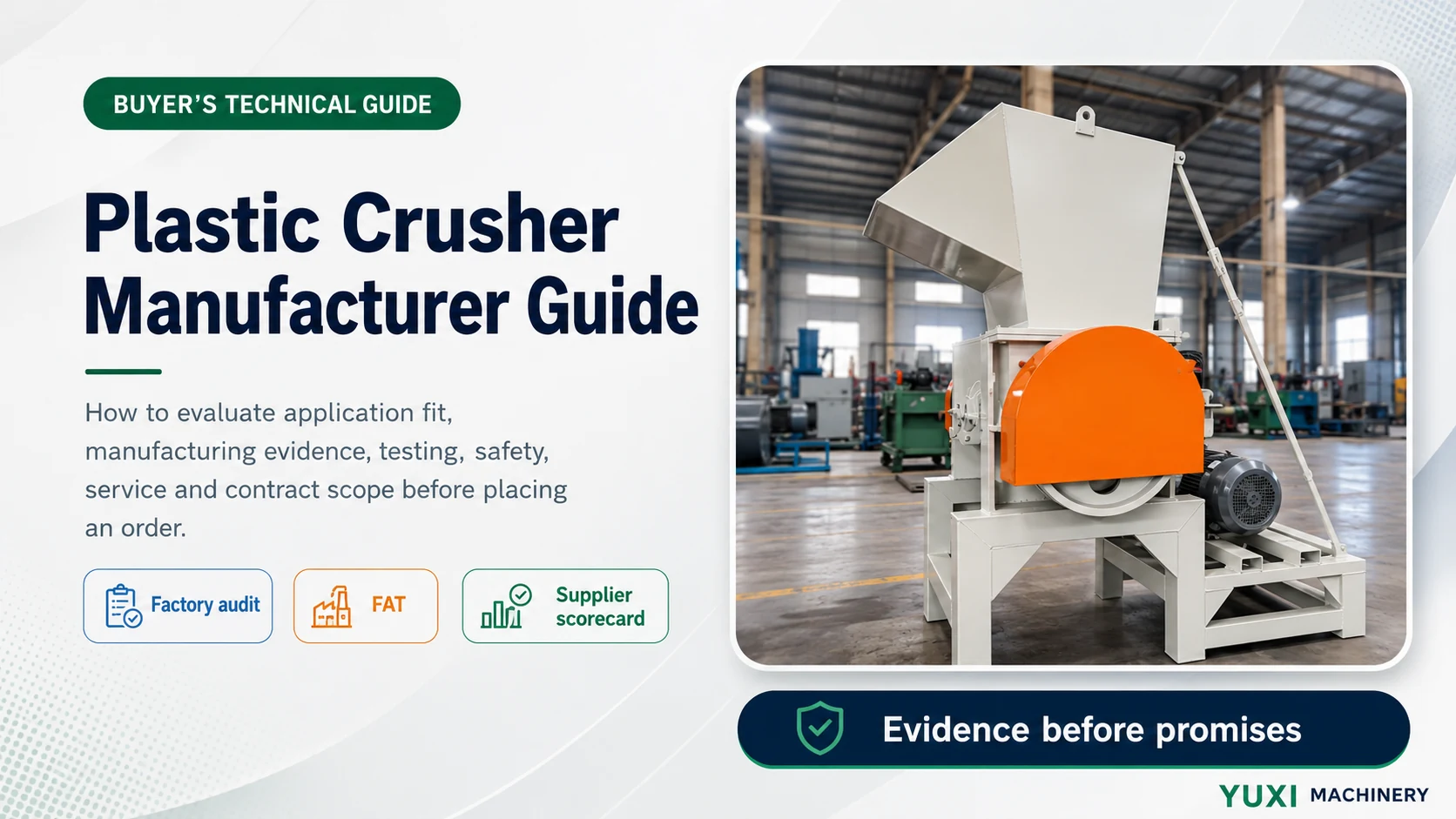
Two suppliers can quote a machine with the same motor power and a similar cutting chamber, yet one proposal may be ready for production while the other is only a price attached to a photograph. The difference usually appears in the questions raised before the quotation, the way the machine is manufactured and tested, and who accepts responsibility when the crusher must be integrated with the rest of the production line.
In This Guide
- Start with a testable purchase brief
- Manufacturer, trader or integrator?
- Six supplier evaluation criteria
- Make quotations comparable
- What to inspect at the factory
- Build a meaningful FAT
- Documents, safety and compliance
- Weighted supplier scorecard
- Red flags that justify a pause
- How to evaluate the YUXI YX-G range
- RFQ information to send
- Frequently asked questions
Before Comparing Manufacturers, Make the Duty Testable
A weak request usually reads: “Please quote a 500 kg/h plastic crusher.” It sounds specific because it contains a number. In practice, it leaves nearly every important variable open. Five hundred kilograms per hour of clean injection runners is not the same duty as five hundred kilograms per hour of loose film, nested crates, wet bottles or dense purgings.
The U.S. EPA distinguishes mono-material from multi-material plastic products and notes that plastics appear in containers, packaging, nondurable goods and durable goods.[1] That broad variety is exactly why the manufacturer needs product form and condition, not only the polymer abbreviation.
Use the plastic crusher materials guide to identify which plastics can usually be granulated directly and which feed conditions require testing, controlled feeding or a different reduction stage.
| Purchase-brief item | Useful evidence | Why the manufacturer needs it |
|---|---|---|
| Feed identity | Polymer, product form, photos, largest normal and occasional pieces | Determines whether direct granulation is realistic and whether the hopper can accept the material safely. |
| Physical condition | Wall thickness, piece mass, bulk density, temperature, moisture and dirt | Changes bite, current peaks, heat, bridging, wrapping, wear and discharge behavior. |
| Foreign material | Metal inserts, labels, stones, glass, sand and unknown components | Defines sorting, metal protection, knife risk and acceptance limits. |
| Required product | Target regrind, allowed oversize/fines and downstream quality need | Guides screen, knife system, evacuation and whether a second stage is required. |
| Capacity definition | Sustained net accepted kg/h, operating hours and allowed interruptions | Prevents a short peak demonstration from being compared with normal production. |
| Plant interface | Feeding height, discharge method, conveyor, blower, cyclone, washing or pelletizing equipment | Clarifies who is responsible for the interfaces that often control line output. |
We have found that the most revealing supplier response often comes before any model number. A capable engineer normally asks where the plastic comes from, how it reaches the chamber, what must leave the screen and what happens next. A weak response jumps directly from “PP” to motor power.
Use the separate plastic crusher capacity guide when defining how kg/h will be measured. This article assumes the duty has already been written in a way that can be tested.
A Manufacturer, Trader and System Integrator Are Not the Same Role
Buyers sometimes treat “factory direct” as a complete qualification. It is not. A manufacturer may build the machine but have limited overseas project support. A trading company may communicate well and consolidate equipment but depend entirely on another factory for technical decisions. A system integrator may buy the crusher from an OEM yet take stronger responsibility for conveyors, controls and commissioning.
Original manufacturer
Should control drawings, fabrication, machining, assembly, inspection, serial records and design changes. Ask which critical parts are made in-house and which are outsourced.
Trading or export company
Can add language, sourcing and logistics value. The actual OEM, warranty path, spare-parts source and technical authority should be disclosed.
System integrator
May be the right contracting party for a complete line. Define who owns machine selection, control logic, safety integration, site acceptance and final performance.
None of these structures is automatically good or bad. The risk appears when the role is hidden. Ask one direct question: Who can approve a change to the rotor, knives, screen, control program or guarding, and who signs the final performance obligation?
Six Criteria for Evaluating a Plastic Crusher Manufacturer
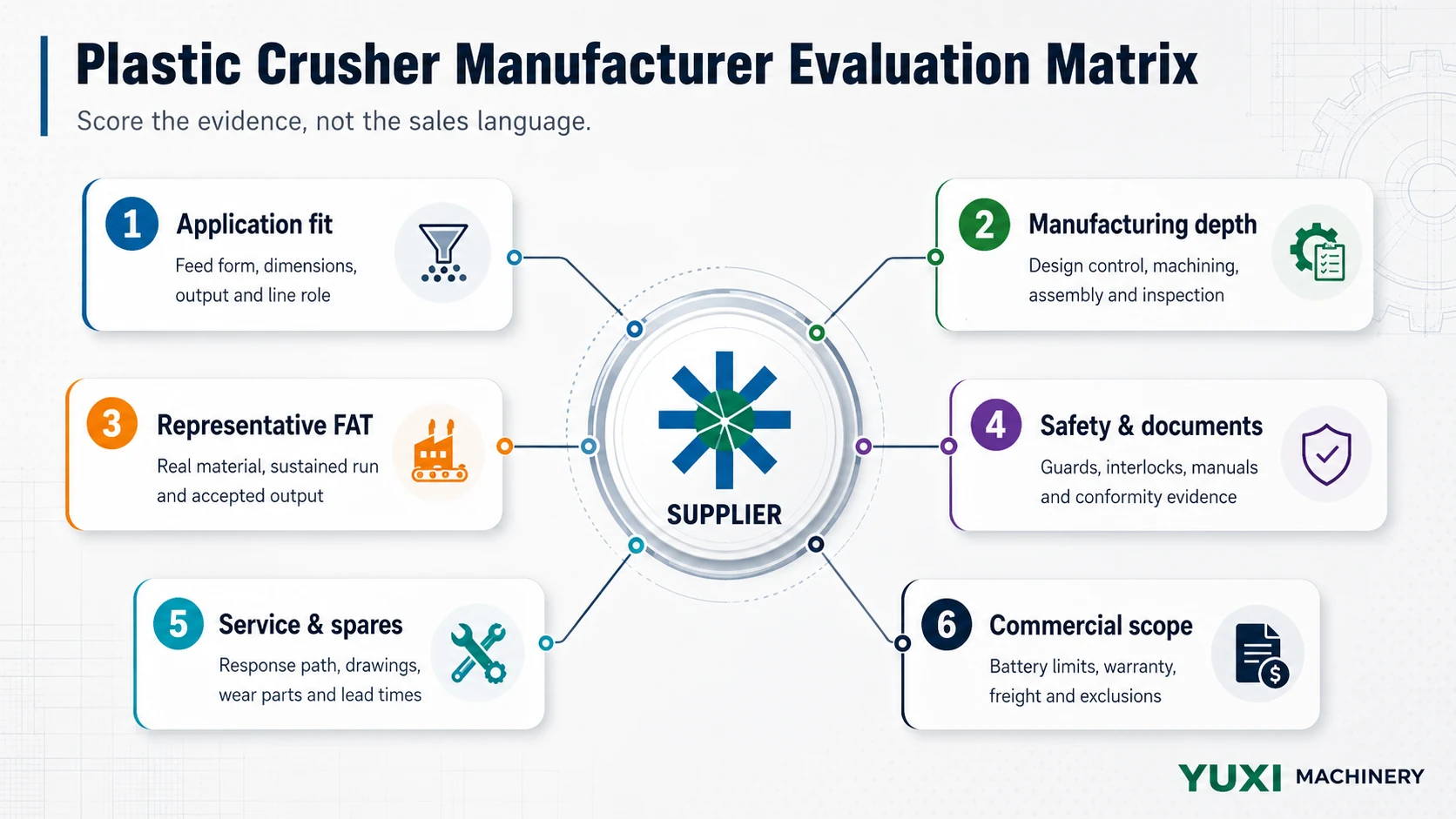
1Application engineering: does the proposal fit the real material?
The first technical check is not whether the catalog looks professional. It is whether the proposed mechanism matches the feed. A high-speed knife-and-screen crusher works best when material can enter, circulate and leave in a controlled way. Review the plastic crusher working principle to understand that material path. Whole pallets, long pipe, large drums, dense blocks or loose bales may require cutting, controlled feeding or primary shredding first; the plastic shredder vs plastic crusher comparison explains where each stage fits.
Ask the supplier to explain the complete material route in plain language. Which item limits feed size? What happens when a nested crate rotates instead of biting? How is light film prevented from bridging or wrapping? What protects the knives from metal? Where does accepted regrind go when the receiving bin is full? A useful answer describes behavior and countermeasures rather than repeating the motor rating.
2Manufacturing depth and change control
A workshop tour should connect the finished machine to controlled drawings and inspection records. Look for machining of knife seats, rotor and shaft work, welding procedures, assembly checks, electrical panel construction and a serial-number system. Outsourcing is normal. What matters is whether outsourced work is specified, inspected and traceable.
ISO describes ISO 9001 as a framework for establishing, maintaining and improving a quality management system.[2] That can be valuable, but it is evidence about the management system—not a performance certificate for one crusher. Verify the certification body and scope, then ask for machine-specific records: rotor runout or balance evidence where applicable, knife-seat dimensions, incoming component inspection, no-load test results and the final inspection checklist.
3Technical transparency in the proposal
The manufacturer should identify the exact model and revision, motor and drive arrangement, cutting chamber, rotor speed, knife configuration, screen, feeding and discharge scope, electrical components, guards, access method, approximate mass and foundation requirements. Phrases such as “famous brand bearing,” “high-quality steel” and “European standard electrical” are not specifications.
Blade information deserves particular attention because a spare order may arrive years later. The plastic crusher blade and knife-gap guide explains why material, heat treatment, geometry, matched grinding and model-specific clearance need to be documented together. Screen opening also affects residence time, heat, capacity and regrind; use the plastic crusher screen size guide when defining the proposed setup.
4Representative test capability
Some factories can demonstrate only a standard machine on convenient scrap. Others can receive representative material, install the proposed screen, reproduce the normal feed method and record measurements. The second capability is more valuable, even when the test uncovers a problem. In fact, a supplier that shows a blockage, explains the cause and corrects it methodically can be more credible than a polished video with no data.
5Safety, guarding and compliance evidence
OSHA’s general machine-guarding requirement calls for guarding against hazards such as points of operation, ingoing nip points, rotating parts and flying material.[3] For a crusher, review the hopper opening, drive guards, chamber access, interlocks, emergency stops, coast-down, electrical isolation, stored energy and the safe method for removing screens and knives.
For EU-bound machinery, CE marking is the manufacturer’s indication that the product meets applicable EU requirements; official EU guidance says the marking follows the required conformity-assessment process.[4] A logo on the quotation is not enough. Ask which legislation and standards were applied, who signs the declaration of conformity, what manuals and risk information are supplied, and whether the final configuration—not a different base model—is covered.
6Service, spare parts and commercial accountability
The first spare-parts question should not be “Are parts available?” Almost every supplier says yes. Ask for the list, quantities, drawings or part numbers, current lead times, shipping method, recommended stock for the first operating year and who diagnoses a failure. For critical knives, screens, bearings, belts, sensors and contactors, clarify whether the buyer can source equivalent parts locally without losing technical support.
Service also needs an escalation path. Who answers the operator? Who can interpret current, vibration or regrind symptoms? What hours are covered? Is remote commissioning included? What triggers an on-site visit, who pays travel and how are warranty parts shipped? Specific answers are easier to enforce than “lifetime service.”
Make Every Quotation Describe the Same Scope
A low quotation often becomes expensive through omissions rather than poor steel. One supplier includes a feed conveyor, blower, cyclone, controls, spare screen and commissioning. Another quotes only the crusher body. The core prices cannot be compared until the battery limits match.
| Quotation section | What to require | Common hidden gap |
|---|---|---|
| Core machine | Model, revision, complete specification and included options | Photo or generic brochure does not match the final machine. |
| Feeding | Manual, conveyor, forced feed, pusher or pre-cut assumptions | Capacity assumes prepared pieces that the plant cannot supply consistently. |
| Discharge | Bin, screw, belt, blower, pipe, cyclone and dust interface | Crusher produces material faster than the discharge system can remove it. |
| Electrical | Voltage, frequency, control voltage, enclosure, components, cable boundary and interlocks | Local panel, transformer, cable or integration work is excluded. |
| Safety | Guards, access interlocks, emergency stops, signage and required risk information | Buyer must redesign guarding after arrival. |
| Documents | Language, drawings, manuals, parts list, conformity documents and FAT report | Only a generic manual is supplied. |
| Service | Installation, commissioning, training, remote support and response path | “Guidance” means a short video call with no commissioning plan. |
| Commercial | Incoterm, packing, freight, payment milestones, lead time, warranty and exclusions | Different delivery points and tax/customs responsibilities distort the comparison. |
Sometimes the correct supplier is not the cheapest and not the most expensive. On a representative export-project pattern, Supplier A offers the lowest machine price but excludes the blower, electrical integration and spare knives. Supplier B costs more but includes those items and agrees to a material test. Supplier C offers a premium package with local service that the buyer may not need. The correct choice depends on the project risk and the buyer’s own technical resources, not on a universal “best value” label.
What to Inspect During a Factory Audit
A factory audit can be on site or live by video, but it should follow the material flow through the manufacturer’s own process. Avoid a tour made entirely of finished machines and marketing displays.
Confirm identity and scope
Match the legal entity, address and quotation. Ask which products are genuinely manufactured at the site and which are sourced elsewhere.
Follow one machine by serial number
Trace its drawing, bill of material, incoming components, fabrication, machining, assembly, inspection, electrical records and final test.
Inspect critical workmanship
Look at knife seats, rotor/shaft machining, weld quality, bearing installation, belt alignment, screen fit, guarding, cable routing, labels and maintenance access.
Ask to see a nonconformance
A credible quality system should show how an error is recorded, corrected and prevented from recurring. A factory claiming that defects never occur is not demonstrating control.
Review packing and shipment preparation
Check corrosion protection, loose-part identification, lifting points, blocking, moisture protection, packing list and the plan for documents and spare parts.
The Factory Acceptance Test Should Reproduce the Agreed Duty
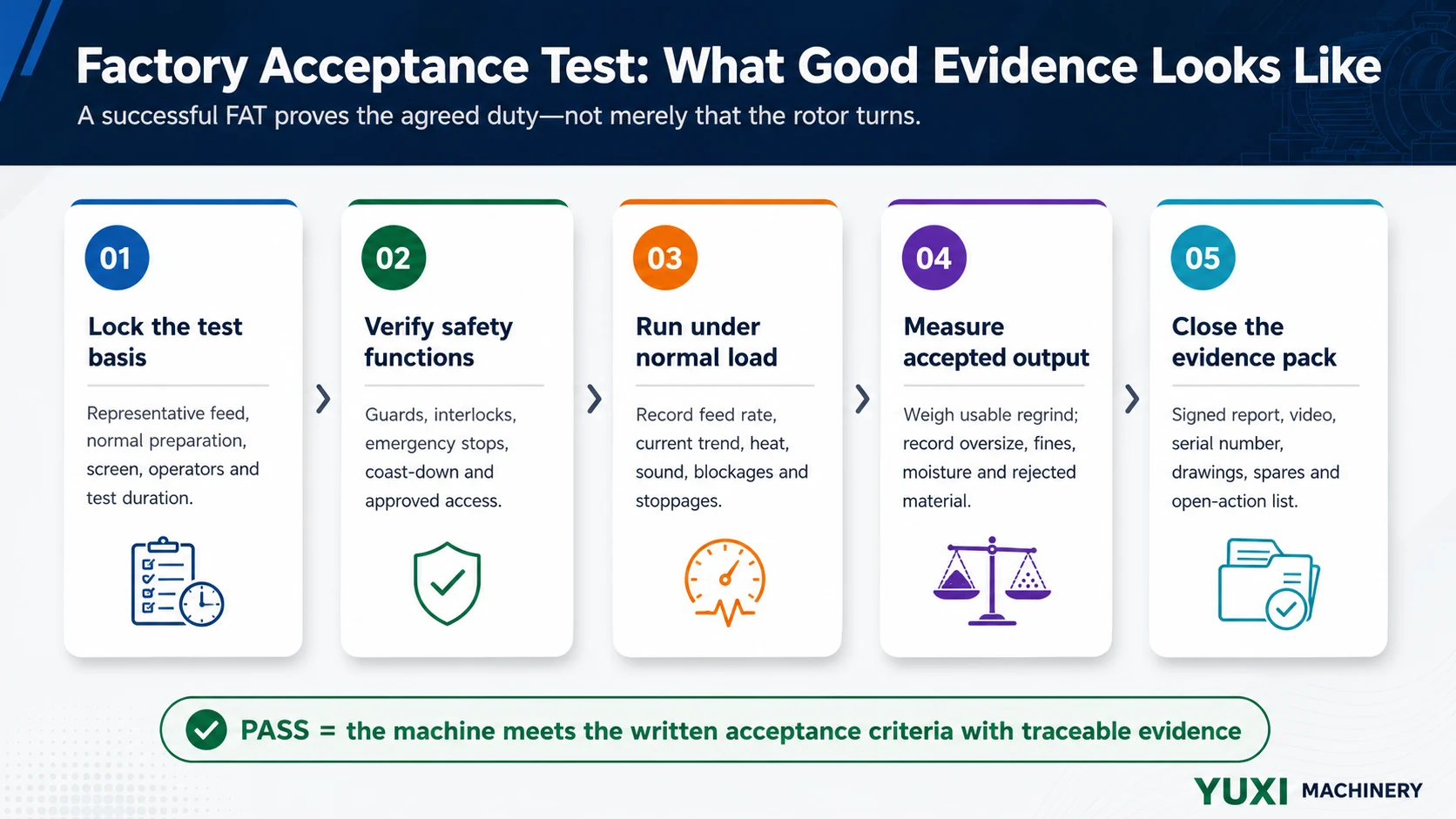
Industry guidance describes a factory acceptance test as a way to check whether equipment complies with contractual requirements and to evaluate components, safety and performance before installation.[5] For a plastic crusher, the test should be agreed before the machine is built, not improvised when the buyer arrives.
| FAT variable | Define before the test | Record during the test |
|---|---|---|
| Material | Source, polymer/product form, dimensions, preparation, moisture and contamination | Actual lot used, rejected pieces and deviations from the agreed sample. |
| Machine setup | Screen, knives, gap, feed method, discharge and control settings | Serial number, installed parts and any adjustment made during the run. |
| Duration | Warm-up, sustained measurement period and restart expectations | Start/stop times, delays, blockages, cleaning and operator interventions. |
| Capacity | Net accepted kg/h and how weighing will be performed | Input mass, accepted output, oversize, fines and rejected material. |
| Operating behavior | Permitted current, temperature, noise/vibration observations and overload logic | Trend data, alarms, trips, unusual sound, heat, wrapping or screen restriction. |
| Safety | Guards, interlocks, emergency stops, access and coast-down checks | Test result, responsible witness and corrective actions. |
Short tests hide the most expensive problems. Film may feed well for two minutes and bridge after the hopper level changes. Warm purgings may begin to smear after the chamber reaches temperature. A cyclone may accept the initial burst and then restrict flow as the receiving system fills. Sustained testing is not about making the video longer. It gives the process enough time to reveal its normal constraints.
The buyer should leave the FAT with a signed report, photos or video, measured data, a list of deviations and a dated action plan. Payment milestones can be tied to closure of critical actions. “Machine runs normally” is not an acceptance criterion.
Documents Are Part of the Machine
A crusher without serial-specific information becomes harder to install, maintain and repair. Request the document index in the purchase order and make final payment conditional on delivery of the agreed pack.
- General arrangement, foundation loads and lifting information.
- Electrical schematics, terminal plan, component list and control description.
- Operating, safety, cleaning and maintenance instructions in the agreed language.
- Lubrication points, lubricant specification and service intervals.
- Knife, fixed-knife and screen identification; approved dimensions and replacement method.
- Recommended spare-parts list with part numbers, quantities and lead times.
- Inspection and FAT records linked to the machine serial number.
- Required declaration, marking and conformity information for the destination.
- Warranty terms, exclusions, claim procedure and service contacts.
ISO notes that certification can add credibility by demonstrating that a product, service or system meets expectations, while certification is performed by certification bodies rather than ISO itself.[6] The same verification principle applies to supplier documents: check issuer, scope, model, date and traceability instead of accepting a logo or a cropped certificate image.
Use a Weighted Supplier Scorecard, Then Apply Hard Gates
A scorecard reduces the influence of one impressive factory visit or one low price. The example below totals 100 points. Change the weights to match the project, but set several non-negotiable gates before scoring.
| Category | Weight | Questions behind the score |
|---|---|---|
| Application and process fit | 22 | Does the supplier understand the feed, select the correct size-reduction stage and define the interfaces? |
| Manufacturing and quality control | 15 | Are drawings, critical processes, inspections, serial records and changes controlled? |
| FAT and performance evidence | 20 | Will the supplier test representative material against written acceptance criteria? |
| Safety and documentation | 13 | Are guards, interlocks, manuals, drawings and destination requirements addressed? |
| Service and spare parts | 15 | Is there a realistic support path, parts plan and technical escalation process? |
| Commercial scope and risk | 15 | Are price, battery limits, payment, lead time, shipping, warranty and exclusions clear? |
- The supplier accepts a written duty based on the actual material, feed method, target regrind and sustained net capacity.
- A representative FAT will use the proposed screen and written pass/fail criteria, with deviations recorded and closed before shipment.
- Guarding, interlocks, electrical isolation and destination-market conformity responsibilities are defined for the final configuration.
- General arrangement, interface drawings, manuals, parts identification, warranty scope and technical escalation contacts are contract deliverables.
A high score cannot cancel a failed gate. A supplier may have excellent pricing and fast delivery, but if the machine cannot be accepted against a written duty, the project still has no defensible performance basis.
Red Flags That Deserve More Than a Follow-Up Email
The capacity is identical for every material
Film, bottles, crates and dense lumps do not share one stable kg/h. Ask for the test basis and normal feed preparation.
The drawing is “available after payment”
A commercial general arrangement can be protected while still showing dimensions, interfaces and scope before the order.
Certifications are presented as performance proof
Management-system or conformity evidence supports qualification; it does not prove output on the buyer’s feed.
The sample test uses a different screen or material
The result may be useful engineering information, but it is not acceptance evidence for the proposed duty.
Spare parts have no part numbers or drawings
“Always available” is difficult to enforce when the machine revision and blade dimensions are not identified.
Every question receives a sales answer
Before ordering, the buyer should have access to someone who can discuss rotor, knives, screen, current, heat, controls and maintenance.
How to Evaluate YUXI as a Plastic Crusher Manufacturer
The current YUXI product page lists six YX-G models. Published data show 7.5–37 kW motors, a 560 rpm rotor, 10 or 12 mm screens, cutting chambers from 270 × 400 mm to 480 × 1,000 mm and reference outputs from 300 to 1,600 kg/h.[7] Those details align the range more closely with a relatively high-speed plastic crusher or granulator than with a conventional slow, high-torque primary shredder.
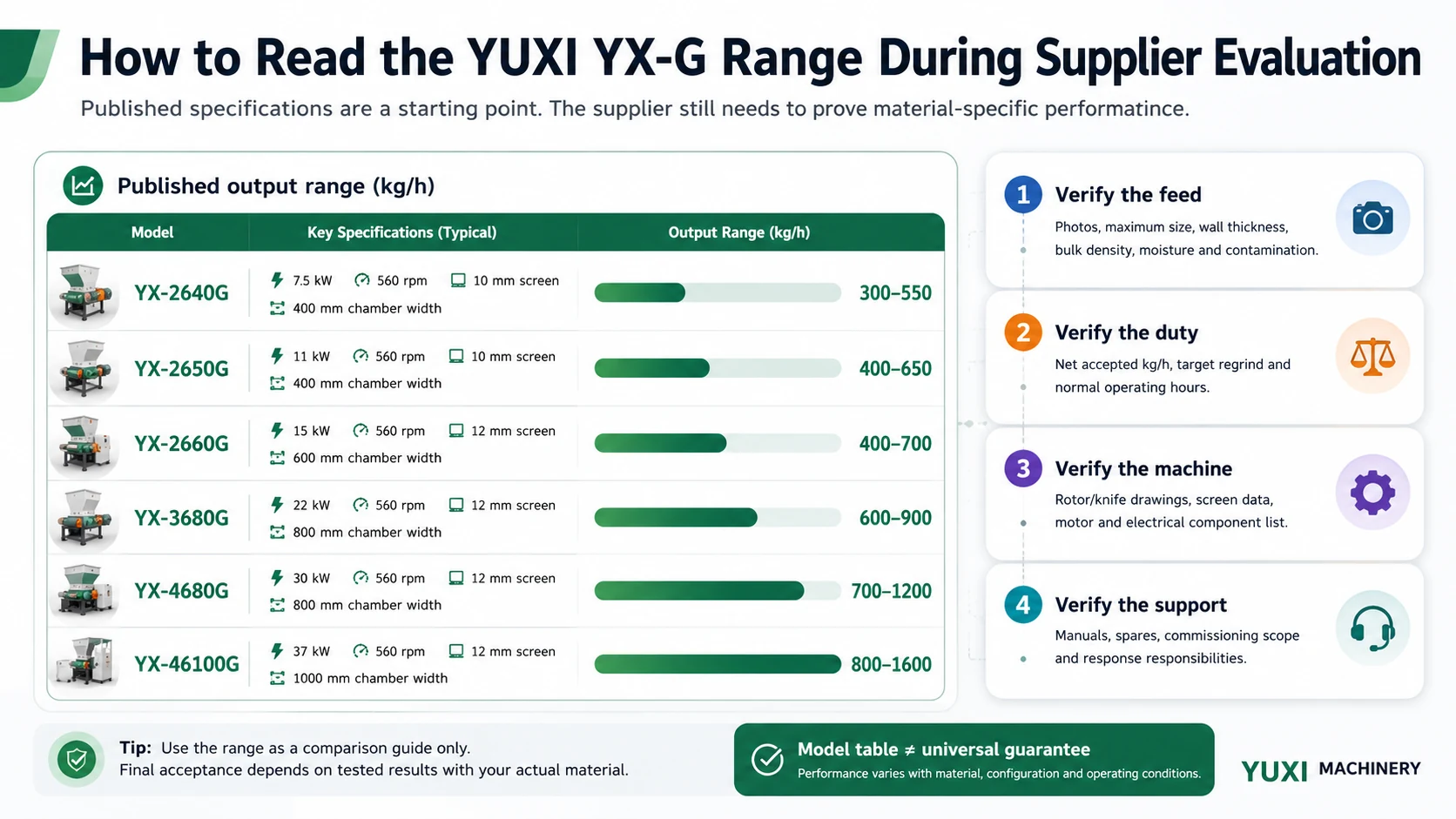
| Model | Power | Rotor speed | Screen | Cutting chamber | Published output |
|---|---|---|---|---|---|
| YX-2640G | 7.5 kW | 560 rpm | 10 mm | 270 × 400 mm | 300–550 kg/h |
| YX-2650G | 11 kW | 560 rpm | 10 mm | 270 × 500 mm | 400–650 kg/h |
| YX-3660G | 15 kW | 560 rpm | 12 mm | 370 × 600 mm | 400–700 kg/h |
| YX-3680G | 22 kW | 560 rpm | 12 mm | 370 × 800 mm | 600–900 kg/h |
| YX-4680G | 30 kW | 560 rpm | 12 mm | 480 × 800 mm | 700–1,200 kg/h |
| YX-46100G | 37 kW | 560 rpm | 12 mm | 480 × 1,000 mm | 800–1,600 kg/h |
Use these figures as reference specifications, not a universal guarantee. YUXI’s own page states that actual output depends on plastic type, bulk density, moisture, contamination, blade condition, screen size and feeding stability.[7] A responsible evaluation therefore asks YUXI to confirm which materials can enter the selected chamber directly, how the published range relates to the buyer’s feed, what screen and discharge system will be installed, and what will be measured during FAT.
The public page also describes application-based selection, screen-controlled output, maintenance access, line-integration support and installation/training support.[7] Those are useful starting claims. Convert each one into a deliverable: the proposed material route, screen drawing, access procedure, interface drawing, commissioning plan, spare-parts list and service contact.
For the current product range, review the YUXI plastic crusher and size-reduction product page. The final quotation should be based on material evidence rather than the broadest material list shown online.
What to Send a Plastic Crusher Manufacturer in the First RFQ
A detailed RFQ does not need to be long. It needs to remove ambiguity. Include the following information in one file or message:
- Plastic resin and product form, with clear photos and a scale reference.
- Normal and maximum dimensions, wall thickness or piece mass, bulk density where useful.
- Moisture, temperature, labels, dirt, metal and other contamination.
- How material will be fed: hand, conveyor, batch dumping, robot, grinder feed or upstream shredder.
- Required regrind and the reason for that size: washing, extrusion, internal reuse or sale.
- Sustained net capacity, shifts per day and expected annual operating hours.
- Existing upstream/downstream equipment, layout limits, voltage and destination country.
- Required FAT method, document language, commissioning and spare-parts expectations.
Representative samples are best for unusual film, thick pipe, filled engineering plastics, dense purgings or mixed material. When shipping samples is impractical, send a continuous video showing handling, dimensions and contamination—not only close-up photographs.
Send YUXI a Testable Plastic Crusher Brief
Send material photos or video, maximum feed size, target regrind, sustained net capacity, operating hours, voltage and downstream process. YUXI can then return a recommended configuration, defined quotation scope and proposed FAT basis, with assumptions and exclusions stated clearly.
FAQ
How do I verify that a plastic crusher supplier is a real manufacturer?
Ask for the legal company name, factory address, production scope, recent workshop video or a live audit, machine serial-number records, machining and assembly evidence, inspection documents and references relevant to the same type of equipment. A trading company can still be useful, but its role and the actual manufacturer must be clear.
Is ISO 9001 enough to qualify a plastic crusher manufacturer?
No. ISO 9001 concerns a quality management system. It can support confidence in documented processes, but it does not prove that a particular crusher is correctly sized, safely configured or capable of the promised output. Verify the certificate and then review machine-specific design, inspection and test evidence.
What should a plastic crusher factory acceptance test include?
Use representative feed and the proposed screen, define a sustained test period, measure accepted output, record motor current and stoppages, inspect regrind, verify guards and interlocks, and close all open actions in a signed report before shipment.
Should the lowest plastic crusher price win the comparison?
Not automatically. Compare the same battery limits, components, feeding and discharge equipment, spares, documents, testing, commissioning, freight, warranty and local compliance work. A low core-machine price can exclude items that are necessary for production.
What documents should be supplied with an industrial plastic crusher?
At minimum, request a model and serial-number record, general arrangement and foundation drawings, electrical drawings, operating and maintenance manual, lubrication information, spare-parts list, knife and screen identification, safety information, conformity documents required for the destination and the final FAT report.
How does the YUXI YX-G range fit this guide?
The public YUXI table lists six YX-G models with 7.5–37 kW motors, a 560 rpm rotor, 10–12 mm screens, cutting chambers from 270 × 400 mm to 480 × 1,000 mm and reference outputs from 300 to 1,600 kg/h. Buyers should still validate feed condition, sustained net output, regrind quality, safety scope and downstream integration for their own project.
Authority and Technical Sources
- U.S. EPA — About Plastic Products and Plastic Pollution: mono-material and multi-material plastic products and major product categories.
- ISO — ISO 9001 Quality Management Systems: purpose and scope of the quality-management framework.
- U.S. OSHA 29 CFR 1910.212: general requirements for machine guarding.
- European Commission — Machinery: CE marking and conformity-assessment guidance.
- Packaging Corporation of America — Factory Acceptance Tests: components, safety and performance evaluation before installation.
- ISO — Certification: role and value of certification and certification bodies.
- YUXI — Plastic Shredder Machine / YX-G Product Page: model specifications, material-selection factors, capacity qualifications and support notes.