Plastic Crusher Blade Selection and Knife Gap Guide
Plastic Crusher Blade Selection and Knife Gap Guide
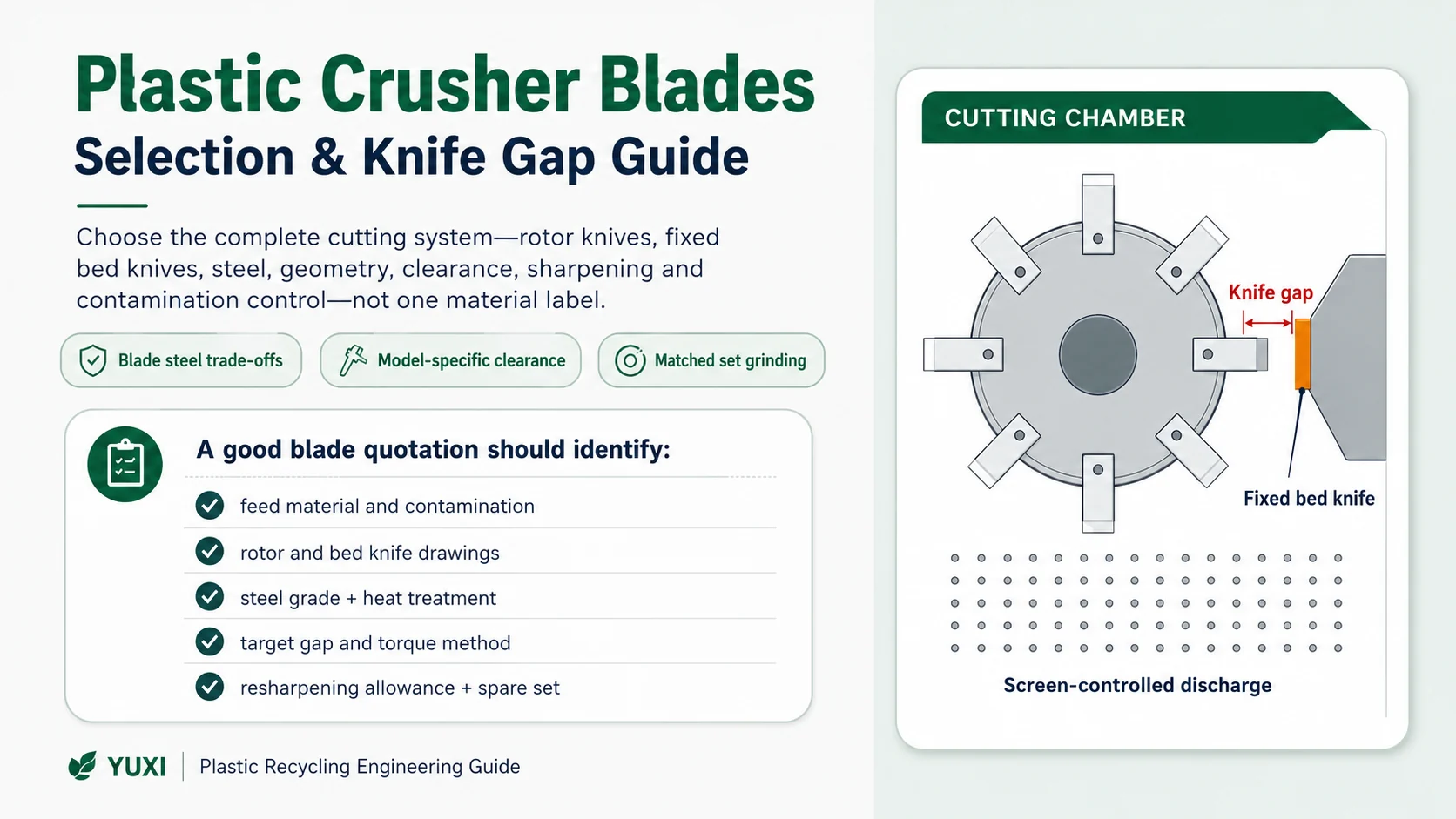
Blade steel matters. So do edge geometry, rotor layout, fixed-knife alignment, clearance, heat treatment, contamination and the way the complete cutting set is sharpened.
A useful blade decision covers the whole cutting pair—not only the steel grade stamped on one knife.
A buyer asks for “D2 plastic crusher blades.” The request sounds detailed, yet five important questions are still unanswered. Is the feed clean bottle scrap or glass-filled engineering plastic? Are the knives straight, staggered or inclined? What is the fixed-knife condition? What clearance does the machine manual specify? And will the complete rotor set be ground to the same height?
We have found that many blade problems begin before the machine starts. The quotation compares alloy names while ignoring geometry, heat treatment, knife seats, bolt torque, screen restriction and contamination. A very hard edge can wear slowly in clean production and chip quickly when a hidden screw enters the chamber. A freshly sharpened rotor can still produce dusty regrind when the bed knives are rounded or the gap is uneven from left to right.
Quick answer: Select plastic crusher blades as a matched cutting system. Start with the actual plastic form, wall thickness, fillers and contamination; then confirm rotor and fixed-knife geometry, steel and heat treatment, target hardness, edge angles, regrinding allowance, mounting dimensions and the model-specific knife gap. Do not use a generic clearance copied from another machine. Published granulator manuals show materially different settings—from roughly 0.10–0.25 mm for some film applications to about 0.36–0.41 mm for certain thick solid-wall pipe applications—because rotor design and feed behavior differ.[2][4]
A Plastic Crusher Uses a Cutting Pair, Not a Single Blade
In a high-speed plastic crusher or granulator, moving knives mounted on the rotor pass close to stationary bed knives. Plastic is sheared at this interface, circulates inside the chamber and leaves when it can pass the screen. The separate plastic crusher working principle guide explains that loop in detail. Here, the focus is narrower: what makes the cutting pair work cleanly and stay serviceable.
Rotor knives
These knives move with the rotor. Their number, position, inclination, mass and height influence bite, cutting frequency, balance and the load transferred into the shaft and bearings.
Fixed or bed knives
These form the stationary side of the shear. A sharp rotor knife passing a rounded bed knife does not create a sharp cutting pair. Both sides need inspection.
Knife seats and fasteners
Debris, burrs, damaged threads or uneven seating can change knife height after torque is applied. That creates an inconsistent gap even when the feeler gauge looked correct earlier.
Screen and discharge
The screen controls residence time. A restrictive screen or weak evacuation causes more recutting and heat, which can make a blade problem look worse—or create one.
This distinction also prevents a common SEO and purchasing confusion. A low-speed single-shaft shredder may use indexable rotor cutters and a hydraulic pusher. A crusher/granulator usually uses longer rotor knives working against fixed knives at much higher cutting frequency. Blade material names can overlap, but the geometry, speed and failure modes are not interchangeable.
Read the YUXI Product Data as a Crusher / Granulator System
The current YUXI plastic shredder product page publishes six YX-G models with a 560 rpm rotor, rotating and fixed knives, 10 or 12 mm screens, 7.5–37 kW motors, 270 × 400 mm to 480 × 1,000 mm cutting chambers and reference outputs from 300 to 1,600 kg/h.[1] Mechanically, that evidence aligns more closely with a high-speed plastic crusher or granulator than with a conventional slow-speed primary shredder.
That classification matters for blade selection. At 560 rpm, a small alignment error repeats many times per minute. Dull edges, excessive clearance or a restrictive screen can turn cutting into rubbing and recutting. The catalog range also lists several chamber widths, so spare knives cannot be ordered by the words “YX-G blade” alone. A correct spare-parts request should include the exact model, serial number, rotor and bed knife drawings, hole pattern, thickness, edge geometry and the most recent grinding dimensions.
Published YUXI factor
Why it matters to blades
What still needs confirmation
560 rpm rotor speed
High cutting frequency makes edge condition, balance and clearance important.
Rotor layout, knife count, cutting angle and allowable imbalance.
10–12 mm screens
Screen restriction affects residence time, recutting, heat and fines.
Open area, thickness and downstream accepted regrind.
Multiple chamber widths
Knife length and bolt pattern vary with model.
Part drawings and serial-number-specific revisions.
300–1,600 kg/h reference range
Blade condition and gap can change sustained output.
Representative material, feed method, accepted output and test duration.
The product page does not publicly specify one universal blade steel. That is sensible. A buyer should not infer an alloy from a photo or assume every feed receives the same heat treatment. Ask for the proposed knife specification for the actual application.
Five Factors Decide Whether a Blade Set Is Actually Suitable
1. Material form is usually more useful than the resin name
“HDPE” can mean thin bottle walls, thick pipe, nested crates or a dense purge. The resin family is the same; the cutting event is not. Our plastic crusher materials guide separates polymer from product form for this reason.
Thin hollow parts collapse and then cut. Thick pipe transfers a stronger impact into the edge. Film may fold or wrap instead of presenting a stable section to the knives. Glass-filled nylon can be easy to feed but abrasive in service. The blade brief therefore needs dimensions, wall thickness, temperature, bulk density, fillers and contamination—not only a resin code.
2. The dominant failure mode should drive the steel decision
Blade steels trade wear resistance against toughness, machinability and grinding behavior. If abrasive wear dominates and contamination is controlled, higher wear resistance can extend the interval between sharpenings. If impacts, hidden inserts or thick irregular pieces dominate, chipping resistance and edge strength may deserve more weight.
Surprisingly, “harder” is not always “better.” A hard edge that chips creates an immediate maintenance event. A slightly tougher setup that wears predictably may deliver more usable production between planned stops.
3. Rotor and bed knives must be treated as one set
A supplier can install new rotor knives against worn fixed knives and still call the rotor “new.” The output will reveal the mismatch: folded edges, tails, noise or uneven load. Inspect both cutting sides and record the remaining grind allowance of each.
4. Geometry must fit how the material enters the chamber
Straight knives, staggered knives, inclined or scissor-cut layouts and open-rotor arrangements change how the load is distributed. A progressive scissor cut can reduce the instantaneous bite compared with a full-width impact. An open rotor may improve airflow and evacuation for certain feeds. Film needs a geometry that minimizes folding and wrapping. Thick rigid material needs enough edge support.
5. The maintenance process must be realistic
A premium blade is a poor choice when the plant cannot measure the gap, torque the bolts correctly or grind the set without overheating it. We normally recommend planning the spare set, lifting method, sharpening supplier, inspection record and minimum allowable knife dimensions before commissioning—not after the first unexpected stop.
Start with the dominant operating risk: wear, wrapping, impact, dust or contamination. The alloy name comes later.
Blade Steel: Ask for Properties, Heat Treatment and Traceability
D2, SKD11, DC53, Cr12MoV, 9CrSi and high-speed steels frequently appear in crusher-blade quotations. The names are useful, but they do not prove final performance. Supplier equivalence, chemistry limits, cleanliness, heat treatment, hardness uniformity and grinding quality can differ.
For example, Uddeholm’s AISI D2 technical information describes very good abrasive wear resistance but comparatively limited cracking resistance.[6] That is the trade-off a buyer should understand. D2 may be appropriate where wear dominates and impact is controlled; it should not be treated as an automatic answer to contaminated feed or severe shock.
Specification question
Why it matters
Useful evidence
What is the exact steel designation?
“Tool steel” or “SKD-type” is too vague for repeat ordering.
Material certificate, chemistry range and recognized equivalent.
What is the final hardness range?
Hardness influences wear, edge deformation and chipping risk.
Heat-treatment record and hardness checks at defined locations.
How is distortion controlled?
Warped knives make uniform clearance difficult.
Flatness, parallelism and dimensional inspection report.
What surfaces are ground?
Grinding the wrong face changes edge angle and knife height.
OEM drawing with marked grinding surfaces and minimum width.
Are rotor knives ground as a complete set?
Unequal height changes clearance and can disturb rotor balance.
Set identification, final height record and matched packing.
Procurement rule: compare complete blade specifications, not alloy labels. A lower-cost knife with controlled heat treatment, accurate flatness and a documented grinding plan can outperform a prestigious grade supplied with poor dimensional control.
Knife Geometry Changes the Cut Before Steel Quality Does
Blade geometry includes the cutting angle, relief angle, thickness, bevel position, edge support, knife inclination and the sequence in which rotor knives meet the fixed knives. These features influence bite, power spikes, noise, fines and the likelihood of wrapping.
Straight or full-width engagement
Simple to inspect and grind, but a wide simultaneous bite can create a sharper load peak depending on chamber design.
Inclined or scissor cutting
The contact progresses across the knife width. This can spread the load and support a cleaner slicing action when correctly aligned.
Staggered knife arrangement
Multiple knife positions distribute cutting events around the rotor. Height consistency and rotor balance become critical after sharpening.
Do not change the bevel angle because a local sharpening shop prefers a standard setup. Conair’s granulator manual warns that the specified relief and cutting angles must be maintained and that overheating during grinding can reduce hardness, strength and durability.[2] The OEM drawing is the governing document.
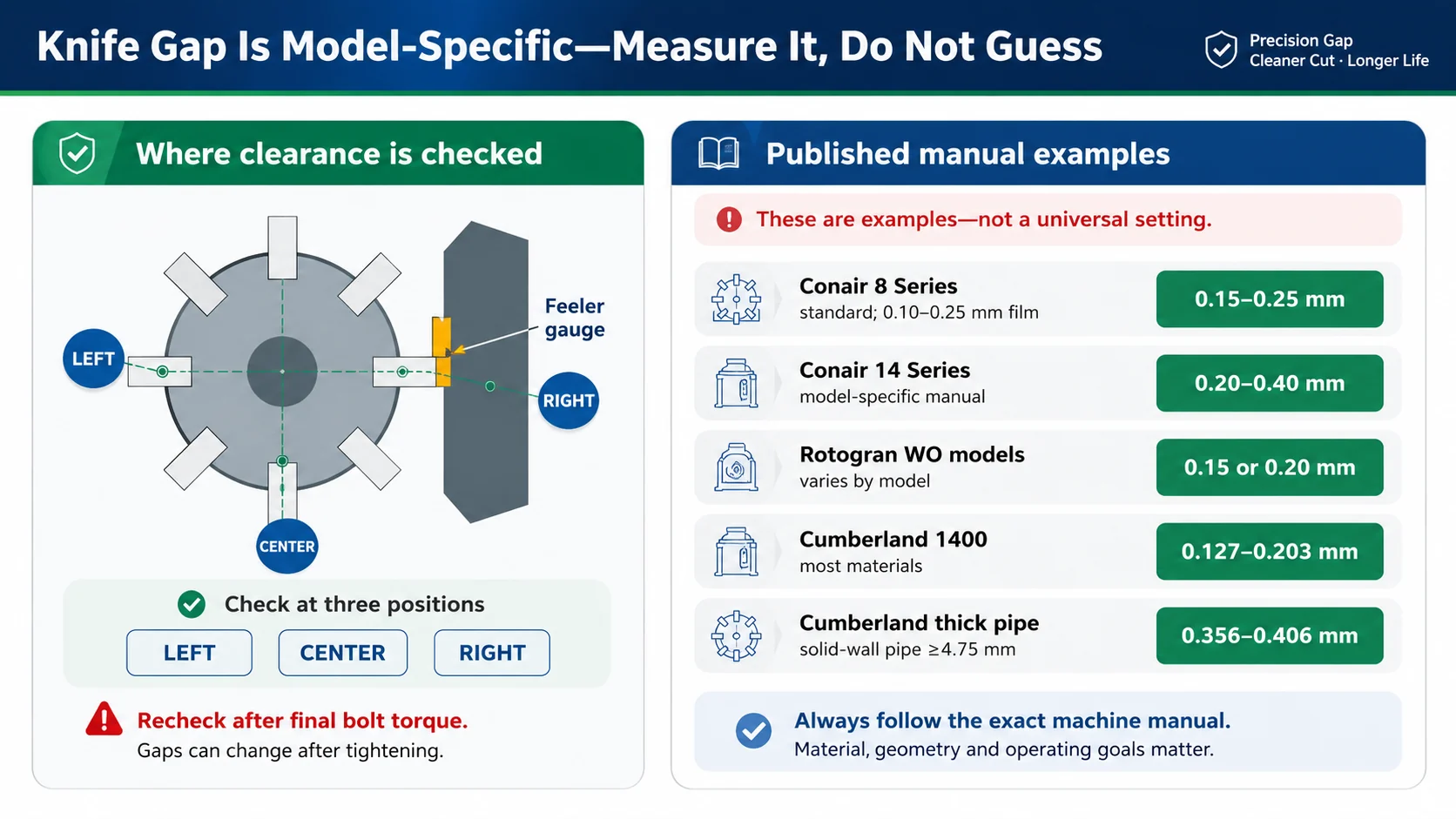
There Is No Universal Plastic Crusher Knife Gap
The knife gap is the clearance between the moving rotor edge and the fixed bed knife at the closest passing point. Too many guides publish one number as though every crusher shares the same rotor diameter, speed, knife geometry and feed. Official manuals show otherwise.
Published source
Example clearance
Important qualification
Conair 8 Series
0.15–0.25 mm standard; 0.10–0.25 mm film
The manual calls these guidelines and says the correct value depends on material type and form.[2]
Conair 14 Series
0.20–0.40 mm
Applies to that machine series, not all granulators.[3]
Rotogran WO models
0.006 or 0.008 in (about 0.15 or 0.20 mm) by model
The same manual also gives a setting procedure and model-specific torque table.[5]
Cumberland 1400 Series
0.005–0.008 in (about 0.127–0.203 mm) for most materials
It gives 0.014–0.016 in (about 0.356–0.406 mm) for certain thick solid-wall pipe.[4]
This variation is the main lesson. The right starting point comes from the exact machine manual or OEM service instruction. Material testing can refine the setting only within the limits allowed by the rotor, bearings, knife seats and adjustment system.
Published ranges vary materially. The safe engineering response is model-specific measurement, not a copied internet value.
A Practical Gap-Setting Sequence
The exact steps and torque values belong to the OEM manual. Still, a sound procedure has a recognizable logic.
Identify the machine and knife set. Confirm model, serial number, rotor revision and whether the adjustable element is the rotor knife, bed knife or both.
Isolate hazardous energy. Stop the machine, wait for rotor coast-down, apply the site’s lockout/tagout procedure and control stored mechanical, hydraulic, pneumatic and electrical energy.
Clean the chamber and knife seats. Resin, dust, burrs or rust behind a knife can change its position after torque.
Install the complete matched set. Use the correct bolts, washers and orientation. Replace damaged fasteners as the OEM requires.
Seat and snug the knives in the specified sequence. Do not jump directly to final torque while one end is floating.
Measure with a feeler gauge. Check each knife pair at the left, center and right where the design permits. The Conair 8 Series manual explicitly describes this three-position check.[2]
Rotate only in the direction allowed by the manual. Some manuals specify backward rotation during checking to avoid cutting the gauge or chipping an edge.
Apply final torque with a calibrated wrench. Recheck the clearance because tightening can move the knife.
Turn the rotor through the required revolutions by the approved external method. Confirm free movement and remove every tool, gauge and block before closing the chamber.
Recheck after the run-in period. Cumberland instructs users to recheck clearance after the first 24–36 operating hours on its 1400 Series.[4]
Do not “test” a suspicious gap by energizing the rotor with guards open. Manual rotation, blocking, interlocks and isolation procedures must follow the manufacturer and the plant’s safety program.
What Happens When the Gap Is Too Wide or Too Tight?
Condition
Likely cutting behavior
Typical symptoms
Gap too wide
Plastic bends, folds or tears instead of being cleanly sheared.
Film tails, long slivers, uneven regrind, higher fines, rising load, wrapping and lower accepted kg/h.
Gap too tight
Edges may rub, contact or lose thermal clearance as the machine warms.
Metallic noise, heat, edge chipping, vibration, polished contact marks or catastrophic knife damage.
Gap uneven across width
One side cuts while another side tears or contacts.
Asymmetric wear, inconsistent regrind, vibration and repeated need for local adjustment.
Correct gap but dull edges
Clearance is measured correctly, yet the radius at the edge prevents a clean shear.
Dust, smear, heat and poor throughput despite “correct” gauge readings.
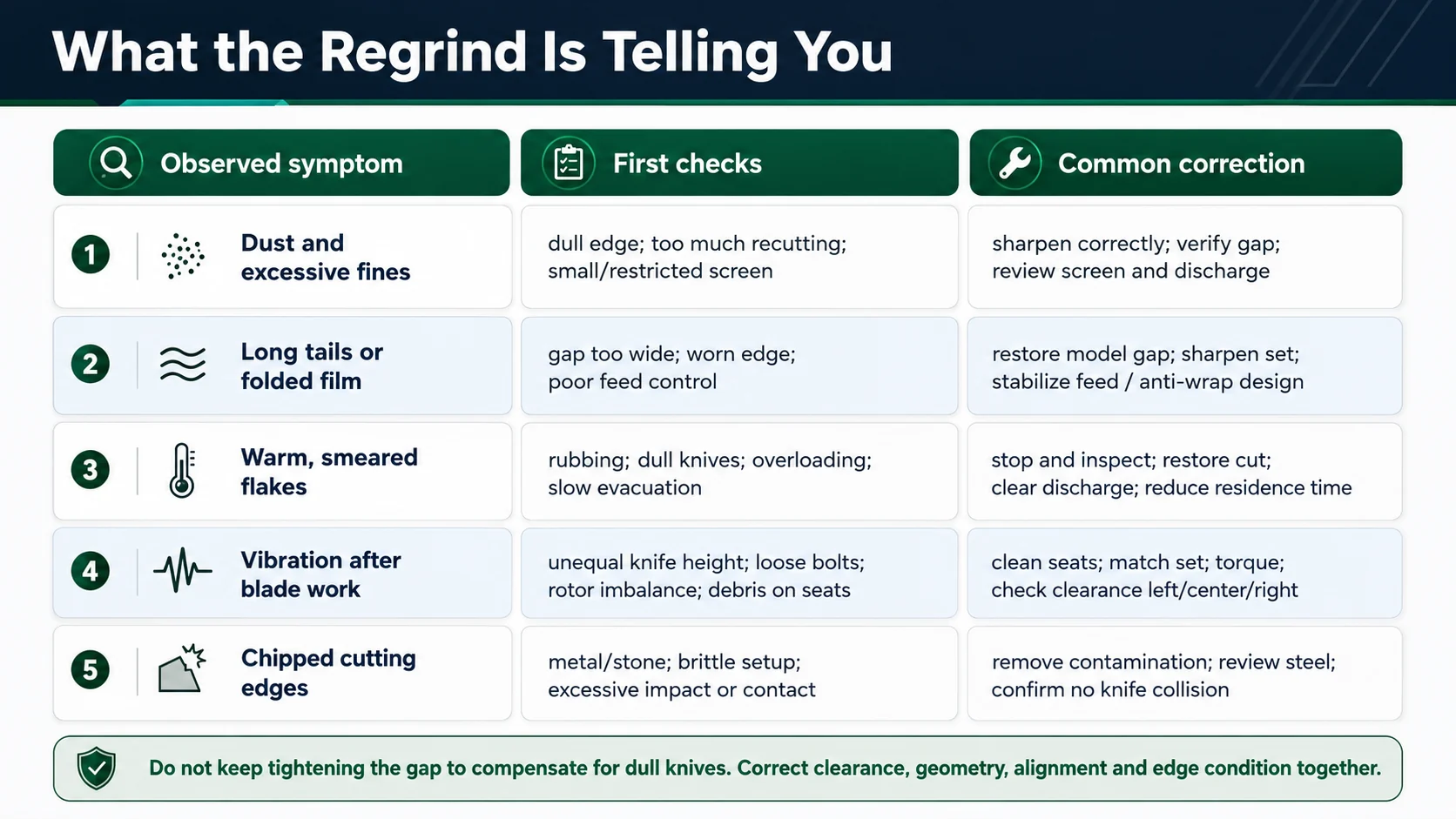
This is why repeatedly closing the gap is not a substitute for sharpening. The measured distance may become smaller while the rounded edge still rubs the material. The corrective action has to address edge condition, geometry, alignment and clearance together.
Regrind shape, temperature and vibration often reveal whether the root cause is edge condition, clearance, alignment, contamination or discharge.
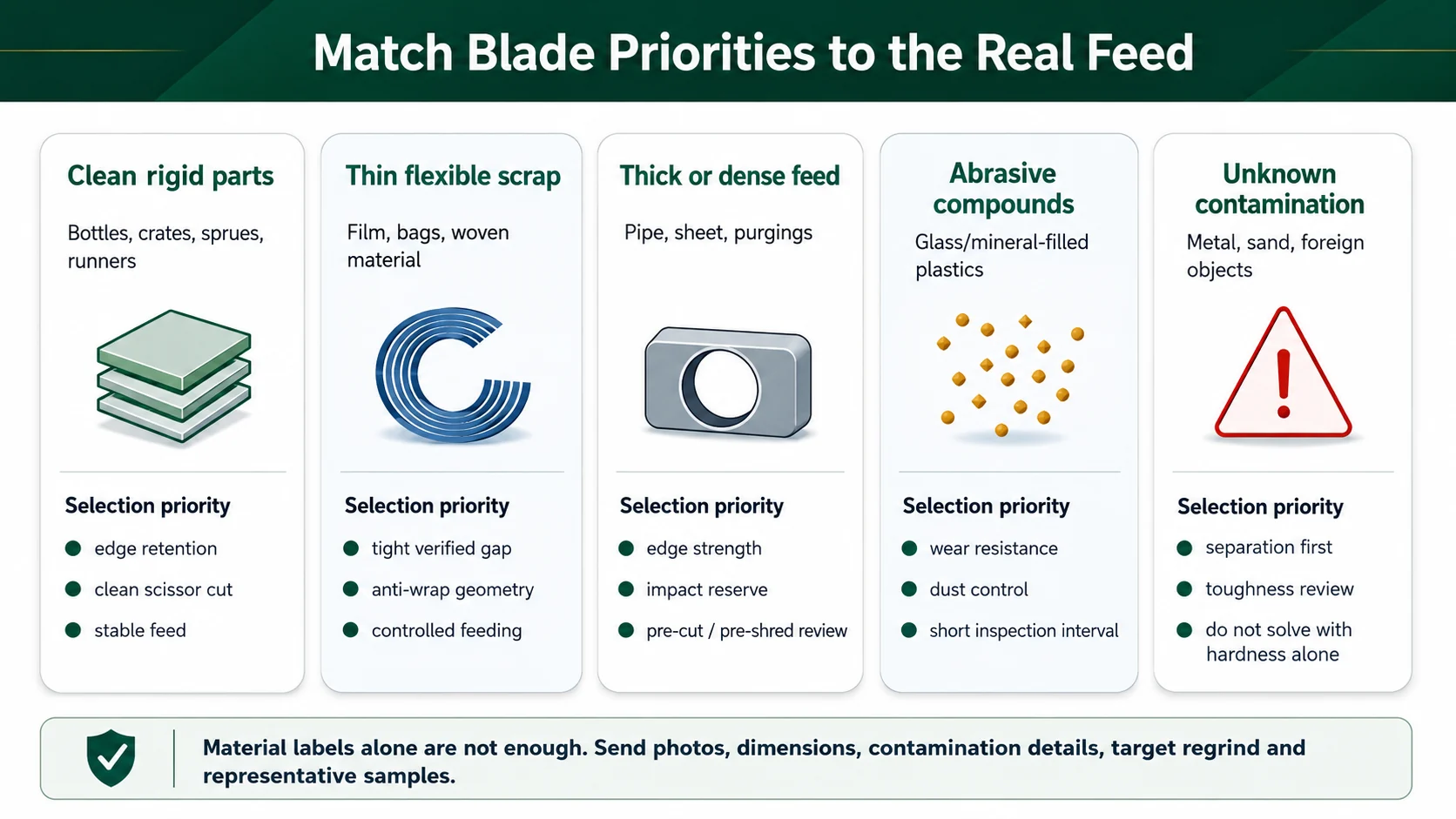
Material-Based Starting Priorities
The table below is a selection framework, not a substitute for a material test. It deliberately avoids assigning one universal alloy to every application.
Feed
Dominant risk
Blade-system priority
Questions before approval
PET/HDPE bottles and clean hollow parts
Variable wall presentation, labels and occasional contamination
Clean shear, stable gap, good evacuation and practical resharpening
Are caps, labels, metal rings or liquid residues present?
PP crates, sprues and injection parts
Impact variation from part geometry
Edge retention with enough toughness; stable feeding
Maximum rib thickness? Nested parts? Glass or mineral filler?
PE/PP film and woven bags
Folding, wrapping, bridging and heat
Verified tight clearance within OEM limits, anti-wrap geometry and controlled feed
Loose, baled or wet? Printed? Sand contamination?
Thick pipe, profiles and sheet
High impact and long sections
Strong edge support, suitable gap and pre-cut/pre-shred review
Outside diameter, wall thickness, length and temperature?
Dense purgings and lumps
Shock, overload and poor ingestion
Toughness, limited bite depth and staged reduction when needed
Largest dimension and mass? Embedded metal? Can it enter safely?
Glass/mineral-filled engineering plastics
Abrasive wear and fine dust
Wear resistance, dust control and shorter inspection interval
Filler percentage, target regrind and downstream dust tolerance?
Mixed post-consumer plastic
Unknown foreign objects and variable behavior
Separation, inspection and representative testing before alloy upgrade
What contamination controls exist before the crusher?
The plastic crusher screen size guide should be reviewed with the blade decision. A smaller screen can keep material in the chamber longer, increasing the number of knife contacts. It may tighten the coarse end of the regrind distribution while accelerating wear and heat if the complete system cannot evacuate the product.
Sharpening Quality Can Matter More Than the Original Alloy
Rotogran recommends inspecting blade sharpness monthly or every 250 hours and states that sharp blades at the proper gap cut instead of tear, producing cleaner granules and fewer fines.[5] The interval is a manual example, not a universal schedule. Abrasive fillers, sand, metal contamination and a restrictive screen can shorten it dramatically.
More important is how the knives are sharpened. The same Rotogran manual says rotor blades should be ground together as a set so their width remains equal and the proper gap can be established. It also warns that grinding heat can soften the cutting edge.[5]
Sharpen when the process changes
Watch accepted throughput, motor-current trend, dust, long pieces, chamber temperature, noise and the force needed to feed material. Calendar time alone misses real wear.
Record every grind
Track date, operating hours or tonnage, material, removed stock, final knife height, gap, torque and any edge damage. This makes recurring failures visible.
Respect minimum dimensions
Knives cannot be ground indefinitely. OEM minimum width, bolt-head clearance and adjustment travel determine when replacement is safer than another grind.
Keep a matched spare set
A ready spare set reduces downtime and prevents the plant from installing one unmatched replacement knife during an urgent stop.
Sometimes the lowest-cost maintenance decision is to remove the full set early, sharpen it correctly and reinstall it with measured clearance. Continuing to run rounded knives can cost more through lost capacity, dust, heat, screen blockage and emergency labor. The separate plastic crusher capacity guide explains why those losses should be measured as sustained accepted kg/h rather than a short peak.
What to Confirm in the Blade FAT and Spare-Parts Order
A factory acceptance test should not end when plastic comes out of the discharge. Include blade-system evidence while the machine and engineering team are still together.
Exact machine model, serial number and rotor revision.
Rotor and bed knife drawings with dimensions, hole pattern, material and grinding faces.
Steel certificate, proposed hardness range and heat-treatment record where supplied.
OEM knife-gap value and measurement locations.
Fastener grade, torque values and tightening sequence.
Cold manual-rotation check and approved warm recheck procedure.
Representative material test using the proposed screen and normal feed method.
Accepted kg/h, fines, longs, smear, motor-current trend and chamber temperature observations.
Blade removal, lifting, storage and sharpening procedure.
One complete matched spare set, not isolated knives from different batches.
During a test, listen for rhythm. A stable cutting sound can become an irregular hammering pattern when feed size exceeds the bite or one knife is sitting high. Inspect the regrind rather than admiring only the discharge rate. Long folded pieces, hot polished flakes and unusual dust are engineering clues.
Send the Material Before Finalizing the Blades
For a YUXI selection, provide the polymer and product form, photos, largest dimensions, wall thickness, fillers, moisture, contamination, target output, required net capacity and downstream process. Representative samples are strongly preferred for pipe, film, purgings, filled plastics or mixed waste.
Request a blade and crusher configuration review
Safety Before Any Knife Inspection or Adjustment
Plastic granulator knives can cause fatal or life-changing injuries even after the stop button is pressed. The rotor has inertia, sharp edges remain exposed and stored mechanical or hydraulic energy may move components unexpectedly.
OSHA’s hazardous-energy standard applies to servicing and maintenance where unexpected energization, startup or release of stored energy could injure employees.[7] WorkSafe New Zealand’s plastics granulator fact sheet likewise calls for locking out power supplies, preventing guard access until knives stop, maintaining interlocks and using appropriate tools and gloves when handling knives.[8]
Minimum boundary: only trained and authorized personnel should open the chamber, handle knives, rotate the rotor for service, set clearance or apply final torque. Follow the exact OEM manual and the employer’s energy-control program. Never reach through the hopper, bypass an interlock or rely on the emergency stop as energy isolation.
Plastic Crusher Blades FAQ
What is the best steel for plastic crusher blades?There is no single best grade.Clean, abrasive feed may favor greater wear resistance, while thick, irregular or contaminated feed may require more toughness and stronger edge support. Compare the exact steel, heat treatment, hardness, geometry, dimensional accuracy and expected
failure mode rather than choosing by alloy name alone.What is the correct plastic crusher knife gap?Use the exact machine manual or OEM service instruction. Published granulator examples range from about 0.10–0.25 mm for some film settings to about 0.36–0.41 mm for certain thick pipe applications. Those values belong to specific machines and materials, not every crusher.Should rotor and fixed knives be sharpened together?They should be evaluated as one cutting pair. Rotor knives are commonly ground as a matched set to keep equal height, while fixed knives must retain the specified edge geometry and enough adjustment range. Follow the OEM drawing and minimum dimensions.Why does a crusher make dust after new blades are installed?New blades can still produce dust if the gap is wrong, the fixed knives are worn, the set is uneven, the screen retains material too long, discharge is restricted or the sharpening geometry is incorrect. Check the complete cutting and evacuation system.Can I replace only one chipped rotor knife?Do not assume that one isolated replacement is acceptable. Knife mass, height and balance can affect the rotor. Consult the OEM about matched replacement, balancing and whether the full set must be changed or reground.How often should plastic crusher blades be sharpened?Use condition and production data rather than a universal calendar. Track accepted kg/h, motor load, fines, tails, heat, noise and inspected edge radius. Abrasive or contaminated feed may require much shorter intervals than clean production scrap.What information is needed to order replacement blades?Provide machine model and serial number, rotor revision, knife drawings, dimensions, thickness, hole pattern, bevel and relief angles, steel specification, hardness, current grind dimensions and photos of the complete cutting chamber. A sample old knife can help but should not replace the drawing.
David focuses on industrial shredding and recycling equipment,including material evaluation,shredder selection,process configuration,and recycling line planning.
Speak To Our Shredder Machine Expert
Get in touch with our nice team today to get a price estimate for a shredder machine.