





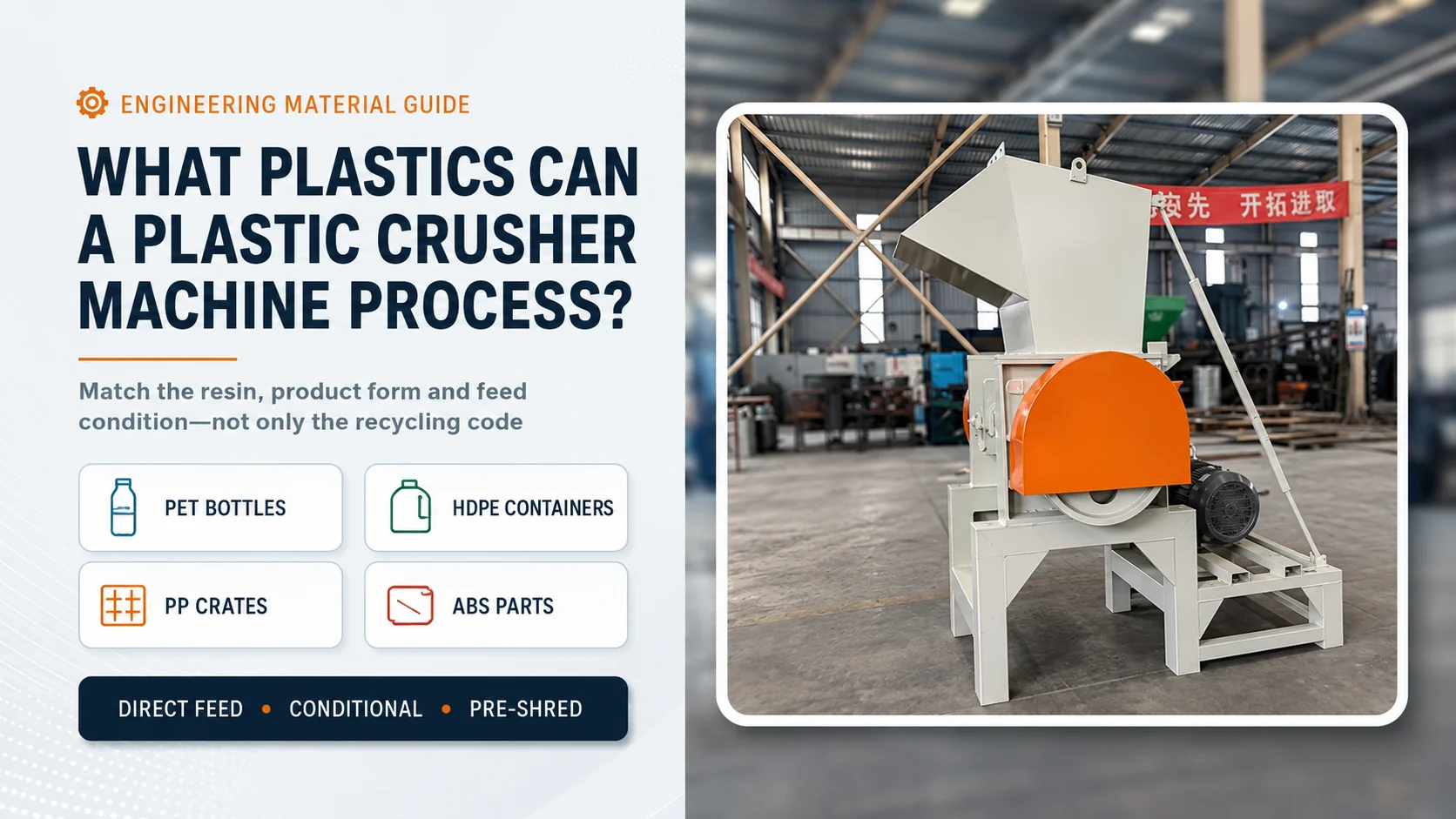
That is where many plastic crusher selections go wrong. The buyer names the resin, the supplier matches a motor size, and everyone moves too quickly. In our experience, the resin name is only the beginning. The machine also has to accept the shape, control the feed, release the cut material through the screen, and deliver regrind that the next process can actually use.
Sometimes the material is easy to cut but difficult to feed. Sometimes it feeds well and wears the knives faster than expected. And sometimes a crusher can reduce the item perfectly well, yet the resulting mixture has little recycling value. That last point is often missed.
The First Question Is Not “Which Resin?”
The U.S. Department of Energy groups common plastics into seven recycling-code categories: PET, HDPE, PVC, LDPE, PP, PS and “other.”[1] Those codes are useful for sorting and communication. They are not a machine specification.
We normally start with a less tidy question: What does the material look and behave like when it reaches the hopper? A short HDPE pipe offcut may enter a crusher without drama. A long thick-wall pipe made from the same HDPE may strike the hopper, rotate instead of biting, and require manual handling that should never have been designed into the process.
The U.S. EPA also distinguishes mono-material products from multi-material products containing combinations of resins, paper or metal.[2] That matters because a crusher changes size, not chemistry. It can cut a laminated package or a molded part with an insert. It cannot turn that mixed construction into a clean, compatible polymer stream.
A Practical Compatibility Map—not a Promise
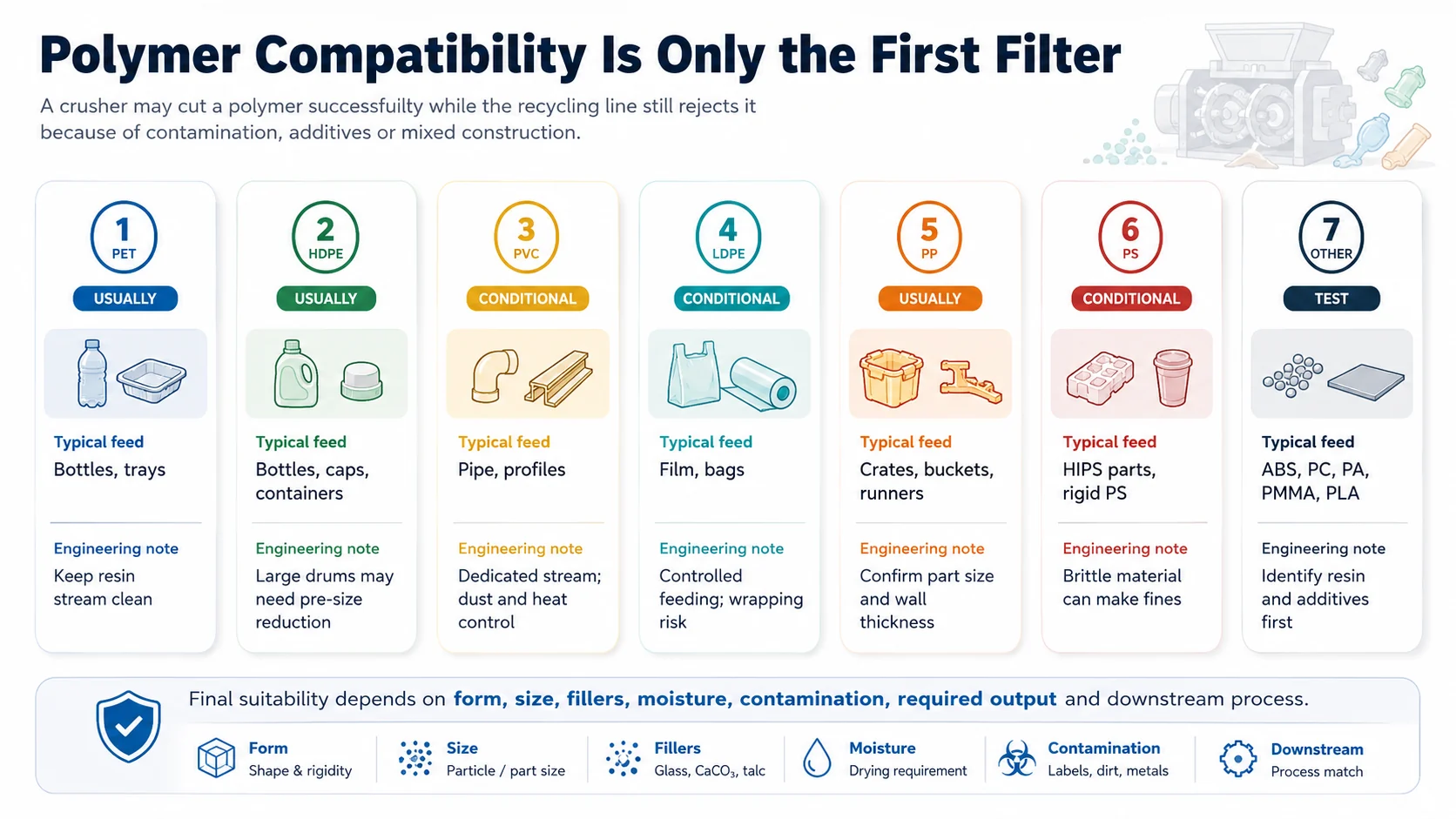
Tables are useful, but they can create false confidence. Read the matrix below as a starting position. “Usually suitable” means the material is commonly granulated when it is clean enough, correctly sized and presented to the rotor in a stable way. It does not mean every object carrying that resin name can be dropped into the same hopper.
| Material | Typical examples | Practical position | What usually decides the result |
|---|---|---|---|
| PET | Bottles, trays, preforms, sheet skeletons and factory rejects | Usually suitable after preparation | Residual liquid, labels, caps, PVC contamination, brittle fracture and the flake size required by washing or sorting. |
| HDPE | Bottles, caps, small containers and prepared pipe pieces | Usually suitable | Part size, wall thickness, hollow geometry and whether drums or long pipe can enter the cutting circle consistently. |
| PP | Crates, buckets, caps, woven sacks, runners and molded rejects | Usually suitable when feedable | Nesting, spring-back, low bulk density and the difference between thin molded parts and dense purgings. |
| LDPE / LLDPE | Film, bags, shrink wrap and flexible sheet | Conditional | Bridging, fluttering, wrapping, moisture, dirt and discharge capacity often matter more than installed motor power. |
| PVC | Pipe, profile, conduit and clean production scrap | Conditional; dedicated handling preferred | Verified material identity, additives, heat, dust, contamination and a defined outlet for the regrind. |
| PS / HIPS | Rigid packaging, appliance housings and molding scrap | Often suitable | Fines, brittleness, inserts and the very low bulk density of foam products. |
| ABS | Clean housings, runners, molded parts and factory rejects | Often suitable after grade review | Flame retardants, paint, plating, e-waste contamination and whether the downstream user accepts the grade. |
| PC, PA, PMMA, POM | Engineering-plastic production waste | Representative test recommended | Toughness, brittleness, temperature increase, filler, knife wear and heavy grinding quality vary according to grade. |
| PLA and other bioplastics | Cups, trays, films and production waste | Testing and maintaining separate | may be possible, but the compatibility of moisture and downstream polymers determines whether the output is useful. |
| Thermosets / FRP | Cured resin, phenolic components, fiberglass panels and reinforced composites | Not a standard thermoplastic granulation job | The material does not simply remelt; reinforcement can be abrasive and dust-intensive, and the recovered fraction needs a defined use. |
What Everyday Plastics Are Really Like in the Crusher
PET: cutting is usually the easy part
PET bottles and clean production scrap are familiar granulator materials. Preforms, edge trim and sheet skeletons are normally easier than post-consumer bottles because their dimensions and contamination are more predictable. They tend to feed with fewer surprises.
Bottles are different. Residual liquid changes the apparent throughput and creates housekeeping problems. Closures and labels introduce other polymers. Thin trays may nest together, then release suddenly as a bundle. A demonstration with ten hand-separated bottles can look excellent while the production hopper behaves quite differently.
We have found that buyers often focus too early on the smallest possible screen. Smaller sounds better. That is not always true. PET can fracture and create more fines when the knives are dull, the gap is poor, the material is cold and brittle, or the pieces circulate repeatedly before passing the screen. The right target is the flake distribution required by the next process—not the smallest particle the machine can make.
Representative troubleshooting note: PET fines rose after several weeks
The first suspicion in this type of situation is often “the screen is wrong.” Sometimes it is. More often, the useful checks are simpler: knife edge condition, knife gap, rotor-to-bed-knife alignment, repeated recirculation and whether brittle trays have been mixed into a bottle stream. Replacing the screen without correcting the cutting condition may only move the problem.
HDPE: easy bottles, awkward geometry
Prepared HDPE bottles, caps and smaller container sections are generally sensible crusher feed. HDPE is tough rather than glass-like, so a clean shearing action matters. Once a hollow bottle is caught, it usually collapses and cuts. Getting that first bite can be the harder part.
Large drums may roll above the rotor or bridge at the inlet. Long pipe creates another set of issues. It can strike guards, require unsafe manual positioning or enter at an angle that creates unstable loading. In practice, a short offcut and a full-length pipe should be treated as different applications even when the material certificate says the same thing.
One buyer scenario we regularly use during selection compares two routes. Route A adds manual sawing before a high-speed crusher. Route B uses a suitable first-stage shredder or dedicated pipe-feed arrangement, then granulates to the final size. Route A may have the lower equipment price. Route B often has the better labor, safety and uptime story.
PP: the resin name hides the largest variation
PP runners, sprues, caps and small molding rejects are usually straightforward. Crates, buckets and battery-box rejects are not automatically difficult, but they are bulkier and more springy. Nested crates can fill the hopper while contributing very little weight. The operator sees a “full” machine; the scale sees poor kilograms per hour.
Then there are purgings. Dense PP purgings may come from the same production line as the clean runners, yet they load the crusher like solid blocks. We have tested selection assumptions where both feeds were described as “PP, 500 kg/h.” The runners suggested a modest machine. The purgings produced sharp current peaks and much slower release through the screen. The corrected recommendation was based on the worst normal piece, not the easiest sample.
Film and woven bags: soft does not mean simple
Film feels easy in the hand, so buyers sometimes assume it will be easy in the machine. Surprisingly, the opposite can happen. Thin film has almost no bulk density. It floats, bridges, folds around itself and can wrap rotating parts instead of entering the cutting zone cleanly.
Clean edge trim with controlled feeding is one situation. Loose shopping bags are another. Wet agricultural film mixed with soil is another again. Even when the knives cut all three, the useful production rate can be controlled by the hopper, feed device, discharge pipe or collection system.
On a typical commissioning sequence, rigid scrap may run first and the crusher appears comfortably sized. Film is introduced later, and the line slows. The motor is not necessarily overloaded. The chamber may simply be starved while loose film hangs above it, or the blower may not move the low-density flake away fast enough. In that case, increasing motor power misses the bottleneck.
We normally recommend a representative trial for film and woven sacks. For some clean factory scrap, controlled feeding is enough. For bulky loose material or bales, a single-shaft pre-shredder for plastic recycling may create a far more stable feed.
PVC: mechanically possible, operationally separate
Rigid PVC pipe and profile scrap can be size-reduced in suitable equipment. The blade does not stop because the polymer is called PVC. However, the material deserves a dedicated assessment because identity, additives, heat and dust matter, and because the regrind should not be casually mixed with PET or polyolefin streams.
The DOE guide notes that PVC is more difficult to recycle than PET and HDPE.[1] That is a recycling-system observation, not proof that PVC cannot be cut. The more useful procurement question is: where will this regrind go, what purity does that outlet require, and what controls are needed around dust and temperature?
In practice, we would be cautious when the buyer says only “white pipe.” Color is not identification. Neither is appearance.
PS, HIPS and foam: watch fines and volume
Rigid PS and HIPS parts can often be granulated. Brittle grades may clear the screen quickly, but they can create more fines and sharper fragments. Appliance housings may include paint, clips, rubber, insulation and flame-retarded grades, so clean factory rejects should not be grouped with mixed dismantling waste.
Foam looks dramatic because it fills space. By weight, there may be very little material. We have found that this confuses capacity discussions: a machine appears to receive a large volume but produces a modest mass flow. Densification or compaction can be more important than choosing the next motor size.
The “Other” Plastics Need More Homework
Resin code 7 is not one plastic. It may include ABS, polycarbonate, nylon, acrylic, acetal, PLA and many blends. Two black housings can look almost identical and behave differently in the chamber—or create completely different downstream quality problems.
ABS production scrap is often a reasonable granulation feed when the grade is known and the parts are clean. Painted, plated or flame-retarded housings need a defined outlet. Mixed e-waste-derived ABS is a different commercial and quality question from virgin-grade factory runners.
PC and PC/ABS can be tough, and repeated cutting may raise temperature. A thick transparent PC reject is not the same as a thin PC/ABS electronics shell. We would look at thickness, grade, screen size, knife sharpness and whether the material begins to smear or heat during recirculation.
PA or nylon can be tough and moisture-sensitive. Glass-filled nylon deserves special attention. It may granulate, but the reinforcement changes knife and screen wear. One recurring buyer surprise is that the first test looks acceptable, while wear cost only becomes visible after a longer run. A five-minute demonstration cannot answer a wear question.
PMMA or acrylic often fractures cleanly, although sharp flakes and fines require control. If optical value or color separation matters, contamination standards should be decided before the machine is selected. POM or acetal should not be processed as an unidentified “engineering plastic”; the grade and material-safety information should come from the material owner.
TPE and TPU can stretch, rebound and build heat instead of shearing cleanly. Sometimes a reduced feed rate or specialized rotor helps. Sometimes another size-reduction method is the better choice. That is exactly why a test should be allowed to disqualify a machine, not merely prove that the sample can be broken.
Fillers change the economics
Calcium-carbonate-filled PP, talc-filled compounds, mineral-filled parts and glass-reinforced nylon can all increase abrasion. The crusher may still process them. However, knife life, screen wear, dust and maintenance time can shift enough to change the cost per tonne.
Representative selection error: “It is only 30% glass-filled nylon”
The phrase “only 30%” sounds minor. From a wear perspective, it is not. A useful quotation should separate the question “Can the machine granulate this part?” from “What knife material, sharpening interval and screen life should we budget for?” Those are different acceptance criteria.
Thermosets and composites are not normal regrind projects
A cured thermoset does not become melt-processable thermoplastic regrind after crushing. Fiberglass-rich panels and composites may require specialized cutting, milling and dust collection, followed by a clearly defined use for the recovered fraction. The machine may be able to break the object. That is not the same as having a workable recycling route.
When Shape Becomes the Real Bottleneck
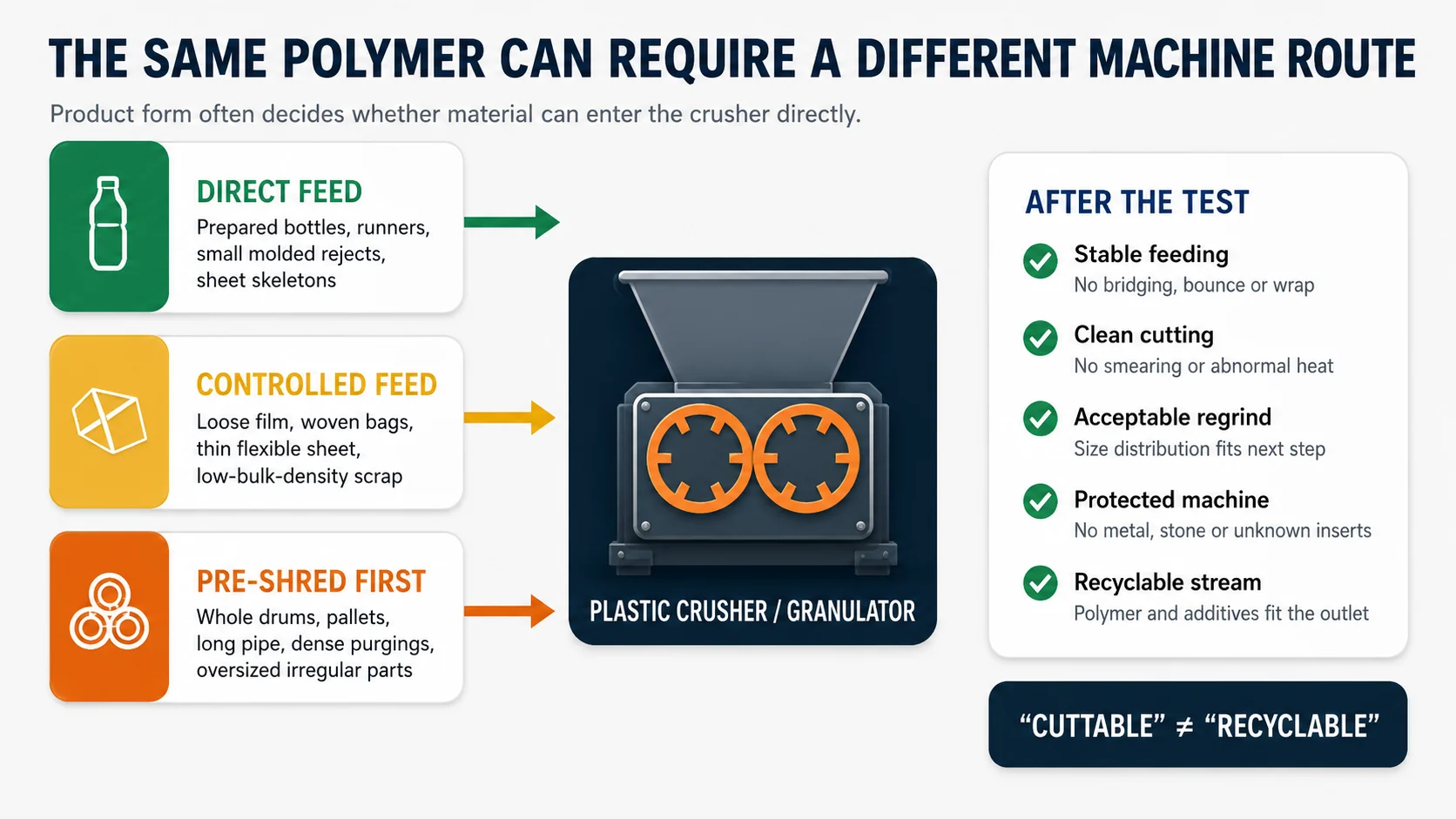
Buyers naturally compare polymers because polymers are easy to name. Machines, however, experience geometry. The rotor sees length, thickness, elasticity, bulk density and the way one piece interacts with the next.
| Feed form | Likely route | What we would watch first |
|---|---|---|
| Sprues, runners and small molded rejects | Often direct to crusher | Stable dimensions, clean post-industrial condition and whether the regrind returns to production. |
| Bottles, caps and small containers | Usually direct after inspection | Hopper fit, residual contents, labels, metal and the required flake size. |
| Sheet skeletons and edge trim | Direct or controlled feed | Flat pieces can bridge; long trim may need a roll feeder or pre-cutting. |
| Loose film and woven bags | Controlled feed or pre-shred | Low density, wrapping, moisture and discharge usually control real output. |
| Whole drums, pallets and large crates | Often pre-shred first | Part dimensions and geometry may prevent safe, repeatable entry into a high-speed chamber. |
| Long pipe and profile bundles | Pre-cut, dedicated feed or shred first | Length, wall thickness, handling and safe presentation to the rotor. |
| Dense purgings and thick blocks | Test; often pre-break | Instantaneous cutting load, current peaks and slow screen release. |
| Mixed post-consumer plastic | Sort and inspect before size reduction | Unknown resin combinations, metal, glass, stones, batteries and residual chemicals. |
Sometimes a two-stage line looks expensive in the quotation and inexpensive six months later. A low-speed first stage accepts bulky, irregular material. The crusher then receives a smaller and more predictable fraction, allowing it to do what it does best: screen-controlled granulation.
The opposite route—forcing everything through one high-speed chamber—may save one line item. It can also add manual cutting, repeated overload trips, knife damage and inconsistent production. We normally recommend comparing the complete operating method, not only the number of machines.
What We Stop Before It Reaches the Hopper
The worst crusher damage often comes from a small object. A steel bolt, a shaft inside a molded roller, a stone hidden in agricultural film or a piece of glass can do more harm than a large clean plastic part. We therefore treat receiving and sorting as part of machine protection, not as someone else’s problem.
Hard contamination comes first. Ferrous and non-ferrous metal, stones, glass, sand and construction debris should be removed before granulation. A magnet is useful, but it does not remove stainless steel, aluminum, stones or glass. It is a control layer, not permission to feed unknown assemblies.
Stored energy and unknown contents require a stop. Batteries, electronic assemblies, pressurized containers and packages holding fuel, solvent or unidentified liquid do not belong in an ordinary plastic crusher process. They need identification and an approved handling route before size reduction.
Contamination can change the legal and safety route. Medical or bio-contaminated plastics are not made acceptable by cutting them smaller. Unknown flame-retarded parts, chemically treated material and hot purgings also need material-specific procedures. In practice, these questions should be settled at receiving, not after the hopper is full.
Where the YUXI YX-G Series Makes Sense
The exact YUXI plastic size-reduction product page lists film, bottles, HDPE pipe, PP woven bags, drums, pallets, lumps and injection-molding waste among common materials. The list is broad. The published machine details help to place the equipment more accurately.
The YX-G range uses a 560 rpm rotor with rotating and fixed knives and 10–12 mm screens. In our experience, those are the characteristics of a relatively high-speed plastic crusher or granulator stage, rather than the slow, high-torque behavior normally associated with a conventional single- or double-shaft shredder.
That distinction matters. A screen-controlled granulator help make a defined regrind size, but it works best when the material can enter and circulate in a controlled way. Large drums, pallets, long pipe, dense blocks or loose bales may need another feed arrangement or a first-stage machine before the YX-G unit.
| Model | Power | Rotor speed | Screen | Cutting chamber | Published output |
|---|---|---|---|---|---|
| YX-2640G | 7.5 kW | 560 rpm | 10 mm | 270 × 400 mm | 300–550 kg/h |
| YX-2650G | 11 kW | 560 rpm | 10 mm | 270 × 500 mm | 400–650 kg/h |
| YX-3660G | 15 kW | 560 rpm | 12 mm | 370 × 600 mm | 400–700 kg/h |
| YX-3680G | 22 kW | 560 rpm | 12 mm | 370 × 800 mm | 600–900 kg/h |
| YX-4680G | 30 kW | 560 rpm | 12 mm | 480 × 800 mm | 700–1,200 kg/h |
| YX-46100G | 37 kW | 560 rpm | 12 mm | 480 × 1,000 mm | 800–1,600 kg/h |
The published output ranges should not be read as one universal capacity for every material shown on the page. Film, PET bottles, PP crates and dense purgings can produce very different kilograms per hour on the same model. Bulk density alone can change the picture. So can wall thickness, moisture, contamination, knife condition, screen opening, feed method and discharge design.
One customer-type mistake is to compare models only by motor power. A larger motor may tolerate a heavier cut, but it does not automatically solve a narrow inlet, unstable feeding or slow material evacuation. We have found that chamber dimensions and feed behavior often decide the model before motor power does.
A Material Test That Tells You Something Useful
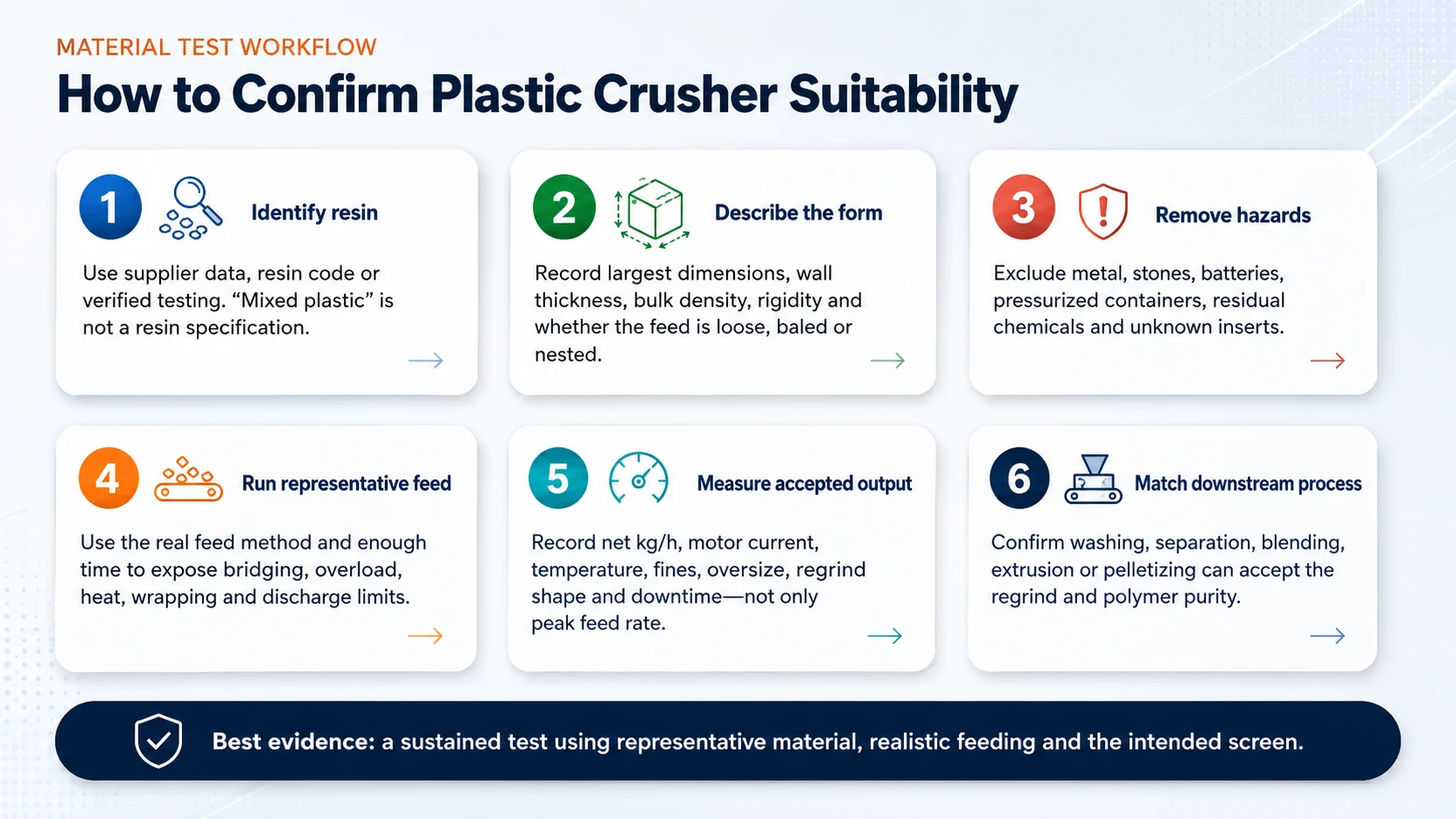
A short video can confirm that the rotor turns and the sample breaks. It cannot prove sustained capacity. We normally want enough representative material to expose the complete cycle: loading, steady feeding, cutting, screen release, discharge, collection, bin changes and any clearing that the operator has to perform.
The sample should include the worst normal pieces. Not deliberately abnormal contamination, but the largest, thickest and most awkward material that appears in routine production. Sending only the cleanest and smallest parts creates an attractive test and a weak selection.
| Test area | What to record | What the result tells us |
|---|---|---|
| Material identity | Resin, grade, blend, filler and known additives | Whether different materials are being treated as one compatible stream. |
| Feed dimensions | Largest length, width, wall section, thickness and bulk density | Whether the material fits, bites and fills the chamber as expected. |
| Contamination | Metal, stone, glass, sand, labels, moisture and residual contents | Likely wear, safety risk and downstream purity. |
| Feeding behavior | Bridging, bouncing, nesting, wrapping and operator intervention | Whether production can be continuous rather than staged for a demonstration. |
| Electrical and thermal behavior | Running current, current peaks, overloads and chamber or bearing temperature | Whether the cut, recirculation and discharge are stable. |
| Accepted output | Net kilograms per hour after normal stoppages | The difference between a peak hand-fed rate and useful production. |
| Regrind quality | Particle distribution, fines, oversize, long slivers and smearing | Whether the screen and knife setup suit washing, extrusion or resale. |
| Wear and maintenance | Knife edge, screen condition, cleaning time and access | What the operating cost may look like beyond the first test. |
What we listen for during an RFQ
A strong RFQ discussion is not a sequence of commands—“Confirm this, state that, provide everything.” It is a technical conversation. We would want to know what material produced the quoted capacity, whether it was pre-cut before the demonstration, which screen was installed, how long the stable run lasted, and whether output was measured at the chamber or after the normal discharge system.
Three questions usually reveal more than a long checklist:
- What was the worst normal piece in the test batch?
- How much operator intervention was needed during the measured run?
- Would the same setup still be recommended after accounting for contamination, knife wear and the downstream quality target?
A quotation that takes longer because the supplier asks detailed questions is not necessarily inefficient. Often, it is the first sign that the selection is being treated as an engineering job rather than a catalogue match.
Representative acceptance-test lesson
A test may reach the requested peak rate for several minutes, then slow when the hopper bridges or the collection bin fills. That does not mean the crusher “failed.” It means the line acceptance method needs to measure the complete operating cycle. Net accepted output is the number that belongs in the business case.
The Safety Checks Capacity Tables Leave Out
Plastic size reduction involves rotating machinery, stored energy, noise, manual handling and material-specific dust or chemical risks. OSHA notes that plastics operations remain subject to general machine-guarding and workplace-safety requirements even though there is no single plastics-industry standard.[3]
Bridging is particularly dangerous because it tempts operators to “help” the feed. A hand, bar or hook should never enter the hopper or cutting chamber while hazardous energy is present. Clearing requires shutdown, isolation, verification of zero energy and the manufacturer’s lockout procedure. The rotor can continue moving after power is removed, and trapped plastic can release suddenly.
Fine plastic dust may also be combustible. OSHA’s combustible-dust overview lists plastics among materials that can become explosible in finely divided form and includes recycling among affected operations.[4] Dust collection, housekeeping, ignition control, electrical classification and explosion protection therefore need to match the actual material and local requirements. A conveying blower is not automatically a compliant dust-control system.
Sometimes the safest equipment decision is made before model selection: reject unknown containers, remove batteries, separate metal-insert parts, cool hot purgings and identify treated or flame-retarded plastics. These steps do not appear in a crusher capacity table. They still determine whether the line is workable.
Questions Buyers Usually Ask After Seeing a Test Video
Can a plastic crusher process PET bottles?
Yes, prepared PET bottles and many PET production scraps are common crusher or granulator feeds. The practical checks are bottle size, labels, caps, residual liquid, hard contamination and the flake size required downstream. The crusher reduces size; it does not replace sorting, washing or polymer separation.
Can the same crusher process HDPE and PP?
Mechanically, many knife-type crushers can process prepared HDPE and PP parts. That does not mean the polymers should be mixed. Keep the streams separate when the downstream user controls polymer type, color, melt behavior or recycled-content quality.
Can a crusher handle film and woven bags?
Sometimes. Film is often a feeding and discharge problem before it becomes a cutting problem. Loose material may bridge, flutter or wrap, so controlled feeding, suitable rotor geometry, effective evacuation or pre-shredding may be required. A representative trial is more useful than a general yes.
Is PVC suitable for a plastic crusher?
Rigid PVC pipe and profile scrap can be size-reduced in a suitable configuration, but the stream should be identified and handled separately. Dust, temperature, contamination, knife condition and the outlet for the regrind should be agreed before production.
Can a crusher process ABS, PC, PA or PMMA?
Cleaning engineering-plastic production waste can usually be granulated, but the grade, toughness, brittleness, filler, flame retardant and thermal behavior vary. We usually recommend testing the actual parts instead of treating all resin-code 7 material as equivalent.
What about thermosets or fiberglass-reinforced plastic?
The machine may physically damage some thermosetting and composite materials,but ordinary thermoplastic granulation is usually the wrong process. Thermosets do not simply remelt, and glass or mineral reinforcement can increase wear and fine dust. Specialized equipment and a defined outlet are normally needed.
When should a pre-shredder be installed?
A pre-shredder becomes useful when feed is too large, long, dense, low-density or irregular for safe, consistent entry into the crusher. Whole drums, pallets, long pipe, dense purgings and baled film are common examples. The first stage stabilizes the feed; the crusher then produces finer, screen-controlled regrind.
What information is most useful for a machine recommendation?
The most useful package includes the polymer and grade if known, clear photos, largest dimensions, wall thickness or bulk density, contamination, moisture, target output size, required net capacity, daily hours and the downstream process. For unusual feeds, representative samples are worth more than a polished description.
The Buying Decision in One Sentence
A plastic crusher can process many thermoplastics. The useful answer, however, is always conditional. Prepared PET bottles, HDPE containers, PP molding scrap, rigid PS and clean ABS are common feeds. Film, woven sacks, PVC, long pipe, drums, pallets, purgings, filled engineering plastics and composites need more project-specific judgment.
In our experience, the quickest way to expose a weak selection is to send the supplier the worst representative piece instead of the best one. Include the largest normal dimensions, the real contamination, the true bulk density and the required downstream result. Then ask for a test using the intended feed method and screen.
The final question is not, “Can the knives cut it?” It is this: Can the complete system accept the real feed safely, produce usable regrind at a sustained net rate, protect the equipment and preserve the value of the material stream?
Need a Material-Based Plastic Crusher Recommendation?
Share the plastic type, actual product photos, largest dimensions, contamination, target output size, required net capacity and downstream process with YUXI. Representative samples are especially useful for film, dense purgings, filled plastics, mixed constructions and any feed that has already caused bridging, wrapping or overloads.
Discuss the Actual Feed
References and Source Notes
- U.S. Department of Energy — Consumer Guide to Recycling Codes. Used for the seven plastic resin-code categories and the general recycling-code context.
- U.S. Environmental Protection Agency — About Plastic Products and Plastic Pollution. Used for mono-material, multi-material and polymer-type context.
- Occupational Safety and Health Administration — Plastics Industry Overview. Used for the general machinery and workplace-safety boundary.