





Most buyers ask the same question at the beginning: “Which model should I choose?” But in real projects, a supplier should not answer that question too quickly. The first thing to confirm is what the shredder will process every day, not just the general machine name. A double shaft shredder should not be selected only by machine name. A unit used for plastic drums will not be designed the same way as one used for waste tires, light metal scrap, e-waste, wood pallets, or mixed municipal waste. These materials may all be processed by a “double shaft shredder,” but the real configuration can be very different. Look, the cutter thickness, tooth shape, and shaft diameter all have to be sized for the actual working conditions—you can’t just guess. Then you’ve got to check if the gearbox has enough torque, whether the feeding is manual or automatic, and don’t forget the hopper opening and the frame rigidity. Every single one of these needs to match what you’re dealing with on site; if even one is off, you’ll be asking for trouble down the road.
Quick Answer: Start with the material, not the machine model. Before choosing the machine, first make the material situation clear. What will be fed into the shredder every day? What is the largest feeding size? What discharge size is acceptable? How many tons per hour are required? Now, what about the machine downstream? In real-world projects, you always want to size the shredder based on the toughest, nastiest material in your feed stream. Because that one material is what ends up driving everything—the cutter geometry, shaft sizing, gearbox load, hopper design, and even how robust your PLC protection needs to be. Everything else just follows from that.In most projects, it should work together with a crusher, granulator, screen, or another secondary size-reduction machine.
Summary
A double shaft shredder machine is usually selected for rough pre-shredding of bulky, mixed or difficult waste. The best selection starts from the waste material and process goal, not from motor power alone. Buyers should provide material photos, feeding size, output requirement, capacity and line layout before asking for a final quotation.
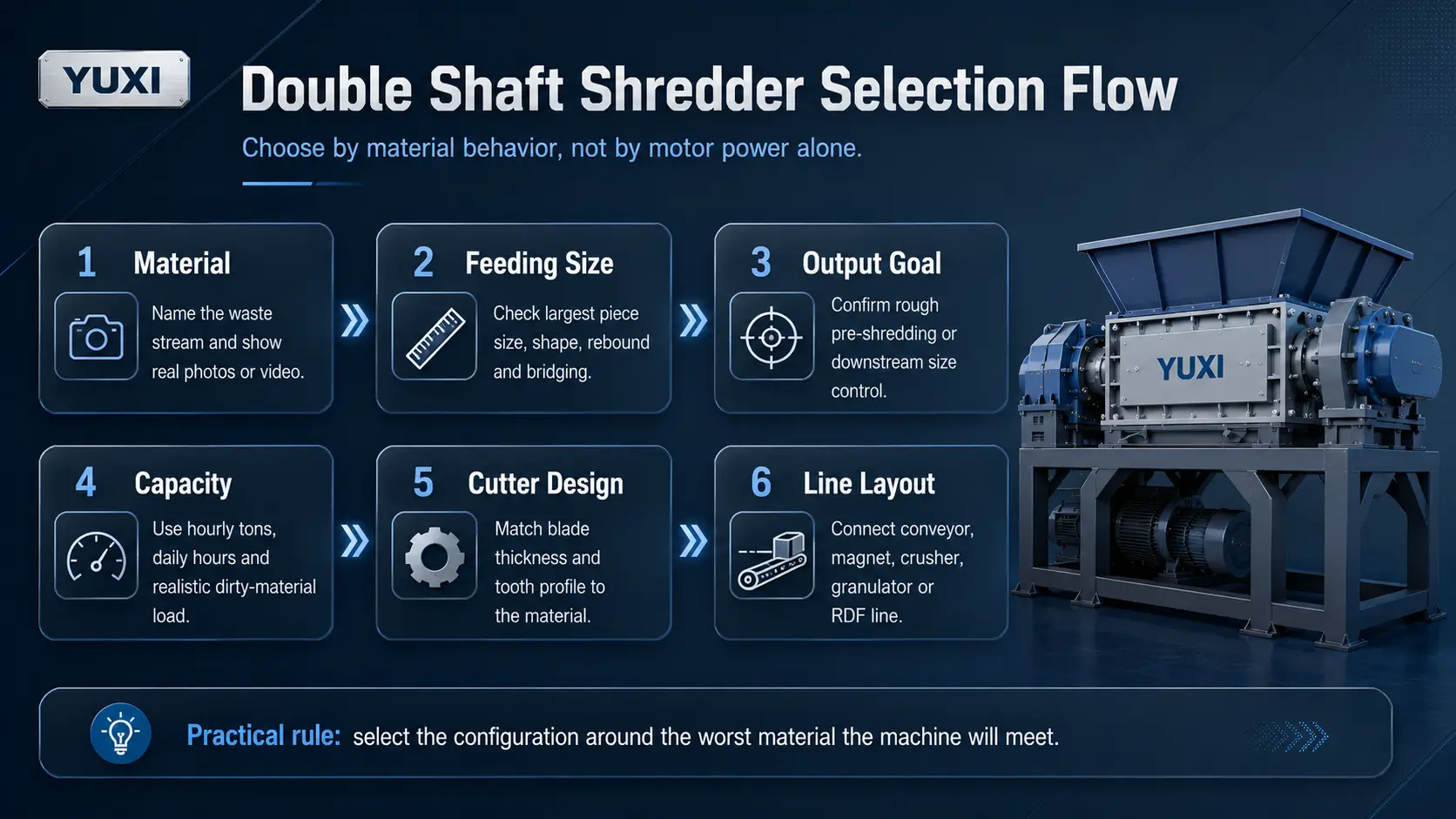
Why Motor Power Alone Is a Bad Starting Point
Motor power is easy to compare on a quotation sheet. That is why many buyers ask, “Is 45×2 kW enough?” or “Can I use 75×2 kW?” The problem is that two machines with similar power can behave very differently in a recycling plant. One may be built for hollow plastic drums. Another may be designed for tires with steel wire. A third may be configured for light metal scrap with shock load. The number on the motor plate does not explain the cutter geometry, shaft size, reducer quality or overload protection.
A double shaft shredder works by slow-speed, high-torque tearing and shearing. Its job is usually to open material, reduce volume and prepare waste for conveying, sorting, crushing, granulating, baling or RDF preparation. It is not normally the final fine-size machine. This is why the question should not be “How much power does it have?” but “Can this configuration pull in my material, survive the difficult pieces and discharge a size that my next machine can accept?”
Field note: when two quotations look close, ask for the cutter thickness, blade material, shaft material, gearbox type, chamber size, hopper size and control logic. A cheaper machine may only be cheaper because it was designed for easier waste.
Step 1: Start from the Real Material, Not the Industry Name
“Plastic recycling” is not enough information. Plastic bottles, HDPE drums, crates, film rolls, pipes and plastic lumps behave differently in the cutting chamber. “Metal recycling” is also too broad. Thin paint buckets and light aluminum profiles are not the same as thick steel parts. A useful selection starts with the real waste stream.
For plastic drums and crates, the issue is often low bulk density and bouncing. The shredder needs enough hook bite and a hopper that helps the material enter the cutter area instead of floating above it. For tires, the issue is rubber rebound, steel wire and blade wear. The machine needs torque reserve, wear-resistant cutters and controlled feeding. For light metal scrap, the concern is shock load. The shaft, blade thickness and reducer must not be selected like a light plastic machine.
For MSW or bulky waste, the difficulty is unpredictability. One batch may contain plastic, textiles, cardboard and wood. The next batch may contain cans, wire, wet waste or hard objects. For this type of material, automatic reverse, easy chamber access and maintenance space are not small details. They are part of daily production.
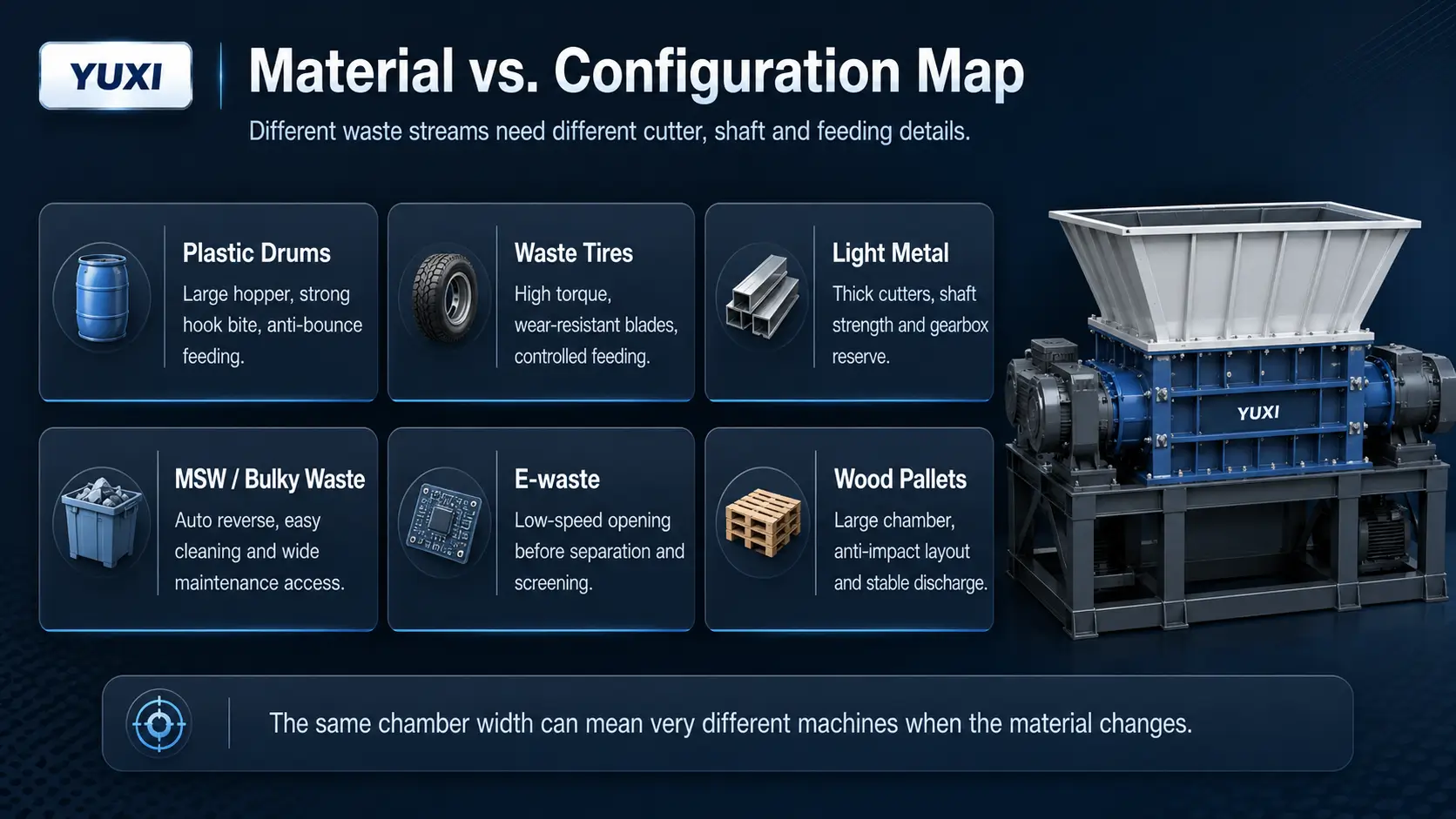
Step 2: Check Feeding Size, Shape and Feeding Method
The largest piece size should be measured, not guessed. A 200-liter plastic drum, a full tire, a long aluminum profile, a wood pallet and a sofa frame create different feeding problems. A chamber may look large enough on paper, but if the material bridges at the hopper, rebounds away from the shafts or enters in a long tangled shape, the machine will not reach the expected capacity.
Feeding method also changes selection. Manual feeding is suitable only for smaller and safer materials. Conveyor feeding gives better control and is common in plastic, paper, packaging and light industrial waste. Loader or grab feeding can be useful for bulky waste, but it requires a stronger hopper, a safer platform layout and enough opening size. Heavy or irregular feeding should never be treated as an afterthought.
Buyer mistake: choosing a chamber by width alone. Width matters, but the useful question is whether the material can be gripped and pulled down continuously. Some light bulky materials need a better hopper and cutter bite more than a bigger motor.
Step 3: Decide Whether Rough Output Is Enough
A double shaft shredder normally produces rough, irregular output. The final piece size is not decided by cutter thickness alone. It also depends on the tooth shape, shaft speed, material flexibility, and the way the waste is pulled apart inside the cutting chamber. Also, do not expect a double shaft shredder to produce small and uniform particles by itself. In many recycling lines, rough and uneven output is completely normal. The machine is mainly used for volume reduction, pre-shredding, bag opening, loosening bulky waste before sorting, or preparing material for the next machine.It is not the best answer when the buyer needs a very uniform small particle in one step.
For example, tire recycling may use a double shaft shredder as the first stage to make rough tire chips, followed by a rasper, steel wire separator and rubber granulation system.ake plastic recycling, for example. You’ll usually see a double-shaft shredder sitting right before a crusher, a washing line, or a granulator—mainly just to smooth out the feed and keep things stable. With metals, it’s a different story. After the rough shred, you might still need magnetic separation, eddy current, or even a hammer mill, depending on what kind of metal you’re processing and what your final recovery goal is. The double shaft machine prepares the material. It does not replace every downstream process.
Selection note: if a supplier promises a precise final size from a standard double shaft shredder without explaining cutter pitch, screen control or secondary crushing, check carefully. Rough output is normal. Uniform output usually needs another sizing stage.
Step 4: Match Capacity to Real Working Hours
Capacity is not only tons per hour in a brochure. Real capacity depends on material density, feeding stability, moisture, impurities, cutter condition and working rhythm. Five tons per hour of plastic drums is not the same operating load as five tons per hour of tires or mixed MSW. A light material may fill the hopper quickly but weigh little. A dense or tough material may feed slowly but load the drive system heavily.
Ask yourself how the plant will actually run. Will the shredder work two hours per day, eight hours per day or two shifts? Will feeding be steady by conveyor, or will a loader drop irregular batches? Is the material clean, or does it include sand, metal impurities, wires, moisture or textiles? A machine selected for ideal sample material may disappoint when real mixed waste arrives.
A good way to go about it is to start with three key numbers: your normal hourly throughput, your peak hourly rate, and your total daily tonnage. Once you’ve got those, take them to the supplier and ask them point‑blank—can this machine run at normal load continuously without issues, and can it handle those peak surges without jamming up every other minute? For a new plant, it is usually safer to leave some torque and capacity reserve instead of buying a machine that must run at its limit every day.
Step 5: Choose Blade Thickness and Tooth Design Around Material Behavior
Cutter blades are the heart of a double shaft shredder machine. The cutter design affects everything—feed, tear‑action, torque demand, and blade maintenance frequency. Thin cutters make smaller strips, but they struggle with hard or heavy materials. Thicker ones are more durable and last longer, but the product comes out coarser and less uniform. You pick your poison based on what you’re shredding. The right choice is a balance between bite, strength, output and wear life.
For plastic drums, buckets and hollow products, tooth shape matters because the material tends to bounce. A strong hook angle helps pull the waste into the cutter chamber. For tires, blade wear and torque load are more important. For light metal scrap, impact strength and shaft support become critical. For textiles, film or fiber-like materials, anti-winding design may decide whether the machine runs smoothly or needs frequent cleaning.
Buyer mistake: asking for the smallest output size without explaining the downstream process. Smaller cutter pitch may look attractive, but it can reduce capacity, increase torque demand and raise wear cost. If the next machine is a crusher or granulator, rough pre-shredding may be enough and more economical.
Step 6: Look at Torque, Gearbox and Shaft Strength
Double shaft shredding is torque work. The cutter shafts rotate slowly and pull difficult waste between intermeshing blades. This is why gearbox quality, shaft material, reducer type and transmission design deserve serious attention. A machine may run well during a short video test with clean material, but daily industrial waste will show whether the drive system has enough reserve.
For tires, light metal scrap, wood pallets and bulky waste, the machine often meets sudden load changes. The cutter may grip a dense section, a wire bundle, a metal edge or a wet mixed piece. If the gearbox and shaft design are too light, the operator will see repeated jamming, abnormal noise, high current, broken cutters or reducer problems. Strong torque is useful only when the mechanical structure can carry it.
When checking a quotation, do not look only at the motor power and price. When you’re going over the machine spec, make sure you ask the supplier about the shaft material, shaft diameter, heat treatment, gearbox type, bearing protection, and coupling design. These are the kinds of things that often get buried in the fine print of a quote, but they’re exactly what determine whether your shredder can take the daily beating. Brochures love to show off fancy features, but they rarely highlight these guts—and those are the parts that actually keep you running shift after shift.
Step 7: Confirm PLC Auto Reverse and Overload Protection
Overload protection is not just a convenience feature. It protects the motor, gearbox, shafts and cutters when the machine meets difficult or unexpected material. A useful control system should monitor current, stop when overload happens, reverse the shafts to release the jam and restart according to a safe logic. For mixed waste, this can reduce manual cleaning and make production more stable.
Auto reverse is a useful protection function, especially when the machine meets temporary overload or material jamming. That said, even the best PLC can’t fix a mismatch. If the material is outside the machine’s design envelope, if the operator dumps too much in at once, or if a big chunk of hard metal finds its way into the chamber, no amount of automation will turn a light‑duty machine into a heavy‑duty one. Reliable performance still comes down to the right cutter geometry, sensible feed control, and a bit of basic operator know-how.
Safety note: shredders are powerful machines. Maintenance, unjamming and blade replacement should follow proper lockout/tagout and site safety procedures. For general machine servicing guidance, buyers can refer to OSHA’s hazardous energy control information at OSHA.
Step 8: Match the Shredder with the Downstream Equipment
In many recycling lines, the double shaft shredder is only the first machine. It prepares the material for the next process. If you choose the shredder without thinking about what comes after it, the whole line can become unstable. The shredder may discharge material too large, too uneven, or too difficult for the next machine to handle.
In a metal recycling line, rough shredded paint buckets, thin sheet scrap or aluminum profiles may go to magnetic separation, eddy current separation, hammer crushing or baling. For more details on line matching, see the waste metal shredding and recycling system. In a tire project, the first shredding stage should be planned with the rasper, steel wire separator and rubber granule system; see the waste tire shredding and recycling system.
For plastic recycling, the double shaft shredder may feed a crusher, washing line, drying system and granulator. For RDF or bulky waste, it may connect with conveyors, screening, sorting, baling and fuel preparation. The purpose is different in each line. That purpose should guide the shredder selection.
Selection Table: Which Configuration Fits Your Material?
| Material | Main Problem | Configuration Focus | Typical Next Equipment |
|---|---|---|---|
| Plastic drums, buckets, crates | Low density, bouncing, hollow shape | Hook blade, large hopper, stable feeding, anti-bounce design | Crusher, washing line, granulator |
| Waste tires | Rubber rebound, steel wire, blade wear | High torque, wear-resistant cutters, controlled feeding | Rasper, steel wire separator, rubber granule line |
| Light metal scrap | Impact load, sharp edges, variable density | Thick cutters, strong shaft, gearbox reserve, overload protection | Magnetic separator, eddy current separator, crusher, baler |
| MSW and bulky waste | Mixed impurities, wet waste, unstable feeding | Large hopper, auto reverse, easy cleaning, maintenance access | Sorting, screening, RDF line, baler |
| E-waste and small appliances | Mixed components, metal/plastic combination | Low-speed opening, controlled discharge, separation planning | Screening, air separation, electrostatic separation |
| Wood pallets and furniture boards | Large feeding size, nails, impact load | Large chamber, strong bite force, anti-impact cutter layout | Magnet, secondary crusher, biomass or RDF preparation |
Buyer Mistakes When Choosing a Double Shaft Shredder Machine
1. Comparing Only the Machine Price
A bare shredder body and a complete working system are different scopes. One quotation may include conveyors, magnetic separation, spare blades and control cabinet details. Another may include only the machine body. Before comparing price, compare what is included.
2. Treating All Materials as the Same Waste
One buyer may say “plastic,” another may say “metal,” and a third may say “industrial waste.” These names are too broad for correct selection. Real photos and videos are much more useful than a general waste category.
3. Expecting Fine, Uniform Output from One Double Shaft Machine
A double shaft shredder is very suitable for rough pre-shredding, volume reduction, and preparing bulky waste for the next stage. But it is usually not the machine used for precise final sizing. If the project requires small, clean, and more uniform particles, the system may need a screen-controlled shredder, crusher, granulator, or other secondary equipment after the first shredding stage.
4. Ignoring Blade Wear and Spare Parts
Blades are wear parts. Tough waste, sand, metal impurities and long working hours increase wear. Ask about spare blade cost, replacement method, delivery time and whether the cutter layout is easy to maintain.
5. Forgetting the Downstream Process
The right output from the shredder is the output that the next machine can handle. A shredder selected without downstream planning can create a bottleneck even if the shredder itself works.
6. Overfeeding the Machine During Daily Operation
Even a heavy-duty shredder needs controlled feeding. Dropping oversized, dense or tangled batches into the hopper too quickly can reduce capacity and increase jamming. The feeding system should match the selected machine.
Field Notes: What We Usually Ask Before Quoting
A good quotation starts with good project information. If you send only “I need a double shaft shredder machine, please give price,” the supplier can only give a rough answer. If you send real material and process details, the recommendation becomes much more accurate.
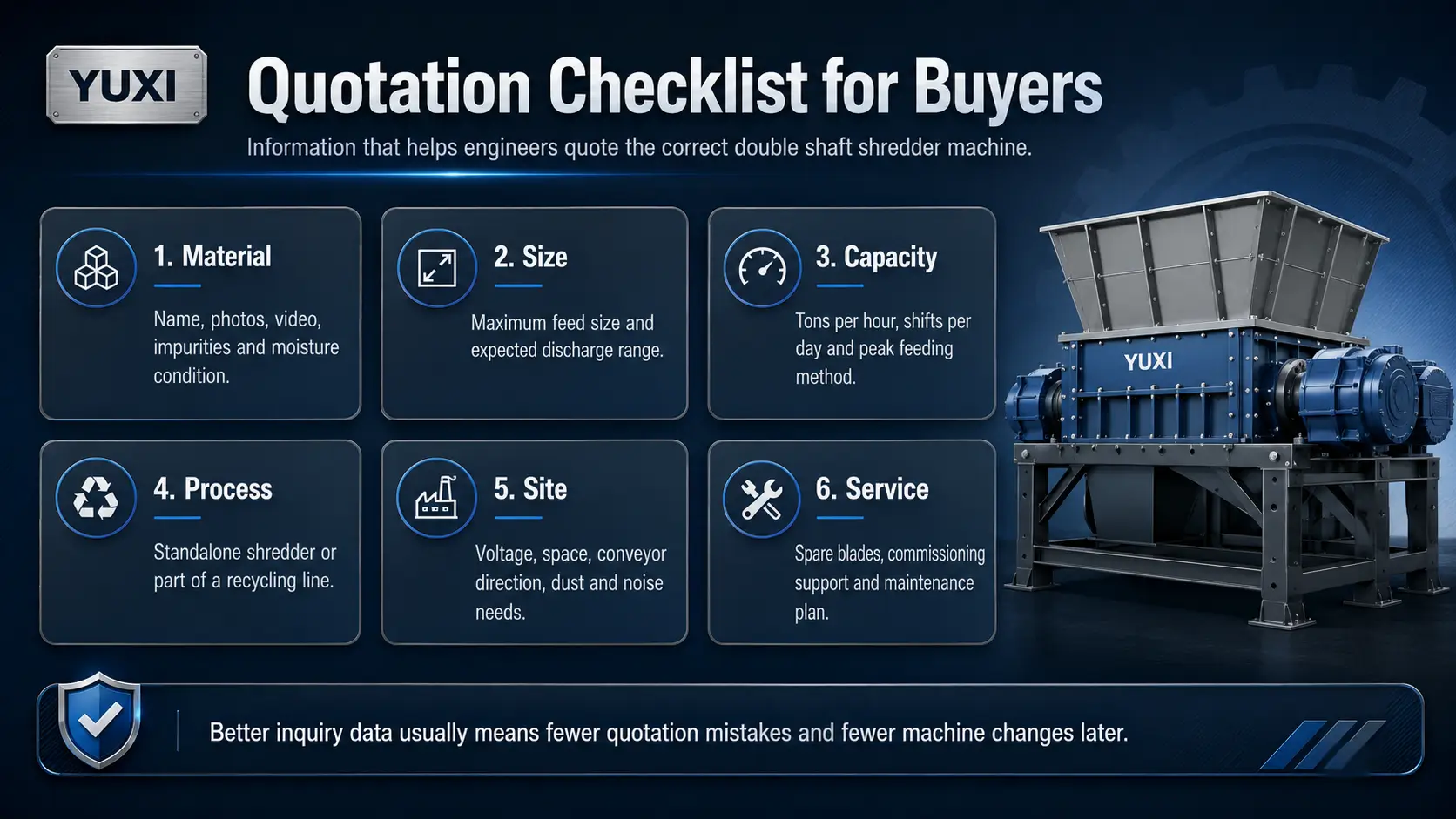
- What material will be shredded? Please send photos or a short video.
- What is the largest feeding size and approximate material weight?
- What output size range is acceptable after the first shredding stage?
- How many tons per hour and how many hours per day will the line run?
- Will the machine work alone or before a crusher, separator, baler, granulator or RDF system?
- How will the material be fed: manually, by conveyor, loader or grab?
- What is the local voltage, frequency and available installation space?
- Are there dust, noise, safety guarding or maintenance access requirements?
This information may look basic, but it often decides the model, cutter design, hopper, conveyor direction and quotation scope. In industrial shredding, unclear inquiry data is one of the most common causes of wrong machine selection.
When Not to Choose a Double Shaft Shredder
A double shaft shredder is versatile, but it is not the right answer for every job. If the project requires very small and uniform flakes, a single shaft shredder with screen control or a granulator may be more suitable after pre-shredding. If the material is extremely heavy steel scrap, a dedicated heavy metal shredder or hammer mill system may be required. If the project needs better internal sizing than a two-shaft machine can provide, compare it with a four shaft design; this comparison is explained in Four Shaft Shredder vs Double Shaft Shredder.
It is also not wise to use a standard double shaft shredder for hazardous or explosive materials without special engineering review. Recycling equipment should be selected according to material risk, site rules and local safety requirements. For general recycling strategy, the U.S. EPA’s material management hierarchy explains how recycling and recovery fit into broader waste handling decisions; see the EPA waste management hierarchy.
How This Guide Fits with Other Double Shaft Shredder Resources
If you are still learning the machine structure, read How Does a Double Shaft Shredder Work? first. If your main concern is investment, compare the cost factors in the Double Shaft Shredder Price Guide. If you are deciding between single and double shaft machines, see Single Shaft vs Double Shaft Shredder.
FAQ: Choosing a Double Shaft Shredder Machine
What is the best double shaft shredder machine for recycling?
The best machine is the one matched to your waste material, feeding size, output target, capacity and downstream process. There is no single best model for all materials.
How do I choose blade thickness?
Choose blade thickness according to material strength, output requirement and wear risk. Light plastics and paper can use thinner cutters, while tires, bulky waste and light metal scrap usually need thicker, stronger cutters.
Can a double shaft shredder shred tires?
Yes, a heavy-duty double shaft shredder can pre-shred tires. Tire projects usually need strong torque, wear-resistant blades and downstream equipment for steel wire separation and rubber granulation.
Can it shred metal scrap?
It can shred light metal scrap such as paint buckets, cans, thin sheets and aluminum profiles. Heavy steel scrap should be reviewed carefully before model selection.
What output size can a double shaft shredder produce?
Output is usually rough and irregular. It depends on blade thickness, tooth design and material behavior. If a small, uniform size is required, add a crusher, granulator or screen-controlled machine.
Is a double shaft shredder better than a single shaft shredder?
It is better for bulky, mixed and difficult waste that needs rough pre-shredding. A single shaft shredder is often better when the project needs more uniform output controlled by a screen.
What information is needed for quotation?
Send material name, photos or video, maximum feeding size, expected output size, capacity, daily working hours, feeding method, voltage and whether the shredder is part of a complete line.
Can YUXI supply conveyors and downstream equipment?
Yes. The double shaft shredder can be matched with feeding conveyor, discharge conveyor, magnetic separator, eddy current separator, crusher, granulator, baler, dust removal and other line equipment.
Get a Double Shaft Shredder Selection Recommendation
Send your material photos, largest feeding size, expected output size, capacity target and working hours. YUXI can recommend a standard model or design a custom double shaft shredder machine layout for your recycling project.