





Industrial Shredder Selection Guide
Most buyers do not lose money because they choose a weak shredder. They lose money because the machine gives the wrong output for the next process. This guide compares four shaft and double shaft shredders from a real recycling-line point of view: feed behavior, output size, downstream stability, maintenance and project cost.
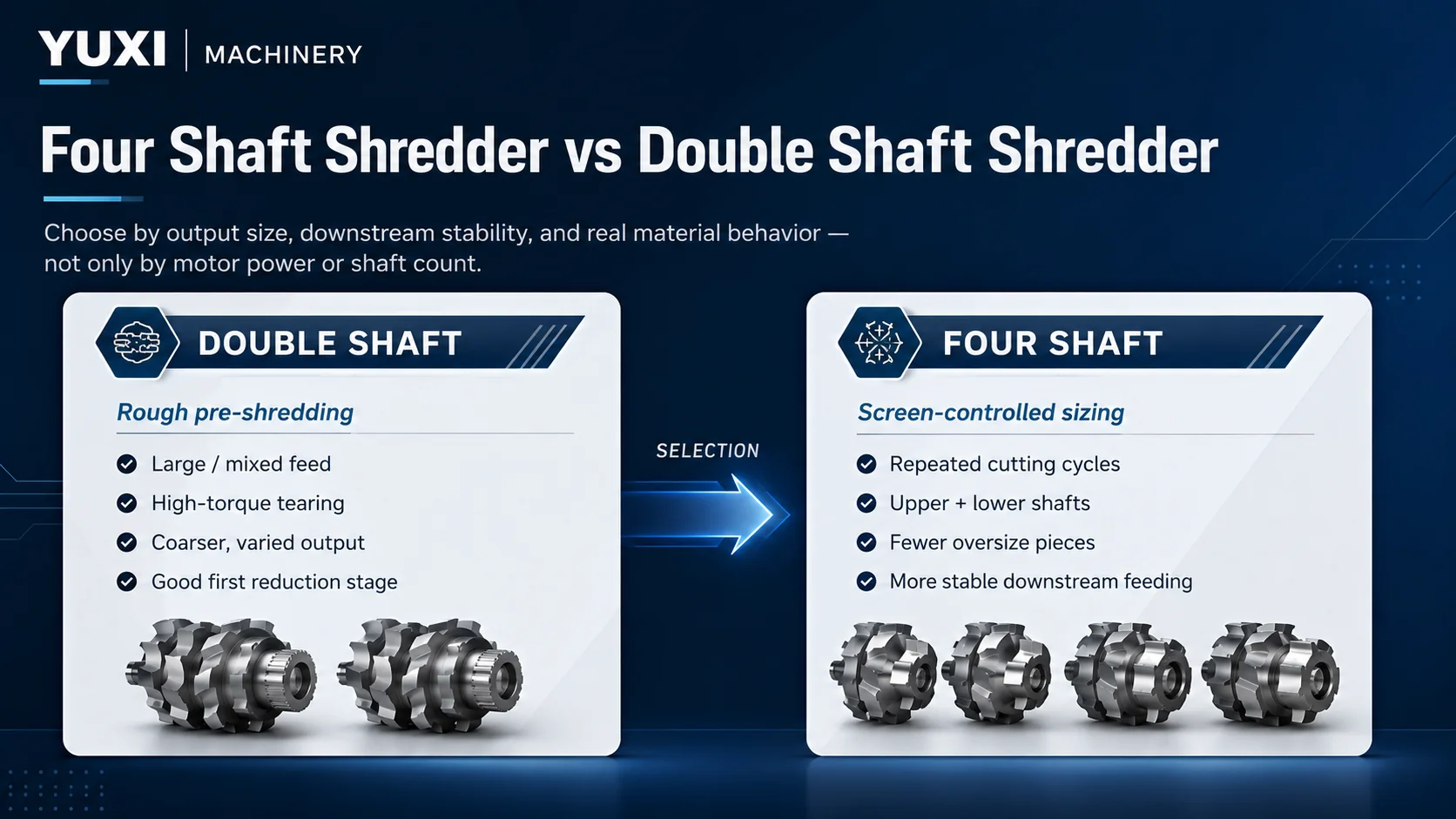
When a customer sends us an inquiry for a waste shredder, the first question is often simple: “How much is the machine?” The useful question is different: “What should the shredded material look like after the machine?” That one detail can change the whole selection.
A double shaft shredder is often the practical choice for high-torque rough shredding. It grabs bulky material, tears it open and reduces volume before sorting, conveying or secondary processing. A four shaft shredder is different. It is normally chosen when the plant needs more repeated cutting and more control over the discharge size, especially when a screen is used to keep oversize pieces inside the cutting chamber.
This article is written for buyers comparing both machines for e-waste, RDF/SRF, plastic drums, industrial packaging waste, bulky waste, light metal scrap and mixed recycling lines. It does not claim that four shafts are always better. In many plants, a double shaft machine is exactly the right first machine. In other plants, using only a double shaft machine creates long strips, oversize pieces and unstable feeding into the next stage.
Quick Answer for Buyers
Choose a double shaft shredder when the main job is rough volume reduction, opening bulky waste, or preparing material for a later sorting or crushing stage. Choose a four shaft shredder when the plant needs controlled output size, fewer oversize pieces and steadier feeding into downstream separation, granulation, washing, baling or RDF/SRF preparation.
In simple terms: double shaft shredders solve the first breaking problem. Four shaft shredders solve the output-control problem.
The Main Difference Is Not Just the Number of Shafts
A common mistake is to read the names literally: two shafts versus four shafts. That sounds like the four shaft shredder must be twice as powerful. In real projects, the difference is more about cutting logic than shaft count.
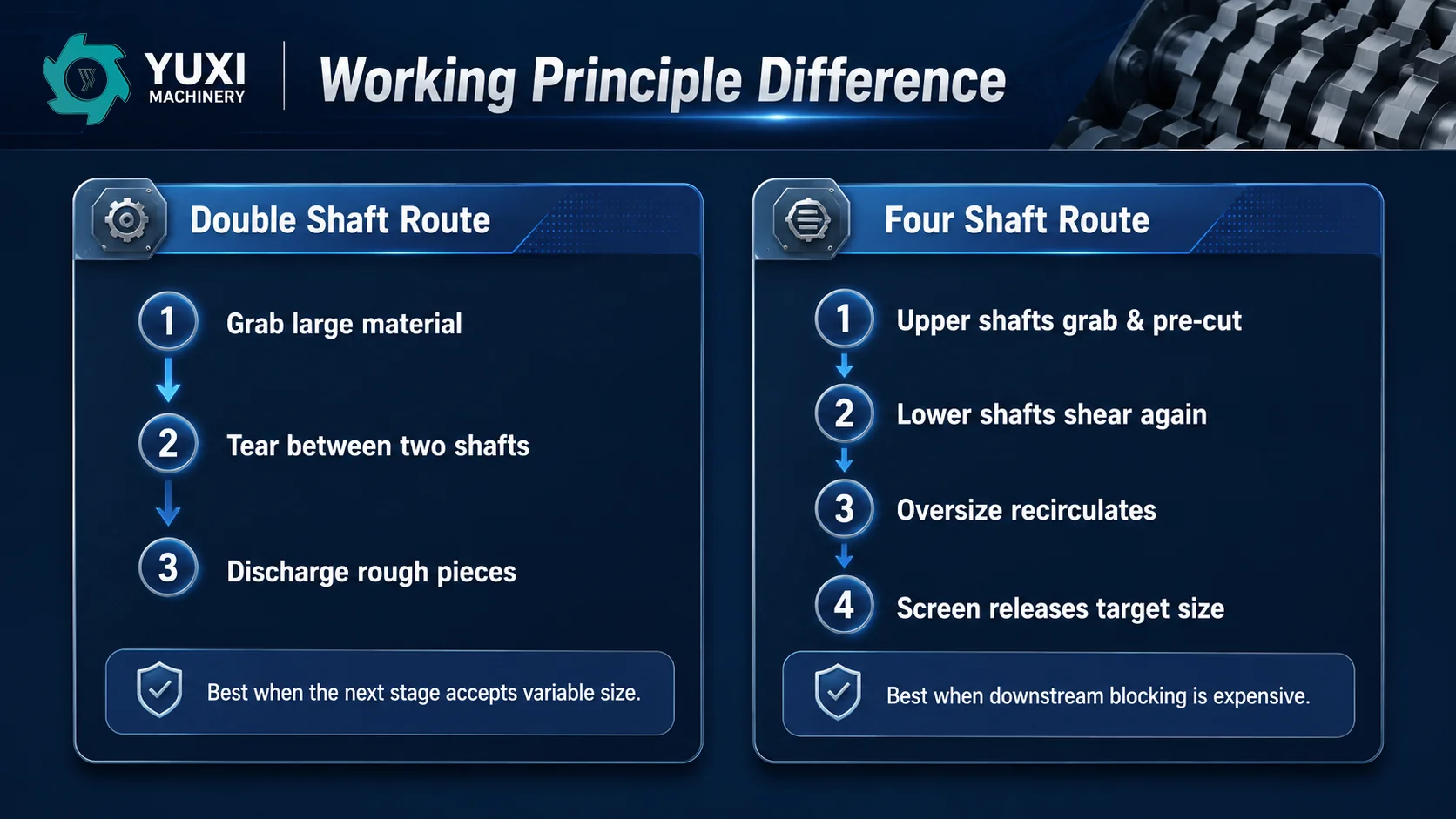
A double shaft shredder uses two counter-rotating cutter shafts. The machine pulls material inward and tears it by shear force and torque. The discharge size is affected by cutter thickness, hook design, blade spacing, material shape and how the material breaks. It is usually not the best machine when the buyer wants a narrow, screen-defined output size.
A four shaft shredder normally uses two upper shafts and two lower shafts. The upper shafts help grab and pre-cut bulky material. The lower shafts continue the secondary cutting. Material that is still too large is held in the chamber and cut again until it can pass through the screen. YUXI’s four shaft shredder product page uses the same engineering logic: upper shafts for initial grabbing, lower shafts for further cutting and screen-controlled discharge for more predictable particle size.
External manufacturers describe the same principle in different words. Franklin Miller notes that quad-shaft shredders use four rotating shafts and a sizing screen for more uniform output. Shred-Tech also describes quad shaft shredders as slow-speed machines that can produce small, consistent shreds sized by the screen. AMOS explains that quad shaft shredders keep material circulating until it reaches the desired particle size, and WEIMA describes four-shaft shredders as suitable for uniform particle sizes with adaptable screen inserts.
That is why the best selection question is not “Which one has more shafts?” It is “Can the next machine accept rough pieces, or does it need a controlled feed size?”
How a Double Shaft Shredder Works
A double shaft shredder is a low-speed, high-torque machine. Material enters the hopper, the two shafts rotate toward each other, and the cutter hooks pull the material down. The material is torn, squeezed and sheared between the two rotating shafts. Pieces drop out after they are small enough to pass through the cutter gap and discharge opening.
This design is valuable when the feed is large, awkward or mixed. Tires, plastic drums, pallets, thin metal containers, municipal solid waste and industrial packaging often need aggressive grabbing before anything else can happen. For these projects, a double shaft shredder can be a strong and economical first reduction machine.
But the output is normally rougher. Long strips may appear when the material is flexible. Hollow containers may flatten before they break. Mixed waste may leave the chamber in different shapes. This is not always a problem. If the next step is manual sorting, magnetic separation with wide tolerance, baling, or another crusher, rough output may be acceptable.
Field note: when a buyer says, “I only need to reduce the volume before transport,” we usually look at the double shaft machine first. When the buyer says, “My conveyor or separator gets blocked by large pieces,” the discussion changes immediately.
How a Four Shaft Shredder Works
A four shaft shredder adds more cutting interaction inside the chamber. The upper shafts grab, open and pre-cut the material. The lower shafts cut again and guide the material across the screen area. Pieces that are smaller than the screen opening discharge. Pieces that are still too large stay inside the chamber and enter another cutting cycle.
This repeated cutting is useful when the customer wants fewer oversize pieces. It also helps when the material has mixed shapes: plastic drums, e-waste casings, small appliances, packaging waste, RDF material, textiles mixed with plastics, or light metal containers. Instead of discharging large fragments too early, the machine keeps them in the cutting zone longer.
The screen is important, but it is not magic. A smaller screen opening can improve size control, but it also increases residence time, motor load, cutter wear and the chance of screen blockage. A buyer who asks for very small output from difficult mixed waste should expect lower capacity or a heavier machine configuration.
For this reason, four shaft shredder selection should start with the downstream process. If the next stage is a granulator, eddy current separator, magnetic separator, air separator, washing line, baler or RDF fuel preparation system, output consistency has real value. If there is no sensitive downstream stage, the extra cost and maintenance of a four shaft machine may not be necessary.
Comparison Table: Four Shaft Shredder vs Double Shaft Shredder
| Selection Point | Double Shaft Shredder | Four Shaft Shredder |
|---|---|---|
| Main role | Rough pre-shredding, opening, volume reduction | Controlled size reduction with repeated cutting |
| Output character | Coarser, less uniform, may include long strips | More uniform when screen size is properly selected |
| Screen control | Usually not the main design feature | Commonly used to control discharge size |
| Best materials | Tires, drums, pallets, bulky waste, light metal, MSW, rough industrial waste | E-waste, RDF/SRF, plastic drums, packaging waste, mixed industrial waste, light metal containers |
| Downstream fit | Good when the next stage accepts rough pieces | Good when separators, granulators, conveyors or balers need steadier feeding |
| Initial cost | Usually lower for the same basic duty | Usually higher because of more shafts, cutters, screen system and drive requirements |
| Maintenance | Simpler structure and fewer cutting parts | More wear points; screen, cutter access and bearing protection must be checked |
| Best buyer profile | Needs strong primary reduction and lower entry cost | Needs controlled output and fewer downstream stoppages |
When a Double Shaft Shredder Is the Better Choice
A double shaft shredder is often the better machine when the project is still at the rough reduction stage. The buyer has large material, needs to reduce volume, and does not require a tight final particle size. This is common in tire pre-shredding, bulky waste reduction, light scrap opening, wood pallet processing and mixed industrial waste preparation.
It is also a practical choice when the downstream process is tolerant. For example, if the shredded material will go to a manual sorting belt, a hammer mill, a secondary granulator, a baler or a transport container, the first shredder does not always need to produce a controlled size. Paying for a four shaft machine may not create enough extra value in that case.
A double shaft machine also has a maintenance advantage. Fewer shafts and fewer cutters normally mean easier service, lower spare parts demand and simpler operator training. For smaller recycling yards, this matters. A machine that local mechanics can maintain properly is often better than a more complicated machine that sits idle after the first serious jam.
Choose double shaft first when:
- The main goal is volume reduction rather than final sizing.
- The material is large, dirty, mixed or irregular.
- Downstream machines can accept rough output.
- The project budget needs a strong but simpler first-stage shredder.
- The line already includes a second size-reduction stage.
For complete scrap projects, a double shaft shredder can be part of a wider waste metal shredding and recycling system. For tire-heavy projects, a dedicated waste tire shredding and recycling system should be evaluated instead of choosing only by shaft count.
When a Four Shaft Shredder Is the Better Choice
A four shaft shredder becomes more attractive when oversize pieces cause real cost. That cost may show up as conveyor blockage, separator overload, uneven RDF fuel feeding, granulator jams, slow manual sorting, or extra labor around the discharge area.
If the buyer needs a controlled fraction before downstream processing, the four shaft machine has a clear reason to exist. It is not just a more expensive shredder. It is a size-control stage. The value is often measured by smoother line operation, fewer shutdowns and a more predictable material stream.
Four shaft machines are especially useful in mixed industrial waste and e-waste projects where different materials break differently. A plastic shell, a wire bundle, a small appliance body and a thin metal container do not behave the same inside a cutting chamber. The repeated cutting zone helps reduce the chance that one type of material leaves the machine much larger than the rest.
Choose four shaft when:
- The required output size must be controlled by a screen.
- Oversize discharge causes downstream blockage.
- The plant handles e-waste, RDF/SRF, packaging waste or mixed industrial waste.
- The buyer wants one machine to do rough reduction and more controlled sizing.
- The downstream line includes separators, washing, granulation, baling or fuel preparation.
For buyers studying four shaft equipment, start with YUXI’s four shaft shredder machine page and prepare material photos, videos and target output size before requesting a configuration.
Which Machine Is Better for E-Waste?
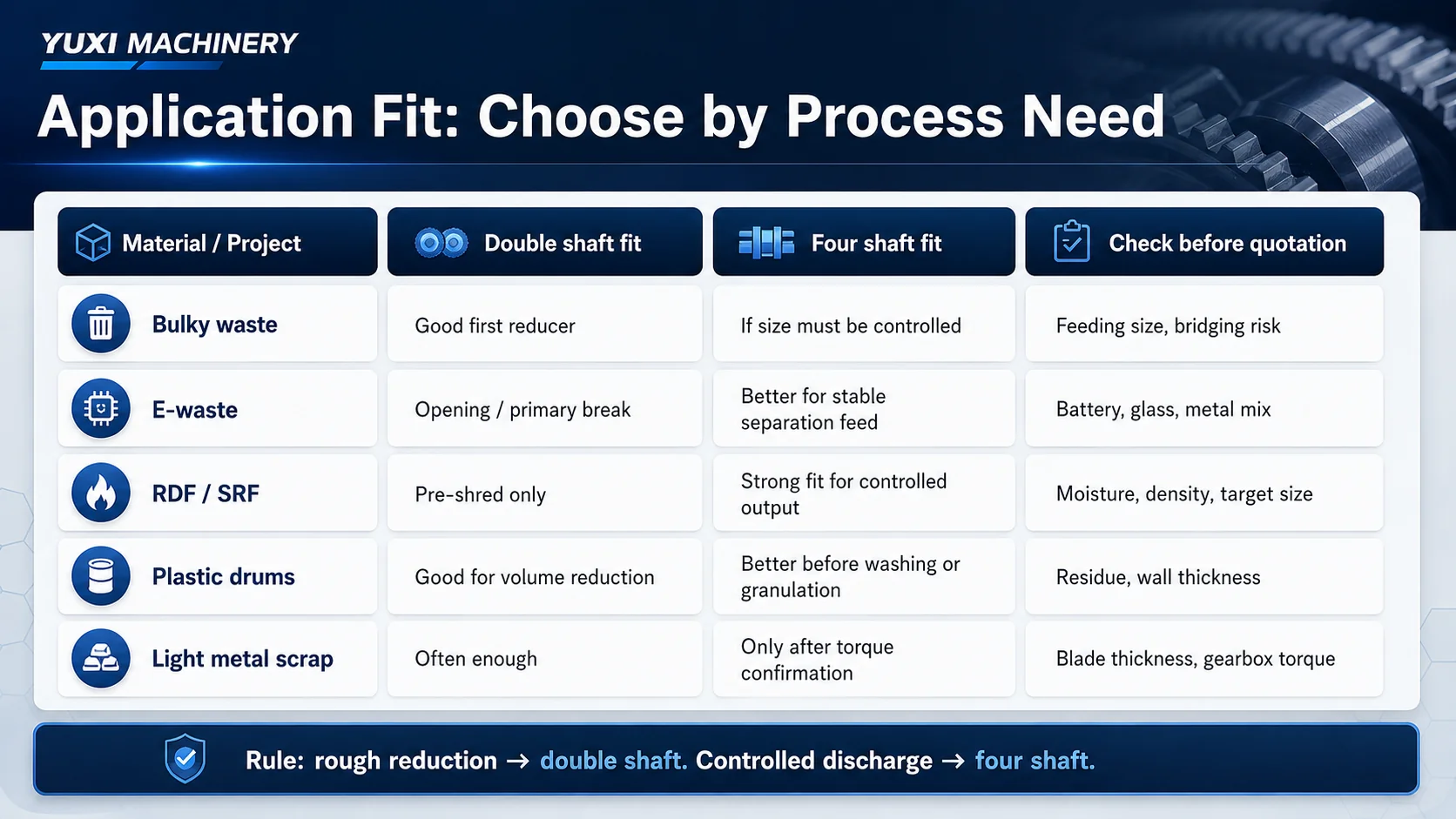
For e-waste, the answer depends on what “e-waste” means in the project. Used computers, printer shells, small appliances, mixed consumer electronics and loose circuit-board related waste all feed differently. Some projects only need to open the material before manual sorting. Other projects need a more stable size before magnetic separation, eddy current separation, air separation or further crushing.
If the e-waste line only needs rough opening, a double shaft shredder may be enough. It can break housings and reduce volume before workers or separators remove metals and plastics. If the line needs more controlled discharge before a separator, a four shaft shredder is usually stronger because it reduces oversize fragments and keeps the feed more consistent.
Selection note: do not ignore batteries, glass, capacitors, dust and unknown contaminants in e-waste. The shredder model is only one part of the project. Fire risk, dust collection, manual pre-sorting and downstream separation all need to be reviewed before the machine is confirmed.
Which Machine Is Better for RDF/SRF?
RDF and SRF preparation usually has stricter feeding requirements than simple waste volume reduction. Long strips, bulky pieces and uneven fractions can cause trouble in conveyors, screens, dryers and fuel-feeding systems. That is why four shaft shredders are often considered for RDF/SRF lines where controlled discharge matters.
A double shaft shredder can still work as a pre-shredder in a fuel preparation line. It may open bags, reduce bulky material and prepare waste for sorting. But if the project needs a more stable output fraction from one shredding stage, the four shaft machine should be evaluated. The screen opening, cutter layout and motor-reducer configuration must be matched to the target size and capacity.
Field note: many RDF inquiries fail because the material description is too vague. “Municipal waste” can mean dry plastics and paper in one plant, but wet textiles, organics, sand and metal pieces in another. The same shredder model will not perform the same way in both cases.
Which Machine Is Better for Plastic Drums and Packaging Waste?
Plastic drums, IBC parts, woven bags, film, packaging residue and hollow containers are common materials in industrial waste projects. A double shaft shredder can reduce volume well, especially when the buyer only needs to break containers before washing, compaction or transport.
A four shaft shredder is better when the output size must be more controlled. For example, if the shredded plastic will feed a granulator or washing line, very large pieces can slow production and increase wear. A screen-controlled four shaft machine can reduce the number of oversized pieces before the next stage.
If the project is focused on plastic recycling, also compare the application with a dedicated plastic shredder machine. Some clean plastic streams may be better handled by a single shaft or plastic-specific configuration. Four shaft equipment is more attractive when the stream is bulky, mixed or less predictable.
Which Machine Is Better for Metal Scrap?
Metal scrap needs a careful answer. Light metal containers, thin drums, aluminum profiles, bicycles and mixed light scrap may be suitable for either double shaft or four shaft shredding depending on the project. Heavy steel scrap, thick structural pieces or very hard metal should not be selected by shaft count alone.
For rough opening and volume reduction, a double shaft shredder is often the first machine to compare. For light metal mixed with plastics, packaging or e-waste, a four shaft shredder may help control the discharge before separation. But the final recommendation must be checked by shaft diameter, cutter thickness, blade material, gearbox torque, chamber size and overload protection.
Buyer warning: do not send only the words “metal scrap” and ask for a price. Send photos, maximum size, thickness, material composition and what should happen after shredding. A machine that handles aluminum cans is not automatically suitable for heavy steel scrap.
Cost and Maintenance: Where the Real Difference Appears
The four shaft shredder usually costs more. That is not only because it has more shafts. It also needs more cutters, more bearings, a more complex cutting chamber, screen components and a stronger design if the material is difficult. The drive system and frame must handle repeated cutting instead of simple rough discharge.
Maintenance also changes. More cutting parts mean more inspection points. The screen must be accessible for cleaning or replacement. Bearing protection, reducer load, cutter wear and chamber access become important. If the plant runs mixed waste with sand, metal contamination or sticky residue, maintenance planning is not optional.
That said, lower purchase price does not always mean lower project cost. If a double shaft shredder creates too many oversize pieces and the line stops several times per shift, the cheaper first machine may become expensive. If a four shaft shredder removes the need for another size-control step, the higher initial cost may be justified.
The right way to compare cost is to ask: what happens after the shredder? A shredder that protects the next three machines may be worth more than a cheaper machine that only looks good on the quotation sheet.
Buyer Mistakes When Comparing Four Shaft and Double Shaft Shredders
1. Choosing only by motor power
Motor power matters, but it does not decide the full result. Torque, reducer configuration, cutter diameter, blade thickness, hook design, shaft strength and screen opening may matter more than the nameplate power.
2. Treating four shaft as always better
A four shaft shredder is better for controlled output. It is not automatically better for every material or budget. If the job is only rough pre-shredding, a double shaft machine may be the smarter purchase.
3. Ignoring output size
Many quotations fail here. The buyer asks for tons per hour but does not define the output size. Capacity without output size is incomplete, because smaller output usually means lower throughput and higher cutting load.
4. Forgetting the screen’s effect on capacity
A screen improves size control, but it also keeps material inside longer. Wet, flexible or sticky material can reduce capacity or block the screen. Screen size must be selected with the real material, not copied from another project.
5. Not checking downstream inlet size
The shredder should be selected around the machines after it. Conveyor width, separator opening, granulator inlet, baler chamber and storage method all affect the best discharge size.
6. Sending no photos or videos
A material name is not enough. “Plastic waste,” “e-waste” or “metal scrap” can describe many different streams. Good suppliers will ask for photos, videos, sizes, contamination and target output before giving a serious recommendation.
Selection Rule from an Engineering View
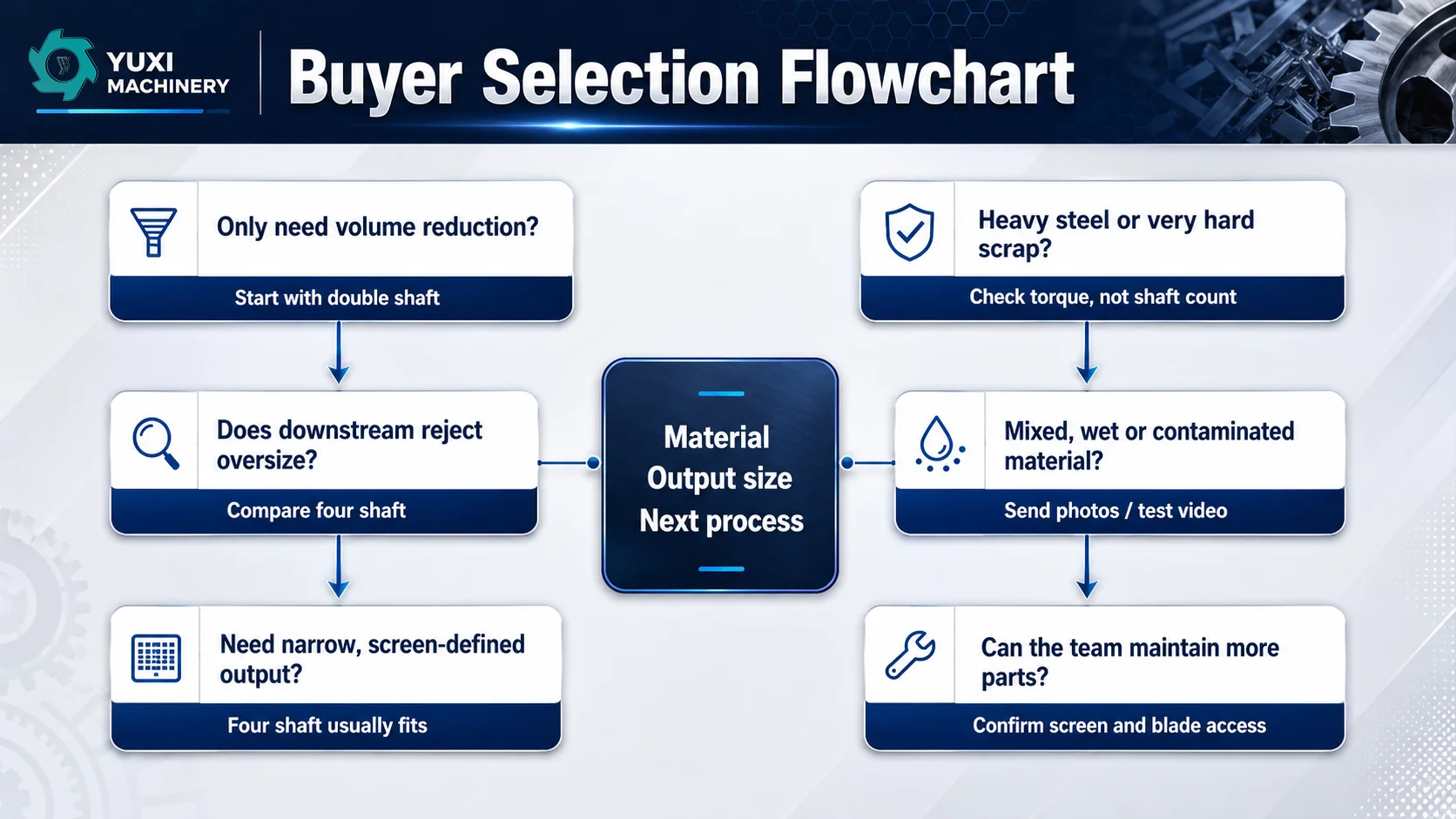
Here is the practical rule we use when reviewing a new project:
- If the first problem is bulky material that must be opened or reduced, start with a double shaft shredder.
- If the problem is oversize material entering the next process, compare a four shaft shredder.
- If the buyer needs a screen-defined output size, four shaft or other screen-controlled equipment should be evaluated.
- If the material is heavy metal scrap, do not choose only by shaft number. Confirm torque, blade thickness and shaft strength.
- If the plant already has a secondary crusher or granulator, the first shredder may not need to do final sizing.
- If the plant wants one machine to reduce and control size before separation, four shaft can be the better investment.
What Information Should You Send Before Quotation?
A reliable quotation needs more than a material name. Before asking whether a four shaft or double shaft shredder is better, prepare the following details:
- Material type and composition
- Maximum feeding size and typical size range
- Photos or short videos of the real material
- Bulk density, moisture and contamination
- Target output size or screen size requirement
- Required capacity per hour or per shift
- Feeding method: conveyor, loader, grab crane or manual feeding
- Downstream process: sorting, magnetic separation, eddy current separation, granulation, washing, baling, fuel preparation or transport
- Working hours, voltage, installation space and maintenance conditions
With these details, YUXI engineers can compare the four shaft shredder and double shaft shredder more accurately and recommend the chamber size, cutter layout, screen opening, motor-reducer configuration and conveyor arrangement.
Final Recommendation
Choose a double shaft shredder when your project mainly needs rough volume reduction, high-torque tearing and a simpler first-stage machine. This is often the right direction for bulky material, tires, pallets, drums, MSW, light scrap and many pre-shredding jobs where the downstream process can accept rough pieces.
Choose a four shaft shredder when output size control, repeated cutting and downstream stability are more important than the lowest initial machine cost. This is often the better direction for e-waste, RDF/SRF, packaging waste, plastic drums, mixed industrial waste and projects where oversize material causes blockage or unstable separation.
The safest decision is not made from a brochure table. It is made from real material, target output size and the machines after the shredder. Send your material photos, videos, required capacity and downstream process to YUXI, and the engineering team can help decide whether a four shaft or double shaft configuration is the better fit.
Need Help Choosing the Right Shredder?
Send material photos, feeding size, desired output size and capacity target. YUXI can help compare double shaft and four shaft configurations for your recycling line.
Get Machine PriceFAQ: Four Shaft Shredder vs Double Shaft Shredder
Is a four shaft shredder better than a double shaft shredder?
Not always. A four shaft shredder is better when controlled output size and fewer oversize pieces matter. A double shaft shredder is often the better value when the job is rough volume reduction or primary pre-shredding.
What is the biggest difference between a four shaft and double shaft shredder?
The biggest difference is discharge control. A double shaft shredder usually tears material and releases a rougher output. A four shaft shredder uses repeated cutting and a screen so material remains in the chamber until it reaches the required size.
Does a double shaft shredder have a screen?
Most double shaft shredders are not selected for screen-controlled sizing. Some designs may use special discharge options, but the common industrial double shaft machine produces a rougher output based mainly on cutter thickness, tooth design and material behavior.
Why does a four shaft shredder produce more uniform output?
The upper and lower shafts cut material more than once, and the screen prevents large pieces from leaving too early. Oversize material circulates inside the chamber until it can pass through the screen.
Which shredder is better for e-waste recycling?
For mixed e-waste feeding into magnetic separation, eddy current separation or manual sorting, a four shaft shredder often provides steadier output. For simple opening or coarse pre-breaking, a double shaft shredder may still be enough.
Which shredder is better for RDF or SRF production?
A four shaft shredder is often stronger for RDF and SRF preparation because fuel lines usually need controlled discharge and fewer long strips. Final selection still depends on moisture, contamination, target size and capacity.
Is a four shaft shredder more expensive to maintain?
Usually yes. It has more shafts, cutters, bearings and screen-related parts. The higher maintenance effort can be justified when stable output reduces downstream blockage or removes the need for another size-reduction step.
Can a double shaft shredder replace a four shaft shredder?
It can replace a four shaft shredder only when the line accepts rougher, less uniform discharge. If downstream conveyors, separators, granulators or balers are sensitive to oversize material, replacement is risky.
What information is needed before choosing the machine?
Send material photos or videos, feeding size, target output size, hourly capacity, contamination level, moisture, downstream equipment and site conditions. A quotation based only on material name is usually not reliable.