Industrial Shredder & Recycling Systems Manufacturer - YUXI

 English

 English
 Fast Delivery
 Reliable
 Certified
 ExperiencedEnglishEnglishFast DeliveryReliableCertifiedExperienced
How to choose the right machine based on material, capacity, screen size, rotor design, and recycling line layout.
Buying a single shaft shredder is not just an affair that can choose a motor power or ask for the lowest price. For recycling plants, the right machine starts with material behavior, output size, feeding stability and the downstream process.
An industrial single shaft shredder should be selected by material type, input size, target output size, hourly capacity, feeding behavior, contamination level, screen size, rotor design, blade material, power supply and downstream process. In real projects, the biggest buying mistake is comparing only motor power or price while ignoring material behavior and screen size. A responsible supplier should ask for photos, videos, capacity targets and final material requirements before recommending a model.
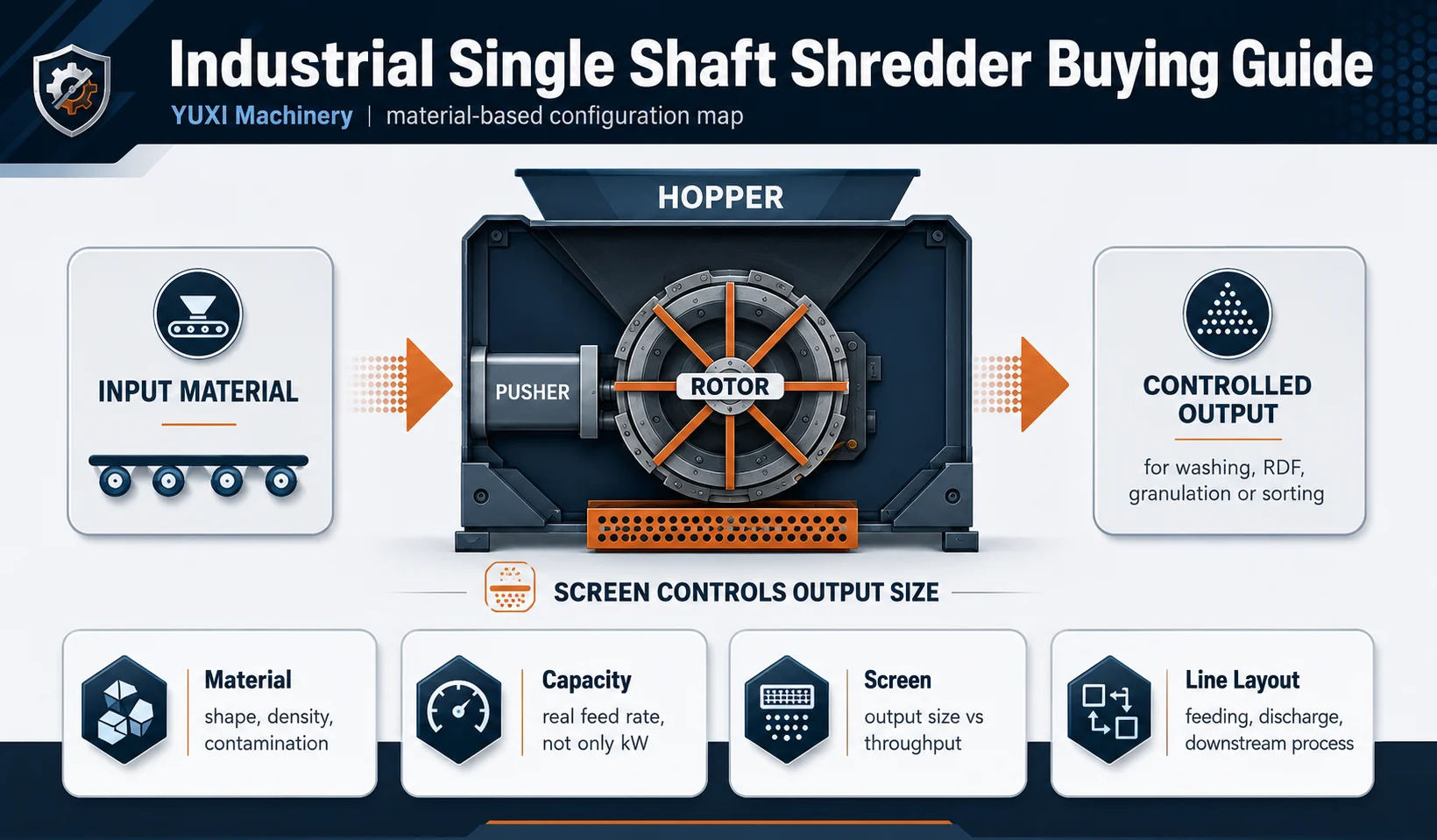
Many first-time buyers begin with two questions: “How many kilowatts is this machine?” and “What is the price per set?” Those questions are so easy to understand, but they are not enough for a serious project to recycle. Double shaft shredders with similar motor power can do very differently if one is processing plastic purgings and the other is handling loose woven bags, paper mill waste or wood pallets with nails.
Motor power is only one part of the configuration.Performing actually also can depend on the cutting chamber size, rotor diameter, rotor width, blade geometry, hydraulic pusher design, screen opening, material density and how the material enters the machine. The same shredder can appear strong on paper and still struggle if the feed material bridges inside the hopper, wraps around the rotor or cannot pass through an over-small screen.
This is why an industrial single shaft shredder buying guide should begin with the working condition, not the model name. The machine is a tool inside a larger process. It must fit the material, the site, the downstream equipment and the operator’s daily routine.
Industry references also describe shredder capacity as being affected by physical size, weight, bulk density and feed volume rather than nameplate power alone.
An industrial single shaft shredder is a type of industrial shredder used as a size reduction machine. It uses one rotor fitted with cutting knives, fixed counter knives, a hydraulic pusher and a bottom screen. The hydraulic pusher presses material toward the rotating rotor. The knives cut the material against the fixed knives. Material that is still too large remains in the cutting chamber until it becomes small enough to pass through the screen.
This structure is the main reason single shaft shredders are used when the buyer wants a more controlled output size than a rough pre-shredder can usually provide. A single shaft shredder is common in plastic recycling, wood waste recycling, RDF/SRF preparation, paper mill waste treatment, textile waste processing and some light industrial waste projects.
WEIMA’s single shaft shredder overview describes the same working sequence: material is pressed by a hydraulic pusher against a rotor with cutting blades, and the grain size is defined by the screen below the rotor. That basic principle is widely used across many industrial shredder manufacturers.
A single shaft shredder is usually a good choice when the project needs repeatable size reduction before the material goes into another process. This could be a plastic washing line, granulator, pelletizing line, RDF preparation line, sorting system, baler, magnetic separation stage or storage system.
For example, plastic lumps and purgings often need to be reduced before they can feed a crusher or granulator smoothly. Woven bags, film and textile scrap may need controlled shredding before further cleaning or densifying. Wood pallets and packaging waste may need size reduction before magnetic separation or fuel preparation. Paper rolls and paper-plastic composites may require a machine that can hold the material in the chamber long enough to cut it down to a practical discharge size.
Selection note: Choose a single shaft shredder when controlled discharge size matters more than simply tearing big material open. If the goal is only rough volume reduction, another shredder type may be more economical.
The YUXI single shaft shredder machine page lists typical applications such as plastic drums, pipes, profiles, fishing nets, wood waste, thin metal drums, electronic waste, paper mill waste, paper-plastic composites and textile bags. The final configuration still depends on material hardness, input size, target output and working hours.
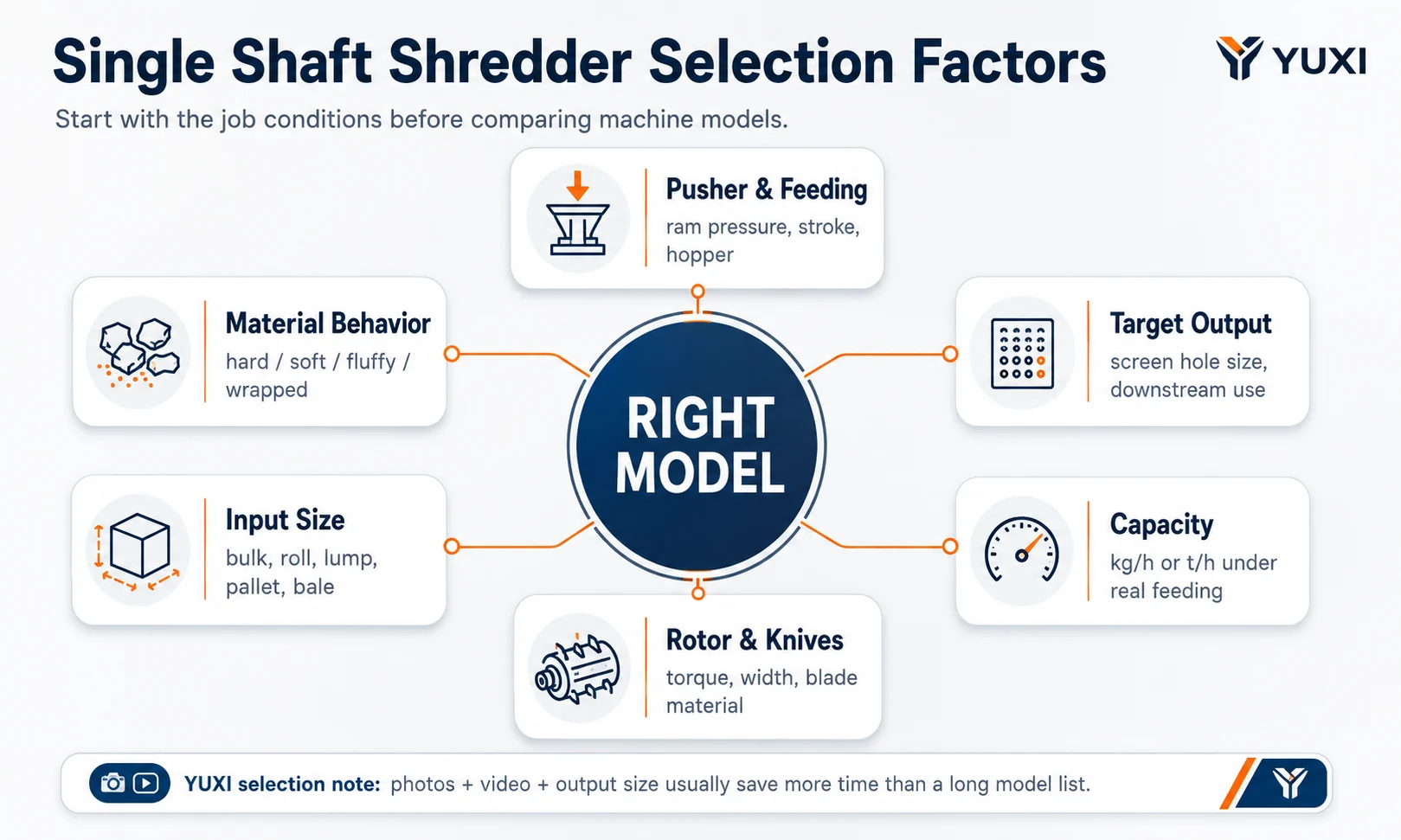
A real supplier should not say that one machine can handle every waste stream. There are situations where a single shaft shredder is not the best first machine, or where it should be used only as part of a two-stage recycling line.
If the material is extremely bulky, irregular and hard to feed, a double shaft shredder may be better for the first reduction stage. If the material is very heavy metal scrap, thick steel pieces or mixed waste with stones and hard contamination, the cutting system and screen of a single shaft shredder may suffer unnecessary damage. If the buyer only needs rough opening, bag breaking or volume reduction, screen-controlled shredding may be more processing than the project actually needs.
Single shaft machines also need careful checking for materials that wrap, bridge or contain hidden contaminants. Film, woven bags and textiles can be processed, but the pusher, rotor, blade angle and screen opening must be chosen with wrapping behavior in mind. Wood pallets can be shredded, but nails and metal pieces should be considered in the layout, often with magnetic separation after discharge.
For buyers comparing machine types, the YUXI guide on single shaft vs double shaft shredder is a useful internal reference. Arlington Machinery also summarizes the same general direction: single shaft machines are often selected for more uniform particle size, while dual shaft machines are often used for aggressive primary reduction of bulky or tough material.
“Plastic waste” is not a complete material description. It could mean injection molding lumps, HDPE drums, PP woven bags, LDPE film, PVC pipe, foam, purgings, mixed rigid plastics or production rejects with metal inserts. Each behaves differently inside a shredder.
The same is true for “wood waste,” “textile waste” or “RDF material.” A pallet, a wood board and a loose pile of packaging chips do not feed the same way. A textile roll is different from loose fabric offcuts. RDF preparation material can range from relatively clean packaging waste to mixed waste with moisture, sand and metal contamination.
Before choosing a machine, the buyer should describe material behavior in practical terms:
A short video is often more useful than a long paragraph. A 20-second clip to show the material, the way is stored and how it will be fed can help the supplier understand bulk density, feeding risk and possible contamination.
Capacity looks simple on quotation sheets, but in the field it is one of the easiest figures to misunderstand. A buyer may ask for “1 ton per hour,” but one ton of dense plastic purgings is not the same as one ton of loose film. The first may occupy a small area on the workshop floor. The second may need a much larger feeding system and more time just to push material into the rotor.
Bulk density, input size and feed continuity change everything. If the machine receives a steady flow from a conveyor, it can work more evenly. If the operator throws material into the hopper in irregular batches, the current load may swing up and down. If the final screen size is small, material will stay longer in the chamber and capacity will drop. If the blades are worn, production may slow even though the motor power has not changed.
Instead of asking only for a capacity number, buyers should ask what conditions the capacity is based on. Is it based on clean material? What input size? What screen opening? What feeding method? How many working hours per day? Is the value a peak capacity or a realistic continuous capacity?
Field note: For overseas projects, it is safer to design with a margin instead of forcing the machine to run at its maximum claimed capacity every hour. A shredder that is always overloaded will not stay cheap for long.
The screen is one of the main reasons buyers choose a single shaft shredder. It helps control the discharge size by keeping oversized material inside the cutting chamber until it can pass through the openings. But a smaller screen is not automatically better.
A small screen can improve size control, but it usually reduces throughput. The material must be cut more times before discharge. The rotor works longer on the same material. Blade wear increases. Motor load may rise. Heat, dust and blockage risk may also become more serious depending on the material.
For that reason, the practical rule is simple: choose the largest screen size that your downstream process can accept smoothly. A granulator, washing line, sorting system or RDF process may not need the smallest possible shredder output. It needs a stable feed size that the next machine can handle without choking, wrapping or producing excessive fines.
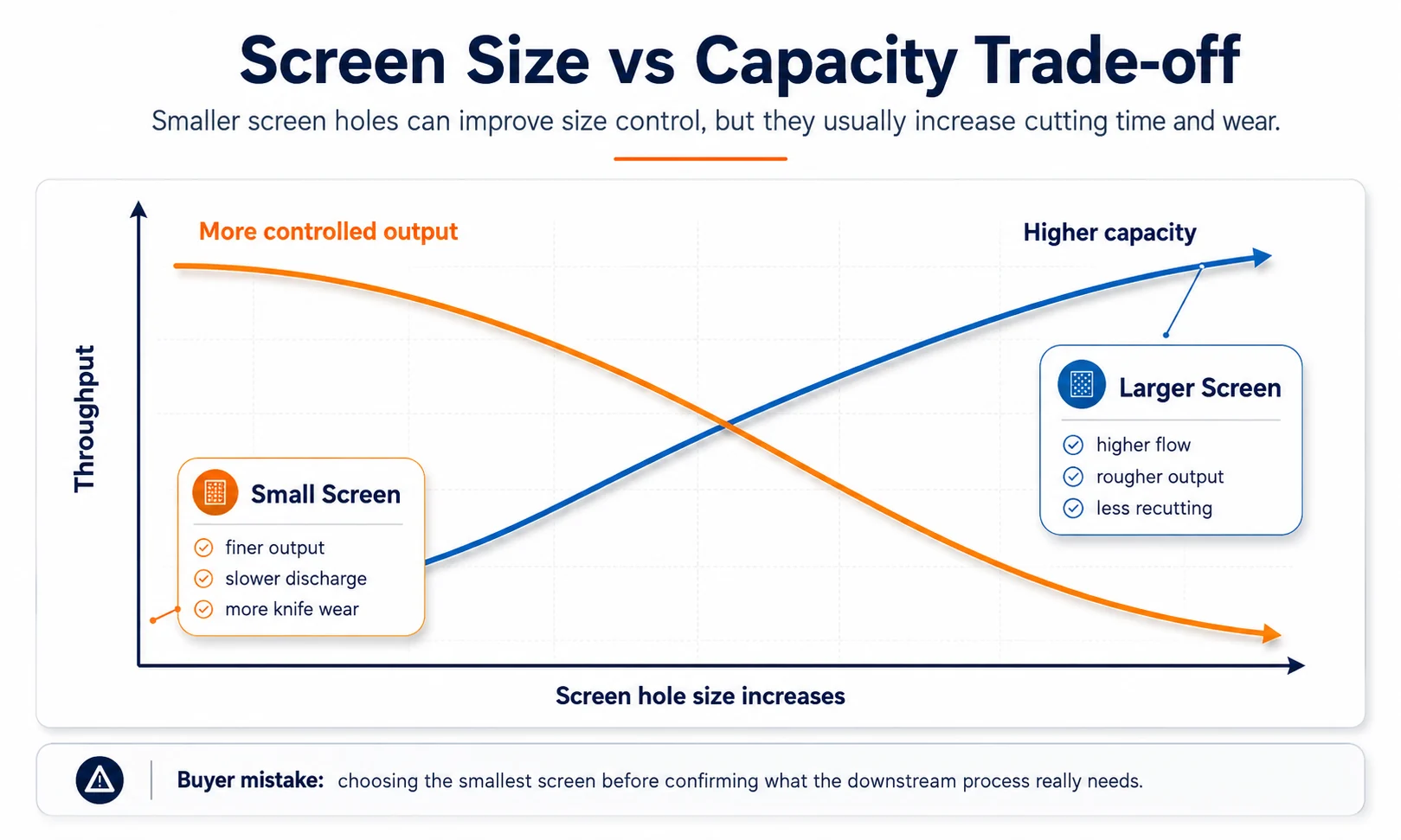
The YUXI article on how to choose a single shaft shredder also highlights the relationship between output size, capacity, hydraulic feeding and downstream process. For most buyers, this is where engineering advice matters more than a simple model table.
The rotor is the working center of the single shaft shredder. Buyers should not look only at the motor. Rotor width affects the feeding width and cutting chamber size. Rotor diameter affects bite, cutting force and stability. Rotor speed affects cutting behavior, heat and throughput. The arrangement of knives affects how the material is grabbed, cut and released.
Blade material and blade access are also important. Clean plastic waste may not require the same wear resistance as dirty wood waste or light metal containers. Textile and film applications may need different cutting geometry from hard lumps. Materials with sand, nails or metal contamination will increase wear cost. If replacement access is difficult, maintenance time becomes a hidden production cost.
Before ordering, buyers should ask:
A machine with cheap wear parts but frequent downtime may cost more than a machine with a better rotor and blade package. This is especially true for recycling plants running two shifts or long daily operating hours.
A single shaft shredder does not rely only on gravity. The hydraulic pusher plays a major role by pressing material toward the rotor. It is especially vital for bulky yet light materials, for example, film, woven bags, textile scraps, foam, paper rolls and light packaging waste.
If the pusher is too weak, too slow or poorly matched to the hopper shape, the rotor may spin and can not take enough material. If the pusher is too aggressive for the material and screen condition, overloads may happen more often. For some projects, the pusher design matters more than a slightly larger motor.
The pusher also affects feeding rhythm. A stable pusher system helps keep the rotor loaded evenly. This can improve production consistency and reduce operator intervention. For buyers planning automatic feeding with a conveyor, the pusher logic and control system should be discussed together with the line layout.
Selection note: Light and fluffy material usually needs more attention to hopper, pusher and feeding design. Hard, dense lumps usually push the buyer to check rotor strength, blade material and torque margin.
For overseas buyers, electrical configuration is not a small detail. Confirmed voltage, frequency, control cabinet standard and site conditions should be checked before production. Many projects need 380V, 415V, 440V, 50Hz or 60Hz configurations. Some sites also need special dust protection, cabinet cooling, local electrical components or safety interlocks.
The drive system should include overload protection and reverse logic for jam conditions. Gearbox strength, coupling design, bearings and maintenance access should all match the application. If the machine is part of a larger recycling line, the shredder control should communicate properly with conveyors, magnetic separators, granulators or downstream machines.
A single machine may look simple in a catalogue, but a recycling line needs stable sequencing. What happens if the discharge conveyor stops? Does the shredder stop feeding? Does the upstream conveyor pause? Can the operator see fault information clearly? These questions are not exciting, but they reduce downtime after installation.
The shredder body is only one part of the project. Feeding and discharge layout can decide whether the machine runs smoothly every day. A workshop that feeds by forklift needs a hopper height and opening suitable for that method. A line fed by conveyor needs a steady feeding width, safe guarding and enough buffer. A project using a grab crane needs a larger receiving area and stronger hopper structure.
Discharge should be planned with the next step in mind. Shredded material may move to a belt conveyor, screw conveyor, air transport system, magnetic separator, crusher, granulator, storage bin or baler. If the output is light and fluffy, it may not behave well on a short steep conveyor. If the material contains metal, magnetic separation may be needed before further processing. If dust is a concern, the discharge area may need cover, collection or slower transfer design.
For complete line planning, YUXI can match shredding, conveying, sorting, separation and downstream process layout through the contact and project discussion page.
The simplest comparison is this: choose a single shaft shredder when output size control matters, and choose a double shaft shredder when rough pre-shredding and strong material grabbing matter more.
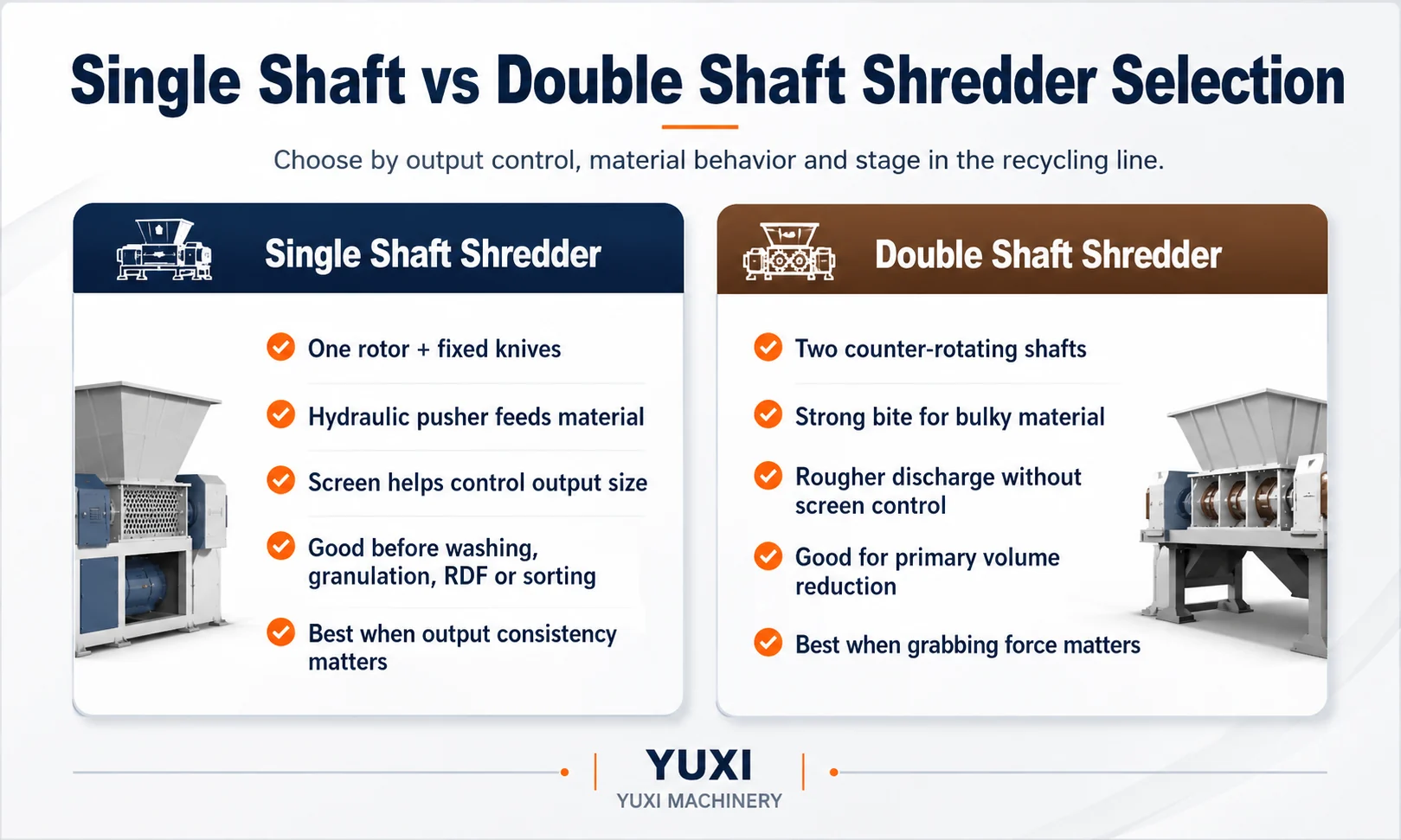
Some lines use both. A double shaft shredder opens or reduces bulky material first, then a single shaft shredder provides more controlled output before the next process. This two-stage solution is common when the input material is difficult but the downstream process still needs a more stable size.
Single shaft shredder quotations vary because the machine scope varies. A low quotation may show only the main machine with a basic configuration. A higher quotation may include stronger rotor design, better blade material, extra screen, spare knives, feeding conveyor, discharge conveyor, magnetic separator, export packing, local voltage configuration and technical support.
The main cost factors include machine frame weight, cutting chamber size, rotor diameter, rotor width, motor power, gearbox grade, hydraulic system, blade material, screen configuration, control cabinet, safety guarding, conveyors, separation equipment and spare parts. Shipping size and packing also matter for overseas buyers.
The cheapest quotation is not always the lowest project cost. If the wrong screen size reduces capacity, if blade wear is too fast, or if the machine cannot feed the material smoothly, the buyer pays later through downtime and modification. A better way is to compare quotations by total scope and application suitability.
For budget planning, see the related YUXI page: Single Shaft Shredder Price: Complete Cost Guide.
A supplier can recommend a more accurate model when the inquiry includes real project information. If the buyer sends only “I need a shredder for plastic, please quote,” the first reply will usually be more questions. Sending the right information at the beginning saves time and reduces selection risk.
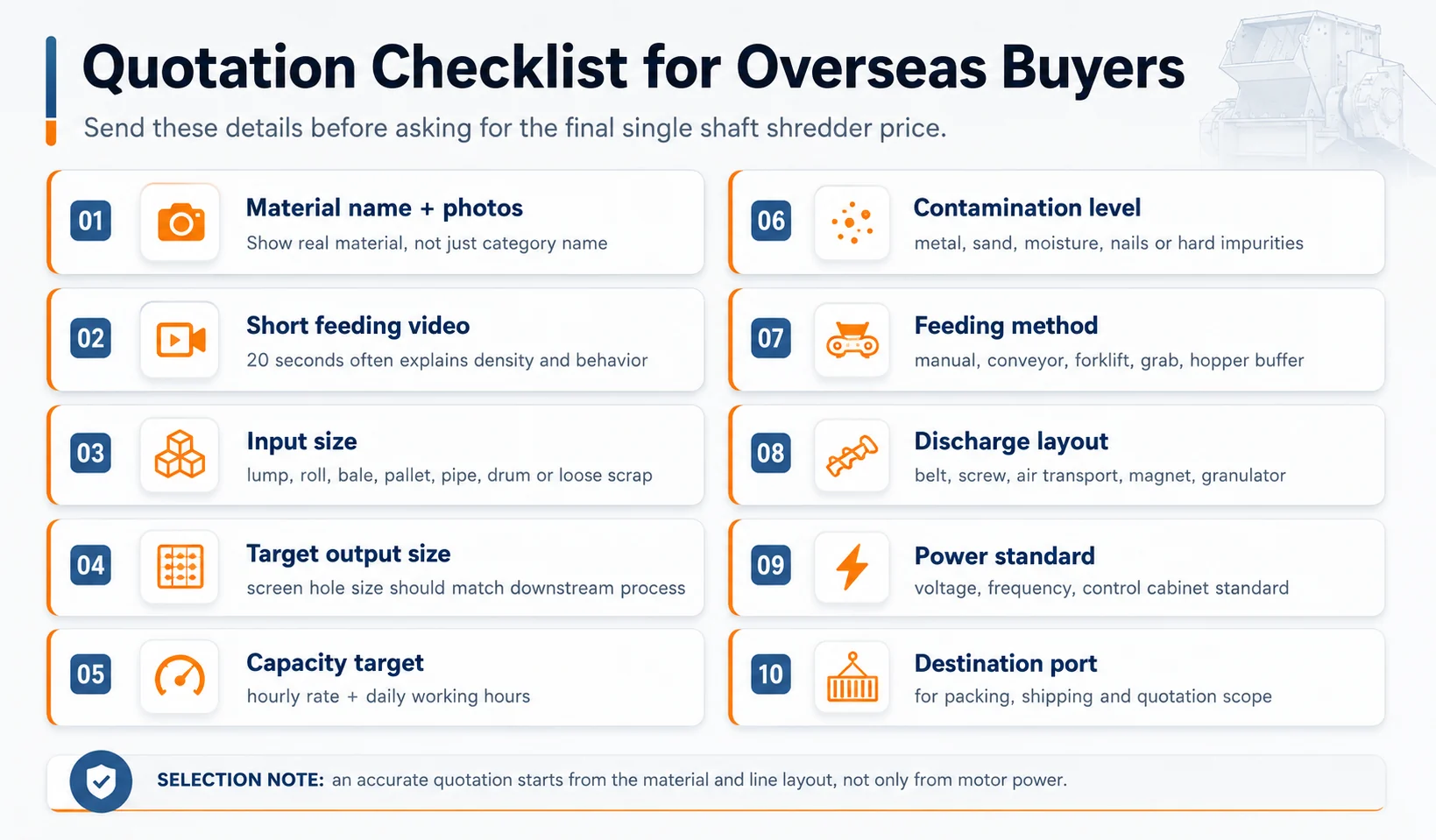
| Information to Send | Why It Matters |
|---|---|
| Material photos and short video | Shows real shape, density, contamination and feeding behavior. |
| Input size and material form | Helps confirm hopper, cutting chamber and feeding method. |
| Required output size | Determines screen size and affects capacity, wear and motor load. |
| Capacity target and working hours | Separates occasional batch use from continuous industrial operation. |
| Moisture and contamination | Changes blade selection, maintenance expectation and protection design. |
| Feeding and discharge method | Affects conveyor design, hopper height, safety guarding and line layout. |
| Voltage, frequency and destination port | Needed for electrical design, packing, freight and final quotation scope. |
Most buying mistakes happen before the order is placed. They often come from comparing machines too quickly without defining the project conditions.
For plastic lumps, rotor strength and blade condition are important. The material can be dense and hard to bite. A stable feed, enough torque and a suitable screen opening are more important than choosing a machine only by capacity claims. If the shredded output will go into a crusher or granulator, the screen should be selected with that downstream machine in mind.
These materials may look light, but they can be difficult. They may bridge in the hopper, wrap around cutting components or discharge unevenly. The hydraulic pusher, rotor knife design and screen size should be reviewed carefully. A screen that is too small can cause long retention time and more wrapping risk.
For pallets, the feeding opening and chamber size are important. Nails or metal pieces should be expected unless the material is well prepared. A magnetic separator after discharge is often worth discussing. The buyer should also check whether the final material is for fuel, board production, storage reduction or further recycling.
A strong supplier does not only send a price. They ask about the material, the output size, the capacity target and the downstream process. They explain why one model is suitable and why another may not be necessary. They should also be willing to discuss wear parts, electrical standard, feeding method, discharge layout, shipping package and after-sales support.
When comparing suppliers, look for practical answers. Can they explain the screen size trade-off? Can they discuss whether the material should use single shaft, double shaft or a two-stage solution? Can they provide a layout suggestion? Can they list what is included and excluded in the quotation? Can they supply spare blades and screens later?
A supplier that asks more technical questions at the beginning may actually be reducing your risk. In industrial recycling equipment, a quick quote is not always a better quote.
YUXI supplies industrial shredder machines and recycling systems for plastic, metal, tire, paper, RDF and mixed industrial waste applications. For single shaft shredder projects, YUXI can review material photos or videos, capacity target, output size, feeding method and downstream process before recommending a configuration.
Depending on the project, a single shaft shredder may be supplied as a standalone machine or matched with conveyors, magnetic separation, crusher, granulator, sorting equipment, baler or RDF preparation system. This is especially useful for overseas buyers who need more than a machine body and want to confirm how the equipment will fit into their plant.
Start with your material. Send photos, a short video, input size, target output size and capacity target. From there, the model selection becomes much more realistic.
Start with the material, input size, target output size, hourly capacity, working hours, feeding method, contamination level and downstream process. Then match the rotor, blades, screen, hydraulic pusher, drive system and control cabinet to those conditions.
Not always. A single shaft shredder is usually better when controlled output size matters. A double shaft shredder is usually better for bulky waste, mixed waste and rough pre-shredding.
Yes. A smaller screen usually gives a more controlled output, but it can reduce throughput, increase repeated cutting time and accelerate blade wear.
Depending on configuration, it can process plastic lumps, purgings, drums, pipes, woven bags, film, wood waste, pallets, paper rolls, textile scrap, RDF/SRF material and selected light industrial waste.
Send material photos, a short video, input size, bulk density if available, contamination level, moisture level, target output size, capacity target, daily working hours, feeding method, voltage, downstream process and destination port.
Not always. A low quotation may exclude conveyors, spare blades, extra screens, proper electrical configuration, export packing, stronger rotor design or after-sales support. Compare the full project scope.

Get in touch with our nice team today to get a price estimate for a shredder machine.
Contact Us