Industrial Shredder & Recycling Systems Manufacturer - YUXI

 English

 English
 Fast Delivery
 Reliable
 Certified
 ExperiencedEnglishEnglishFast DeliveryReliableCertifiedExperienced
Choose the machine from the real material, required output and complete process—not from installed power, a model number or a broad material name.
Hydraulic shredder selection should start with the material, the job the machine must do and the requirements of the next process.
To choose the right hydraulic shredder, first build an accurate material profile and decide whether the machine is being selected for rough opening, controlled size reduction or both. Then confirm what the hydraulic system actually powers, choose a single-shaft or double-shaft cutting structure, define net capacity under real conditions, and check the hydraulic unit, cutters, feeding system, maintenance access and downstream equipment.
The biggest machine is rarely the safest choice. A correct selection is the machine that processes the agreed material at a realistic net rate, creates an output the next machine can accept and can be maintained without excessive downtime.
Most bad projects do not begin with a completely unsuitable machine. They begin with incomplete information. A supplier receives three photos, a broad description such as “industrial waste,” and a request for ten tons per hour. The quotation is built around assumptions. After installation, the actual feed is wetter, denser, more contaminated or more difficult to load than the sample. The machine reverses too often, the screen blocks, the oil runs hot or the discharge conveyor cannot keep up.
The buyer may then blame the hydraulic system, while the real problem is the selection process. The machine was never matched to the material form, the normal operating rate or the next piece of equipment.
Use this guide to identify those problems before the order is placed.
“Hydraulic shredder” is not always a complete technical definition. On one machine, hydraulic motors drive the cutter shafts. On another, the cutting rotor is driven by an electric motor and reducer while a hydraulic cylinder only controls the material pusher. A third design may use hydraulics for both cutting and feeding.
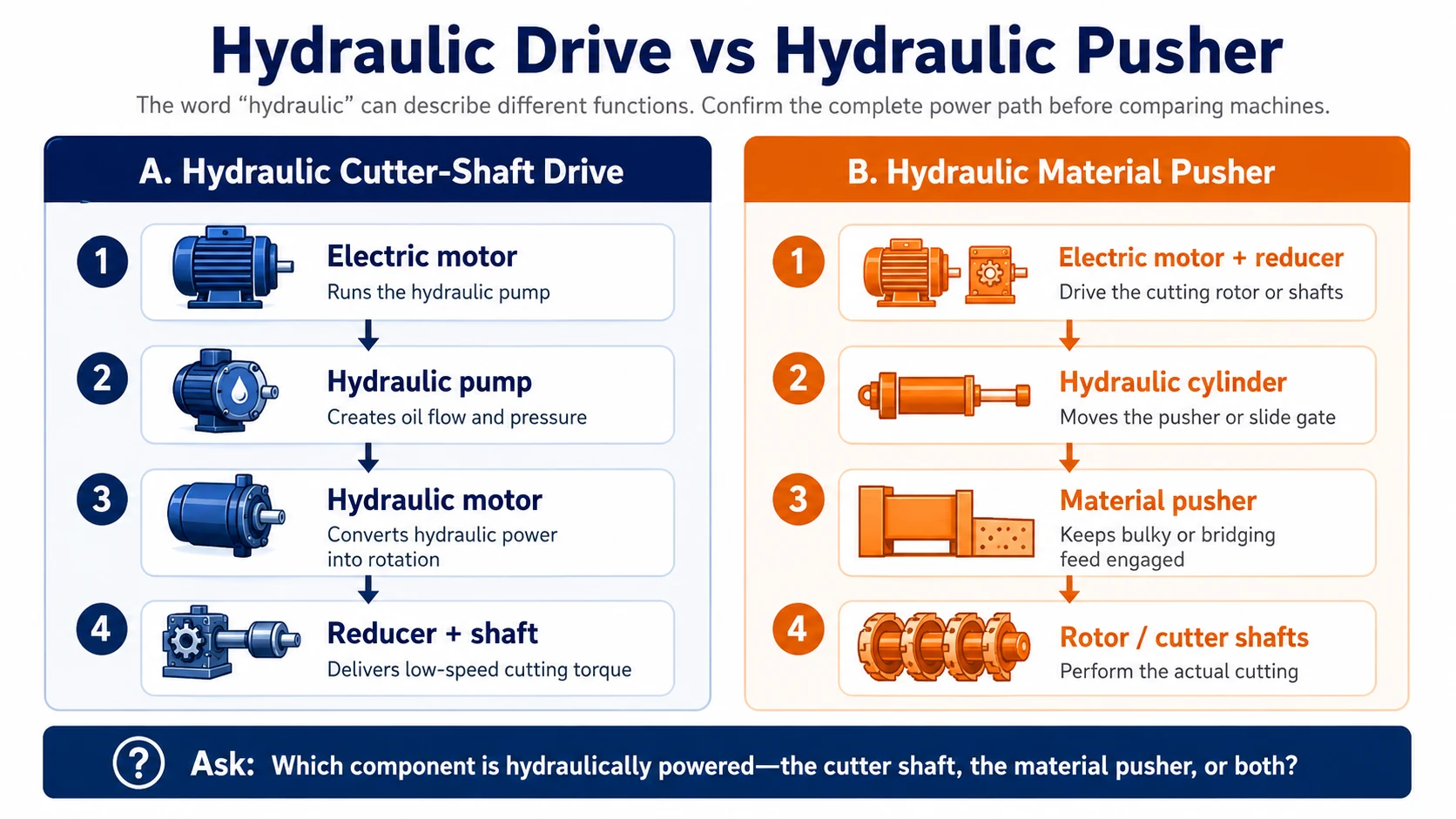
Confirm the complete power path. A hydraulic material pusher and a hydraulic cutter-shaft drive solve different problems.
In a direct hydraulic drive arrangement, an electric motor normally turns a hydraulic pump. Pressurized oil drives one or more hydraulic motors, and the motor output is transmitted to the cutter shaft through the selected reduction arrangement. This setup can provide smooth stopping, starting and reversing under load. WEIMA describes this full-load response as a core benefit of its hydraulic drive option, while SSI uses automatic reversing to reorient difficult material and stops the machine after a preset number of unsuccessful attempts.
A single-shaft shredder often uses a hydraulic pusher to keep light, bulky, hollow or bridging material engaged with the rotor. The pusher improves feeding, but it does not prove that the cutting rotor is hydraulically driven. Pusher force, stroke, speed, guide wear and load-feedback logic become important selection points.
The material name is only the starting point. “Plastic waste” could mean clean injection-molding sprues, hollow HDPE drums, compacted film bales or glass-filled production scrap. “Metal waste” could mean aluminum profiles, thin drums, prepared appliance shells or solid steel blocks. Those feeds do not belong in one capacity table.
| Material information | What the supplier needs | Why it changes the machine |
|---|---|---|
| Normal feed size | Typical length, width, thickness and diameter | Determines hopper, chamber and feeding behavior |
| Maximum feed size | Largest occasional piece that may enter | Defines overload risk and whether pretreatment is needed |
| Single-piece weight | Typical and maximum weight | Affects loading method and shock load |
| Bulk density | Loose bulk density in kg/m³ or lb/ft³ | Changes volumetric feeding and real tons per hour |
| Material form | Rigid, flexible, hollow, solid, fibrous, elastic or stringy | Changes gripping, wrapping and pusher requirements |
| Moisture and temperature | Dry, damp, wet, hot or frozen | Affects feeding, corrosion, oil cooling and downstream handling |
| Contamination | Metal, sand, stone, glass, soil, liquids and unknown objects | Changes wear rate, safety and feed exclusions |
Buyers often show the supplier an easy material sample and treat the difficult pieces as rare exceptions. In practice, the exceptions cause the stoppages. Identify the largest item, the hardest item, the most contaminated item and the item most likely to wrap around the shafts. Those pieces should be included in the engineering review and, when safe, in the material test.
The shaft count does not tell you which machine is “better.” It tells you how the machine cuts and controls the material. The decision should be tied to the job.
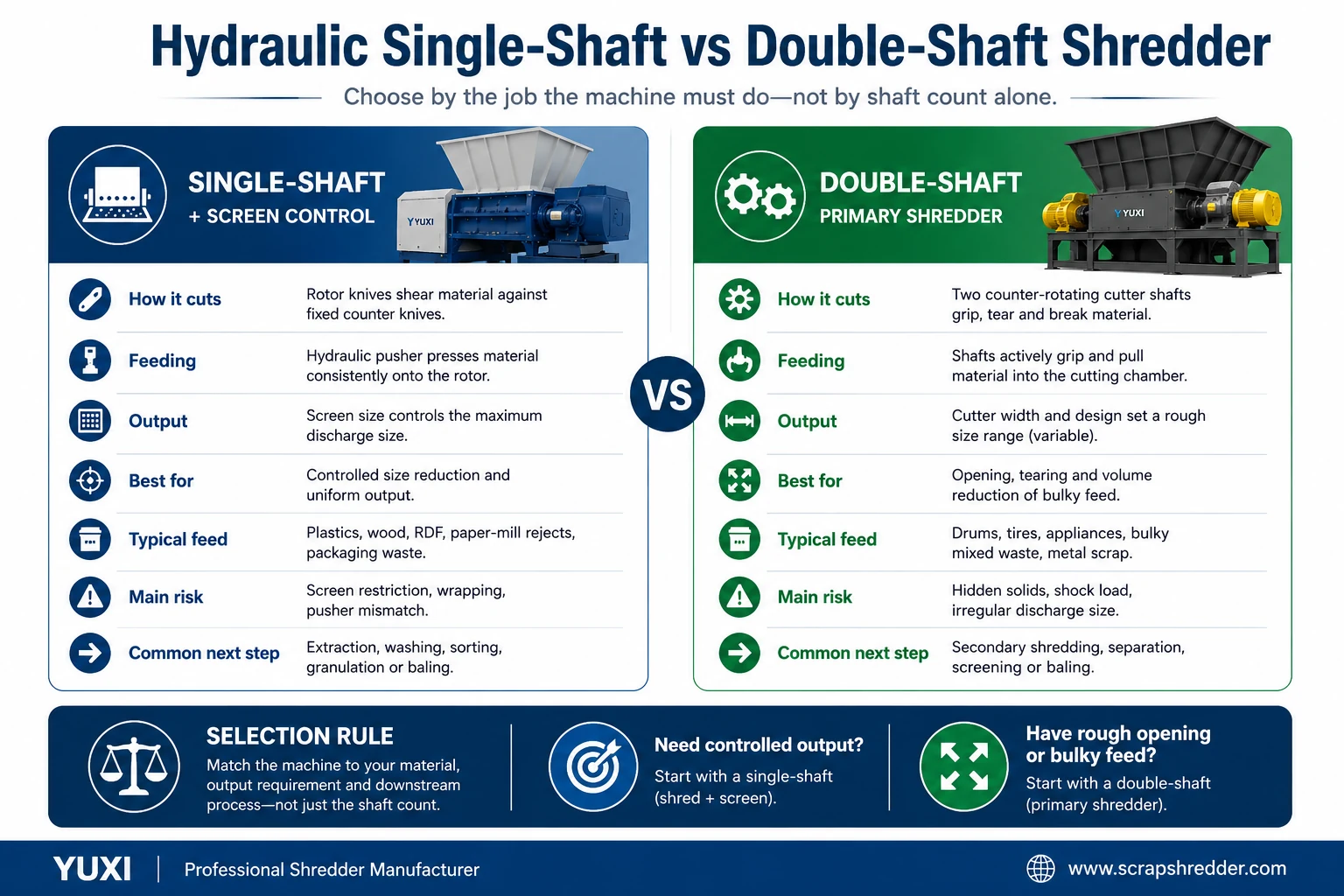
Single-shaft machines are commonly selected for controlled screen discharge. Double-shaft machines are commonly selected for primary opening and volume reduction.
For broader machine architecture, compare the single shaft shredder and double shaft shredder product pages.
“Small output” is not a technical requirement. Define whether the downstream process has a maximum size limit, an average size target, an allowed oversize percentage or a shape requirement.
On a screen-controlled single-shaft shredder, the material remains in the chamber until it can pass through the selected opening. A smaller screen may improve size control, but it can also reduce capacity, increase residence time and raise heat and wear. Flexible material may wrap; wet or sticky material may block the screen.
A double-shaft machine usually creates strips or irregular pieces influenced by cutter width, hook profile, shaft spacing and material behavior. It is normally the wrong machine to promise a narrow final particle distribution in one pass.
Ask what the magnet, screen, granulator, baler or secondary shredder can accept. That answer should define the primary-shredder discharge requirement. A good line does not maximize the first machine’s capacity while starving or overloading everything after it.
Capacity is determined by more than motor power. Franklin Miller’s industrial shredder guide notes that physical size, weight, bulk density, feed quantity and cutting-chamber size all affect capacity. Cutter design, screen opening, loading method, reversing and downtime further change the real result.
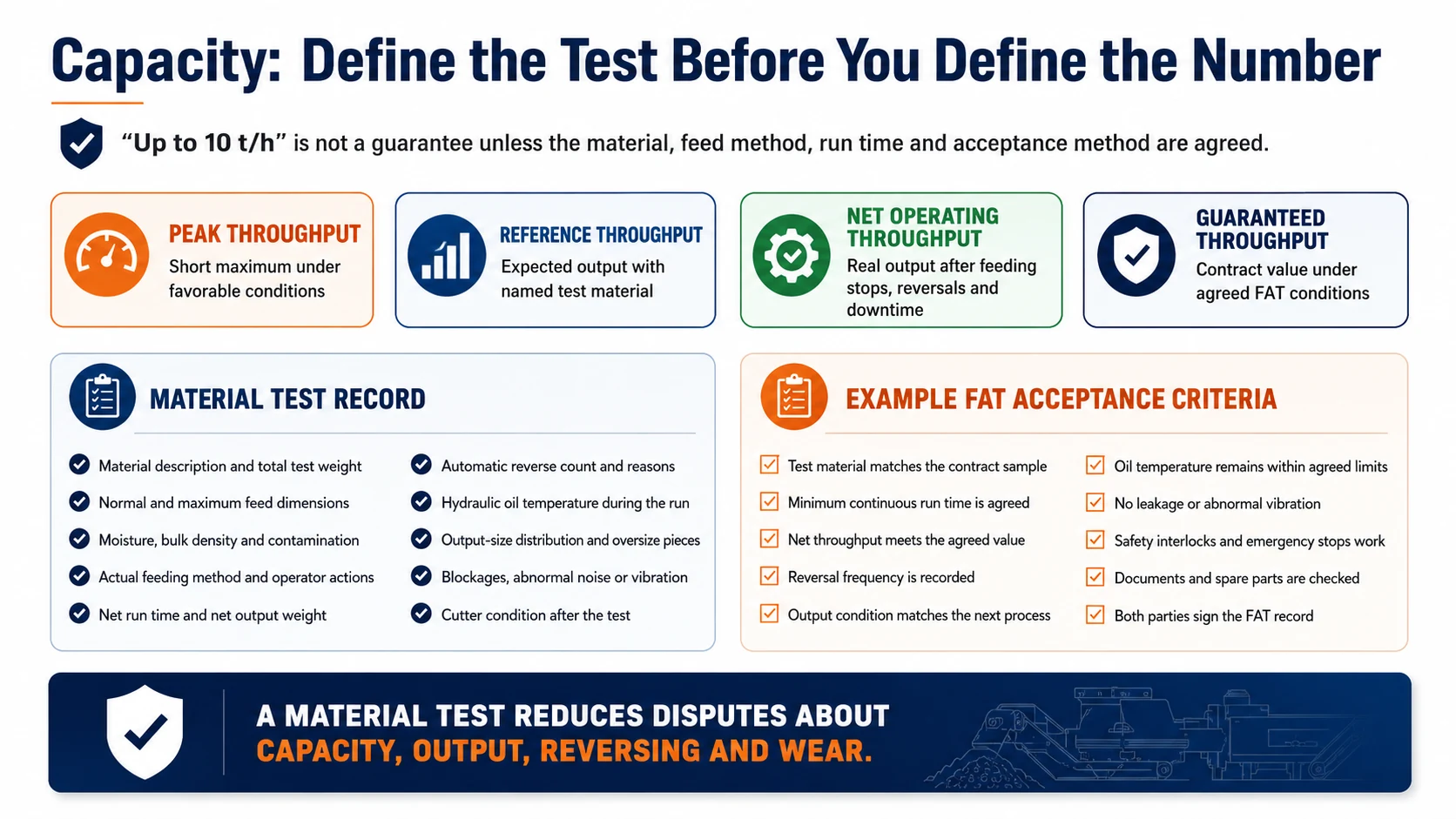
Define net throughput and the test method. A short peak number should not become the basis of a production guarantee.
| Capacity term | Practical meaning |
|---|---|
| Peak throughput | A short maximum achieved under favorable conditions. It is rarely a sustainable production target. |
| Reference throughput | An expected rate based on a named test material, feed method and machine configuration. |
| Net operating throughput | Actual saleable or processable output after normal feeding interruptions, reversals and operating delays. |
| Guaranteed throughput | A contractual value measured under an agreed test method and agreed material conditions. |
A hydraulic shredder cannot be evaluated from installed kW alone. The pump, hydraulic motor or cylinder, pressure range, flow, motor displacement, reduction ratio, cooling and filtration work as a system.
Ask for the number and type of pumps and hydraulic motors, the method used to vary speed and torque, and whether two cutter shafts can respond independently. Brand names are useful only when the quoted model, specification and local replacement path are clear.
Pressure is closely related to available hydraulic motor torque, while flow influences motor speed. Maximum relief pressure is not the same as continuous working pressure. A supplier should explain the normal operating range rather than providing only the highest number on the circuit.
Oil temperature and cleanliness determine the life of pumps, valves, motors and seals. Confirm tank capacity, filter rating, oil specification, temperature alarms, cooling method and the highest ambient temperature at the site. Long shifts in a hot enclosed building may require more cooling than a short demonstration run.
| Hydraulic item | What to request |
|---|---|
| Pump | Type, displacement, control method, rated flow and service support |
| Hydraulic motor | Quantity, displacement, rated torque/speed range and shaft arrangement |
| Pressure | Normal working pressure, alarm threshold and relief setting |
| Reservoir | Usable volume, level/temperature sensing and access for cleaning |
| Filtration | Filter location, rating, clogging indication and replacement method |
| Cooling | Air or water cooling, design ambient temperature and alarm/shutdown logic |
“Special alloy steel blades” is not enough information for an industrial purchase. The cutting geometry, shaft support, chamber protection and service method decide whether the machine keeps working after the sales demonstration.
Thicker cutters may tolerate heavier loading but usually create a coarser output. More aggressive hooks can improve gripping but may increase local load. Thin cutters are not automatically better; they must still withstand the material and shaft torque.
Request the cutter grade, heat-treatment process, working hardness range and the allowed rebuilding or regrinding method. Ask how many times the cutter can be serviced, what dimensional limits apply and whether cutters must be ground as a matched set.
Compare expected cutter life, replacement price, labor hours, screen and comb wear, liner cost and downtime. A harder cutter that takes much longer to replace may have a higher real cost than a more serviceable design.
Check bearing and seal isolation, replaceable wear plates, combs or cleaning fingers, cutter locking, chamber access and the procedure for removing non-shreddables. SSI emphasizes bearing/seal isolation and auto-reverse as reliability features, but no protection system makes every hard object acceptable.
A large hopper looks impressive, but capacity comes from stable engagement with the cutters. The correct loading system depends on whether the feed is hollow, flexible, long, heavy, compacted or likely to bridge.
A pusher is useful for light, bulky or bridging feed. Check stroke, pressure, speed, guide design and the control response when the rotor load rises. Too much pusher pressure can increase reversals and wear instead of increasing production.
Conveyors are useful for smaller, more uniform material and controlled metering. Match conveyor width, speed, sensors and stop/start logic to the shredder. A conveyor that keeps feeding during a downstream blockage can fill the discharge area and force the machine to stop.
Bulky waste, metal scrap, tires and appliances are often loaded by grab or wheel loader. The operator needs a clear maximum batch size. Dropping a full bucket into the hopper is not a valid capacity test and can create avoidable shock loading.
Automatic reverse is a protection and material-reorientation function. It is not a cure for wrong cutters, excessive feed, a blocked screen or an unsuitable machine.
Relief valves and pressure controls limit excessive hydraulic load. Temperature, level and filter alarms protect the power unit. Ask which events create a warning, a controlled stop or an emergency shutdown.
A typical sequence stops the shaft, reverses for a defined time, then attempts forward operation again. SSI states that its controls stop the shredder after a preset number of unsuccessful attempts. The YUXI quotation should state which reverse times, attempt limits and material programs are adjustable.
If the machine reverses repeatedly, investigate the root cause: the feed may be too large, the cutter may be worn, the screen may be restricted, the pusher may be too aggressive or the downstream discharge may be blocked. Increasing power without correcting the cause may only raise wear and heat.
The correct shredder is the one that improves the complete line. Work backward from the next machine and define what it can accept.
For material streams that require very consistent recirculating size control, the four shaft shredder may also be worth evaluating. Clean plastics with a different duty may be better matched to a dedicated plastic shredder.
Hydraulic drive is valuable in the right duty, but it is not a universal upgrade. WEIMA highlights smooth full-load start, stop and reverse as hydraulic-drive advantages. Electric-drive suppliers point to lower conversion losses, less hydraulic oil and simpler maintenance for stable stationary duty. Cumberland states that electric shredders can require less space and maintenance and can be more energy-efficient for many materials, while Lindner has published electric-drive designs intended to reduce heat and hydraulic losses.
| Hydraulic drive may add value when | Electric drive may be simpler when |
|---|---|
| The machine must start or reverse under heavy load | The feed and loading rate are stable |
| Material resistance changes sharply | Continuous energy efficiency is a primary goal |
| Frequent controlled speed changes are required | The plant prefers motor/reducer maintenance |
| Shock-loaded primary reduction is the main duty | Hydraulic oil, hoses and cooling are undesirable |
| A hydrostatic or mobile power system is required | The installation is stationary and predictable |
Compare lifecycle cost rather than installed power alone. Include energy, oil, filters, cooling, hoses, seals, cutter wear, labor, downtime and the value of production lost during repairs.
Maintenance access is easy to ignore in a quotation and expensive to discover after installation. Ask the supplier to demonstrate how the chamber is opened, how foreign objects are removed and how cutters, screens, combs and hoses are serviced.
A material test is the most practical way to reduce disputes about capacity, output, reversing and wear. It is especially important for tires, paper-mill rejects, reinforced materials, wet mixed waste, appliances and metal with uncertain contamination.
FAT criteria should cover more than a short no-load run. Agree on the test material, duration, net capacity, output requirement, maximum reversal frequency, temperature limit, leakage inspection, vibration/noise condition, alarms, emergency stops and supplied documents.
| Project condition | Better starting point | Reason |
|---|---|---|
| Large plastic containers needing controlled output | Hydraulic single-shaft | Pusher feeding and screen discharge |
| Steel drums and prepared appliance shells | Hydraulic double-shaft | Active gripping and primary tearing |
| Passenger or truck tires | Heavy double-shaft, subject to test | Feed strength, bead wire and cutter bite require confirmation |
| Paper-mill rejects with wire and wrapping | Test both configurations | Moisture, wrapping and target output decide the result |
| Clean, stable production scrap | Compare electric single-shaft | Hydraulic drive may add unnecessary cost and maintenance |
| Bulky furniture and mattresses | Hydraulic double-shaft | Rough opening and volume reduction are the main jobs |
| Fine and controlled final size | Single-shaft or two-stage line | Screen or secondary sizing provides better control |
| Unknown mixed waste | Material audit and representative test | No model should be selected from the category name alone |
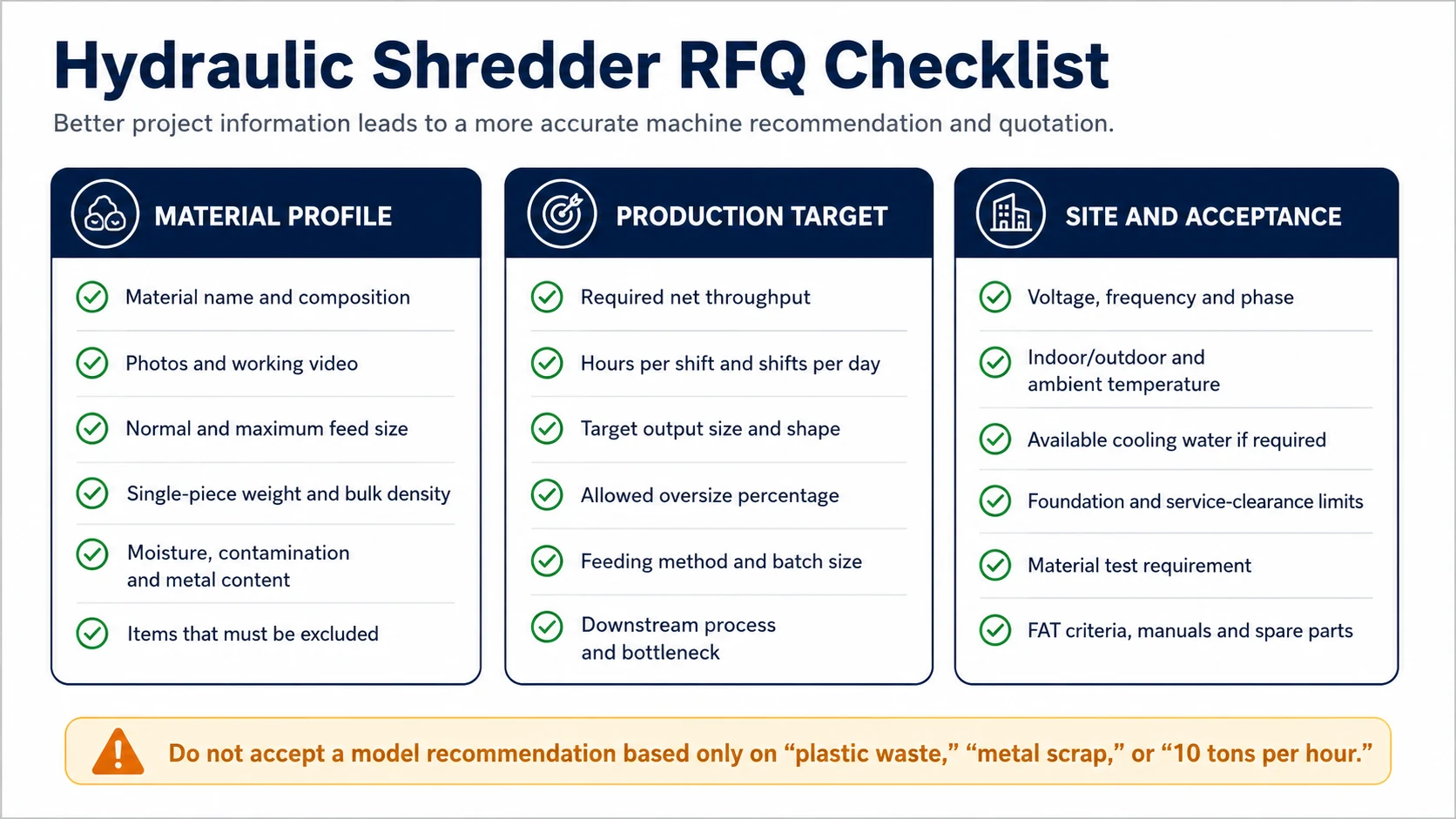
Send complete operating information before requesting a model and price.
| Information | Buyer should provide |
|---|---|
| Material | Name, composition, photos and video of normal and difficult pieces |
| Feed size | Normal and maximum dimensions, plus maximum single-piece weight |
| Condition | Bulk density, moisture, temperature and contamination |
| Production | Required net throughput, hours per shift and shifts per day |
| Output | Maximum size, preferred range, allowed oversize and required shape |
| Process | Feeding equipment, downstream equipment and current bottleneck |
| Site | Power supply, indoor/outdoor conditions and highest ambient temperature |
| Acceptance | Material test, FAT method, documents, spares and installation responsibility |
Start with a complete material profile, the required net throughput, the output condition the next process can accept, and the real operating schedule. Then decide whether the project needs a hydraulic cutter-shaft drive, a hydraulic material pusher, or both, and whether a single-shaft or double-shaft cutting system is the better fit.
A hydraulic-drive shredder uses hydraulic motors to turn the cutter shaft or shafts. A hydraulic-pusher shredder uses a hydraulic cylinder to push material toward a rotor, while the rotor may still be driven by an electric motor and reducer. Some machines use hydraulics for both functions.
Choose a single-shaft configuration when controlled output through a screen is important. Choose a double-shaft configuration when the first task is rough opening, volume reduction and active gripping of bulky or difficult material. Mixed or uncertain feed should be tested before the final decision.
No. Hydraulic drive can be useful for starting under load, frequent reversing and changing feed resistance. Electric drive can be simpler and more energy-efficient for stable continuous duty. The right choice depends on the material, operating schedule, maintenance resources and lifecycle cost.
Specify the material, normal and maximum feed size, bulk density, moisture, feeding method, cutter or screen configuration, test duration and accepted output. Use net operating throughput rather than a short peak figure, and include the test method in the quotation or FAT agreement.
A double-shaft shredder usually produces a coarse and variable output influenced by cutter width, tooth design and material behavior. When a narrow final size range is required, a single-shaft screen system or a two-stage line is often more reliable.
Check hydraulic oil condition, filters, hoses, seals, cooling, pumps, motors, pressure alarms, cutters, bearings, combs, screens and wear liners. Maintenance access and spare-part lead time are as important as the component specification.
Yes for difficult, mixed, abrasive, wet, reinforced or unfamiliar material. A test should record feed details, net run time, net output, reversals, oil temperature, output condition, blockages and cutter condition so both parties can agree on realistic acceptance criteria.
Choose the hydraulic shredder from the whole process. Define the real material, the output the next machine can accept, the net production target and the daily operating conditions. Confirm whether hydraulics power the cutter shafts, the pusher or both. Then compare cutter structure, feeding, protection, cooling, maintenance access and lifecycle cost.
For mixed or difficult material, a representative test and a written FAT are more useful than a long specification table. They turn assumptions into measurable acceptance criteria and give both buyer and supplier a clear basis for the project.
Share material photos, normal and maximum feed size, target net capacity, required output and the downstream process. YUXI can review whether a hydraulic single-shaft, hydraulic double-shaft or another configuration is the better starting point.

Get in touch with our nice team today to get a price estimate for a shredder machine.
Contact Us