Industrial Shredder & Recycling Systems Manufacturer - YUXI

 English

 English
 Fast Delivery
 Reliable
 Certified
 ExperiencedEnglishEnglishFast DeliveryReliableCertifiedExperienced
A single shaft shredder is not difficult to maintain, but it does punish poor routines. Most production problems start with a few predictable areas: knife wear, knife clearance, screen blockage, hydraulic pusher movement, bearing temperature, gearbox lubrication and unsafe service habits.
The best maintenance routine for a single shaft shredder is a planned routine: inspect the cutting chamber before operation, rotate or replace knives before severe wear, keep the screen clear, monitor the hydraulic pusher, check bearings and gearbox lubrication, and record repeated symptoms such as overload, vibration, abnormal noise or inconsistent discharge size.
For buyers comparing a single shaft shredder machine with other industrial shredders, maintenance is also a purchasing issue. A machine with accessible service doors, replaceable knives, protected bearings and convenient screen removal is easier to keep in production than a machine that looks strong but is difficult to inspect.
Regular maintenance protects four things at the same time: production capacity, output size, machine life and operator safety. A single shaft shredder uses a rotor, fixed counter knives and a screen to cut material until it reaches the required size. When the knife edge becomes dull or the screen becomes blocked, the machine may still run, but it works harder for a poorer result.
Preventive maintenance is a planned method used to reduce unexpected equipment failures, rather than waiting for breakdowns to happen. IBM describes preventive maintenance as a proactive approach designed to help prevent unexpected failures, which fits shredder operation very well because many failures are visible before the machine stops completely IBM.
Predictive maintenance goes one step further by using operating data to identify problems early. McKinsey has reported that predictive maintenance can reduce machine downtime by 30–50% and increase machine life by 20–40%, which explains why many plants now track current load, vibration, temperature and operating hours instead of relying only on fixed schedules McKinsey.
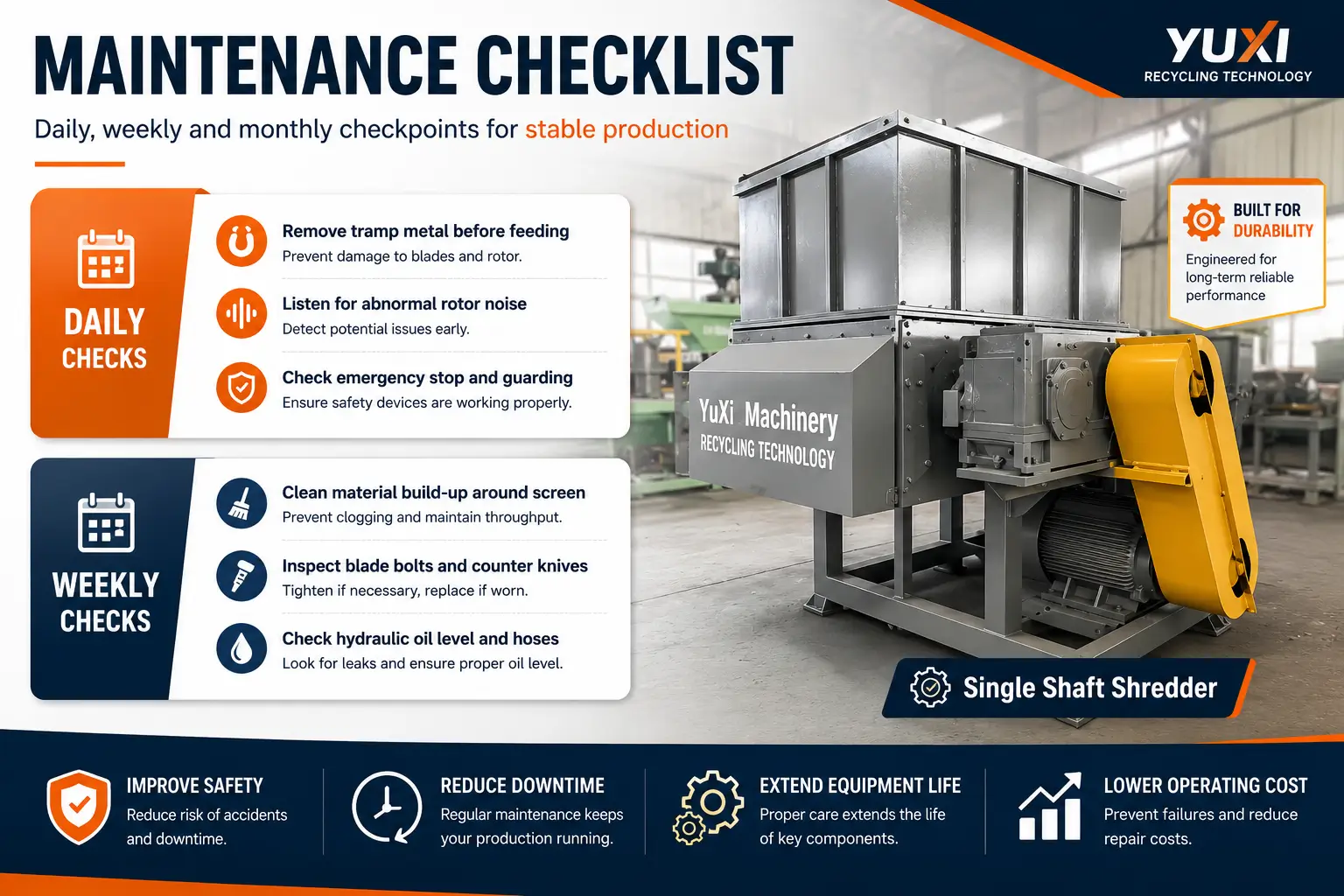
Daily maintenance should be short enough that operators actually do it, but complete enough to catch the most common failures. The goal is not to rebuild the machine every morning. The goal is to find loose bolts, foreign metal, blocked screens, low oil, damaged knives and unsafe guarding before production starts.
| Daily item | What to check | Why it matters |
|---|---|---|
| Feed area | Remove metal bolts, stones, thick steel pieces or other tramp material. | Foreign objects can chip knives, crack screens or lock the rotor. |
| Rotor knives | Look for broken corners, severe rounding, missing bolts or uneven wear. | Dull knives increase motor load and reduce cutting quality. |
| Counter knives | Check visible damage and confirm no looseness. | Poor knife engagement causes tearing instead of cutting. |
| Screen | Check blockage, cracked bars, enlarged holes and trapped material. | The screen controls output size and strongly affects capacity. |
| Hydraulic pusher | Watch movement speed, oil level, hose leakage and unusual noise. | Unstable feeding causes overload, low capacity and repeated jams. |
| Safety devices | Test emergency stop, guards, interlocks and warning devices. | Maintenance safety is part of uptime, not separate from it. |
OSHA’s machine guarding guidance states that machine parts, functions or processes that may cause injury must be safeguarded, and its general machine guarding standard requires guards to be secured where possible OSHA Machine Guarding OSHA 1910.212. For shredder maintenance, that means inspection access should never become an excuse to bypass guarding during operation.
Weekly and monthly tasks should be adjusted by material. A plastic lump shredder may need more cutting chamber cleaning. A wood waste shredder may need more attention to dust, bearing temperature and tramp metal. RDF and mixed industrial waste applications usually need a more aggressive inspection routine because contamination is less predictable.
Blade maintenance is usually the most important part of single shaft shredder maintenance. The rotor knives and counter knives decide whether the machine cuts material efficiently or only tears, rubs and overheats it. Once knives become dull, operators often notice three changes: output becomes uneven, capacity drops and motor load rises even when the same material is fed.
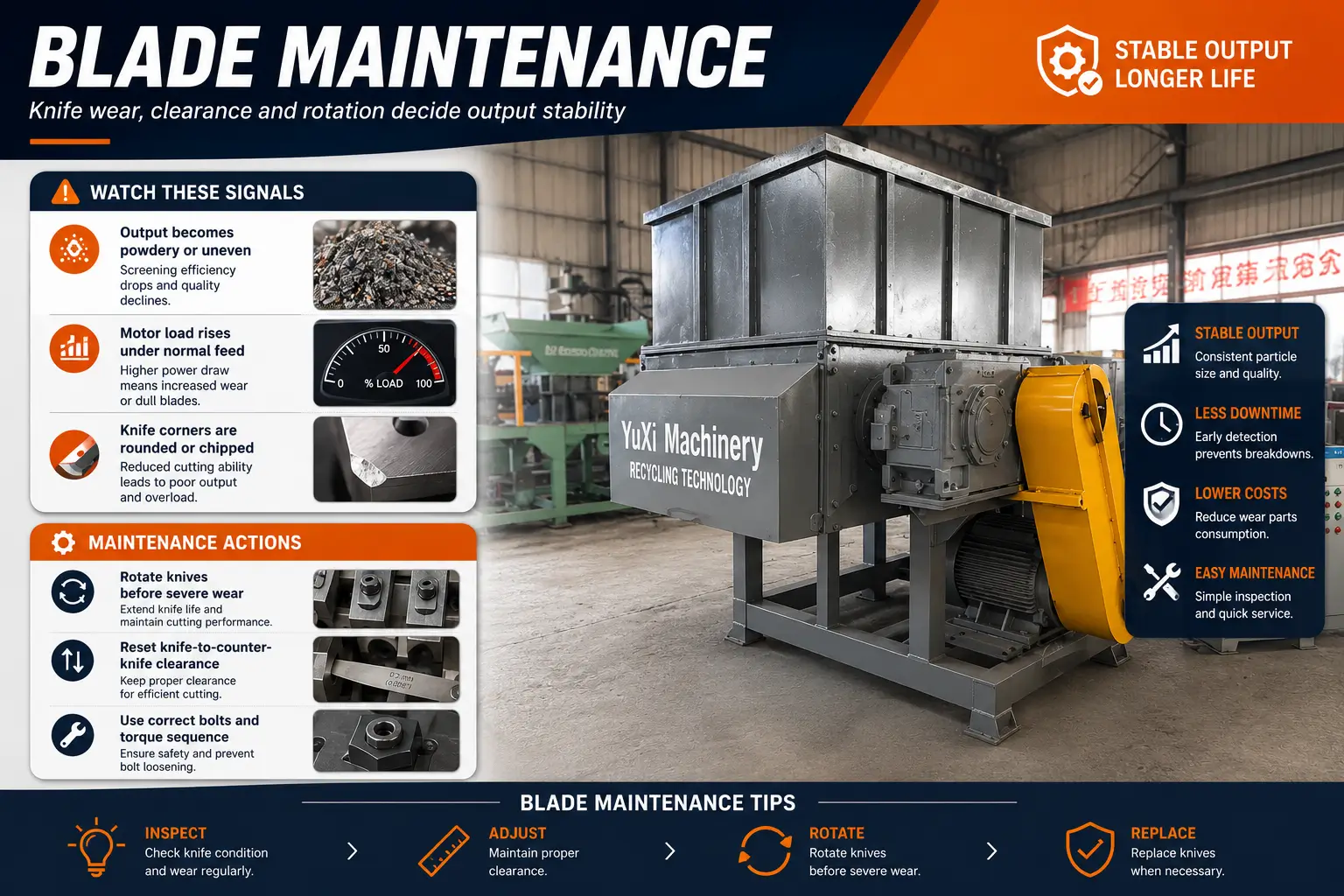
Knife-to-counter-knife clearance should be checked after knife rotation, knife replacement or impact damage. If clearance is too large, the shredder may tear material instead of cutting it cleanly. If clearance is too tight, knives can contact each other, increasing wear and the risk of damage. The correct clearance should follow the machine manufacturer’s setting, because rotor diameter, blade design and material type all affect the right value.
In many projects, rotating knives early is better than using them until the edge is completely lost. A knife with one damaged corner may still have usable edges, but if the operator continues running it too long, the rotor load rises and the fixed counter knife may also suffer. Replacement is necessary when rotation no longer restores stable cutting, when bolts cannot hold correctly, or when cracks and deformation appear.
| Material | Blade wear pattern | Maintenance note |
|---|---|---|
| Plastic lumps and purges | Impact and edge rounding | Watch knife corners and avoid large hard lumps beyond machine design. |
| Plastic film | Wrapping and heat build-up | Keep knives sharp and check anti-wrapping areas frequently. |
| Wood pallets | Nail impact and abrasive dust | Remove metal when possible and inspect screen/frame more often. |
| RDF/SRF material | Mixed wear from contamination | Use more frequent inspections and track motor load trends. |
| Light aluminum scrap | Localized chipping from harder pieces | Confirm application suitability and avoid heavy steel contamination. |
The screen is easy to ignore because it is not as visible as the rotor, but it controls the final discharge size. A damaged or enlarged screen makes output coarser. A blocked screen reduces capacity and keeps material inside the cutting chamber for too long, which increases heat, dust, wear and power consumption.
The hydraulic pusher is another key system. It keeps material pressed toward the rotor. If the pusher moves too aggressively, the rotor may overload. If it moves too slowly or unevenly, the shredder may run with low capacity. Hose leakage, poor oil condition, dirty rails or cylinder seal problems can all appear as feeding problems.
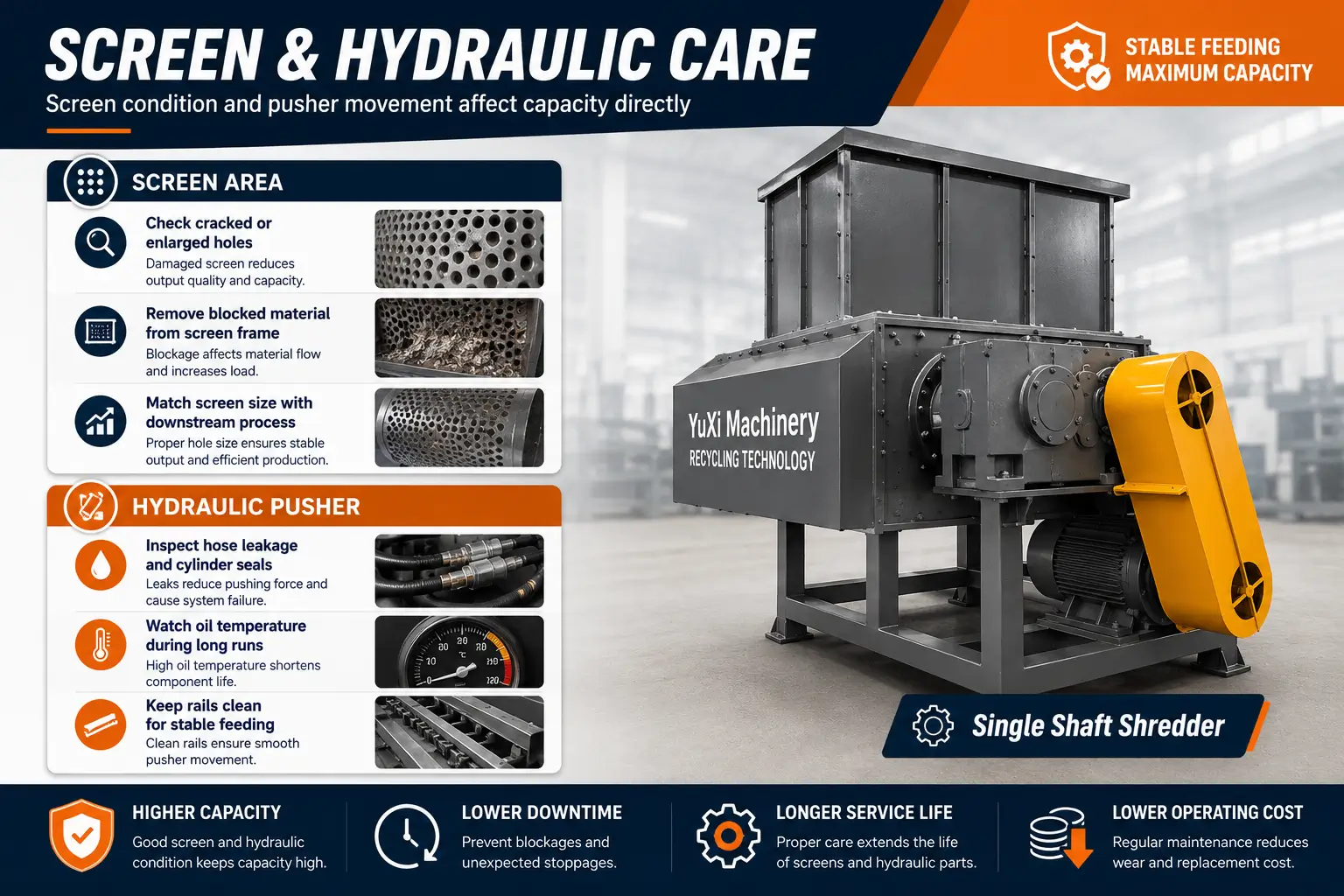
| Symptom | Possible screen or hydraulic cause | Action |
|---|---|---|
| Output becomes too large | Screen holes worn, cracked or wrong size | Inspect and replace screen if needed. |
| Capacity drops | Screen blocked or pusher not feeding steadily | Clean screen area and inspect hydraulic movement. |
| Repeated overload | Pusher pressure too high or material stuck near screen | Check pusher setting and remove chamber build-up. |
| Uneven discharge | Partly blocked screen or worn knives | Clean screen and inspect knife condition together. |
Bearings and gearbox problems often start quietly. A bearing may run hotter than normal before it becomes noisy. A gearbox may show oil leakage or rising temperature before tooth damage becomes serious. Electrical faults may show as repeated overload trips, loose terminals, damaged sensors or unstable current readings.
Check bearing temperature after the machine reaches stable operating conditions. Compare the result with previous records instead of looking only for an absolute number. A sudden temperature change is more useful than one isolated reading. Dust, vibration, poor lubrication, misalignment and shock load from hard material can all shorten bearing life.
Gearbox oil should be inspected based on the manufacturer’s service interval. Look for oil leakage, unusual smell, discoloration, metal particles or abnormal noise. If the gearbox is overloaded repeatedly because knives are dull or the screen is blocked, changing oil alone will not solve the root cause.
The electrical cabinet should stay clean and dry. Loose terminals, dust build-up, damaged cables and poor sensor signals can create intermittent faults that are hard to diagnose during production. For modern shredders, motor load trend records are especially useful because current spikes often appear before a jam becomes serious.
This section is useful for operators because most maintenance decisions start with a symptom, not with a theory. The best troubleshooting routine is: stop safely, isolate power, inspect the cutting chamber, identify whether the problem is material, knife, screen, hydraulic or drive related, then record what was found.
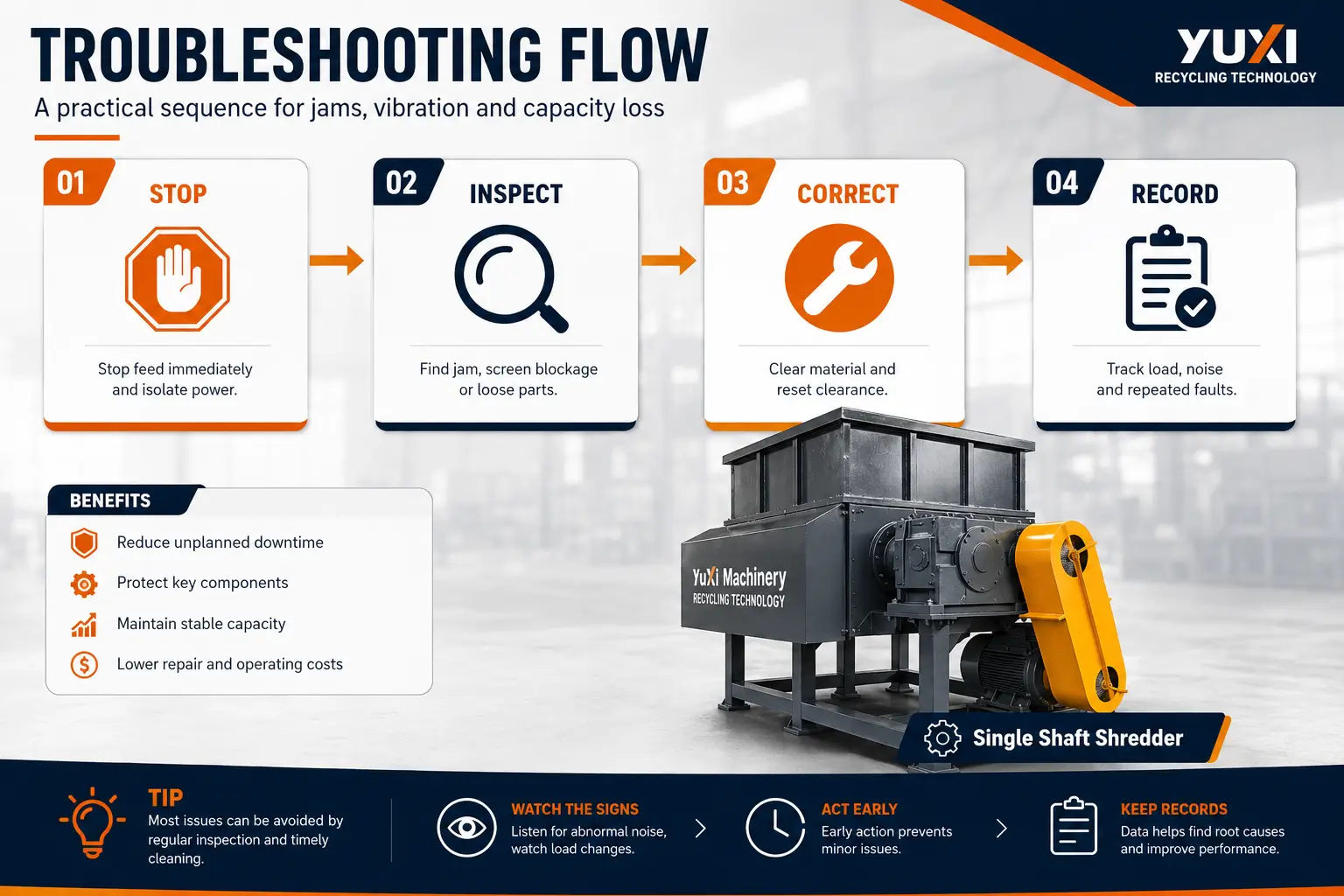
| Problem | Likely causes | Recommended action |
|---|---|---|
| Machine jams frequently | Oversized feed, tramp metal, dull knives, blocked screen, aggressive pusher setting | Stop safely, clear material, inspect knives/screen, adjust feeding and pusher behavior. |
| Output size is inconsistent | Worn knives, enlarged screen holes, incorrect clearance, uneven feeding | Check knife condition, reset clearance and inspect screen wear. |
| Capacity drops suddenly | Screen blockage, dull blades, hydraulic feeding issue, motor load limitation | Clean screen, inspect blades and verify pusher movement. |
| Excessive vibration | Rotor imbalance, loose bolts, bearing issue, hard foreign object impact | Stop operation, inspect rotor, knives, bolts and bearings before restart. |
| Bearing runs hot | Poor lubrication, dust contamination, overload, misalignment | Check lubrication, clean surrounding area and compare with temperature records. |
| Hydraulic pusher stops moving | Low oil level, hose leakage, valve issue, cylinder seal problem, sensor fault | Inspect oil, hoses, cylinder, valve and control signals. |
| Abnormal rotor noise | Knife contact, trapped metal, loose knife bolt, bearing or gearbox issue | Do not continue running. Isolate power and inspect the cutting chamber and drive system. |
Before clearing jams or opening inspection areas, maintenance staff should follow lockout/tagout discipline. OSHA’s hazardous energy guidance focuses on controlling energy during servicing and maintenance so machines do not start unexpectedly or release stored energy while workers are exposed OSHA Control of Hazardous Energy.
A good schedule combines fixed intervals with operating experience. A plant shredding clean plastic scrap may not need the same frequency as a plant processing RDF, wood waste or mixed industrial material. Still, the table below gives a practical starting point for most industrial single shaft shredder applications.
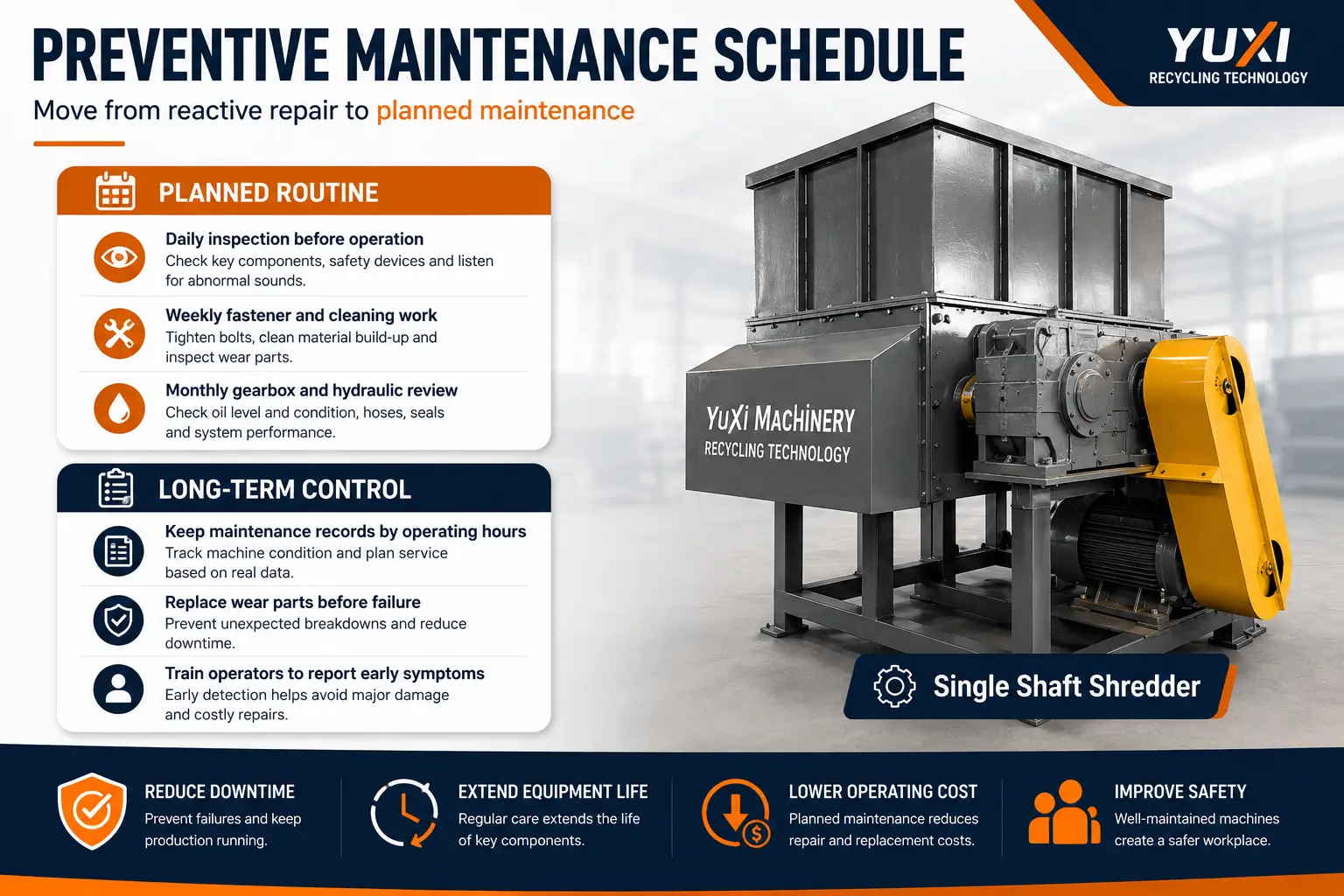
| Interval | Maintenance tasks | Record to keep |
|---|---|---|
| Before each shift | Check feed area, emergency stop, visible knives, screen blockage, oil level and abnormal noise. | Pre-start checklist and operator name. |
| Daily | Clean around discharge, inspect chamber after shutdown and note unusual load or vibration. | Motor load trend, jam events, cleaning notes. |
| Weekly | Inspect blade bolts, screen frame, hydraulic hoses, pusher rails, bearing temperature and fasteners. | Fastener inspection and temperature record. |
| Monthly | Check gearbox oil, electrical cabinet, rotor wear, sensor condition and spare parts stock. | Oil condition, electrical inspection, spare parts list. |
| Quarterly | Review knife rotation history, inspect counter knives, evaluate screen replacement and service hydraulic components. | Knife life record and maintenance cost trend. |
| Yearly | Complete mechanical inspection, drive system review, electrical safety review and operator retraining. | Annual service report and improvement list. |
This is an important buying question. Two machines may have similar motor power and rotor size, but very different maintenance costs after installation. When evaluating a shredder machine supplier, buyers should check how the machine will be serviced after a few months of real production.
For projects that require controlled output size before granulation, washing, RDF production or downstream separation, single shaft shredders are often selected because the screen can help stabilize discharge size. If the project only needs rough volume reduction, a double shaft shredder may also be considered. The maintenance logic is different, so the equipment choice should match the final process, not only the feed material.
There is no single maintenance interval that fits every plant. The same shredder model may behave differently when processing plastic purges, films, wood pallets, textile waste, aluminum profiles or RDF material. Maintenance should be based on material behavior, contamination level, output requirement and running hours.
| Application | Main maintenance risk | Practical advice |
|---|---|---|
| Plastic recycling | Blade dulling, melting or wrapping depending on material type | Keep knives sharp, avoid overheating and match screen size with downstream granulator or washing line. |
| Wood recycling | Nails, dust, impact load and bearing contamination | Improve pre-sorting, inspect screen/frame and watch bearing temperature. |
| RDF/SRF production | Mixed contamination, unpredictable hard objects, high wear | Use frequent inspections, record overload events and keep spare wear parts ready. |
| Textile waste | Wrapping around rotor or pusher area | Inspect anti-wrapping zones and clean chamber more often. |
| Light aluminum scrap | Knife chipping from harder contamination | Confirm machine suitability and remove heavy steel before feeding. |
| E-waste plastics | Metal inserts, dust and mixed hardness | Use careful pre-sorting and inspect knives/screens more frequently. |
If your project handles plastic, wood, RDF, textile or mixed industrial waste and needs a maintenance-friendly configuration, YUXI can help evaluate rotor design, knife material, screen size and feeding method based on the real material. You can also review the main product page here: Single Shaft Shredder Machine.
There is no universal replacement interval. Blade life depends on material abrasiveness, contamination, feeding size, operating hours and knife material. In many plants, knives are rotated before severe edge rounding and replaced when rotation no longer restores stable cutting performance.
The cutting chamber inspection is usually the most important. Operators should check foreign metal, visible knife damage, loose bolts, screen blockage and abnormal material build-up before production.
Common causes include oversized feed, tramp metal, dull knives, incorrect knife clearance, blocked screen, poor hydraulic pusher movement or material that does not match the machine configuration.
Remove tramp metal, avoid overload feeding, rotate knives early, maintain correct clearance, keep the screen clean and choose blade material according to the feed material.
Excessive vibration may come from rotor imbalance, loose knife bolts, bearing damage, hard object impact or uneven material trapped inside the cutting chamber. The machine should be stopped and inspected before continued operation.
Yes. Plastic applications often focus on knife sharpness, wrapping and downstream size control. Wood applications usually require more attention to nails, dust, bearing temperature and screen/frame impact.
A single shaft shredder maintenance guide should not be treated as a generic cleaning list. The real maintenance priorities are cutting performance, screen condition, hydraulic feeding stability, drive system health and safe service procedures. When these areas are checked regularly, the machine is more likely to keep stable capacity, controlled output size and predictable operating cost.
For recycling plants, the best routine is simple: inspect daily, clean weekly, review hydraulic and drive systems monthly, rotate knives before severe wear, and keep records of load, vibration, temperature and downtime. That turns maintenance from emergency repair into production control.
YUXI can configure rotor design, blade material, screen size and hydraulic feeding according to plastic, wood, RDF, textile, aluminum and mixed industrial waste applications.
Contact YUXI for a project evaluation · View Single Shaft Shredder Machine

Get in touch with our nice team today to get a price estimate for a shredder machine.
Contact Us