





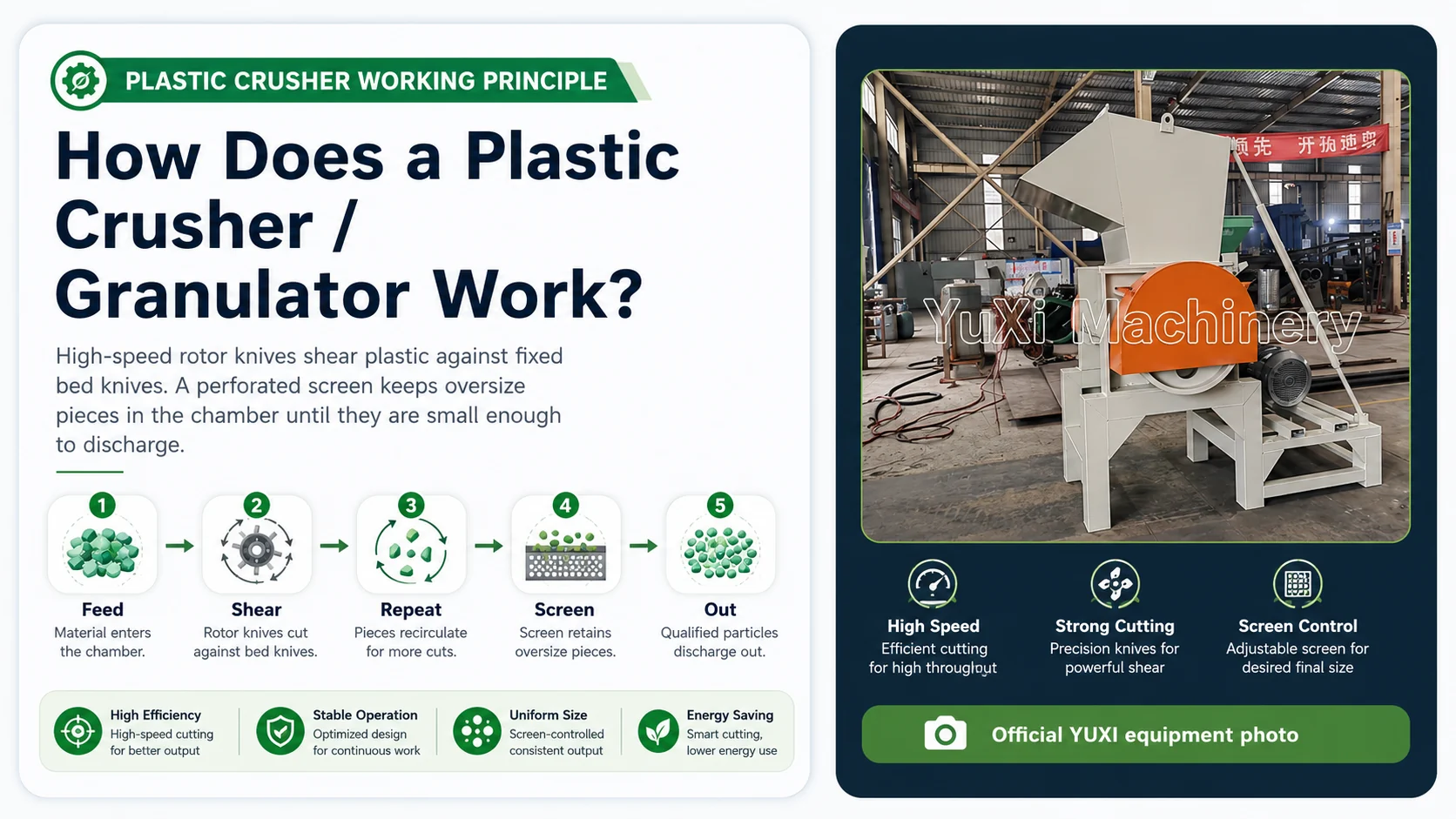
First, Identify the Machine by Its Mechanism
“Shredder,” “crusher,” and “granulator” are often used loosely in supplier catalogs. That creates a practical buying problem because the same word can describe machines with very different speed, torque, feeding behavior, and output.
A conventional industrial shredder usually performs primary size reduction. Single-shaft designs commonly use a slow rotor, a hydraulic pusher, and a screen; double-shaft designs use two counter-rotating shafts for rough reduction. A plastic crusher or granulator is normally a higher-speed cutting machine designed to produce smaller, more uniform regrind from material that can already enter the chamber in a controlled way.
The most reliable way to separate the categories is to inspect the hardware and the process:
| Check | Plastic Crusher / Granulator | Conventional Plastic Shredder |
|---|---|---|
| Primary action | High-frequency cutting between rotor and fixed bed knives | Lower-speed tearing, shearing, biting, or pulling |
| Typical feed condition | Prepared parts, bottles, sprues, runners, sheet skeletons, smaller rigid scrap | Bulky, long, low-density, baled, or irregular waste |
| Output role | Finer, screen-controlled regrind | Coarse reduction or stabilized feed for a second stage |
| Common line position | Final mechanical sizing before washing, blending, extrusion, or pelletizing | Pre-shredding before granulation, sorting, washing, or RDF preparation |
For a broader terminology comparison, see Plastic Shredder vs Plastic Crusher. The working-principle discussion below focuses on the rotor-knife-and-screen machine.
The Complete Plastic Crusher Working Cycle
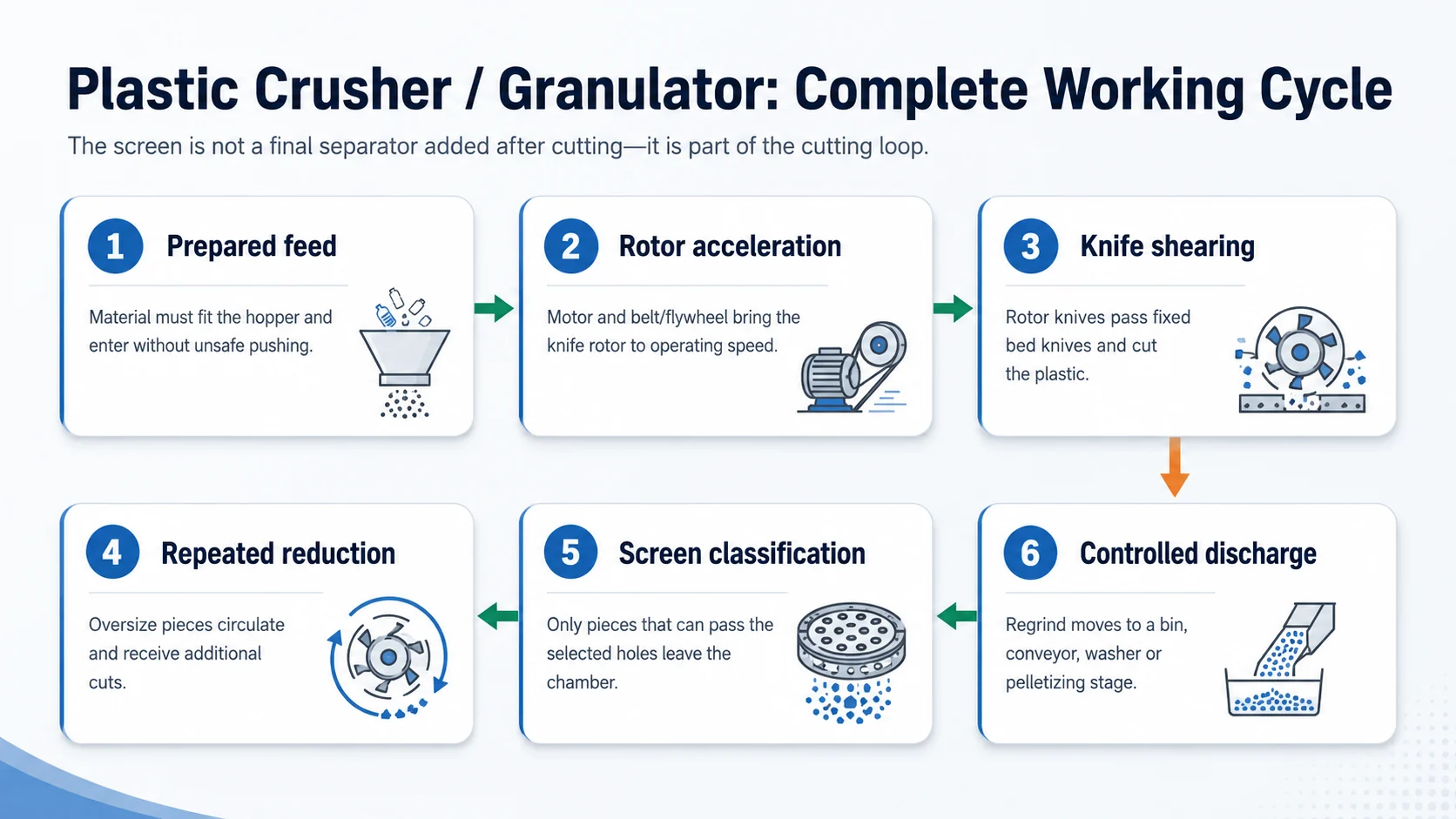
1. The feed is prepared and presented to the hopper
The cycle starts before the motor is loaded. Parts must fit the hopper, fall toward the cutting circle, and reach the knives without requiring an operator to push material into a hazard zone. Part shape matters as much as polymer type. A flat sheet skeleton, a hollow bottle, a dense purge, and a flexible film bundle can all be made from thermoplastics but behave very differently at the inlet.
Stable feeding keeps the chamber occupied without packing it solid. An empty chamber wastes motor time; an overfilled chamber causes current spikes, repeated overloads, heat, and irregular output. Feed conveyors, roll feeders, bale opening, pre-cutting, or pre-shredding may be needed when gravity feeding is not reliable.
2. The drive brings the rotor to operating speed
The motor transmits power through belts,pulleys,couplings or other drive devices.Rotors and flywheels store rotational energy.Once the material enters,the stored inertia helps the tool to continue to pass each cut,instead of relying on instantaneous motor power.
Rotor speed is not an isolated performance number. More knife passes per minute can increase cutting opportunities, but the result also depends on rotor diameter, knife count, cutting angle, chamber geometry, screen area, and whether accepted regrind can leave quickly.
3. Rotor knives pass the fixed knives and create the cut
The main size-reduction event occurs at the narrow clearance between moving rotor knives and stationary bed knives. The action is closer to industrial scissors than to a hammer smashing plastic. The moving knife carries the part into the fixed edge; the local stress exceeds the material’s resistance and a section is severed.
Clean shearing requires sharp edges, firm tool mounting,correct alignment,and the gap specified by the manufacturer.When the knife is blunt or the gap is wrong,the machine will rub,tear,bend or beat the material instead of cutting it clean.This increases temperature,noise,electricity demand,fines,and the risk of smearing soft polymers on the screen.
4. Oversize pieces recirculate in the cutting chamber
A first cut rarely creates finished regrind. Pieces are thrown, redirected, and drawn back toward the cutting zone. Their orientation changes with each contact, so subsequent knife passes reduce different dimensions.
This repeated-cut behavior explains why feed form affects throughput. Thin brittle parts may fracture and clear quickly. Thick, ductile, or rounded parts can bounce or deform before the knives establish a good bite. Film can flutter, bridge, or wind around rotating components instead of behaving like rigid scrap.
5. The screen classifies the material inside the machine
A perforated screen is mounted beneath or around the lower part of the rotor. It acts as a retention gate. Pieces that can pass the openings leave the cutting chamber; pieces that cannot pass remain available for more cuts.
The screen opening is therefore a process setting, not merely an accessory dimension. Smaller holes normally demand more cuts and longer residence time. That can create finer regrind, but it can also reduce throughput, increase heat, and raise the amount of fines if knife condition or discharge is poor.
6. Accepted regrind is discharged and transferred downstream
Once material passes the screen, it must be removed from the lower chamber. Depending on the configuration, the exhaust may use gravity,screw,belt conveyor or pneumatic airflow.The removal of defects will cause re-grinding and accumulation,re-enter the cutting area,and be subjected to unnecessary additional cuts.If there is no useful production,the result may be more dust,heat and energy consumption.
The discharge point should be designed with the next operation in mind. A washing line needs consistent transfer and water-management planning. An extrusion line may need dust removal, metal protection, blending, and controlled storage. Internal regrind reuse may require stricter color, resin, and contamination control.
Main Components and What Each One Actually Does
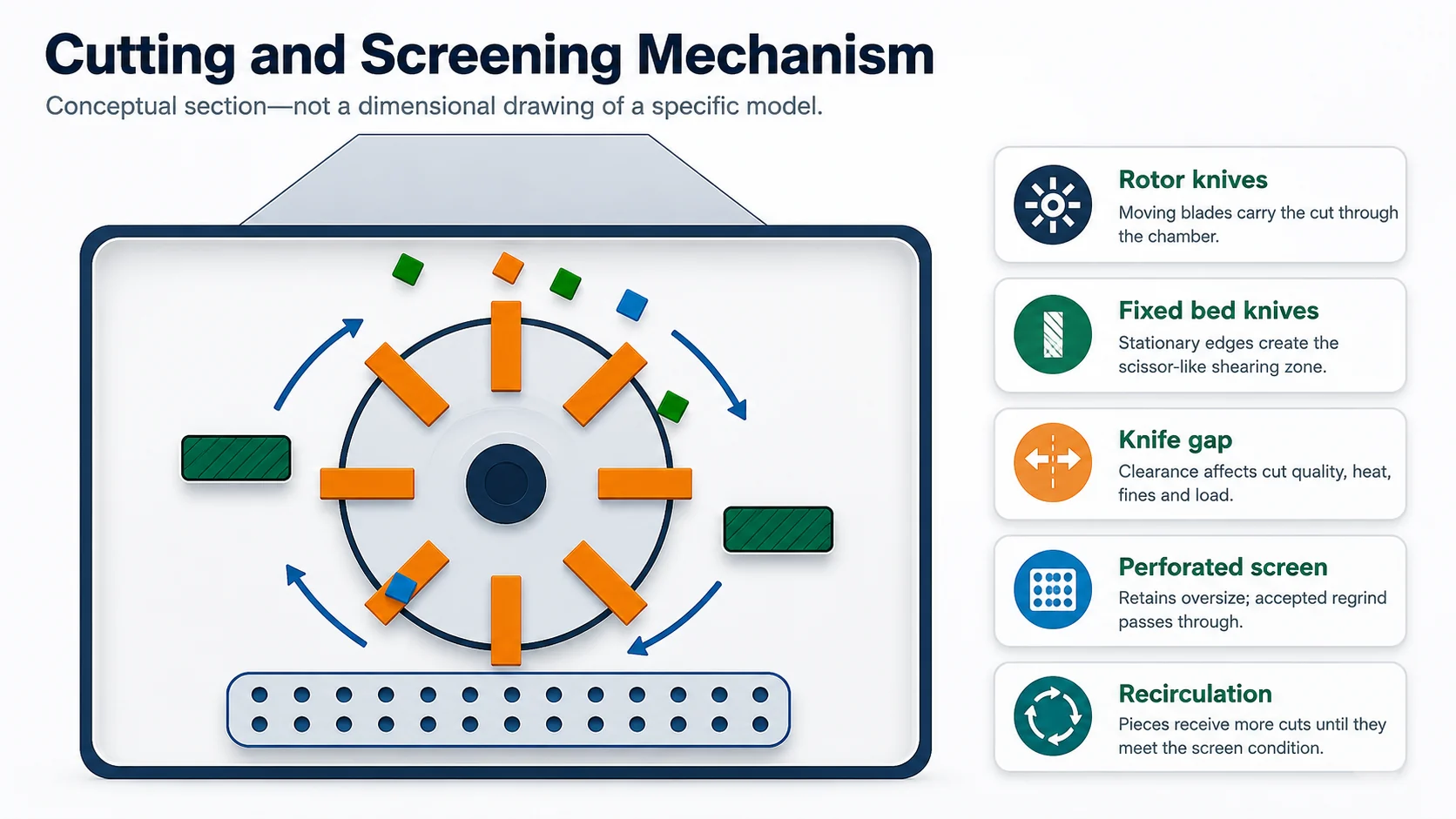
| Component | Function | Buyer or operator check |
|---|---|---|
| Feed hopper | Receives parts and keeps people away from the cutting zone | Largest safe part size, anti-kickback design, bridging risk, interlocks |
| Rotor | Carries moving knives through the cutting circle | Rotor design, balance, inertia, knife mounting, access for cleaning |
| Rotor knives | Deliver repeated moving cuts | Material, geometry, sharpness, fastening, resharpening limit |
| Fixed bed knives | Provide the stationary cutting edge | Adjustment method, alignment, replacement access |
| Knife gap | Controls how cleanly the two edges shear | Specified setting and measurement method—not a guessed clearance |
| Screen | Retains oversize and releases accepted regrind | Opening size, open area, thickness, wear, removal time |
| Drive and bearings | Supply and support rotor motion under changing load | Overload protection, belt tension, lubrication, temperature, vibration |
| Discharge system | Removes accepted material from below the screen | Transfer capacity, dust, blockages, downstream interface |
| Controls and guards | Prevent unsafe access and manage start, stop, overload, and emergency states | Interlocks, emergency stops, rotor stop time, electrical isolation |
How the YUXI YX-G Series Fits This Working Principle
The current YUXI product page uses the broad name “Plastic Shredder Machine,” but its published YX-G specifications are better understood as a plastic crusher/granulator stage. The evidence is the combination of a 560 rpm rotor, rotating and fixed knives, and 10–12 mm screen openings. That architecture is materially different from the lower-speed, high-torque single- or double-shaft shredders used for bulky pre-reduction.
The published model range is summarized below. These figures should be treated as reference specifications, not unconditional production guarantees.
| Model | Motor | Rotor speed | Screen opening | Cutting chamber | Published output |
|---|---|---|---|---|---|
| YX-2640G | 7.5 kW | 560 rpm | 10 mm | 270 × 400 mm | 300–550 kg/h |
| YX-2650G | 11 kW | 560 rpm | 10 mm | 270 × 500 mm | 400–650 kg/h |
| YX-3660G | 15 kW | 560 rpm | 12 mm | 370 × 600 mm | 400–700 kg/h |
| YX-3680G | 22 kW | 560 rpm | 12 mm | 370 × 800 mm | 600–900 kg/h |
| YX-4680G | 30 kW | 560 rpm | 12 mm | 480 × 800 mm | 700–1,200 kg/h |
| YX-46100G | 37 kW | 560 rpm | 12 mm | 480 × 1,000 mm | 800–1,600 kg/h |
The published output should always be related to the tested plastic,part size,volume density,moisture,polllution,screen opening,tool condition,feeding method,diacharge arrangement and net operation time.When the downstream washer or extruder can accept less material than the crusher,the widest chamber or the largest motor is not the best choice for automation.
What Changes the Cutting Result?
Knife condition and knife gap
Sharp, correctly aligned knives separate material with less rubbing. Dull edges increase residence time because pieces deform or bounce instead of being severed. A gap that is too large encourages tearing and fines; a gap that is too small risks contact, heat, and mechanical damage. The correct value is machine- and material-specific and should come from the manufacturer’s service procedure.
Screen opening and open area
The hole size affects the release condition, while total open area affects how easily accepted regrind can leave. Two screens with the same nominal hole diameter can behave differently if thickness, hole pattern, wear, or blank area changes. A worn screen can also pass larger, less consistent pieces.
Rotor design, knife count, and speed
More knife passes create more opportunities to cut, but they can also carry particles around the chamber and generate fines if the screen cannot release material fast enough. Cumberland notes that rotor, knife arrangement, tip angle, speed, and sharpness all influence granulate quality and efficiency. This is why a 560 rpm number should be read together with rotor diameter, knife configuration, and screen area.
Material temperature and ductility
Cold, brittle plastic may fracture readily. Warm or ductile material can stretch and absorb energy. Heat-sensitive polymers may soften as residence time and friction rise. If the material begins to smear, the operator should investigate cutting quality and material flow rather than simply forcing more feed into the chamber.
Feed geometry and bulk density
A kilogram of solid purgings occupies much less hopper volume than a kilogram of bottles or film. Low-density feed can make a machine appear “slow” because the volumetric feed rate, not the cutting force, becomes the bottleneck. Long parts can bridge across the hopper. Round hollow items can roll and bounce before the knives take a bite.
Contamination
Metal, stones, sand, glass fiber, and mineral fillers accelerate wear or cause sudden damage. EPA distinguishes mono-material plastic products from multi-material products that may also include paper or metal. From an equipment perspective, that distinction matters because the crusher does not sort incompatible polymers or protect itself from every foreign object. Sorting and metal protection belong upstream.
Why Plastic Crusher Capacity Varies So Much
Catalog capacity is usually a range because the crusher is part of a material-handling system. The same machine can show very different hourly output on clean injection runners, hollow bottles, thick HDPE sections, and mixed post-consumer parts.
A useful capacity equation is not a single formula but a chain:
Any weak link lowers the measured kg/h. A wide chamber cannot compensate for a hopper that bridges. A large motor cannot compensate for dull knives. A larger screen may improve throughput but produce output that the washer or extruder does not want. A short test can also hide time lost to clearing, screen cleaning, knife inspection, bin changes, and normal material variation.
When comparing quotations, ask whether the number is instantaneous feed rate, peak output, or sustained net production. The most useful figure is sustained accepted regrind per hour on representative material after the line has reached stable operation.
Which Feed Can Go Directly to a Crusher?
| Feed condition | Likely route | What must be confirmed |
|---|---|---|
| Sprues, runners, defective molded parts, smaller rigid scrap | Often suitable for direct granulation | Largest dimensions, wall thickness, resin, metal inserts, target regrind |
| Flattened or controlled-size bottles and containers | Direct crusher or integrated washing-line crusher | Labels, caps, liquid, feed rate, wet or dry process |
| Large drums, crates, pallets, IBC sections | Pre-cut or pre-shred before granulation in many projects | Hopper opening, bite, part rebound, safe loading, full-cycle test |
| Long or large-diameter pipe | Dedicated pipe feeding, cutting, or first-stage shredding | Diameter, wall thickness, length, resin, feed restraint |
| Loose film, bags, woven sacks | Controlled feeder or pre-shredder may be required | Wrapping, bridging, bale density, moisture, sand, throughput stability |
| Dense purgings and lumps | Test before direct granulation; pre-shredding may be safer | Maximum mass, temperature, brittleness, rotor bite, current draw |
| Mixed post-consumer plastic | Sort and remove hazards before size reduction | Resin mix, metal, glass, dirt, moisture, downstream quality target |
This is why “Can it crush HDPE?” is not enough information. A thin HDPE bottle and a cold solid HDPE purge can require very different chamber, rotor, feeding, and drive conditions even though the resin name is the same.
One-Stage vs Two-Stage Size Reduction
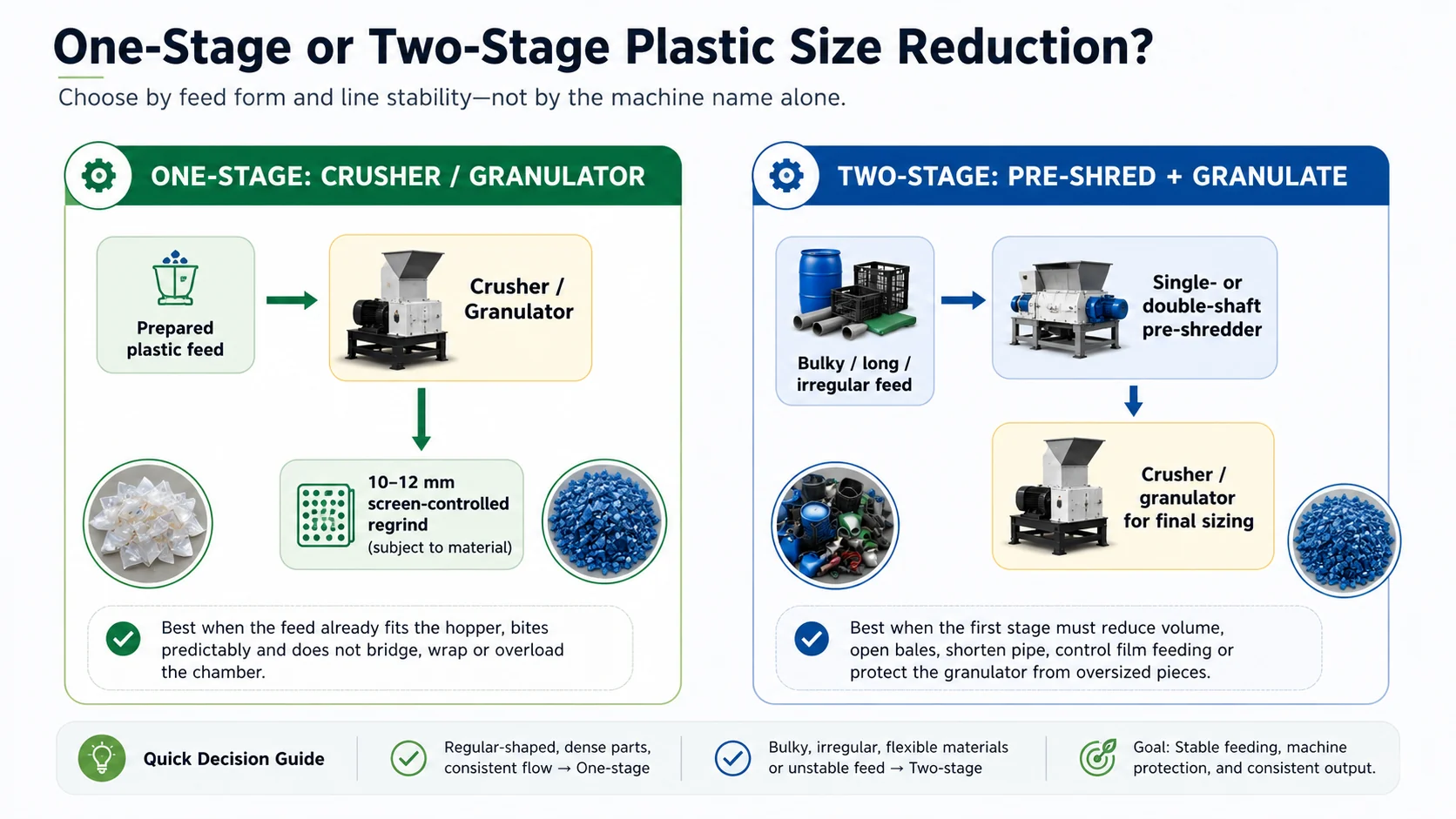
Single-stage crushers are very attractive because the line is shorter and there are fewer transmission points.The effect is best when the input is already suitable for the hopper,the knife can accept predictable bite,and the output of the screen control matches the next process.
Two-stage reduction is often more stable when feed is bulky, long, baled, flexible, or dense. A single-shaft shredder can use a pusher and screen to create controlled pre-shred, while a double-shaft shredder is useful for rough opening and volume reduction. The crusher then performs the finer, high-frequency cutting stage.
The extra machine is not automatically wasted cost. It can protect the granulator from oversize feed, reduce unsafe manual intervention, stabilize amperage, and make the second-stage output easier to control. The decision should be based on a material test and the economics of uptime, not on the desire to make one machine process every feed form.
The Safety Boundary Is Part of the Working Principle
The rotor continues to store energy after power is removed, and the hopper, screen cradle, belts, pulleys, and cutting chamber all contain potential hazard points. A normal production interlock is not a substitute for an energy-control procedure during cleaning, unjamming, screen changes, or knife work.
OSHA’s plastics-machinery guidance warns that missing, removed, or bypassed guards can expose workers to moving parts and severe injuries. OSHA also requires an effective lockout/tagout program where servicing could expose a worker to unexpected energization or startup. Site procedures must consider electrical energy,rotor coast descent,gravity,pneumatic or hydraulic equipment,and any stored mechanical energy.
- When the machine is running,do not use hands,feet,rods or loose tools to force the material through the hopper.
- Before entering or reaching the danger zone,stop,isolate,lock,verify thje zero energy state,and wait for the full rotor to stop.
- Keep guards and interlocks functional; do not defeat them to shorten cleaning or setup time.
- Use the manufacturer’s rotor-locking, knife-handling, lifting, and torque procedures.
- Assess dust, noise, ejected fragments, fire load, and housekeeping for the actual resin and contamination.
What a Buyer Should Verify in a Material Test or FAT
A useful factory acceptance test does more than show that the rotor turns and plastic comes out. It should prove that the whole cycle remains stable on the buyer’s representative—and preferably most difficult—feed.
- Representative feed: record resin, product form, dimensions, bulk density, moisture, and contamination.
- Safe loading: confirm the material enters without reaching into the hopper or repeated manual pushing.
- Stable current: record normal load, peaks, overload trips, and restart behavior.
- Net capacity: weigh accepted output over a meaningful stable period and include normal handling time.
- Output distribution: inspect oversize, longs, fines, dust, and heat—not only one attractive handful.
- Screen result: confirm the installed opening, screen condition, and whether it matches downstream equipment.
- Temperature and smearing: inspect the chamber, screen, and output after continuous running.
- Metal protection: define upstream magnets, detection, sorting, and the response to foreign objects.
- Maintenance access: demonstrate opening, cleaning, screen removal, knife access, rotor locking, and safe lifting points.
- Line interface: verify discharge height, airflow or conveyor capacity, dust management, and downstream feed rate.
The existing plastic shredder machine selection guide can be used for the broader RFQ process, but this working-principle test should remain focused on how the crusher accepts, cuts, screens, and discharges the buyer’s material.
Match the Machine to the Real Feed
For YX-G model selection, send material photos, maximum dimensions, resin type, bulk density or wall thickness, contamination, required regrind, net capacity, daily hours, downstream process, voltage, and layout. YUXI can then confirm whether direct granulation is realistic or whether a pre-shredder is required.
Review the YUXI Plastic Size-Reduction Range
FAQ
Is a plastic crusher the same as a plastic granulator?
In many recycling quotations, the terms are used for the same high-speed, screen-controlled cutting machine. The important check is the mechanism: a rotor carrying moving knives cuts against fixed bed knives, and a perforated screen retains oversize material. Do not rely on the label alone.
Does the screen opening equal the exact final particle size?
No. The screen controls what can pass, but particle shape depends on the polymer, wall thickness, knife condition, cutting geometry and repeated cutting. Long, thin pieces may pass a hole even when one dimension is larger than the nominal opening.
Why are plastic crushers usually faster than a shredder?
Crushers or granulators usually use faster knife rotors for repeated cutting and finer output.Traditional single-shaft or double-shaft shredders work more slowly and are more suitable for bulky,different or irregular feeding.The correct choice depends on the input form and the downstream goal.
Can the YUXI YX-G series process plastic film?
Film suitability cannot be confirmed from polymer name alone. Loose film and woven bags can bridge, flutter or wrap, so feeding method, bundle form, contamination and test results matter. Some projects need controlled feeding or a pre-shredding stage before granulation.
Why can actual capacity be lower than the catalog range?
The throughput changes with volume density,part geometry,screen opening,sharpness,knife gap,feed consistency,moisture,pollution,discharge efficiency and downtime. A useful acceptance test measures sustained net output on representative material, not a short no-load or hand-fed demonstration.
What causes plastic to melt or smear in the cutting chamber?
Common contributors include dull knives, excessive rubbing, an unsuitable knife gap, an overly small screen, slow discharge, unstable overfeeding and heat-sensitive material. Stop and inspect rather than treating the symptom by increasing feed pressure.
When should a buyer use two-stage size reduction?
Use a pre-shredder before the crusher when feed is too large, long, dense, low-bulk-density or irregular to enter the granulator safely and consistently. The first stage stabilizes size and feeding; the granulator then produces the controlled regrind.
What data should be sent for a machine recommendation?
Send the polymer and product form, photos and dimensions, wall thickness or bulk density, contamination, moisture, target output size, required net capacity, daily hours, downstream process, voltage and available layout. Representative samples are best when the material is unusual.
Authority and Technical Sources
- U.S. OSHA — Machine Guarding: Plastics Machinery.
- U.S. OSHA 29 CFR 1910.147 — Control of Hazardous Energy.
- U.S. EPA — About Plastic Products and Plastic Pollution: mono-material and multi-material plastic products.