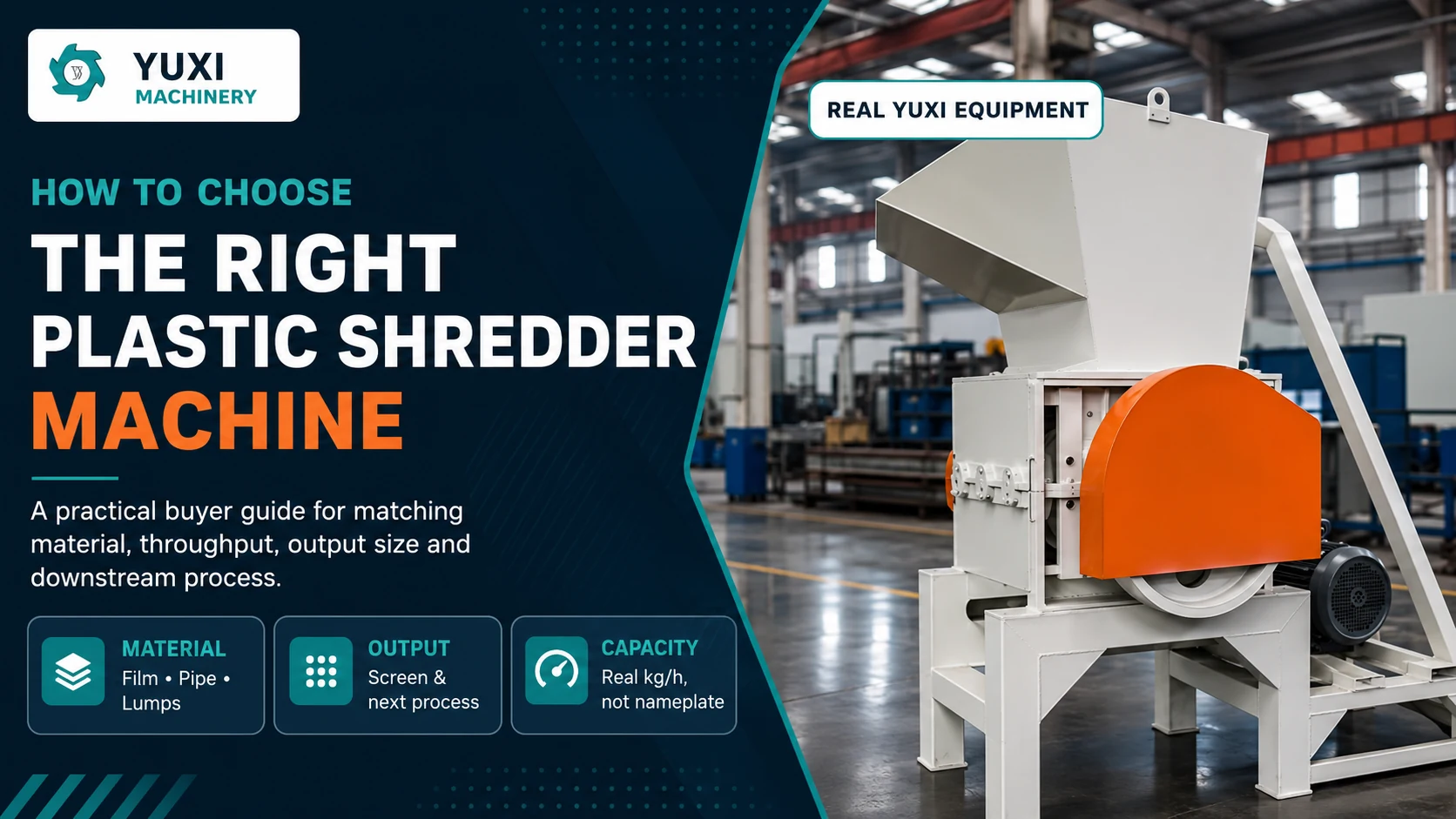
Choose the machine around the actual plastic waste, feed dimensions, required output and downstream recycling process—not around motor power or a headline capacity alone.
The correct machine is the one that keeps the whole recycling process stable, not simply the model with the largest motor or chamber.
Quick Answer: How Do You Choose a Plastic Shredder Machine?
Start with five facts: the plastic form, maximum feed dimensions, real hourly volume, required discharge size and the next machine in the process. These details decide whether you need a screen-controlled plastic shredder, a double-shaft pre-shredder, a crusher or a two-stage system.
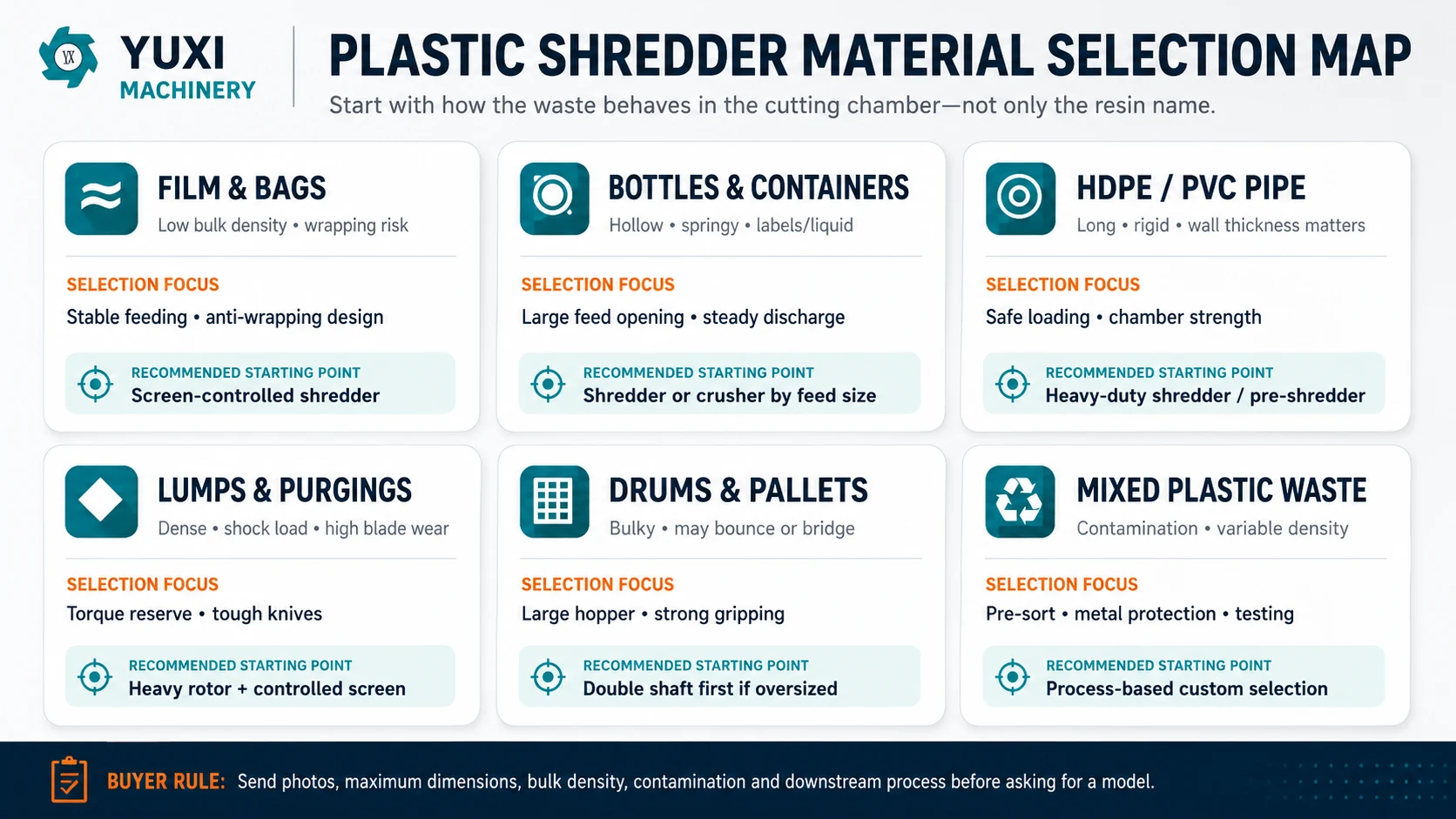
For film, feeding stability and anti-wrapping design may matter more than motor power. Long pipe and dense purgings need stronger cutting components and torque reserve. Bulky drums or pallets may need coarse pre-shredding before a screen-controlled machine or granulator. Always ask the supplier to confirm capacity on material comparable to yours.
The first buying question is not “What power do I need?” It is “What problem must the machine solve?” A shredder can reduce storage volume, open bales, prepare material for washing, protect a granulator from oversized feed or produce a controlled intermediate size. Those are different duties.
A plant processing post-consumer bottles may need stable feed into washing equipment. A pipe recycler may need to turn long, thick sections into pieces a granulator can accept. An injection molding factory may want to return clean runners and rejected parts to production. A mixed-waste operator may only need rough opening before sorting. The machine type, cutter design and acceptable output all change with the process role.
Selection note: write one sentence that defines the duty before requesting a quotation. For example: “Reduce 400 mm HDPE pipe offcuts to below 60 mm before granulation at 800 kg/h.” That sentence is far more useful than “Need plastic shredder, 30 kW.”
It is also important to decide whether the shredder must make the final saleable product. In many industrial lines, it should not. A coarse first stage followed by a crusher or granulator can be more stable, easier to maintain and less expensive per ton than forcing one machine to make very small flakes.
2. Audit the Plastic Material Before Comparing Machines
“Plastic waste” is too broad for machine selection. Even the resin name is not enough. LDPE film, an HDPE drum, a thick HDPE purge block and a woven PP bag behave differently in the cutting chamber. The supplier needs to understand material form, geometry, density and contamination.
Material form controls feeding, gripping, cutting load and wear. It should be the first selection filter.
Describe the physical form
Loose, baled, bundled, nested or compacted
Film, bottle, pipe, sheet, drum, pallet, lump or molded part
Maximum length, width, diameter and wall thickness
Approximate piece weight and bulk density
Describe the difficult parts
Metal inserts, screws, wire or closures
Sand, glass, stones, labels or paper
Moisture, oil, liquid residue or chemical exposure
Glass fiber, mineral filler or abrasive additives
Bulk density deserves special attention. A cubic meter of loose film contains far less mass than a cubic meter of dense purgings. The same chamber may appear highly productive on heavy parts but struggle to reach the same kg/h on light film because the rotor is waiting for material. For light feed, hopper behavior and controlled pushing can determine output more than installed motor power.
Contamination affects machine choice, wear and downtime. Sand and glass accelerate knife wear. Metal can chip blades or damage a screen. Wet or sticky material can block discharge and increase cleaning time. A supplier who only asks for the resin type is not yet ready to recommend a reliable configuration.
3. Choose Between a Plastic Shredder, Double-Shaft Pre-Shredder and Crusher
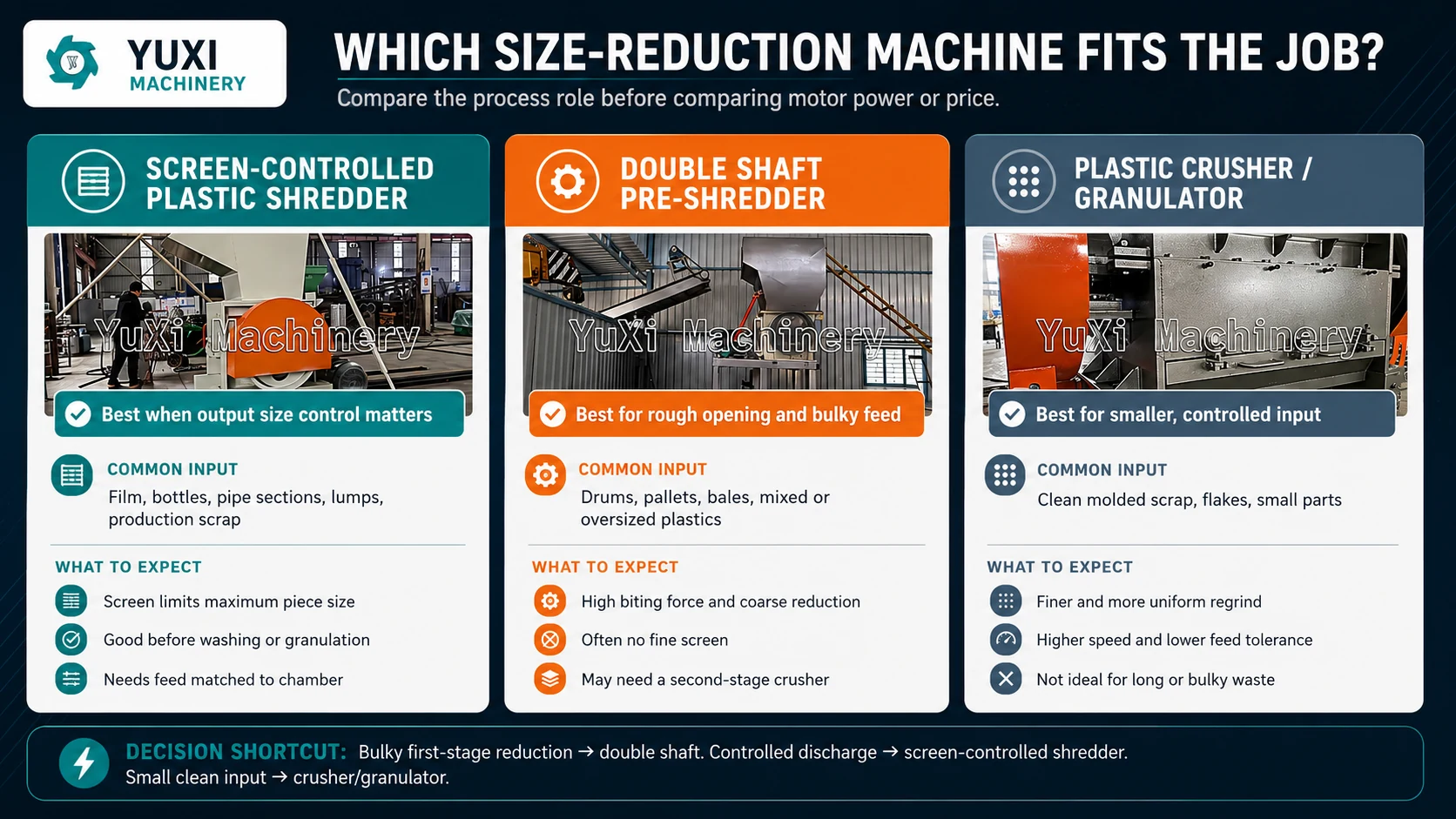
Industrial buyers often compare three machine categories that overlap in marketing language but perform different jobs. The correct choice depends on feed tolerance and the required discharge.
Machine type should be selected by process role, not by the label used in an online listing.
Machine type
Best use
Output behavior
Main limitation
Screen-controlled plastic shredder
Film, bottles, pipe sections, molded parts, lumps and factory scrap when a maximum discharge size is needed
Oversized pieces remain in the chamber until they pass through the screen
Very bulky or long items may need special feeding or pre-shredding
Opening bales, drums, pallets, large hollow parts and mixed plastic waste
Coarse, irregular output with strong biting action
Often needs a second stage when a smaller, controlled output is required
Plastic crusher / granulator
Clean, smaller and consistently fed plastic parts or pre-shredded material
Finer, more uniform regrind
Less tolerant of long, bulky, tangled or uncontrolled feed
Two-stage system
Large or difficult feed that must become stable flakes for washing or extrusion
Coarse shredding first, finer granulation second
More equipment, floor space and maintenance planning
A single shaft shredder is commonly chosen when controlled discharge and repeated cutting against a screen are important. A double-shaft machine is often better when the first task is to grip and open large, bulky waste. Neither is universally better. They solve different feed problems.
Unsuitable scenario: a small high-speed crusher should not be treated as a substitute for a heavy-duty shredder when the input includes long pipe, large purge blocks, film bales or uncontrolled mixed plastics. The machine may jam, require constant manual pre-cutting or suffer avoidable damage.
4. Set Capacity from Real Material and Working Hours
Published throughput is a reference, not a universal promise. Capacity changes with material density, feed size, screen opening, contamination, knife condition and how consistently the chamber is loaded. A specification that says “1000 kg/h” without naming the material and output size is incomplete.
Start with the daily volume. If the plant must process 6 tons during an eight-hour shift, the arithmetic target is 750 kg/h. The machine should have enough margin for loading interruptions, cleaning, screen changes and normal wear. But excessive oversizing can also be wasteful: a large chamber may not grip small light pieces efficiently, and the larger drive increases capital and electrical infrastructure.
Field note: ask for three numbers: tested capacity on comparable material, expected continuous capacity in your line and maximum short-term capacity. Treat the continuous number as the planning value.
Working hours influence the required duty level. A reclaim machine operating two hours per day can use a different maintenance strategy from a recycling plant running two shifts. Continuous service calls for careful attention to bearings, cooling, lubrication, access for knife changes and the availability of spare screens and cutting parts.
5. Match the Chamber, Hopper and Feeding Method to the Input
A machine can have enough power and still underperform because the waste does not reach the cutters consistently. Feeding is often the real bottleneck in plastic shredding.
Film and woven bags
Loose film is light, elastic and easy to wrap. It can bridge in a hopper or move with the rotor instead of being cut. The supplier should explain how the material is kept in the cutting zone, how wrapping is controlled and whether bales must be opened before feeding.
Long pipe and profiles
Long sections create loading and safety issues. Confirm the maximum pipe diameter, wall thickness and length that can be introduced without unsafe manual handling. Large pipes may need a horizontal feed arrangement or a dedicated pre-shredder rather than a standard top hopper.
Drums, pallets and hollow parts
Bulky hollow plastics can bounce above the cutters. The opening must accept the part, while the cutter geometry must create enough grip to pull it in. If operators must repeatedly push material by hand, the configuration is wrong.
Lumps and purgings
Dense blocks place high instantaneous load on knives, rotor and drive. The chamber should not be sized only by whether the piece physically fits. The supplier must check whether the cutter can bite the material without excessive shock or repeated overload.
6. Specify the Output Size Around the Next Process
On a screen-controlled machine, the screen limits the maximum discharge size. A smaller opening generally produces smaller pieces, but it can also reduce throughput, increase recirculation and accelerate wear. The correct screen is the largest opening that still feeds the next process reliably.
If a granulator follows, the shredder may only need to reduce bulky material into pieces that enter the granulator safely. If the discharge goes directly to washing, the wash tank, screw conveyor and friction washer may have their own size limits. Pelletizing lines may require still smaller and more consistent flakes, but that does not automatically mean the first shredder should make the final size.
Buyer mistake: requesting “10 mm output” because a competitor lists that number, without checking whether the actual material can pass a 10 mm screen economically. Output size must be tied to the material thickness, capacity and downstream equipment.
Ask to see a representative sample after a full material test. A photo of a few ideal flakes is not enough. Look for the range of sizes, the amount of fines, any long strips and how consistently the machine discharges over time.
7. Compare the Cutting System and Drive—not Only Motor Power
Motor power is easy to compare, but it does not explain whether a machine is suited to the job. Buyers should review the complete path from the motor to the material.
Rotor or shaft geometry: diameter, working width, knife arrangement and how the material is gripped.
Blade material and heat treatment: toughness, wear resistance, re-sharpening method and replacement procedure.
Fixed counter knives: adjustment method, clearance and accessibility.
Screen: hole size, thickness, support structure and opening method for service.
Transmission: gearbox or belt drive, coupling, bearings, seals and overload protection.
Control logic: current monitoring, reverse sequence, restart behavior and fault records.
Thin, soft film needs a different cutting edge and feeding behavior from thick pipe or glass-filled parts. A knife that stays sharp on clean molded scrap may wear quickly in sand-contaminated agricultural film. When the supplier recommends one blade configuration for every plastic, ask for application-specific test evidence.
Auto-reverse is useful, but it is not a cure for a wrong machine. Frequent reversing means the chamber is overloaded, the feed is unsuitable, the knives are dull, the screen is too small or the drive lacks reserve. Stable production should not depend on constant reversing.
8. Select the Shredder as Part of the Complete Recycling Line
A plastic shredder rarely works alone in a commercial plant. It may receive material from a sorting belt or bale opener and discharge to a crusher, magnetic separator, wash tank, dryer or pelletizer. The machine must fit the physical and process layout.
Confirm the feed height, discharge height, conveyor width, transfer points and maintenance clearance. Check whether wet material can drain, whether dust or light film can escape, and how metal contamination will be detected. The control system should coordinate starts, stops and overloads with the equipment before and after the shredder.
For an existing line, provide a drawing with floor space, ceiling height, access doors and available electrical power. A technically suitable machine can still become expensive if it cannot enter the building, align with the existing conveyor or open for maintenance.
Unsuitable scenario: buying a standalone machine today with no discussion of future washing or pelletizing, then expecting it to integrate later without changes. Discharge size, elevation, controls and capacity should be planned for the intended process from the start.
9. Check Maintenance Access, Safety and Site Conditions
Most buyers compare production data first and maintenance access last. In daily operation, the opposite order is often more useful. Knives dull, screens block and contamination must be removed. The machine should be designed so these tasks can be completed safely and without excessive downtime.
Ask how the hopper and screen are opened, what lifting tools are required, how knives are locked during service and how the rotor is prevented from moving. The installation should include guarding, emergency stops, interlocks and documented isolation points. OSHA’s lockout/tagout guidance is a useful reference for controlling hazardous energy during service, while ISO 12100 provides a general machinery risk-assessment framework.
Site conditions also matter. Outdoor installation, high humidity, salt air, dust, low temperature or a wet washing area can change enclosure, coating and electrical requirements. Confirm voltage, frequency, phase, control cabinet cooling and local component standards before production.
The best spare-parts package is application-specific. Clean factory scrap may need only routine knives and screens. Dirty mixed plastics may justify additional cutting parts, bearings, seals and a faster re-sharpening plan. Request lead times and drawings for wear parts before the machine ships.
10. Practical Selection Notes by Plastic Waste Type
Loose or baled? Wet or sandy? What feeds the washing line?
PET bottles / HDPE containers
Hollow parts, labels, caps and residual liquid
Large opening, controlled discharge, drainage and downstream washing fit
Are bottles flattened? Are labels and liquids removed first?
HDPE / PVC pipe
Length, diameter and wall thickness
Safe loading, strong cutting, chamber and drive reserve
Maximum diameter? Longest section? Pre-cutting available?
Injection molding scrap
Wide mix of runners, parts and occasional dense lumps
Screen control, clean handling and manageable fines
Will regrind return to production? What final flake size is acceptable?
Purgings and solid lumps
High piece weight and shock load
Heavy rotor, tough knives, overload protection and test proof
Largest piece weight? Resin temperature? Fillers or metal inserts?
Drums, crates and pallets
Bulky feed that may bounce
Large hopper, strong gripping or double-shaft first stage
Can parts be flattened? Is coarse output acceptable?
Mixed industrial plastics
Variable density and contamination
Pre-sorting, metal protection, tolerant first stage and testing
What percentage is metal, rubber, textile, wood or dirt?
11. How the Current YUXI Plastic Shredder Range Fits Selection
The current YUXI product page lists six screen-controlled plastic size-reduction models. Published motor power ranges from 7.5 to 37 kW, cutting chambers from 270 × 400 mm to 480 × 1000 mm, and reference output from 300 to 1600 kg/h. The listed screen diameters are 10 or 12 mm, with a published rotor speed of 560 rpm.
Model
Power
Cutting chamber
Screen
Published output
YX-2640G
7.5 kW
270 × 400 mm
Φ10 mm
300–550 kg/h
YX-2650G
11 kW
270 × 500 mm
Φ10 mm
400–650 kg/h
YX-3660G
15 kW
370 × 600 mm
Φ12 mm
400–700 kg/h
YX-3680G
22 kW
370 × 800 mm
Φ12 mm
600–900 kg/h
YX-4680G
30 kW
480 × 800 mm
Φ12 mm
700–1200 kg/h
YX-46100G
37 kW
480 × 1000 mm
Φ12 mm
800–1600 kg/h
These figures are a starting point only. Actual output depends on material form, bulk density, moisture, contamination, blade condition, screen and feeding stability. A light film application should not assume the same kg/h as dense molded parts. Likewise, a piece that fits the opening may still be too thick or heavy for the intended cutting duty.
The selection discussion should therefore begin with the smallest model that can accept the feed and meet continuous output with margin, then check whether a larger chamber or a different machine type is justified. For very large pipe, bulky pallets or mixed contaminated waste, a dedicated pre-shredder may be more appropriate than simply moving to the largest model in this series.
12. Verify the Supplier’s Recommendation Before Ordering
A good quotation should explain why the proposed machine matches the material. It should not be a catalog page with a price added. Ask the supplier to identify the assumptions behind the configuration.
What material and screen were used for the quoted capacity?
What is the largest acceptable feed item, not only the chamber opening?
What blade material and arrangement are recommended for this waste?
How often is reversing expected during normal operation?
How are the knives, counter knives and screen serviced?
Which motor, transmission, bearings and electrical components are included?
What protection is provided against metal contamination?
Which spare parts are included, and what are their lead times?
What documents, drawings, manuals and commissioning support are supplied?
For difficult materials, request a material test. The video should show the original feed, the full loading cycle, machine current or overload behavior, discharge through the selected screen and a close view of the output. An edited ten-second clip of easy pieces does not prove continuous performance.
Also compare quotation scope. One supplier may include conveyors, a control cabinet, spare knives and export packing while another lists only the machine body. The separate plastic shredder machine price guide explains how to compare investment and total ownership cost on the same basis.
13. Common Mistakes When Choosing a Plastic Shredder
Buying by motor power
Two 30 kW machines may have different chambers, rotors, screens, bearings and duty levels. Power is one part of the specification, not the specification itself.
Using the highest catalog capacity
The top capacity number is often achieved with favorable material and feeding. Plan around tested continuous output for your waste, not the best-case headline.
Ignoring the largest or hardest item
An average feed description can hide the piece that causes every jam. Tell the supplier the maximum pipe diameter, lump weight and contamination risk.
Demanding final granules from the first stage
A very small screen can reduce capacity and increase wear. It may be better to shred coarsely and use a granulator for final size reduction.
Assuming one machine handles every plastic equally
Film, pipe, purgings and pallets need different feeding and cutting behavior. A versatile machine still needs a defined operating envelope.
Leaving line layout until after purchase
Conveyor elevations, access, floor loading, electrical supply and maintenance clearance should be confirmed before manufacturing drawings are approved.
Skipping a material test
Testing is especially important for dirty film, glass-filled plastics, long pipe, dense purgings and mixed waste. These applications create the most uncertainty.
14. Plastic Shredder RFQ Checklist
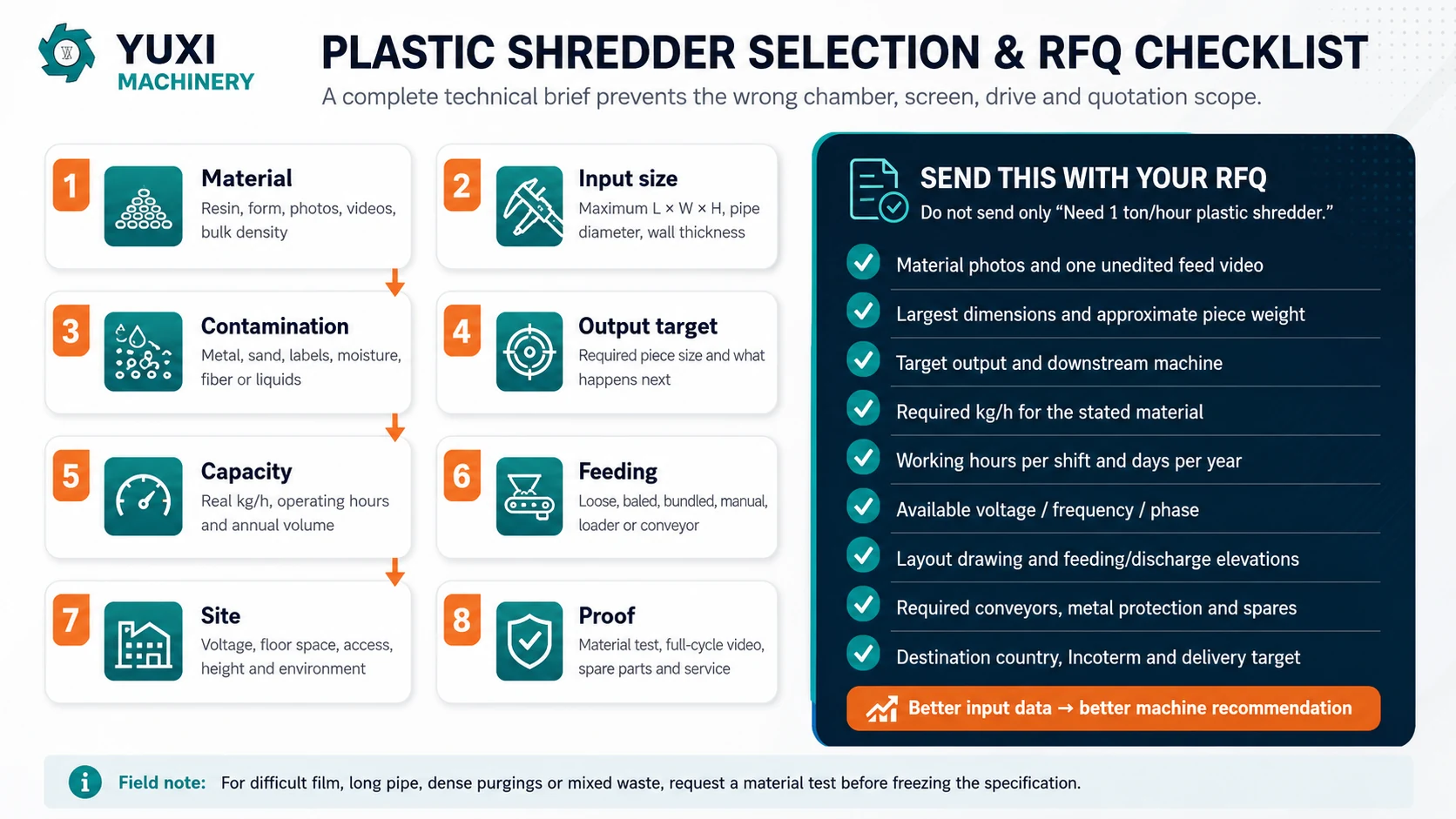
A complete RFQ lets the supplier recommend a chamber, screen and drive around the real duty.
Send the following information in the first inquiry:
Material: resin type, material form, clear photos and one unedited video.
Dimensions: maximum length, width, diameter, wall thickness and approximate piece weight.
Condition: loose or baled, wet or dry, clean or contaminated, and any metal or abrasive content.
Output: required maximum size and the machine or process that follows.
Capacity: required kg/h, working hours per shift and annual volume.
Feeding: manual, loader, conveyor, bale opener or other method.
Site: voltage, frequency, phase, floor space, access and environmental conditions.
Scope: conveyors, metal separation, crusher, washing equipment, spares and commissioning.
Commercial details: destination, preferred Incoterm and required delivery schedule.
Final Recommendation
The right plastic shredder is selected from the material outward. Define what enters the machine, what must leave it and what happens next. Then compare chamber, feeding, cutter design, screen, drive, maintenance access and supplier evidence. A well-matched smaller machine can outperform an oversized model that feeds badly or produces the wrong discharge.
Before requesting a final quotation, prepare the RFQ checklist above and send representative material photos or a sample. This gives the engineering team enough information to confirm whether a screen-controlled shredder, double-shaft pre-shredder, crusher or two-stage system is the safer choice.
What size plastic shredder do I need?Match the chamber to the largest feed item and the continuous capacity to your real material. Do not choose by motor power alone.
Is a single shaft or double shaft shredder better for plastic?Single-shaft or screen-controlled machines are better when discharge size matters. Double-shaft machines are better for rough opening of bulky or mixed waste.
Can one machine shred film, pipe, bottles and lumps?Sometimes, but one setup will not perform equally well on every material. Confirm each waste stream and test the most difficult one.
How should plastic shredder capacity be calculated?Use required tons per shift, actual operating hours and expected downtime. Capacity must be stated for a named material and screen.
Does a smaller screen always give better output?No. It gives smaller discharge but can reduce throughput and increase wear. Match the screen to the downstream machine.
When is a two-stage system better?Use two stages when bulky or difficult feed must become small, consistent flakes. The first stage opens the material; the second controls final size.
Should I request a material test?Yes for long pipe, dense purgings, dirty film, filled plastics or mixed waste. Test the full cycle with the proposed screen.
What information is needed for a quotation?Send material photos, maximum size, contamination, target output, required kg/h, working hours, voltage, layout and downstream process.
Product specifications in this article are based on the YUXI plastic shredder product page reviewed on July 16, 2026. Final configuration and output require application confirmation.
David focuses on industrial shredding and recycling equipment,including material evaluation,shredder selection,process configuration,and recycling line planning.
Speak To Our Shredder Machine Expert
Get in touch with our nice team today to get a price estimate for a shredder machine.

 English



 Fast Delivery
 Reliable
 Certified
 Experienced