





This buyer’s guide cuts through the noise on pre‑shredding for plastic drums, tires, light scrap metal, wood pallets, e‑waste, MSW, and more – helping you make smart, informed decisions before the real separation work even starts.
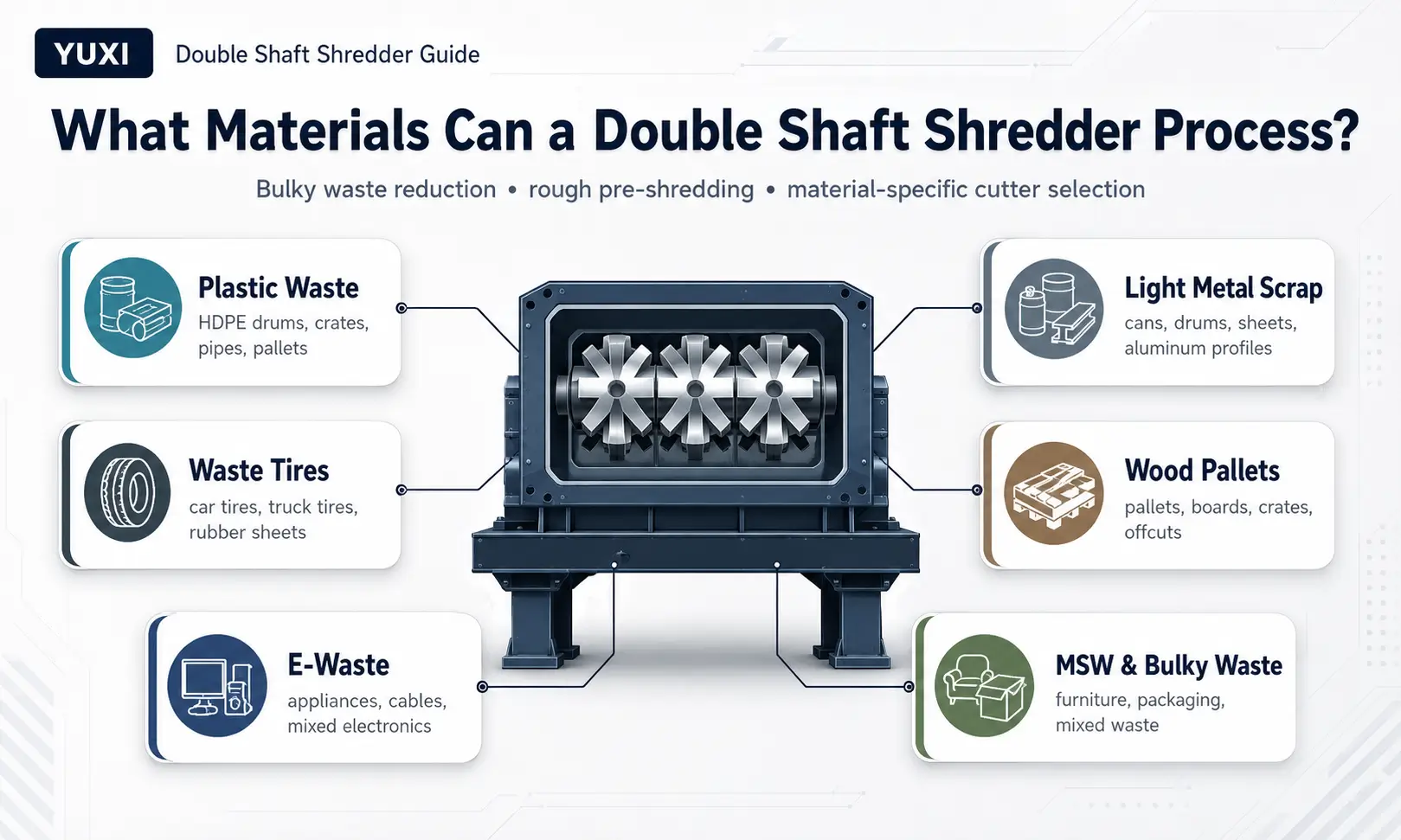
When a buyer asks, “Can your double shaft shredder process my material?”, the honest answer should not start with a simple yes. A double shaft shredder machine can process many waste streams, but stable operation depends on much more than the material name. Plastic drums, film, truck tires, aluminum extrusions, pallets, paint containers, furniture scrap, and MSW frequently appear alongside one another in product literature. Yet their actual behavior inside the shredding chamber varies widely—and that’s where the real selection challenge begins.
The real test for a shredder isn’t whether it can handle a single bite of your material. It’s whether it can keep grinding, tearing, and spitting it out, day in and day out, without clogging up, snapping blades, or screaming under the load. That’s why anyone who knows their stuff doesn’t start with a spec sheet—they start with the actual feed: the size, shape, thickness, and toughness, not to mention any contamination, how it’s loaded, the target output size, and where it goes next.
This guide explains what materials a double shaft shredder can process, where it works well, where it needs a heavy-duty configuration and where another machine may be a safer choice. It is written for recycling plants, factory waste handlers, project investors and procurement teams who need to judge whether a two shaft shredder is the right first step in a recycling line.
AIO Quick Answer
A double shaft shredder can process bulky plastic waste, waste tires, rubber products, light metal scrap, wood pallets, cardboard, textiles, e-waste, household appliances, MSW and mixed industrial waste. It works best when the material needs strong grabbing, tearing and coarse size reduction rather than precise small particle sizing. The final configuration should be selected according to material size, hardness, thickness, contamination level, cutter design, shaft strength, motor torque and required output size.
Why Material Type Matters More Than the Machine Name
Many buyers search for a double shaft shredder because they have seen that this machine is used for “plastic, metal, tires, wood and waste.” That is true in a broad sense, but it is too general for equipment selection. Two machines may both be called double shaft shredders while using different chamber widths, shaft diameters, blade thicknesses, cutter tooth profiles, reducers and drive powers. One may be suitable for plastic crates and cartons, while another is built for tires, metal buckets and mixed industrial waste.
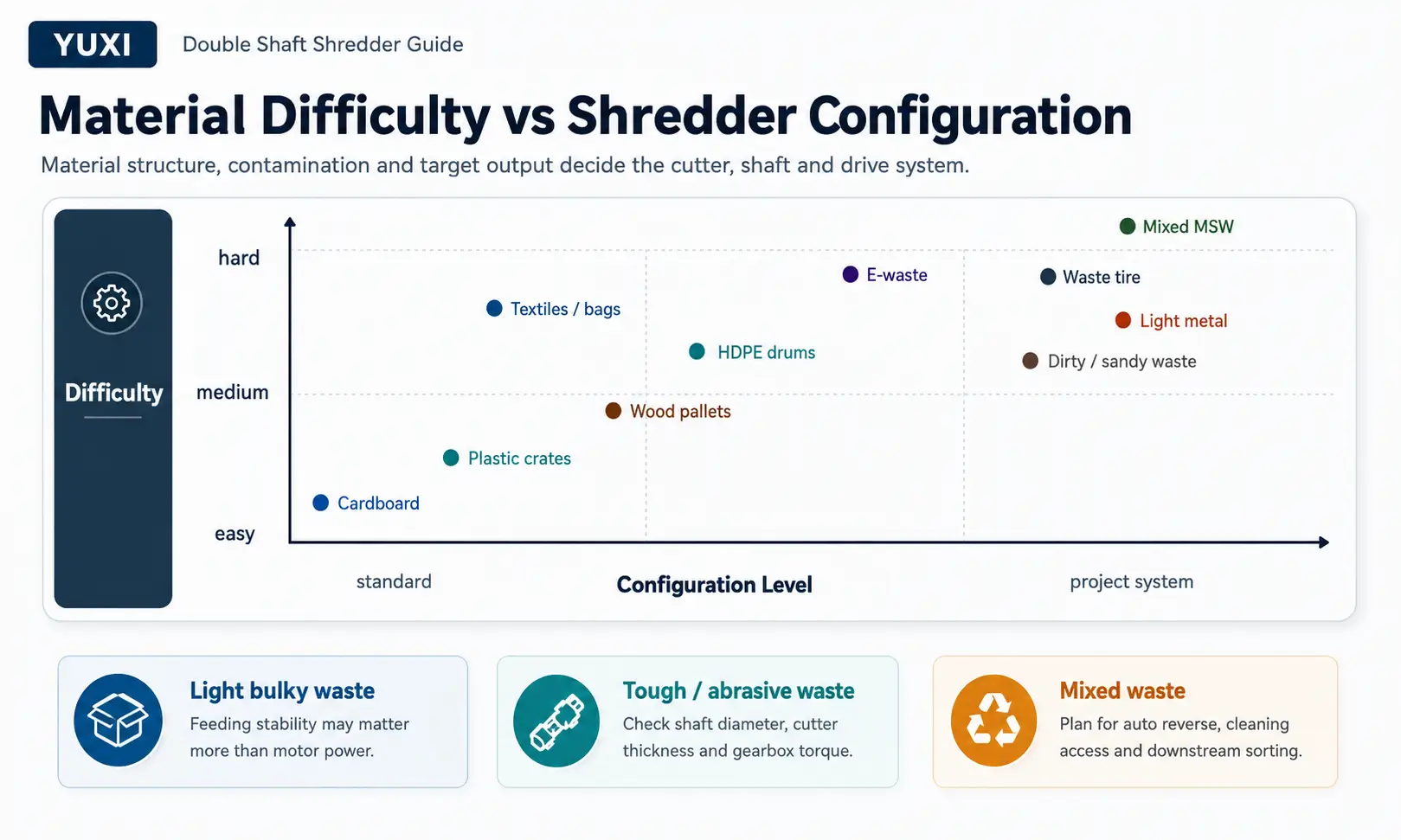
Material structure has a big influence. A hollow plastic drum collapses differently from a solid plastic lump. A passenger tire rebounds and wraps differently from a thin aluminum sheet. A wood pallet may contain nails. Mixed MSW may hide stones, textiles, wires, wet waste or hard objects. These details decide how the blades grip the material, how much torque is required, how often the PLC reverse function is triggered and how quickly the cutters wear.
For this reason, a supplier should ask for more than the material name. Here’s what we usually need to figure out the right machine: what’s the biggest piece going in? What’s the average size and thickness? Is it hollow or solid? We also look at moisture, any trash or contaminants mixed in, how fine you need the output, your target tons per hour, and how many hours a day it’ll run. Oh, and pro tip: just shoot a quick smartphone video of the waste pile and send it over. That usually tells us way more than a long text description.
Main Materials a Double Shaft Shredder Can Process
A two shaft shredder is most useful as a primary shredder or pre-shredder. Its two counter-rotating shafts pull material into the chamber, then tear and shear it into rough pieces. It is normally used before conveying, sorting, magnetic separation, eddy current separation, washing, granulation, baling, RDF preparation or further crushing.
| Material Type | Common Examples | Suitability | Selection Note |
|---|---|---|---|
| Plastic waste | HDPE drums, crates, pallets, pipes, plastic lumps | Very suitable | Cutter hook shape and blade thickness should match wall thickness and feeding size. |
| Waste tires and rubber | Passenger tires, truck tires, rubber sheets, conveyor belts | Suitable with heavy-duty setup | Requires strong torque, wear-resistant blades and controlled feeding. |
| Light metal scrap | Cans, paint buckets, thin drums, aluminum profiles, sheet scrap | Suitable with correct configuration | Not the same as shredding thick solid steel or heavy castings. |
| Wood waste | Wood pallets, boards, crates, packaging wood, furniture panels | Suitable | Check nails, stones and metal contamination before feeding. |
| E-waste | Small appliances, computer shells, keyboards, cable bundles | Suitable for pre-shredding | Downstream separation is important for metal, plastic and electronic components. |
| MSW and bulky waste | Furniture, packaging waste, household waste, industrial solid waste | Suitable for rough reduction | Material uncertainty is the main challenge; feeding control and cleaning access matter. |
| Paper, cardboard and textiles | OCC, cartons, books, fabric, woven bags, carpet waste | Suitable | Anti-winding cutter layout and discharge design should be considered. |
Plastic Waste: Drums, Crates, Pipes, Pallets and Lumps
Plastic waste is bread and butter for a double-shaft shredder. We’re talking about HDPE drums, cleaned chemical barrels, plastic buckets, crates, pallets, pipes, heavy purgings, and rigid packaging. These materials are usually just too bulky or awkwardly shaped for a standard granulator to swallow directly. That’s where the double-shaft shredder comes in—it acts as the heavy-duty primary breaker to get everything down to a manageable size.
When you’re dealing with bulky hollow plastics like 200-liter drums, the machine needs serious grab. If the bite force isn’t there, the drums will just bounce around on top of the cutters instead of drawing in. To fix this, everything has to work together: the specific hook angle of the cutters, blade thickness, the slope of the hopper, and how you control the feed.For plastic pipes, length and wall thickness matter. A thin pipe can behave like a flexible tube, while a thick-wall pipe may need stronger torque and a different cutting profile.
One buyer mistake is asking for “small output” from the first shredder without explaining the final recycling process. A double shaft shredder normally gives rough pieces. If the plastic must go into washing, granulating or pelletizing, the line may need a crusher or granulator after the shredder. For controlled particle size, a screen-equipped machine or secondary size reduction stage is usually more realistic than forcing the two shaft shredder to do everything.
Waste Tires and Rubber Materials
Waste tires look simple from the outside, but they are a demanding material. Rubber is elastic, tires are round, and many tires contain steel wire. Passenger tires, truck tires, rubber blocks, rubber sheets and conveyor belts can all be processed by a double shaft shredder, but the configuration should be heavier than a machine used only for cartons or light plastic packaging.
For tire pre-shredding, the key points are low-speed torque, cutter wear resistance, shaft strength, gearbox protection and feeding control. The shredder has to open and tear the tire instead of only scratching the surface. If the tire rebounds or rides on the cutter, capacity drops and reverse cycles increase. For truck tires or larger tires, chamber size and cutter bite become even more important.
In a complete tire recycling line, the double shaft shredder normally creates tire chips before the material moves to a rasper, steel wire separator, granulator and screening system. The shredder should not be judged by motor power alone. A lower-speed, high-torque drive with strong reducers and suitable cutter geometry is usually more important than a high-speed motor number that looks good on paper.
Light Metal Scrap: Cans, Drums, Buckets and Thin Profiles
A double-shaft shredder can absolutely handle light metal scrap, provided it’s engineered for that kind of abuse. We’re talking about things like aluminum cans, paint buckets, thin-gauge drums, sheet metal, aluminum profiles, light iron, and factory offcuts. Usually, the goal here is to crush the volume down, rip open closed containers for safety, prep the material for magnetic separation, or just take the load off your downstream granulators.
The boundary must be clear. Light metal scrap is not the same as heavy solid steel. Thick steel blocks, large bearing blocks, engine blocks, heavy castings and high-hardness alloy parts can overload a standard two shaft shredder or damage blades. For those materials, a heavy metal shredder, hydraulic shredder, hammer mill system or custom scrap metal recycling line may be more suitable.
For light metal applications, ask about shaft material, shaft diameter, blade material, heat treatment, reducer type, bearing protection and overload control. Auto-reverse is a great feature, but let’s be real—it’s not going to magically turn a light-duty shredder into a heavy-duty scrap metal beast. Good selection still depends on matching the material difficulty to the cutter and drive system.
Wood Pallets and Waste Wood
Wood waste is easy work for a double-shaft shredder—we’re talking wood pallets, packaging crates, boards, furniture panels, and light construction offcuts. The machine is a lifesaver when a plant needs to crush the bulk down before hauling it off, baling it, or prepping it for biomass, RDF production, and secondary crushing.
The hidden issue with wood pallets is not always the wood itself. Nails, screws, metal brackets, stones and concrete pieces can enter the hopper with the pallets. A properly configured machine can tolerate reasonable contamination, but no shredder likes repeated impact from hard objects that should not be in the stream. For pallet shredding, it is wise to consider a discharge conveyor and magnetic separator after the shredder.
Feeding method also affects performance. Long boards may bridge at the hopper. Pallets fed by loader may fall unevenly. A wide hopper and strong bite force help, but the operator should avoid dumping too much material at once. Stable feeding usually gives better capacity than aggressive feeding that causes repeated overload.
E-Waste and Household Appliances
E-waste is another material group where a double shaft shredder is often used as a pre-shredder. It can open small appliances, computer shells, keyboards, cable bundles, plastic electronic housings, mixed electronic scrap and some household appliance components. The goal is usually to open the material and make downstream separation possible.
Compared with high-speed crushing, low-speed shearing can be useful for mixed electronic scrap because it reduces violent impact and helps open the structure gradually. After shredding, the material may go to screening, air separation, magnetic separation, eddy current separation, electrostatic separation or manual sorting depending on the project.
However, e-waste is not one simple material. A washing machine shell, refrigerator plastic part, circuit board batch and cable bundle require different thinking. Batteries, pressurized parts, liquids and hazardous components should be removed according to local handling rules before shredding. For electronic scrap projects, the shredder should be selected together with the downstream separation process, not as a standalone machine only.
MSW, Bulky Waste and Mixed Industrial Waste
Municipal solid waste, bulky waste and mixed industrial waste are common reasons buyers consider a two shaft shredder. These materials may include furniture, packaging waste, plastic products, textile waste, foam, wood pieces, light metal items, paper, bags and factory rejects. The shredder reduces volume and prepares material for RDF/SRF production, sorting, baling or disposal reduction.
For mixed waste, the hardest part is uncertainty. The supplier needs to know whether the stream contains stones, glass, sand, mud, water, metal blocks, ropes, fabric, mattresses or sealed containers. The more uncertain the material is, the more important it becomes to design for torque reserve, auto reverse logic, easy chamber cleaning and wear part access.
A field note from many mixed-waste projects is that the rated capacity is often limited by feeding and sorting, not only by the shredder motor. If operators load wet, heavy, tangled waste in large batches, the machine may reverse more often. If the plant controls feeding and removes obvious hard contaminants, the same shredder can run more smoothly. For mixed waste, the best machine is often the one that is easiest to maintain, not only the one with the largest motor.
Paper, Cardboard, Textiles and Woven Bags
Paper, cardboard, OCC, books, cartons, textiles, leather scraps, carpet waste and woven bags are also possible materials for a double shaft shredder. These materials are normally lighter than tires or metal scrap, but they bring another issue: wrapping and bridging. Long strips of textile or woven material can wrap around shafts if the cutter layout is not suitable.
For light, bulky materials, feeding stability and anti-winding design may matter more than heavy motor power. A project that processes clean cartons all day is different from one that processes wet fabric, dirty packaging and mixed bag waste. Moisture can increase weight, reduce flow and make discharge less predictable.
If the purpose is RDF preparation or volume reduction before baling, rough shredded pieces may be enough. If the purpose is fiber recovery or a more controlled downstream process, the shredder should be integrated with a conveyor, separator, screen or secondary size reduction system.
Materials That May Not Be Suitable for a Standard Double Shaft Shredder
A strong shredder is not a license to feed everything. Some materials should be avoided or checked carefully before entering a standard double shaft shredder. This section is important because many equipment problems start when the buyer assumes “high torque” means “no material boundary.”
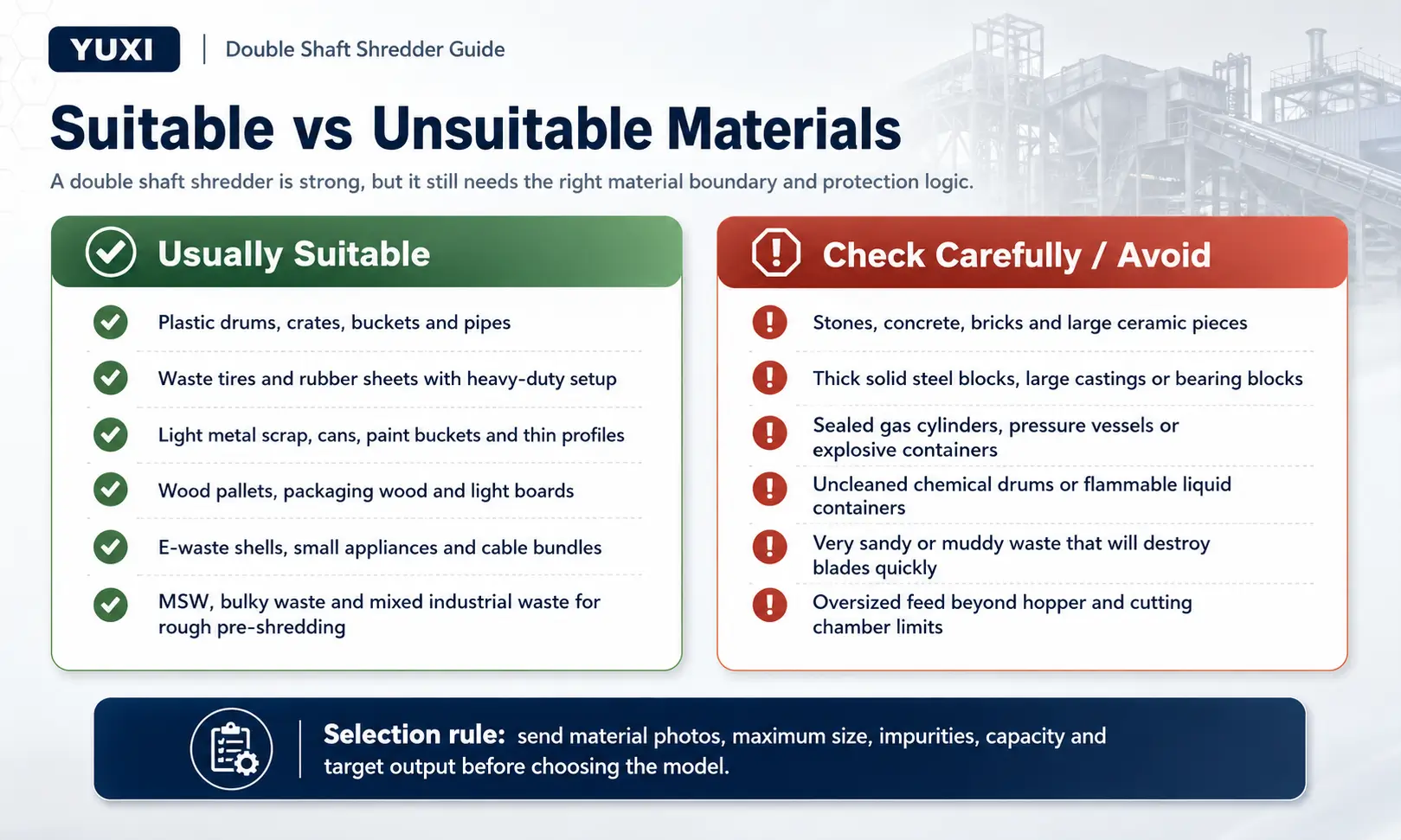
Stones, concrete, bricks, ceramics and large glass blocks are not good feed materials for most shredders. Thick solid steel blocks, bearing blocks, large castings and high-hardness alloy parts should not be treated as ordinary light metal scrap. Sealed gas cylinders, pressure vessels, explosive containers, flammable containers and uncleaned chemical drums must not be fed without proper safety handling.
Very sandy or muddy waste can also shorten blade life quickly. Even if the machine can physically tear the material, abrasive contamination may turn the project into a wear-part problem. Oversized pieces beyond the hopper opening or chamber width also need pre-cutting or a different feeding layout.
How Cutter Design Changes for Different Materials
Cutter design is one of the most important decisions in a double shaft shredder project. Buyers often ask whether thicker blades are better. The answer depends on the material and the output target. Thin blades may create smaller strips or pieces, but they may not be strong enough for tough or impact-heavy materials. Thick blades are stronger and more durable, but the output is usually rougher.
Hook shape affects how the blade grabs the material. Plastic drums, tires and wood pallets often need good bite force. Textile waste and woven bags need anti-winding consideration. Light metal scrap needs blade strength and impact resistance. Rubber and tire materials need wear resistance and enough torque to avoid long reverse cycles.
The spacer design also affects discharge size. In many double shaft machines, there is no screen controlling the final output. The size is influenced by blade thickness, tooth profile, shaft speed, material behavior and whether the material tears cleanly or bends. This is why two projects using the same chamber size may still use different cutters.
Output Size: What Buyers Often Misunderstand
A double shaft shredder is mainly a rough reduction machine. It is excellent at opening, tearing and reducing bulky materials, but it is not usually the best choice when the buyer wants very uniform small particles in one step. The output may be strips, chunks or rough pieces depending on the material.
If the project requires 20–50 mm uniform output, the line may need a secondary crusher, granulator, screen system, four shaft shredder or screen-equipped single shaft shredder. For plastic recycling, the double shaft shredder often prepares material for a crusher and washing line. For tire recycling, it prepares tire chips for a rasper and granulation line. For metal recycling, it may open and reduce light scrap before magnetic separation and further crushing.
This does not make the double shaft shredder less useful. It simply means its role should be clear. It is often the first machine that makes difficult material manageable for the rest of the recycling system.
Real Project Selection Notes
Scenario 1: Plastic Drum Recycling
A buyer processing HDPE drums should confirm drum size, wall thickness, whether the drums are cleaned, whether there is residual liquid and the target downstream process. If the drums go into a washing and granulating line, rough shredding may be enough before secondary crushing. A wide hopper, good cutter bite and stable discharge are more important than chasing an unrealistically small one-step output.
Scenario 2: Tire Pre-Shredding Line
A tire recycling project should confirm tire type, maximum diameter, percentage of truck tires, steel wire content, required tons per hour and downstream equipment. A heavy-duty double shaft shredder can be used as the first reduction stage, but the line still needs proper steel separation and granulation equipment after pre-shredding. Blade material and reducer protection are critical.
Scenario 3: Mixed Industrial Waste
For mixed factory waste, the inquiry should not stop at “industrial waste.” The supplier needs photos and a list of likely contaminants. If the material includes textiles, packaging, plastics, light metals and wood, the shredder configuration may be straightforward. If it includes stones, thick steel pieces, liquids or hazardous containers, the process needs sorting or a different machine layout before shredding.
Questions to Ask Before Buying
Before choosing a model, prepare practical information instead of only asking for a price. The more complete the material information is, the more accurate the machine recommendation will be.
- What exact material do you need to shred?
- What is the maximum feeding size and average piece size?
- Is the material hollow, solid, flexible, elastic, wet or mixed?
- Are there metals, stones, sand, mud, water, chemicals or sealed containers inside?
- What output size do you expect after the first shredding stage?
- What hourly capacity and daily working hours do you need?
- Will the shredded material go to a crusher, separator, baler, washing line, RDF line or granulator?
- How will the machine be fed: conveyor, loader, grab, forklift or manual feeding?
When a Double Shaft Shredder Is the Right Choice
A double shaft shredder is a good choice when the first job is to reduce large, irregular or mixed materials into manageable pieces. It is especially useful when the material is difficult to feed into a high-speed crusher directly. If the project involves bulky plastic, waste tires, light metal scrap, wood pallets, e-waste, MSW or industrial solid waste, a two shaft shredder is often worth evaluating first.
It may not be the right first choice when the buyer needs a very uniform final particle size in one step, or when the material is mainly hard solid metal, stone, concrete or hazardous sealed containers. In these cases, the project may need a different shredder type, pre-sorting, pre-cutting or a complete recycling system design.
Conclusion
A double shaft shredder can process a wide range of materials, including plastic drums, rigid plastic waste, tires, rubber, light metal scrap, wood pallets, cardboard, textiles, e-waste, MSW and bulky industrial waste. Its real strength is not precision sizing. Its strength is grabbing, tearing and opening difficult material so the rest of the recycling line can work.
For buyers, the safest selection method is simple: do not choose the machine by material name alone. Confirm the material form, maximum size, thickness, contamination, target output, capacity, feeding method and downstream process. With the right cutter design, shaft strength, reducer torque and protection system, a double shaft shredder can become a reliable first stage for many recycling projects.
Need to Confirm Whether Your Material Is Suitable?
Send YUXI your material photos, maximum size, impurities, required capacity and target output. Our team can help judge whether a double shaft shredder is suitable or whether your project needs a different shredding or recycling line layout.
Request a Material Test SuggestionFAQ
Can a double shaft shredder process plastic drums?
Yes. Plastic drums are one of the most common applications, especially 200-liter HDPE drums, buckets, crates and other bulky hollow plastic waste. The cutter hook shape and feeding method should match the drum size and wall thickness.
Can it shred waste tires?
Yes, but tire shredding needs a heavy-duty configuration. Whole tires, truck tires and rubber sheets require strong low-speed torque, wear-resistant blades and controlled feeding because steel wire and rubber elasticity increase the load.
Can a double shaft shredder shred metal?
It can process light metal scrap such as cans, paint buckets, thin sheets, aluminum profiles and light drums. Heavy solid steel blocks, large castings or very thick scrap normally need a stronger metal shredding system or a different process.
Is it suitable for wood pallets?
Yes. Wood pallets and packaging wood can be shredded by a double shaft shredder. Nails and small metal parts should be considered when selecting blade material and downstream magnetic separation.
Can it produce small uniform particles?
Not usually by itself. A double shaft shredder is mainly used for coarse pre-shredding. If the project needs smaller and more uniform output, a secondary crusher, granulator, screen or single shaft shredder may be needed.
What information should I send before choosing a model?
Send material photos or videos, maximum feeding size, approximate bulk density, impurities, target output size, hourly capacity and downstream process. These details are more useful than only giving the material name.
References and Related Reading
For broader recycling and waste management context, you may also review the U.S. EPA explanation of the non-hazardous materials and waste management hierarchy, which emphasizes reduction, reuse, recycling and recovery before disposal: EPA Sustainable Materials Management hierarchy.