Industrial Shredder & Recycling Systems Manufacturer - YUXI

 English

 English
 Fast Delivery
 Reliable
 Certified
 ExperiencedEnglishEnglishFast DeliveryReliableCertifiedExperienced
Understand realistic budget levels, the engineering choices behind a quotation, and the details buyers should compare before ordering a plastic shredder for film, bottles, pipe, drums, pallets, lumps or mixed factory scrap.
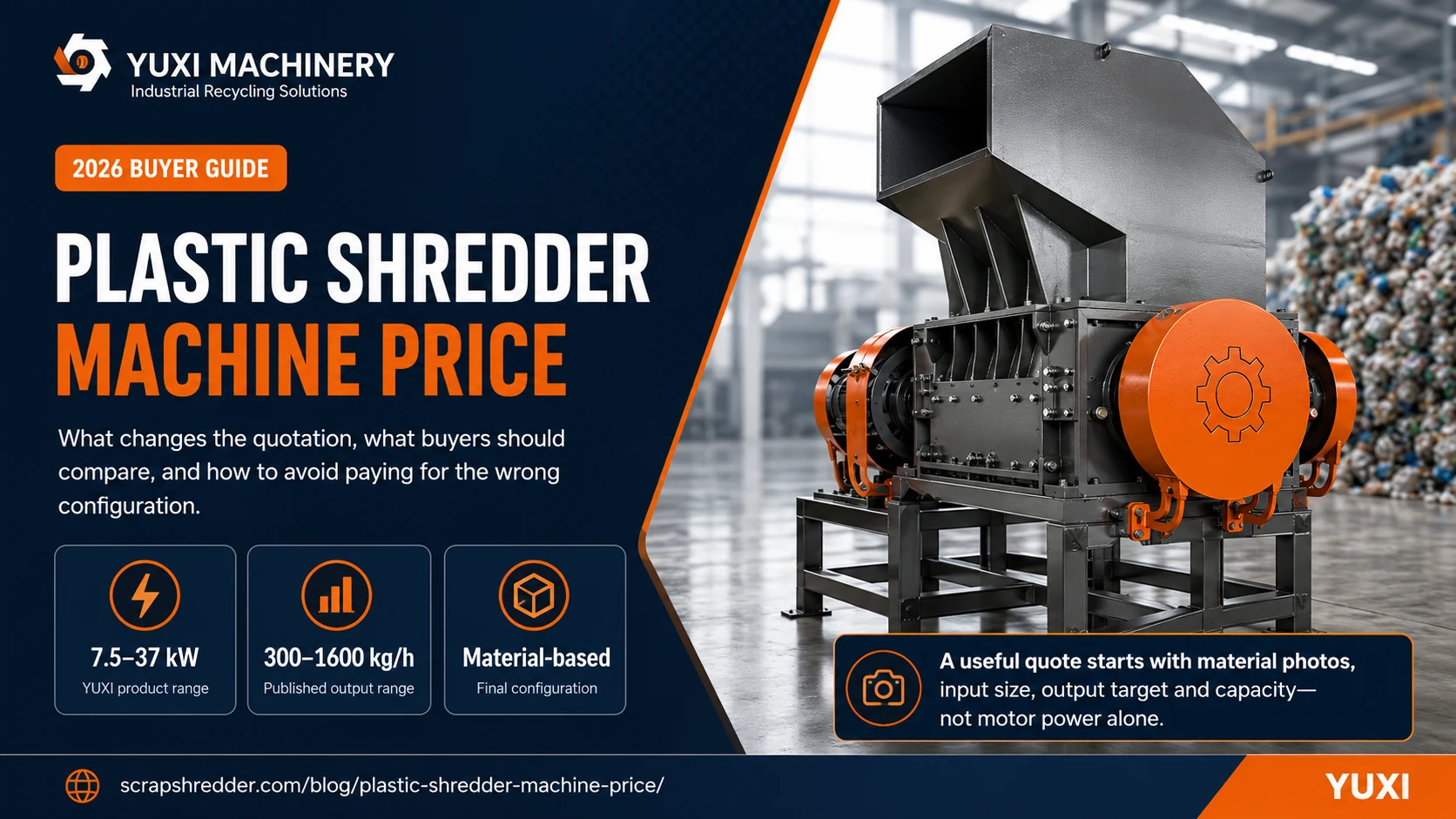
Public market references place common industrial plastic shredder and granulator projects broadly around US$15,000–US$60,000 for a standalone machine. Smaller crushers may start below that range, while large pipe shredders, heavy-duty custom systems and two-stage solutions can reach US$60,000–US$150,000 or more. A complete washing, drying or pelletizing line can exceed US$100,000 and may reach several hundred thousand dollars.
These numbers are planning references, not a YUXI quotation. A real plastic shredder machine price depends on the plastic form, maximum input dimensions, hourly capacity, screen size, rotor and blade design, drive system, feeding method, safety scope, electrical standard, conveyors, spare parts, shipping and installation support. Two machines with the same motor power may be built for very different duties.
The current YUXI plastic shredder series published on the product page covers 7.5–37 kW, cutting chambers from 270 × 400 mm to 480 × 1000 mm, and reference outputs from approximately 300–1600 kg/h. Actual output still changes with bulk density, moisture, contamination, screen size, blade condition and feeding stability.
Online prices are confusing because sellers often use “plastic shredder,” “plastic crusher,” “granulator” and “recycling machine” for very different equipment. A small high-speed crusher for clean injection molding runners should not be compared with a low-speed shredder for large HDPE pipe or pallet-sized rigid plastics. Complete recycling lines are another investment level again.
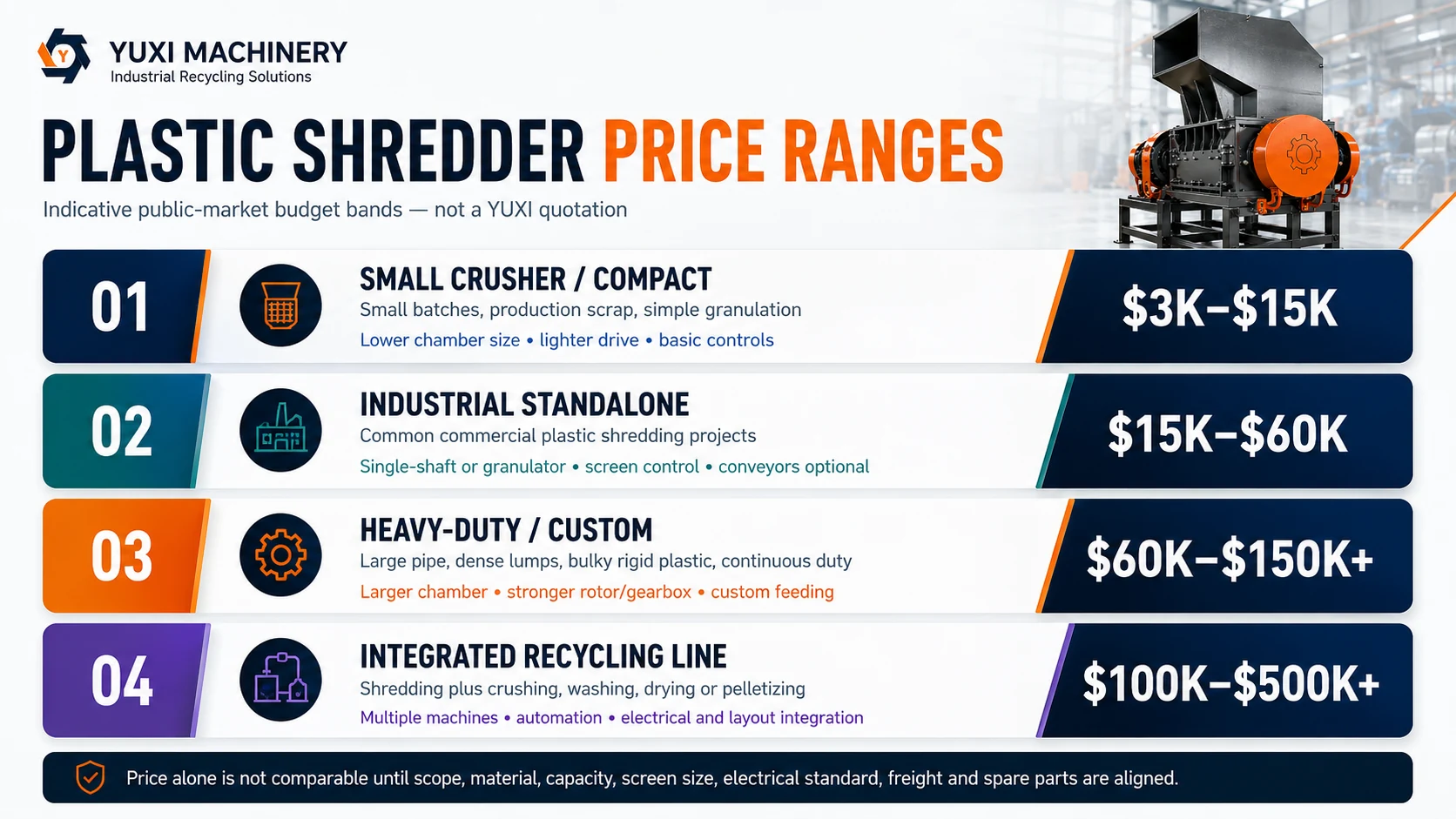
| Project level | Indicative public-market range | Typical application | What buyers should verify |
|---|---|---|---|
| Small crusher or compact machine | US$3,000–US$15,000 | Clean production scrap, small rigid parts, limited batches | Whether it is a true shredder or only a high-speed crusher; duty cycle; feed opening; electrical scope |
| Industrial standalone shredder / granulator | US$15,000–US$60,000 | Film, bottles, drums, moderate pipe sections, lumps and factory plastic waste | Rotor design, screen, hydraulic pusher, actual material capacity, control system and included conveyors |
| Heavy-duty or customized system | US$60,000–US$150,000+ | Large pipe, thick purgings, bulky rigid plastic, continuous production or mixed difficult feed | Torque reserve, gearbox, shaft/rotor strength, custom hopper, feeding support, wear parts and test results |
| Integrated recycling line | US$100,000–US$500,000+ | Shredding plus crushing, washing, drying, sorting or pelletizing | Complete process scope, water and power demand, layout, automation, commissioning, installation and output quality |
Recent public manufacturer and industry guides show similarly wide ranges. Some list industrial shredders around US$15,000–US$60,000, while complete plastic recycling systems extend well above US$100,000. Treat these as a budget window only. Supplier country, manufacturing standard, machine weight, component brands, freight, exchange rates and local installation can move the final landed cost significantly.
Field note: an unusually low online price is often a starting listing for the smallest configuration. It may exclude the hydraulic pusher, screen, conveyor, spare blades, control cabinet upgrades, export packing and freight. Before comparing it with a detailed factory quotation, request a line-by-line scope.
Most price differences can be explained by engineering decisions. The buyer does not need to become a shredder designer, but the quotation should make these decisions visible. When a supplier cannot explain why a particular rotor, screen, chamber or drive was selected, the price is difficult to evaluate.
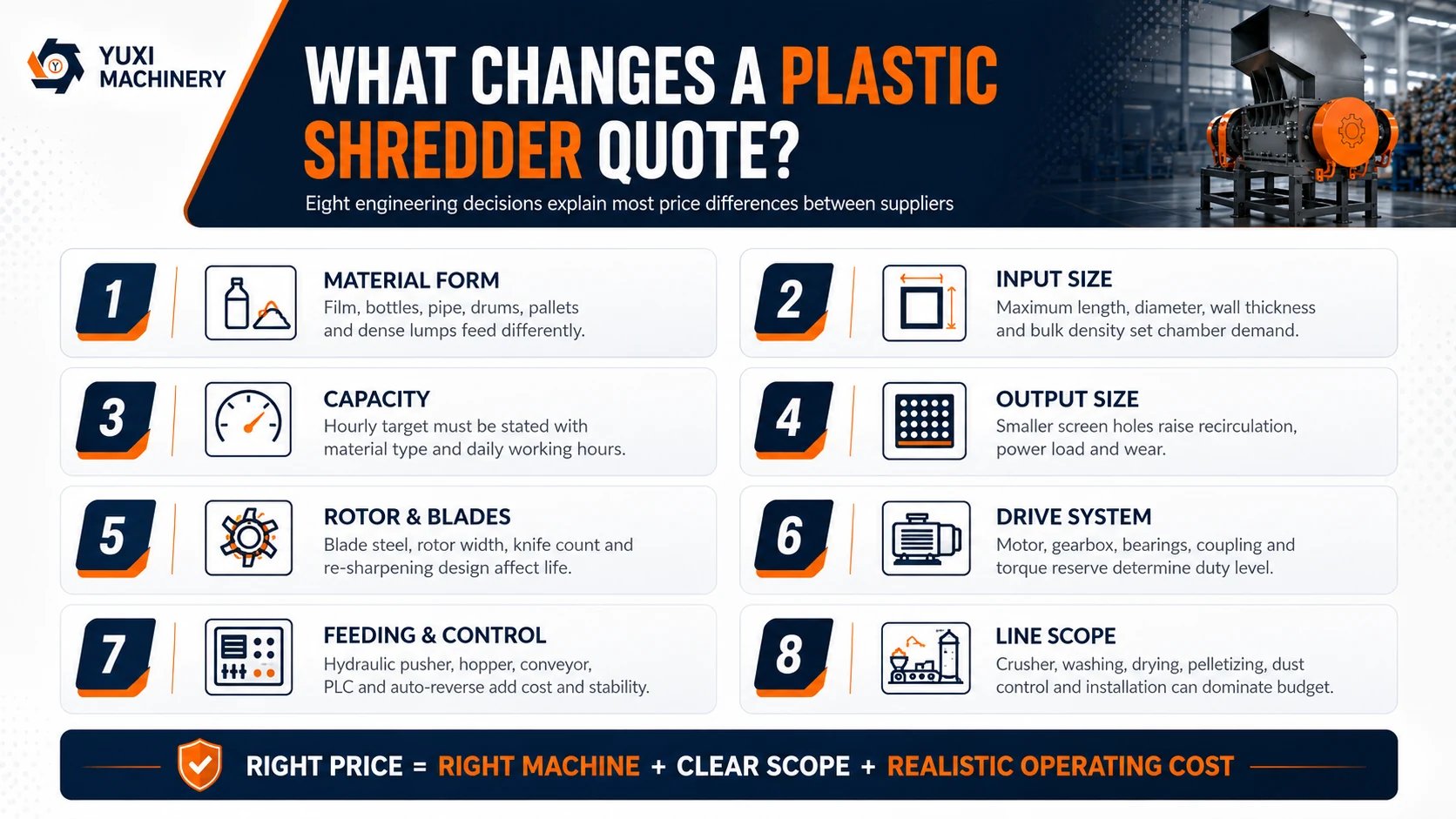
“Waste plastic” is not a complete material description. Loose film behaves differently from a compressed film bale. Empty HDPE bottles are light and springy, while thick pipe and injection molding purgings are dense. Pallets and drums are bulky. Glass-fiber-filled plastic is abrasive. Material with sand, labels, screws or metal inserts creates more wear and risk.
These differences affect how the material is gripped, whether it wraps around the rotor, how much torque is required, and how quickly blades lose their edge. For this reason, material photos and a short video are normally more useful than a resin name alone.
The longest dimension, diameter, wall thickness and shape decide the chamber opening and hopper design. Long HDPE pipe may need a horizontal ram or a pipe-specific feeding layout. A 200-liter drum needs enough opening to enter without constant manual cutting. Film bales may require controlled pushing so the rotor receives material evenly.
A larger chamber is not simply more steel. It usually means a longer rotor, heavier frame, stronger bearings, more knives, a larger hydraulic system and a higher-capacity drive. These items raise both purchase price and shipping weight.
Capacity must always be tied to a named material. A machine that produces 1000 kg/h on clean, dense plastic parts may process far less loose film because the feed contains more air and is difficult to keep in contact with the rotor. Screen size, moisture, contamination and operator feeding also change output.
Duty cycle matters as much as the hourly target. A factory reclaiming scrap for two hours per shift does not need the same gearbox, cooling allowance and maintenance plan as a plant running sixteen hours per day. Continuous production generally justifies heavier components and easier service access.
On a screen-controlled plastic shredder, pieces remain in the chamber until they are small enough to pass through the screen. Smaller holes can create a more controlled output, but they also increase recirculation, energy use and blade contact. The machine may need more power or lower throughput to achieve a smaller particle size.
Do not specify the smallest possible screen without checking the downstream process. If a crusher or granulator follows the shredder, the first stage may only need to reduce bulky waste into a stable, feedable size. Asking the shredder to produce final granules can increase cost and wear without improving the line.
Rotor diameter, working width, knife count, blade angle and counter-knife clearance determine how the machine cuts. Blade material and heat treatment affect toughness, wear resistance and re-sharpening life. A configuration for soft film is not automatically suitable for thick pipe or glass-filled engineering plastic.
Ask whether the blades can be rotated, re-sharpened or replaced individually; how the counter knives are adjusted; and what lifting or access system is provided for maintenance. A cheaper blade set that requires frequent shutdowns can cost more over a year than a better-matched design.
Motor power is easy to compare, but it does not describe how reliably the torque reaches the rotor. Gearbox type, service factor, coupling design, bearing protection and rotor speed all matter. Difficult material creates shock load and temporary overloads. A properly selected drive should handle these events without turning every jam into a repair.
Buyers should ask for the motor and gearbox brands, rated power, rotor speed, overload logic and recommended working current. A large motor on a weak transmission is not a heavy-duty machine.
Single-shaft plastic shredders commonly use a hydraulic pusher to move material toward the rotor. The ram stroke, pressure control and movement logic affect feeding stability. The PLC may adjust ram movement according to motor current, reverse the rotor during overload and restart automatically when conditions return to normal.
Feeding and discharge conveyors can be essential for real production, but many online prices show only the shredder body. Metal detection, magnetic separation, dust extraction, sound enclosure and access platforms may also be required. Each item should appear separately in the scope.
Guarding, emergency stops, interlocks, lockout points and electrical design are not optional decoration. Industrial machinery should be assessed around its full life cycle, including operation, cleaning and blade maintenance. ISO 12100 provides a framework for machinery risk assessment and risk reduction, while IEC 60204-1 covers electrical equipment of machines. For US projects, buyers should also review local machine-guarding and electrical requirements. EU buyers should confirm the applicable CE documentation and transition to Regulation (EU) 2023/1230.
Electrical voltage and frequency, component brands, control cabinet cooling, cable labels, manuals and declarations can change cost. The safest comparison is not “CE or no CE,” but exactly what documents, components and protective functions are included.
The product page currently lists six models. They appear to be medium-speed, screen-controlled plastic size-reduction machines rather than the very large low-speed primary shredders used for whole vehicles, municipal solid waste or heavy metal scrap. This makes the series more relevant to plastic processors, recycling workshops and line operators who need controlled feed before washing or granulation.
| Model | Power | Cutting chamber | Screen | Published output | Practical buying meaning |
|---|---|---|---|---|---|
| YX-2640G | 7.5 kW | 270 × 400 mm | Φ10 mm | 300–550 kg/h | Compact production-scrap or smaller recycling jobs with controlled feeding |
| YX-2650G | 11 kW | 270 × 500 mm | Φ10 mm | 400–650 kg/h | Wider feed opening for moderate factory scrap and small recycling lines |
| YX-3660G | 15 kW | 370 × 600 mm | Φ12 mm | 400–700 kg/h | Mid-range option when feed size or daily volume exceeds compact models |
| YX-3680G | 22 kW | 370 × 800 mm | Φ12 mm | 600–900 kg/h | Suitable starting point for larger bottles, parts, film or line feeding after testing |
| YX-4680G | 30 kW | 480 × 800 mm | Φ12 mm | 700–1200 kg/h | Larger chamber and power for higher-volume industrial plastic processing |
| YX-46100G | 37 kW | 480 × 1000 mm | Φ12 mm | 800–1600 kg/h | Largest listed model for higher throughput or wider material feed |
Selection note: do not choose the model only by matching the required kg/h to the top number in the table. Ask what material was used to establish that range, how it was fed and whether the same screen diameter was installed. For light film or irregular bulky feed, the practical throughput may be limited by feeding. For thick purgings or pipe, it may be limited by cutting load.
Film looks easy because it is thin, but it can be one of the most troublesome materials to feed. Loose film may float, bridge in the hopper or wrap around rotating parts. Compressed bales create a different load. Price is influenced by anti-wrapping rotor design, hydraulic pusher control, bale opening method and whether the line needs continuous feeding into a washer.
For very clean thin film, a specialized cutter-compactor or integrated pelletizing system may be more efficient than a general-purpose shredder. The buyer should describe the final process, not only request a “film shredder.”
Bottles are hollow and low-density. The key issue is usually stable feeding and volume reduction rather than extreme torque. A plastic bottle shredder may be followed by label removal, washing and granulation. If caps, liquids, labels and metal contamination are present, sorting and washing scope can cost more than the shredder itself.
Pipe diameter, length and wall thickness drive the configuration. Short offcuts may enter a conventional hopper. Long pipes may require a horizontal pusher or dedicated pipe shredder. Thick-wall pipe and large-diameter lumps need more rotor strength and torque. These projects commonly move into the heavy-duty or customized price range.
Dense purgings are hard on blades and drive components. The same physical volume can weigh many times more than bottles or film. Quotation focus should be blade toughness, rotor diameter, gearbox service factor and whether the material needs pre-cutting. For internal factory reuse, output cleanliness and prevention of metal contamination may be as important as throughput.
These materials are bulky and may bounce at the rotor. The hopper opening, knife hook geometry and pusher force influence whether the machine grips them consistently. Large drums and pallets may justify a double shaft shredder for rough pre-shredding, followed by a screen-controlled machine or crusher for smaller output.
Mixed material creates the largest quotation uncertainty. Different resin types, labels, dust, moisture, screws, wire and occasional metal pieces change wear and risk. A supplier may recommend magnetic separation, manual sorting, metal detection or a more tolerant pre-shredder. A material test is strongly recommended before finalizing the blade and screen configuration.
The machine type should be selected by process role. Buying the cheapest category can increase total project cost if another machine must be added later.
| Machine type | Best role | Output behavior | Price logic |
|---|---|---|---|
| Single shaft shredder | Controlled shredding of plastic lumps, film, bottles, pipe sections and production scrap | Screen controls maximum discharge size | Hydraulic pusher, rotor, knives and screen increase complexity but provide better size control |
| Double shaft shredder | Rough opening and volume reduction of bulky drums, pallets, bales or mixed waste | Usually rougher output without a screen | Can be cost-effective for primary reduction, but a second crusher may be needed |
| Plastic crusher / granulator | Finer reduction when input is already small and controlled | Smaller, more uniform regrind | Often cheaper for clean small scrap; unsuitable for oversized or difficult feed |
| Two-stage system | Bulky feed requiring stable final flakes | Shredder first, crusher or granulator second | Higher capital cost but often better uptime, output control and component life |
A common buyer mistake is comparing a single-shaft screen-controlled quotation with a basic double-shaft pre-shredder price. They are not producing the same result. The existing double shaft shredder price guide explains how rough primary shredding costs are affected by blades, gearboxes and material duty.
A shredder can reduce size, but it does not automatically remove labels, dirt, moisture, metal or mixed polymers. Buyers planning to sell washed flakes or pellets need to define the complete process. The downstream specification determines what the shredder must deliver.
The machine-only FOB price may represent a small part of the installed project. Freight, import duty, inland transport, foundation, lifting, cabling, water supply, commissioning and operator training should be estimated separately. For an existing plant, measure the available floor space, ceiling height, access door, conveyor elevation and maintenance clearance before production drawings are approved.
Unsuitable scenario: do not purchase a small standalone shredder and assume it can later become a high-capacity washing line by adding conveyors. The rotor, chamber, discharge height and control architecture may not match the future line. Expansion should be discussed during model selection.
The lowest purchase price is not always the lowest recycling cost. For plants running every day, blade life, energy, cleaning time and downtime can outweigh a modest saving on the purchase order.
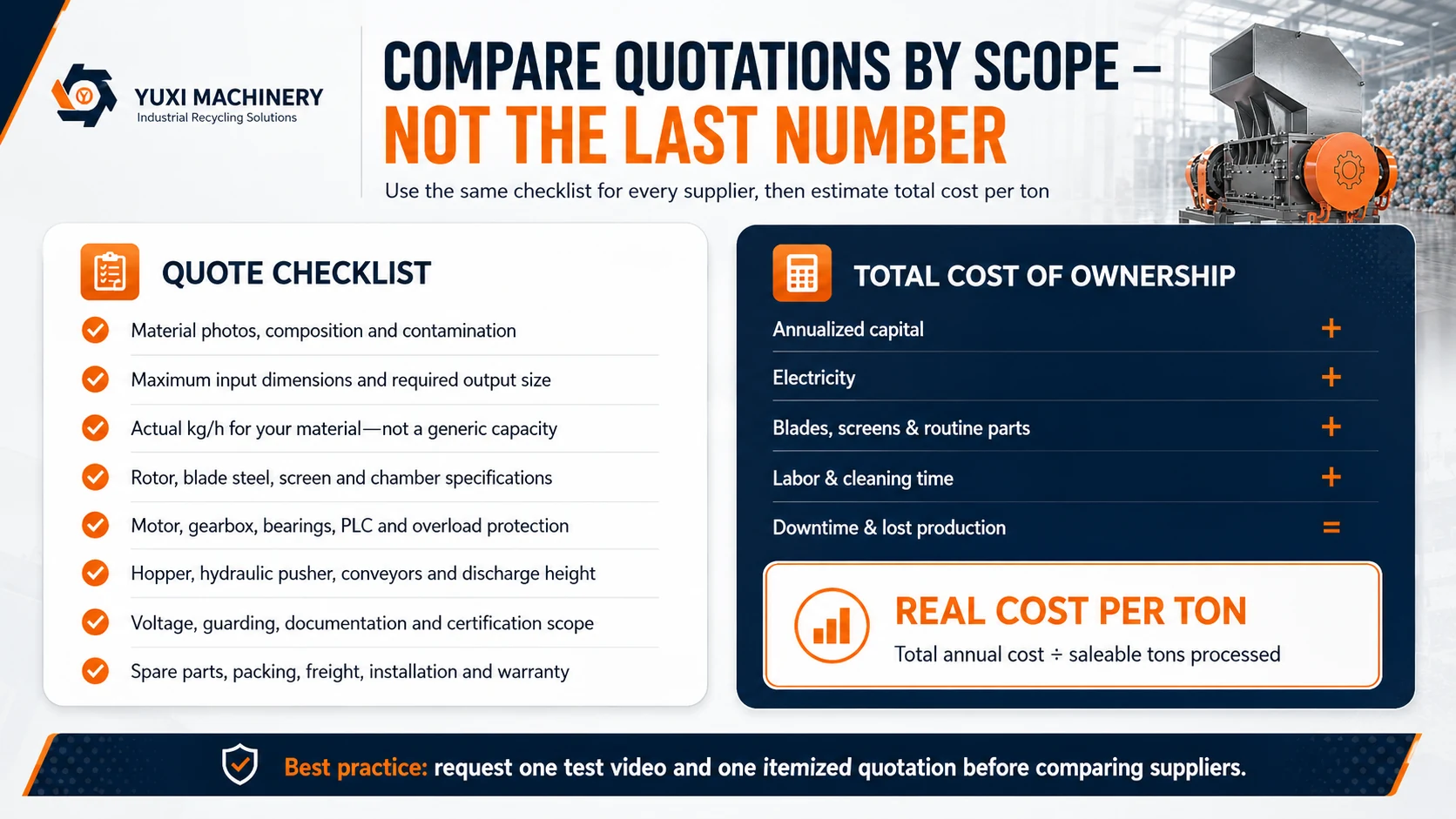
A practical annual calculation is:
Total annual cost = annualized machine investment + electricity + blades and screens + routine maintenance + labor + cleaning + downtime + waste handling.
Then divide this figure by the saleable tons processed, not the theoretical nameplate output.
Assume a 22 kW machine runs at an average 70% electrical load for 8 hours per day and 250 days per year. At US$0.12/kWh, estimated annual shredding electricity is:
22 × 0.70 × 8 × 250 × 0.12 = US$3,696 per year.
If the plant actually processes 1600 saleable tons in that period, the shredder electricity contribution is approximately US$2.31 per ton. This is only an example. Real power draw, local energy price, idle time and saleable output must be measured for the project.
Ask the supplier for expected blade inspection intervals, re-sharpening procedure, spare knife quantity, screen replacement method, lubrication points and bearing protection. Highly contaminated material may need shorter service intervals. The quotation should include a recommended startup spare-parts package and identify which parts can be sourced locally.
Downtime is often the largest hidden cost. Check how the screen opens, whether the hopper or chamber has hydraulic access, how knives are removed, and whether the control system records overload events. A machine that is slightly more expensive but can be cleaned and serviced quickly may produce a lower cost per ton.
Prepare a comparison sheet and force every quotation into the same structure. Do not compare one machine’s bare FOB price with another supplier’s price including conveyors, electrical customization and spare parts.
For difficult material, request a test video showing the full cycle: unedited feeding, rotor response, screen discharge, output size and current load. A short polished clip showing only easy pieces does not prove the machine can run the buyer’s actual waste stream.
Motor power does not reveal chamber size, rotor strength, knife design, gearbox service factor or feeding stability. A 30 kW machine can be built for a very different duty from another 30 kW machine.
Capacity must be confirmed on comparable material and screen size. Loose film, wet bottles, thick pipe and dense lumps will not produce the same kg/h.
Trying to make a shredder produce final granules can reduce throughput and accelerate wear. A two-stage shredder-plus-granulator system may be more economical.
Sand, stones, screws and metal inserts can damage blades and screens. Sorting, metal detection or a more tolerant first stage may be cheaper than repeated repairs.
The required discharge size and line layout depend on whether the material is washed, granulated, extruded, baled or sold as rough shred. The shredder should be selected around that destination.
FOB is not installed cost. Check export packing, freight, duty, inland delivery, foundation, lifting, electrical work, commissioning, spare parts and local compliance.
A machine squeezed against a wall may be difficult to open for screen changes or knife service. Confirm maintenance clearance on the layout before shipment.
Send the following details at the first inquiry:
With these details, the supplier can decide whether the published plastic shredder range is suitable, whether a different industrial shredder machine is needed, or whether a material test should be completed first.
Common standalone industrial machines are often discussed in a broad US$15,000–US$60,000 budget range. Heavy-duty custom machines and complete lines can cost much more. Final price depends on material, capacity and scope.
They may use different chamber sizes, rotors, blades, gearboxes, hydraulic systems, controls, guarding and component brands. Motor power alone does not define machine duty.
Usually yes for small, clean and controlled scrap. A crusher is not a substitute when the input is oversized, tangled, thick or difficult to feed.
It can require more power, more cutting time and stronger wear parts. It may also reduce throughput. The screen should match the next process.
A line with shredding, crushing, washing, drying or pelletizing can range from above US$100,000 to several hundred thousand dollars. Capacity, automation and output quality decide the scope.
Ask for an itemized list covering the shredder, hopper, pusher, screen, control cabinet, guarding, conveyors, spare parts, packing, freight terms, manuals and service.
Sometimes, but one configuration will not perform equally well on every material. Film needs stable anti-wrapping feeding; pipe and lumps need stronger cutting and torque.
Choose single shaft when controlled output through a screen is important. Choose double shaft for rough opening and volume reduction of bulky material. Some lines use both stages.
Usually knives, counter knives, screens and selected bearings or seals. The exact package depends on material contamination and planned operating hours.
Send material photos, maximum size, required output, kg/h target, working hours, voltage, destination and downstream equipment.
A plastic shredder machine price is meaningful only after the project duty is clear. Start with the waste stream and the next process. Confirm the largest feed size, realistic hourly target, screen requirement and contamination. Then compare rotor, blades, drive system, controls, maintenance access and the complete commercial scope.
The cheapest machine can be the correct choice for a clean, low-volume factory scrap application. It becomes expensive when it is forced to process large pipe, dense purgings, dirty mixed waste or continuous production beyond its design. A better buying decision is the machine that delivers stable cost per ton with manageable maintenance.

Get in touch with our nice team today to get a price estimate for a shredder machine.
Contact Us