Industrial Shredder & Recycling Systems Manufacturer - YUXI

 English

 English
 Fast Delivery
 Reliable
 Certified
 ExperiencedEnglishEnglishFast DeliveryReliableCertifiedExperienced
Four Shaft Shredder for Sale: New, Used and Custom Machine Buying Guide
Compare new custom machines, ready-stock units, refurbished equipment and used shredders by configuration, testing, delivery scope, warranty and lifetime operating risk.
When looking for a four shaft shredder for sale, first decide whether you need a new custom machine, a ready-stock unit, a refurbished shredder or used equipment. Compare machines only when the material, screen opening, cutter configuration, output target, duty cycle and included conveyors are clear. Before purchase, request a representative material test or documented reference, a complete component list, factory acceptance procedure, delivery boundary, warranty terms and spare-parts plan.
A search for a “four shaft shredder for sale” produces several very different offers. One listing may be a new machine manufactured after the order. Another may be a finished unit sitting in stock with a fixed cutter stack and screen. Used-equipment marketplaces may list older machines with unknown wear, missing documents or controls that are no longer supported. All of them can appear under the same keyword.
That makes this a process purchase, not a simple equipment search. The buyer needs to know what the shredder must do, what configuration is being offered and what remains outside the quoted price. A machine advertised as suitable for plastic, metal, e-waste, RDF, textiles and bulky waste may not use the same cutter, screen or duty rating for every one of those streams.
The purpose of this guide is to help you move from an online listing to a defensible purchase decision. It covers new and used machines, quote comparison, testing, delivery, installation and lifecycle support. The focus is not on finding the most impressive brochure. It is on proving that the offered machine will feed, cut and discharge your material in a way the rest of the recycling line can use.
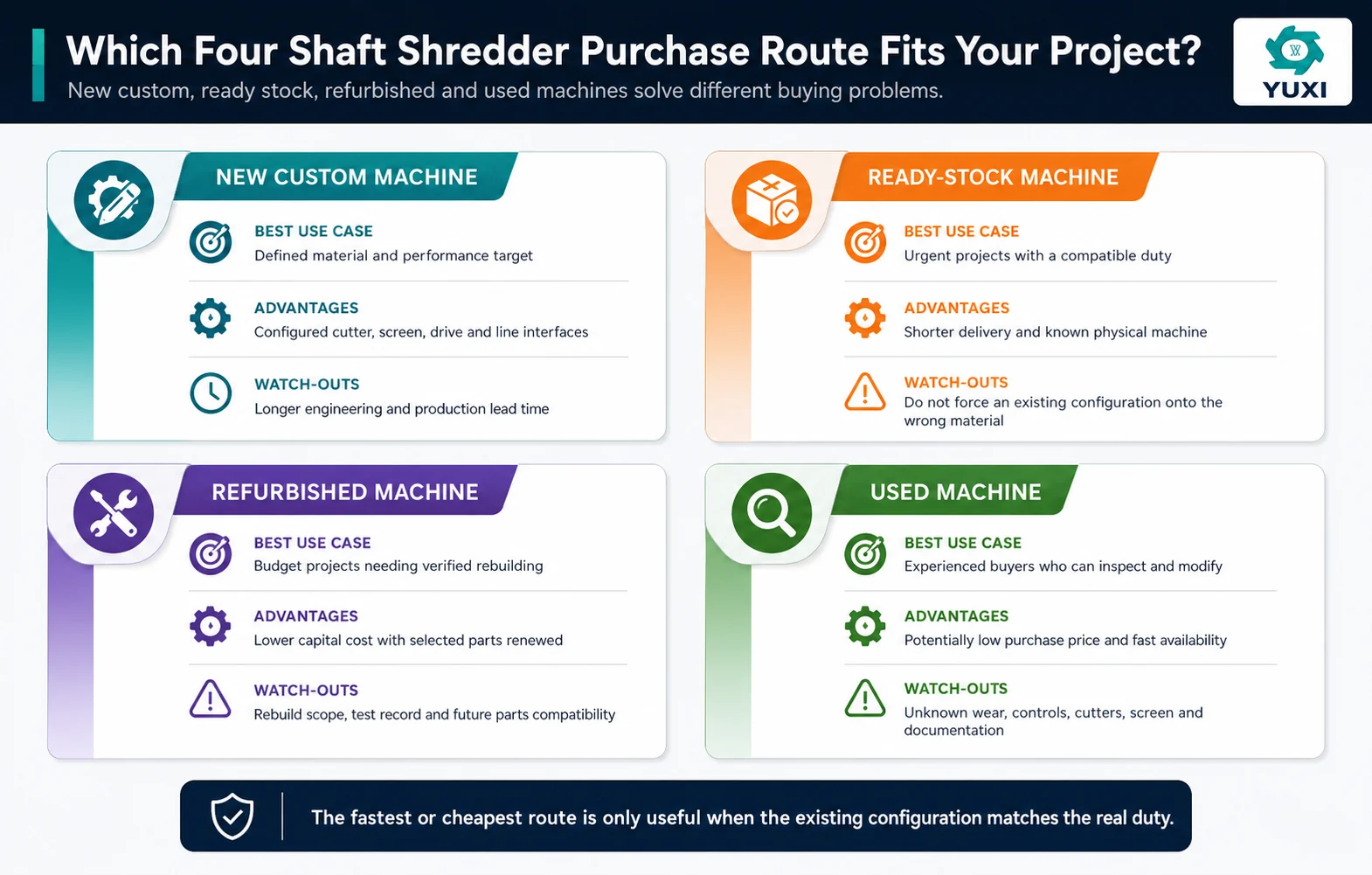
In industrial equipment, the words “for sale” can describe at least four commercial situations.
The manufacturer uses your material, output and capacity data to finalize the cutter layout, screen, drive and accessories. The machine does not physically exist in its final form when the quotation is issued. This route offers the best opportunity to match the application, but it also requires engineering approval and production time.
The chamber, shafts, cutters, reducers and control cabinet are already built. Delivery can be faster, but major mechanical changes may be limited. A stock unit is only a good purchase when its existing cutter, screen and drive match your duty. “Available now” is not an engineering reason to accept the wrong configuration.
The base machine has been used, but selected components have been repaired or replaced. Refurbishment may range from new paint and bearings to a full cutter, shaft, reducer and controls rebuild. Ask for an itemized scope and test results rather than relying on the word “refurbished.”
The buyer accepts most condition risk. The unit may be offered by the original owner, a dealer, an auction platform or an equipment marketplace. Used four shaft shredders are listed on marketplaces such as Machineseeker and Machinio, but availability and condition vary widely. Used four-shaft listings on Machineseeker illustrate how model, age, location and seller information can differ from one listing to another.
A four shaft shredder is generally considered when the project needs more controlled discharge than a basic coarse pre-shredder. Four interacting shafts improve material engagement and recutting, while a screen retains pieces that are still too large.
The purchase is usually justified when:
It may not be the right purchase when the project only requires rough volume reduction, when a downstream crusher already performs the sizing duty or when the feed is heavy structural metal beyond the machine’s design. Franklin Miller describes quad-shaft shredders as machines for controlled output, secure destruction and process consistency, while WEIMA positions four-shaft equipment for uniform reduction of difficult materials. These uses support the same buying logic: purchase the extra cutting and screen system only when it solves a real process requirement. Franklin Miller’s quad-shaft overview provides a useful reference for that positioning.
The separate four shaft shredder vs double shaft shredder comparison is useful when your project is still between coarse pre-shredding and screen-controlled sizing.
Used equipment can be a good investment, but the original application matters. A machine that spent years cutting clean cardboard has a different risk profile from one that processed contaminated metal-bearing waste. Hour-meter readings are useful only when maintenance and duty records support them.
The same machine family can cover several applications, but the offered configuration should change with the feed.
| Application | What the Buyer Needs | Configuration Questions |
|---|---|---|
| E-waste | Open housings and create a stable feed for metal/plastic separation. | How are batteries and hard inserts controlled? What screen size supports the separators? |
| Plastic drums and packaging | Reliable grabbing of hollow items and controlled discharge before washing or granulation. | Will the hopper prevent bridging? Are hooks aggressive enough without excessive load peaks? |
| RDF/SRF | Shorter, more consistent combustible material for screening, drying or feeding. | How does the design manage film, textile, moisture and wrapping? |
| Bulky waste | Open large items and reduce long pieces before sorting or disposal. | Is the chamber large enough? What prevents mattresses and textiles from bridging? |
| Light metal scrap | Fold, tear and shear thin sheet or light mixed metal before separation. | What is the allowable metal thickness? How are solid objects and impact peaks handled? |
| Mixed industrial waste | A robust system that tolerates changing feed without constant reversing. | What contamination assumption and safety margin are included in the quotation? |
WEIMA describes four-shaft systems with cutting and clearing shafts plus an integrated screen, emphasizing controlled, uniform output for materials including metal, plastic, paper and waste. That reinforces an important purchase point: the material list in an advertisement is only the first filter. The buyer still needs a project-specific cutter, screen and drive confirmation. WEIMA’s four-shaft product overview is one example of this application-based positioning.
A low machine price may exclude the equipment needed to operate it. Ask the seller to mark every included and excluded item.
A marketplace may show a simple price, but industrial four-shaft systems are rarely comparable without technical context. The following factors change both purchase price and operating cost:
Online listings can show broad or promotional price ranges that do not represent a complete installed project. A Made-in-China listing, for example, publishes one price band for a particular four-shaft recycling machine, while marketplace listings may show used machines without a comparable rebuild or accessory scope. These numbers can help establish that a market exists, but they do not replace an application-based quotation. The detailed four shaft shredder price guide explains equipment and lifecycle cost factors separately.
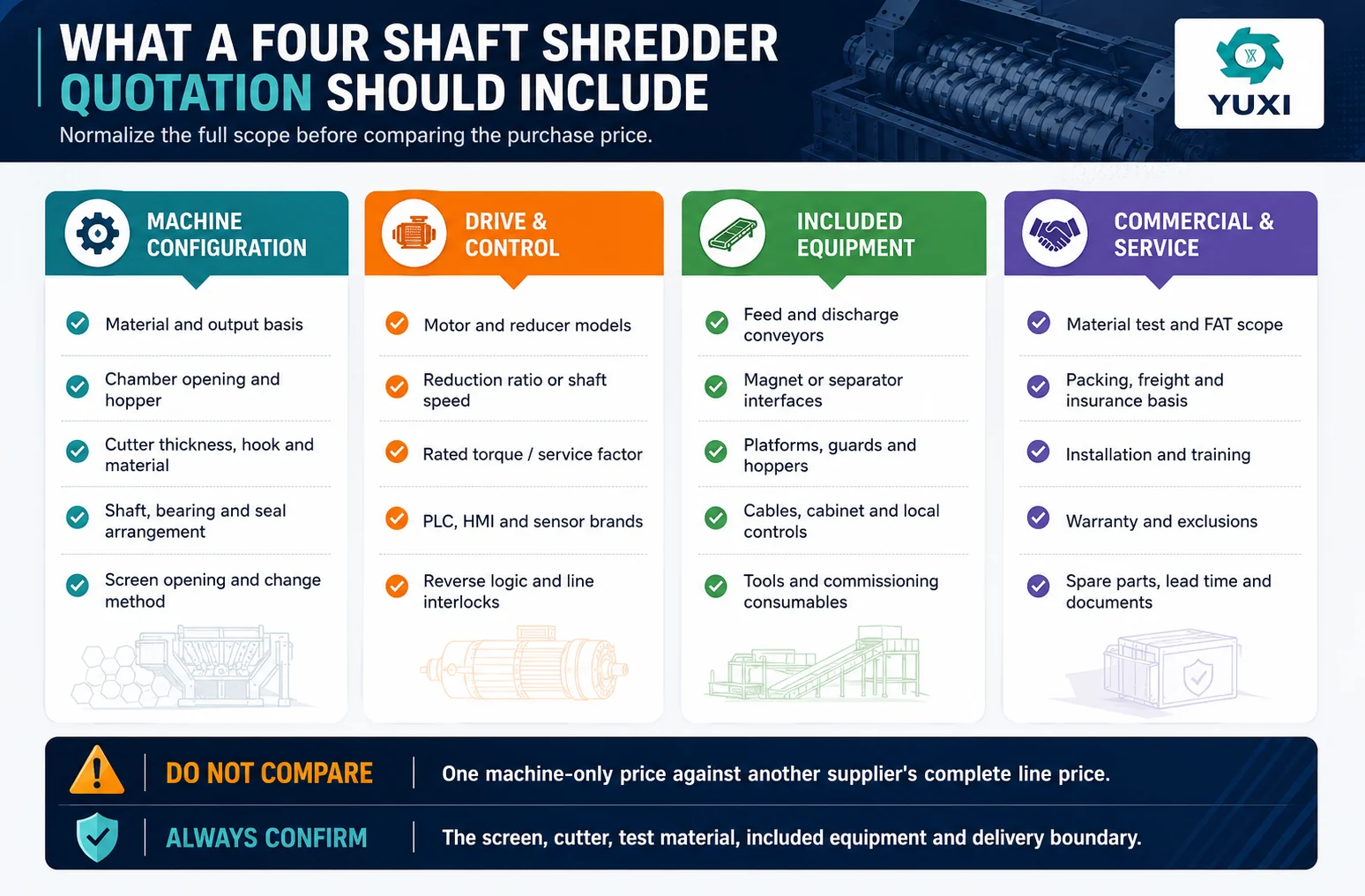
The proposal should state the feed used to select the machine and the screen or discharge target. Capacity without this basis is not meaningful.
Compare clear feeding opening, working length and throat geometry—not only external dimensions. Large hollow objects and flexible bundles need different hopper behavior.
Confirm cutter thickness, hook count or profile, material, heat treatment and total quantity. These details affect grabbing, output shape, impact strength and future spare-parts cost.
Ask for the shaft drawing reference or at least the critical design description. Confirm bearing model and how dust, wire, liquid and fine particles are prevented from reaching it.
Record motor and reducer models, reduction ratio or shaft speed, rated output torque and service factor. Motor power alone cannot show the machine’s response to hard objects or a small screen.
Confirm opening, hole shape, plate material, support and replacement method. A smaller opening normally increases recutting, load and wear while reducing throughput.
The proposal should explain current or torque monitoring, forward/reverse sequence, feed-conveyor pause, alarm stop and downstream interlocks. Control logic is part of the mechanical protection system.
Request stable net throughput, not a short peak. Define whether capacity excludes loading pauses, screen cleaning, manual removal and material remaining in the chamber.
The four shaft shredder working principle guide explains how cutters, secondary shafts, recirculation and the screen interact inside the chamber.
Send the same material, output, capacity and duty information to every supplier. Include photos and a working video.
Ask the supplier to identify assumptions, risks and the reason for the proposed cutter, screen and drive. A quotation received quickly is not useful if it solves a different duty.
For mixed or difficult waste, send a representative sample. Agree on screen, feeding, test duration and weighing method before the test begins.
After testing or technical approval, identify the final chamber, cutters, reducers, screen, controls and accessories by drawing or revision number.
Decide which drawings, material records, test sheets and electrical files must be delivered. Define inspection hold points if a third party will visit.
Connect capacity to the defined material, output and feeding method. List the required safety and control functions. Avoid a general sentence such as “machine operates normally.”
Complete foundation, lifting, electrical, feed, discharge and commissioning responsibilities before shipment.
The separate four shaft shredder manufacturer guide provides a full supplier and factory due-diligence checklist.
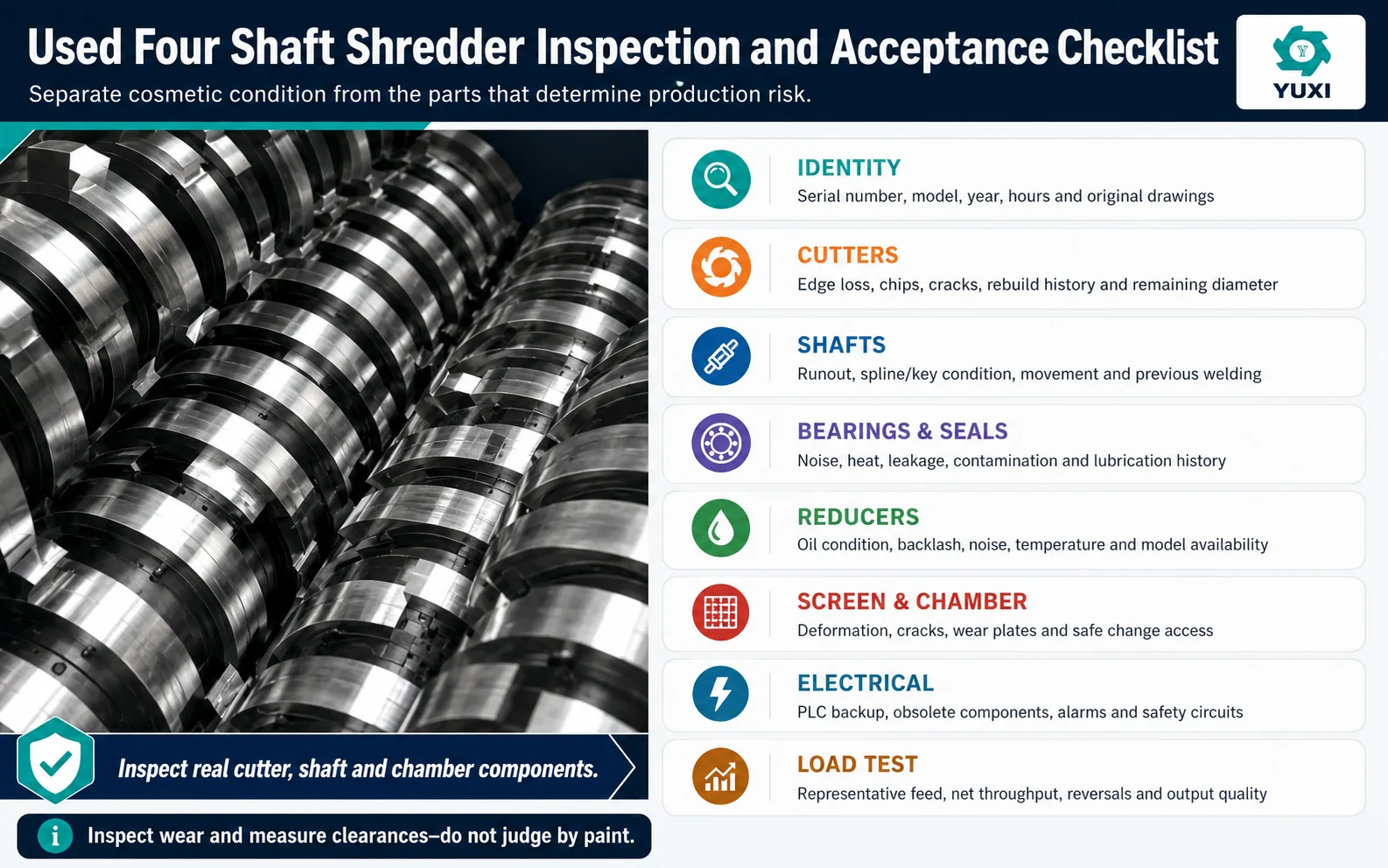
A used machine should be evaluated as a collection of high-cost mechanical and electrical systems. Fresh paint can improve appearance without changing the condition of cutters, shafts or reducers.
Measure remaining cutter diameter or edge loss where possible. Look for chipped hooks, cracks, uneven wear and evidence of repeated welding. Confirm that replacement cutters are still available and that the stack has not been assembled from incompatible parts.
Inspect runout, movement, spline or key condition and previous weld repair. A worn cutter can be replaced; a damaged shaft can change the economics of the entire purchase.
Run the machine long enough to observe noise and temperature. Inspect oil condition, leakage, backlash and contamination around seals. Confirm reducer model availability before assuming it can be repaired locally.
Check deformation, cracks, worn supports, chamber liners and safe access. An incorrect or damaged screen can release oversize pieces or create continuous overload.
Obsolete PLC, HMI, variable-speed drives or safety relays may require a cabinet rebuild. Verify emergency stops, guards, interlocks and the reverse sequence.
Test with material close to your intended feed. Record current, reversing frequency, output and leaks. A no-load video proves only that the shafts can rotate.
The factory acceptance test, or FAT, should confirm that the delivered configuration matches the approved scope and performs the agreed functions.
Record the test with a signed protocol, photographs and video. Where the production material cannot be shipped, define the limitations of the substitute test and use site acceptance to confirm final line performance.
A sale is not complete when the machine leaves the factory. Confirm the route from workshop floor to stable production.
Clarify Incoterm, freight, insurance, port charges, import tax and unloading. Ask whether the machine ships assembled, partly disassembled or in an open-top container.
Shafts should be restrained, openings sealed and electrical components protected from moisture. Loose accessories must be labelled against a packing list.
Obtain machine weight, center of gravity, lifting points, dynamic loads and anchor requirements early. Leave space to remove the screen, reducers and shafts later.
Confirm power supply, earthing, cable sizes, lubrication, compressed air if used, dust connection and the height and width of feed and discharge conveyors.
Define who performs mechanical checks, electrical energization, dry run, load run and operator training. List the conditions that must be complete before a supplier technician travels.
Warranty should explain the process for determining cause, not only the duration. Wear parts such as cutters and screens are normally excluded, but shaft, bearing, reducer and electrical failures require a clear investigation route.
Ask for part numbers, drawings, current prices and estimated lead times. Confirm which items are standard international components and which require factory manufacture.
Lifetime cost is affected by cutter life, screen wear, energy use, maintenance labor, downtime and spare-part freight. A machine that requires a full shaft removal to replace one damaged cutter may cost more to maintain than a higher-priced design with better access.
Remote support should include a defined contact channel and the ability to review alarms, current trends, settings, photos and video. For critical lines, confirm the availability and cost of on-site service.
A machine family can be versatile, but cutter and duty suitability still need confirmation.
The number cannot be compared with another seller’s capacity.
Check whether conveyors, control cabinet, screen, spares, packing and service are included.
Request serial-number photos, live video and nameplates for stock or used equipment.
Future cutter and screen supply may become difficult.
New paint and bearings do not prove the condition of shafts and reducers.
A rotating machine is not the same as a production-ready machine.
Send the same completed template to each supplier:
Material: [components and percentages]
Normal / maximum feed size: [dimensions and largest dense object]
Bulk density: [kg/m³ or measured volume and weight]
Moisture and contamination: [metal, wire, sand, glass, liquid, etc.]
Required output: [screen opening and acceptable oversize / long-piece condition]
Capacity: [average t/h, peak feed and tons per shift]
Operating duty: [hours/day, shifts/day and days/year]
Feeding method: [conveyor, loader, grab or manual]
Downstream process: [separator, granulator, washing or baling]
Purchase route: [new custom, ready stock, refurbished or used]
Required scope: [machine, conveyors, magnet, platform, controls and service]
Required evidence: [material test, reference, FAT, drawings and component list]
Destination: [country, voltage, frequency, installation location]
Ask each supplier to list technical deviations and exclusions. The resulting answers are easier to compare than generic sales proposals.
The best four shaft shredder for sale is not the machine with the lowest online price or the largest motor. It is the machine whose configuration, test evidence, delivery scope and support match the process your plant must run every day.
Send material photos or video, feed size, contamination, target output, hourly capacity, working hours and downstream process. YUXI can review a new custom or available configuration and prepare a comparable technical proposal.
The price depends on chamber size, cutters, shaft and reducer duty, screen, controls, conveyors, testing, spares and service. A useful quotation must be tied to the material and required output.
Buy new when configuration and performance are critical. Used equipment can reduce initial cost when your team can inspect wear, controls and documentation and can accept repair or modification risk.
Some items such as screen, hopper and controls may be changed. Major shaft, cutter or reducer changes may remove the delivery-time advantage. Confirm the existing configuration first.
Provide material composition, size, density, moisture, contamination, output target, capacity, working hours, feeding method, downstream equipment, power supply and required purchase scope.
Compare them only after normalizing material, screen, cutter, chamber, drive, accessories, testing, packing, installation, warranty and spare parts.
It can process suitable light metal and metal-containing mixed waste when shaft strength, cutter thickness and reducer torque match the feed. Heavy solid or structural metal requires separate evaluation.
Inspect cutters, shafts, bearings, seals, reducers, screen, chamber, controls, safety devices, documents and spare-parts availability. Require a representative load test.
A good FAT checks configuration, mechanical assembly, electrical controls, protection logic and load performance under agreed material and screen conditions.
Ready-stock and used units can ship faster. A custom machine requires engineering approval, manufacturing, testing and packing. Confirm lead time after the final configuration is frozen.

Get in touch with our nice team today to get a price estimate for a shredder machine.
Contact Us