Industrial Shredder & Recycling Systems Manufacturer - YUXI

 English

 English
 Fast Delivery
 Reliable
 Certified
 ExperiencedEnglishEnglishFast DeliveryReliableCertifiedExperienced
A double shaft shredder can be a very useful front-end machine in metal recycling, but only when the scrap type, thickness, impurity level and downstream process match the shredder configuration.
Many metal recycling buyers ask a very simple question: Can a double shaft shredder shred metal? The honest answer is yes, but that answer is not enough for equipment selection. A thin aluminum can, a paint bucket, an appliance shell, a long aluminum profile, a steel drum and a thick bearing block are all called “metal scrap” in daily conversation, but they do not behave the same way inside a cutting chamber.
A double shaft shredder for metal recycling is usually selected for rough pre-shredding, volume reduction and material opening. It works at low speed with high torque, pulling bulky scrap into two counter-rotating shafts and tearing it into pieces that are easier to transport, sort, bale or further crush. For light and medium metal scrap, this can be exactly the right first step. For heavy solid steel, thick castings, sealed cylinders or oversized hard scrap, a normal double shaft shredder is not the right machine.
In metal recycling, you’ll often see a double‑shaft shredder used as the first step in size reduction. It’s a good fit for light scrap, steel or aluminum drums, cans, aluminum extrusions, thin sheet metal, appliance shells, and mixed industrial waste. The machine runs two slow‑speed, high‑torque shafts that grab the material, pull it into the cutting chamber, and tear it down into chunks that are much easier to handle. Once it’s pre‑shredded, you can sort it, bale it, convey it, or feed it straight into a secondary crusher for finer grinding—whatever your downstream process needs. For thick solid steel, large castings, bearing blocks or dangerous sealed containers, a stronger metal shredding system or a different safety process is required.
What it is · Suitable metal materials · Best applications · Recycling line layout · Unsuitable scrap · Cutter and shaft design · Capacity notes · Buyer mistakes · FAQ
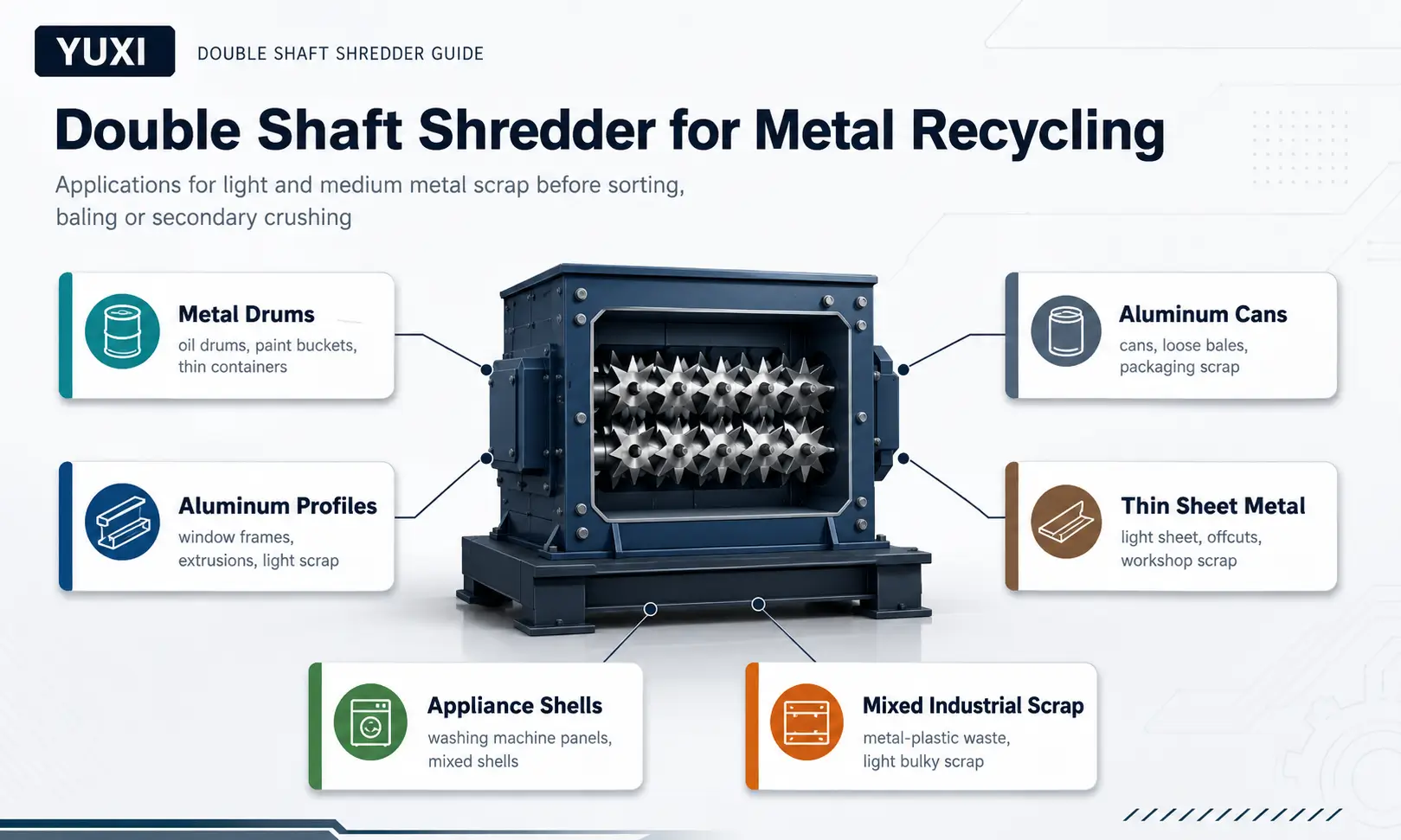
In most metal recycling setups, the double‑shaft shredder sits at the front of the line as the pre-shredder. It’s the first step in breaking things down. Its job is not to make perfectly uniform metal particles. Its job is to open, bite, tear and reduce bulky material so that the next process can work more smoothly. That next process may be magnetic separation, eddy current separation, manual inspection, a hammer mill, a baler or a storage conveyor.
The machine uses two shafts rotating toward each other. Cutter hooks grab the scrap and pull it into the cutting chamber. The material is sheared and torn between cutter discs, spacers and counter knives. Because the speed is low, the process is different from a high-speed metal crusher. The advantage is strong grabbing force and lower dust generation. The limitation is that output size is rough and strongly affected by cutter thickness, tooth profile and material behavior.
For this reason, the most important selection question is not “how many kilowatts?” It is “what exactly is the material?” A practical quotation should be based on material photos, videos, maximum dimensions, wall thickness, impurity level, required capacity and target downstream use.
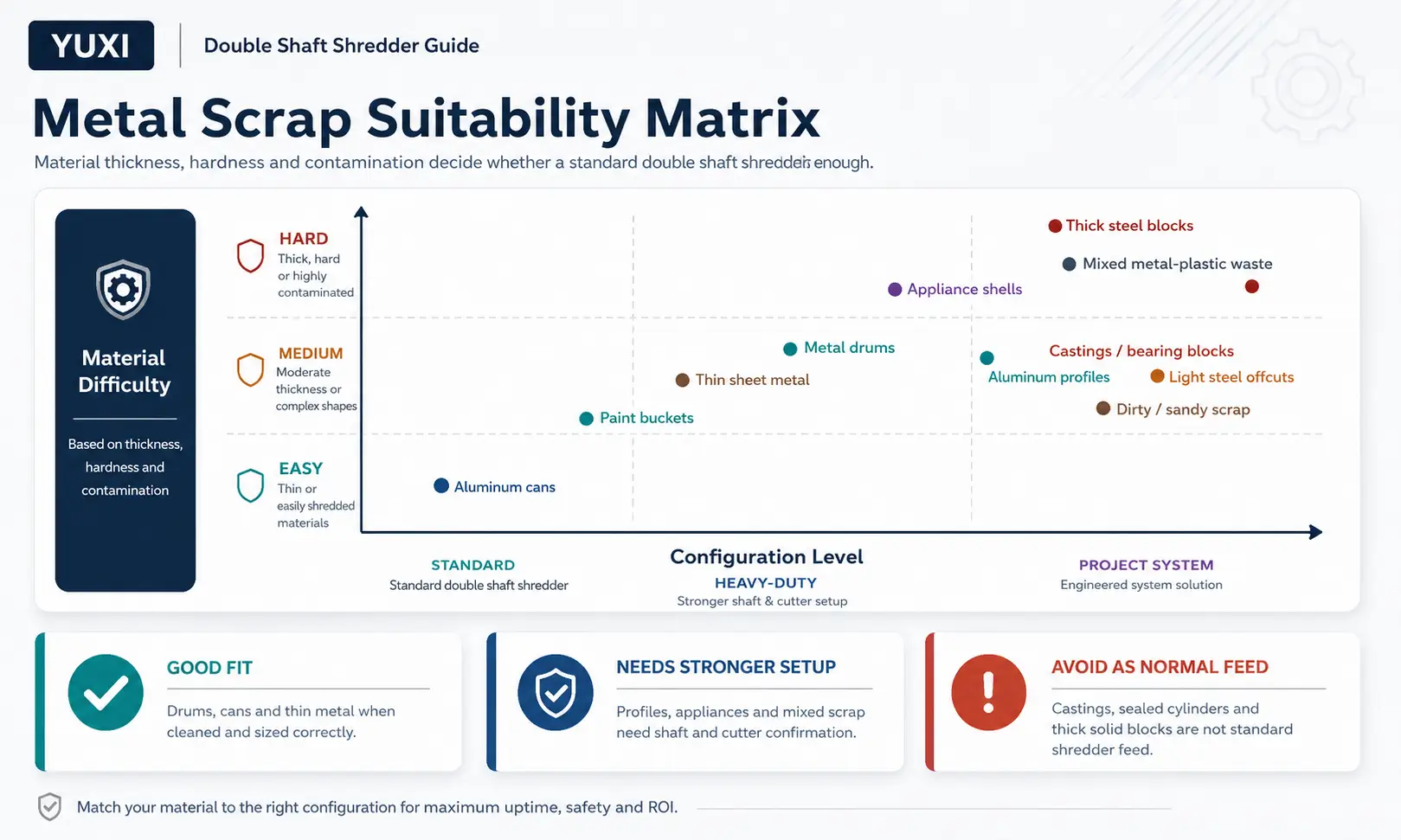
A double shaft shredder can handle many light and medium metal recycling materials. The table below gives a practical selection view, not a guarantee that every item can be fed into every model. The same material name may need a different shaft, cutter and gearbox configuration when the thickness or feeding size changes.
| Metal Material | Suitability | Selection Notes |
|---|---|---|
| Metal drums | Very suitable when cleaned and opened | Check wall thickness, residual liquid, lid condition and whether the drum is sealed. |
| Paint buckets | Suitable | Clean flammable residue before feeding. Bucket thickness and volume decide cutter load. |
| Aluminum cans | Suitable | Often used for volume reduction. Feeding density may affect hourly capacity more than motor power. |
| Aluminum profiles | Suitable with correct cutter design | Long profiles need good biting force and controlled feeding to avoid bridging or bouncing. |
| Thin sheet metal | Suitable | Sheet thickness, elasticity and feeding method should be checked before choosing blade thickness. |
| Appliance shells | Suitable for pre-shredding | Good for opening mixed metal-plastic shells before magnetic or manual separation. |
| Light workshop scrap | Depends | Check hardness, maximum size and whether there are solid blocks, tooling steel or stones. |
| Mixed industrial waste | Depends strongly on impurities | Useful for rough pre-shredding, but contamination must be understood before model selection. |
| Thick steel blocks | Usually not suitable | Use a heavy-duty metal shredder, hydraulic shear or crushing line instead. |
| Castings and bearing blocks | Not recommended for normal configuration | High hardness and impact load can damage cutters, shafts, bearings and gearboxes. |
Official waste and recycling statistics also show why metal scrap usually needs pre-processing before it can be recovered efficiently. In real recycling yards, ferrous scrap, appliances, and other metal-containing waste rarely arrive in a clean and uniform condition. They may be mixed with paint, plastic parts, rubber, insulation, labels, residual liquid, dust, or other non-metal materials. A double shaft shredder can help open, tear, and reduce the size of bulky scrap, but it should be seen as one step in the whole recycling line. Careful inspection, sorting, and safe removal of unsuitable materials are still necessary before and after shredding. For background on ferrous metal recovery data, see the U.S. EPA ferrous metals material data.
Metal drums and paint buckets are common materials for a double shaft metal shredder. They are bulky, hollow and difficult to feed directly into many downstream machines. A slow-speed dual shaft shredder can bite the container, flatten it, tear it open and reduce volume before magnetic separation, baling or secondary crushing.
The buying note is simple: the container must be safe before shredding. Sealed drums, gas cylinders, pressure vessels and containers with flammable or chemical residue should not be treated as ordinary scrap. OSHA guidance for compressed gases highlights the hazards associated with compressed gas containers, and in real recycling yards these items require dedicated handling before any crushing or shredding operation. A shredder selection discussion should always ask whether the incoming metal containers are clean, open and non-pressurized.
Aluminum cans, profiles, window frames and light sheet are often good candidates for rough size reduction. Aluminum scrap is usually lighter than steel, but it can be long, springy and awkward to feed. The advantage of a double shaft shredder is that the two shafts can grab and shorten the material before it moves to a conveyor, baler or separation stage.
For long aluminum profiles, feeding method matters. A small machine with a narrow chamber may not accept long profiles efficiently unless they are pre-cut or fed at a controlled angle. A larger hopper and stronger bite can improve feeding, but it also increases machine cost. This is why project planning should start from the longest piece, not only the average material.
Appliance shells are rarely pure metal. Washing machine panels, small appliance casings, refrigerator parts and electronic scrap frames often include plastic, foam, cables, rubber, insulation and screws. A double shaft shredder is useful here because it opens mixed structures without relying on high-speed impact as the first step.
After rough shredding, the material can be sent to magnetic separation for ferrous metal, eddy current separation for aluminum and other non-ferrous metals, or manual sorting for larger contaminants. If the final target is small pieces, a hammer mill or secondary crusher may be added after the rough shredding stage.
Factory bins often contain mixed light scrap: thin steel offcuts, aluminum pieces, packaging metal, small frames and sometimes plastics or cardboard. A double shaft shredder can reduce volume and make the material easier to handle. But this is also where many selection mistakes happen. The word “light scrap” may hide thick tooling pieces, stones, concrete chunks or hardened parts that are not suitable for a normal shredder configuration.
For this type of inquiry, a supplier should ask for photos from several loads, not only one clean sample. The worst 10% of the material often decides blade life and gearbox stress.
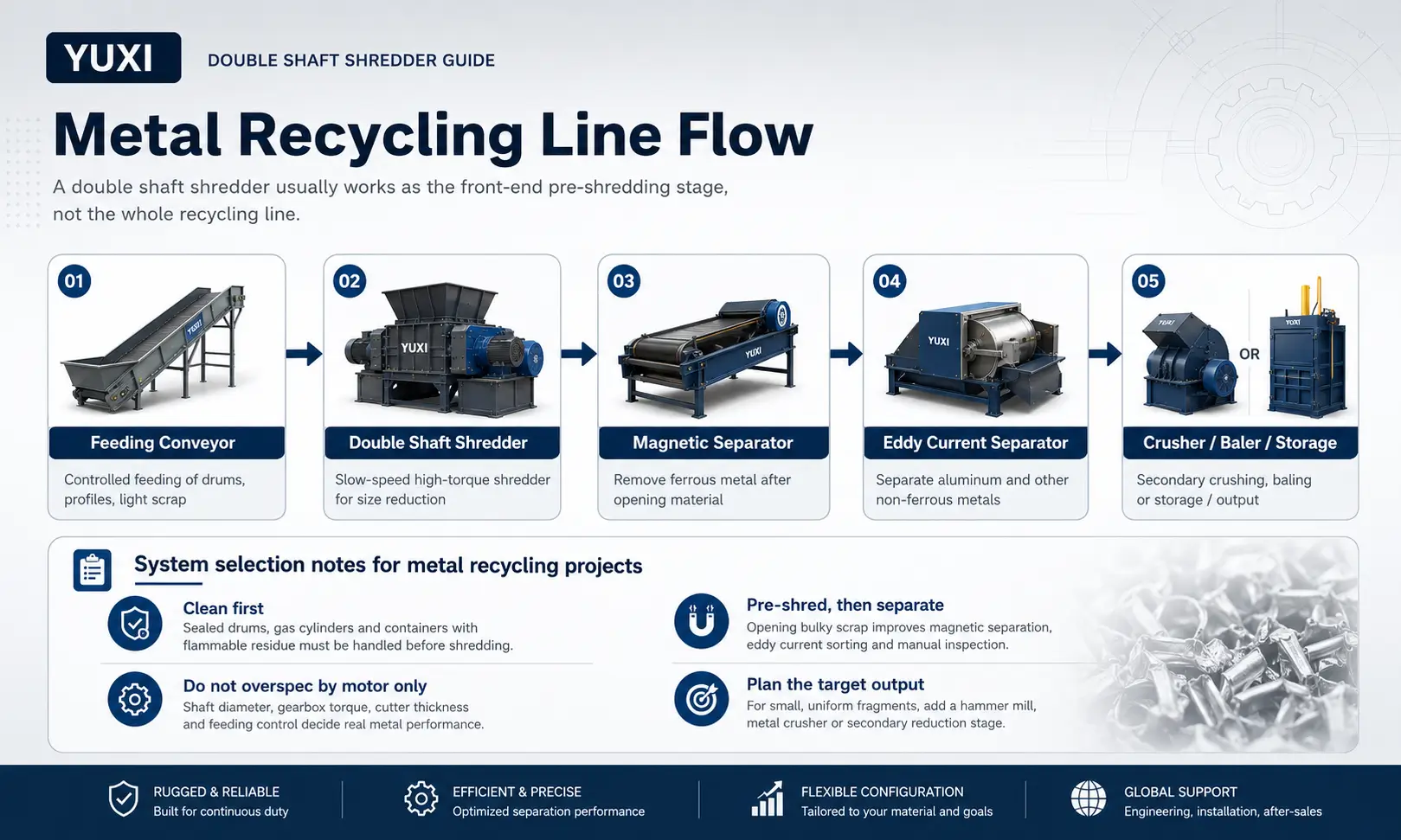
Most buyers do not really need only a shredder; they need a process. A practical metal recycling line may look like this:
Feeding conveyor → Double shaft shredder → Discharge conveyor → Magnetic separator → Manual sorting or eddy current separator → Metal crusher, baler or storage area
The double shaft shredder takes the first mechanical load. It reduces bulky metal waste into smaller, more transportable pieces. The magnetic separator removes ferrous metal. An eddy current separator can help separate aluminum and other non-ferrous metals in suitable layouts. A crusher or hammer mill can then further reduce material if the buyer needs finer output or better liberation.
This is also why output size promises should be handled carefully. A double shaft shredder can make rough pieces, but it should not be sold as a one-machine solution for small, uniform metal particles unless the configuration includes a suitable secondary stage.
A good supplier should not say that a double shaft shredder can process all metal. The problem is not only whether the blade can bite the material. The real risk is shaft damage, gearbox overload, blade cracking, bearing stress, unsafe feeding and long downtime.
If a buyer sends one clean photo but says the real material is “mixed scrap from different factories,” the machine should not be quoted only from that one photo. Ask for the largest, thickest and dirtiest pieces in the feed. Those pieces decide whether the project needs a heavier model, a hydraulic shear, a metal crusher or a different sorting process.
For gas cylinders and pressurized containers, safety rules are not a marketing detail. These items can create explosion, pressure and toxic gas risks if handled incorrectly. General OSHA rules for compressed gases are available from OSHA 1910.101, and recycling plants should apply local safety procedures before any mechanical processing.
Cutter thickness affects both output and durability. Thin cutters can make smaller strips, but they are not always suitable for tough metal scrap. Thicker cutters are stronger and more impact-resistant, but the discharge is usually rougher. For metal drums, aluminum profiles and thin sheet, the goal is not always the smallest possible output. The goal is stable biting, acceptable blade life and reliable discharge.
Blade material matters more when metal is involved. A buyer should ask about cutter steel grade, heat treatment, hardness, toughness, repair method and replacement cost. A very hard cutter may resist wear but become more brittle under shock. A tougher cutter may survive impact better but need more regular sharpening or replacement. The right choice depends on the material stream.
Motor power is easy to compare on a quotation sheet. Shaft diameter and shaft material are less obvious, but they are often more important for metal recycling. The shaft carries torsional load, shock load and bending stress when irregular scrap is pulled into the chamber. A larger model with stronger shafts may be safer than simply increasing motor power on a smaller frame.
Low-speed torque is the real working force of a double shaft shredder. Auto reverse helps when the chamber is overloaded, but it is not magic. It cannot make a light-duty model perform like a heavy-duty metal recycling shredder. If the feed contains thick steel, hard blocks or too many contaminants, the PLC may reverse again and again, capacity will drop and the machine will still suffer mechanical stress.
Many inquiries start with “How many tons per hour?” The answer depends on more than the model number. Metal recycling capacity is affected by material type, feeding size, wall thickness, bulk density, hollow or solid structure, feeding method, cutter width, chamber size, motor and gearbox configuration, required output size and the number of working hours per day.
For example, one ton of loose aluminum cans takes much more volume than one ton of compact steel sheet. A hollow drum may look large but can collapse quickly. A long aluminum profile may need more feeding control than a short metal bucket. Mixed appliance shells may contain plastic and insulation that lower density but increase sorting complexity.
This is why a responsible supplier will often give a capacity range instead of one fixed number. It is better to run a material test or at least review real photos and videos before confirming production capacity. If the buyer needs guaranteed output for a production contract, a test run is worth far more than a catalogue number.
A double shaft shredder and a hammer mill are not the same machine. They may appear in the same metal recycling project, but they solve different problems.
| Item | Double Shaft Shredder | Hammer Mill / Metal Crusher |
|---|---|---|
| Main role | Pre-shredding and rough size reduction | Crushing, impact reduction and finer metal liberation |
| Speed | Low speed | High speed |
| Working force | High torque tearing and shearing | Impact and collision force |
| Output | Rough pieces | Smaller fragments, depending on screen and machine design |
| Best use | Bulky light metal, drums, mixed waste and pre-opening | Secondary or final crushing when smaller output is required |
If the buyer mainly needs to reduce bulky metal drums or aluminum profiles before sorting, the double shaft shredder may be the first machine to discuss. If the buyer needs small metal pieces or better separation of materials, the project may also need a hammer mill, metal crusher or complete downstream system.
“How many kW?” is not enough. A metal recycling shredder should be checked by shaft diameter, cutter thickness, gearbox torque, chamber size, bearing protection and how the machine handles overload.
Aluminum cans and thick steel blocks are not the same project. Metal drums and castings are not the same project. The material name is only the start of selection.
A double shaft shredder usually makes rough output. For small and uniform metal fragments, plan a secondary crusher or hammer mill instead of forcing one machine to do everything.
Sealed gas cylinders, pressure vessels and chemical drums must be handled separately. A strong shredder does not remove the safety responsibility of the recycling plant.
Before choosing a double shaft shredder for metal recycling, prepare clear information for the supplier. This saves time and avoids an undersized machine.
For a custom Double Shaft Shredder Machine, cutter layout should be selected from the waste stream first. Machine size comes after the material is understood.
Yes. It can shred many light and medium metal recycling materials, including metal drums, cans, aluminum profiles, thin sheet metal and appliance shells. Heavy solid steel needs a stronger system.
It is suitable for pre-shredding bulky or mixed scrap metal before sorting, baling or secondary crushing. The exact configuration depends on metal thickness, hardness and impurities.
Yes. Metal drums are common materials for double shaft shredders, but sealed drums or drums with flammable, chemical or pressurized residue must not be fed directly.
Yes. It can process aluminum cans, aluminum profiles, light sheet and mixed aluminum scrap, especially when the material is bulky or difficult to feed.
Usually not by itself. A double shaft shredder is mainly for rough size reduction. For smaller particles, add a hammer mill, metal crusher or secondary reduction stage.
A double shaft shredder for metal recycling is valuable when the project needs strong grabbing force, slow-speed torque and rough pre-shredding of bulky light or medium metal scrap. It is especially useful for metal drums, paint buckets, aluminum profiles, cans, thin sheet metal, appliance shells and mixed industrial scrap that needs to be opened before sorting or further processing.
It is not a universal solution for every type of scrap metal. Thick steel blocks, heavy castings, bearing blocks, sealed cylinders and highly contaminated loads require different handling or heavier equipment. The best selection starts with real material information: photos, maximum size, thickness, impurities, target output and downstream process. Once those details are clear, the right cutter, shaft, gearbox and line layout become much easier to choose.
Send material photos, video, maximum size, thickness, impurity information, target output and required capacity. The machine should be selected from the real scrap stream, not from the name “metal recycling” alone.

Get in touch with our nice team today to get a price estimate for a shredder machine.
Contact Us