Industrial Shredder & Recycling Systems Manufacturer - YUXI

 English

 English
 Fast Delivery
 Reliable
 Certified
 ExperiencedEnglishEnglishFast DeliveryReliableCertifiedExperienced
A working guide for buyers who need to stop jams, improve feeding, control flake size, protect downstream equipment, and choose the right first step for a plastic recycling line.
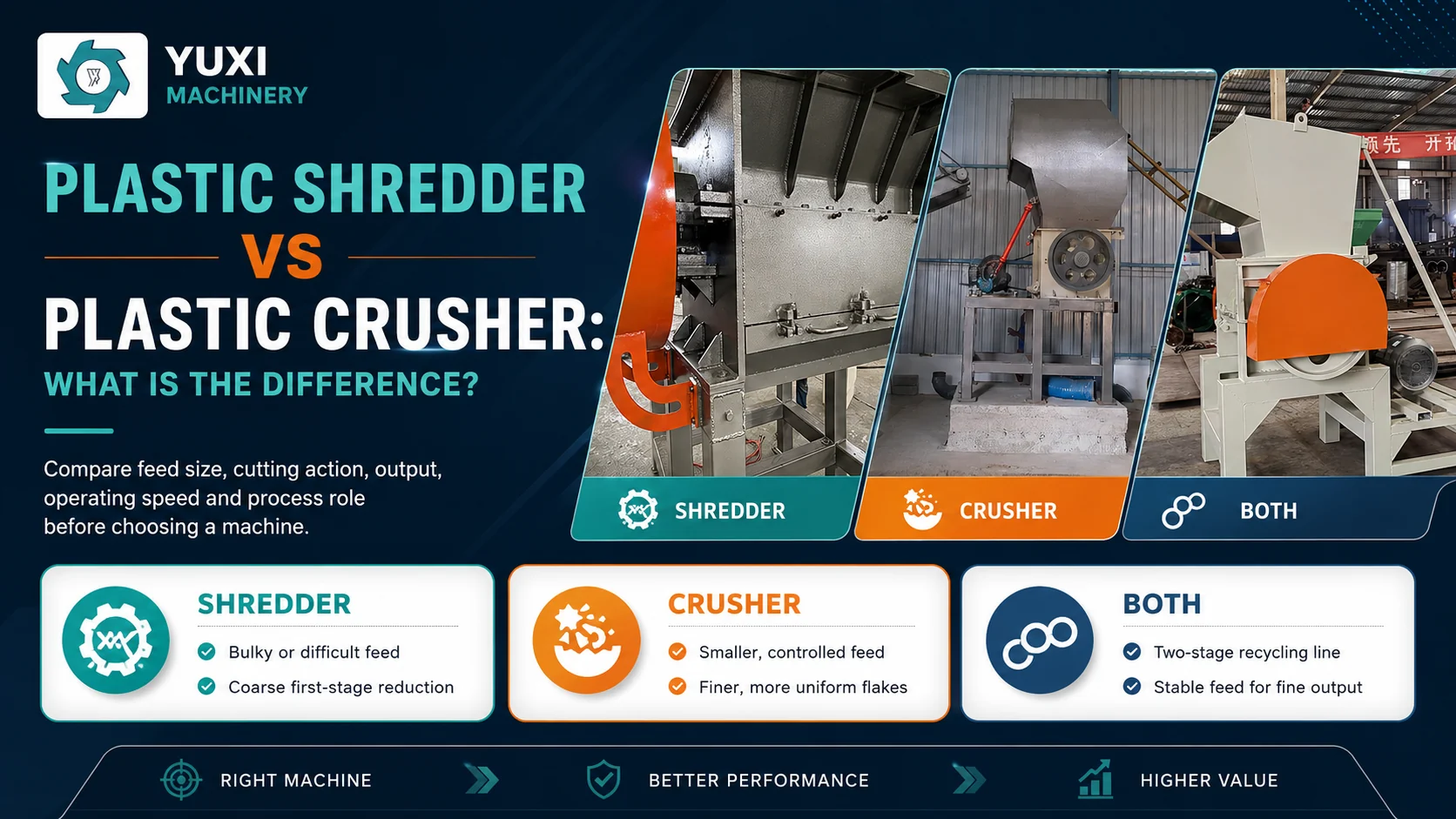
Use a plastic shredder when the normal feed is too bulky, too long, too dense, or too irregular for a high-speed knife mill. A shredder is built to get the first bite. It pulls material into the chamber and reduces it with torque. The output is usually coarse or medium-sized.
Use a plastic crusher, often called a granulator, when the feed already fits the chamber and the plant needs smaller, more even regrind. A crusher cuts at a higher rotor speed. Moving knives pass fixed knives, and a screen controls the discharge size.
When the material starts as pipe, drums, pallets, film bales, or heavy purgings but must end as small flakes, use both machines. The shredder handles the difficult feed. The crusher finishes the size reduction.
Most inquiries start with one sentence: “Do I need a shredder or a crusher?” That sounds simple, but it leaves out the reason the current process is failing.
The real complaint is usually one of these:
Those are process problems. A machine name does not solve them. The useful comparison is how each machine behaves with the buyer’s actual material, feed method, screen, operating hours, and downstream equipment.
Equipment suppliers do not use “shredder,” “crusher,” and “granulator” in the same way. One supplier may call a screen-equipped knife rotor a shredder. Another supplier may sell a similar machine as a crusher. In North American molding plants, “granulator” is common. In export quotations, the same general machine may be called a crusher.
Ignore the label for a moment. Ask for the hardware:
A low-speed double-shaft machine and a 560 rpm screen-controlled knife machine can both appear under “plastic shredder.” They do not accept the same material and do not make the same output. The drawing and test video matter more than the title on the quotation.
The shredder is built around feed tolerance and torque. Cutters grab the material and pull it into the chamber. A double-shaft shredder tears and shears between two cutter stacks. A single-shaft shredder uses a ram to push material against one rotor and fixed counter knives.
The machine can accept larger and less regular pieces. An unscreened double-shaft shredder normally makes coarse, irregular output. A screen-controlled single-shaft design gives better maximum-size control, but its first job is still to handle material that a crusher cannot feed reliably.
The crusher is built around knife cutting and a controlled screen. A faster rotor carries moving knives past fixed bed knives. Material is cut again until it passes the screen.
The crusher gives smaller, more even regrind when the feed is already within the chamber limit. It is less forgiving of long pipe, large hollow parts, thick purge blocks, and hidden metal. Stable feeding and correct knife clearance are essential.
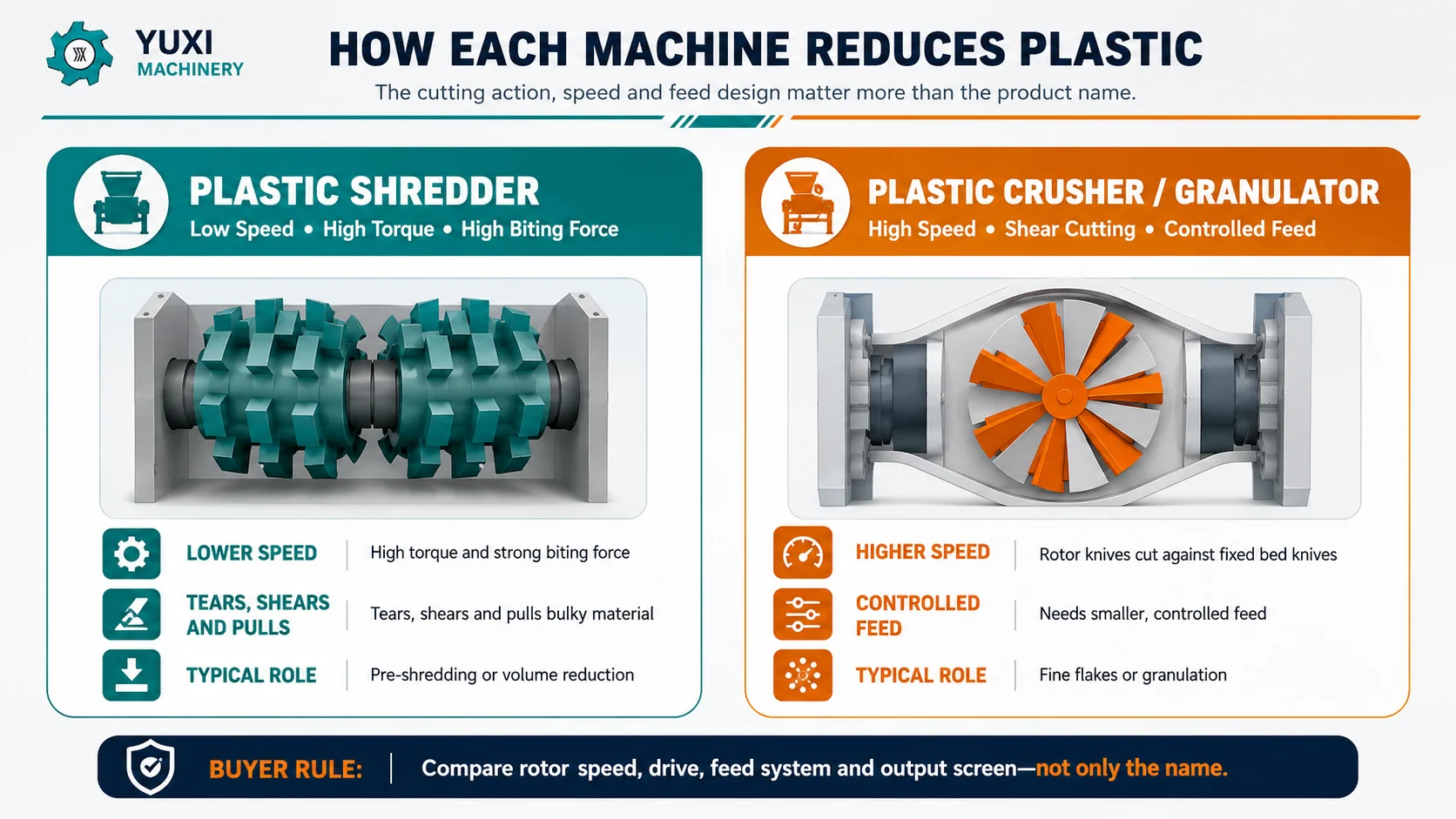
| Point to compare | Plastic shredder | Plastic crusher / granulator |
|---|---|---|
| Main duty | Primary reduction, bale opening, volume reduction, and feed preparation | Finer size reduction for washing, extrusion, pelletizing, or in-house reuse |
| Normal feed | Pipe, drums, pallets, bales, heavy lumps, large parts, and mixed bulky plastic | Runners, molded parts, flakes, thin profiles, and pre-shredded material |
| Cutting behavior | Grabs, tears, bends, and shears with torque | Cuts repeatedly between moving and fixed knives |
| Feed tolerance | Better tolerance for uneven and oversized pieces | Best with smaller, steady, controlled feed |
| Discharge | Coarse or medium; may include irregular pieces or strips | Smaller and more uniform because of the screen |
| Operating speed | Usually lower or moderate, depending on design | Usually higher |
| Common bottleneck | Ram cycle, grabbing, cutter loading, or oversized contaminants | Feed bridging, screen plugging, dull knives, heat, or suction limits |
| Metal sensitivity | May survive small unexpected pieces better, but metal still causes damage | High-speed knives and screens are more vulnerable |
| Best next step | Crusher, washer, sorter, densifier, or coarse reuse | Washing, drying, extrusion, pelletizing, or molding reuse |
| What the operator sees | Likely cause | What to check before buying or changing the machine |
|---|---|---|
| Whole drums bounce above the rotor | Feed opening is too small, knife hooks do not grip, or the machine relies on gravity | Use a larger hopper, stronger gripping geometry, ram feed, or a shredder first |
| Long pipe bridges across the hopper | Pipe length and diameter exceed the normal feeding path | Confirm dedicated pipe feed, horizontal ram, safe loading, and chamber length |
| Film floats or wraps | Low bulk density, poor feeding control, wrong rotor, or material entering in ropes | Check ram or roller feed, anti-wrapping rotor, bale opening, and cleaning access |
| Machine reverses every few seconds | Overfeeding, dense purge, hard contamination, small screen, or weak torque path | Review largest piece weight, current log, screen, drive, and feed rate |
| Output contains long strips | No screen, wide cutters, material orientation, or flexible plastic stretching | Add screen control, a second stage, recirculation, or different cutter geometry |
| Crusher makes powder and heat | Dull knives, poor knife gap, small screen, blocked screen, or long residence time | Inspect knife condition, clearance, airflow, screen area, and discharge suction |
| Published capacity is not reached | Material density differs from test material, feed is unstable, or downstream equipment is slower | Run a timed test on the real material and count only saleable output |
| Knife damage repeats | Metal, sand, glass fiber, stones, or embedded inserts | Add inspection, magnets, metal detection, sorting, and a contamination limit |
| Cleaning takes too long | Poor chamber access, difficult screen removal, dead zones, or too many fasteners | Review opening method, rotor lock, screen cradle, lifting points, and color-change procedure |
| Material piles up between machines | Shredder and crusher capacities are not balanced | Add interlocks, variable-speed conveyors, a buffer hopper, and load-based control |
A crusher opening may be wider than the part, yet the part still may not reach the rotor. This is common with hollow drums, crates, flat sheet, and long profiles. The part lands across the hopper, bounces, or rests on other pieces. The operator then reaches for a pole, a forklift, or a saw. At that point, the line already has a feeding problem.
Manual pre-cutting is acceptable for a rare oversize item. It is not a good normal operating method. It adds labor, lowers real throughput, and creates a safety issue around the feed opening. A buyer who needs two workers to cut and push material has not purchased a true 1-ton-per-hour system, even if the motor can process that much after the material enters.
For bulky feed, compare three things:
Film causes problems that do not appear in rigid-plastic tests. Loose film carries a great deal of air. It can float above the rotor, bridge in the hopper, wind around shafts, and pull into long ropes. Wet agricultural film adds sand and weight. A compact bale behaves differently from loose trim.
A high-speed crusher can work well on clean edge trim when a roller feeder presents the material at a steady rate. The same crusher may perform poorly on loose bags or opened bales. The rotor spends time moving air instead of cutting plastic. Throughput falls even though the chamber looks full.
Film projects usually need one or more of the following:
Do not use rigid scrap capacity to estimate film capacity. Ask for a test with the same film form, bale density, moisture, and contamination. A clean LDPE film roll and dirty agricultural film are not the same job.
Purge blocks and thick-wall pipe are the opposite of film. They do not fill the chamber with air. They put a large mass against a small number of knife edges. The load rises quickly. If the piece is too large, the machine may stop, reverse, and try again without making useful progress.
For dense material, motor power is only one part of the design. Check rotor diameter, gearbox service factor, shaft size, knife support, bearing arrangement, and the largest piece weight. A large 40-kilogram purge block can be harder on the machine than hundreds of kilograms of bottles.
The practical choices are:
A demonstration that uses thin slices cut from the purge does not prove the machine can accept the original block. The test feed must match the daily feed.
Capacity numbers are often based on a clean, dry material that feeds well. A buyer may later run wet bottles, low-density film, long pipe, or mixed scrap. The machine rating stays the same, but the process changes.
Real output is limited by the slowest part of the line. That may be the hopper, ram, shredder, crusher, screen, suction fan, washer, dryer, or operator. A crusher capable of 1,000 kg/h cannot deliver 1,000 kg/h if the conveyor supplies 500 kg/h or the screen plugs every hour.
Use a simple test method:
The difference matters. A machine may make 800 kg during 45 minutes of cutting, but only 500 kg during a clock hour after loading and cleaning delays are included.
An unscreened double-shaft shredder can leave long strips, especially with film, woven bags, and thin sheet. That may be acceptable before sorting or washing. It is a problem when strips wrap around a conveyor, bridge above a crusher, or enter an extruder feed system.
The usual fixes are a screen-controlled shredder, smaller cutter spacing, recirculation, or a second-stage crusher. Do not promise a fine and uniform output from a rough pre-shredder unless the supplier has tested the exact material.
Fines often increase when knives are dull or the clearance is too wide. Instead of making a clean scissor cut, the rotor rubs, tears, and repeats the cut. A screen that is too small keeps material in the chamber longer and creates more knife contact.
Check knife sharpness, knife gap, screen area, rotor loading, and air evacuation. A clean cut normally gives better regrind and uses less energy than repeated rubbing.
Heat can build when the screen is clogged, the knives are dull, the material is soft, or discharge airflow is weak. The plastic stays in the chamber and rubs against the rotor. Once it softens, it can coat the screen and make the problem worse.
Stop and correct the cause. Do not keep feeding because the motor still runs. Inspect the screen, knives, knife gap, suction line, and actual feed rate. A larger screen or a two-stage process may be better than trying to make final granules in one hot chamber.
Auto-reverse is protection, not production. A few reverse cycles during uneven feeding are normal. A machine that reverses every few seconds is telling the operator that the cutting load and feed rate do not match.
Common causes include:
Review the motor-current log and the timing of each reverse. If the machine reverses only when the ram advances, adjust the feed logic. If it reverses on one type of part, set a feed limit or change the machine. If the current remains high after the chamber is empty, inspect the rotor, bearings, screen, and drive.
Post-consumer plastic may contain screws, wire, steel rings, stones, glass, sand, and liquid. Some inserts become visible only after the shredder opens the product. That is why metal protection is often most effective between the shredder and the crusher.
A magnet can remove loose ferrous metal. It will not find every stainless-steel or nonferrous insert. A metal detector can help, but the line still needs inspection and a reject plan. If metal is embedded inside thick plastic, the first machine and cutter design must be selected with that risk in mind.
Sand and glass fiber may not cause one dramatic failure. They shorten knife life. The buyer should define the contamination level and ask for expected sharpening intervals. “Mixed plastic” is not enough information for a wear-part estimate.
Two machines can make similar output during a short test and still have very different operating costs. The difference often appears during screen cleaning, knife service, and color changes.
Ask the operator to walk through these jobs before purchase:
Granulator designs with quick chamber access and repeatable knife settings reduce the time between production runs. Easy access is not a cosmetic feature. It determines whether the operator cleans the machine correctly or postpones the work until quality falls.
Keep a startup spare package on site. It normally includes moving knives, fixed knives, screens, fasteners, seals, and the bearings or wear parts with the longest delivery time. The exact list depends on the material and operating hours.
A two-stage line is not automatically better. It costs more, takes more floor space, and adds another drive and control system. It is justified when one machine cannot accept the feed and make the final output without repeated trouble.
The shredder handles the difficult first step. It reduces pipe, drums, pallets, bales, or purgings to a size the crusher can feed. The crusher then makes the smaller, screen-controlled flake. A conveyor between the machines creates a useful inspection point for metal removal.
Balance the two machines around the slowest stage. Add a variable-speed conveyor, buffer hopper, and electrical interlock. If the crusher load rises, the shredder or feed conveyor must slow down before material piles up.
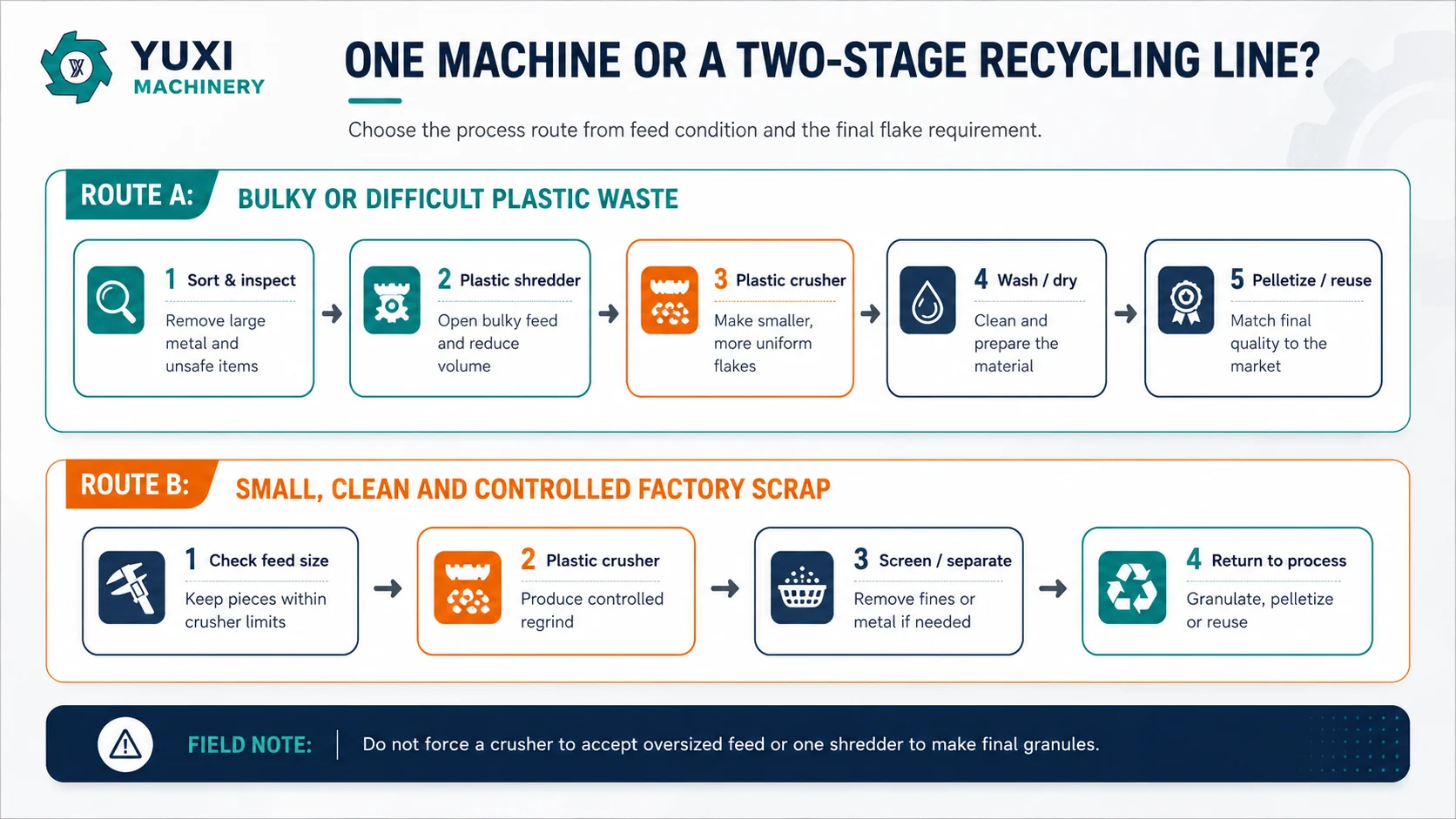
The buyer wants small regrind for extrusion. A crusher can make the required flake, but the full pipe cannot enter safely. The practical route is a pipe shredder or heavy first stage followed by a crusher. The RFQ must include pipe diameter, wall thickness, length, and maximum piece weight.
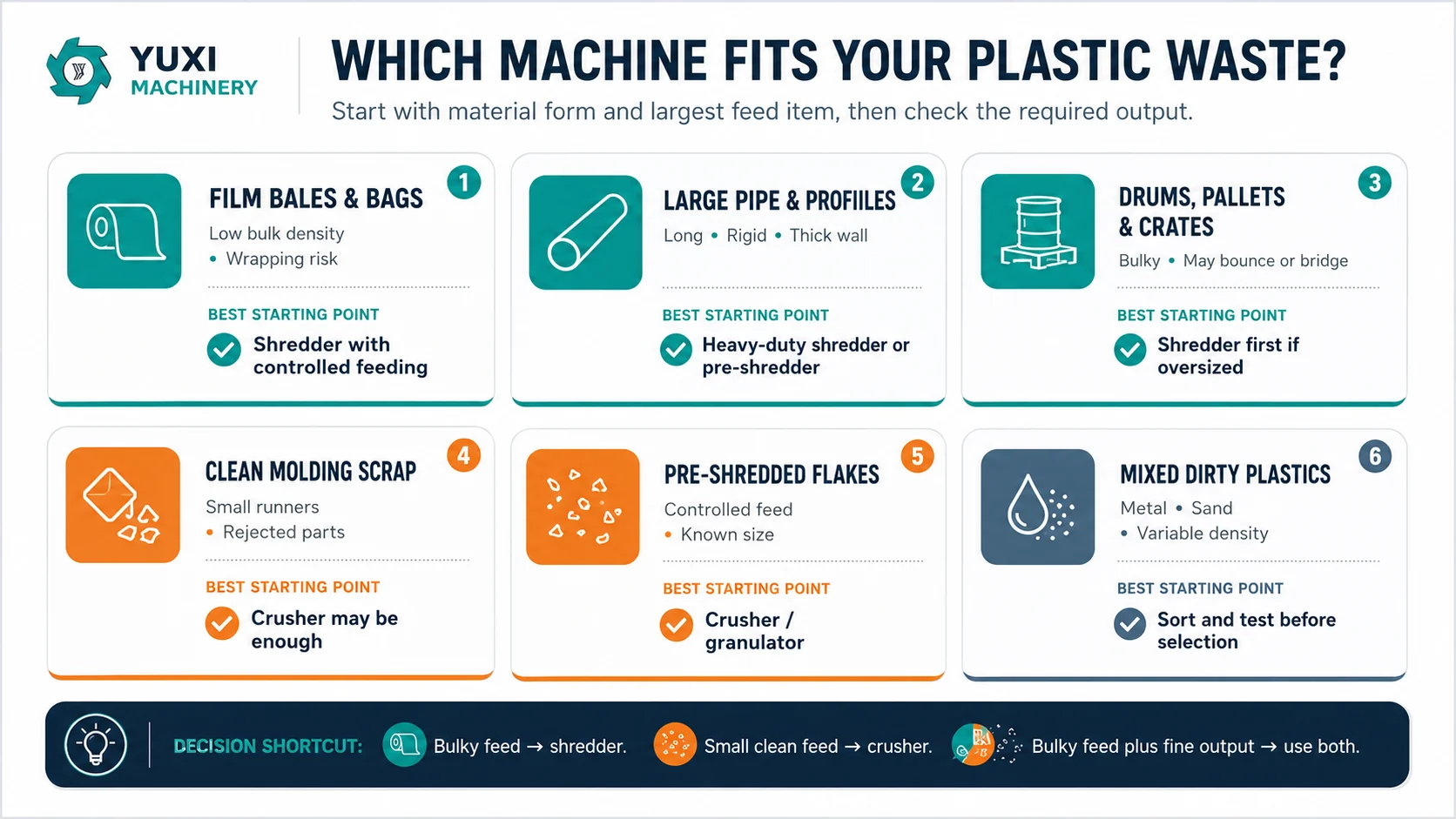
The scrap is dry, clean, and produced beside the molding machine. Every piece fits the crusher. A crusher alone is normally the simplest answer. A shredder would add cost and cleaning work without removing a real bottleneck.
The material is light after the bale opens. Stable feeding matters more than high rotor speed. A ram-fed shredder or film-specific feeding system is normally the first step. Add a crusher only if the washer or pelletizing line requires a smaller flake.
The items are hollow and bulky. They bounce in a small crusher throat. A shredder with a wide hopper and strong gripping action is easier to operate. If the buyer sells coarse shred, one machine may be enough. If the material goes to fine washing, use a crusher after inspection.
The blocks are heavy and irregular. One block can overload a light machine. The buyer must define the largest block, not only the monthly tonnage. A heavy shredder, controlled pre-cutting, or two-stage system may be required.
Size reduction is only one part of the job. The line needs sorting and metal control. A shredder can open the products, then a magnet, detector, or inspection belt protects the crusher.
The current YUXI product page lists six screen-controlled plastic size-reduction models. Published power ranges from 7.5 to 37 kW. Cutting chambers range from 270 × 400 mm to 480 × 1000 mm. The listed rotor speed is 560 rpm, with 10 or 12 mm screens and reference output from about 300 to 1,600 kg/h.
This matters because the equipment sits closer to a screen-controlled knife machine than to a slow unscreened primary shredder. It is suitable when the feed can enter the chamber and the buyer needs controlled discharge before washing, granulation, or pelletizing. Large pipe, whole pallets, large drums, or heavy purge blocks may still require a separate first stage.
| Model | Power | Cutting chamber | Screen | Published output |
|---|---|---|---|---|
| YX-2640G | 7.5 kW | 270 × 400 mm | Φ10 mm | 300–550 kg/h |
| YX-2650G | 11 kW | 270 × 500 mm | Φ10 mm | 400–650 kg/h |
| YX-3660G | 15 kW | 370 × 600 mm | Φ12 mm | 400–700 kg/h |
| YX-3680G | 22 kW | 370 × 800 mm | Φ12 mm | 600–900 kg/h |
| YX-4680G | 30 kW | 480 × 800 mm | Φ12 mm | 700–1,200 kg/h |
| YX-46100G | 37 kW | 480 × 1000 mm | Φ12 mm | 800–1,600 kg/h |
These are reference values. Actual output changes with bulk density, moisture, contamination, knife condition, screen size, and feeding stability. Model selection should start with the material test and the next process, not the top number in the table.
“Need 1 ton per hour plastic shredder” is not enough for a reliable recommendation. Send the information an engineer needs to reproduce the load.
For the full selection process, use the plastic shredder machine selection guide. For budget planning, use the separate plastic shredder machine price guide.
A good test answers operating questions. It does not only make a clean video.
For a two-stage line, test the transfer between machines. A shredder result is not useful if the output bridges above the crusher. The final test should include conveyors, metal protection, and interlocks whenever possible.
Shredders and granulators contain rotating cutters that can cause severe injury. Feed openings need guarding that prevents access to the knives. Anti-kickback protection may be needed on roll-fed or hand-fed systems. Cleaning, knife work, and screen changes require energy isolation and verification before anyone enters the danger area.
Review emergency stops, interlocks, access doors, rotor locking, stored hydraulic energy, and the lockout procedure. The maintenance method should be part of the purchase review, not written after installation.
The usual causes are unstable feeding, a smaller screen, lower bulk density, dull knives, screen plugging, or a slower downstream system. Test the real material and count actual saleable output per scheduled hour.
Film may enter in long ropes, float above the rotor, or wind around shafts when feeding is unstable. Check the ram or roller feed, rotor design, bale opening method, and cleaning access.
Frequent reverse cycles normally mean overfeeding, dense oversize pieces, contamination, dull knives, a small screen, or a drive that does not match the load.
Some large crushers can process smaller hollow parts, but whole drums and pallets often bounce or bridge. A shredder is normally a more reliable first stage.
The material may be staying in the chamber too long because the screen is clogged or too small. Dull knives, incorrect knife gap, weak airflow, and overfeeding also create heat.
An unscreened shredder does not control every piece. Flexible plastic may stretch between cutters. Use a screen-controlled machine, recirculation, different cutters, or a crusher after shredding.
Use inspection before shredding for visible metal. Add a magnet, detector, or inspection point after shredding when hidden inserts may be exposed before the crusher.
Use two stages when the original feed is too bulky for the crusher but the final process needs small, even flakes. The two machines should be balanced with conveyors and interlocks.
Send the largest normal item and its weight. The maximum pipe, pallet, drum, or purge block usually sets the chamber and drive requirement.
Use the real material, quoted screen, largest normal feed item, continuous feeding, motor-current record, output weight, reverse count, and a chamber-access demonstration.
Tell YUXI what the operator is dealing with: bridging, wrapping, overloads, long strips, fines, metal damage, cleaning time, or an unstable downstream line. Include material photos, the largest feed item, target output, and the next process.

Get in touch with our nice team today to get a price estimate for a shredder machine.
Contact Us