





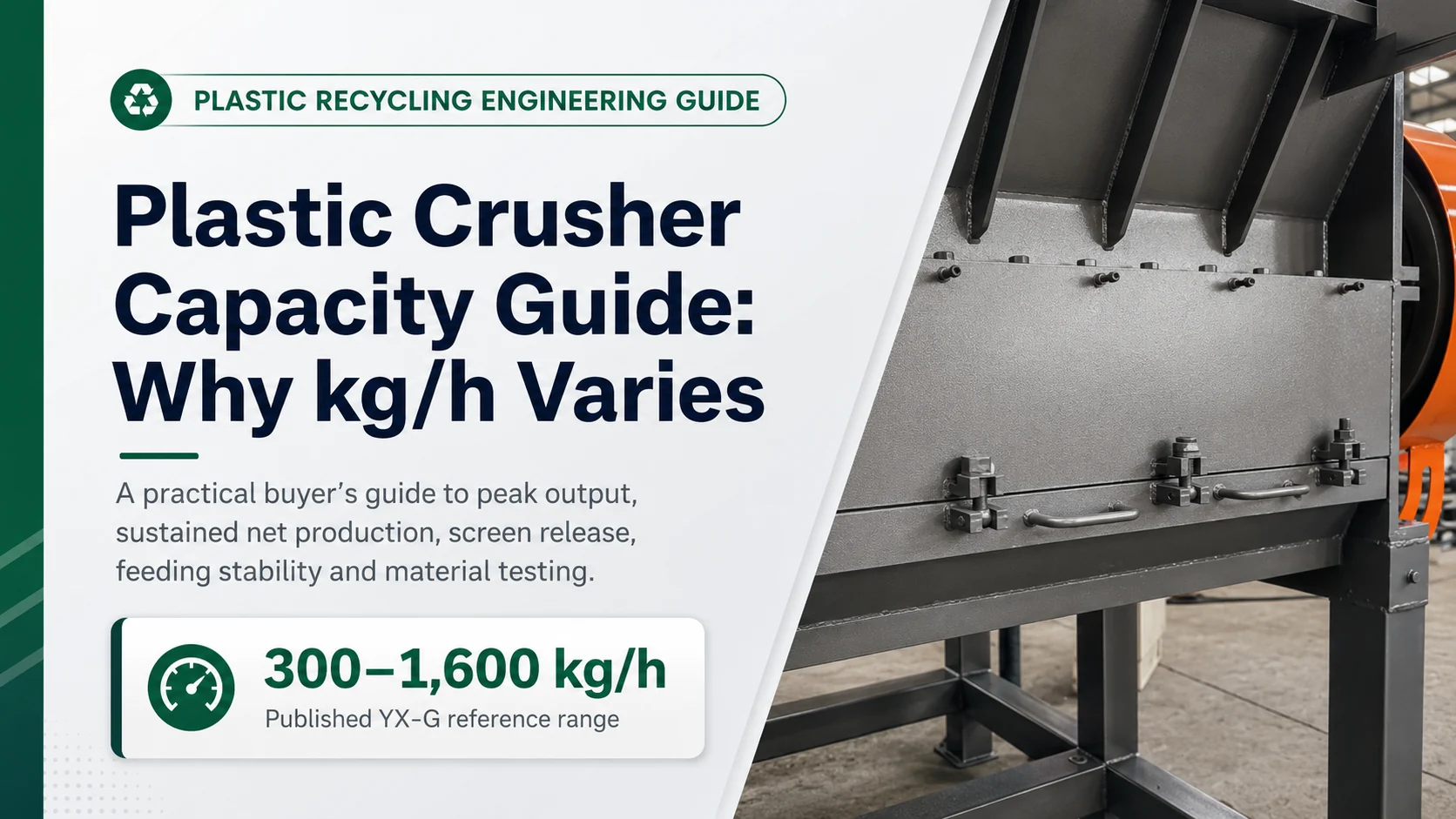
Quick answer: The capacity of a plastic crusher is usually expressed in kilograms of regrinding produced per hour,but it is not a fixed attribute of the motor or cutting chamber. The most useful figure is sustained net accepted output measured with representative material, the intended screen and feed method, normal discharge, and ordinary operating interruptions. Material bulk density, part geometry, wall thickness, temperature, moisture, contamination, knives, screen open area, feeding stability, evacuation and uptime can all change the result.
Start by Asking Which “Capacity” the Supplier Means
The word capacity is used too loosely in recycling quotations. A buyer asks for 800 kg/h, a supplier writes “800–1,200 kg/h,” and both sides move on. The number looks precise. The test boundary is not.Peak feed or peak discharge
A short high rate achieved on easy, prepared material. It can show that the rotor and drive have useful reserve, but it may exclude hopper refilling, bridging, overload recovery, bag changes, screen cleaning and other normal events.Stable gross output
The mass leaving the crusher during a steady run. Better than a peak, but it may still count fines, oversize, longs, metal-contaminated material or regrind that the downstream process rejects.Sustained net accepted output
The mass of usable regrind produced over total elapsed test time under representative conditions. For most purchase decisions, this is the most defensible kg/h figure.Shift or daily production
Hourly rate multiplied by real availability. Knife checks, cleaning, material changes, jams, planned maintenance and operator practices determine whether the theoretical hourly figure becomes saleable tonnage.Practical definition: Plastic crusher capacity should be written as a tested result, not a bare number. A useful statement includes the material, largest normal dimensions, bulk density or wall thickness, moisture and contamination, screen, feed method, discharge method, test duration, accepted output criteria and normal stoppages.
Capacity Is a Chain, Not a Motor Rating
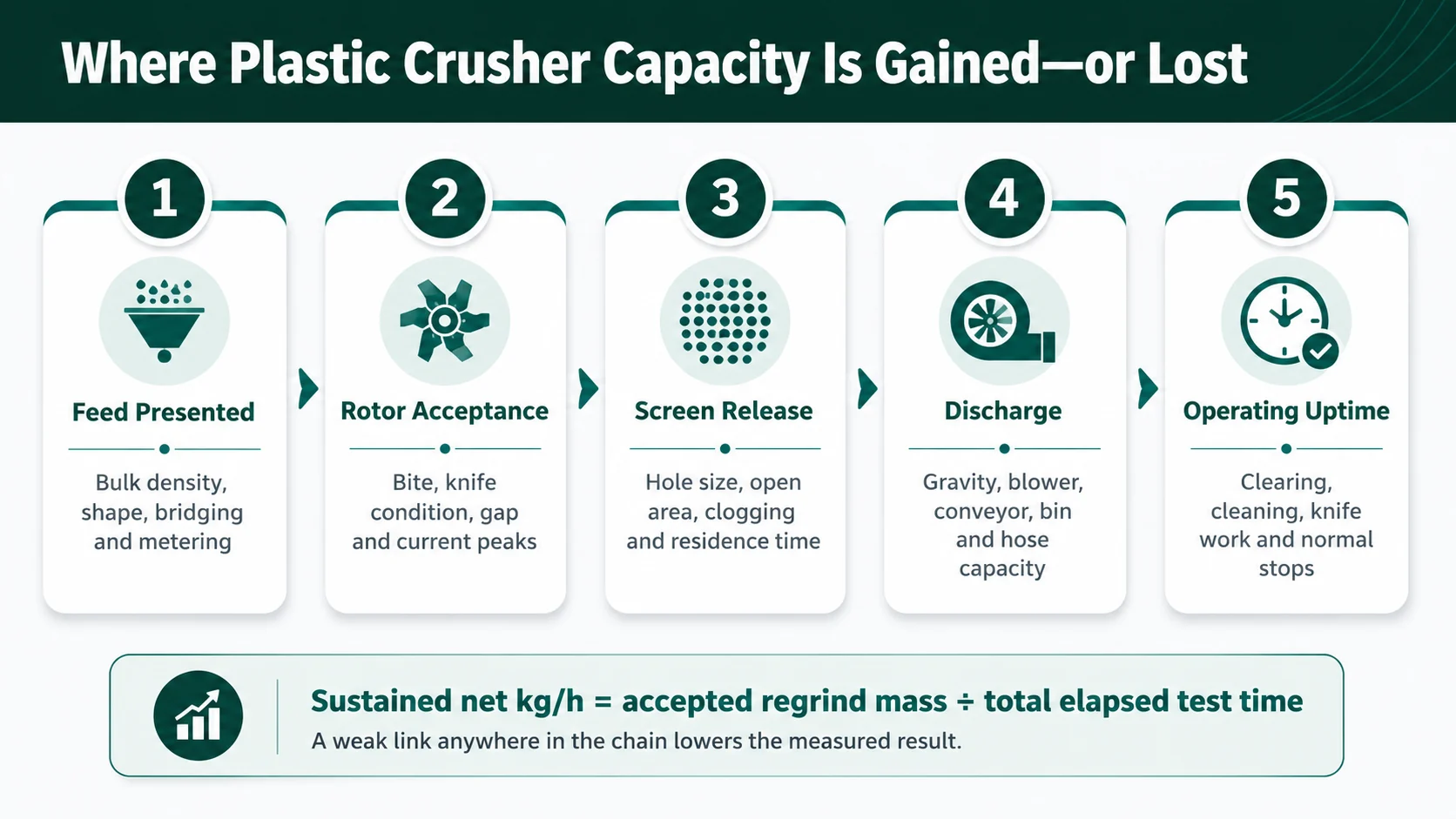
Net output = feed presented to the rotor × cutting acceptance × screen release × discharge availability × operating uptime.
This is not a literal multiplication formula for a quotation. It is a diagnostic model. If loose film never reaches the knives consistently, additional motor power does little. If correctly sized flakes cannot leave because a screen is blinded or a discharge hose is restricted, the chamber recuts material and creates heat. If the crusher generates 900 kg/h for 40 minutes,but cleans up,replaces bags and waits for the downstream washing machine in the next 20 minutes,the useful results per hour are much lower.
The Variables That Move Plastic Crusher Capacity
Bulk density and feed geometry
A kilogram of dense purge occupies far less hopper volume than a kilogram of bottles or film. The crusher may have enough cutting power, yet low-density feed cannot be presented quickly enough by gravity. Round bottles can bounce. Crates can nest. Long runners can rotate across the hopper. Thin film can bridge or flutter above the cutting circle. WITTMANN’s granulator guidance says actual throughput can vary with material type, additives, inserted-part size, material density, wall thickness, regrind size, material temperature, feeding and evacuation method.[2] That list is useful because it moves the capacity discussion away from motor kW alone.Polymer behavior, wall thickness and temperature
Brittle plastic may fracture and clear rapidly, although it can also create fines. Tough or warm plastic can stretch, absorb energy and stay in the chamber longer. Thick walls increase the work per piece. Hot production scrap may smear or partially clog a screen. The same resin name is not enough; grade, temperature and product form matter.Screen opening, open area and condition
A smaller hole retains material for more cutting and normally reduces output. However, nominal hole diameter is not the whole screen specification. Thickness, perforated area, hole pattern, wear and material buildup influence release. Cumberland notes that screen choice depends on material and machine speed, and that some designs used to control “longs” can reduce throughput.[3] That is the capacity–quality trade-off. A larger screen may raise kg/h but produce regrind the washer, sorter or extruder does not accept. Chasing the highest number of hours can simply move the bottleneck downstream.Knife sharpness, gap and rotor condition
Sharp, correctly set knives shear. Dull knives rub, deform and heat the plastic. The chamber retains material longer, current becomes less stable, fines increase, and output drops. Cumberland identifies reduced throughput as a common consequence of poor granulator maintenance and notes that filled, dirty, recycled, tough or thick materials can accelerate knife wear.[5] A larger gap is not a shortcut to capacity. It may turn clean cutting into tearing and create slivers. An excessively tight or incorrect gap can create contact, heat and mechanical risk. The machine manual and manufacturer procedure control the setting.Feeding method and surge control
Metered conveyor feeding is easier to evaluate than dumping boxes. A surge can pack the chamber and trip the motor; starvation leaves the rotor running without useful work. Cumberland states that efficient feeding is important for maximizing granulator throughput.[4] The practical point is simple: stable feed rate usually produces a more useful capacity result than occasional aggressive loading.Discharge and downstream limits
Gravity discharge, screw conveyors, air transport, cyclones, flexible hose, bins and bagging stations all have finite capacity. If regrind accumulates beneath the screen, it can return to the chamber or block new discharge. The crusher then looks underpowered even though the restriction is outside the cutting chamber. The downstream washer, dryer, separator or extruder also sets a ceiling. A crusher sized for 1,200 kg/h is not useful if the next machine accepts 700 kg/h and causes repeated waiting. We normally size the line backward from the downstream accepted rate.Moisture, dirt and foreign objects
Water changes the apparent feed mass and can make light materials clump. Labels, sand, glass, stones and metal increase wear and downtime. Mixed waste also creates inspection and rejection work that a clean-factory-scrap test does not show. Capacity should be based on the material as received, not an idealized sample that has been cleaned for the demonstration.Operating method and availability
Two plants with the same machine can produce different shift tonnage. One uses a metered conveyor, consistent batches, trained operators and planned knife service. The other relies on irregular manual loading, waits for bags, clears bridges repeatedly and runs knives beyond the useful edge condition. The catalog machine is the same. The operating system is not.Why the Same Crusher Shows Different kg/h on Different Feed
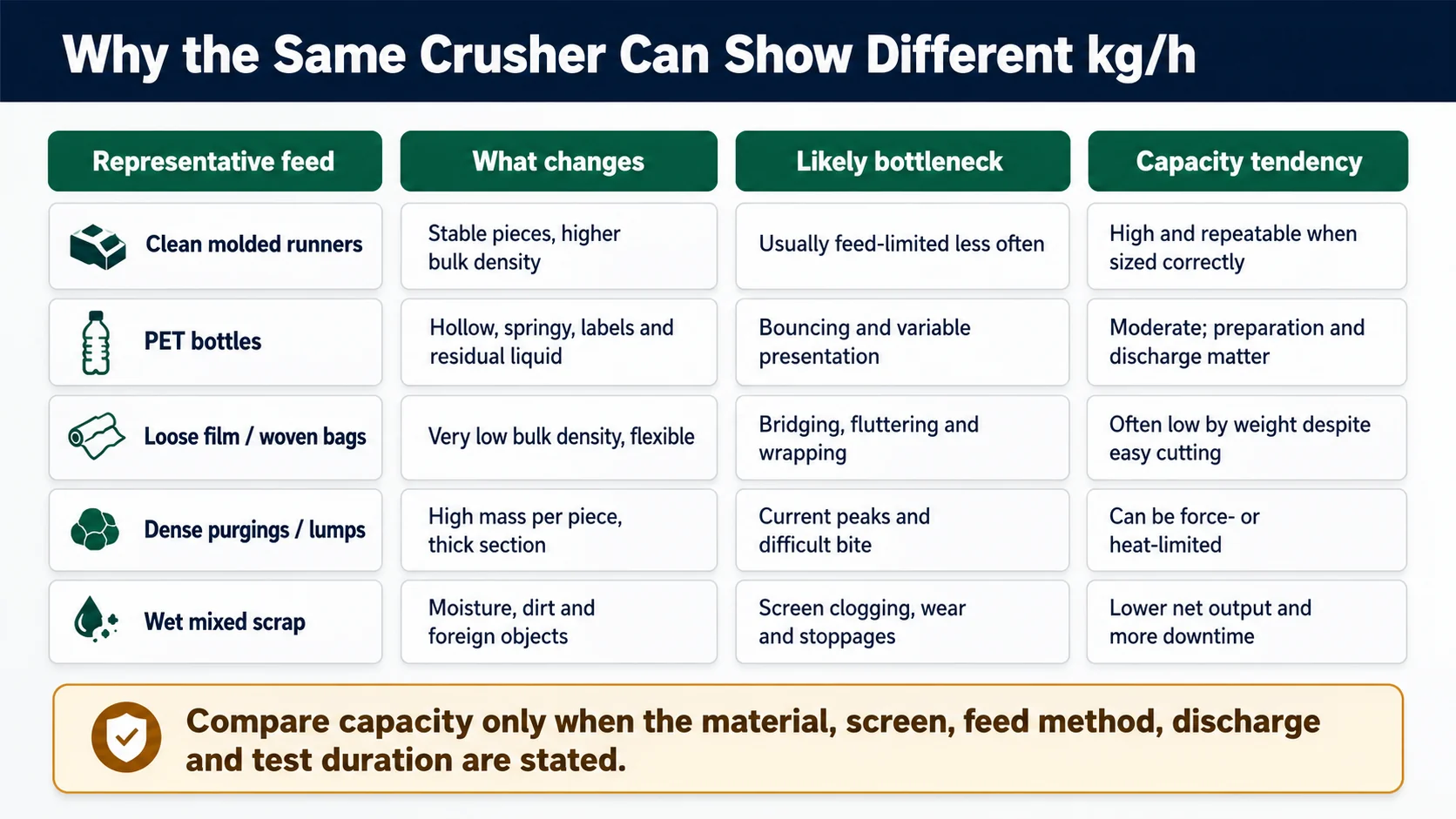
| Feed | Why kg/h changes | What to verify before accepting a number |
|---|---|---|
| Clean injection runners and sprues | Uniform, dry pieces can feed predictably. Long or tangled runners may still rotate or bridge. | Largest dimensions, orientation, batch dumping versus metered feed, accepted regrind size. |
| PET bottles and hollow containers | Low bulk density, bouncing, nested shapes, labels, caps and residual liquid create variation. | Bottle preparation, moisture, contamination, feed conveyor and air-conveying capacity. |
| PP crates and buckets | Spring-back, nesting and large hollow geometry can limit chamber ingestion. | Whole versus pre-cut parts, hopper opening, bite behavior and safe loading. |
| Loose film and woven bags | The material may be easy to cut but difficult to present by weight; bridging and wrapping dominate. | Bundle form, bulk density, moisture, dirt, roll or force feeding, evacuation and anti-wrapping behavior. |
| Dense purgings and lumps | High mass per piece raises current peaks; warm material can smear and thick sections take longer to reduce. | Maximum piece mass, temperature, brittleness, pre-breaking and sustained current. |
| Wet or mixed post-consumer scrap | Dirt and foreign objects increase wear, screen cleaning, sorting and rejection time. | As-received contamination, upstream metal protection, accepted fraction and normal cleaning interval. |
How to Read the YUXI YX-G Capacity Table
The current YUXI plastic size-reduction product page publishes six YX-G models. The listed equipment uses a 560 rpm rotor, rotating and fixed knives, and 10–12 mm screens. Those characteristics place the range closer to a relatively high-speed plastic crusher or granulator stage than a conventional slow, high-torque primary shredder.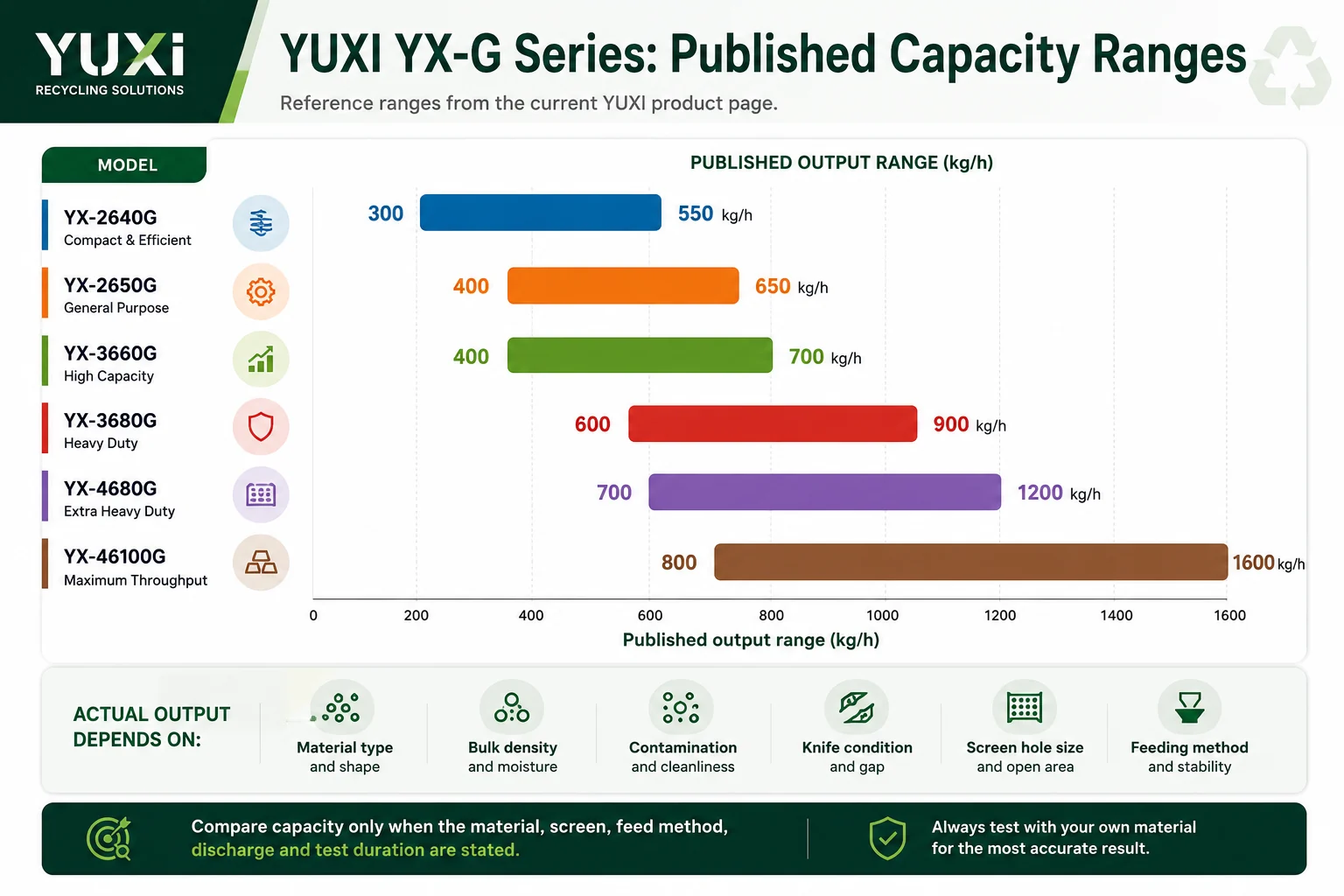
| Model | Power | Rotor speed | Screen | Cutting chamber | Published output |
|---|---|---|---|---|---|
| YX-2640G | 7.5 kW | 560 rpm | 10 mm | 270 × 400 mm | 300–550 kg/h |
| YX-2650G | 11 kW | 560 rpm | 10 mm | 270 × 500 mm | 400–650 kg/h |
| YX-3660G | 15 kW | 560 rpm | 12 mm | 370 × 600 mm | 400–700 kg/h |
| YX-3680G | 22 kW | 560 rpm | 12 mm | 370 × 800 mm | 600–900 kg/h |
| YX-4680G | 30 kW | 560 rpm | 12 mm | 480 × 800 mm | 700–1,200 kg/h |
| YX-46100G | 37 kW | 560 rpm | 12 mm | 480 × 1,000 mm | 800–1,600 kg/h |
Do not select a model from the maximum kg/h column alone. Check whether the largest normal part can enter the chamber, whether the screen produces the required output, whether the discharge can remove it, and whether the test material matches the production mix.
How to Calculate Capacity Without Hiding Downtime
The basic measurement is straightforward:Sustained net kg/h = accepted regrind mass ÷ total elapsed minutes × 60.
The difficult part is defining accepted and deciding which time belongs in the denominator. We normally include the operating interruptions that are expected in production: ordinary hopper refilling, routine bridge clearing under the approved procedure, bin or bag changes, screen observation and other normal handling. A major unrelated power failure may be recorded separately, but it should not be quietly deleted from the test log.
A simple example
Suppose a test feeds material for 60 elapsed minutes. The collection system receives 720 kg. After screening and inspection, 55 kg is oversize or long material, 20 kg is excessive fines, and 5 kg is foreign contamination. The accepted output is therefore 640 kg. The defensible net result is 640 kg/h, not 720 kg/h. If the same crusher briefly discharged at an equivalent rate of 900 kg/h during the cleanest ten minutes, that is useful diagnostic information. It is not the business-case capacity. In our experience, confusion between these two numbers causes more procurement disputes than the difference between adjacent motor sizes.| Record | Why it belongs in the test sheet |
|---|---|
| Feed mass and batch composition | Confirms that the difficult material was not excluded. |
| Total elapsed time | Prevents a short stable interval from being presented as a full-hour result. |
| Motor current and overload events | Shows whether the rate is sustainable or achieved by repeated peak loading. |
| Accepted output mass | Separates usable regrind from total material collected. |
| Oversize, longs, fines and contamination | Connects kg/h to downstream quality. |
| Temperature, smearing and screen condition | Exposes heat buildup or restricted release during continuous operation. |
| Stops and interventions | Shows whether the process depends on repeated manual help. |
How Much Capacity Margin Should the Project Specify?
There is no honest universal derating percentage. A fixed “multiply the catalog by 0.7” rule looks convenient, but it can be too conservative for clean, metered factory scrap and dangerously optimistic for wet film or mixed post-consumer waste. We normally start with the downstream requirement. If the washing line accepts 600 kg/h of prepared feed, the crusher should not merely touch 600 kg/h in a short demonstration. It needs enough tested reserve to remain above the line demand when feed changes, knives wear within the normal service interval and routine handling occurs. The reserve should come from a representative test and an agreed operating plan, not a copied percentage. The broader plastic size-reduction machine selection guide covers chamber size, output target and complete-line decisions. For this article, the capacity rule is narrower:Specify the required net line rate, the normal and worst feed, daily hours, accepted output quality and expected availability. Then ask the supplier to demonstrate a stable margin under those conditions.
Oversizing also has limits. A very large chamber with intermittent hand feeding may run empty, create larger power peaks, complicate cleaning and cost more than the rest of the line needs. The correct machine is not automatically the one with the largest maximum figure.
A Capacity FAT That Is Worth More Than a Test Video
A useful factory acceptance test should reproduce the buyer’s actual operating problem. We normally recommend enough representative material for the crusher to reach stable temperature and expose feeding, screen release, discharge and normal handling behavior.- Document the feed. Record polymer, product form, largest dimensions, wall thickness or bulk density, temperature, moisture and contamination.
- Use the intended configuration. Install the proposed screen, knives, feeding arrangement and discharge system.
- Include the difficult material. Do not test only clean, small or pre-cut samples when production includes awkward pieces.
- Run beyond the attractive first minutes. Observe current, chamber behavior, screen release, temperature and discharge after stable operation.
- Weigh and classify the output. Record accepted regrind, oversize, longs, fines, contamination and any material remaining in the system.
- Log every intervention. Note bridging, overloads, cleaning, bin changes and waiting for downstream equipment.
- Inspect after the run. Check knife edge, gap, screen, chamber buildup, bearings and accessible wear points under the approved energy-control procedure.
- Repeat when the mix varies. A film-heavy or purge-heavy batch may require a separate run instead of being hidden in one average.
When Actual Output Is Low, Look for the Bottleneck Before Buying a Bigger Motor
| Observed symptom | Likely causes to investigate | Practical direction |
|---|---|---|
| Rotor often runs empty | Low bulk density, slow loading, bridging above the chamber or an undersized conveyor. | Measure feed rate by volume and mass; improve metering or feed presentation. |
| Frequent current peaks or trips | Large dense pieces, surges, dull knives, incorrect gap, blocked screen or difficult bite. | Stop forcing feed; inspect knives, screen and piece-size limits, then stabilize loading. |
| High current but low discharge | Small or clogged screen, poor open area, recutting, restricted blower or blocked hose. | Inspect the release and evacuation path before changing the drive. |
| Output becomes dusty or hot | Dull knives, excessive residence time, repeated recutting, warm feed or slow discharge. | Check knife condition, material temperature, screen and collection level. |
| Capacity drops gradually over days | Knife wear, gap drift, screen wear or buildup, accumulating contamination, poor preventive maintenance. | Compare against a maintenance baseline and restore the cutting condition. |
| Crusher waits for the line | Downstream washer, conveyor, cyclone, bin or operator is the real bottleneck. | Measure each machine’s accepted rate and balance the complete process. |
| Output differs sharply by shift | Different material mix, loading method, operator intervention or cleaning practice. | Standardize batches, log feed composition and compare net accepted kg/h. |
Capacity Testing Must Not Create an Unsafe Feeding Method
Bridging and poor bite can tempt an operator to push material into the hopper. That is not a capacity solution. OSHA’s plastics-machinery guidance describes web grinders or granulators as machines with razor-sharp rotary and stationary knives and recommends guarding, correct feeding training and energy-control procedures for cleaning and inspection.[6] Never reach into the hopper or cutting chamber, defeat an interlock, or use an improvised bar while hazardous energy is present. Clearing, screen work and knife inspection require the manufacturer’s shutdown and lockout procedure, verification of zero energy and control of stored motion. Fine plastic dust can also be combustible. OSHA’s combustible-dust material includes plastic dust and recycling operations among the recognized hazard contexts.[7] Dust collection, housekeeping, ignition control, electrical classification and protection measures must be engineered for the actual material and local requirements. A conveying blower is not automatically a compliant dust-control system.Capacity is never worth an unsafe intervention. If continuous production depends on an operator pushing, pulling or clearing material near moving knives, the feed system or machine selection needs to change.
Plastic Crusher Capacity FAQ
What is a typical plastic crusher capacity?
Industrial machines cover a wide range, but a generic number is not useful without the material and test conditions. The current YUXI YX-G table publishes 300–1,600 kg/h across six models. Actual output depends on material form, density, moisture, contamination, knives, screen, feeding and discharge.Why is plastic crusher capacity given as a range?
A range reflects variation in feed and operating conditions. Clean dense molded scrap, hollow bottles, loose film and thick purgings can show different kg/h on the same machine. Screen opening, knife condition and line availability add further variation.Does a larger motor guarantee higher kg/h?
No. Motor power provides cutting reserve, but capacity may be limited by hopper ingestion, bulk density, screen release, discharge or downstream equipment. A larger motor cannot correct unstable feeding or a blocked evacuation path.Does a smaller screen reduce capacity?
Usually, because material remains in the chamber for more cutting before it can pass. The exact effect also depends on screen open area, thickness, rotor speed, polymer behavior and discharge. The required regrind quality should control the decision.How should kg/h be measured during a factory test?
Weigh accepted regrind over total elapsed test time using representative material, the proposed screen, normal feed and normal discharge. Record stops, overloads, fines, oversize, longs, temperature and interventions rather than reporting only the best short interval.Should downtime be included in capacity?
Normal production interruptions should be included when calculating sustained net output or shift tonnage. Major unrelated outages can be logged separately, but ordinary loading, bin changes, clearing and cleaning should not be hidden.Can one capacity number cover film, bottles and lumps?
Not reliably. These feeds have very different bulk density, geometry, bite and discharge behavior. Test them separately or define a representative production mix by mass and include the difficult fraction.What information should I send for a capacity recommendation?
Send the polymer and product form, photos, largest dimensions, wall thickness or bulk density, moisture, contamination, target regrind, required net kg/h, daily hours, feed method, downstream equipment, voltage and layout. Representative samples are strongly preferred for unusual material.Need a Capacity Test Based on Your Actual Plastic?
Share the material form, largest pieces, bulk density or wall thickness, moisture, contamination, target screen size, required net kg/h and downstream process. YUXI can use that information to discuss the appropriate YX-G model, feeding arrangement and test boundary. Discuss Your Capacity TargetReferences and Source Notes
- WITTMANN Group — Innovations 3/2022, granulator sizing and feeding guidance. Used for the factors affecting estimated versus actual throughput and representative feeding advice.
- Cumberland — Granulator Screens. Used for screen hole size, rotor-speed interaction, longs and throughput trade-offs.
- Cumberland — Hoppers and Feed Rolls. Used for the role of efficient feeding in maximizing granulator throughput.
- Cumberland — What Goes Wrong When a Granulator Is Not Maintained. Used for knife wear, screen buildup and reduced-throughput context.
- OSHA — Plastics Machinery: Web Grinders. Used for rotary/stationary knife hazards, guarding, training and energy-control guidance.
- OSHA — Combustible Dust National Emphasis Program. Used for plastic-dust and recycling-operation hazard context. The page is archived; local current requirements and professional hazard assessment still control the installation.