





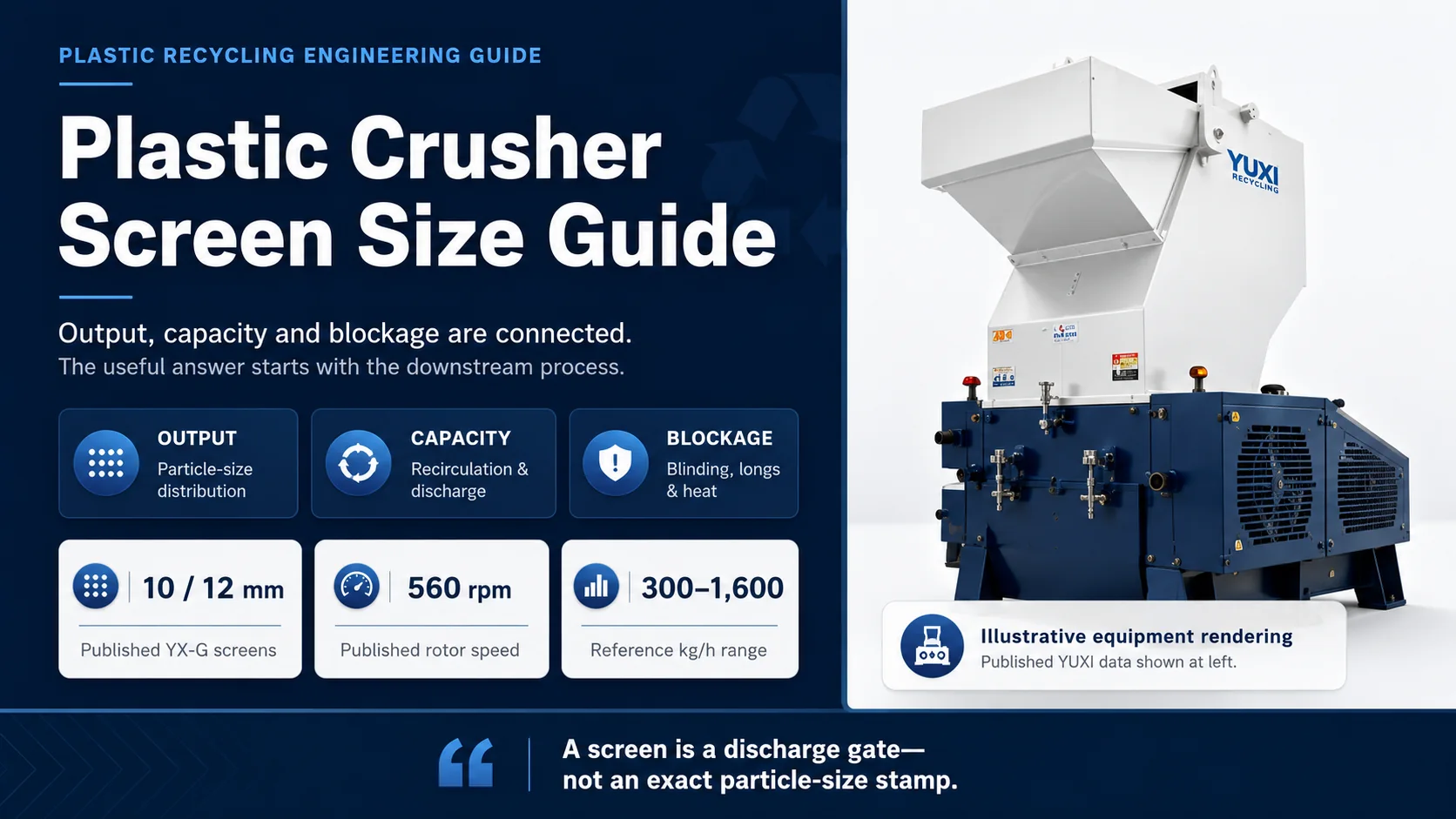
Quick answer: Choose a plastic crusher screen size from the accepted downstream regrind first, then verify that the selected screen can deliver sustained net capacity without excessive recutting, heat, fines or blockage. A smaller hole generally tightens the coarse end of the particle distribution but can lower throughput. A larger hole generally releases material sooner but produces a broader, coarser distribution. Hole diameter alone is not enough: screen open area, thickness, hole shape, knife condition, rotor speed, feed consistency and discharge all affect the result.
The Screen Is the Exit Gate in a Repeated Cutting Loop
A knife-type plastic crusher or granulator does not make one cut and release the part. Rotating knives pass fixed knives, reduce the feed, and move the fragments around the chamber. Pieces that can pass the screen leave. Pieces that cannot pass remain in the cutting zone and are cut again. This is the same closed loop explained in our plastic crusher working principle guide, but the screen deserves its own article because it affects several outcomes at the same time. Cumberland describes the screen-hole diameter as the control for output granulate size and notes that the useful selection depends on the material composition, machine size and rotor speed.[2] That last point is easy to miss. A screen cannot be selected in isolation from the rest of the machine. At a high rotor speed, a very restrictive screen can create more recirculation and impact. At a slower speed, a thinner screen with smaller holes may still clear effectively. Two machines using nominally identical 8 mm screens can therefore deliver different kg/h, dust levels and flake distributions.The practical definition: a screen controls when a fragment is allowed to leave. It does not independently determine how the fragment was cut, how warm it became, how much dust was created or whether the discharge system can carry it away.
A 10 mm Hole Does Not Produce Identical 10 mm Flakes
Buyers often ask for “10 mm output” as though the crusher were an extrusion die. A granulator produces an irregular distribution. Some fragments pass as soon as their cross-section and orientation fit through the perforation. Others stay longer and become much smaller. Brittle plastics can fracture into fines. Tough plastics can form curved or elongated pieces. Thin strips—often called longs—may have a length greater than the hole diameter yet still orient through a round opening. Cumberland specifically identifies longs as a screen-clogging issue and lists angled-hole screens as one way to reduce them, while noting a throughput trade-off.[2] Rapid also explains that much of the cutting action occurs close to the screen surface and that rounded, worn hole edges are a reason to replace a screen.[4]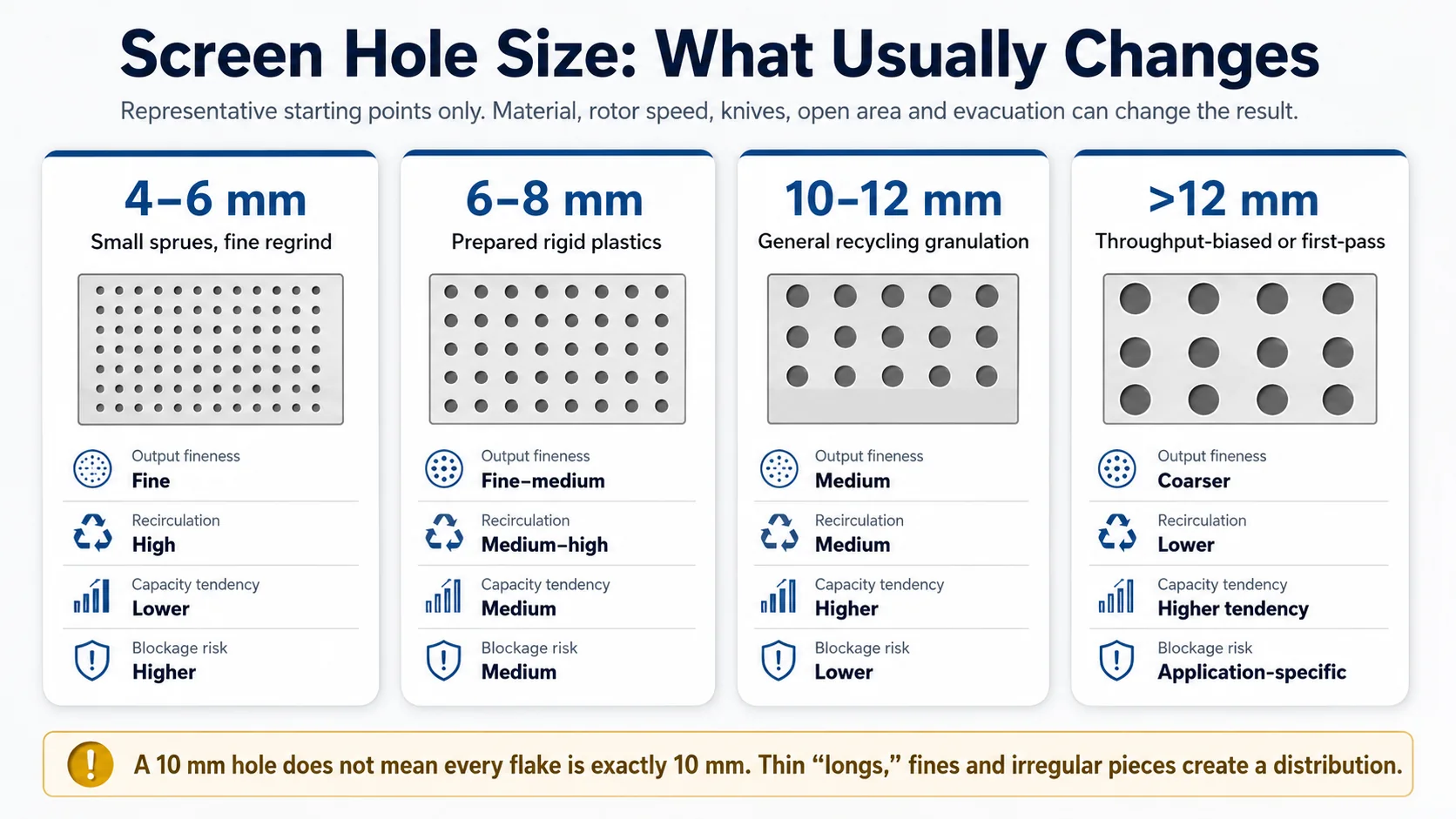
Useful Starting Points—Without Pretending They Are Guarantees
There is no universal conversion from screen hole to plastic application. Still, buyers need a place to begin. The table below combines commonly published granulator practice with the current YUXI range. Rapid publishes 5 mm screens on small granulators, Herbold discusses 4–8 mm secondary granulation, and YUXI publishes 10 mm and 12 mm screens on the YX-G series.[1] [8] [9]| Nominal round-hole range | Typical objective | Likely trade-off | Questions before selection |
|---|---|---|---|
| 4–6 mm | Fine regrind for small sprues, runners or a downstream process needing a tighter coarse limit. | Longer retention, more recutting, potentially more dust and heat. | Are knives sharp? Is the material brittle, elastic or heat-sensitive? Can the evacuation system clear fine light regrind? |
| 6–8 mm | Fine-to-medium granulation of prepared rigid scrap. | Often a balance between quality and capacity, but highly material-dependent. | What fines limit and sustained net kg/h are required? Are labels, moisture or flexible pieces present? |
| 10–12 mm | General recycling granulation where a medium flake is accepted. | Earlier release can support output, while the downstream process must accept a broader distribution. | Will washing, drying, conveying, separation or pelletizing accept the coarse tail and longs? |
| Above 12 mm | Coarser first-pass duty or a throughput-biased setup. | Less retention but larger flakes; the next machine may become the bottleneck. | Is this still a final granulation step, or should the line use a shredder followed by a smaller-screen granulator? |
Why a Smaller Screen Can Reduce Capacity So Quickly
The capacity effect is not mysterious. When the opening becomes smaller, fewer fragments qualify to leave after each knife pass. The retained mass circles back toward the rotor. More cuts are needed per kilogram. The chamber carries a larger working inventory, and the material absorbs more mechanical energy before discharge. Conair advises balancing screen size against throughput because smaller screens can reduce output.[3] That relationship also appears in manufacturer capacity notes: published kg/h is normally conditional on material shape, thickness, properties and the desired granulate size. Our separate plastic crusher capacity guide owns the broader kg/h methodology; here the important point is that the screen changes the workload per kilogram.What increases inside the chamber
Residence time, repeat cutting, contact near the screen, frictional heat, opportunity for fines generation and sensitivity to dull knives.What must increase outside the chamber
Discharge efficiency, air conveying or gravity flow, bin capacity, dust handling and downstream ability to accept the produced fraction.Diameter Is Only One Screen Variable
Open area
Open area is the total perforated area available for discharge. More holes or a larger effective screen surface can let qualified material leave sooner. Conair links greater screen area with higher throughput, fewer fines and reduced heat generation on its granulator designs.[10] A small screen with limited area can therefore be restrictive even when its hole diameter appears suitable.Screen thickness
A thick screen is mechanically robust, but the passage through each hole is longer. Sticky, soft or irregular fragments can bind against the hole wall. Cumberland describes perforated or milled-back screens with a thinner working area for materials that blind holes, allowing the rotor to push material through more effectively.[2]Hole shape and orientation
Round holes are common, but they are not the only option. Angled holes may interrupt thin longs. Slot or special-hole geometries can be useful in defined applications, though they change open area, particle shape and strength. A special screen should be treated as an engineered component, not a generic sheet of perforated steel.Condition and fit
A worn screen develops rounded edges. A bent screen may sit unevenly in the cradle. Cracks or elongated holes allow oversize leakage. Incorrect seating can create local traps where material accumulates. Screen inspection should therefore include the hole edges, curvature, fastening points, cradle contact and clearance—not only visible blockage.The Same Screen Behaves Differently on Different Plastic
Brittle rigid plastics
Rigid PS, acrylic or some ABS grades can fracture quickly. They may clear the screen well, yet create more sub-size dust than the buyer expects. Moving to a smaller screen may not improve the useful product; it can simply increase the fine fraction.Tough, ductile PE and PP
Polyethylene and polypropylene often bend and stretch before they shear. With sharp knives, the cut can be clean. With dull edges or an unsuitable gap, the material rubs, warms and forms soft fragments that smear against the screen. The problem may look like moisture blockage even when the feed is dry.Film and woven material
Film has little mass per unit volume. It can flutter, fold, wrap or form a soft mat over the perforations. A smaller screen does not solve poor feeding. In some cases, stable metering, a roll feeder, forced feeding, a compactor or a pre-shredder matters more than hole diameter.Hot purgings and elastic compounds
Hot or tacky material needs time to cool before granulation. Conair documents a test in which two visually similar PP/HDPE purging batches behaved very differently because filler and tackifier levels changed friction and heat. One batch processed cleanly; the other softened and accumulated on the rotor screen until cooling and equipment changes were made.[5] This is a useful reminder: chemistry can dominate a screen decision.Filled and abrasive plastics
Glass fiber, mineral filler, sand and hard contamination accelerate wear on knives and screen edges. The crusher may continue to run, but the particle distribution and throughput can drift as the cutting surfaces lose condition. Screen material and wear allowance should be discussed together with the actual filler and contamination—not after the first replacement interval.Six Different Problems That Operators Call “Screen Blockage”
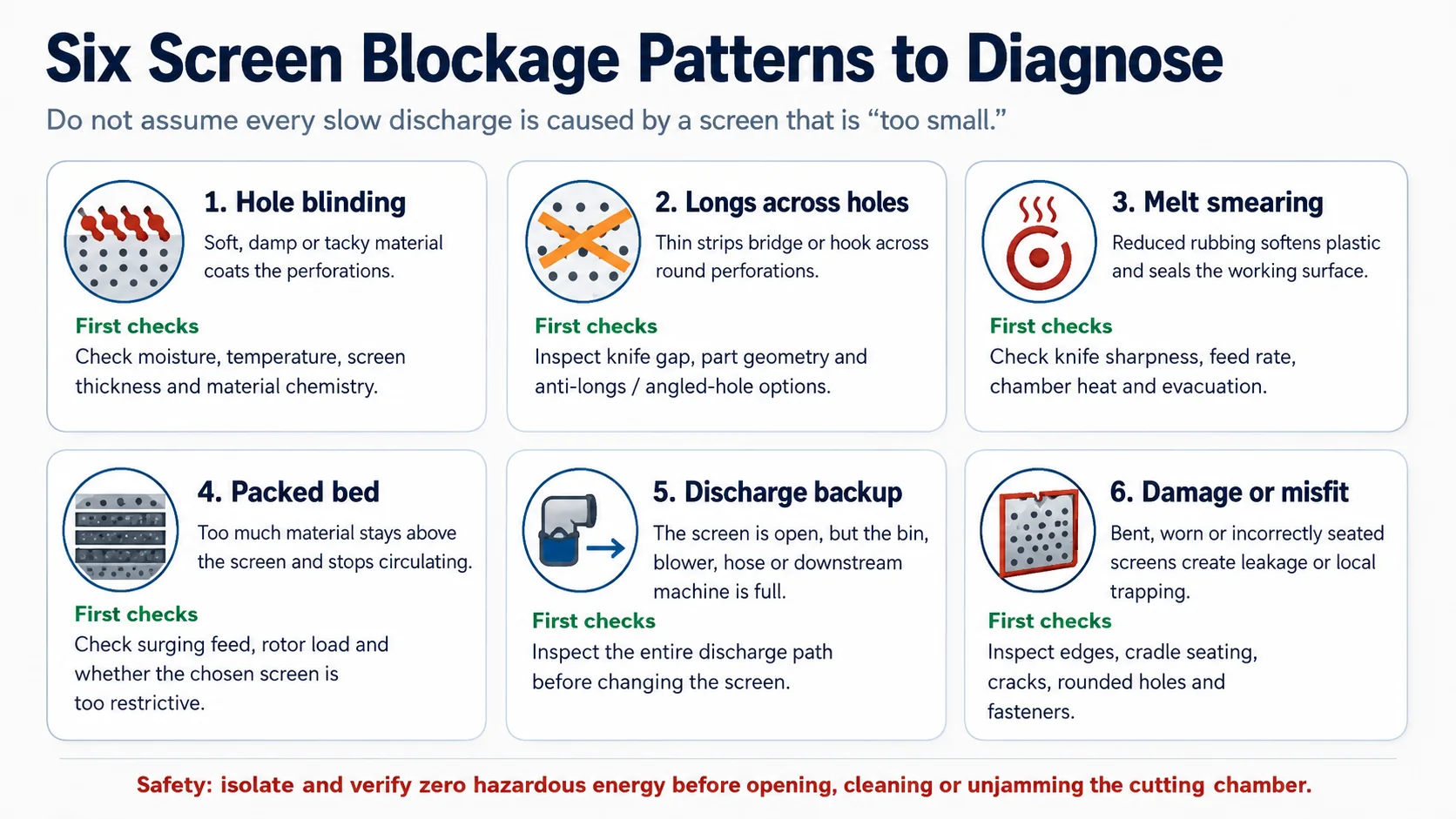
1. Hole blinding
Soft, wet, tacky or label-rich material coats individual perforations. The effective open area falls gradually. The operator sees fewer clear holes rather than one large obstruction.2. Longs bridging
Thin strips cross or hook into holes. They can form even when the average flake looks acceptable. Knife gap, part geometry and hole design are common checks.3. Heat smearing
The material softens from repeated cutting and friction, then wipes across the screen surface. Stopping only to scrape it away treats the symptom, not the thermal cause.4. Packed chamber bed
Feed surges or an overly restrictive screen leave too much mass above the screen. The rotor may continue turning, but material circulation becomes poor and current fluctuates.5. Discharge-system backup
The perforations are open, yet the bin is full, the blower is weak, the hose is plugged or the downstream machine is stopped. Qualified regrind has nowhere to go.6. Screen damage or misalignment
Rounded holes, cracks, a bent panel or poor seating can trap material locally or release oversize. A replacement screen may be needed even when it does not look fully blocked.A Troubleshooting Sequence That Avoids Random Screen Changes
When production drops, changing to a larger screen is tempting because the effect is immediate. Sometimes it is the right answer. Sometimes it hides dull knives, unstable feeding or a blocked discharge hose. We prefer a fixed sequence.1
Observe the failure before cleaning it
Record motor current, sound, feed behavior, discharge flow and where material is accumulating. Photograph the screen surface. A cleaned machine has already lost much of the evidence.2
Inspect the complete discharge path
Check the space below the screen, transition, blower, cyclone or filter, conveying hose, bin and downstream interlocks. A backed-up system can look exactly like internal screen restriction.3
Check knives and knife gap
Dull or poorly adjusted knives rub instead of shearing cleanly. Conair identifies sharp knives and correct gaps as the first maintenance checks for poor regrind, dust, jamming and low output.[5]4
Identify the blockage type
Dry longs, sticky blinding, melted smear and packed material require different responses. Do not group them under one maintenance code.5
Change one variable and retest
Adjust feed rate, cool the material, clean the discharge system, sharpen knives or trial another screen—but avoid changing several items together. Otherwise the team will not know what solved the problem.Do not push material through the hopper or scrape the screen while hazardous energy is present. Blockages are precisely the moments when operators are most likely to bypass normal feeding boundaries.
How to Interpret the Current YUXI YX-G Screen Data
The public YUXI plastic shredder / crusher product page lists six YX-G models. All publish a 560 rpm rotor speed. The two smaller models use a 10 mm screen; the four larger models use a 12 mm screen. Power ranges from 7.5 to 37 kW, cutting chambers from 270 × 400 mm to 480 × 1,000 mm, and reference output from 300 to 1,600 kg/h.[1]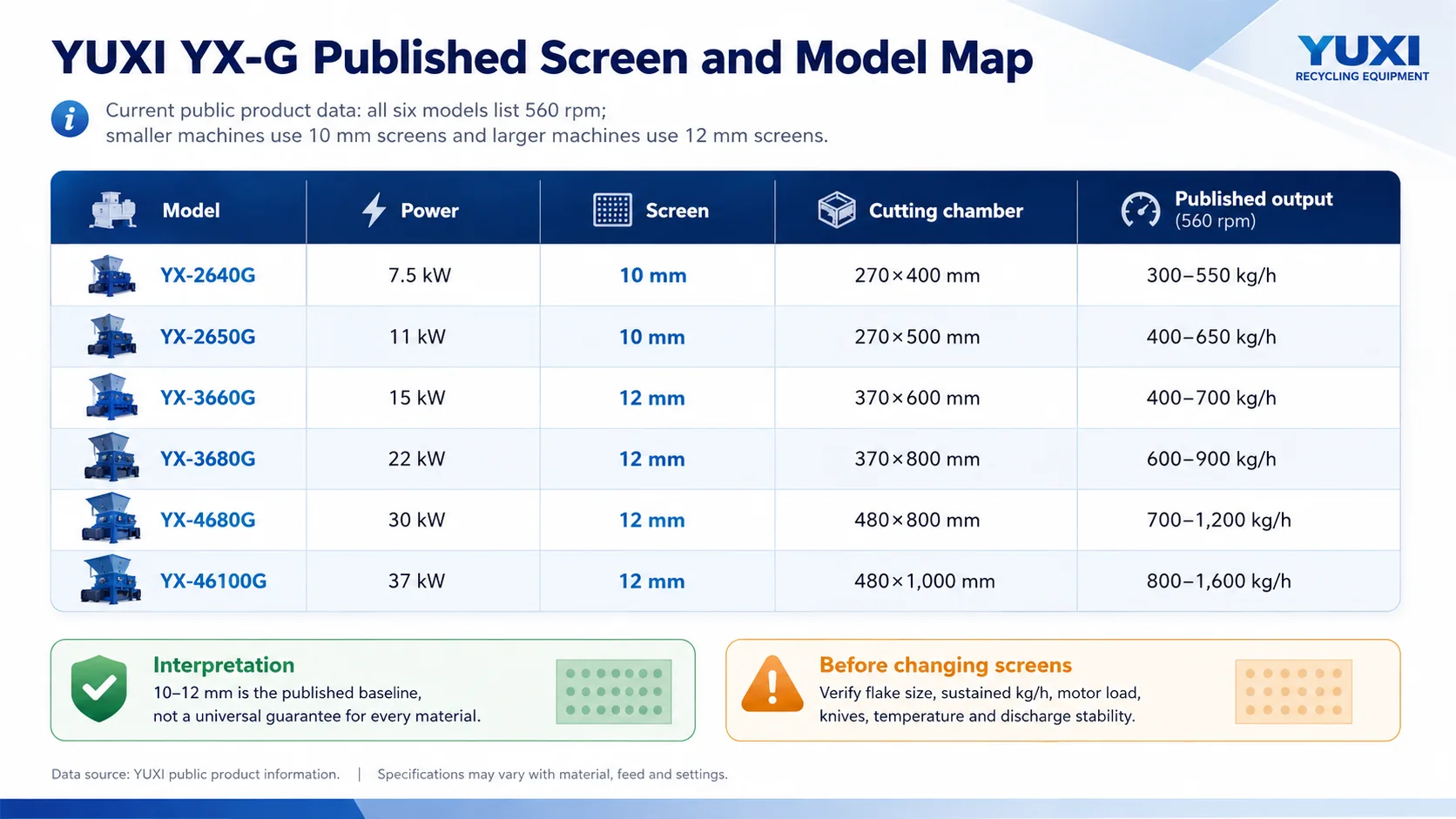 Technically, this is closer to a high-speed crusher or granulator range than a conventional low-speed, high-torque primary shredder. That distinction matters. At 560 rpm, a smaller screen can increase repeated cutting and heat more quickly than buyers expect from the word “shredder.”
The published 10 mm and 12 mm configurations suggest a general-purpose balance between controlled regrind and practical capacity. They do not establish a universal preferred size. A buyer needing finer output should provide the actual material, target distribution, net kg/h and downstream process. A buyer processing whole drums, pallets, long pipe, dense purgings or baled film may need controlled feeding or a first-stage shredder before asking the YX-G machine to make final regrind.
Technically, this is closer to a high-speed crusher or granulator range than a conventional low-speed, high-torque primary shredder. That distinction matters. At 560 rpm, a smaller screen can increase repeated cutting and heat more quickly than buyers expect from the word “shredder.”
The published 10 mm and 12 mm configurations suggest a general-purpose balance between controlled regrind and practical capacity. They do not establish a universal preferred size. A buyer needing finer output should provide the actual material, target distribution, net kg/h and downstream process. A buyer processing whole drums, pallets, long pipe, dense purgings or baled film may need controlled feeding or a first-stage shredder before asking the YX-G machine to make final regrind.
Selection boundary: do not order a smaller screen based only on the desired marketing phrase “fine output.” Confirm whether the full line can maintain stable feeding, clean cutting, discharge and temperature at the required net capacity.
How We Would Compare Two Screen Sizes in a Useful Test
A two-minute hand-fed video is not enough. The test should compare screens under the same material and operating boundary. Representative feed matters more than perfect feed. Include the difficult shapes, normal moisture, labels and realistic contamination level.| Measure | Why it matters | How to record it |
|---|---|---|
| Sustained accepted kg/h | Shows whether finer output is purchased with an unacceptable production loss. | Weigh accepted discharge over a defined net runtime; log ordinary stops and clearing. |
| Particle-size distribution | Separates useful product from fines, oversize and longs. | Use agreed sieves or a documented sampling method, not visual impression alone. |
| Motor current trend | Reveals surging, packed chamber conditions and unstable recirculation. | Record continuously or at fixed intervals; note feed interruptions. |
| Temperature trend | Helps identify friction, softening and screen smear. | Use a repeatable measurement point and compare from a similar starting temperature. |
| Discharge stability | A good screen result is useless if the blower, hose or bin repeatedly backs up. | Log flow interruptions, high-level alarms, hose cleaning and collection changes. |
| Cleaning and change time | Downtime can erase a small improvement in peak kg/h. | Measure safe isolation, opening, screen removal, cleaning, inspection and restart. |
Screen Access and Blockage Clearing Are Hazardous-Energy Tasks
A plastic crusher contains rotating mass and cutting edges. The rotor may coast after power is removed, and trapped material can release when the screen cradle is opened. OSHA’s lockout/tagout standard includes cleaning and unjamming where workers may be exposed to unexpected startup or stored energy.[6] Before opening, removing, cleaning or reseating a screen, follow the manufacturer’s energy-control procedure, isolate all relevant energy sources, restrain stored energy, verify isolation and wait for complete rotor stop. Interlocks and stop buttons are not substitutes for an energy-isolation procedure during servicing. Fine plastic dust can also create a fire or deflagration hazard. OSHA includes plastics and recycling operations in its combustible-dust guidance.[7] A smaller screen may increase fines on some materials, so dust collection, housekeeping, ignition control and local compliance need to be considered when screen size changes.Plastic Crusher Screen Size FAQs
Does a 10 mm screen produce 10 mm plastic flakes?
Not exactly. A 10 mm round hole controls which pieces can leave the chamber, but the finished product is a particle-size distribution. Many flakes will be smaller, brittle materials can create fines, and thin elongated pieces may pass depending on orientation.Will a smaller screen always improve regrind quality?
No. A smaller screen can reduce the upper end of the flake distribution, but it also increases recirculation and cutting. If knives are dull, the material is heat-sensitive, or evacuation is weak, the result may be more dust, smear, heat and downtime rather than better regrind.Why does the screen block even when the plastic is dry?
Dry material can still block through thin longs, softening from friction, excessive chamber loading, paper or label contamination, worn knives, a thick low-open-area screen, or backup in the discharge system.Can I increase capacity by fitting the largest available screen?
A larger screen often lets material leave sooner, but capacity only improves when the downstream process accepts the coarser distribution and the feed, cutting chamber and discharge system remain stable. Oversized flakes can simply move the bottleneck to washing, drying, conveying or pelletizing.What screen sizes does the YUXI YX-G series publish?
The current public YUXI table lists 10 mm screens on YX-2640G and YX-2650G, and 12 mm screens on YX-3660G, YX-3680G, YX-4680G and YX-46100G. All six models list 560 rpm. Final suitability should be confirmed on the actual feed and downstream requirement.What should be measured in a screen comparison test?
Measure sustained accepted kg/h, particle-size distribution, fines, oversize or longs, motor current, chamber temperature trend, stoppages, discharge stability and screen cleaning time. Use the same representative feed and test duration for each screen.References and Source Notes
- YUXI Plastic Shredder Machine: current YX-G model table, 560 rpm rotor speed, 10 mm and 12 mm screens, chamber sizes and reference capacity ranges. Source
- Cumberland — Granulator Screens: hole diameter and granulate size, rotor-speed considerations, milled-back screens, longs and angled-hole options. Source
- Conair — Seven Key Factors for a Size Reduction Solution: screen size must be balanced with throughput; material, feed and part dimensions also affect performance. Source
- Rapid Granulator — Open-Hearted Granulators: cutting activity near the screen and the need to replace screens with rounded worn hole edges. Source
- Conair — Plastic Size Reduction FAQs: material-dependent throughput, PET preform versus bottle discharge behavior, purging chemistry and knife-maintenance diagnostics. Source
- OSHA 29 CFR 1910.147: control of hazardous energy during servicing, including cleaning and unjamming where unexpected startup or stored energy can cause injury. Source
- OSHA — Combustible Dust Overview: plastics and recycling operations can be affected by combustible-dust hazards. Source
- Rapid 150 Series: published 5 mm screen-hole diameter on small beside-the-press granulators. Source
- Herbold HB Series: discussion of 4–8 mm final granulation and the throughput limits of trying to make small granules in one primary step. Source
- Conair 12 Series Viper: greater screen area is associated with higher throughput, fewer fines and lower heat generation. Source