





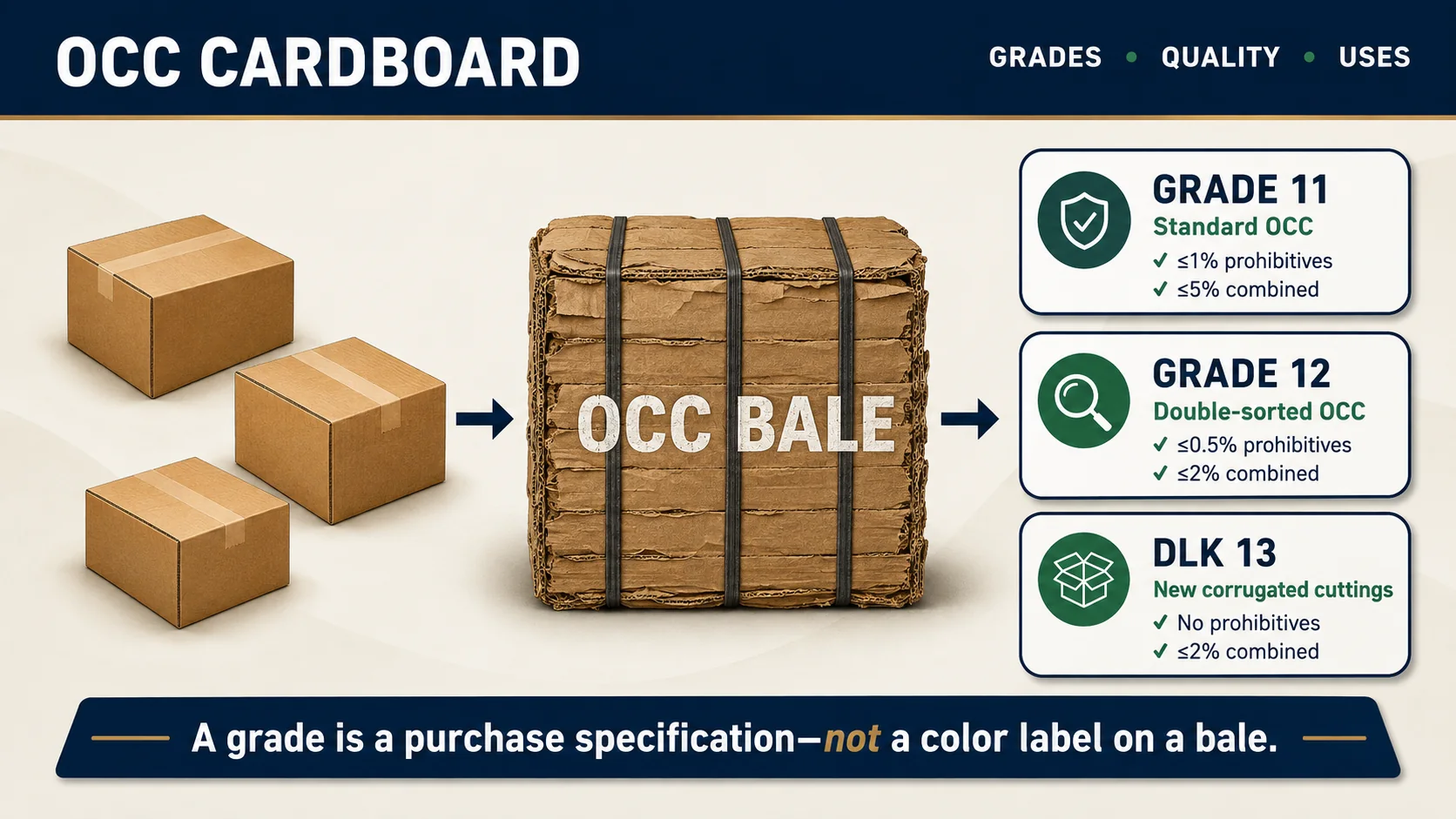
A bale can look like clean brown cardboard from the outside and still fail when it is opened. Plastic film may be folded into the center. Rainwater may have raised the weight. Boxboard cartons, waxed produce cases or food residue may be hidden between good corrugated sheets. That is why “brown cardboard” is not a complete purchase description.
In recycling, OCC stands for old corrugated containers. The term refers mainly to used corrugated boxes and sheets recovered for recycling, but professional buyers and sellers attach it to a grade, tolerance limits and an agreed inspection method.[2] A grocery-store bale, an e-commerce fulfillment-center bale and clean corrugated cuttings from a box plant can all contain brown fiber. They should not automatically be sold as the same material.
Quick answer: OCC cardboard is used corrugated packaging collected as a recovered-paper raw material. In North American trade, ReMA Grade 11 is the standard OCC grade, Grade 12 is a more tightly sorted commercial grade, and Grade 13 covers new double-lined kraft corrugated cuttings. The grade is determined by source, included paper, outthrows, prohibitive materials and moisture—not by color alone. The receiving mill’s contract may be tighter than the published industry specification.[1]
What Does OCC Mean in Cardboard Recycling?
Corrugated board is built from flat liner sheets bonded to a fluted medium. The structure gives shipping boxes stiffness without making them solid blocks of paper. After use, those boxes can be collected, flattened, sorted and baled as a fiber source for paper mills.
The word old in OCC does not mean rotten or obsolete. It separates post-use corrugated containers from new production trim. The word containers also matters. OCC is centered on corrugated shipping packaging, not every brown or paper-based item found in a warehouse.
Commercial teams sometimes use “OCC” loosely for a whole cardboard stream. Operations teams cannot afford that shortcut. A quotation, purchase order or plant design should describe the actual material: where it comes from, whether it is loose or baled, which corrugated grades dominate, how much other paper is present, how the material is stored and which buyer will receive the output.
Post-consumer OCC
Used shipping cases from retail, distribution, factories and commercial collection. Quality varies with source separation, weather exposure and what was packed inside.
Double-sorted OCC
A cleaner commercial fraction produced through tighter source control and additional sorting. It is not merely standard OCC given a different label.
New corrugated cuttings
Pre-consumer converting scrap such as clean box-plant cuttings. ReMA lists this as DLK Grade 13, a different source category from used boxes.
Not Everything Called “Cardboard” Is OCC
“Cardboard” is an informal umbrella term. In a recycling yard it may describe corrugated boxes, cereal cartons, paper tubes, solid board, molded fiber, liquid cartons or coated takeaway packaging. Those materials do not necessarily repulp in the same way, and a mill may purchase them under different grades.
| Material | OCC status | Practical reason |
|---|---|---|
| Used corrugated shipping boxes | Core OCC feed | They contain the liner and fluted medium expected in the grade. |
| Clean corrugated sheets and dividers | Usually suitable when grade-compliant | They are corrugated board even when they were not formed into a complete box. |
| Paperboard cartons such as cereal boxes | Not automatically OCC | Solid paperboard is a different construction and may count as an outthrow in a tighter OCC grade. |
| Waxed, wet-strength or heavily treated corrugated cases | Buyer-specific | Repulpability depends on the coating or treatment and the mill process; testing may be required.[6] |
| Food-soiled or liquid-saturated boxes | Often rejected | They create odor, biological contamination, excess moisture and loss of usable fiber. |
| Composite cartons with plastic or foil layers | Separate or special grade | They need a process designed for the multi-material structure. |
| New box-plant corrugated cuttings | Not post-consumer OCC | They may qualify as DLK Grade 13 when they meet its specification. |
A useful receiving question is not “Is this brown?” It is “Which published or buyer-defined grade does this load meet after it is sampled?”
OCC Grade 11, Grade 12 and DLK Grade 13
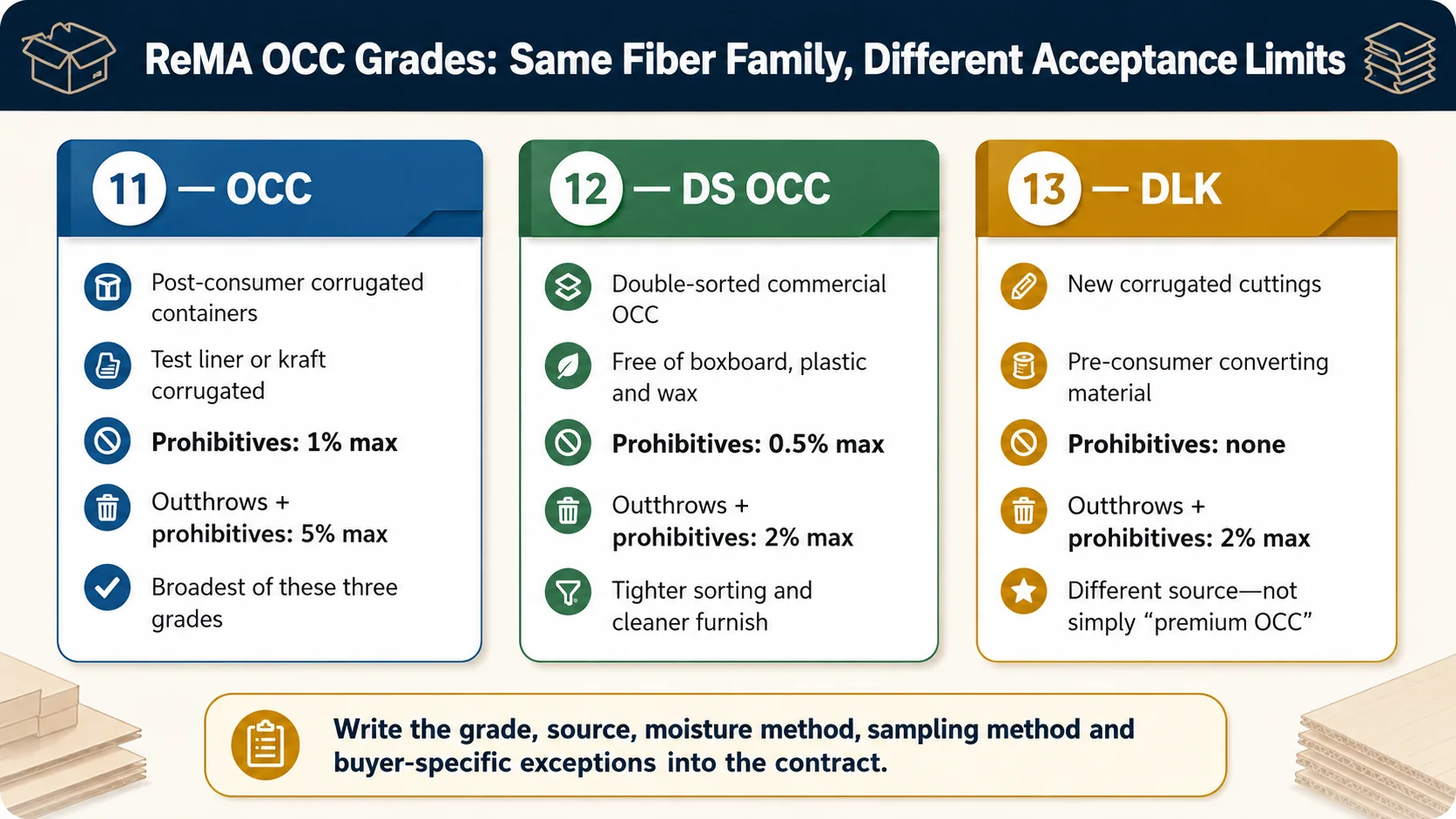
The Recycled Materials Association (ReMA, formerly ISRI) Specifications Circular is widely used as a common trading language in North America. It provides grade descriptions and maximum tolerance levels, but it does not replace the purchase contract. The January 2026 paper-stock specifications define the three corrugated grades below.[1]
| ReMA grade | Material description | Prohibitive materials | Outthrows + prohibitives | Operational interpretation |
|---|---|---|---|---|
| 11 — OCC | Corrugated containers having liners of either test liner or kraft. | 1% maximum | 5% maximum | Standard post-use OCC. Source and inspection still control how consistently the bale meets the limit. |
| 12 — DS OCC | Double-sorted corrugated containers generated from supermarkets and industrial or commercial facilities; specified as free of boxboard, off-shore corrugated, plastic and wax. | 0.5% maximum | 2% maximum | A tighter, cleaner commercial furnish. Extra sorting and source control are part of the grade. |
| 13 — DLK | New corrugated cuttings with liners of test liner or kraft; ReMA also lists specific unacceptable treated or adhesive-bearing materials. | None permitted | 2% maximum | Pre-consumer converting scrap. It should not be presented as simply the highest version of post-consumer OCC. |
Why the percentages are easy to misread
A load with 4% total unwanted material may fit the combined limit for Grade 11 but fail Grade 12. However, the total is not the only test. If a prohibitive category exceeds its own limit, adding more clean cardboard does not make the load acceptable. The material also has to match the written grade description.
Unlabeled shorthand such as “95/5 OCC” can create another problem. Does the second number include all outthrows? Does moisture sit outside the ratio? Are waxed cases excluded? Which sampling method applies? A ratio is useful only when the contract explains every category behind it.
How EN 643 Corrugated Grades Relate to OCC
European trading commonly references EN 643, the European list of standard grades of paper and board for recycling. It is a separate classification system, not a direct translation of ReMA Grade 11 or Grade 12. CEPI guidance says the standard is a basic buying-and-selling reference and that specific agreements may still be needed for individual requirements.[3]
For corrugated board, CEPI’s published guidance on the revised EN 643 list shows 1.05.00 ordinary corrugated board and 1.05.01 corrugated board. The first may include up to 10% other packaging paper and board; the second may include up to 5%. Both are shown with maximum 1.5% non-paper components and 2.5% total unwanted material.[3]
Do not convert codes by guesswork. A supplier should state the exact standard, revision, code, origin, moisture basis and buyer-specific additions. “OCC,” “1.05.01” and “Grade 12” are not interchangeable labels.
A Quality Standard Is a Starting Point, Not the Whole Contract
Industry specifications create a shared language. The purchase agreement turns that language into an acceptance system. A useful OCC contract normally identifies the following:
- Named grade and revision: for example, ReMA Grade 11 from a specified circular or a defined EN 643 code.
- Approved sources: retail, distribution, industrial, curbside, mixed recycling or converting plant.
- Excluded materials: wax, wet-strength board, boxboard, film, foam, food, liquid, glass, wood, metal or hazardous items.
- Moisture limit and test method: including the instrument, sampling depth and treatment of excess water weight.
- Sampling and sorting procedure: how many bales or what mass is opened, where samples are taken and how categories are weighed.
- Bale requirements: dimensions, wire or strap, integrity, identification, gross and tare weights and transport condition.
- Disposition: accept, price adjustment, downgrade, partial rejection, full rejection or supplier corrective action.
The ReMA general paper provisions specify that paper stock should be packed dry and set a maximum moisture limit of 12% unless buyer and seller agree otherwise. They also require an agreed testing method. That last point is essential. One handheld reading on the bale surface is not the same as a representative moisture result from the load.[1]
Outthrows and prohibitive materials are not the same
ReMA describes outthrows as papers that make a pack undesirable or unsuitable for the stated grade. Prohibitive materials are more serious: they can make the pack unacceptable, unusable or damaging to equipment. The circular also applies zero tolerance to categories such as medical, hazardous, toxic and radioactive wastes or substances.[1]
In practice, the classification should be agreed before a dispute. A plastic liner may be a non-paper contaminant. A cereal carton may be a grade mismatch. A sealed chemical container may trigger rejection and a safety response. Calling all three “trash” hides the operational difference.
Which OCC Contaminants Matter Most?
OCC quality is controlled at several points. Source separation prevents a problem. Receiving inspection catches it. Bale opening exposes it. Sorting removes it. Mill screening handles smaller, process-compatible attachments. No single machine does all of those jobs.
| Quality issue | Where it should be controlled | Why it matters |
|---|---|---|
| Rain, free water and wet storage | Covered collection, storage and receiving moisture checks | Adds non-fiber weight, weakens boxes, changes flow and can promote odor or biological degradation. |
| Food, oil and residual liquids | Reject or segregate at source and receiving | Paper recycling guidance generally expects paper to be empty, clean and dry.[7] |
| Plastic film, bags and stretch wrap | Source control, bale opening and manual or mechanical pre-sort | Can wrap equipment, appear in the product and increase mill rejects. |
| Bale wire, straps, nails and large metal | Safe wire removal, pre-sort and magnetic separation where applicable | Creates injury, equipment and product-contamination risks. A magnet does not remove non-ferrous items. |
| Boxboard and mixed paper | Source grading and sorting | May be an outthrow or a permitted minor fraction depending on the exact grade. |
| Waxed, wet-strength, laminated or treated board | Supplier declaration and mill-specific test | Some coatings are repulpable; others need special processing or are unsuitable. The 2025 AF&PA/FBA voluntary standard provides test protocols rather than a blanket approval.[6] |
| Tape, labels and normal staples | Usually handled in paper-mill stock preparation | AF&PA describes these items being screened from the slurry, although excessive loads can still create reject and maintenance problems.[4] |
| Wood, glass, stones, batteries or hazardous items | Reject at receiving under a safe procedure | They can damage machinery, contaminate fiber or create fire, exposure and environmental hazards. |
Practical rule: remove large, hazardous and easy-to-identify contaminants before size reduction. Do not shred a mixed load and expect the smaller pieces to become a higher paper grade.
How OCC Quality Is Checked at Receiving
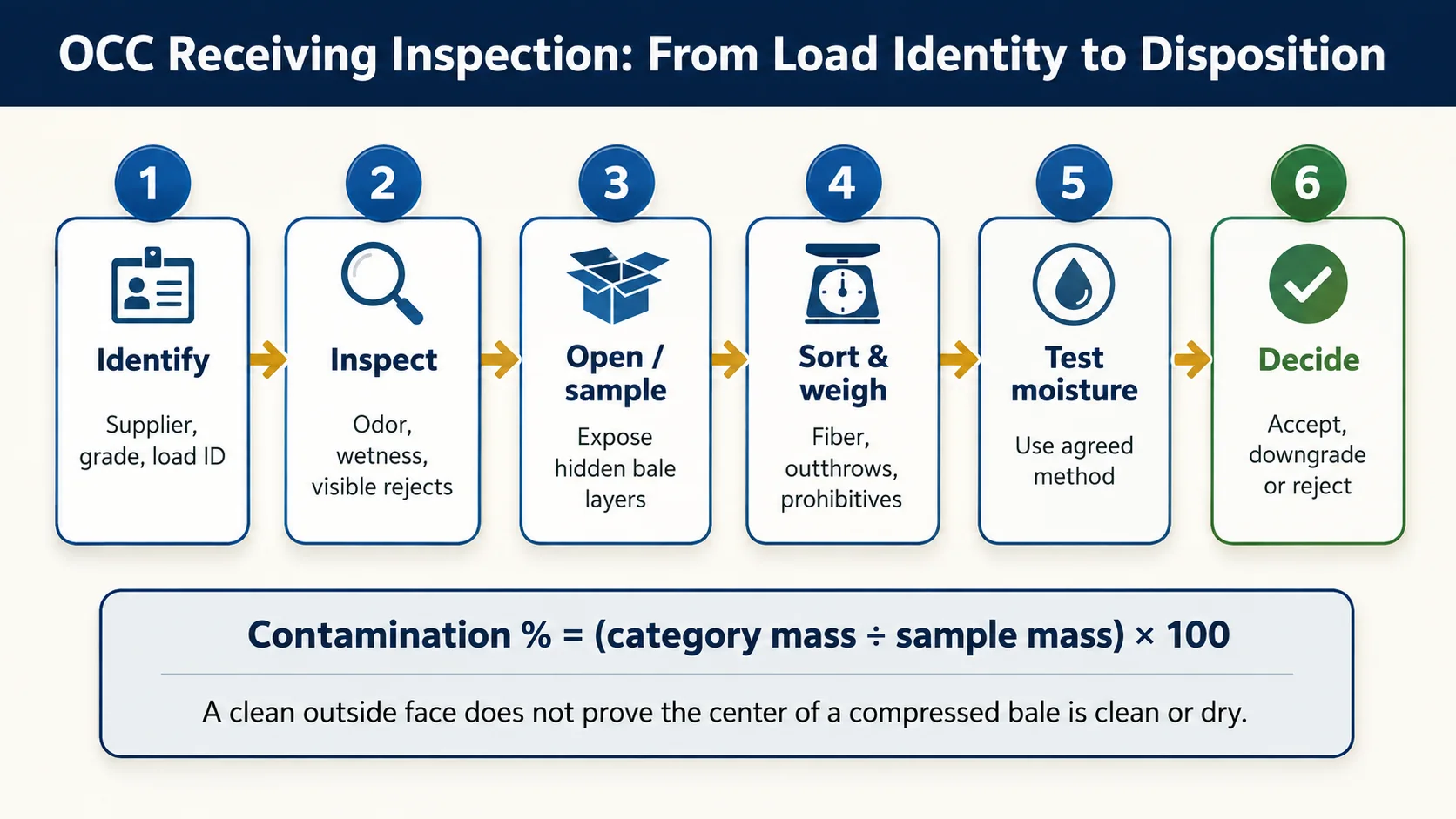
A reliable inspection has to connect the bale to a supplier, a load and a decision. The first step is identification: purchase order, declared grade, vehicle, bale count, gross and tare weights, collection source and storage history. Photos are useful, but they are not a substitute for sampling.
1. Inspect the whole load before unloading
Look for torn bales, water staining, odor, visible film, mixed colors, loose refuse and inconsistent bale construction. Check the trailer floor and roof for water. A load may be clean but wet, or dry but incorrectly graded. Record both conditions separately.
2. Open representative material
The outside layers are often the best-looking part of a compressed bale. A meaningful check exposes internal layers from selected bales or samples material during controlled bale opening. The sampling plan should reflect the risk, supplier history and size of the lot.
3. Sort categories and weigh them
Separate acceptable corrugated fiber, grade-mismatched paper, non-paper components and prohibitive materials using the definitions in the purchase specification. Weigh each fraction on a suitable scale.
Contamination percentage = category mass ÷ representative sample mass × 100
The formula is simple. The difficult part is obtaining a representative sample and applying the same category definitions every time.
4. Measure moisture using the agreed method
Surface probes are fast screening tools. Oven-dry or other agreed methods can be more suitable for a formal settlement, depending on the contract. Whatever method is used, the procedure should state where readings are taken, how many are required and how wet pockets are handled.
5. Record the disposition and feedback
Accepted, downgraded and rejected loads should remain traceable. Supplier, date, grade, measured fractions, photos, operator, instrument and decision are the minimum useful record. Trend data often reveals a collection route or shift that repeatedly introduces film or rainwater.
How OCC Grade Changes a Cardboard Recycling Plant
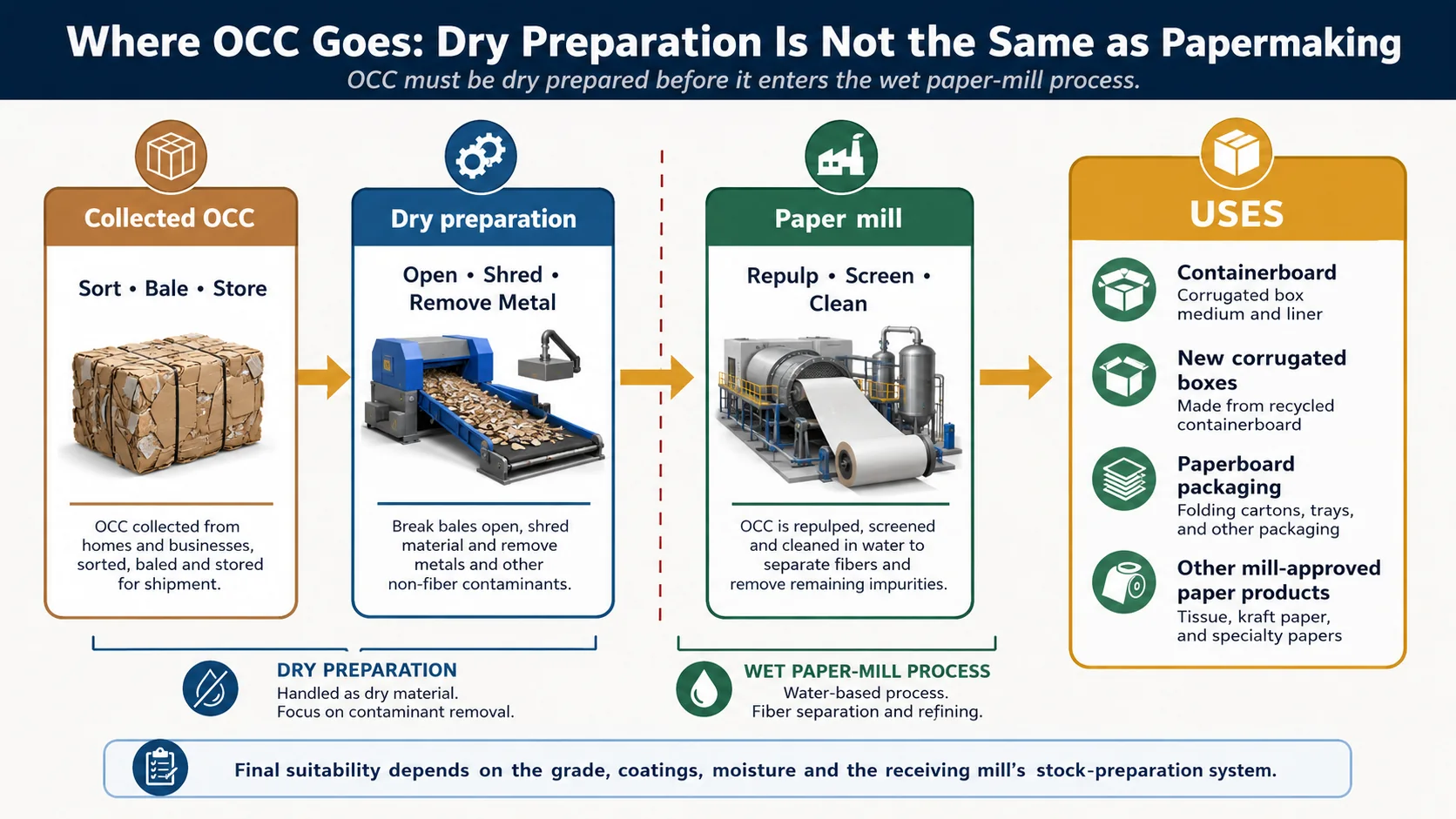
A recycling line should be selected after the input grade and the output buyer are defined. The current YUXI waste cardboard recycling machine and plant is presented as a dry preparation system for controlled feeding, primary shredding, ferrous removal, metered conveying, dry fiber opening, dust control and optional baling. It is not presented as a complete wet pulping or paper-making line.
That boundary is important. Dry equipment can reduce bulky boxes, expose metal, stabilize feeding and mechanically open suitable paper. It cannot verify fiber chemistry, remove every coating or turn food-soiled mixed waste into mill-approved Grade 12.
| Feed condition | Plant implication | Decision to confirm |
|---|---|---|
| Loose, flattened commercial boxes | Receiving and metering may be relatively simple, but low bulk density can starve equipment. | How will the loader or conveyor maintain a stable feed? |
| Dense wired OCC bales | Requires safe bale handling, wire removal or controlled opening and space for inspection. | Which bales are sampled before they enter the line? |
| Grade 11 with variable film and boxboard | Needs stronger pre-sort and reject control than clean source-separated feed. | What output grade will the buyer actually accept? |
| Double-sorted Grade 12 target | Demands source control and quality assurance; machinery alone cannot create the grade. | Where are boxboard, wax and plastic removed and measured? |
| Wet or treated corrugated cases | Can change shredding, dust, opening and downstream repulpability. | Should the load be rejected, segregated or tested separately? |
| Clean DLK cuttings | May need controlled conveying and baling more than aggressive contaminant removal. | Would over-processing reduce value or add avoidable dust? |
We’ve found that the wrong grade assumption often appears later as an equipment complaint. A line is asked to make clean fiber from a stream that was never source-separated, or a nominal capacity was based on dense bales while the real feed is loose, springy boxes. The better sequence is grade, buyer, material test, then equipment.
The related guide to the industrial cardboard recycling process explains where dry preparation ends and paper-mill pulping begins.
What Is OCC Cardboard Recycled Into?
After collection and preparation, OCC normally travels to a paper mill. The mill repulps the recovered paper with water, removes screening rejects, cleans the fiber slurry and forms new paper or board. AF&PA describes tape, labels and staples being screened out during this process.[4]
The most important outlet is containerboard—the linerboard and corrugating medium used to make new corrugated packaging. AF&PA reports that nearly half of U.S. recycled paper in 2024 went into containerboard.[5] Depending on grade, fiber performance and mill equipment, recovered paper can also contribute to paperboard packaging and other paper products.
End use is not decided by the word OCC alone. Repeated fiber processing shortens and changes the furnish; moisture, coatings, adhesives and non-paper components affect yield and cleaning demand. Mills blend recovered and virgin fiber according to the product they are making. For a recycler, the commercial objective is therefore not “maximum shredding.” It is a consistent, documented furnish that the selected buyer can use.
Information to Define Before an OCC Recycling Project
A useful equipment proposal starts with representative material and the buyer’s acceptance specification. Send more than the words “waste cardboard.”
- Declared grade: ReMA Grade 11, Grade 12, DLK, EN 643 code or buyer-specific description.
- Source: retail, fulfillment, industrial, curbside, mixed recycling, paper mill or box plant.
- Feed form: loose boxes, flattened sheets, wired bales, strapped bales, rolls or cuttings.
- Bale data: dimensions, mass, density, wire or strap and unloading method.
- Quality evidence: representative photos, opened-bale photos, sort analysis, moisture results and seasonal variation.
- Contaminants: film, boxboard, wax, wet-strength board, food, metal, foam, wood, glass and hazardous exclusions.
- Output contract: loose or baled form, accepted grade, bale specification and downstream mill.
- Capacity basis: sustained accepted output per hour or shift, including normal loading, sorting, clearing and bale changes.
- Site data: workshop dimensions, clear height, doors, traffic, storage, electrical supply, dust and fire controls.
Representative testing is especially valuable when the stream includes treated produce boxes, uncertain imported packaging, rain-exposed bales or material from mixed collection. A small test cannot replace a commercial acceptance plan, but it can expose feeding, wrapping, dust and reject problems before the layout is frozen.
Plan an OCC Recycling Line Around the Grade You Need
Send material photos, bale information, declared grade, moisture and contamination data, required sustained output, downstream buyer specification and workshop dimensions. YUXI can review the dry preparation scope from receiving and bale opening through shredding, metal removal, fiber opening, dust control and baling.
OCC Cardboard FAQs
What does OCC stand for in recycling?
OCC stands for old corrugated containers. In recovered-paper trading it normally means used corrugated boxes and sheets that meet an agreed grade specification. It does not automatically include every product casually called cardboard.
Is every cardboard box acceptable as OCC?
No. Corrugated shipping boxes are the core material, but wet, food-soiled, waxed, heavily laminated or mixed packaging can fall outside a buyer’s OCC specification. Paperboard cartons, tubes and composite packs may be separate grades.
What is the difference between OCC Grade 11 and Grade 12?
Under the January 2026 ReMA specifications, Grade 11 OCC allows up to 1% prohibitive materials and 5% combined outthrows plus prohibitives. Grade 12 double-sorted OCC has tighter limits of 0.5% and 2% and a more restrictive material description.
What moisture limit applies to OCC bales?
The ReMA paper-stock provisions set a 12% maximum moisture limit unless buyer and seller agree otherwise. The test and sampling method should also be agreed, because surface readings and a few dry sheets do not necessarily represent a complete bale.
Do tape, labels and staples have to be removed from OCC?
Normal amounts can usually be removed during paper-mill screening, but large straps, bale wire and excessive plastic should be removed earlier. The receiving mill’s specification controls acceptance.
What is OCC cardboard recycled into?
OCC is commonly repulped for containerboard used in new corrugated boxes. Depending on fiber quality and mill capability, recovered paper can also enter paperboard packaging and other paper products.
Can a dry cardboard recycling plant make Grade 12 from mixed waste?
Not by shredding alone. Double-sorted quality depends on source control, inspection, bale opening, sorting and rejection of nonconforming material. Dry equipment can prepare and clean suitable feed, but it cannot convert hazardous, wet or chemically unsuitable material into compliant fiber.
References
- Recycled Materials Association (ReMA), “2026 January ReMA/ISRI Specifications,” paper stock general provisions and Grades 11, 12 and 13.
- ReMA Specifications, “Old Corrugated Containers (OCC),” Grade 11 description and trading terms.
- Confederation of European Paper Industries (CEPI), “The New EN 643,” corrugated-board grades 1.05.00 and 1.05.01, their permitted other packaging paper and board, and maximum unwanted-material limits.
- American Forest & Paper Association, “The Paper Recycling Process,” collection, MRF baling, mill repulping, screening and new-product formation.
- American Forest & Paper Association, “Paper & Cardboard Recycling,” 2024 U.S. recycling rates and the share of recovered paper used to make containerboard.
- American Forest & Paper Association and Fibre Box Association, “Updated Voluntary Standard for Recycling Cardboard,” repulpability and recyclability tests for coated or treated corrugated fiberboard.
- U.S. Environmental Protection Agency, “Frequent Questions on Recycling,” general guidance that paper materials should be empty, clean and dry.