Plastic Crusher Machine for Sale: Buyer Checklist Before Ordering
How to compare an industrial plastic crusher by actual feed behavior, regrind requirement, sustained throughput, safety, line interfaces and the items hidden behind a low core-machine price.
A machine can look right in a quotation and still be wrong on the factory floor. The hopper accepts the sample shown in a video, but not the longest production reject. The motor is large, yet the screen holds material in the chamber and output falls. Or the crusher performs well by itself, then waits because the blower, conveyor or washing line cannot clear the discharge.
Quick answer: When reviewing a plastic crusher machine for sale, do not start with price or motor power. First prove that a crusher—not a primary shredder—is the correct machine for the real feed. Then define accepted regrind and sustained net capacity, compare the whole order scope, verify safety and destination requirements, and use a representative factory acceptance test before shipment. The model table creates a shortlist. The material test closes the decision.
1. Confirm That a Plastic Crusher Is the Right First Machine
A plastic crusher or granulator uses rotating knives against fixed knives, with a perforated screen retaining pieces until they are small enough to discharge. That high-speed cutting loop is explained in the plastic crusher working-principle guide. It is well suited to prepared rigid scrap, molded rejects, runners, smaller containers and other feed that can enter the cutting chamber safely and consistently.
That is not every plastic waste stream. Long pipe, whole pallets, dense purgings, tangled film, woven bags, straps and unpredictable mixed waste may bridge, wrap, bounce or overload a high-speed granulator. Sometimes the correct purchase is not a larger crusher. It is pre-cutting, a different feeding method, or a low-speed shredder followed by a crusher.
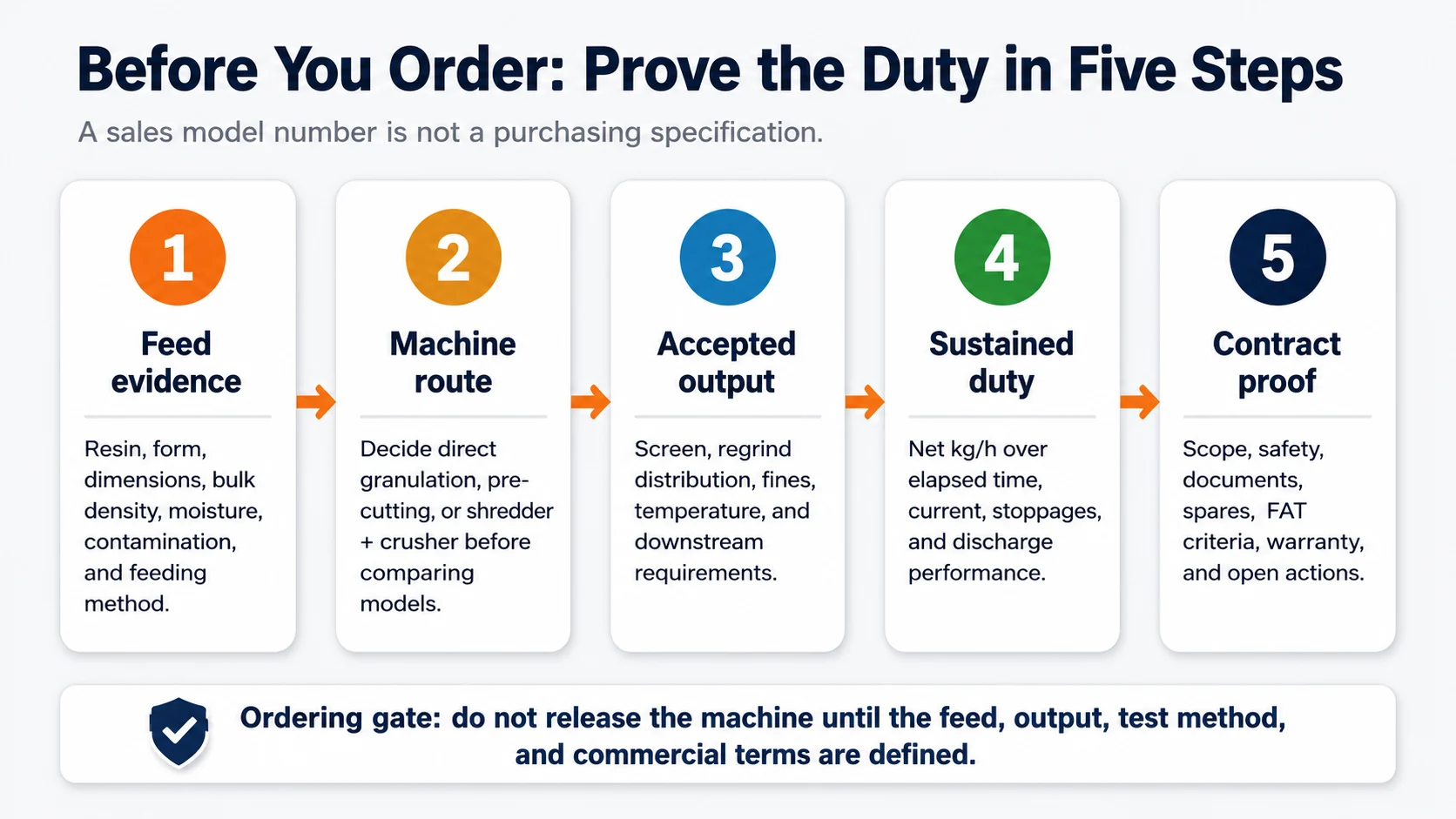
Five gates turn a generic machine offer into a testable production duty.
Common buying error: selecting by polymer name alone. “PP” may arrive as thin woven bags, thick injection rejects, hollow crates or dense purgings. The same resin can require a different hopper, rotor duty, feeding method and even a different machine route.
The shredder-and-granulator two-stage guide is the better internal destination when the feed is bulky or inconsistent. This article assumes a crusher is still under consideration after that first route decision.
2. Send a Feed Brief That a Machine Can Be Sized Against
“Waste plastic” is not a feed specification. A useful RFQ describes what the machine will see on a normal shift and what the worst credible piece looks like. We normally recommend putting the information in one page with photographs, a ruler or pallet for scale, and a short sample inventory.
Material identity
State the resin or resin mix where known, fillers, glass fiber, flame retardants, elastomer content and any heat-sensitive behavior. Additives can change toughness, abrasion and cutting temperature.
Physical form
List the normal and maximum length, width, thickness, pipe diameter, wall thickness, piece weight and whether parts are nested, baled, flattened or loose.
Condition and contamination
Record moisture, sand, labels, oil, metal inserts, fasteners, stones and process temperature. Contamination affects wear, safety and whether upstream separation is needed.
How it reaches the hopper
Manual loading, conveyor, robot, batch tipping and direct discharge from a molding machine create different peaks and different guarding or interlock needs.
Use the plastic crusher material guide to screen likely applications, but do not turn a broad material list into a guarantee. The final decision should be based on representative feed evidence and a documented limit for oversize or prohibited items.
3. Define “Good Output” Before Asking for a Screen
Buyers often write “10 mm output” because the quoted screen has 10 mm holes. That is not a complete acceptance criterion. Screen opening controls passage, but actual regrind is a distribution affected by knife condition, knife gap, rotor geometry, material shape, repeated cutting, temperature and discharge.
Start with the downstream need. Is the material entering a washer, an extruder, a dosing system or internal molding reuse? Each process may care about different things: maximum oversize, fines, flakes versus chunky regrind, bulk density, heat, dust or metal carryover.
Specify the proposed screen opening and screen pattern.
Define how the sample will be taken and weighed.
Set any maximum oversize and acceptable fines method.
Record regrind temperature or smearing when heat-sensitive material is involved.
State whether the acceptance sample is taken before or after cyclone, blower or dust separation.
The detailed trade-off belongs in the plastic crusher screen-size guide. For the purchase order, the key point is simpler: screen size is part of a tested configuration, not a standalone promise.
4. Replace a Headline kg/h Number with a Testable Duty
Capacity is a result of the whole cutting and material-handling cycle. Dense, clean molded scrap can fill a chamber efficiently. Hollow bottles may look voluminous but contribute little mass per hopper load. Flexible strips can wrap. A small screen increases recutting. A weak blower or narrow conveyor can make the crusher wait even when the rotor still has power available.
Write the requirement as sustained net accepted output over total elapsed test time. Include normal feeding, screen, discharge, stops, reversals or cleaning events. Gross feed divided by cutting-only minutes produces a number that is difficult to reproduce in production.
Practical acceptance line: “Process representative material through the proposed machine, screen and discharge arrangement for an agreed sustained period. Weigh accepted regrind over total elapsed time and record motor current, stoppages, oversize, fines and material temperature.”
The plastic crusher capacity guide explains why kg/h varies and how to structure the test. Keep the exact guaranteed value and pass/fail tolerance in the commercial schedule, not only in email discussion.
5. How to Read the Current YUXI YX-G Model Range
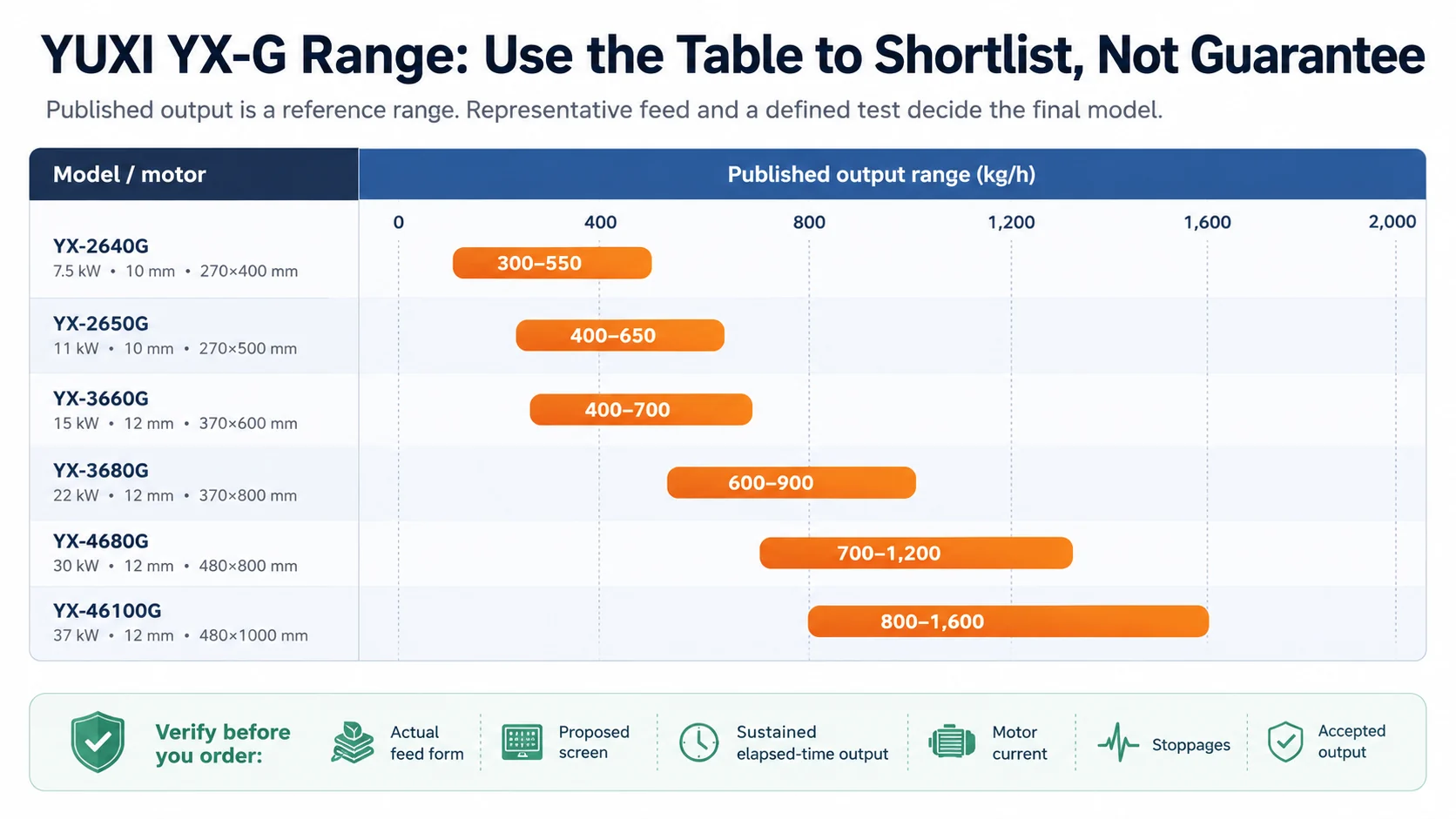
The current YUXI plastic shredder machine page publishes six YX-G models with a 560 rpm rotor, 7.5–37 kW motors, 10 or 12 mm screens, cutting chambers from 270 × 400 mm to 480 × 1,000 mm, and reference outputs from 300 to 1,600 kg/h. Those characteristics align the range more closely with a high-speed plastic crusher or granulator than with a conventional slow, high-torque primary shredder.
Model
Motor
Rotor speed
Screen
Cutting chamber
Published output
YX-2640G
7.5 kW
560 rpm
10 mm
270 × 400 mm
300–550 kg/h
YX-2650G
11 kW
560 rpm
10 mm
270 × 500 mm
400–650 kg/h
YX-3660G
15 kW
560 rpm
12 mm
370 × 600 mm
400–700 kg/h
YX-3680G
22 kW
560 rpm
12 mm
370 × 800 mm
600–900 kg/h
YX-4680G
30 kW
560 rpm
12 mm
480 × 800 mm
700–1,200 kg/h
YX-46100G
37 kW
560 rpm
12 mm
480 × 1,000 mm
800–1,600 kg/h
Do not read the rows as six interchangeable steps on a price ladder. A wider chamber may improve ingestion for some feed, but output can still be limited by bulk density, screen release or discharge. The YUXI product page itself states that plastic type, bulk density, moisture, contamination, blade condition, screen size and feeding stability affect actual output.
A responsible YUXI inquiry therefore asks which model accepts the maximum piece without unsafe pushing, which screen is included, what feed rate the discharge system can remove, and how the published range relates to the buyer’s material.
6. Check the Mechanical Configuration Behind the Model Name
Hopper and feeding behavior
Confirm the hopper opening, useful throat, internal angles, anti-bounce features and the safe loading method. A chamber can be wide enough on paper while the hopper geometry still lets hollow parts bridge above it. For conveyor feeding, define conveyor width, speed control, height, metal protection and stop logic.
Rotor, knives and knife gap
Request a rotor drawing or clear description, number of rotating and fixed knives, knife dimensions, reversible edges where applicable, material specification, setting method and access for removal. Knife steel alone does not predict service life. Feed contamination, edge geometry, heat treatment, gap, mounting accuracy and sharpening history all matter. The dedicated plastic crusher blade and knife-gap guide should own the deeper technical explanation.
Screen and discharge
Confirm screen opening, thickness, open area, mounting, removal method and whether an alternative screen is included. Then follow the material out of the chamber. Is discharge by gravity, screw, belt, blower or cyclone? What happens if that device stops? The controls should prevent continued feeding into a blocked path.
Bearings, drive and structural access
Ask for bearing arrangement, lubrication instructions, belt or coupling details, guard removal procedure, rotor locking method, screen and knife lifting needs, and the maintenance envelope around the machine. A low purchase price loses its advantage quickly if every knife change requires moving a conveyor or dismantling a fixed platform.
7. Put Safety and Electrical Requirements in the RFQ
Safety cannot be added as a vague “CE required” line after the machine is built. The buyer should identify the destination, applicable laws and site standards, then require a machine-specific risk assessment, guarding concept, electrical drawings and verification evidence. ISO 12100 provides a general methodology for machinery risk assessment and risk reduction.[1]
For plastics size-reduction equipment in the United States, ANSI/PLASTICS B151.11-2021 specifically covers granulators, strand pelletizers, dicers and single-shaft rotary grinders using rotary cutting action.[2] OSHA’s general machine-guarding rule requires guarding against hazards such as point-of-operation and rotating-part exposure, while hazardous-energy control applies during servicing where unexpected energization or stored energy can injure workers.[3][4]
Electrical scope should identify supply voltage, frequency, phases, fault level where required, enclosure rating, control voltage, motor starting method, emergency-stop circuit, interlocks, overload protection, component brands or approved equivalents, cable entry and documentation language. IEC 60204-1 applies to electrical, electronic and programmable electronic equipment and systems of non-portable machines, beginning at the point where the supply connects to the machine electrical equipment.[5]
Guarded access to hopper, drive, belts, pulleys, couplings and discharge.
Interlocks that stop hazardous motion when access is opened, with a defined restart condition.
Emergency stops positioned around normal operating and clearing areas.
A documented method for isolation, verification and control of stored mechanical energy.
Safe rotor restraint and tools for knife or screen service.
Warnings and instructions in the language required by the destination.
Important: A standard name on a quotation is not conformity evidence by itself. Ask which edition applies, what parts of the machine are covered, who performs the assessment, and which test records, declarations or technical files will be supplied.
8. Compare the Full Order Scope, Not the Core Machine Price
Two quotations with the same model and motor may have different battery limits. One includes a feed conveyor, blower, cyclone, electrical panel, spare screen, knife-setting tools, packing and commissioning. The other stops at the bare crusher frame. Comparing only the headline price rewards missing scope.
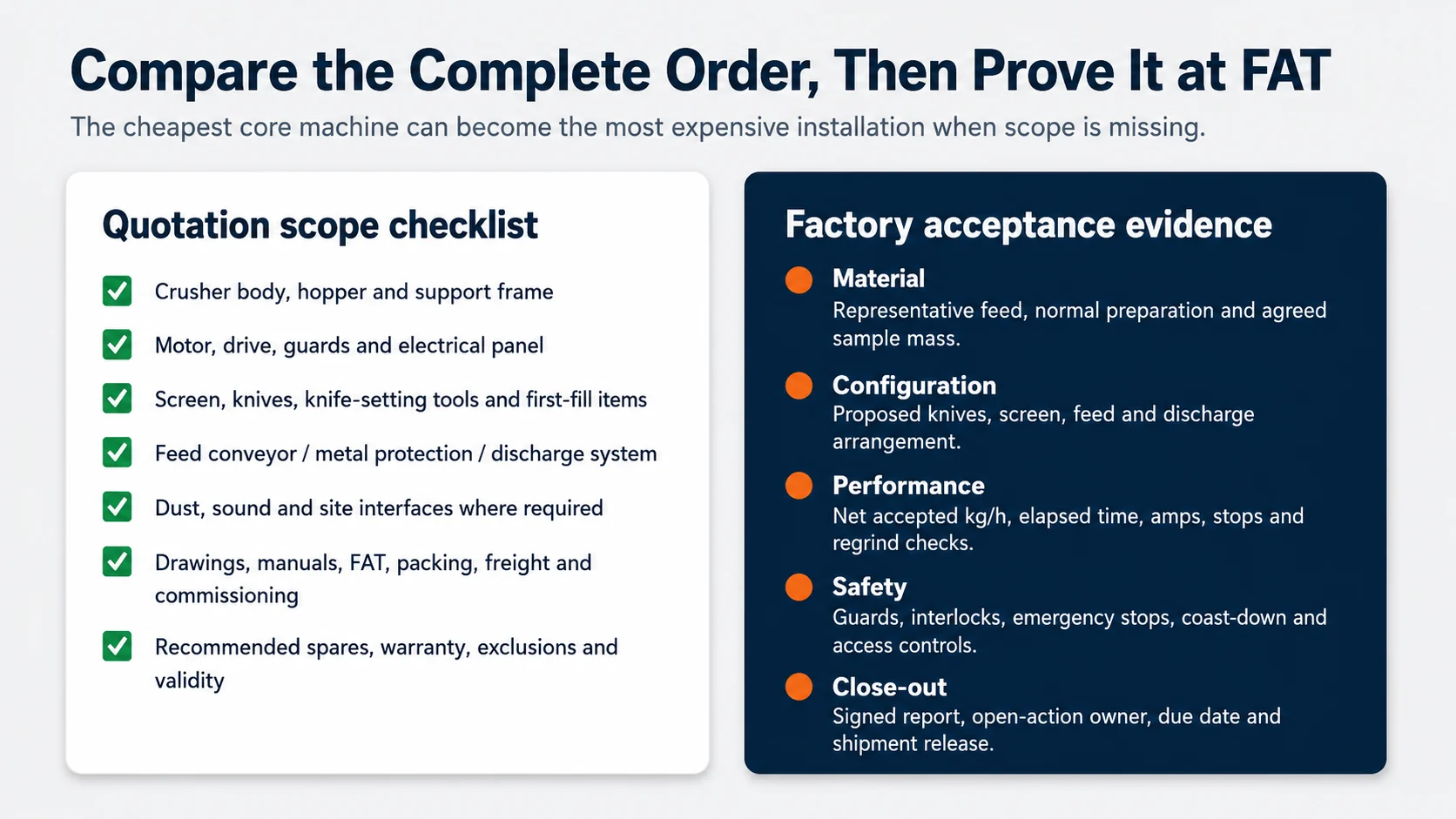
Put every item on one comparison sheet, then link the commercial release to a signed acceptance record.
Manual or conveyor loading, metal detection, belt width, speed control, platform and interface?
Discharge
Gravity, screw, belt, blower or cyclone; capacity, height, dust and blockage logic?
Electrical
Panel, supply, starting method, controls, interlocks, component list, cables and site termination?
Safety/compliance
Destination requirements, assessment, guarding, labels, declarations and verification records?
Documents
GA, foundation, electrical, manual, lubrication, parts list, knife/screen drawings and FAT report?
Commercial
Incoterm, packing, freight, taxes, installation, commissioning, training, lead time, payment and exclusions?
Lifecycle
Commissioning spares, two-year wear recommendation, warranty, response time and part identification?
Universal price ranges are unreliable because feed duty, machine size, safety scope and line equipment vary. A better comparison is total installed responsibility: what must still be designed, purchased or modified after the machine arrives?
9. Use a Representative Test Before Shipment
A short video of clean scrap entering an open hopper is useful for orientation. It is not a factory acceptance test. FAT should use the proposed configuration and written pass/fail criteria. Where shipping a large sample is difficult, agree on the closest practical representative material and clearly record the remaining uncertainty.
Before the test
Identify the machine serial number or production record, knives, knife gap method, screen, motor, electrical settings, feed sample, sample preparation, test duration, measurement instruments and the people authorized to accept or reject the result.
During the test
Record start and finish time, gross feed, accepted regrind, motor current, overloads, stops, manual intervention, screen or discharge blockage, sound or vibration observations, regrind distribution and temperature where relevant. Test guards, interlocks and emergency stops without bypassing normal protective functions.
After the test
Inspect the chamber, knives, screen, fasteners, bearings and discharge path. Photograph the accepted configuration. Put every open action into the FAT report with an owner and due date. Shipment release should be explicit; silence should not be treated as acceptance.
Do not let the test drift: changing the feed, screen or discharge arrangement can produce useful development data, but it no longer proves the ordered duty unless the purchase specification is updated too.
10. Ask for the Documents and Spare Parts Before the Crate Is Closed
Documentation is easier to negotiate before final payment than after a stoppage. At minimum, request a model and serial-number record, general arrangement, foundation and load data, electrical drawings, operating and maintenance manual, lubrication schedule, parts list, knife and screen identification, safety information, declarations required for the destination and the signed FAT report.
Wear parts need traceability. “Standard blade” is not enough when a replacement is required two years later. The dimensions, drawing number, material or approved specification, heat-treatment requirement, bolt grade, tightening method and the installed machine revision must be recorded. The same applies to screens, bearings, belts, seals and sensors.
After startup, use the plastic crusher maintenance checklist to establish baseline current, temperature, sound, output and regrind quality. The purchasing team should make sure the manual and spare-parts package are complete enough for that maintenance system to work.
Final Plastic Crusher Buyer Checklist
Gate
Before the order is released
Evidence
1. Machine route
Crusher is suitable for maximum feed; pre-shredding decision is closed.
Material review and route note
2. Feed definition
Resin, form, size, weight, bulk density, moisture, contamination and feeding are recorded.
RFQ feed sheet and photos
3. Accepted output
Screen and regrind acceptance method reflect downstream needs.
Output specification
4. Capacity
Net sustained kg/h, elapsed time and test configuration are defined.
Performance schedule
5. Mechanical configuration
Hopper, chamber, rotor, knives, screen, drive and discharge are fixed.
Technical datasheet / drawings
6. Line interfaces
Feed height, discharge height, conveyor, blower, cyclone, dust and controls are matched.
GA and interface list
7. Electrical
Supply and panel scope, controls, components, cable limits and documentation are clear.
Electrical specification
8. Safety
Applicable requirements, guarding, interlocks, emergency stops and isolation are addressed.
Risk assessment and verification plan
9. Commercial scope
Battery limits, Incoterm, packing, freight, commissioning, warranty and exclusions are compared.
Normalized quotation sheet
10. FAT
Representative material, pass/fail criteria, report and shipment-release process are agreed.
Signed FAT protocol
11. Documents
Drawings, manual, parts list, lubrication and declarations are deliverables.
Document register
12. Spares and service
Commissioning spares, wear list, part IDs, lead times and response channel are stated.
Spare-parts and service schedule
When You Should Not Order Yet
Pause the purchase when the feed is still described only as a polymer, the maximum piece has not been measured, the downstream process has no output requirement, the supplier will not define the capacity test, or the quote excludes interfaces that determine whether the machine can run. The same applies when destination compliance is treated as a logo rather than a documented engineering task.
That pause is not indecision. It is cheaper than discovering after delivery that the feed needs a shredder, the electrical panel does not match the site, or the claimed output used a larger screen and cleaner material than production.
Plastic Crusher Machine for Sale FAQs
What information should I send before asking for a plastic crusher price?Send the resin and material form, photos with scale, normal and maximum dimensions, wall thickness or piece weight, bulk density where useful, moisture and contamination, feeding method, required regrind, sustained net kg/h, available power and downstream process.Is the largest motor the safest choice?No. Motor power must be matched to chamber, rotor, knives, screen, feed behavior, duty cycle and discharge. A larger motor cannot correct bridging, wrapping, a restricted screen or a downstream bottleneck.What is usually missing from the cheapest quotation?Common gaps include feeding and discharge equipment, metal protection, spare screen or knives, electrical interfaces, safety work, documentation, FAT, packing, freight, commissioning and site modifications.When is a shredder needed before a crusher?Pre-shredding is often the better route when feed is too large, long, tangled, dense or inconsistent for safe and stable direct granulation. Prove the route with representative material.
Send YUXI Your Material and Duty Before You Order
Share material photos, maximum dimensions, contamination, target regrind, sustained capacity, available power and downstream equipment. YUXI can use those inputs to discuss the machine route, YX-G shortlist, test configuration and complete quotation scope.
David focuses on industrial shredding and recycling equipment,including material evaluation,shredder selection,process configuration,and recycling line planning.
Speak To Our Shredder Machine Expert
Get in touch with our nice team today to get a price estimate for a shredder machine.

 English



 Fast Delivery
 Reliable
 Certified
 Experienced