





A procurement team can spend a few weeks comparing the motor,rotor diameter and manual capacity,and then find that the real difference is much more basic:one supplier’s quotation is for a slow-speed primary shredder,the other’s quotation is for a screen-controlled granulator,and the third supplier assumes that the customer will pre-cut each tray manually. All three quotations may contain technically correct numbers. They still cannot compare.
That is why a list of the Top Plastic Shredder Manufacturers needs more than ten company names. Buyers need to know what each supplier is actually strong at, which plastics and feed forms its equipment is designed around, how much of the recycling line it can integrate, and where the commercial or technical trade-offs appear.
Why Manufacturer Selection Matters More Than the Nameplate
Plastic recycling is not one uniform duty. A clean injection runner, a roll of edge trim, a nested crate, a thick HDPE pipe, a contaminated bottle bale and a dense purge behave differently at the hopper, rotor and screen. The U.S. Environmental Protection Agency also distinguishes between mono-material and multi-material plastic products, a reminder that “plastic waste” can hide very different sorting and processing requirements.[1]
The commercial stakes are substantial. The OECD estimated that about 353 million metric tons of plastic waste were generated worldwide in 2019,of which only 9& was finally recycled.[2] Better equipment alone cannot solve collection, sorting or market problems. However, a mismatched size-reduction system may add avoidable fines, pollution, power peaks, knife wear, labor and downtime before the material even reaches washing or extrusion.
In our experience, manufacturer selection usually fails in one of three ways. First, the buyer compares equipment categories rather than equivalent process duties. Second, the capacity test uses clean and conveniently sized samples that do not represent normal production. Third, the quotation looks complete but leaves out feeding, discharge, metal protection, dust control, spare parts, commissioning and downstream bottlenecks.
How We Evaluated the Manufacturers
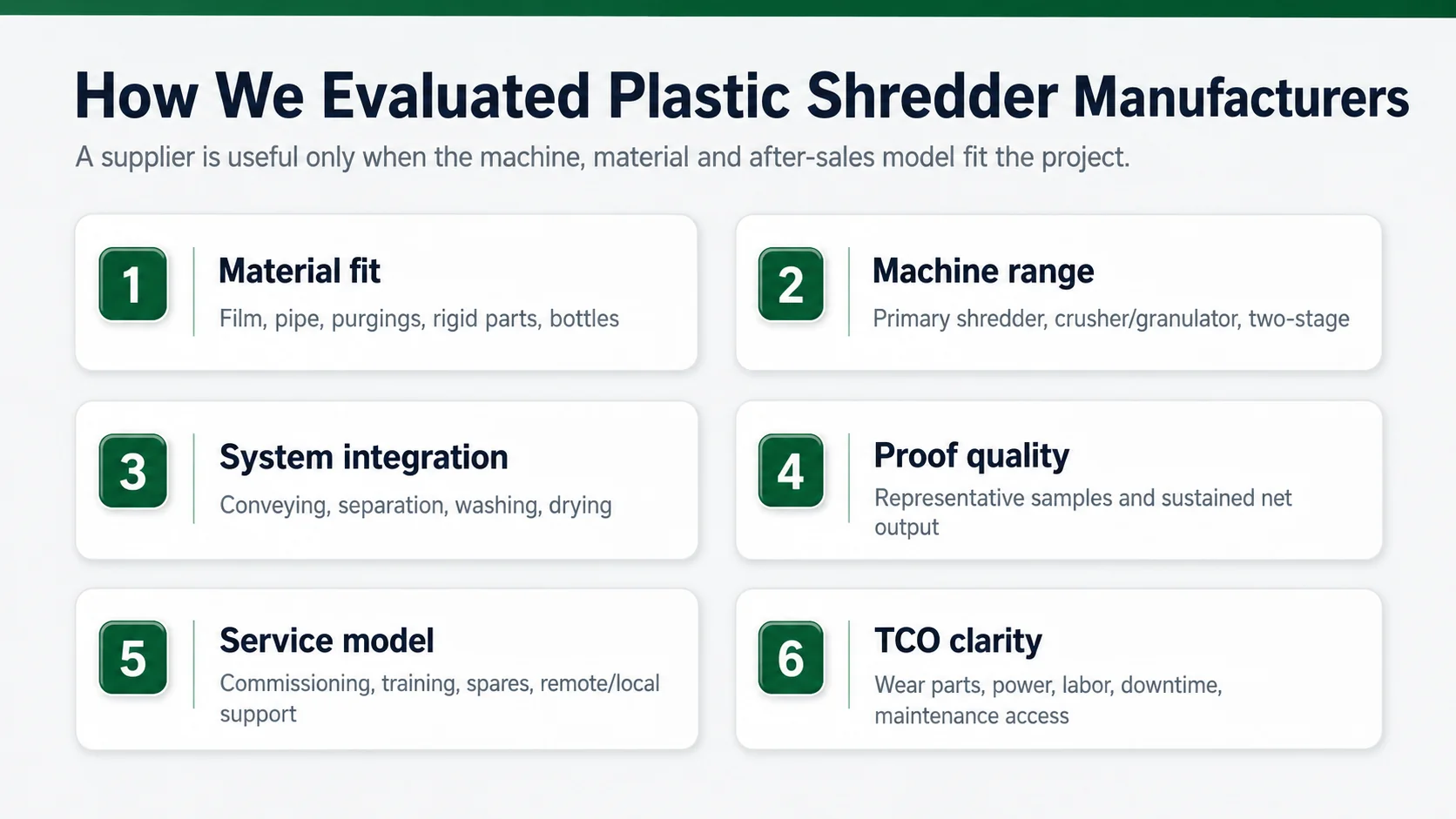
| Criterion | What We Looked For | Why It Matters to a Buyer |
|---|---|---|
| Plastic application depth | Published solutions for film, rigid parts, pipe, purgings, bottles, fibers or contaminated post-consumer waste. | A machine that cuts one sample is not automatically suitable for sustained production on another feed form. |
| The machine range includes | Single-shaft, double-shaft, four-shaft, crusher/granulator, pulverizer or complete two-stage options. | Suppliers should be able to recommend the right mechanism instead of impling each project on a product line. |
| System integration | Feeding, conveying, separation, washing, drying, dust control and downstream coordination. | Net line output is controlled by the slowest stable stage, not the shredder nameplate alone. |
| Test quality | Representative material trials, measurable output, energy/current data, particle-size review and contamination controls. | A short demonstration can hide bridging, wrapping, heat, screen blockage and normal production interruptions. |
| Service and documentation | Commissioning, training, manuals, electrical documents, spare-parts planning and regional support. | The first difficult question often arrives months after the machine is installed. |
| Total cost of ownership | Wear parts, labor, power, downtime, maintenance access, freight and local compliance work. | The lowest equipment price can become the most expensive operating route. |
Top 10 Plastic Shredder Manufacturers in 2026
WEIMA
WEIMA is one of the most recognizable specialist names in industrial shredding. Its plastics material pages cover production waste, film, fibers, PET, crates, containers and other rigid or flexible feeds. The company also publishes a long operating history and a huge installation base, although buyers should regard these figures as statements provided by the manufacturer.[3]
Why it stands out: WEIMA provides a wide range of applications and sufficient configuration depth yo support internal recycling,post-consumption preparation and two-stage production lines.When a project requires a mature single-shaft platform,a recorded reference base and international support,this is usually a logical benchmark.
Buyer watch-out: A premium supplier can still quote the wrong configuration if the feed description is weak. Define film condition, pipe dimensions, purge mass, contamination and downstream granulator requirements before using a brand premium as a substitute for testing.
Vecoplan
Vecoplan publishes multiple plastics-oriented shredder platforms, including configurable machines for varied feedstocks and heavy-duty solid-plastics applications. Its current product materials emphasize adaptable rotors, drive choices, homogeneous output and options for foreign-object response.[4]
Why it stands out: The company is particularly relevant when the shredder must be engineered around a demanding duty rather than purchased as a fixed commodity machine. Buyers can compare drive architecture, rotor design, pusher behavior and line controls within one supplier ecosystem.
Buyer watch-out: Configuration freedom creates more decisions. Ask the supplier to explain why each option is required, what happens when the material changes, and which performance limits remain after the machine is integrated with conveyors, separation or granulation.
Lindner Recyclingtech
Lindner supplies stationary and mobile shredders as well as system solutions. Its plastics portfolio includes in-house and post-consumer applications, with published emphasis on preparing material for washing, separation and downstream recycling.[5]
Why it stands out: Lindner is a strong candidate when the project is larger than a standalone shredder. Its value becomes clearer where coarse reduction, washing, drying, controls and continuous operation have to be engineered as one production route.
Buyer watch-out: Full-system engineering normally raises capital cost and project complexity. A smaller factory processing clean production scrap may not need the same scope as a contaminated post-consumer plant. Buyers should separate necessary process controls from attractive but nonessential options.
UNTHA
UNTHA publishes plastics shredders for rigid and flexible material, including configurable single-shaft platforms and multiple cutting-system choices. The company’s application literature discusses rotor profiles and equipment adaptation rather than presenting one universal plastic machine.[6]
Why it stands out: UNTHA is relevant where stable operation, controlled output and configuration discipline matter more than buying the largest motor. Its broader shredder portfolio also helps buyers compare single-shaft and multi-shaft routes.
Buyer watch-out: The correct cutting system and screen are application decisions, not catalog decorations. Require a written explanation of the proposed rotor, knife geometry, screen, pusher and discharge design, together with the expected wear pattern on the actual material.
YUXI Machinery
YUXI’s current public plastic size-reduction product page lists film, bottles, HDPE pipe, woven bags, drums, pallets, lumps and injection-molding scrap. The YX-G table covers six models from 7.5 to 37 kW, with the published reference capacities from 300 to 1,600 kg/h.[7]
Why it stands out: This series is attractive to buyers who need an export-oriented, cost-conscious machine to prepare rigid or flexible plastic waste,and want the crusher to be integrated with the conveying,washing or granulation stages. The public model table gives buyers a starting point for comparing chamber size, motor power, screen and output.
Buyer watch-out: The 560 rpm rotor, rotating and fixed knives, and 10–12 mm screens place the published YX-G machines closer to high-speed crushers or granulators than to conventional slow, high-torque primary shredders. Large pallets, bales, long pipe or dense purgings may require pre-shredding, controlled feeding or another configuration. Also verify regional commissioning, spare-parts lead time and local support rather than assuming an export quotation includes them.
SSI Shredding Systems
SSI publishes one-, two- and four-shaft low-speed, high-torque shredders for plastics and other difficult materials. Its portfolio is particularly relevant when bulky items, mixed feed or a demanding reduction duty requires a custom-engineered system rather than a standard granulator.[8]
Why it stands out: SSI gives buyers access to multiple shaft configurations and a long-established custom engineering approach. It can be a strong fit where primary reduction, torque and damage tolerance matter more than producing final fine regrind in one pass.
Buyer watch-out: Custom engineering can mean higher cost, longer project development and a machine that is excessive for clean, already-sized production scrap. Define whether the project truly needs rough primary reduction or would be better served by a smaller crusher or granulator.
Genox
Genox publishes a wide plastics portfolio covering pipes, purgings, film, bags, bottles and containers, along with shredders, granulators and washing systems. Its range spans many power and chamber sizes, making it one of the more visible Chinese suppliers for complete plastic recycling projects.[9]
Why it stands out: Buyers can purchase several size-reduction and washing stages from one supplier,and compare special production lines for rigid plastics or films. That can simplify interface responsibility when the project has many conveyors and process handoffs.
Buyer watch-out: A very broad catalog increases the need for disciplined model selection. Verify the exact factory, machine revision, electrical standard, component list, test method, regional service arrangement and critical-spares package attached to the quotation.
ZERMA
The origin of ZERMA can be traced back to 1941,focusing on reducing the size of plastics,including shredders,granulators and crushers. It publishes specialized options for pipes, lumps, purgings and higher-capacity applications, which is useful when a project requires both coarse and fine reduction.[10]
Why it stands out: Plastic is the core of the product range,not the side application. Buyers can use the paper shredder to build a two-stage route for the granulator and keep the core size reduction equipment in a technical series.
Buyer watch-out: ZERMA operates through a global network, so service experience can vary by region. Confirm who will commission the equipment, who stocks the wear parts and whether the quoted machine is a primary shredder, a granulator or a combined line.
Herbold Meckesheim
Herbold Meckesheim specializes in plastics recycling equipment, including shredding, granulation, washing, separation and drying. Its public materials cover clean production scrap as well as more complex post-consumer routes and large pipe applications.[11]
Why it stands out: The company is a strong candidate when the shredder is only one part of a complete mechanical recycling plant. Its experience across washing and material preparation helps buyers address contamination, moisture and downstream quality rather than treating size reduction as an isolated step.
Buyer watch-out: Complete-line expertise is valuable but can be more than a small clean-scrap project needs. Clarify the required battery limits, responsibility for wastewater or dust systems, accepted product specification and performance test for the entire line.
CMG Granulators
CMG focuses on granulators and shredders for plastics and publishes solutions that combine primary shredding with downstream granulation. Its material emphasizes high-capacity size reduction, controls and energy management for production and post-consumer applications.[12]
Why it stands out: CMG is particularly relevant when the buyer’s real requirement is not only to tear bulky plastic but to produce a controlled regrind for washing, blending or extrusion. The shredder-granulator interface is therefore part of the product discussion.
Buyer watch-out: Buyers focused only on rough primary reduction may find the portfolio more granulation-centered than they need. Regional service coverage should also be checked against the larger global groups.
Quick Comparison of the 10 Manufacturers
| Manufacturer | Country / Base | Strongest Fit | Typical Buyer | Main Watch-Out |
|---|---|---|---|---|
| WEIMA | Germany | Broad plastics applications and mature single-shaft systems | Industrial recycler or manufacturer valuing references and support | Premium investment; configuration still needs testing |
| Vecoplan | Germany | Highly configurable engineered shredding systems | Project with demanding feed or control requirements | Complex option set and premium scope |
| Lindner | Austria | Post-consumer preparation and washing-line integration | Medium or large recycling plant | Full-system cost and project complexity |
| UNTHA | Austria | Configurable single- and multi-shaft duties | Buyer prioritizing uptime and application matching | Cutting-system details must be engineered |
| YUXI | China | Prepared plastic scrap and high-speed crusher/granulator stage | Cost-conscious medium-scale exporter project | Do not confuse YX-G with a universal primary shredder |
| SSI | United States | Heavy-duty custom low-speed shredding | Bulky, mixed or difficult feed application | Can be excessive for simple clean regrind |
| Genox | China | Broad export range and complete recycling systems | Buyer wanting shredder, granulator and washing line | Validate exact configuration and regional support |
| ZERMA | Global / German-origin | Pipe, purgings and two-stage plastic size reduction | Plastics processor needing shredder plus granulator | Dealer and service capability varies by region |
| Herbold | Germany | Mechanical recycling lines and contaminated feed | Post-consumer or pipe recycling plant | System scope may exceed small clean-scrap needs |
| CMG | Italy | Granulator-shredder integration and controlled regrind | Production or post-consumer processor | Check local service and primary-shredder depth |
Match the Manufacturer to the Real Size-Reduction Route
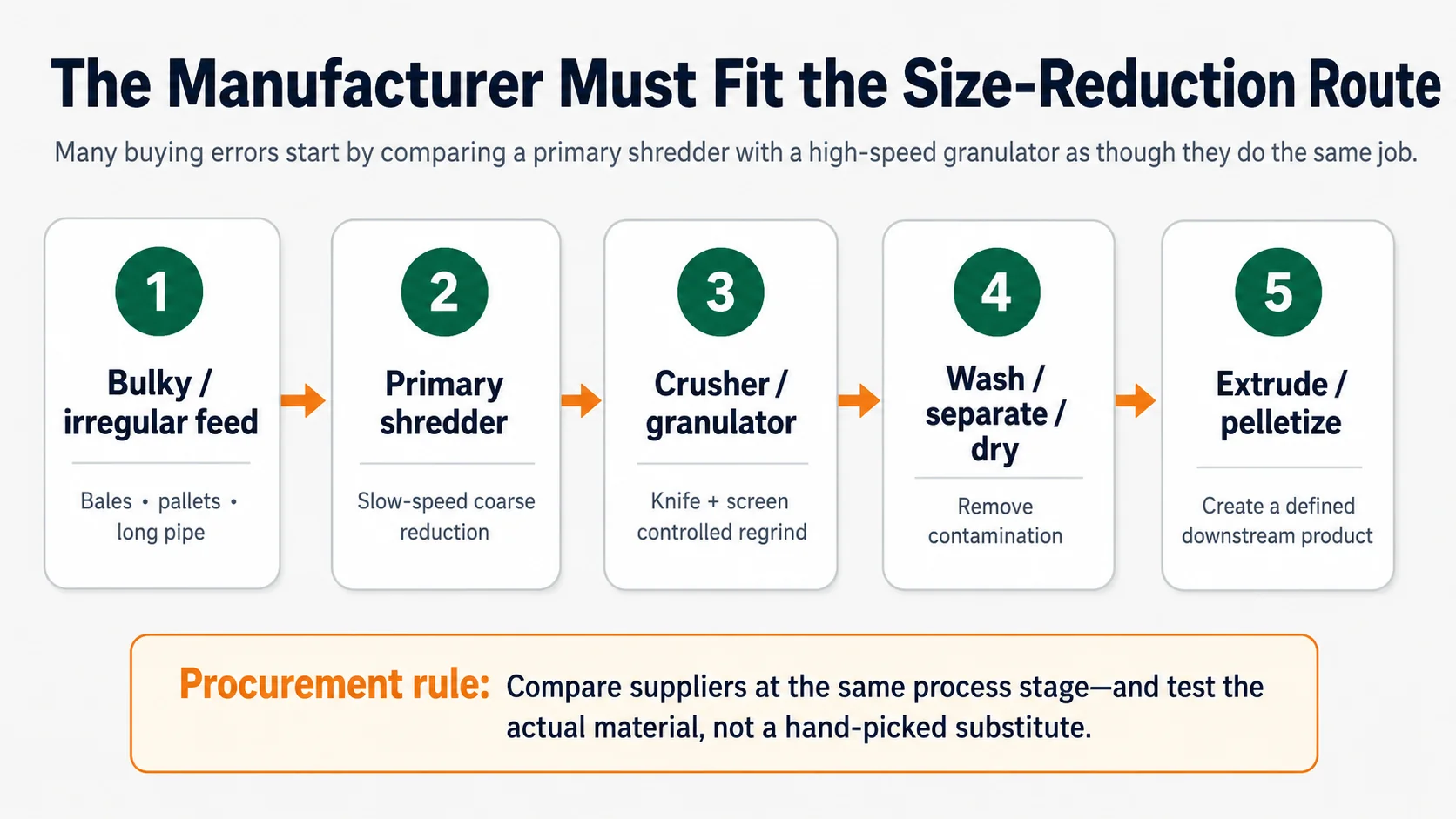
The easiest way to eliminate unsuitable suppliers is to define the process stage before requesting a price.Traditional single-shaft shredders usually use slower rotors, a pusher and a screen to reduce bulky or irregular plastic. The double-shaft shredder uses the counter-rotating shaft for coarse tearing or shearing,which is usually used for tough,mixed or easily contaminated feed.
The crusher and granulator are different. Its faster knife rotor cuts against fixed knives, while a screen retains oversize material until it can pass. The detailed plastic crusher working principle is therefore closer to repeated cutting than to slow-speed ripping.
Choose a primary-shredder specialist when:
The feed includes complete pallets, large drums, pipe, bales, thick purgings, long profiles or irregular parts that cannot enter a granulator safely and consistently. Torque, pusher behavior, foreign-object tolerance and coarse output are central.
Choose a crusher/granulator specialist when:
The material is already prepared enough to enter a high-speed chamber and the buyer needs finer, screen-controlled regrind. Knife geometry, clearance, screen, evacuation, heat and downstream flake quality become central.
Many plants need both. The first stage stabilizes feed size and loading. The second stage produces the final regrind. A supplier that manufactures only one machine type can still be the correct choice, but the buyer must identify who is responsible for the interface between them.
Why Plastic Shredder Prices Vary So Widely
A small granulator for clean sprues and a heavy-duty primary shredder for whole pipe are both sold under the phrase “plastic shredder.” Their prices should not be close. The broader plastic shredder machine price guide should be used for cost structure; the manufacturer comparison here focuses on why supplier scope changes the quotation.
| Cost Driver | What Changes | Question to Ask |
|---|---|---|
| Feed geometry | Hopper, pusher, rotor, torque, chamber opening and pre-cutting requirement | What is the largest normal and occasional piece the machine may receive? |
| Output target | Screen, recirculation, knife work, heat, energy and downstream capacity | Is the target coarse primary output or final accepted regrind? |
| Contamination | Metal protection, damage risk, cleaning, wear and rejection procedures | What contaminants were present in the test sample and quotation basis? |
| Automation | Conveyors, level sensors, current control, reversing logic and operator labor | Which functions are included in the control panel and line scope? |
| Compliance and safety | Guarding, electrical design, access, dust control and local engineering | Which standards are covered, and what remains the buyer’s responsibility? |
| Service model | Commissioning, travel, training, remote support and spare-parts inventory | Who responds locally when production stops? |
One export-project pattern is worth remembering. The lowest quotation often excludes feed conveyors, discharge, spare knives, screens, installation travel and local electrical changes. The highest quotation may include all of them. Comparing only the machine line item rewards the least complete document.
How to Build a Shortlist You Can Defend Later
1. Start with the material package, not the desired model
Send resin and product form, not only “PP” or “PET.” Include clear photos, maximum dimensions, wall thickness or bulk density, moisture, dirt, labels, metal inserts, temperature and the percentage of difficult material in the normal mix. The existing guide to what plastics a crusher can process explains why polymer and product shape must be assessed together.
2. Define net output in a way both sides can measure
State the accepted particle range, the measurement period and what downtime is included. A credible test weighs usable output after normal loading, clearing, bin changes and cleaning. The plastic crusher capacity guide goes deeper into peak versus sustained kg/h.
3. Require an application explanation
Ask each supplier why it selected the shaft count, rotor speed, knife pattern, screen, pusher, feed method and discharge system. A serious answer connects each design choice to the material. A weak answer repeats motor power and catalog capacity.
4. Test representative material
We’ve found that a sample test becomes much more useful when it includes the awkward fraction. Add nested containers, damp bottles, thick wall sections, dusty film or dense purgings in the same proportion expected in production. Record motor current, bridging, wrapping, screen behavior, discharge, temperature, fines and the mass of accepted output.
5. Audit the support route before the machine ships
Determine who will install it,who will provide electrical documents,how remote support works,which wearable parts are in stock,and how quickly the replacement screen or tool set can reach the factory.Ask for letters of recommendation with similar materials and working hours,and then contact them directly as much as possible.
6. Compare safety and documentation, not only productivity
OSHA’s machine-guarding resources identify plastics machinery as an area requiring effective guarding, and its hazardous-energy rules require lockout/tagout procedures for servicing and clearing.[13] Fine plastic dust may also be combustible under certain conditions; OSHA includes plastics and recycling among the materials and operations that can face combustible-dust hazards.[14]
For a broader RFQ framework, use the plastic shredder selection guide. The manufacturer name should be the last filter, not the first.
Where the YUXI YX-G Range Fits in This Comparison
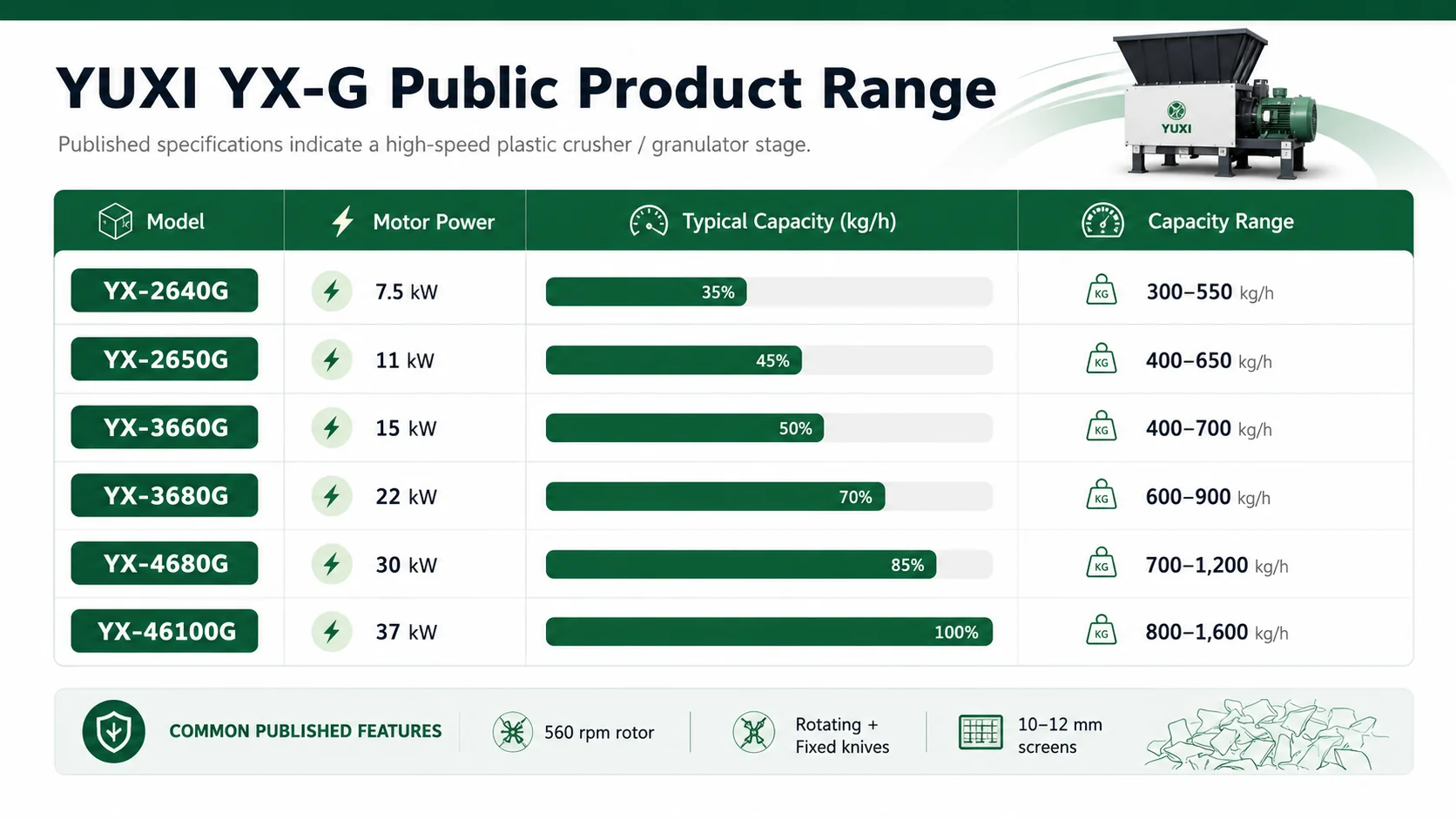
YUXI publishes six YX-G models. All use a listed rotor speed of 560 rpm, rotating and fixed knives, and either a 10 or 12 mm screen. The cutting chambers range from 270 × 400 mm to 480 × 1,000 mm, and published reference output spans 300–1,600 kg/h.[7]
| Model | Power | Rotor Speed | Screen | Cutting Chamber | Published Output |
|---|---|---|---|---|---|
| YX-2640G | 7.5 kW | 560 rpm | 10 mm | 270 × 400 mm | 300–550 kg/h |
| YX-2650G | 11 kW | 560 rpm | 10 mm | 270 × 500 mm | 400–650 kg/h |
| YX-3660G | 15 kW | 560 rpm | 12 mm | 370 × 600 mm | 400–700 kg/h |
| YX-3680G | 22 kW | 560 rpm | 12 mm | 370 × 800 mm | 600–900 kg/h |
| YX-4680G | 30 kW | 560 rpm | 12 mm | 480 × 800 mm | 700–1,200 kg/h |
| YX-46100G | 37 kW | 560 rpm | 12 mm | 480 × 1,000 mm | 800–1,600 kg/h |
That public evidence supports three practical conclusions. First, the YX-G range should be evaluated as a high-speed crusher or granulator stage. Second, it can be a sensible candidate for prepared bottles, molded scrap, smaller pipe sections, crates, woven material or other feeds that enter the chamber in a controlled way. Third, the published upper capacity is not a universal promise for film, bottles, pallets and dense blocks alike. YUXI itself states that actual output varies with material type, bulk density, moisture, contamination, blade condition, screen size and feeding stability.[7]
For an overseas buyer, the value case is strongest when YUXI receives complete material data, performs a representative test, confirms the feed and discharge route, and defines commissioning plus critical spares before shipment. The limitation is equally clear: a buyer needing a slow, high-torque primary shredder for unprepared bulky waste should not select a YX-G model solely because the product page uses the word “shredder.” The mechanism decides the duty.
Send the Material Before Choosing the Brand
A useful quotation starts with photos, dimensions, contamination, target regrind, sustained net capacity, daily operating hours, voltage, layout and downstream process. For unusual material, representative samples are more valuable than a polished specification sheet.
Discuss Your Plastic Size-Reduction ProjectFAQ
Who are the top plastic shredder manufacturers in 2026?
The best choice depends on material form, required output, process stage, service coverage and total cost—not the list position alone.
Is a plastic shredder the same as a plastic crusher or granulator?
No. Traditional shredders normally work at lower speed and higher torque to reduce bulky or irregular materials. Crushers or granulators usually use faster knife rotors and a screen to make smaller and more controlled regrinding. Some suppliers manufacture both, so buyers should compare mechanisms rather than labels.
Which manufacturer is best for plastic film?
There is no universal best brand. Film projects need the supplier to demonstrate feeding, anti-wrapping behavior, evacuation, screen release and sustained output on the actual film condition. WEIMA, Vecoplan, Lindner, UNTHA, Genox and other specialists offer film-oriented configurations, but the specific rotor, feeder and line design matter more than the logo.
Which manufacturer is best for large plastic pipe or purgings?
Large pipe and dense purgings generally require a machine designed for the geometry and load. Ask for dimensional limits, sample testing, current profiles and a clear pre-shredding or granulation route.
Why can two suppliers quote very different capacities?
The quoted materials, feed preparation, bulk density, screen size, measurement period and downtime may differ. Compare sustained net output using representative feed and count normal interruptions such as loading, clearing, screen cleaning and bin changes.
Where does the YUXI YX-G range fit?
The published YX-G range uses a 560 rpm rotor, rotating and fixed knives, and 10–12 mm screens. That places it closer to a high-speed plastic crusher or granulator for prepared scrap and controlled regrind than to a slow primary shredder for every bulky feed. Large pallets, bales, long pipe or dense blocks may need pre-shredding or another feed configuration.
What should I send manufacturers before requesting a quotation?
Send polymer and product forms, clear photos, maximum size, wall thickness or volume density, moisture, contamination, target output size, sustained net capacity, daily hours, upstream and downstream equipment, voltage, layout limits and representative samples as much as possible.
Final Thoughts
The supplier correctly classified the process stage, proved the proposed machine on the representative materials, defined the complete system boundary and could support the equipment after installation.
For a clean factory-scrap project, a compact crusher or granulator may be the right answer. For complete pallets, pipe, bales or dense purgings, a primary shredder may be essential. For contaminated post-consumer material, the washing and separation line can matter as much as the shredder. Compare like with like. Then let the test data—not the brochure ranking—decide.
Authority and Manufacturer Sources
- U.S. EPA — About Plastic Products and Plastic Pollution.
- OECD — Global Plastics Outlook.
- WEIMA — Plastics Applications; Company Information.
- Vecoplan — Shredder Product Range; plastics application materials reviewed July 2026.
- Lindner — Plastics Recycling Solutions.
- UNTHA — Plastics Recycling.
- YUXI — Plastic Shredder / Crusher Product Page and YX-G Model Table, accessed July 2026.
- SSI Shredding Systems — Plastics Applications.
- Genox — Plastic Recycling Systems.
- ZERMA — Plastic Size Reduction Equipment.
- Herbold Meckesheim — Plastic Recycling Machinery.
- CMG Granulators — Shredders and Granulators.
- U.S. OSHA — Machine Guarding: Plastics Machinery; 29 CFR 1910.147 Control of Hazardous Energy.
- U.S. OSHA — Combustible Dust.