





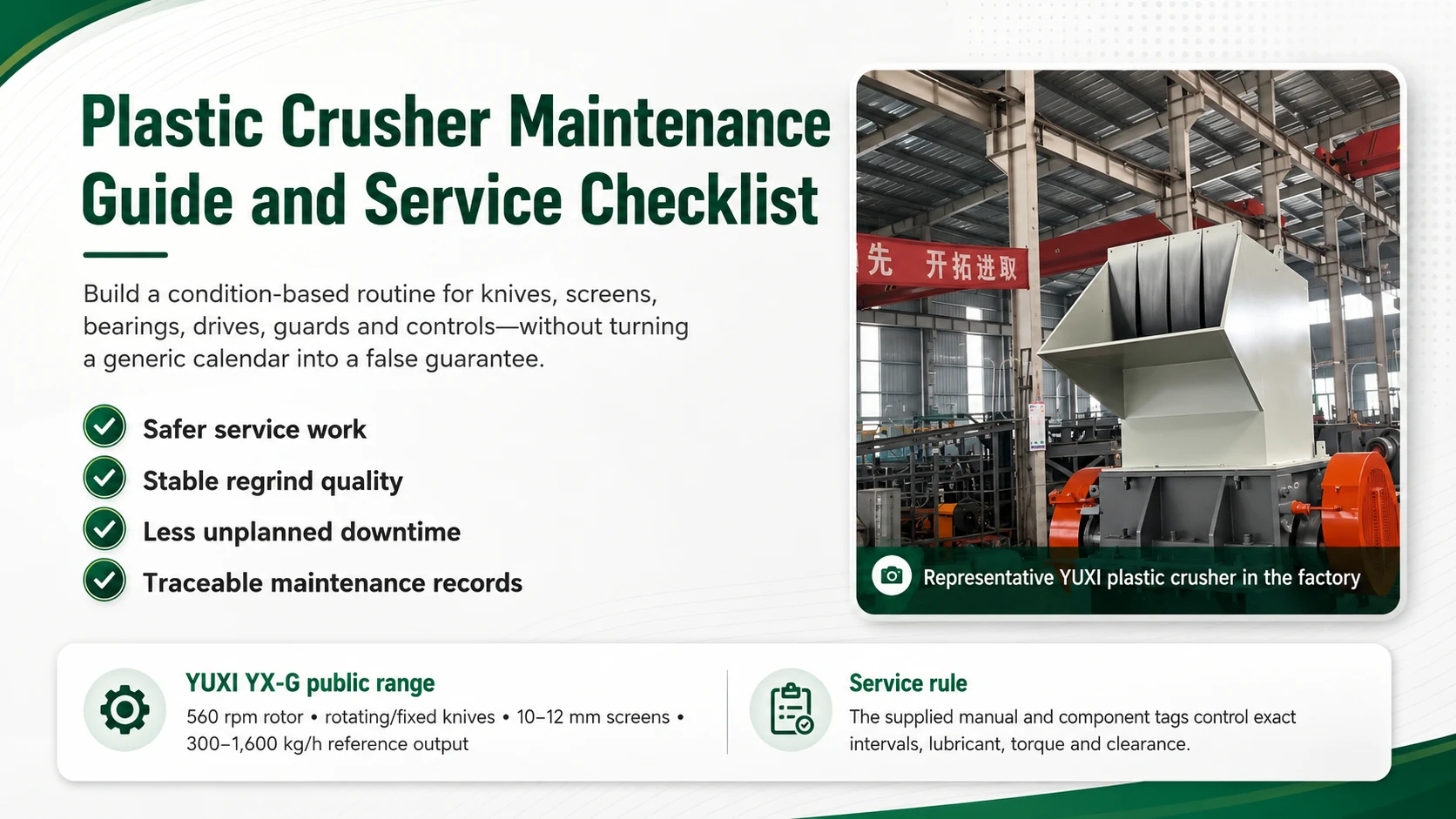
The crusher still starts. That is exactly why the maintenance problem is easy to miss. Cutting takes a little longer, the motor current drifts upward, regrind becomes dustier, and the operator compensates by feeding more carefully. Production continues—until a loose knife, cracked screen, overheated bearing or failed interlock turns a small warning into a long shutdown.
The best plastic crusher maintenance program is rarely the thickest checklist. It captures a small change before closing,making ownership obvious,pointing out the correct manual to the technician,and leaving notes that can be actually used for the next shift.The calendar is still helpful.However,it cannot provide the correct amount of knife clearance,bolt torque,lubricant or grease for a specific machine.
Maintenance Owns the Condition of the Machine
Once a machine and process have been selected, how do operators and technicians keep the cutting system, screen, bearings, drive, discharge and safety functions in a known condition?
Preventive work
Planned inspection, cleaning, tightening, lubrication and functional tests performed before a failure becomes obvious.
Condition-based work
Service triggered by evidence such as edge wear, changing current, rising temperature, vibration, noise, output drift or screen damage.
Corrective work
Repair after a defect, trip, jam or component failure. The objective is not only restart; it is to remove the cause and confirm safe operation.
A useful program uses all three. Calendar-only maintenance can replace parts too early and still miss a rapidly developing defect. Breakdown-only maintenance often costs more in collateral damage, lost production and hurried work.
Read the YUXI Product Data as a Maintenance Clue
The current YUXI product page publishes six YX-G models with a 560 rpm rotor, rotating and fixed knives, 10 or 12 mm screens, 7.5–37 kW motors, and reference output ranges from 300 to 1,600 kg/h. The same page states that actual output depends on plastic type, bulk density, moisture, contamination, blade condition, screen size and feeding stability.[1]
That combination places the range in a high-speed crusher or granulator duty. It also explains why small changes in knife condition, screen restriction and feed stability can show up quickly as longer cutting time, heat, current draw or regrind inconsistency. The YUXI plastic crusher product page should therefore be read together with the machine-specific manual supplied for the ordered configuration.
Build a Baseline Before You Build a Calendar
A maintenance interval without a baseline is guesswork. During commissioning—or immediately after a controlled overhaul—record what “healthy” looks like on representative material. This does not need an expensive monitoring system. A disciplined log is often enough.
Operating baseline
Material and form, screen installed, normal feed method, accepted net kg/h, motor current range, discharge behavior, typical sound and chamber temperature trend.
Mechanical baseline
Knife dimensions after grinding, approved clearance, fastener specification, screen condition, belt or coupling condition, bearing temperature and foundation fasteners.
Safety baseline
Guard condition, interlock response, zero-speed or coast-down behavior, emergency-stop test, isolator identification and stored-energy controls.
Documentation baseline
Keep the documents technicians actually reach for: the current manual revision, electrical drawings, spare-parts list, lubrication chart, torque values and inspection forms. We’ve found that one missing drawing—or no named person to escalate to—can turn a straightforward check into hours of delay.
The separate plastic crusher capacity guide explains why sustained accepted output is more useful than a short peak. For maintenance, the same principle applies: compare today’s performance against a stable reference under similar material and screen conditions.
Sometimes the operator says, “The machine is slow.” That may be correct, but it is not yet a diagnosis. A baseline lets the technician ask: slow compared with which feed, which screen, which knife condition and which discharge setup?
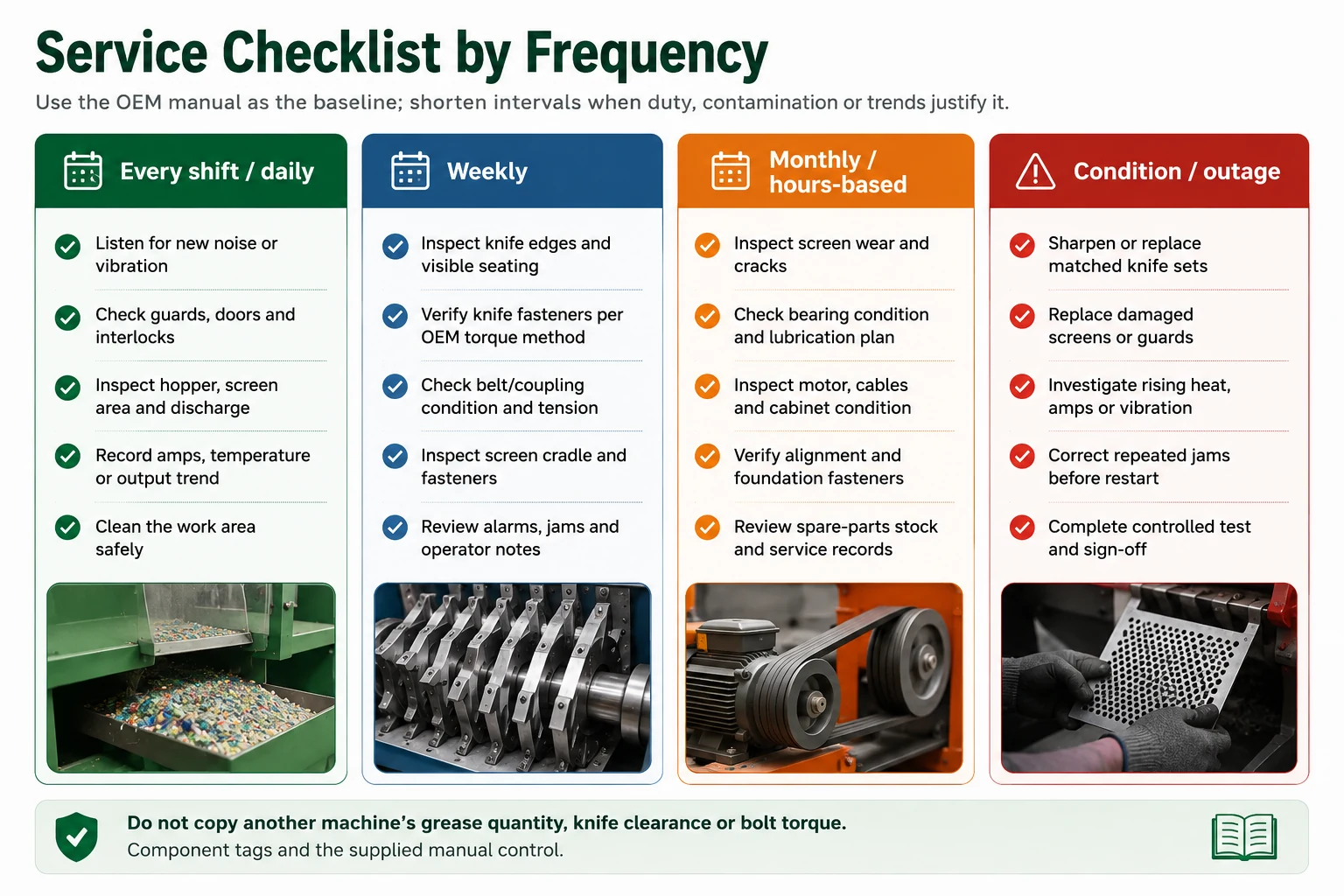
Every-Shift and Daily Plastic Crusher Maintenance
The daily round should be brief enough to complete and specific enough to matter. It is primarily an operator inspection, not an invitation to open guarded areas while the machine is energized.
| Check | What to look or listen for | Action boundary |
|---|---|---|
| Work area and feed | Metal, stones, tools, accumulated regrind, blocked access, mixed or unexpectedly dense feed. | Remove hazards using the approved procedure; stop feeding if the material is outside the agreed specification. |
| Guards, doors and hopper | Loose or damaged guarding, worn infeed flaps, missing fasteners, doors not seating correctly. | Do not run with a defeated, bypassed or damaged safeguard. |
| Sound and vibration | Listen for a sound that was not there before: a cyclic knock, scrape, rattle, bearing rumble, belt squeal or unfamiliar impact. In practice, the change from the normal baseline matters more than whether the machine is simply loud. | Stop and investigate when the change is sudden, severe or cannot be explained. Continuing to feed usually hides the clue rather than solving it. |
| Current and heat trend | Higher amps for the same feed, frequent overloads, hot bearing housing, unusual smell or smoke. | Do not keep increasing feed to hide deterioration. |
| Regrind and discharge | More fines, ragged edges, longs, oversized pieces, dust, blocked hose, weak air flow or material building above the screen. | Check cutting, screen and discharge condition under isolation. |
| Service record | Running hours, alarms, jams, cleaning, observed defects and material changes. | Record the finding before the next shift loses the context. |
Cumberland’s T50 manual illustrates why daily checks should include screen-cradle security, infeed-flap condition, interlock components, rotor lock, safety switches and housekeeping. It then assigns deeper knife, screen, lubrication and belt checks to planned intervals.[2] The exact frequency for a YUXI installation must still come from its manual and operating duty.
Weekly Checks: Look for Loosening, Wear and Drift
High-speed cutting produces vibration and repeated load cycles. Weekly work should focus on items that can loosen, wear or move out of adjustment. Perform internal checks only under the approved isolation procedure.
- Inspect visible rotor and fixed-knife edges for rounding, chipping, cracking or impact damage.
- Check knife seating surfaces and fasteners using the OEM sequence and specified torque method.
- Inspect the screen, cradle and retainers for looseness, cracks, polished contact marks or material packing.
- Check belt condition and tension, or inspect coupling elements and guards where a coupling is used.
- Look for grease leakage, damaged seals, loose bearing fasteners and a changing temperature trend.
- Inspect discharge ducting, blower connections, flexible hoses and supports for leaks or blockage.
- Review the week’s alarms and jams. Repetition is a maintenance signal, not normal production.
One common mistake is to tighten every accessible bolt “as much as possible.” That is not maintenance. Knife fasteners, bearing housings and structural joints require the specified grade, condition, lubrication state, sequence and torque. Reusing damaged or incorrect fasteners can create a more serious failure than the original looseness.
Monthly, Hours-Based and Planned-Outage Work
A fixed monthly heading is useful for scheduling, but operating hours and severity often provide the better trigger. A lightly loaded clean-scrap machine and a recycler processing abrasive, contaminated feed should not automatically share the same interval.
Screen and cutting-chamber inspection
Remove retained material, inspect holes for elongation and cracks, check the cradle and sealing surfaces, and confirm the rotor turns freely by the approved manual method before closing.
Drive and alignment
Inspect belt wear, pulley condition, coupling elements, motor mounting, foundation fasteners and signs of misalignment. Correct the cause of repeated belt adjustments.
Bearings and lubrication: follow the trend, not one reading
We normally compare temperature and noise with the machine’s own baseline, then inspect seals and grease condition before adding lubricant. More grease is not automatically better. Surprisingly, over-greasing can create the same heat and seal trouble that operators often blame on too little lubrication.
Electrical cabinet: clean, cool and checked by the right person
Qualified electrical personnel should review connections, cooling paths, dust, cable damage, overload history and safety-circuit faults. In practice, we avoid blowing conductive dust around a live cabinet; it can move contamination deeper into exactly the components we are trying to protect.
Structural condition
Check welds, frame, hopper, doors, hinges, screen supports, motor base and anchoring for cracks, fretting, movement or repeated contact marks.
Performance review
Trend net output, current, knife hours, screen life, jams and unplanned stops. Adjust the maintenance plan when evidence changes—not because the calendar page turned.
Cumberland’s published example calls for periodic knife-clearance and wear checks, knife-bolt torque checks, screen inspection, lubrication and belt-tension review; it also warns not to over-grease bearings.[2] Treat those items as evidence of what matters across granulators, not as permission to copy that manual’s exact interval or lubricant into another machine.
Knife and Screen Maintenance: Service the Cutting System as a Pair
Conair’s troubleshooting guidance matches a pattern technicians often notice on the floor: throughput falls first, then noise, heat, power draw, dust or fines begin to drift. Dull or misaligned knives and a deteriorating screen are common suspects, but they should be checked as one cutting system. Conair recommends sharpening or replacing the knives, restoring the manufacturer-specified clearance, and cleaning or replacing the screen as required.[3]
The detailed plastic crusher blade and knife-gap guide covers geometry, steel and gap selection. The maintenance task is to preserve the approved configuration and identify when it has changed.
Knife service sequence
- Identify the machine, rotor revision and approved knife set.
- Lock out, control stored energy, wait for complete rotor stop and secure the rotor using the manufacturer’s method.
- Clean before measuring. Plastic, dust or burrs under a knife can change height and gap.
- Inspect edges, bodies, holes, seats, threads, washers and fasteners. Cracks or deformation require escalation.
- Measure grind dimensions and confirm whether rotor knives must remain a matched set for height and balance.
- Install with the specified fasteners, sequence, torque condition and clearance procedure.
- Rotate the rotor manually by the approved method to check interference before closure.
- Restore guards, remove tools, clear personnel, complete controlled restart and record the work.
Do not judge knives by appearance alone. A shiny edge can be rounded. A new rotor set can still cut poorly against worn fixed knives. Surprisingly, a screen problem can imitate a blade problem: retained material recirculates, heat rises and the operator sees dust even though the cutting gap is acceptable.
Screen inspection
Look for cracks, broken bridges, elongated holes, thinning, polished areas, distortion, blocked open area and poor seating. A damaged screen can release oversize material or fail further under impact. The separate plastic crusher screen-size guide covers selection trade-offs; maintenance should restore the specified screen, not quietly change the process by drilling holes or fitting an unapproved substitute.
Drive, Bearings and Lubrication: Avoid the “More Grease” Reflex
When a bearing housing feels hot, adding grease is a tempting response. That is not always correct. Heat can result from over-greasing, under-lubrication, the wrong product, contamination, excessive belt load, misalignment, bearing damage or process overload.
Belts
Inspect tension, glazing, cracking, dust, matched-set condition, pulley wear and alignment. A belt repeatedly losing tension may indicate a deeper alignment or mounting problem.
Couplings
Inspect guards, flexible elements, fasteners and alignment evidence. Replace the correct element; do not improvise with a different hardness or geometry.
Bearings
Trend temperature, noise and vibration. Check seals and grease purge. A sudden change matters more than a single generic temperature rule.
The Cumberland manual directs users to the motor manufacturer’s lubrication information, specifies periodic rotor-bearing lubrication for that particular model, and explicitly warns against over-greasing.[2] That is the right hierarchy for a YUXI installation as well: use the supplied lubrication chart and component tag, not an internet table.
During an outage, lubrication looks like a small job. Sometimes it causes a surprisingly avoidable problem. We clean each fitting before connecting the gun, confirm the lubricant identity and condition, and record the product, quantity, running hours and technician. Mixing incompatible greases—or using a dirty gun—can undo the whole service.
Maintenance Starts with Energy Control, Not a Stop Button
OSHA 29 CFR 1910.147 applies to servicing and maintenance where unexpected energization, startup or release of stored energy could injure employees. Its definition includes inspection, adjustment, cleaning, unjamming, lubrication and tool changes when exposure exists.[4]
A plastic crusher may involve electrical energy, rotor inertia, gravity from a raised hopper or screen cradle, pneumatic or hydraulic pressure, belt tension, stored material and sharp knives. Pressing stop does not isolate those hazards.
OSHA’s general machine-guarding rule requires protection from point-of-operation, rotating-part and flying-chip hazards.[5] HSE guidance similarly says movement should stop before guards are removed, stored energy must be controlled, machines should be isolated for maintenance and guards replaced before restart.[6]
Safety-function checks
- Inspect guards, hinges, fasteners, actuators and alignment; do not defeat switches to save time.
- Test interlocks, emergency stops and zero-speed or coast-down functions under the manufacturer’s approved method.
- Investigate any door that opens too early, switch that works intermittently or safety fault that requires repeated resetting.
- After service, account for tools and parts, restore every guard, clear personnel and use a documented restart check.
Cleaning and Changeovers: Where Small Maintenance Problems Start
Cleaning is often handed off as routine work. That is a mistake. In the crusher, the person may work next to sharp knives,heavy rotors,trapped material and open guards,so we handle internal cleaning with the same energy control discipline as any other service task.
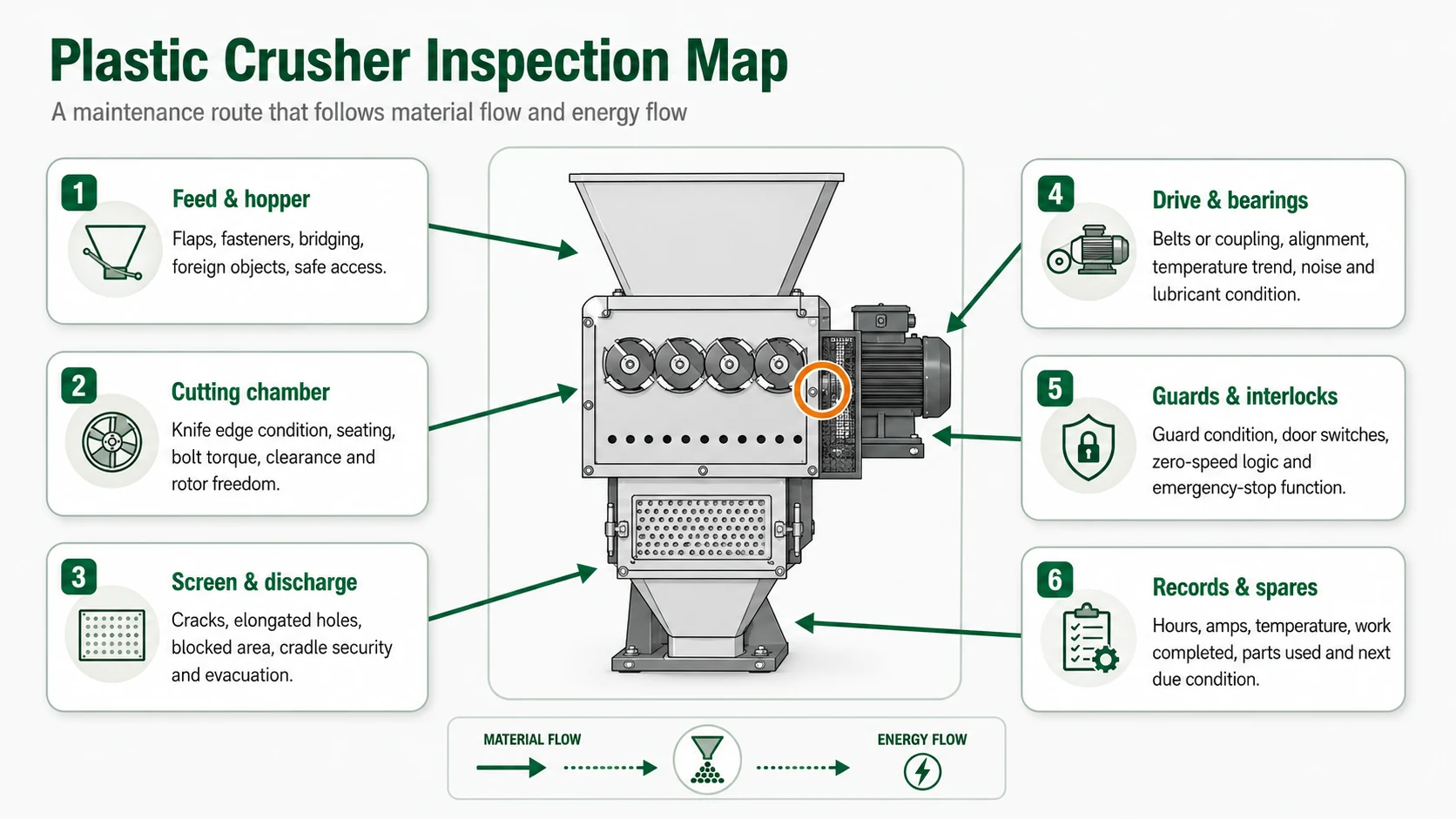
In practice, we work through the material path rather than cleaning only what is easy to see: hopper, chamber, rotor, fixed-knife area, screen, cradle, discharge and ducting. The method still has to suit the material and the machine. Combustible dust, static, hot surfaces and compressed air all require judgment; compressed air can spread contamination or drive it into bearings and controls.
During a resin or color change, retained flakes often hide above the screen, behind knife blocks or in discharge transitions. We’ve found that these small pockets are what cause the awkward “mystery contamination” on the next run. Where cross-contamination matters, record the previous material, the cleaning method and the acceptance check.
A clean machine also makes inspection easier. Hairline cracks, fretting, oil leakage and loose fasteners are hard to see under layers of dust and regrind.
Use Symptoms to Prioritize Inspection
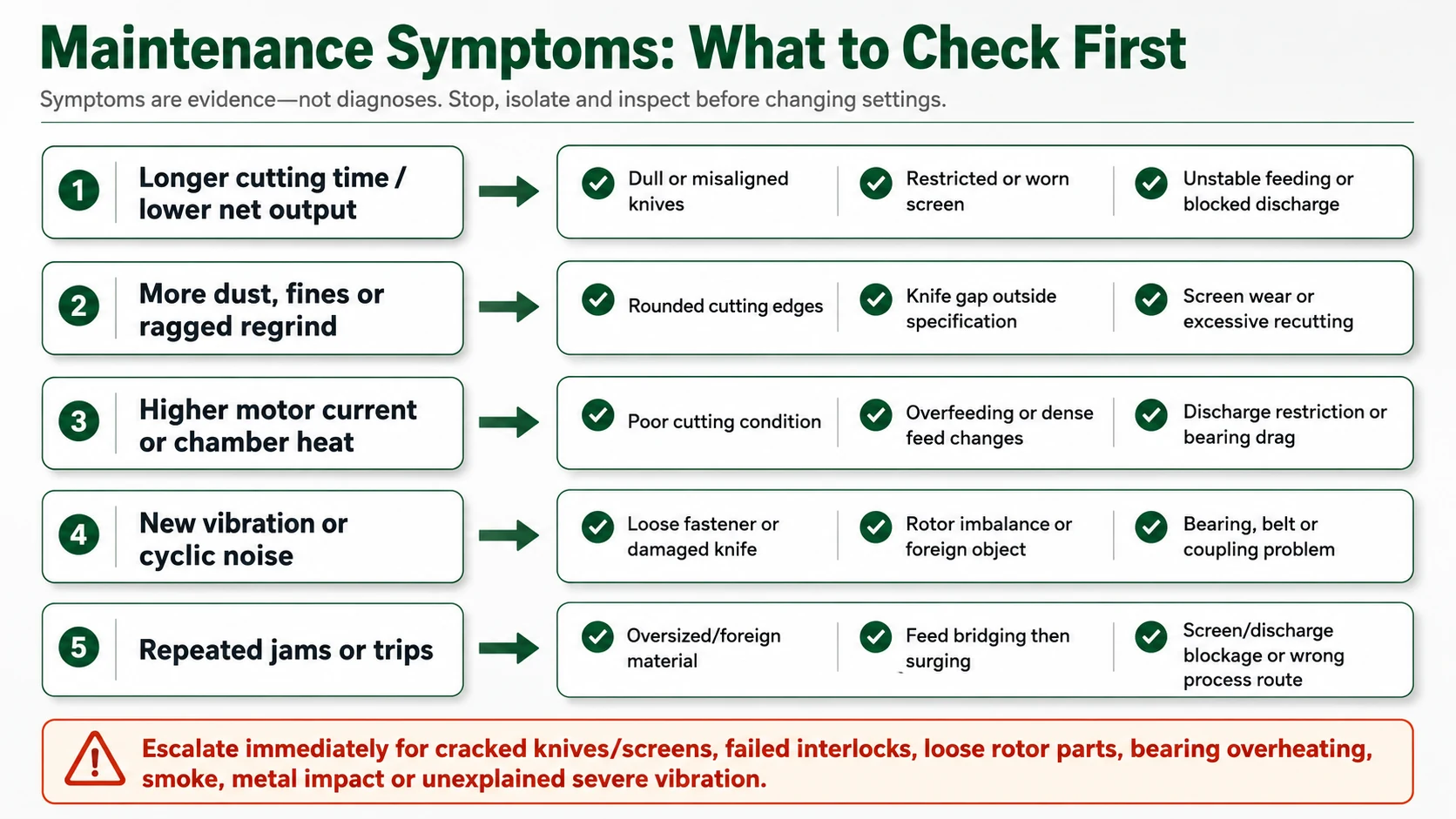
| Symptom | Likely maintenance checks | Do not overlook |
|---|---|---|
| Cutting takes longer | Knife edges, fixed knives, clearance, screen restriction, feed change. | A downstream blower or hose can be the real bottleneck. |
| More fines or dust | Rounded edges, excessive recutting, worn screen, heat and material brittleness. | A smaller or blocked screen may increase residence time. |
| Higher current | Cutting condition, overfeed, dense feed, bearing drag, belt tension, blocked discharge. | Compare the same material and screen before blaming the motor. |
| Vibration or cyclic knock | Loose/damaged knife, foreign object, rotor balance, bearing, pulley or coupling. | Stop immediately for sudden or severe change. |
| Repeated overload or jam | Oversized feed, surging, dull knives, restricted screen/discharge. | The machine may need a pre-shredder rather than more aggressive feeding. |
When feed geometry is the root cause, maintenance alone cannot make a one-stage machine behave like a complete line. The shredder–granulator two-stage system guide explains when coarse pre-reduction and controlled metering are the better engineering answer.
Plan Spares Around Consequence and Lead Time
A spare-parts list should not be a random shelf of expensive components. Rank parts by failure consequence, consumption rate, lead time, storage requirements and whether replacement needs factory support.
Operational wear parts
Approved rotor/fixed knife sets, screens, knife fasteners, belts or coupling elements, seals, infeed flaps and common discharge hoses.
Safety-critical parts
Correct interlock actuators, switches, guard fasteners, emergency-stop components and safety relays as specified for the machine revision.
Long-lead mechanical parts
Bearings, special housings, pulley or coupling components and rotor-related parts identified with the manufacturer.
Documentation and tooling
Keep the tools that make the job repeatable, not improvised: knife-setting fixtures, rotor restraints, torque tools, feeler gauges and suitable lifting devices, together with the current drawings, manuals and inspection forms. On service work, the missing fixture is often the reason a simple adjustment turns into trial and error.
Store knives and screens dry, protected and clearly identified by model and revision. Record sharpening history and remaining grind allowance. A blade that “fits the holes” is not automatically the correct blade.
What a useful service record contains
- Date, running hours, material and screen configuration.
- Reason for work: planned, condition-based, alarm, jam or failure.
- Measurements before and after service.
- Parts removed, parts installed and traceable part numbers.
- Fastener, clearance and lubrication data from the approved instruction.
- Safety-function and no-interference checks.
- Controlled test result, technician and reviewer.
- Next due date, hours or condition trigger.
For model-specific parts, service instructions or project support, contact YUXI with the machine model, serial number, material, photos and observed symptoms.
Plastic Crusher Service Checklist
The table below is designed for adaptation. Add the exact task number, specification and frequency from the supplied manual.
| Frequency / trigger | Inspection or service item | Acceptable condition / specification | Finding and action | Sign-off |
|---|---|---|---|---|
| Every shift | Area, feed contamination, guarding, sound, vibration, discharge and alarms | Baseline condition; no unsafe defect | ||
| Daily | Hopper/flaps, accessible fasteners, leaks, housekeeping, operating trend | Per manual and site standard | ||
| Weekly | Knife condition, screen/cradle, drive, bearing trend, jam history | Per approved dimensions and condition limits | ||
| Monthly / hours | Screen wear, lubrication, belt/coupling, electrical cabinet, foundation | Per component tag and manual | ||
| Condition trigger | Rising amps/heat/noise/vibration, poor regrind, repeated trips | Root cause identified before return to service | ||
| After knife/screen work | Clearance, torque, free rotation, tools removed, guards restored | Controlled restart completed | ||
| Planned outage | Full structural, rotor, bearing, drive, control and safety review | Approved by responsible technician |
Frequently Asked Questions
How often should a plastic crusher be serviced?
There is no universal interval. Use the supplied manual as the minimum framework, then adjust by running hours, feed severity, contamination, knife and screen condition, temperature, vibration, alarms and production trend. Every-shift operator checks and planned technician inspections should work together.
How do I know the knives need sharpening?
Look for rounded or damaged edges and changes in cutting time, current, heat, noise, fines and regrind quality. Confirm the fixed knives, gap, screen and discharge before assuming rotor knives are the only cause.
Can I keep running with a cracked screen?
No. Stop and follow the isolation procedure. A cracked screen can release oversize material, damage nearby parts or fail further. Replace it with the approved screen and investigate the cause.
Should bearings be greased every week?
Only if the machine and bearing instructions specify that interval. Lubricant type, quantity and frequency depend on the bearing, speed, seal, environment and duty. Over-greasing can create heat and seal problems.
Can an operator clear a jam without lockout?
Do not assume so. Unjamming is included in hazardous-energy rules when exposure to unexpected startup or stored energy exists. Follow the machine-specific and site energy-control procedure.
What records are most useful?
Running hours, material, screen, output trend, amps, temperature, vibration/noise observations, alarms, measurements, parts used, knife grind history, lubrication, safety tests and controlled restart results.
What information should I send YUXI for service support?
Send model and serial number, electrical supply, material and screen, running hours, recent maintenance, clear photos or video, alarm history, current/temperature trend, regrind sample and a precise description of when the symptom occurs.
References
- YUXI Machinery, “Plastic Shredder Machine,” current product specifications and application guidance, accessed July 2026.
- ACS Group / Cumberland, T50 Tangential Offset Granulator Manual, preventive-maintenance, knife, screen, lubrication and safe-access instructions.
- Conair Group, “Plastics Granulator Maintenance for Regrinding,” knife, screen and regrind-quality maintenance guidance.
- U.S. Occupational Safety and Health Administration, 29 CFR 1910.147, Control of Hazardous Energy (Lockout/Tagout).
- U.S. Occupational Safety and Health Administration, 29 CFR 1910.212, General Requirements for All Machines.
- UK Health and Safety Executive, “Safe Maintenance,” isolation, stored energy, guard removal and restart guidance.