





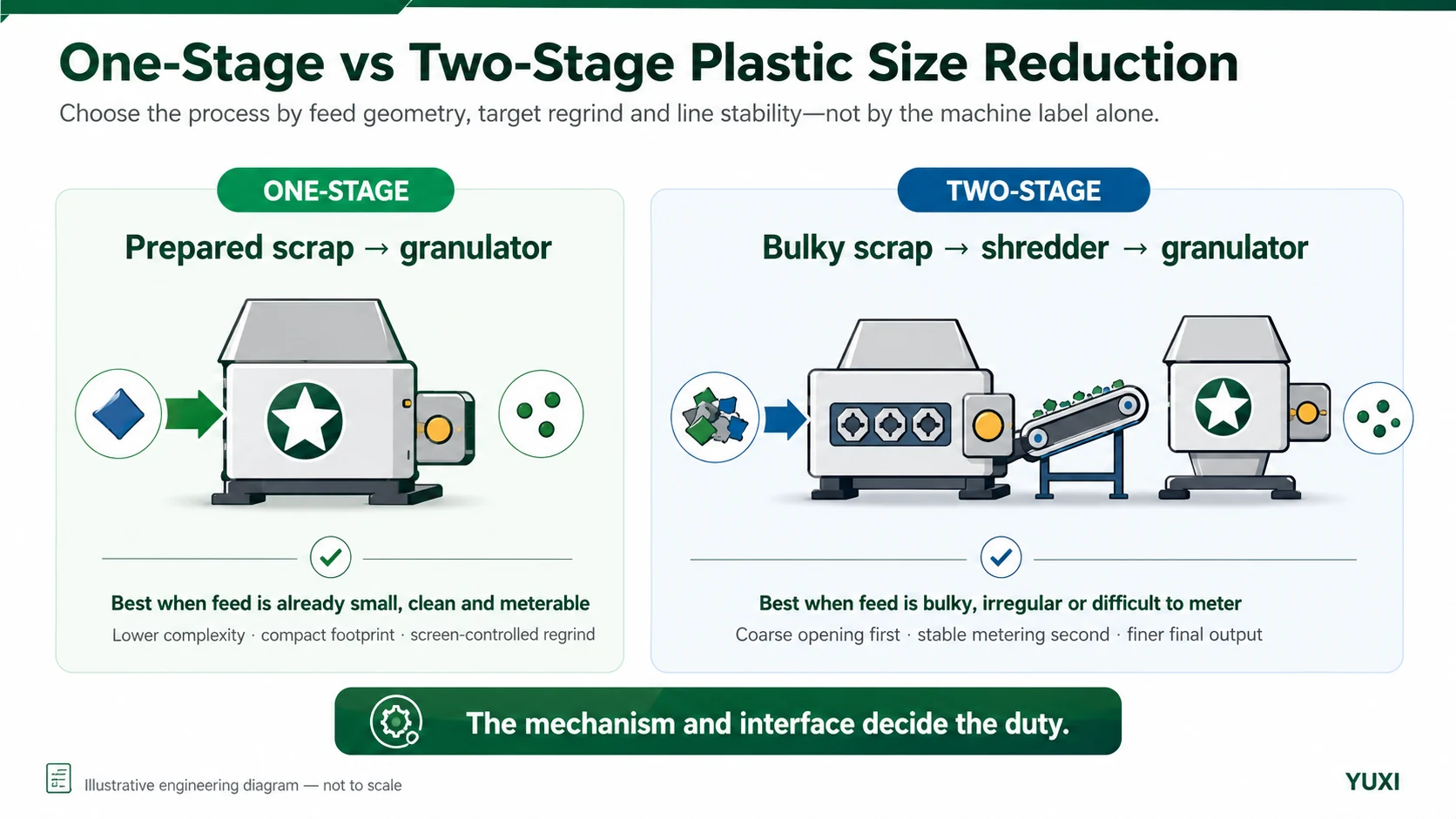
The buyer’s first drawing showed one crusher. The material photos arrived later: nested crates, thick purge blocks, several lengths of pipe and a few bales that had been tied for storage. Technically, all of it was “plastic.” From a feeding point of view, it was four different jobs.
We see this often. A plant starts with a target such as 10 mm regrind and asks whether a large crusher can do everything in one pass. Sometimes it can. Sometimes the same decision creates violent load peaks, manual cutting, knife damage and a line that only performs well during a short demonstration. The important question is not whether one machine can cut the material once. The key is whether the whole process can accept normal feed,prodece the required output,and maintain a stable net rate.
First, Clarify What “Two-Stage” Means
In this article, two-stage means mechanical size reduction in two steps: primary shredding followed by secondary crushing or granulation. It does not mean a two-stage extrusion or “mother-baby” pelletizing line. Search results often mix those two meanings, even though the equipment, process purpose and buyer questions are different.
Primary shredding changes awkward material into a more manageable intermediate feed. The output may still be too coarse or irregular for direct reuse. Secondary granulation then reduces that intermediate material through a faster knife-and-screen process to a smaller, more controlled regrind. WEIMA describes a representative route in which a slow universal shredder pre-reduces plastics to roughly 40–60 mm before a secondary granulator produces material in approximately the 3–15 mm range. Those values are an application example, not a universal specification.
One-stage granulator
Prepared scrap enters a crusher or granulator directly. This is the simplest route when the feed already fits the chamber and the plant needs fine, screen-controlled regrind.
One-stage shredder
A single- or double-shaft shredder may be enough when the objective is volume reduction, opening or a relatively coarse output. It is not automatically a substitute for a granulator.
Two-stage system
A primary shredder accepts difficult feed; a secondary crusher or granulator creates the final regrind. Conveying, buffering, metal protection and controls connect the stages.
This Article Owns the System Decision, Not the Machine Definitions
The broad category difference is already covered in the plastic shredder vs plastic crusher comparison. The plastic crusher working principle explains how rotor knives, fixed knives and a screen create regrind. This guide goes one level higher. It asks how the machines should be arranged, what each stage must deliver to the next one and when adding a shredder improves the total line rather than merely adding equipment.
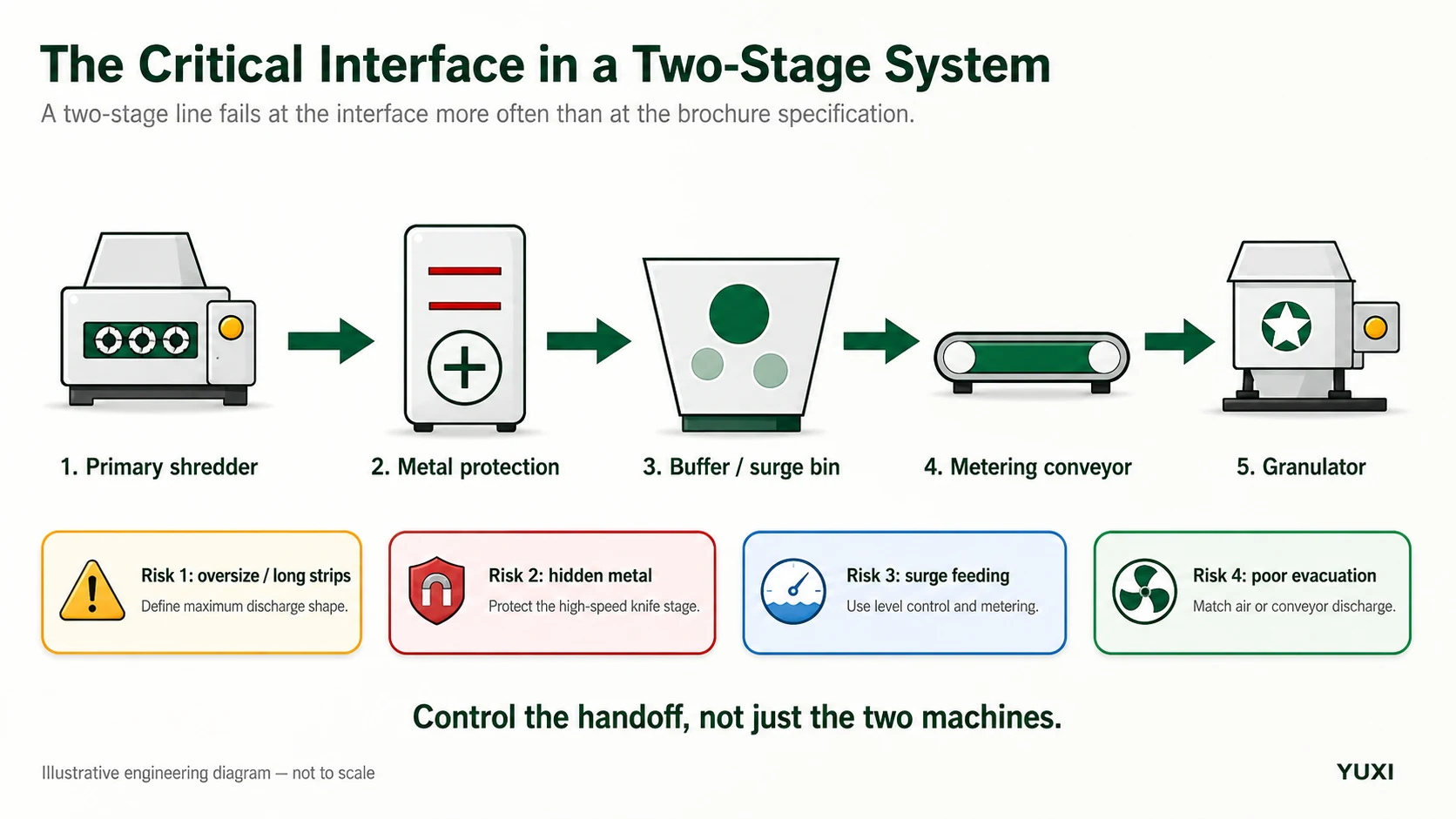
That boundary matters for buyers. A process can contain the “correct” shredder and the “correct” granulator and still run badly because the shredder creates long strips, the conveyor dumps in batches, the metal detector is installed in the wrong place or the air-discharge system cannot remove the final regrind fast enough.
When One-Stage Plastic Size Reduction Is the Better Choice
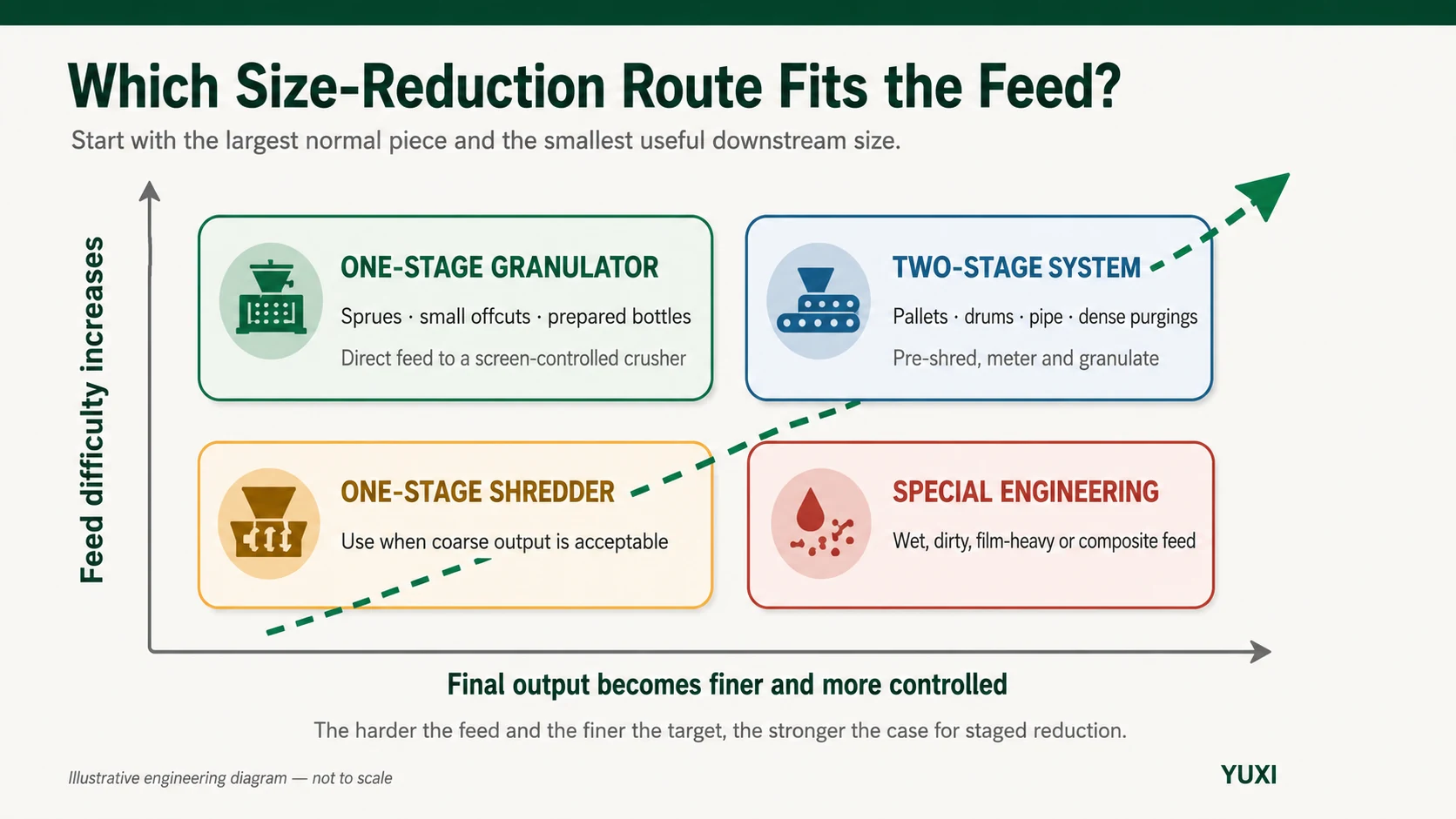
Two-stage systems are useful, but they are not automatically more professional. We normally recommend staying with one stage when the material is already prepared and the extra machine would solve no real operating problem.
The feed enters the granulator without forced preparation
Typical examples include injection-molding runners, small rejected parts, cut bottle scrap, sheet edge trim, pre-cut profiles and clean production offcuts. The important word is not “plastic.” It is prepared. Pieces must fit the hopper, present themselves to the rotor and avoid violent single-piece loading.
The final regrind can be produced without excessive residence time
A crusher screen controls discharge, but forcing large or dense pieces through a small screen can increase repeated cutting, heat and wear. The separate plastic crusher screen size guide explains why the nominal hole is only one part of this behavior. If the direct granulator can make the required output while staying within a stable current and temperature range, a pre-shredder may add little value.
Feed variability is limited
A factory recycling one known product has a different problem from a recycler buying mixed loads. When dimensions, resin, moisture and contamination remain narrow, one-stage equipment is easier to size. The line is shorter, there are fewer transfer points, and cleaning between resin batches may be faster.
The required output is coarse enough for one shredder
One stage does not always mean “granulator only.” A screen-controlled single-shaft shredder can be enough when the downstream process accepts a coarser fraction. A double-shaft shredder can also be enough for rough opening or volume reduction when a narrow particle-size distribution is not required.
When a Shredder–Granulator Two-Stage System Performs Better
The case for two stages becomes stronger when the input geometry and final-output requirement pull the machine in opposite directions. Bulky scrap wants a large hopper, high torque and aggressive feeding. Fine regrind wants sharp knives, controlled clearance, a smaller screen and reliable evacuation. One machine can sometimes compromise between those jobs. Two machines allow each stage to be designed around one dominant duty.
Bulky or awkward material controls the process
Whole pallets, drums, IBC sections, thick pipe, bumper-size molded parts, baled film and dense purgings may fit the polymer list for a granulator but not its practical feed window. A primary shredder reduces the largest dimension, opens hollow shapes and turns batch-loaded waste into pieces that can be conveyed and metered.
The downstream process needs much finer output
Washing, blending, extrusion and pelletizing routes often work better with a controlled feed size. A shredder may make material manageable without making it ready for the next process. ZERMA states that its granulators may run stand-alone or within complete systems that include shredders; its ZCS combination pairs slow, high-torque shredding with a granulator that can use a smaller screen for an immediately reusable product.
The plant needs stable automatic feeding
One export-project discussion changed after the buyer stopped describing capacity as “one ton per hour of PP” and started describing how the material arrived. Half the feed was loose molded scrap. The rest came as nested crates and thick start-up lumps. The crusher could process the first group directly, but the second group caused long gaps followed by heavy current peaks. A pre-shredder and buffer did not simply add cutting capacity; they changed the feed from irregular batches into a controllable stream.
Wear must be moved to the right stage
High-speed granulator knives are not the ideal first contact for every hidden bolt, metal clip or sand-heavy part. Primary shredding followed by magnetic or metal-detection protection can reduce the chance that foreign metal reaches the fine-cutting stage. This does not make the system contamination-proof. It gives the line a better opportunity to identify and remove contamination before the highest-speed knife rotor.
What a Practical Two-Stage Plastic Size-Reduction Line Contains
A two-machine quotation is not yet a two-stage system. The complete route normally includes six functions, even when some are combined mechanically.
- Primary feeding: conveyor, forklift hopper, ram feeder or another method that safely presents bulky material to the shredder.
- Primary shredding: single-shaft or double-shaft reduction selected around the feed geometry, contamination and required intermediate size.
- Foreign-object protection: magnetic separation, metal detection, manual inspection or a combination appropriate to the material.
- Buffering and metering: a surge bin, level-controlled conveyor or screw that decouples the two machines and prevents batch dumping into the granulator.
- Secondary granulation: rotor knives, fixed knives and a screen produce the agreed final regrind.
- Discharge and dust control: gravity, conveyor, blower, cyclone, filter or bagging system removes product as fast as the granulator creates it.
WEIMA’s plastic-box recycling case illustrates this architecture in the field: a single-shaft shredder produced material below 50 mm, an overbelt magnet protected the next stage, and a downstream granulator produced flake below 4 mm. The exact sizes belong to that project. The broader lesson is that the conveyor and metal-protection step were part of the process design, not optional accessories added after commissioning.
The Interface Usually Decides Whether the Line Feels Stable
Intermediate particle size
The granulator supplier should define the largest acceptable normal piece, occasional oversize, troublesome shapes and maximum piece mass. “50 mm output” is not enough when the shredder can still produce a 300 mm long strip that happens to be narrow. Flexible plastics may fold through a screen; thick parts may leave as dense chunks. The specification needs a shape limit, not only one nominal dimension.
Surge and starvation
A shredder often discharges in waves. A granulator performs best with more consistent feeding. Without buffering, the secondary machine alternates between starvation and overload. We have found that a level switch and a variable-speed metering conveyor can be more valuable than increasing either motor size.
Control logic
The line should start from downstream to upstream and stop in the reverse sequence unless the OEM’s risk assessment specifies otherwise. Interlocks should prevent the shredder from continuing to fill a stopped granulator. The PLC should identify which device caused the stop rather than presenting one generic fault. After a trip, the restart sequence must account for material already sitting in the conveyor, buffer and cutting chambers.
Discharge capacity
A granulator can be limited by what happens after the screen. Slow air evacuation, a full cyclone, a blocked filter or a narrow conveyor can hold material inside the chamber and make the machine appear underpowered. The accepted system capacity must therefore be measured at the final product outlet, not only at the shredder discharge.
Separate Machines or an Integrated Shredder–Granulator?
Two-stage reduction does not require two separate foundations. Some manufacturers combine a shredder and granulator in one compact machine. Vecoplan’s VDZ, for example, is described as a two-stage shredder–granulator combination that handles bulky production waste in one housing and removes the transfer conveyor between the two cutting functions. Lindner also presents a compact in-house solution that combines a primary shredder and granulator for production waste and offcuts.
| Design | Advantages | Trade-offs to check |
|---|---|---|
| Separate shredder and granulator | Flexible machine sizing, easier bypass or independent operation, room for magnet and buffer, easier future capacity changes. | More floor space, transfer equipment, guarding, controls and interface responsibility. |
| Integrated two-stage machine | Compact footprint, no external transfer conveyor between stages, one coordinated package. | Less freedom to resize one stage later; maintenance access and single-point downtime require careful review. |
| Granulator only | Lowest process complexity when the feed is prepared. | Can become the feeding bottleneck or absorb unnecessary impact when feed is bulky. |
| Shredder only | Useful for coarse opening, volume reduction or a larger final size. | May not produce the fine, uniform regrind required by washing, blending or extrusion. |
Do not classify an integrated unit as “one-stage” merely because it has one frame or one control panel. Count the material transformations. If it is shredded first and granulated second, it is a two-stage mechanism.
Cost, Power, Wear and Footprint: Avoid the Easy Comparison
A one-stage line usually has lower initial complexity. A two-stage line usually has more motors, conveyors, controls, foundations and wear parts. That does not make either one cheaper over the project life.
| Cost driver | One-stage tendency | Two-stage tendency | What to verify |
|---|---|---|---|
| Capital equipment | Lower when direct granulation is realistic. | Higher due to the first stage and interface equipment. | Complete battery limits, not machine-only price. |
| Installed power | One main cutting machine. | Two cutting machines plus conveying and extraction. | Actual kWh per accepted tonne under representative feed. |
| Knife and screen wear | Granulator sees every feed impact. | Primary stage absorbs coarse duty; fine stage receives prepared feed. | Wear-part cost per tonne and sharpening interval. |
| Labor | Low when feeding is simple; high when manual pre-cutting is needed. | Can reduce manual preparation if the system is automated. | Normal loading, clearing, cleaning and resin-change labor. |
| Footprint | Usually smaller. | Usually larger unless functions are integrated vertically or in one housing. | Maintenance envelope, not only machine outline. |
| Downtime exposure | Fewer components, but one machine performs every duty. | More components; one failed interface can stop the line. | Bypass plan, spare parts and fault recovery. |
WEIMA lists lower wear, lower energy use and more constant output as benefits of its two-stage concept. Those claims are useful as design hypotheses, not universal guarantees. The correct comparison is a representative test that measures accepted output, total energy, normal interventions and wear under the same material and final-size requirement.
Material-Based Route Matrix
The polymer name alone is not enough. The broader plastic crusher materials guide explains the difference between resin compatibility and feedability. For system design, product form usually decides the first stage.
| Feed form | Likely starting route | Why | Critical test point |
|---|---|---|---|
| Clean runners and small molded rejects | One-stage granulator | Prepared, consistent production scrap can often enter directly. | Longest runner, batch loading and screen release. |
| Cut PET or HDPE bottles | One-stage granulator or wet granulation route | Hollow feed is manageable when size and moisture are controlled. | Nesting, residual liquid, labels and evacuation. |
| Whole crates, drums and pallets | Shredder + granulator | Large hollow geometry makes direct feeding unstable. | Hopper bite, intermediate size and anti-bounce control. |
| Long or large-diameter pipe | Purpose-built shredder + granulator | Length, wall thickness and spring force exceed normal granulator feeding. | Maximum diameter, wall, length and piece mass. |
| Dense purgings and start-up lumps | Heavy shredder + granulator, or purpose-built combination | High impact and mass per piece can overload a fine-cutting rotor. | Largest mass, temperature, fillers and hidden metal. |
| Loose film and woven bags | Case-specific: force feeding, shredding, agglomeration or granulation | Soft material can bridge, flutter and wrap even when it is easy to cut. | Bale form, moisture, dirt, anti-wrapping and sustained feed density. |
| Dirty post-consumer rigid plastic | Pre-shred + protection + washing / wet granulation | Contamination and moisture may dominate wear and process choice. | Metal, sand, glass, washing position and reject plan. |
Where the YUXI YX-G Range Fits
The current YUXI plastic size-reduction product page lists six YX-G models with a 560 rpm rotor, rotating and fixed knives, and 10–12 mm screens. Motor power spans 7.5–37 kW, cutting chambers span 270 × 400 mm to 480 × 1,000 mm, and the published reference output range is 300–1,600 kg/h.
Those published characteristics place the YX-G range closer to a high-speed plastic crusher or granulator stage than to a conventional slow, high-torque primary shredder. In a one-stage project, the feed therefore needs to be prepared enough to enter the chamber steadily. In a two-stage project, the YX-G machine is logically the secondary sizing unit after a suitable pre-shredder, metal-protection step and metering conveyor.
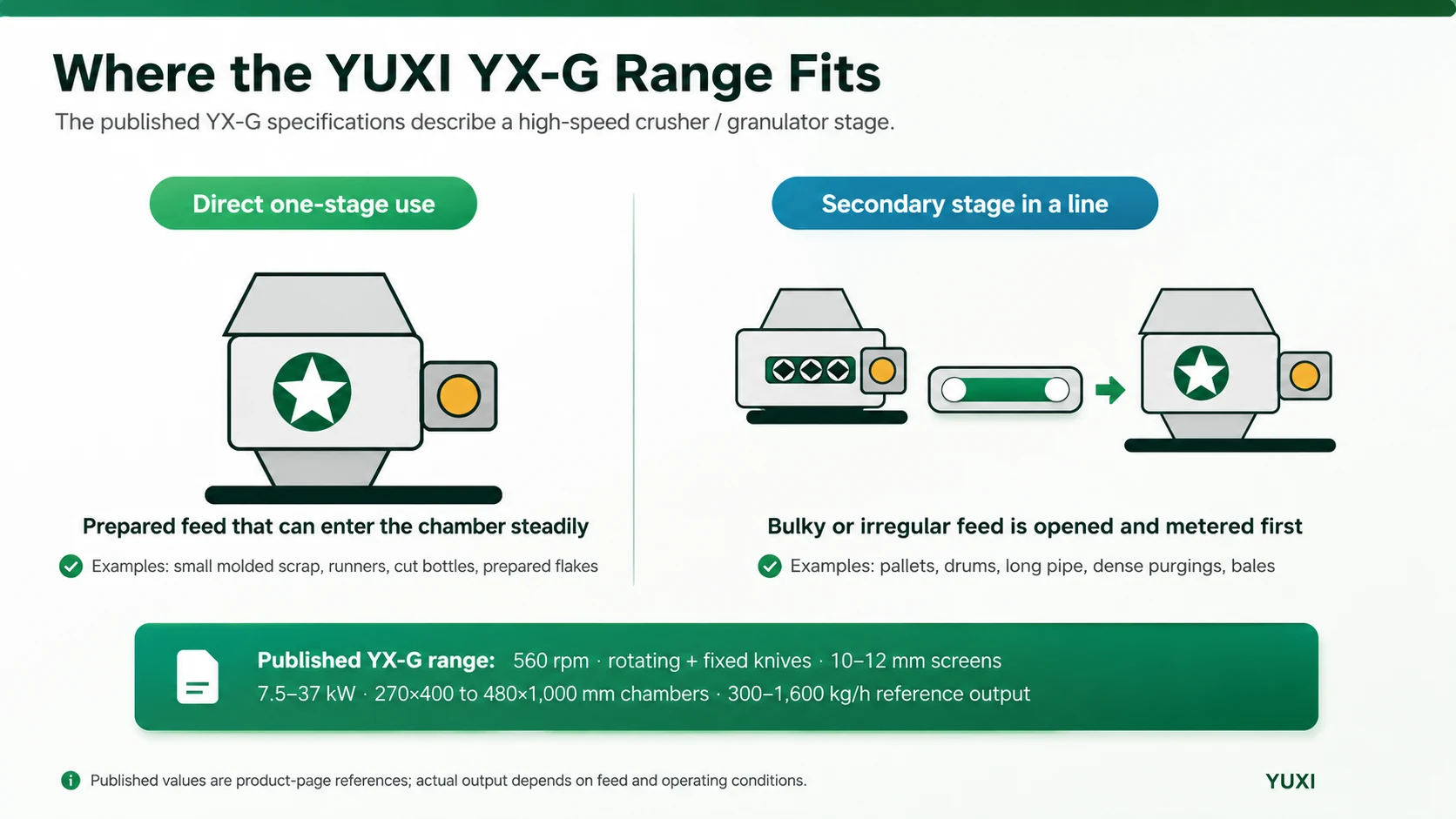
The output range should not be read as a line guarantee. YUXI states that actual output depends on plastic type, bulk density, moisture, contamination, blade condition, screen size and feeding stability. A two-stage line adds more variables: primary-shredder discharge, conveyor control, magnet performance, buffer level, secondary-machine load and final evacuation.
For larger drums, pallets, long pipe or dense lumps, YUXI should first confirm whether the proposed upstream machine is a single-shaft shredder, a double-shaft shredder or another purpose-built primary reducer. The correct answer depends on the material’s normal and maximum form, not only the target granulator model.
How to Test a One-Stage or Two-Stage System Before Acceptance
A short cutting video proves that the machine rotates and the material can be reduced. It does not prove sustained production. A useful factory acceptance test should reproduce the material mix, feed method, screen, discharge route and operating sequence proposed for the site.
- Define the test batch. Record resin, product forms, maximum dimensions, piece mass, moisture, contamination and proportions by mass. Do not replace a mixed stream with the easiest sample.
- Use the proposed screens and knives. A test with a larger screen or different knife configuration cannot validate the final quotation.
- Run long enough to reach steady behavior. The agreed test should include normal feeding, buffer cycling, current variation, product discharge and routine clearing rather than only the first few minutes.
- Measure each stage. Record shredder output, intermediate oversize, buffer level behavior, granulator accepted output, fines, energy, bearing temperature and stoppage time.
- Test the controls. Stop the granulator and confirm upstream feeding stops safely. Simulate a full buffer, conveyor trip and metal-detector event. Confirm alarms identify the cause.
- Inspect all outlets. Check final regrind, oversize, dust and rejected metal. A clean product photo is incomplete if the reject and loss streams are not reviewed.
- Agree the acceptance formula. Net capacity should be based on accepted final product over total elapsed production time, with the agreed normal interruptions counted consistently.
The existing plastic crusher capacity guide covers kg/h test logic in more detail. For this system-level test, the key addition is to record the interaction between the two stages rather than reporting only the faster machine.
Common Buying Mistakes We Would Avoid
Buying the largest granulator instead of solving the feed problem
A bigger chamber and motor can help, but they do not automatically make whole pallets, long pipe or dense purgings meterable. Sometimes the correct upgrade is a smaller, well-fed secondary granulator behind a primary shredder.
Specifying only average intermediate size
The granulator is often stopped by the longest strip or heaviest chunk, not the average piece. Specify maximum geometry and an allowed oversize percentage.
Matching nameplate capacities
A 1,000 kg/h shredder and a 1,000 kg/h granulator do not automatically form a 1,000 kg/h line. The values may use different materials, screens and test periods. The buffer and metering system must also manage short-term differences.
Skipping metal protection because the feed is “plastic”
Post-industrial scrap can still contain bolts, inserts, tools, clips and conveyor fragments. Post-consumer feed adds more uncertainty. The line should define where metal is detected or removed and what happens after a detection event.
Ignoring cleaning and resin change
Two stages create more surfaces that retain color, resin and fines. For in-house recycling, cleaning time may matter as much as maximum capacity. Access doors, screen handling, conveyor cleanout and dust-system emptying should be reviewed during layout approval.
Safety, Guarding and Noise Are System Questions
Plastic granulators contain high-speed heavy knives and a screen-controlled cutting chamber. WorkSafe’s plastics-granulator guidance identifies contact with knives, ejected material, noise and access to moving parts among the hazards that require guarding and safe procedures. A two-stage line adds conveyors, pinch points, stored material, hydraulic pushers and automatic restart logic.
Maintenance, jam clearing, knife work and screen changes require control of hazardous energy. OSHA’s 29 CFR 1910.147 covers servicing and maintenance where unexpected energization, startup or release of stored energy could cause injury.[2] The line risk assessment should cover electrical, mechanical, hydraulic, pneumatic and gravitational energy across the complete system, not only the machine being opened.
Noise also changes with the route. The UK HSE identifies granulators and other size-reduction machinery as high-noise activities and lists measures such as remote or conveyor feeding, separate rooms, enclosure, damping and cutter or speed choices.[1] A pre-shredder may reduce violent granulator impacts, but the complete installed system still needs a site-specific noise assessment.
Define the Feed Before Choosing the Number of Stages
Send material photos, largest normal and occasional pieces, wall thickness or piece mass, bale form, contamination, target final regrind, net capacity, daily hours, upstream preparation, downstream equipment, voltage and layout limits. YUXI can then confirm whether direct YX-G granulation is realistic or whether the project needs a primary shredder and controlled transfer system.
Discuss a Plastic Size-Reduction LineShredder Granulator Two-Stage System FAQ
Is a two-stage plastic size-reduction system always better?
No. It is better when the first stage solves a real feed, impact or metering problem and the second stage is needed for finer regrind. Clean, prepared production scrap may be handled more economically by one granulator.
What is the difference between a shredder and a granulator in a two-stage line?
The shredder performs coarse opening and makes bulky material manageable. The granulator uses a faster knife-and-screen process to produce smaller, more controlled regrind.
Can a double-shaft shredder feed a plastic granulator?
Yes, provided the shredder discharge meets the granulator’s maximum size and shape limits and the line includes suitable metal protection, buffering and metering. Rough double-shaft output may contain long strips, so testing is important.
Can I add a shredder in front of an existing granulator later?
Often yes, but the retrofit must review conveyor height, buffer volume, controls, metal detection, floor loading, guarding, dust extraction and whether the existing granulator can accept the new intermediate feed.
Does one machine housing mean the process is one-stage?
No. An integrated shredder–granulator can perform two sequential reduction functions inside one machine package. The number of stages describes the material transformations, not the number of frames.
Where does the YUXI YX-G series fit?
The published 560 rpm rotor, rotating and fixed knives, and 10–12 mm screens place the YX-G range in the crusher / granulator role. It can operate directly on prepared feed or as the secondary stage after suitable pre-shredding.
What should be guaranteed in a two-stage line quotation?
Define representative feed, normal and maximum dimensions, final accepted product, net system capacity, test duration, screens, energy measurement, allowed oversize, contamination limits, control logic, line battery limits and the treatment of downtime.