Aluminum Wheels & Cast Scrap: Shredder vs Crusher Selection
How to Choose Between a Shredder and Crusher for Aluminum Scrap
Scrap aluminum wheels and cast housings look simple on a yard floor: dense pieces, easy to recognize, easy to load. The machine decision is less simple. A whole wheel with weights and valve hardware, a gearbox housing with a steel bearing still inside it, and a box of clean broken castings can all be sold under a broad “cast aluminum” description. They do not create the same load in a shredder or crusher.
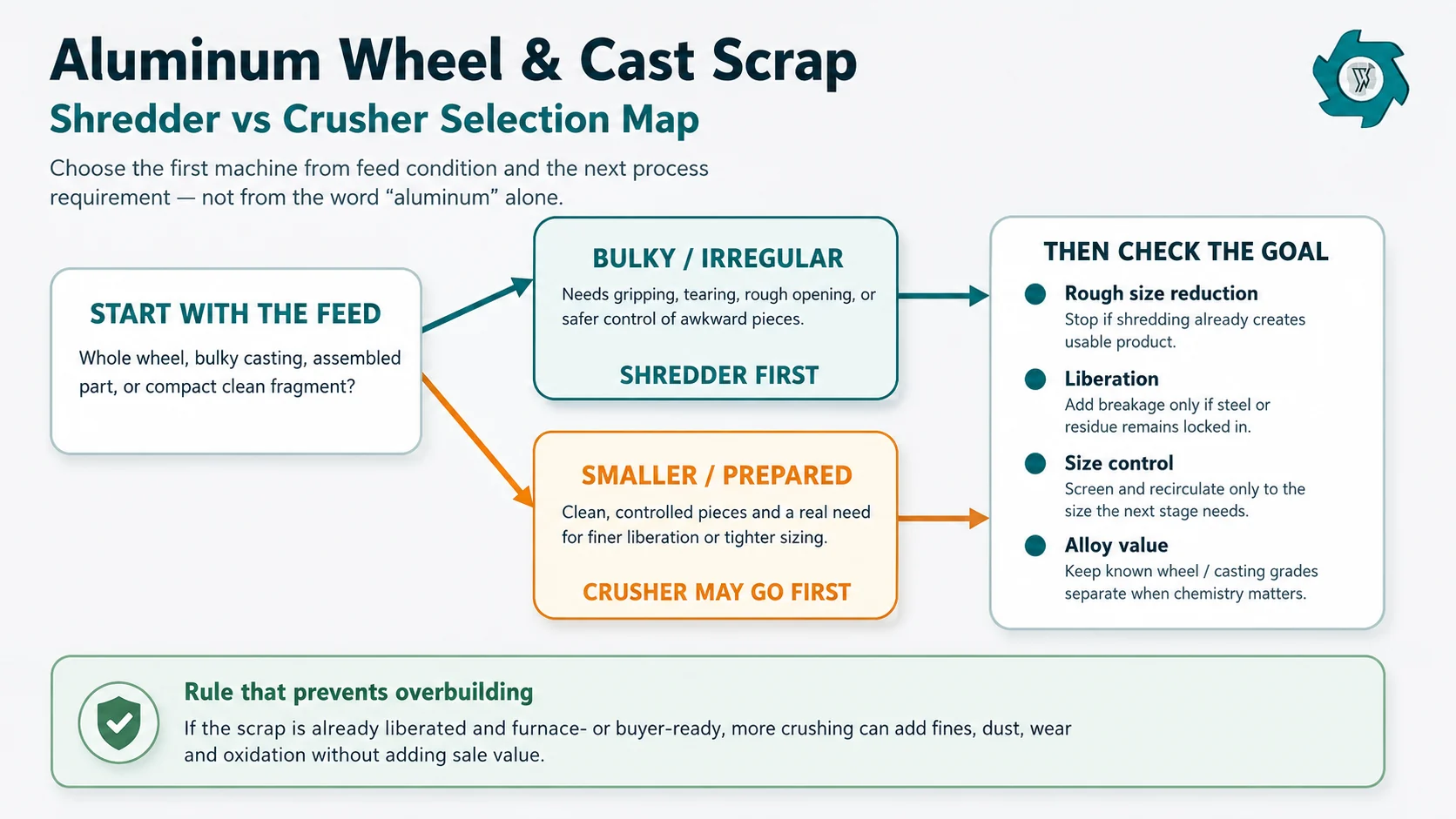
Start with feed geometry and the required downstream product. A shredder and a crusher solve different parts of the same size-reduction problem.
Choose by the first job the machine must do
Selection rule: When the feed material is large, irregularly shaped, or difficult to handle, a low-speed shredder is usually the first choice for rough size reduction. Once the material is already small enough to enter the equipment smoothly and the process requires finer crushing, better separation, or tighter particle size control, a crusher or hammer mill is often a better option.
That sounds obvious, but equipment quotations often blur the boundary. “Aluminum wheel crusher,” “cast aluminum shredder” and “metal crusher” are used loosely in the market. The machine name matters less than the mechanism, feed envelope and discharge duty.
Why aluminum wheels and castings are not one feed category
Cast aluminum is a metallurgy label and a trade category, not a complete machine specification. Automotive wheels are commonly produced from cast Al-Si-Mg alloys; published wheel studies frequently use A356 or AlSi7Mg-type compositions as reference materials.[1]
The geometry is the first difference. A wheel has a wide circular rim, spokes and a thick hub area. It may roll or bridge differently on a conveyor, yet once it reaches a cutting chamber it presents a fairly compact, dense load. A cast transmission housing or engine casing is less predictable. Thin ribs can break quickly while thick bosses, bearing seats and embedded hardware create short high-load events.
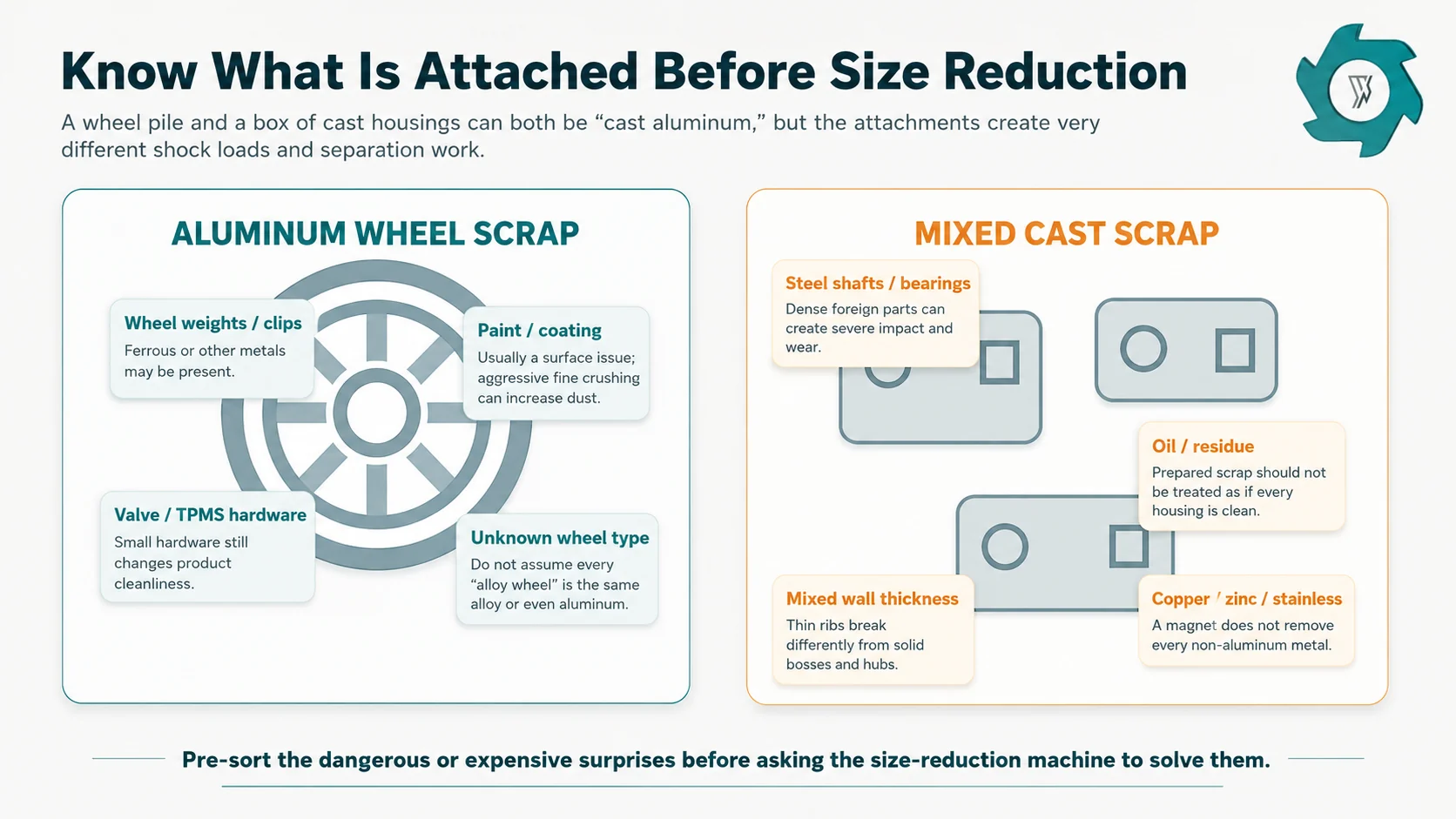
Then there are attachments. Wheel weights, valves and tire-pressure hardware may remain. Cast automotive housings can arrive with bearings, steel inserts, shafts, fasteners, oil residue, rubber mounts or copper-bearing components. A simple magnet is useful later, but it cannot protect the first machine from a dense steel shaft that should have been removed before feeding.
The attachment map matters as much as the aluminum itself. Pre-sorting a few dense foreign parts can save more downtime than increasing motor power.
There is also an alloy-value question. If a recycler receives a known wheel stream separately, blending it immediately into general mixed aluminum may give away some of that segregation value. The Aluminum Association notes the importance of recycled aluminum as feedstock for both wrought and cast products, while end-of-life automotive studies treat different scrap fractions separately rather than as one universal aluminum stream.[2][3]
So before machine selection, define the feed in plain terms: whole bare wheels, damaged wheels, wheel pieces, dismantled housings, mixed engine castings, or a combination. Add the largest dimensions, piece mass if unusually heavy, and the foreign material that actually remains.
Shredder vs crusher: the operating difference that matters
Selection point
Low-speed shredder
Impact crusher / hammer mill stage
Main job
Grip, open and roughly reduce bulky or irregular pieces.
Break material further for liberation, finer sizing or downstream separation.
Feed tolerance
Usually better for awkward geometry when the cutter and chamber are correctly configured.
Usually expects a more controlled feed envelope and benefits from pre-sizing when pieces are too large or inconsistent.
Discharge
Rougher and less uniform; strongly influenced by cutter geometry and material behavior.
Generally smaller, with size controlled by machine design, grate/screen arrangement and recirculation where used.
Shock / impact behavior
High torque and lower speed help with controlled tearing, but dense foreign steel still creates severe load.
Repeated impact can liberate attachments effectively, but unsuitable hard inclusions can accelerate wear or damage.
Fines and dust
Normally lower than aggressive high-speed fine crushing for the same coarse duty.
Higher risk of fines and dust as reduction becomes more aggressive.
Best place in line
Front end when feed must first be made manageable.
Secondary or final reduction when smaller size creates a real separation or handling benefit.
For a broader discussion of this primary-shredding role in metal projects, see the site’s guide to a double shaft shredder for metal recycling. The important point here is narrower: a shredder does not need to beat a crusher at making small pieces. Its value may be that it turns unreliable whole-piece feeding into a controlled stream that the next machine can accept.
When a shredder should go first
A shredder-led route makes the most sense when the front-end problem is ingestion rather than final particle size. Whole wheels are a good example. Their diameter and dense hub region can be perfectly manageable for a correctly sized machine, but forcing oversized or irregular wheels directly into a crusher throat that was designed around smaller feed can turn every load into an operator intervention.
The same is true for bulky cast housings. If the feed includes large gearbox cases, irregular hollow castings or pieces that arrive in mixed orientations, a low-speed stage can shorten and open them before impact crushing.
A shredder is especially worth reviewing when:
the largest normal piece is close to, or larger than, the crusher’s reliable feed opening;
wheels and housings arrive mixed with awkward shapes that do not self-feed consistently;
the project needs rough volume reduction before manual or magnetic inspection;
the downstream crusher works better on pre-sized feed than on whole articles;
automatic reverse and controlled low-speed bite are useful for occasional overload events.
When direct crushing makes more sense
Direct crushing can be the simpler route when the material is already prepared: smaller wheel sections, clean cast gates and runners, broken housings, or compact pieces that enter the crusher steadily.
A massive pre-shredder may look safer on paper, but if the incoming cast scrap is already within the crusher’s feed envelope, it adds another drive, conveyor interface, wear system and maintenance point. That cost only makes sense if the first stage solves a measured problem.
Direct crusher selection should still be conservative. Feed size is only one variable. Wall thickness, alloy condition, steel attachments, moisture or residue, and the required discharge all affect load.
When a two-stage shredder + crusher route earns its cost
The two-stage route is useful when the project has two different problems. Stage one must stabilize a difficult feed. Stage two must improve liberation or produce a smaller controlled fraction. Trying to make one machine solve both duties can lead to compromise: the shredder is forced to make material finer than it does efficiently, or the crusher is forced to accept pieces that are too bulky and irregular for stable feeding.
A common two-stage logic is:
The exact order is not fixed. Sometimes an early magnet after shredding is valuable because it removes liberated ferrous parts before they reach the high-speed stage. In another feed, crushing must happen before enough steel is exposed for efficient magnetic removal.
Steel attachments: liberation comes before magnetic separation
Magnetic separation is straightforward only after the steel is physically free. A magnet cannot pull a steel insert out of a casting if aluminum still locks the two materials together. This is the real reason some cast scrap needs more breakage.
Look at both product streams during testing. If the clean aluminum pile looks good but the ferrous fraction carries attached aluminum, the line is losing value. If the reject stream contains large aluminum-rich pieces, more liberation or a different size range may be needed. On the other hand, if the output is already clean and the rejects show little metal loss, another crushing pass can simply create more fines.
Do not confuse ferrous removal with complete alloy sorting. A magnet does not remove copper, zinc or stainless steel, and it does not separate A356-type wheel scrap from every other aluminum casting alloy. Where chemistry affects the furnace recipe or selling price, incoming segregation, handheld verification, sensor sorting or controlled blending is a separate decision.
Smaller output is not automatically better aluminum scrap
Fine output looks controlled in a product photo. In a real plant it carries trade-offs. Every extra reduction step consumes wear life and creates more fresh surface area. The process can also generate more fines and airborne dust, especially as impact intensity increases.
For aluminum, that dust issue deserves specific attention. OSHA identifies aluminum among combustible metal dusts and notes that finely divided material can become explosible when dispersed in air under the right conditions.[4] The U.S. Chemical Safety Board has documented fatal aluminum-dust incidents, including one at a cast aluminum wheel plant.[5] These sources are not saying every wheel crusher is inherently unsafe. They are a reminder that “make it finer” changes the hazard picture and therefore changes housekeeping, extraction and explosion-protection requirements.
In practical selection, define the minimum reduction needed for the next step. If a magnet can remove liberated steel at a coarse size and the furnace accepts that size, there may be no reason to chase a much finer particle. If an eddy-current or sensor sorter requires a narrower presentation range, screening and controlled secondary reduction may be justified. The downstream specification should set the stop point.
Throughput, wear and operating consequences
It is tempting to compare a shredder and crusher by motor power or brochure tons per hour. That comparison is weak. A crusher may process prepared cast fragments very quickly but spend far more time dealing with whole irregular pieces. A shredder may accept the whole pieces steadily yet produce a discharge that still needs a second stage.
Daily output is the product of the entire line. Loading, reversals, manual picking, magnet cleaning, screen recirculation, dust-system stops and product-bin changes all count.
Wear also follows the worst recurring item, not the average aluminum content. Dense steel bearings, shafts or hard inserts can dominate cutter and hammer life. Painted, dirty castings may add abrasive contamination. Very fine targets increase the number of impacts and the time material remains in the reduction zone.
Installed power is not the same as measured kWh per accepted ton. A two-stage system has more installed drives, but it may run more smoothly if the first stage prevents repeated crusher stalls. The only defensible comparison is a representative test with total line energy and accepted output measured over the same boundary.
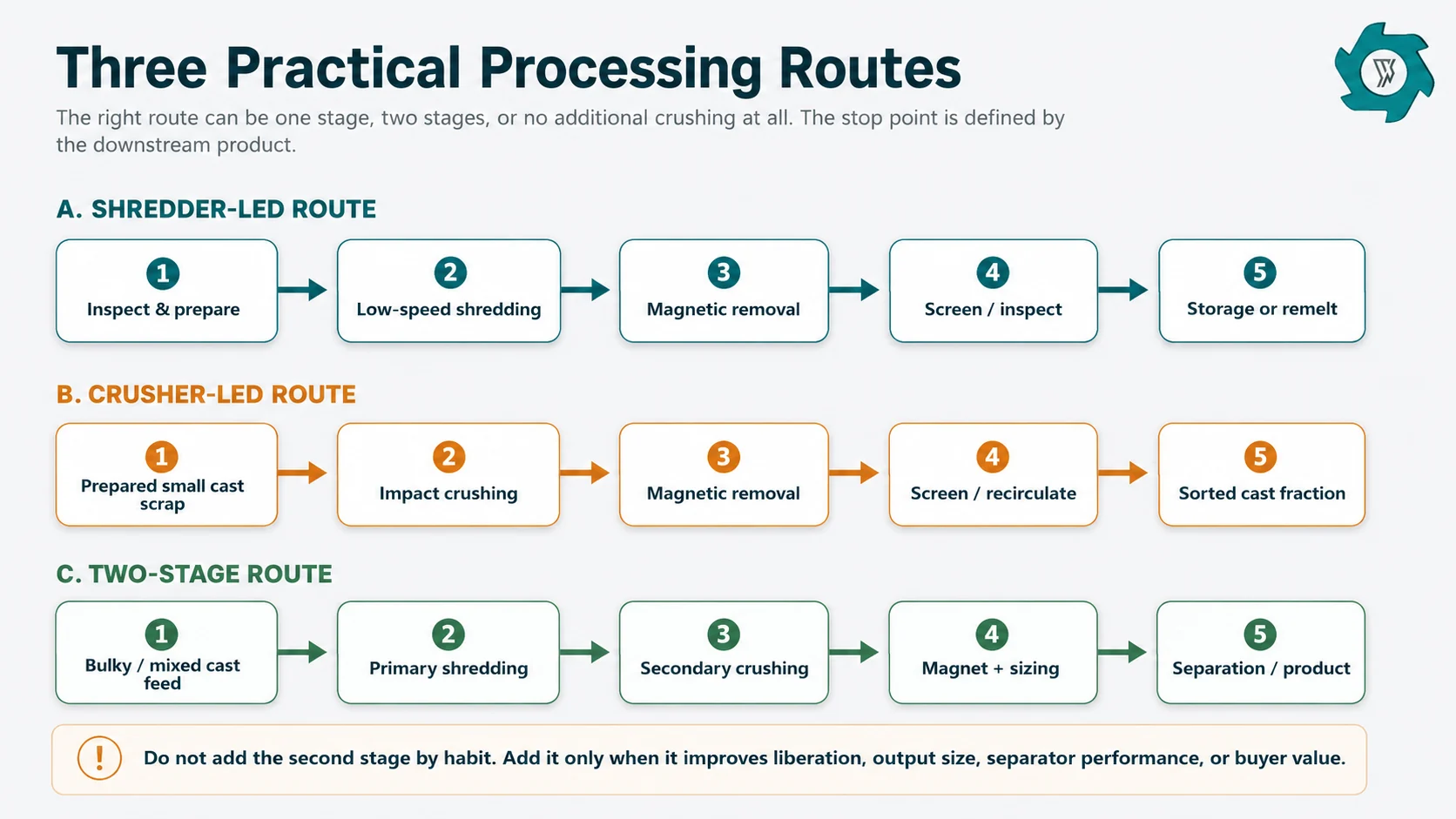
Three practical process routes
One-stage and two-stage routes can all be correct. The useful stop point is where the feed is sufficiently liberated and sized for the next step.
Route A: whole wheels or bulky castings → shredder-led
Use this when whole-piece feeding is the main challenge. Inspect and remove obvious dense foreign items, shred to a manageable size, then use magnetic separation and screening as required.
Route B: prepared cast fragments → crusher-led
Use this when the incoming scrap is already small enough and the target is better liberation or a tighter size range. The crusher takes the main reduction duty, followed by magnetic removal and sizing. This route avoids a primary shredder that would not materially improve the feed.
Route C: large mixed cast feed → shredder + crusher
Use this when large pieces must first be opened, but the downstream process still needs finer liberation. A magnet between stages is often worth testing. Removing liberated steel before the impact crusher can reduce unnecessary wear, but the best position depends on how quickly the attachments separate.
How to test the selection before you buy
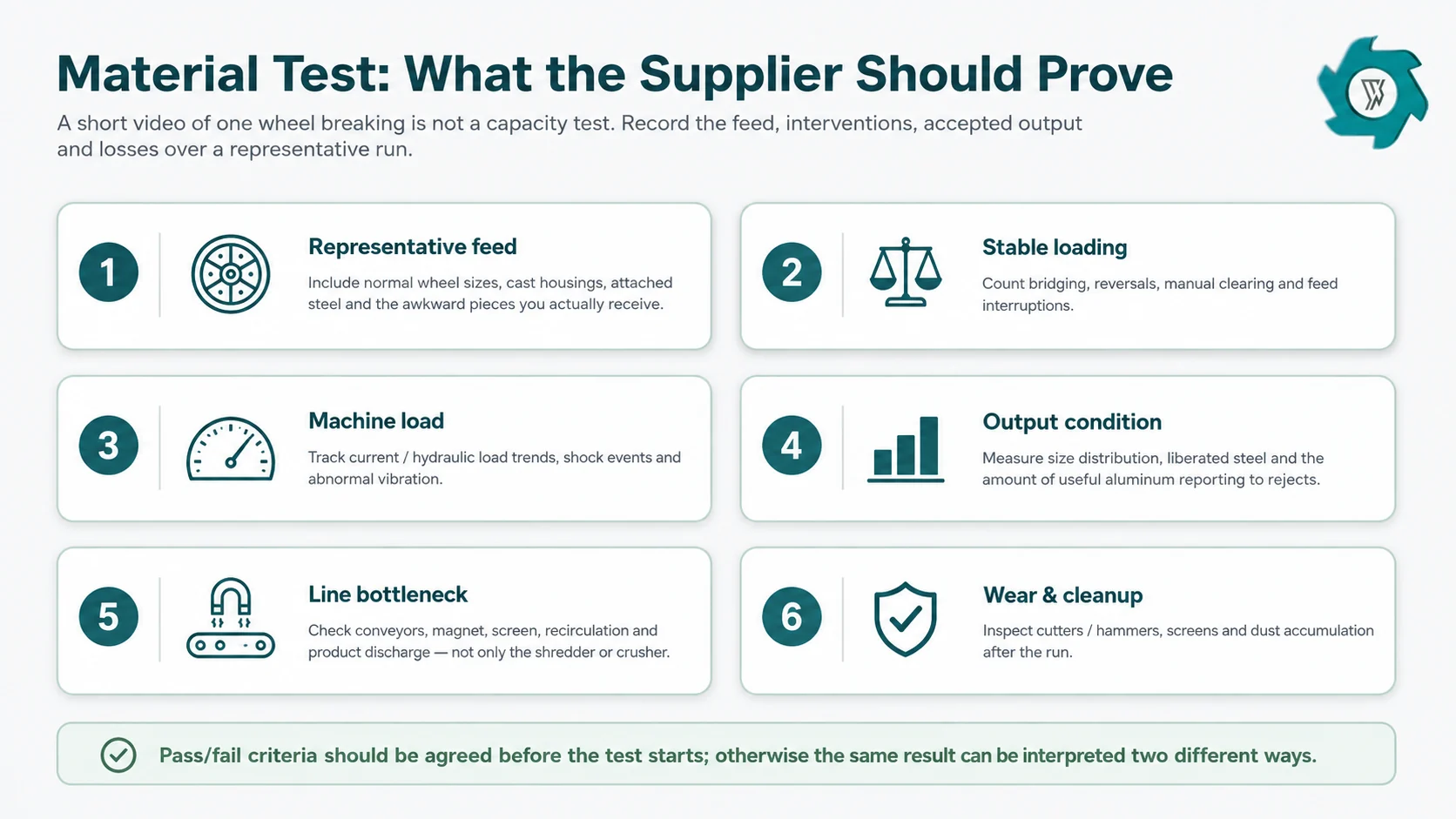
Do not ask a supplier only, “Can your machine crush an aluminum wheel?” Almost any successful demonstration video can answer that. The useful question is whether the proposed line can process your normal wheel and casting mix for a meaningful period without hidden intervention, while producing the output your next step needs.
Build the test batch from normal production material. Include the common wheel sizes, several heavy castings, and the attachments that really arrive. If the supplier only tests clean, hand-selected pieces, you are testing the marketing sample rather than the project.
A useful test measures feeding, load, output, metal losses and downstream bottlenecks. One successful bite is not a capacity result.
During the run, record total feed mass, elapsed time, normal stops, reversals, manual clearing and material rejected before the machine.
Then sample the outputs. Weigh the aluminum product, ferrous fraction and residue. Look for aluminum attached to removed steel and for valuable metal lost in rejects. Measure the particle-size range if downstream sorting depends on it. A line should be accepted on the combined result, not on the appearance of one clean handful.
Dust and safety boundary for cast aluminum size reduction
Primary safety starts before the machine. Unknown sealed components, pressurized items, residual fluids and complete undismantled assemblies need a receiving rule.
Where high-speed crushing creates aluminum fines, the dust system must be designed around the actual material and local requirements. OSHA’s combustible-dust guidance specifically includes aluminum and magnesium among metal dusts of concern.[4]
Fine aluminum and water also require specialist review in some dust-handling contexts. The safe design depends on particle characteristics and collection method.
Five buying mistakes that make the wrong machine look right
1. Comparing machine names instead of mechanisms
Two suppliers can both write “wheel crusher” on a quotation while proposing completely different reduction principles. Ask for the rotor/cutter mechanism, normal speed range, feed opening, overload logic and how discharge size is controlled.
2. Using the cleanest sample as the design feed
The line is usually controlled by recurring difficult pieces. Include the dirty, assembled or heavy end of the normal mix in the test.
3. Treating a magnet as a substitute for dismantling
A magnet works after liberation. A complete steel shaft that should have been removed before feeding can damage the reduction stage long before the separator sees it.
4. Chasing a fine discharge without a downstream reason
Smaller particles can help separation, but they can also raise wear, recirculation and dust. Specify the downstream requirement first.
5. Accepting a capacity figure without a test boundary
Ask whether capacity is measured at machine feed, machine discharge, screened product or saleable aluminum output.
What to send for a serious shredder vs crusher recommendation
clear photos and short videos of the normal incoming scrap;
largest wheel diameter and width, plus representative cast-part dimensions;
piece mass for unusually heavy castings;
whether tires, hubs, bearings, shafts, valves, wheel weights or other hardware remain;
estimated aluminum, ferrous and non-metal proportions if known;
required sustained net throughput and daily operating hours;
target product size and what the material goes to next;
whether alloy segregation must be preserved;
available feeding method, power supply, floor space and dust-control constraints.
For factory acceptance, agree the feed batch, test duration, measurement points, allowed interventions, output specification and pass/fail criteria before the machine runs.
Need a Wheel & Cast Scrap Line Review?
Send representative wheel and casting photos, the largest pieces, attached steel or non-metal contamination, required net capacity and target output. The process review can then decide whether the project needs a shredder, a crusher, both stages, or less equipment than the original RFQ assumed.
Aluminum Wheel & Cast Scrap FAQ
Is a shredder or crusher better for scrap aluminum wheels?
Neither is automatically better. Whole or bulky wheels often favor a low-speed shredder when the first job is controlled gripping and rough size reduction. A crusher is more useful when the feed is already prepared and the project needs finer breakage or better liberation. The final choice should be tested on representative scrap.
Can aluminum wheels go directly into a crusher?
They can in some projects if the crusher is designed for the feed dimensions, density and attachments, and if the incoming wheels are prepared to the supplier’s stated limits. Some mixed assemblies, large tires, or heavy and complicated parts may need to be prepared first before entering the next processing stage.
When do I need both a shredder and a crusher?
First, oversized or irregular feed should be handled by the primary size-reduction stage. The second stage is then used when the process requires better liberation, more consistent sizing, or cleaner sorting results. However, if the first crushing stage already produces a product with market value, an additional crushing stage may not be necessary.
Will magnetic separation remove all contamination from cast aluminum scrap?
No. A magnet removes ferrous material after it has been liberated. Copper, zinc, stainless steel, rubber, plastics, coatings and different aluminum alloys need separate controls where they matter to the product specification.
Why not crush aluminum as fine as possible?
Finer is not automatically better. Extra crushing can increase wear, dust, fines, surface oxidation and recirculation. Stop reducing size when the material is sufficiently liberated and fits the next sorting, handling or remelting step.
What should I send before asking for a machine recommendation?
Send representative photos or video, normal and maximum piece dimensions, whether tires or assemblies remain, estimated steel and non-metal attachments, required net throughput, target output, downstream process, operating hours, power supply and workshop constraints.
David focuses on industrial shredding and recycling equipment,including material evaluation,shredder selection,process configuration,and recycling line planning.
Speak To Our Shredder Machine Expert
Get in touch with our nice team today to get a price estimate for a shredder machine.

 English



 Fast Delivery
 Reliable
 Certified
 Experienced