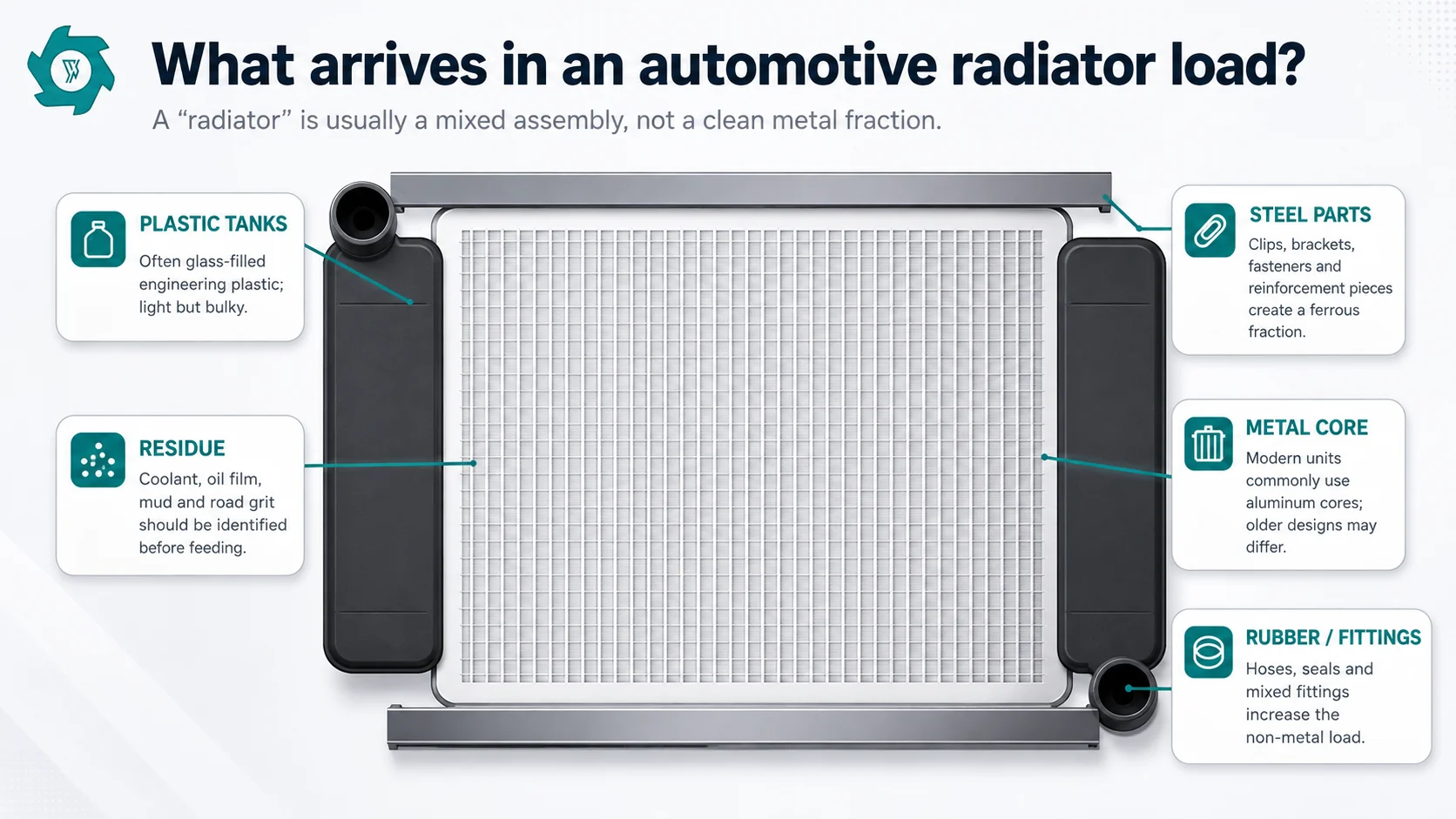
Automotive radiator recycling becomes difficult at the point where a buyer stops thinking about “radiators” as one material. A modern car radiator may arrive with an aluminum core, plastic side tanks, steel clips and brackets, rubber seals, hose stubs, transmission-cooler fittings, dirt and traces of coolant. Older units can bring a different metal mix again. That makes the feed much less predictable than clean, pre-cut air-conditioner coils.
Automotive radiators are mixed assemblies before they are scrap grades
DENSO lists plastic-tank radiators with aluminum or copper cores among its common radiator constructions. In the scrap yard, that construction matters because the tank, core, fasteners and attached fittings do not behave the same way once size reduction starts. A radiator with its side tanks and brackets still attached is therefore a very different feed from a clean ACR section.For equipment selection, treat the radiator as a small mixed-material assembly. The metal core may be the valuable part, but the attachments determine how the line must be protected and separated.Scrap buyers also use “dirty radiator” as a commercial description. The details vary by yard, but steel, plastic and other foreign material are typical reasons for a downgrade.
Decision pointBefore choosing a machine, separate the question “Can the line physically take this radiator?” from “Can the line produce the fraction my buyer accepts?” A wide feed opening can solve the first problem while leaving the second untouched.
Start with drainage, not with the shredder
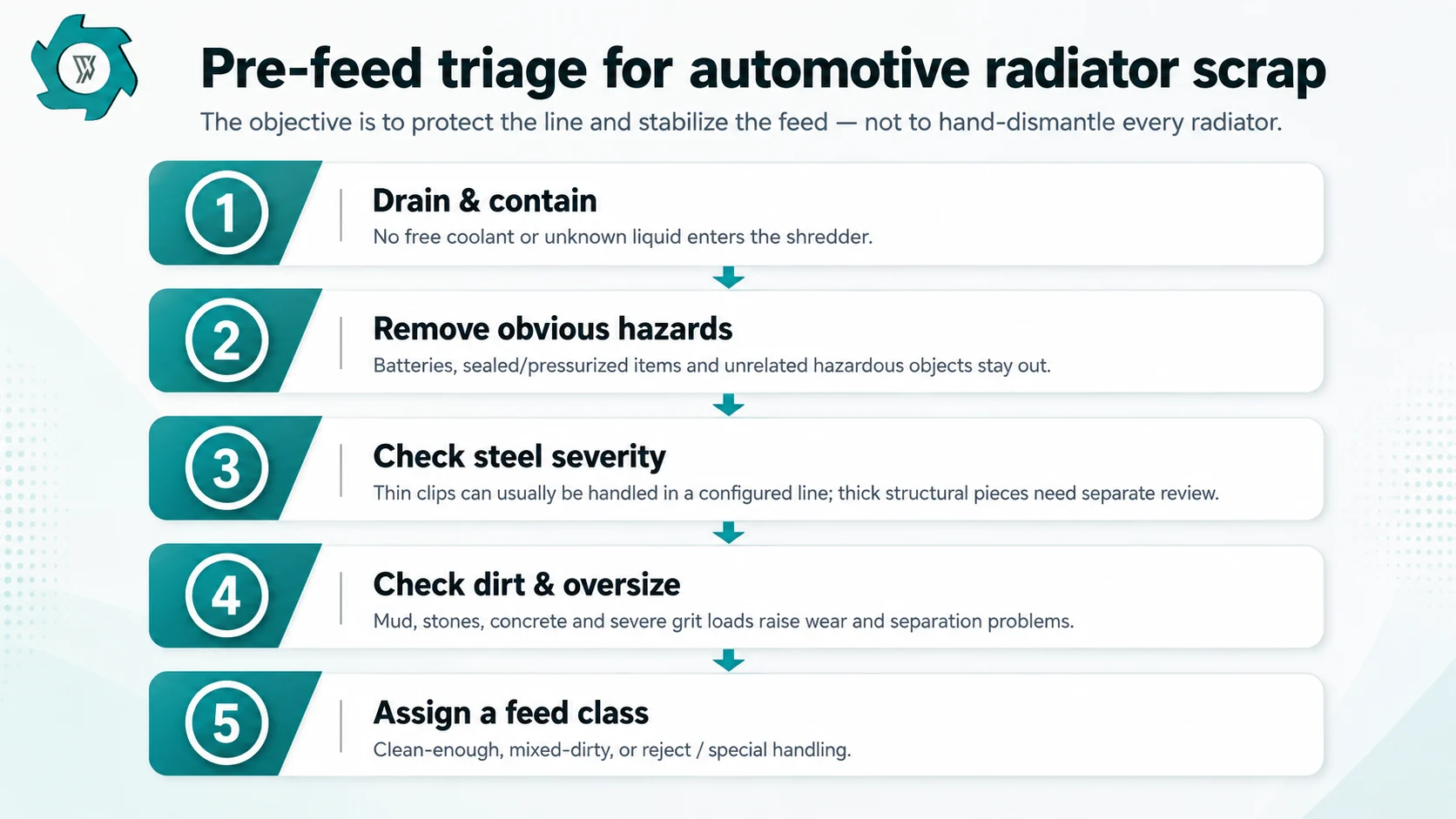
The first preparation step is simple: free liquid should not be treated as normal shredder feed. The copper aluminum radiator recycling line page already lists residual coolant, oil and free liquid among the materials to remove before feeding. That is not just a housekeeping preference. Liquid changes storage, makes dirt adhere to the core, contaminates fines, and creates a separate waste-management problem that the metal line is not designed to solve.Used antifreeze deserves its own container and its own procedure. Massachusetts DEP notes that used antifreeze commonly contains ethylene glycol and can pick up regulated contaminants during service. The U.S. EPA likewise advises keeping used antifreeze separate from other wastes and characterizing or recycling it according to the applicable rules. Requirements vary by state and country, so the plant’s environmental procedure should be checked locally rather than copied from a generic metal-scrap SOP.A short receiving inspection removes the material that should never be used to test a normal radiator recycling line.When free coolant is excluded at receiving, an operator can distinguish “dirty metal feed” from “wet waste.” That makes later troubleshooting much easier. If the gravity or air-separation section suddenly becomes unstable, the team can look at particle size and feed mix rather than wondering whether a wet batch changed the behavior of the light fraction.
Plastic tanks: remove them only when the economics justify it
Modern replacement radiators commonly use plastic tanks with an aluminum core; one Duralast specification, for example, identifies a PA66 glass-filled plastic tank and an aluminum core. From a recycling standpoint, that plastic is bulky and low in metal value, but it does not automatically mean every tank must be cut off by hand.For a complete crushing and separation line, leaving the plastic tanks attached can make sense when labor is expensive, incoming volume is high, and the downstream route has enough non-metal separation capacity. Primary shredding opens the assembly, the metal stages recover ferrous and non-ferrous fractions, and the plastic reports mainly to the light or non-metal stream. The tradeoff is that the plant must move, crush and separate more material for the same amount of recoverable metal.Manual removal becomes more attractive when the incoming units are easy to dismantle, the plant is small, plastic content is unusually high, or the output buyer pays a clear premium for a cleaner prepared feed. It can also be useful when the downstream equipment was originally designed for flatter ACR sections rather than whole automotive radiators.
Plastic-tank condition
Likely approach
Why
Tanks intact, normal passenger-car radiators, high throughput
Often leave attached for a configured complete line
Avoids a labor bottleneck; plastic is separated downstream.
Large fan shrouds and extra plastic assemblies still attached
Remove obvious bulky extras
Reduces low-value volume and prevents the line from being sized around non-radiator plastic.
Small batch with cheap manual labor and a clean-feed premium
Consider manual tank removal
Upgrading before shredding may be economically rational.
Separator designed for clean, flat ACR sections
Pre-dismantle or change the process route
Feed preparation has to match the machine’s actual acceptance window.
Sometimes the wrong cost is optimized. A buyer sees ten minutes of manual dismantling as “free” because it happens before the production line, then compares machines only by electrical power. In reality, that labor is part of the process. The better comparison is cost per ton of saleable metal after all dismantling, feeding, wear, sorting and rework are included.
Steel frames and brackets need two different decisions
“Steel” is too broad to be a useful feed description. Thin clips, screws and crimped edges are normal attachments. A heavy truck-radiator support frame or an unrelated structural member is another matter. The line should not be quoted as if those two objects create the same load.The normal route is to let the primary shredder open the radiator, then remove liberated ferrous pieces magnetically. The pillar process follows that logic: after shredding and crushing, magnetic separation removes steel frames, screws, clips and other ferrous parts. This is exactly where a complete line has an advantage over a narrow stripping machine: it has a planned destination for the iron fraction.But magnetic separation downstream does not make every steel object acceptable upstream. The receiving rule should still exclude unusually thick brackets, solid steel blocks, construction debris and other pieces outside the agreed feed envelope. If the difficult objects are part of the normal business rather than rare mistakes, they should be shown to the supplier and included in the material test.For primary size reduction, the useful selection questions are chamber opening, cutter geometry, shaft strength, protection logic and how the radiator enters the cut. A general guide to choosing a double-shaft shredder is relevant here because radiator duty is determined by actual shape and attachments, not by the word “metal.”
Dirty feed is mostly a consistency problem
Mud, road grit, oily residue, rubber hoses, fan shrouds and unrelated dismantling leftovers do not all damage the line in the same way. Grit is abrasive. Rubber and soft plastics change the light fraction. Oil or sticky residue makes fines cling together. Large unrelated objects create shock loads. The common effect is inconsistency: one tonne no longer behaves like the next.This is why a single contamination percentage can be misleading. Two loads might both be described as “15% impurities,” yet one contains mostly plastic tanks and the other contains mud, steel and hoses. Their wear pattern, magnetic load and separator response will be different.
A feed-class system is more useful than a single cleanliness number
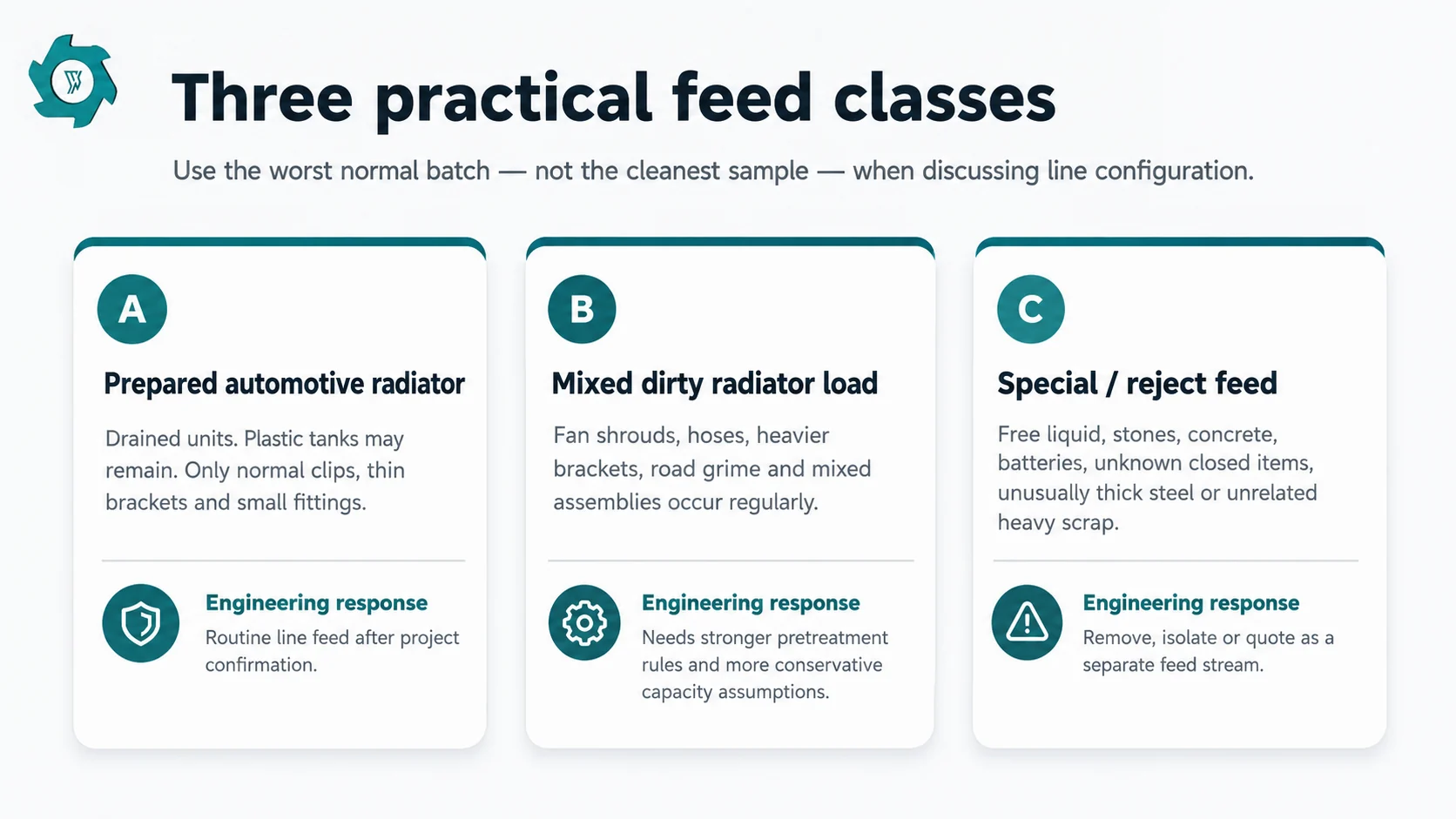
Feed classes help purchasing, production and the equipment supplier use the same language when discussing “dirty” radiators.A simple three-class system works well during project discussions. Class A is drained automotive radiators with normal tanks, clips and fittings. Class B is the mixed dirty load that the plant expects to see regularly: extra hoses, fan shrouds, heavier brackets, dirt and inconsistent shapes. Class C is material that needs separate handling—free liquid, stones, concrete, batteries, unknown closed objects, unusually thick steel or unrelated heavy scrap.
How dirty automotive feed changes the process route
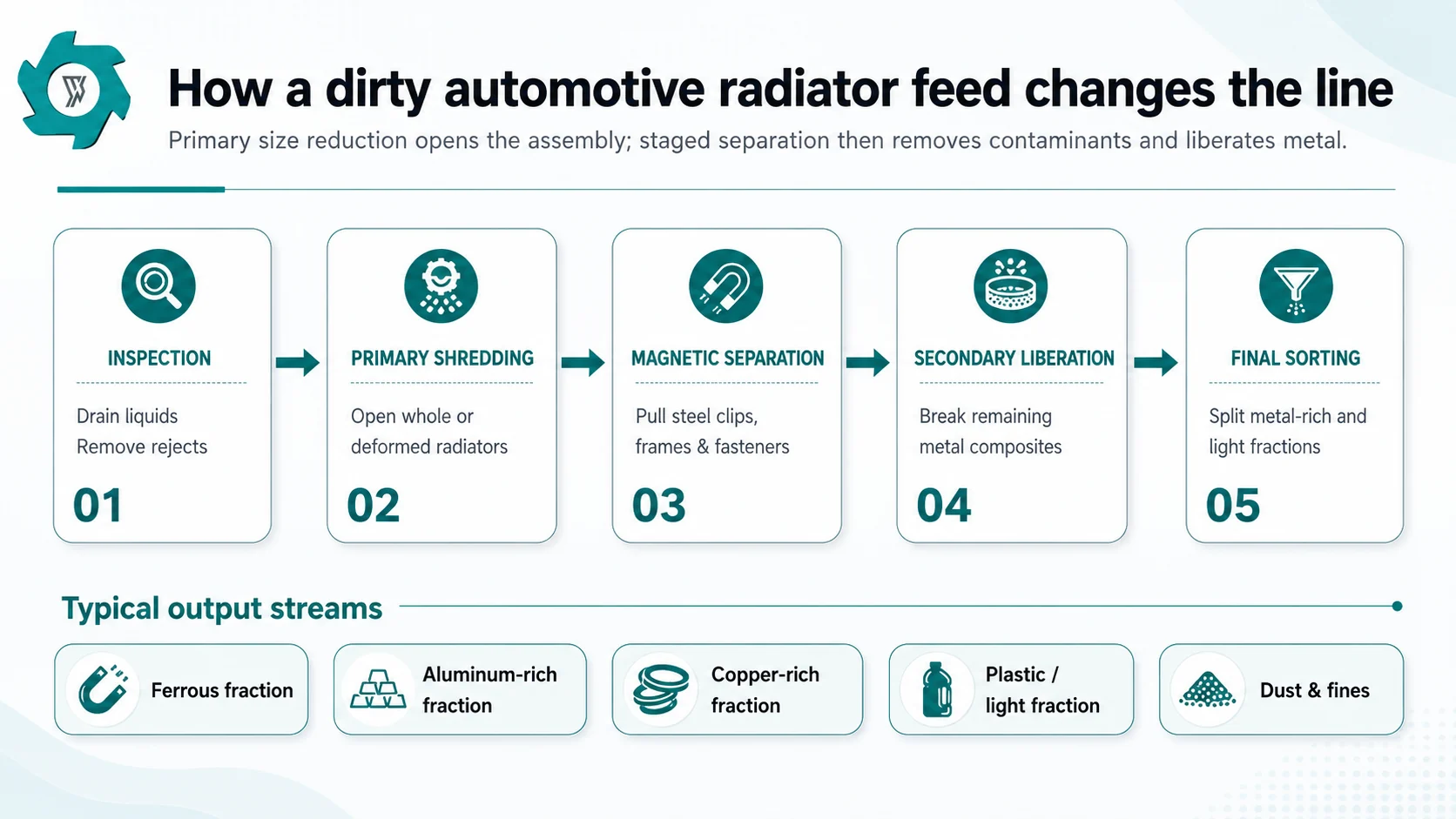
A complete automotive radiator line is a staged system because no single separator can solve the whole feed. The typical logic is: inspection and drainage, primary size reduction, magnetic removal of ferrous pieces, further liberation where metals remain attached, then final non-ferrous and light-fraction separation.Dirty feed does not require “more crushing” everywhere. It requires each contaminant to be released early enough for the next separator to remove it.The sequencing matters. If a steel bracket is still locked into a large composite piece, the magnet has less opportunity to remove it cleanly. If plastic remains tightly trapped with metal, the light fraction carries value away. If copper and aluminum are still bonded after the first reduction stage, final purity stalls even though the particles look small. Good line design therefore works backward from what each separator needs to see.
Primary shredding: open the assembly
The first shredder should make the radiator easier to convey and separate. It does not need to turn everything into fine particles. Over-reducing early can create more fines, increase wear and mix light contamination through the metal stream before the large unwanted pieces have been removed.
Magnetic separation: remove ferrous material as soon as it is liberated
Steel clips, frame pieces and screws should leave the process before they become a recurring load on later non-ferrous separation. A stable magnetic fraction is also a useful process signal: if the iron stream suddenly becomes much heavier, the incoming radiator mix changed even if the weighbridge total did not.
Secondary liberation: only where attached metals still need it
Copper-aluminum composites or stubborn metal-plastic pieces may need a second crushing stage. The reason is liberation, not simply smaller output. A smaller particle that still contains two materials is not yet a clean product.
Why nameplate tons per hour can mislead on car radiators
Automotive radiators are awkward capacity material because they are light for their volume. Add plastic tanks and fan shrouds and the conveyor can look full while the weighbridge rate remains modest. Add heavy steel attachments and the mass rises, but that does not mean the useful non-ferrous output rose with it.For this reason, a serious quotation should separate at least three numbers: gross feed rate, sustained operating rate on the agreed radiator mix, and expected mass split to the main output fractions. Those numbers do not need to be guaranteed before testing, but the supplier and buyer should at least use the same definitions.
Capacity question
What to clarify
Why it matters
“How many tons per hour?”
Gross feed or saleable metal output?
Dirty feed can add weight and volume without adding target metal.
“Can it take whole radiators?”
Passenger car, truck, stacked bundles or loose units?
Feed shape changes gripping and chamber loading.
“What impurity level is acceptable?”
Plastic, steel, rubber, grit or liquid?
Different contaminants stress different stages.
“Is manual sorting required?”
Routine preparation or only reject removal?
Labor should be included in process cost.
A practical RFQ for automotive radiator recycling
Machine suppliers can do more with ten good feed photos than with a long spreadsheet of generic specifications. The RFQ should show the easy material and the troublesome material. A short phone video of a loader picking up a normal batch is especially useful because it reveals bulk density, deformation and the amount of attached plastic better than a close-up photo.
Material-test ruleDo not send only the cleanest sample. A useful test contains the difficult but normal feed. If the plant receives a predictable “bad batch” every week, include it.
Common mistakes when buying for automotive radiator scrap
Buying a clean-coil machine for whole car radiators. A separator designed around flat, uniform ACR pieces can perform well in its intended job and still be the wrong answer for plastic-tank automotive radiators.Calling every ferrous attachment “steel contamination.” This hides the difference between normal fasteners and structural pieces that change the duty of the primary shredder.Leaving drainage outside the line specification. If the quote begins at the feed conveyor but the real plant still needs a coolant-management area, the installed process is incomplete.Using one capacity figure for clean and dirty feed. The line may process both, but sustained net output and wear will not be identical.Assuming more crushing always improves purity. Liberation matters. Excess reduction can simply create fines and move the separation problem downstream.
Choose the feed rule before you choose the machine
The most reliable automotive radiator projects start with a receiving standard. Define what arrives drained, which tanks and normal brackets may remain, what level of grime is acceptable, which heavy objects are rejected, and what the final buyer calls a saleable fraction. Once that is clear, the equipment route becomes much easier to defend.For prepared car radiators, a complete line can often handle plastic tanks and normal ferrous attachments without turning dismantling into a full manual operation. For heavily mixed loads, the plant may need a stronger primary stage, stricter reject removal and more conservative capacity assumptions. And for wet or hazardous material, the answer is not a bigger shredder. It is separate handling before size reduction.
Automotive Radiator Recycling FAQ
Do plastic radiator tanks need to be removed before recycling?
Not always. In a complete crushing and separation line, plastic tanks may remain on many drained automotive radiators if the system is configured for that feed. Manual removal becomes more useful when plastic is excessive, the downstream separation route is narrow, or the buyer is trying to upgrade material before sale.
Can steel frames and brackets go through a radiator recycling line?
Normal clips, screws and light brackets can be handled by a correctly configured line and removed as a ferrous fraction after size reduction. Unusually thick structural steel, heavy reinforcement and unrelated solid steel should be reviewed or removed before feeding.
What makes an automotive radiator load “dirty”?
In scrap trading, a radiator is usually considered “dirty” when materials like steel, plastic, rubber, fittings, or other residue are still attached. But grading rules are not exactly the same from one buyer to another. In practice, it is better to check the buyer’s receiving standard rather than assume there is one definition that applies everywhere.
Should used coolant be drained before shredding radiators?
Yes. Free coolant and other liquids should be drained, contained and managed separately before radiators enter mechanical size reduction. Used antifreeze can require specific storage, recycling and waste-characterization practices depending on jurisdiction and contamination.
Why does dirty feed reduce real radiator recycling capacity?
Dirty feed increases non-metal volume, produces more ferrous and light fractions, can raise wear from grit, and may require slower or more cautious feeding. Nameplate capacity therefore matters less than sustained throughput on representative automotive radiator scrap.
What should be sent to a supplier before choosing the line?
Send representative photos and videos, the largest normal radiator, the worst normal batch, approximate levels of plastic and ferrous attachments, evidence of coolant or oil residue, loading method, required sustained throughput and the target saleable fractions.
Send the Feed That Actually Causes Problems
Share photos of your clean batch and your dirtiest normal automotive radiators. YUXI can review plastic content, ferrous attachments, feed size and target fractions before recommending the shredding and separation route.
David focuses on industrial shredding and recycling equipment,including material evaluation,shredder selection,process configuration,and recycling line planning.
Speak To Our Shredder Machine Expert
Get in touch with our nice team today to get a price estimate for a shredder machine.

 English



 Fast Delivery
 Reliable
 Certified
 Experienced