Radiator Fin Crushing Machine: Better Cu-Al Liberation
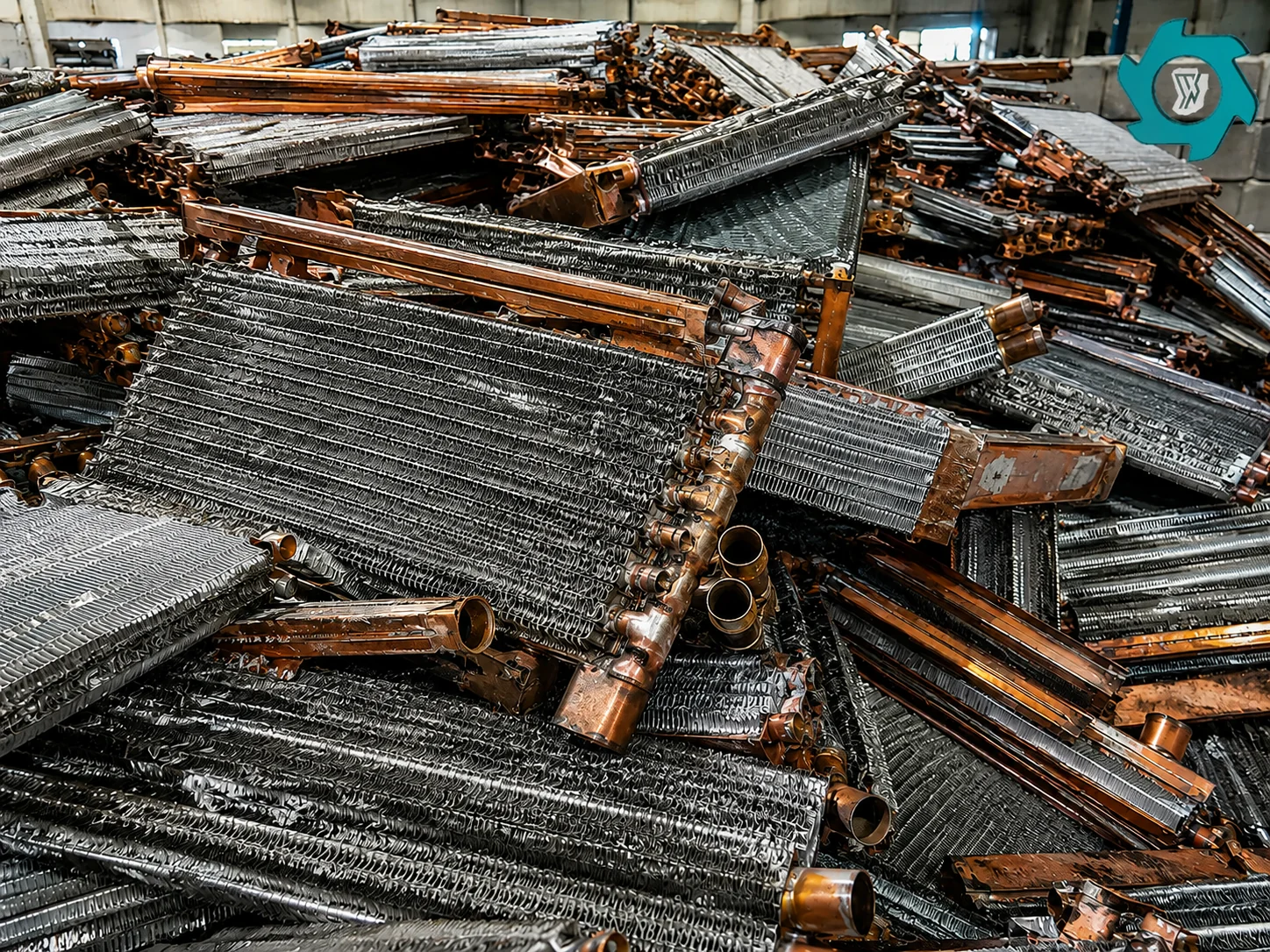
A radiator fin crushing machine earns its place in a recycling line when the first size-reduction stage has made the scrap smaller, but not truly separable. Copper tubes can still leave the crusher carrying folded aluminum fins; flat aluminum can wrap around copper; and a gravity separator may be asked to sort particles that are physically still one piece. At that point the problem is not separator adjustment. It is incomplete liberation. Copper-aluminum radiator cores are mechanically simple to recognize but difficult to separate while fins and tubes remain attached. The crusher must break those attachments before density-based sorting can do useful work.
Why a smaller radiator piece can still be a bad separator feed
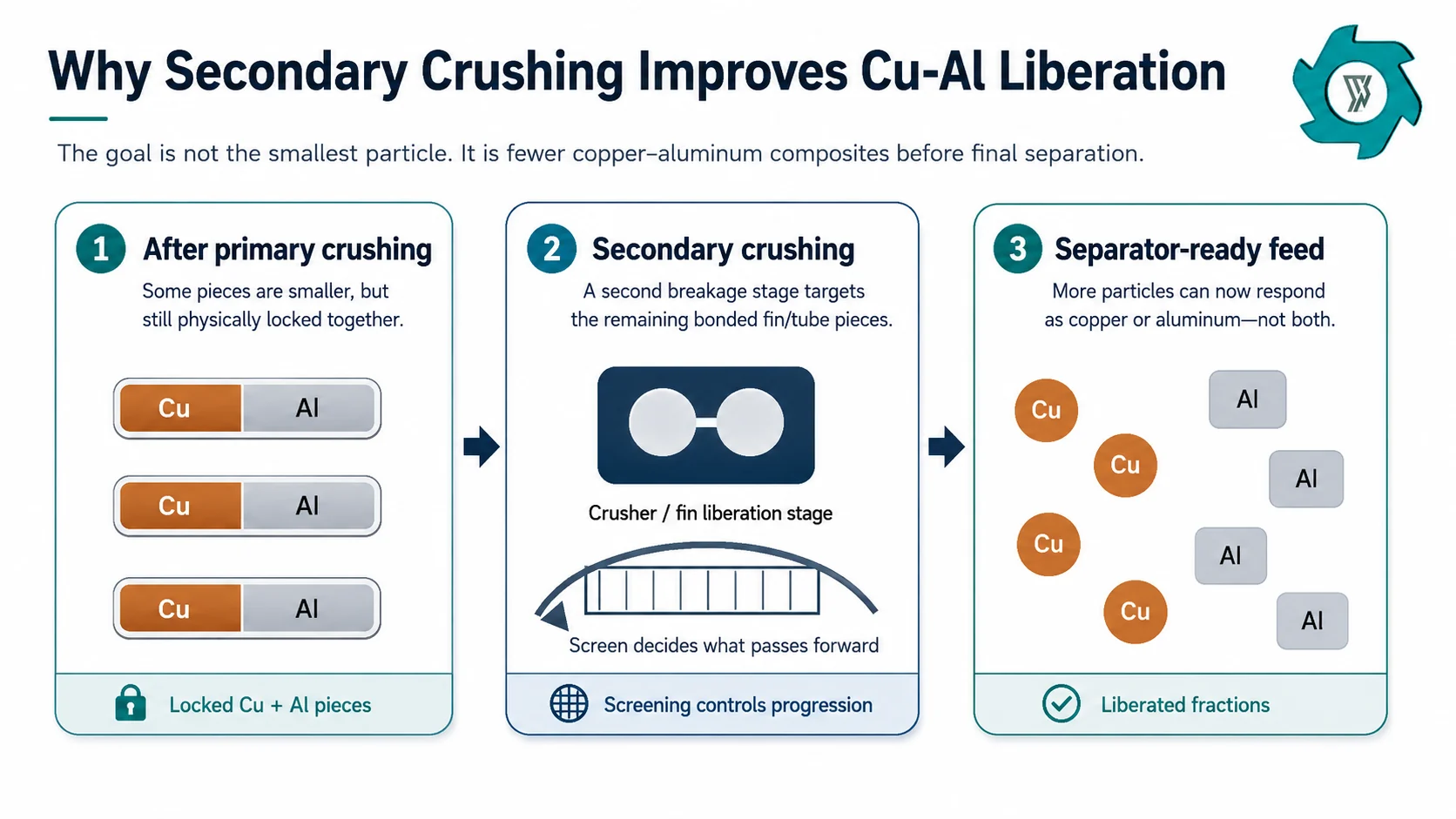
Primary shredding solves a handling problem. It takes a bulky heat exchanger and turns it into pieces that conveyors, crushers and separators can accept. That is valuable, but size reduction and liberation are not the same thing. A 60 mm fragment can be fully liberated if it is a clean piece of copper tube. A much smaller fragment can still be a poor particle if it contains copper and aluminum locked together. This distinction is well established in recycling research: the quality of downstream physical separation depends on how well materials are liberated during comminution, not simply on the nominal particle size. The same principle appears in end-of-life vehicle recycling, where incomplete liberation carries one metal into another product stream and lowers recovered-material quality. That is why the copper aluminum radiator recycling line uses staged liberation rather than assuming one crusher can solve every feed condition. Primary reduction makes the material manageable. Secondary crushing is applied when the remaining copper-aluminum joints are still limiting separation.
What secondary crushing actually changes
The useful change is mechanical: more of the mixed particles become single-material particles. Copper tube sections are exposed, aluminum fin packs are broken away, and composite pieces become easier to classify by density and aerodynamic response. Secondary crushing should be judged by the reduction in locked Cu-Al pieces. A screen and return loop can send only the incompletely liberated fraction back for another pass. We have found that this is where buyers sometimes focus on the wrong number. They ask for a very small discharge size because it sounds like proof of stronger crushing. In practice, the better question is: at what size range does this feed become sufficiently liberated for the next separator? Those are not the same question. A good secondary stage therefore works together with screening. Material that is already in the useful size band moves forward. Oversize or visibly locked composite pieces can return. This selective recirculation matters because it avoids forcing already liberated copper and aluminum through unnecessary additional impacts.
Five signs that the first crushing stage is not enough
1. Copper product still carries obvious aluminum fin material
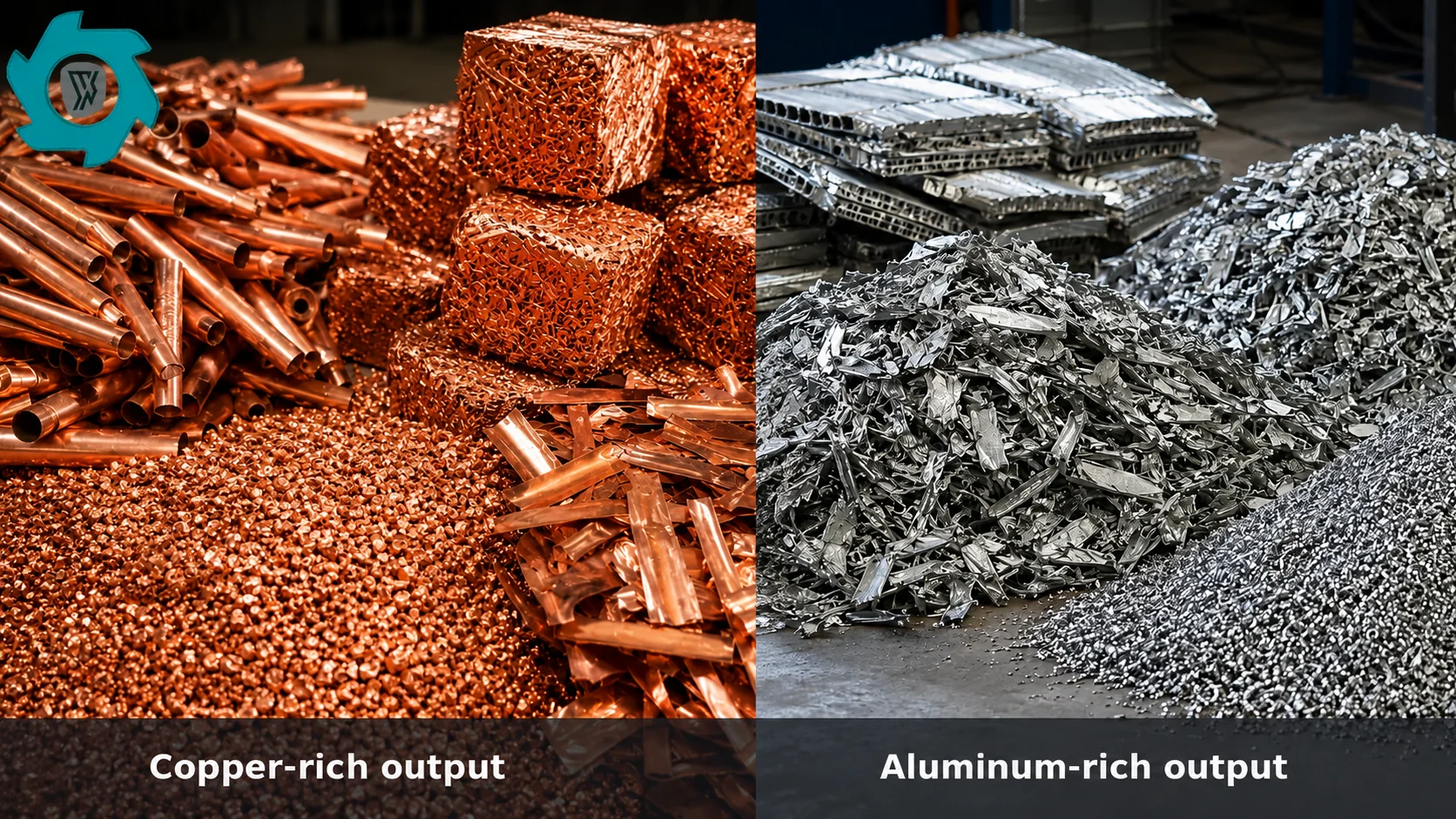
A few stray flakes are not the issue. The important symptom is a repeating pattern: copper tube sections leaving with folded fin packs or aluminum tightly wrapped around them. If that material reports to the copper-rich outlet, the separator is receiving composite particles that it cannot classify cleanly.
The reverse can happen as well. A light, fin-dominant particle may carry a short copper tube segment and still behave more like the aluminum fraction. That copper loss is easy to miss because the aluminum pile can look visually clean from a few meters away.
3. The middlings or return stream keeps growing
A stable amount of middlings is normal in many physical separation circuits. What deserves attention is a rising or persistently heavy return load, especially when hand inspection shows many copper-aluminum pieces rather than simple misplaced single-metal particles. That is a liberation problem first.
4. Separator adjustments improve one product but immediately damage the other
Operators may change airflow, deck angle, vibration or feed depth and see the copper fraction improve—while copper recovery in the aluminum or reject stream gets worse. Sometimes the separator really does need tuning. However, when no setting creates a clean split, check whether the incoming particles are physically separable before changing settings again.
5. Product quality changes sharply when the radiator mix changes
Clean AC coils, damaged automotive radiators and mixed industrial heat exchangers do not break in the same way. Tube wall thickness, fin construction, steel attachments, soldered or brazed joints, plastic and contamination all change breakage behavior. A line that liberates one feed easily may leave another feed heavily locked.
A simple liberation test before adding more crushing
You do not need a laboratory mineral analyzer to make the first production decision. A disciplined plant sample is usually enough to show whether secondary crushing deserves attention.
Sample by timeTake equal-duration samples during stable running, not one convenient shovel from the top of a bin.
Separate by sizeUse the plant screen fractions or a simple sieve check so coarse and fine material are not judged together.
Hand-sort locked piecesRecord copper-only, aluminum-only and Cu-Al composite mass in each sample.
For each size fraction, weigh the visibly locked copper-aluminum pieces and divide that mass by the total sample mass. Then repeat the check at the copper-rich, aluminum-rich and middlings outlets. The absolute percentage that is acceptable will depend on the buyer specification and economics; the important point is to use the same method each time. One customer may be satisfied selling a copper-aluminum concentrate after iron and plastic removal. Another may need distinctly separate copper-rich and aluminum-rich products. The second project has a much tighter liberation requirement. That is why a universal “purity target” copied from a brochure is not a useful design basis.
What you observe
Likely cause to check first
Useful response
Many coarse Cu-Al composite pieces after the crusher
Insufficient breakage or too much feed for the available crushing duty
Evaluate a secondary liberation pass and confirm screen/return capacity
Large amount of fines but composite pieces still remain
Energy is being spent on easy-to-break material instead of the locked fraction
Improve size classification and selective recirculation rather than simply increasing intensity
Clean particles, but poor separator split
Separator loading, particle-size spread, moisture or settings
Fix separation conditions before adding another crusher
Good result on AC coils, poor result on mixed car radiators
Feed construction and contamination changed
Separate recipes or process routes by feed family where practical
Adjust classification so liberated metal is not re-crushed unnecessarily
Where the radiator fin crushing machine fits in the line
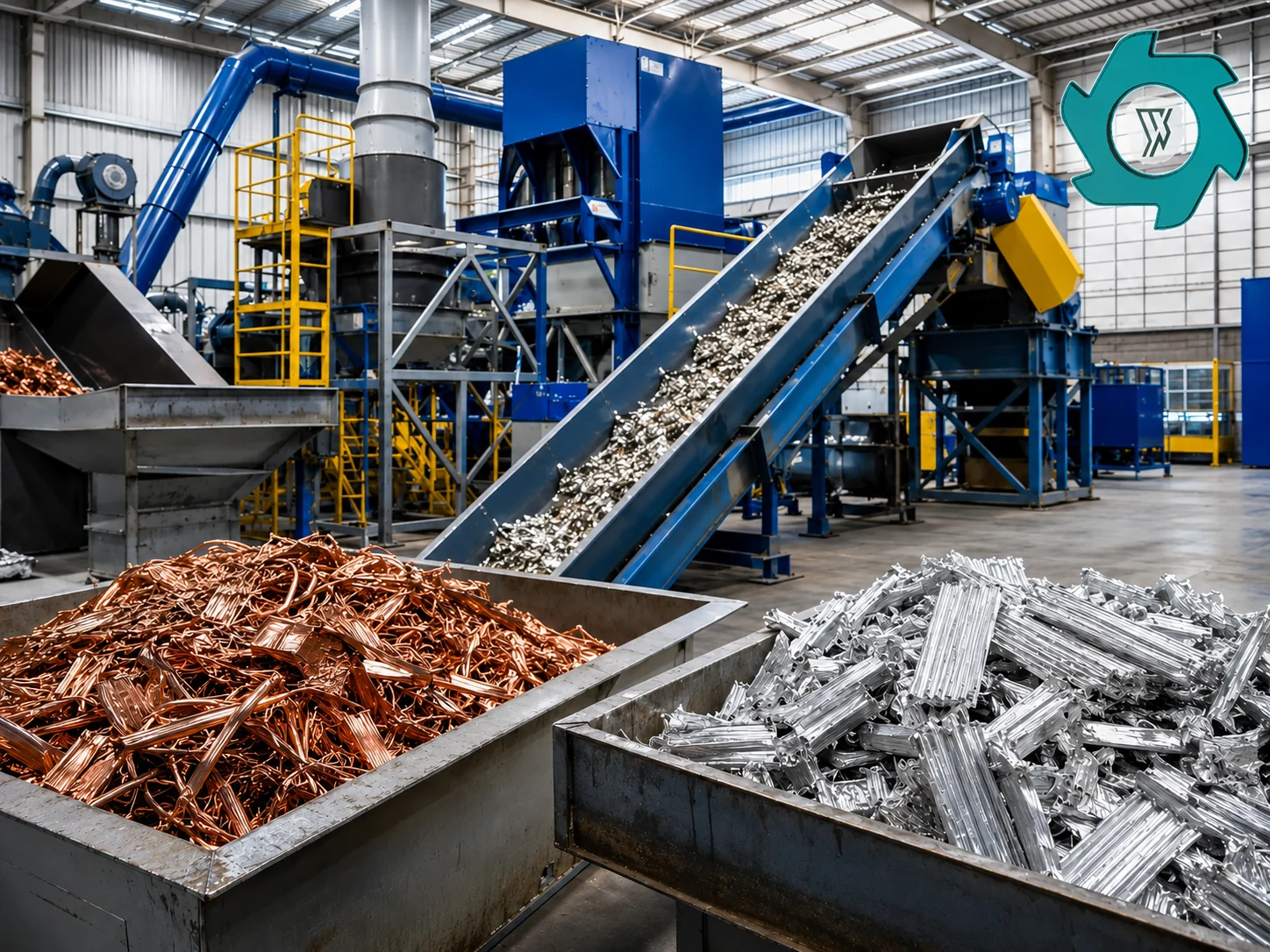
For mixed radiator scrap, a low-speed shredder is usually better treated as a pre-shredder than as the final liberation machine. Its job is to grab awkward, bulky material and reduce it enough for controlled downstream processing. The role of a double shaft shredder in metal recycling is similar: rough, high-torque opening first; finer and more controlled crushing later when the process requires it. The exact sequence is project-specific, but secondary liberation is normally positioned after the first major size-reduction step and before the final copper-aluminum split. Iron may be removed before or between crushing stages depending on the flow sheet. Screening is especially useful around the secondary crusher because it decides which particles need another pass. A complete line should make the crusher, screen, return conveyor and separator work as one circuit. Secondary crushing by itself cannot compensate for unstable feeding or poor classification.
Do not confuse liberation with over-crushing
More breakage can improve liberation, but only up to the point where the next problem appears. Recycling research on end-of-life products notes that more intensive comminution can increase liberation, yet it also raises energy use and can introduce other losses. Radiator scrap adds a practical concern: thin aluminum fins can turn into very light fines quickly. Those fines are difficult to manage. They increase the load on dust collection, may behave differently from larger aluminum particles on a gravity or air separator, and can carry saleable metal into the wrong stream. Excessive fragmentation of copper is not desirable either if the downstream market prefers a coarser, cleaner metal fraction.
Dust is also a safety issue, not just a recovery issue. Fine aluminum dust can be combustible. Crushing, conveying and dust collection should be engineered with the applicable local fire, explosion, electrical and housekeeping requirements in mind. Do not treat a higher dust load as a normal price of “better” crushing.
For this reason, the right secondary crusher is not necessarily the machine that produces the finest sample during a short test. A more convincing test shows that the required liberation is achieved at the intended throughput, while the fine fraction and dust load remain under control.
How screening and return flow protect recovery
A screen after secondary crushing does more than produce a tidy particle-size specification. It gives the line a decision point. Material within the useful band can proceed to separation. Oversize material can be inspected or returned. If the return stream contains mainly composite pieces, the circuit is doing productive work. If it contains large amounts of already clean copper and aluminum, the screen cut or return logic may be wasting capacity. We normally recommend sampling the return belt separately during commissioning. It tells you more than the crusher motor current alone. A high return load can mean poor liberation, but it can also mean the screen is too restrictive, the feed is too uneven, or the line is being pushed above the rate at which the crusher and screen can stabilize.
Match the secondary crushing strategy to the feed
Feed condition
What often goes wrong
Secondary crushing priority
Clean, pre-cut copper-aluminum AC coils
Fins remain wrapped around tube sections even though the pieces look small
Focus on clean liberation with minimum unnecessary fines
Whole or deformed automotive radiators
Plastic, steel clips and irregular frames create a very mixed crusher feed
Stabilize pretreatment and ferrous/non-metal removal before judging fin crushing
Dirty coils with oil, coolant residue or compacted debris
Material sticks, carries light contamination and feeds inconsistently
Improve drainage/cleanliness first; wet sticky fines can make separation unreliable
Mixed heat exchangers
Different tube and fin constructions create different breakage behavior
Use representative testing and expect more flexible screening/recirculation
High all-aluminum content
The line may be crushing metal that does not need a Cu-Al liberation step
Confirm the actual recovery objective before adding secondary duty
Sometimes the best answer is not a larger secondary crusher. Separating the feed into two families can be cheaper. For example, a relatively uniform AC coil stream may run with one recipe, while mixed automotive material uses a heavier front-end preparation route. That reduces the amount of “compromise” tuning asked of one machine.
How to select a radiator fin crushing machine
A useful quotation should explain how the machine fits the circuit. A motor power number by itself does not tell you whether the crusher can accept your actual feed, whether it will liberate the remaining composites, or what the downstream screen will see.
Start with the secondary-stage feed, not the original radiator size
Provide the normal and maximum piece size entering the fin crusher, together with photos of the material after the first crusher. This is much more useful than sending only a photo of a complete radiator. The secondary machine never sees the complete radiator if the front end is doing its job.
Define what the separator needs
The crusher discharge should be selected backward from the screen and final separator. Ask what particle-size spread the separator can handle stably, what maximum composite size is acceptable, and how very light fin material behaves at the intended feed depth.
Ask how oversize is controlled
Some projects rely on a screen and return conveyor; others use a different classification arrangement. What matters is that oversized or poorly liberated particles are identified without recycling the entire product stream. A closed loop should be measurable, not just drawn on a flow chart.
Compare wear access and real maintenance work
Radiator fin material looks light, but it can be accompanied by steel clips, hard fittings, dirt and other surprises. Ask how the crushing chamber is opened, which wear parts are routinely inspected, how foreign metal is handled, and how long a normal service intervention takes. Production lost during maintenance belongs in the capacity calculation.
Include dust extraction in the machine scope discussion
Secondary crushing creates fresh surface area and a lighter fine fraction. The quotation should show where extraction points are located, what enclosure is provided, and how the crusher connects to the plant dust system. Site-specific combustible-dust review remains the responsibility of the final plant design and local requirements.
What to measure during a material test or FAT
A short video of material passing through a crusher proves that the machine turns. It does not prove that the proposed circuit will make saleable copper and aluminum. For a meaningful test, agree on the feed and the measurements before the trial starts.
Feed description: radiator type mix, contamination, moisture/residue condition and incoming size range.
Net test rate: use sustained feed over a defined test period rather than a peak moment.
Crusher discharge sample: record the size distribution and the visible locked Cu-Al fraction.
Screen oversize/return: weigh it and determine whether it is mostly composite material or already liberated metal.
Separator products: sample copper-rich, aluminum-rich and middlings/reject streams separately.
Fine fraction: record how much fine aluminum, copper and non-metal is created and where it reports.
One export project can look excellent in a staged photograph and still need a different screen or return strategy once real mixed feed is used. That is why we prefer to treat commissioning as a mass-balance exercise, not a photo check.
When secondary crushing is worth the extra equipment
When the additional stage turns locked mixed material into products that downstream buyers value more, the business case is strongest. The gain may come from higher copper recovery, less copper carryover into the aluminum fraction, less aluminum contamination in the copper fraction, or a smaller middlings stream. In practice, we would make the decision from three numbers: the mass of locked Cu-Al pieces before the secondary stage, the reduction in that locked mass after the stage, and the value recovered after allowing for fines and operating cost. Those three numbers tell a much clearer story than “more crushing equals more recovery.” The point of secondary liberation is a cleaner split between copper-rich and aluminum-rich fractions, not a cosmetic reduction in particle size.
RFQ checklist for the secondary crushing stage
Before asking for a model, send enough information for the supplier to understand the problem the machine must solve:
Representative photos or samples of material after primary crushing.
Normal and maximum incoming piece dimensions at the secondary crusher.
Estimated copper, aluminum, iron, plastic and other contamination in that stream.
Current locked Cu-Al percentage if you have already sampled it.
Required sustained throughput and daily operating hours.
Screen arrangement, oversize return plan and downstream separator type.
Target product: Cu-Al concentrate or separate copper-rich and aluminum-rich fractions.
Acceptable fine fraction or downstream buyer restrictions on fines.
Available power, installation space, feeding height and maintenance access.
Dust extraction and site safety requirements that must be integrated with the machine.
Check Whether Your Radiator Feed Needs Secondary Crushing
Send YUXI photos of the material after your first crushing stage, the current separator outputs and the throughput you need. We can review whether the bottleneck is liberation, screening, return flow or separator loading before recommending another machine.
FAQ
What does a radiator fin crushing machine do?
It acts as a controlled secondary size-reduction stage. Its main job is to break copper-aluminum composite pieces that remain after primary crushing, so the downstream separator receives a higher share of liberated copper and aluminum particles.
Does every radiator recycling line need secondary crushing?
No. Clean and easy-to-liberate feed may reach an acceptable product after the first crushing stage. Secondary crushing becomes useful when sampling shows too many copper tubes still carrying aluminum fins, mixed metal pieces in the product streams, or a high amount of recoverable metal returning with middlings.
Should the crusher make the material as fine as possible?
No. Finer is not automatically better. Excessive breakage can create aluminum fines, increase dust load, reduce throughput and make particle behavior less stable. The target is sufficient liberation within a controlled size range, not the smallest possible particle.
How can I check whether liberation is good enough?
Take timed samples from the crusher discharge and separator outlets, screen them by size, then hand-sort the copper-aluminum composite pieces. Track the mass percentage of locked pieces and where they report. A rising locked fraction in the copper, aluminum or middlings stream is a stronger signal than visual impressions from one handful.
What information should I send before selecting a secondary crusher?
Send representative feed photos or samples, normal and maximum piece size entering the secondary stage, copper-aluminum attachment condition, contamination, required net throughput, downstream screen and separator details, target products, operating hours and dust-control requirements.
David focuses on industrial shredding and recycling equipment,including material evaluation,shredder selection,process configuration,and recycling line planning.
Speak To Our Shredder Machine Expert
Get in touch with our nice team today to get a price estimate for a shredder machine.

 English



 Fast Delivery
 Reliable
 Certified
 Experienced