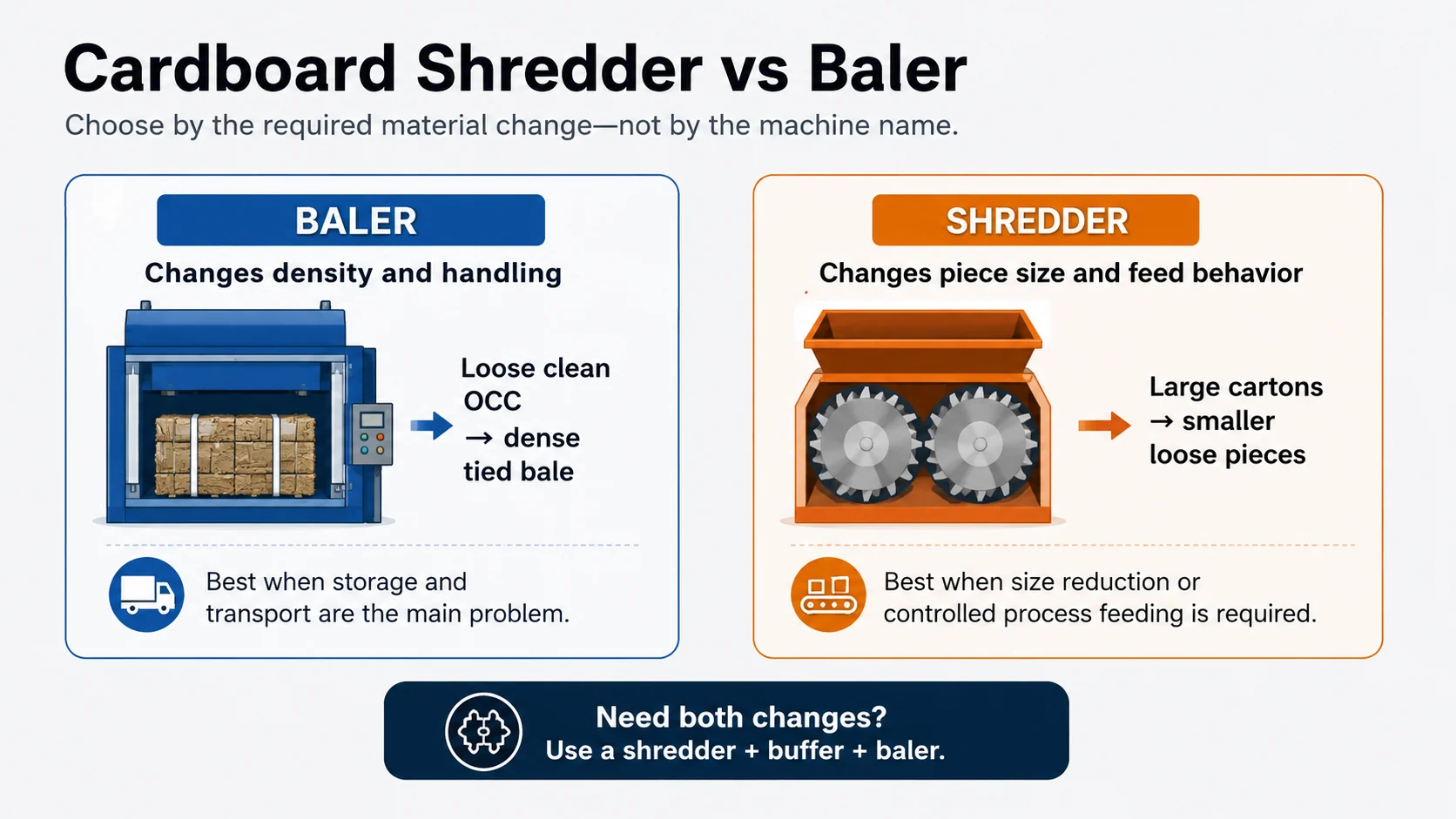
“Do we need a cardboard shredder or a baler?” is usually presented as a machine question. Once the material photos arrive, it becomes a process question. Clean flattened boxes waiting for a recycler are one job. Oversized corrugated sheets jamming a conveyor are another. Wired OCC bales that must be opened, inspected and prepared for dry fiber processing are something else again.That distinction matters because a shredder and a baler do not perform competing versions of the same task. A shredder changes piece size and feed behavior. A baler changes density and logistics. Some facilities need one of those changes. Some need both. A smaller number need a complete preparation line around them.A baler makes dense shipping units; a shredder makes smaller loose pieces. The equipment choice starts with the required change in the material.
Start With the Required Output, Not the Machine Name
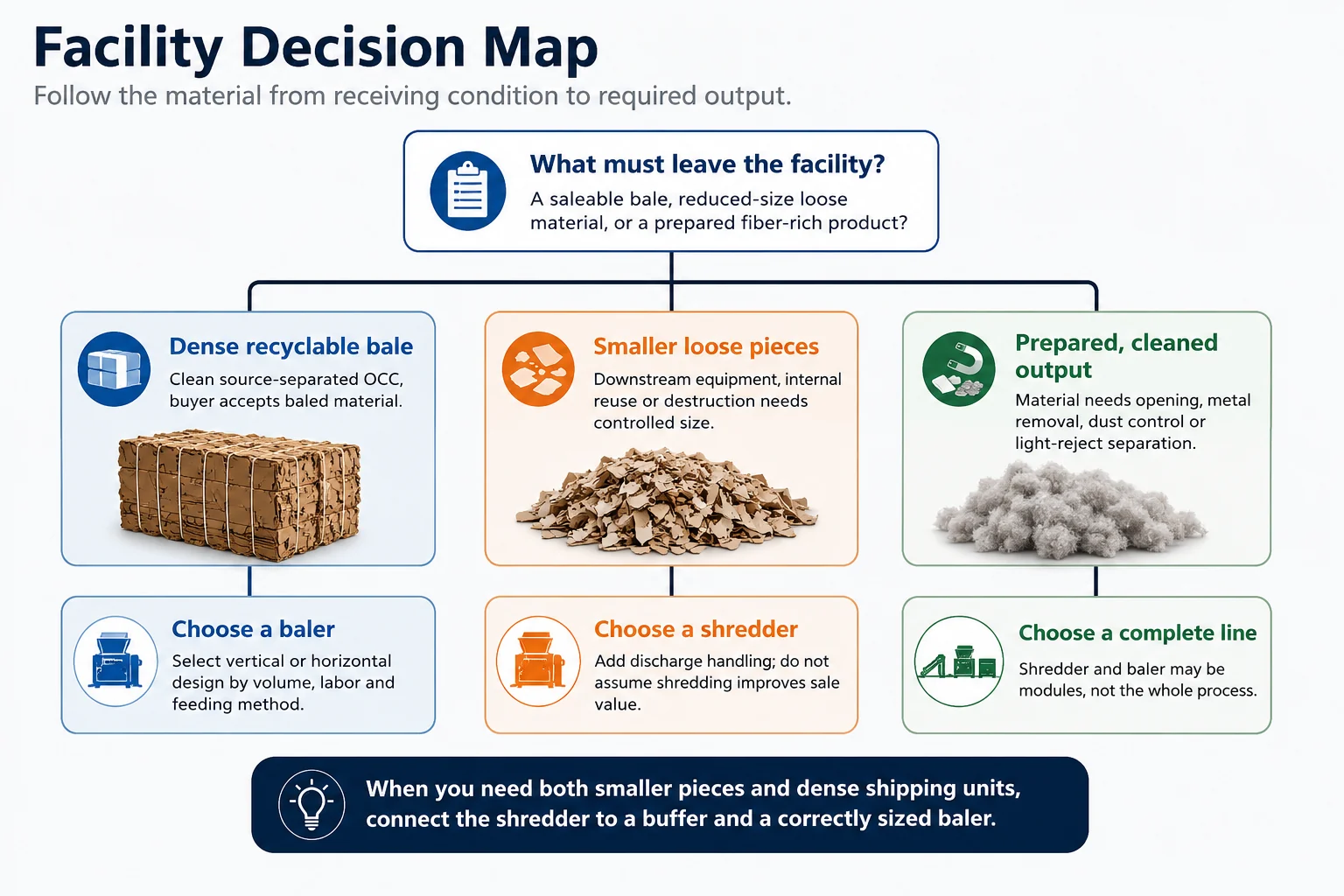
Choose a cardboard baler when reasonably clean loose OCC only needs to become dense, stackable bales for storage, pickup or sale. Choose a cardboard shredder when large cartons, sheets or trim must be reduced to a controlled size for conveying, destruction, internal reuse or another process. Use a shredder and baler together when irregular material must first be reduced and then compressed.Neither machine removes every contaminant. Neither one, by itself, is a complete OCC preparation plant. If the facility must open incoming bales, remove ferrous material, meter feed, mechanically open fiber, control dust or separate light rejects, the project has moved beyond a simple shredder-versus-baler decision.
A Shredder Changes Size; a Baler Changes Density
A cardboard shredder tears, shears or cuts large material into smaller pieces. In an industrial OCC system, the purpose is often to stop large cartons from bridging, create a more uniform burden for conveyors, expose hidden contaminants and prepare the feed for a later opening or separation stage. The discharge remains loose unless another machine handles it.A baler works differently. It compresses loose cardboard inside a chamber and secures the compacted material with wire, strap or another tying method. The main result is a dense handling unit. At a materials recovery facility, paper-based packaging is commonly sorted, baled and shipped to a paper mill; pulping and further cleaning occur later at the mill.[1]
Question
Cardboard shredder
Cardboard baler
Primary material change
Reduces piece dimensions and changes flow behavior.
Increases bulk density and creates a tied handling unit.
Typical input
Large cartons, corrugated sheets, production trim, opened bale material or bulky paper waste.
Loose, reasonably clean cardboard that can enter the chamber safely and consistently.
Typical output
Loose shredded cardboard or a controlled intermediate feed.
Dense rectangular bales for storage and transport.
What it does not prove
It does not prove contamination has been removed or that the material is ready for a paper mill.
It does not open incoming bales, reduce maximum piece size or prepare fiber.
Main bottleneck risk
Bridging, uneven feeding, foreign objects, wear and downstream backup.
Loading rhythm, chamber cycle, tying, bale discharge and finished-bale handling.
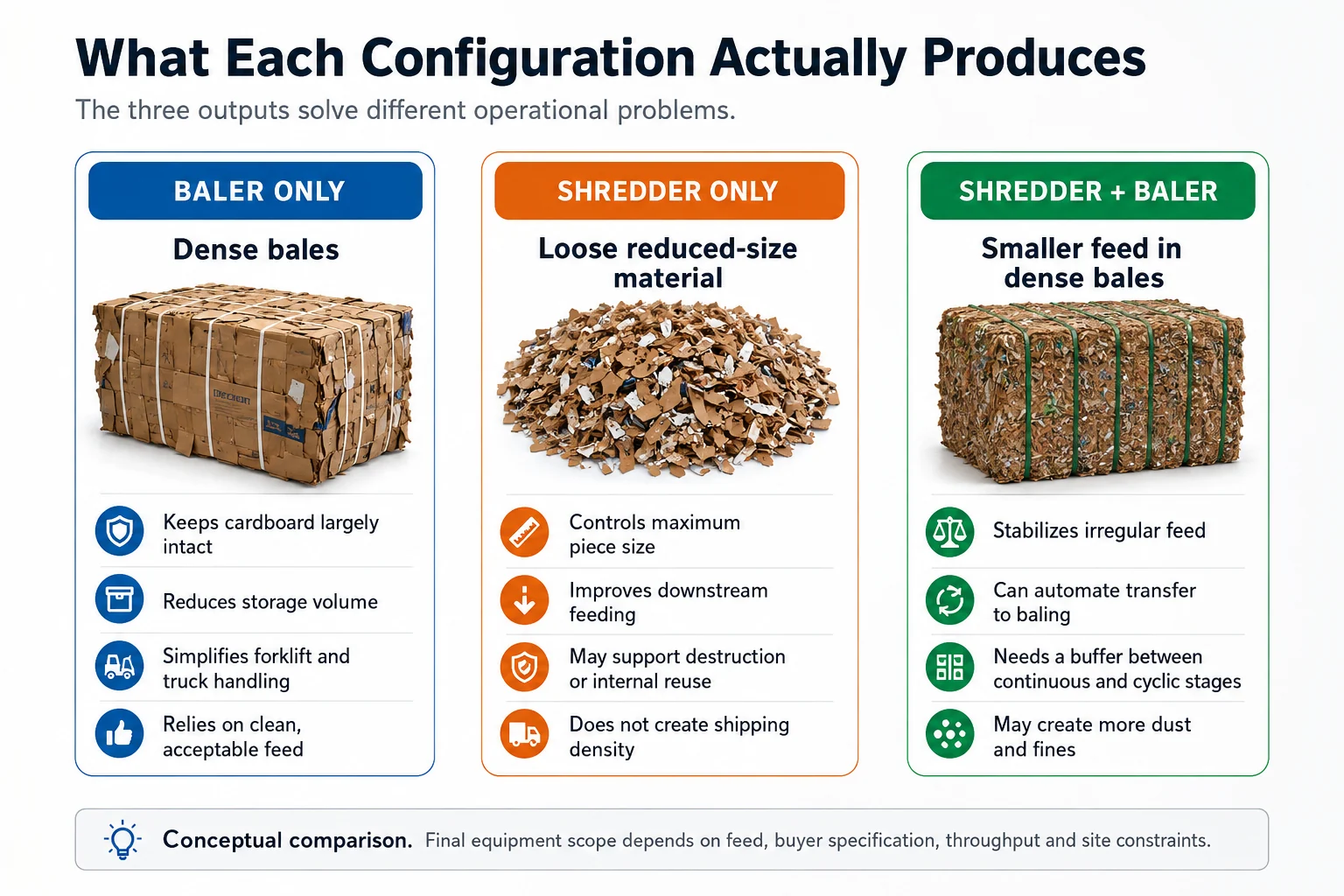
The configurations should be compared by the output condition they create, not by motor power or machine size alone.The recovered-paper contract also matters. ReMA’s OCC guidance defines the grade, limits outthrows and prohibitive materials, and states that the packing unit—such as bales or loose material—should be specified in the agreement.[2] In practical terms, the downstream buyer may decide the equipment boundary before the supplier does.
When a Cardboard Baler Is Enough
A baler-only project is usually the cleanest decision. The facility generates source-separated corrugated boxes, the recycler or broker accepts baled OCC, and the operational problem is floor space or pickup frequency. Retail stores, supermarkets, warehouses and distribution centers often fall into this group.In this situation, shredding can add cost without adding value. It introduces cutters, wear parts, another drive, more transfer points and usually more paper dust. It may also make manual housekeeping harder. If flattened boxes already feed the baler consistently and the buyer wants ordinary OCC bales, keeping the material intact is often the simpler route.
Signs that direct baling is the better choice
The cardboard is generated loose and is already separated from general waste.
Most pieces fit the loading opening after normal flattening or simple box breakdown.
The recycler pays or accepts material as tied OCC bales.
No downstream process needs a controlled shredded size.
Operators can load, tie and remove bales without disrupting the facility.
The type of baler still matters. A vertical baler is a batch machine and can suit lower or intermittent volumes where manual loading and tying are acceptable. A horizontal baler is more easily integrated with conveyors and higher continuous volumes. That is a separate sizing question; it should be based on daily tonnage, peak generation, labor and the buyer’s preferred bale.One mistake appears repeatedly in warehouse discussions: the team wants a shredder because the cardboard pile looks bulky. But bulk alone does not prove shredding is needed. The baler is the machine designed to solve shipping density. If the boxes can reach its chamber safely and predictably, adding size reduction may only move the pile from one shape to another before it is compressed.
When a Cardboard Shredder Is the Right First Machine
A shredder-only project makes sense when reducing size is the actual output requirement. Corrugated sheet trim may need to enter a pneumatic collection system. Large cartons may need to become a uniform feed for another machine. Branded packaging may need to be made unusable before disposal. Some facilities also use shredded cardboard internally as void fill or as a feedstock for a separate process.Here, the key question is not “Can the machine cut cardboard?” Almost any suitable industrial shredder can tear dry board under some conditions. The useful question is whether it can accept the largest normal item, control feeding, tolerate expected contaminants and deliver the required size without creating an unmanageable volume of dust or fines.The YUXI plant uses a double shaft shredder as a primary reduction stage because bulky cartons and irregular paper waste need positive, low-speed tearing before downstream metering and dry opening. In that context, the shredder is one preparation module. It is not presented as a substitute for the baler at the end of the line.
A shredder alone is less attractive when material must leave by truck
Loose shredded cardboard still occupies substantial space. Depending on cut size and how the pieces interlock, it can be awkward to contain and may blow or spill at transfer points. A facility that shreds first but has no discharge plan can discover that it reduced the dimensions of each piece without solving storage or transport.That is why we normally ask what happens during the ten minutes after the shredder. Does material fall into a covered bin? Enter a pneumatic line? Feed a fiber opener? Move directly to a baler? The answer often determines whether “shredder only” is a complete solution or merely the first half of one.
When Your Facility Needs Both a Shredder and a Baler
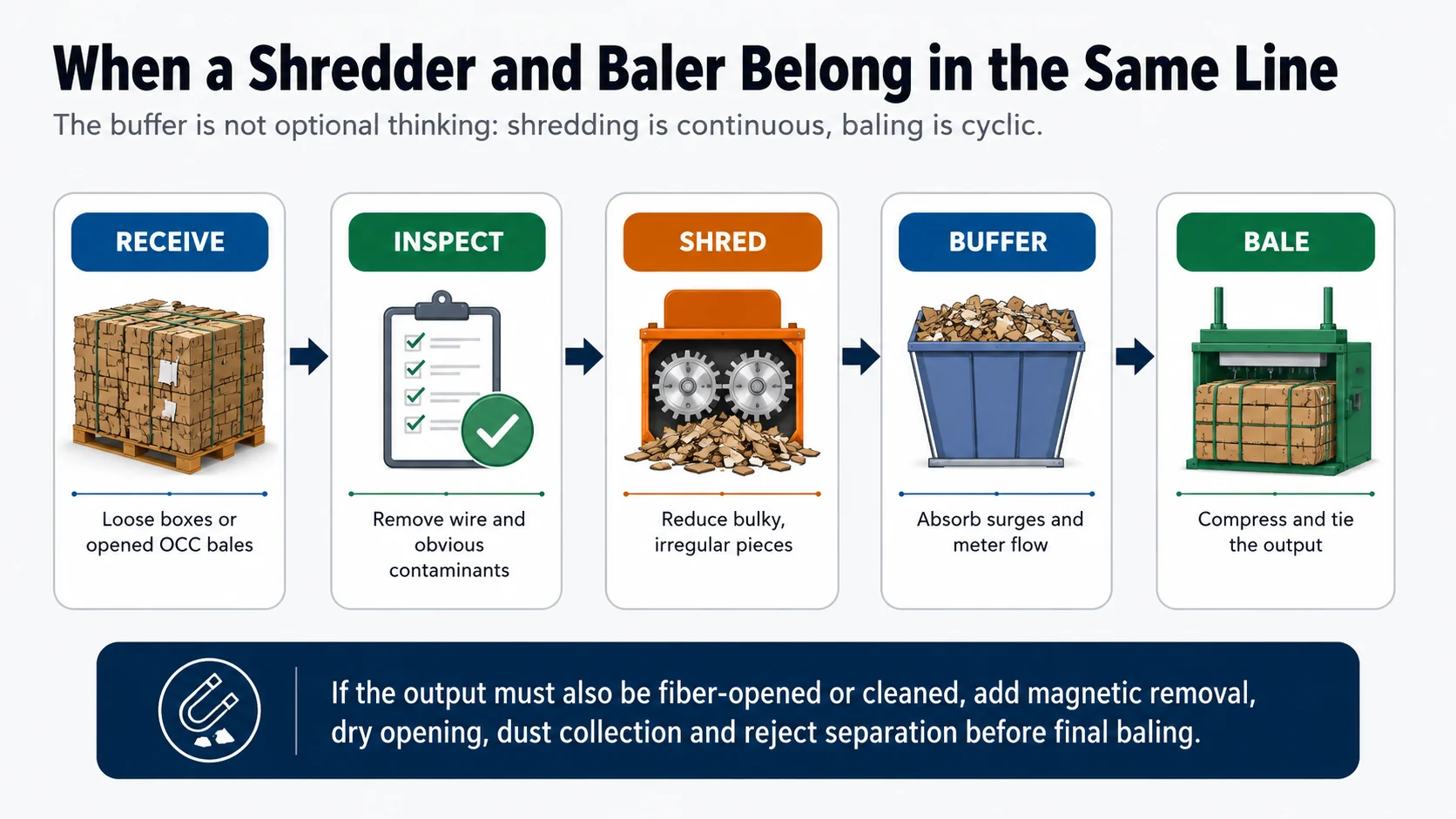
Use both machines when the feed must undergo two separate changes: first smaller and more manageable, then denser and easier to ship. This is common with irregular production scrap, large corrugated offcuts, carton rejects or automated lines where unprocessed pieces do not feed a baler consistently.Sometimes pre-shredding allows a conveyor-fed baler to receive a steadier burden. Sometimes it does not. That is an engineering judgment, not a universal rule. Very fine shredding can increase dust, reduce useful sheet structure and create more material carryover. The preferred cut is usually only as small as the next stage genuinely needs.A shredder produces continuously while a baler operates in cycles. A buffer and controlled discharge prevent the baler from repeatedly stopping the upstream process.
The buffer between the machines deserves attention
This is where many simple equipment lists become incomplete. A shredder can discharge continuously. A baler fills, compresses, ties and ejects in cycles. If shredded material falls directly into a small baler hopper, the upstream machine may have to stop every time the chamber is unavailable.A buffer or metered conveyor decouples those rhythms. It absorbs short surges, maintains a controlled bed and gives the baler time to complete its cycle. The cardboard recycling plant capacity guide explains why complete-line output is set by the lowest stable connected stage rather than the fastest individual machine.
Pre-shredding does not automatically improve bale quality
Shredded material can fill voids more evenly, but dense bales depend on the baler, material condition, chamber geometry, pressure, tying system and operating method. Wet board, film, foam and mixed grades can still produce unstable or unacceptable bales. The effect should be tested with the actual feed and the intended bale specification.
When a Shredder and Baler Still Are Not Enough
Incoming baled OCC creates the clearest boundary. A baler makes bales; it does not safely open another baler’s product. Wired bales need staging, controlled wire removal, opening and inspection. Once the material is released, sudden slugs can overload a conveyor or shredder unless the front end meters them.Contaminated or quality-sensitive feed creates another boundary. The shredder can expose staples, wire, film and labels, but it does not make those materials disappear. A magnetic separator may be needed for ferrous pieces. Manual sorting, screening or light-reject separation may be needed for non-paper contamination. Dust collection must be designed around the actual shredding and transfer points.The YUXI waste cardboard recycling plant therefore combines receiving, bale opening or pre-sorting, primary shredding, magnetic removal, metered conveying, mechanical dry fiber opening, dust control and optional final baling. The complete cardboard recycling plant equipment list describes the function of each module. The present article has a narrower purpose: identifying where the baler-only, shredder-only and integrated-line boundaries sit.For buyers, the simplest distinction is this:
Baler-only: the material is acceptable and only needs densification.
Shredder-only: the material only needs controlled size reduction and has a defined loose-output route.
Shredder plus baler: the material needs reduction followed by densification.
Complete line: the material also needs opening, sorting, separation, dust control or a defined fiber-rich output.
Six Factors That Decide the Equipment Scope
1. What will the downstream user accept?
Start with the buyer, mill or internal process. Ask whether it wants ordinary OCC bales, shredded board, opened fiber-rich material or another specification. The OCC cardboard grade guide is useful here because “cardboard” can hide meaningful differences in grade, moisture and contamination.A machine proposal made without that output definition is likely to optimize the wrong thing. A clean bale is not the same product as shredded loose board. Mechanically opened dry fiber is not finished wet pulp. The equipment must be selected around the commercial handoff point.
2. How does the cardboard arrive?
Loose flattened boxes are easy to inspect but bulky by volume. Unflattened cartons can bridge. Long corrugated sheets can span a hopper or baler opening. Production trim can be light, springy and continuous. Compressed bales are dense but demand wire removal and controlled release.We have found that the largest normal item is often more useful than the average size. A system that handles ninety-nine small boxes can still stop on the one long folded sheet that bridges across the opening. Send dimensions and video, not only a material name.
3. Is contamination a quality issue or a machine-protection issue?
Metal, stones and wood can damage cutters or block transfers. Film, tape, waxed board and food residue may reduce the value or usability of the recovered paper. Shredding can make inspection easier, but it can also distribute contamination through a larger volume of smaller pieces.That is why the correct sequence is usually inspection first, size reduction second, and targeted separation after the material has been liberated. The exact route depends on what is present. A generic statement that a shredder “removes impurities” should be treated cautiously.
4. What is the sustained daily duty?
A small shop generating cardboard in short batches may tolerate manual baler loading. A distribution center with continuous receiving cannot. Likewise, a shredder chosen from a short demonstration may not sustain the real duty when large boxes, wet layers and operator interruptions are included.Compare net productive throughput, bales per hour, chamber cycle, tying time, discharge handling and loader or forklift availability. Do not compare shredder tonnes per hour with baler bale weight as if they were equivalent performance numbers.
5. How much labor and floor movement can the site support?
A vertical baler can appear compact until the facility adds the staging area, safe operating zone, bale ejection space and forklift route. A shredder line needs infeed access, discharge containment, service clearance and a plan for jams or foreign objects.The cardboard recycling plant layout guide treats those circulation and maintenance areas as part of the process footprint. They should be drawn before the purchase order, not discovered during installation.
6. Can the equipment be operated and serviced safely?
OSHA warns that machinery used to transport, compact and bale paper can be fatal, and it identifies crushing, moving parts and unexpected startup among the hazards.[3] Cardboard baling guidance likewise emphasizes that unintended activation can have catastrophic consequences.[4]Shredding and dry paper handling can also create fine dust. OSHA lists paper and pulp among materials that may be explosible in dust form under the right conditions.[5] Guarding, interlocks, hazardous-energy control, dust assessment and site-specific fire protection belong in the design basis. Capacity should never depend on unsafe jam clearing or defeated controls.
Typical Recommendation by Facility Type
Follow the required output first. Incoming form, contamination, throughput and site constraints then refine the machine type and configuration.
Facility
Likely starting configuration
Why
What could change the answer
Retail store or supermarket
Vertical baler
Clean boxes are generated intermittently and need storage-volume reduction.
Very high volume, labor limits or a recycler requiring a different bale may justify a horizontal baler.
Warehouse or distribution center
Baler, often conveyor-fed at higher volume
The commercial output is normally a dense OCC bale.
Oversized unflattened cartons, automatic handling or product-destruction requirements may add a shredder.
Corrugated box plant
Shredder or trim collection plus baler
Continuous sheet trim and rejects may need size control before automated collection and baling.
Clean pneumatic trim can use a different front end from heavy glued or laminated rejects.
Recycling center or MRF
Sorting and baling system
The main product is usually a marketable recovered-paper bale.
A shredder may be added for oversized material, confidential destruction or a specific downstream preparation route.
OCC dry preparation facility
Complete line with shredder and optional baler
The goal includes controlled feeding, separation, dry opening and output preparation.
Final loose or baled output depends on the downstream user and transport plan.
Facility receiving wired OCC bales
Bale opening, inspection and metered processing
The incoming packing unit must be safely released before continuous processing.
If the bales are merely traded or stored, processing may not be needed at all.
Selection Mistakes We Would Avoid
Buying a shredder because the pile looks large
A large loose pile is often a density problem. A baler is designed to solve that. Confirm whether the boxes are too large to feed or simply occupy too much floor space.
Expecting a baler to open or reprocess incoming bales
The names are confusing because both operations involve bales. The equipment direction is opposite. A baler compresses material into a bale; a bale opener releases compressed material for inspection and processing.
Assuming shredding removes contamination
It may expose contaminants, but it can also distribute them. Write a separate separation duty for wire, ferrous pieces, film, wood and other rejects.
Connecting a shredder directly to an undersized baler
The first test may look acceptable at a low feed. At production rate, the baler cycle stops the shredder, the transfer chute backs up and operators begin clearing material manually. Size the buffer and discharge together.
Comparing motor power with hydraulic force
These numbers describe different machine functions. A larger shredder motor does not predict bale density. A higher baler force does not prove large cartons will enter the chamber. Compare complete duty and output evidence.
Ignoring the cost of the surrounding system
Conveyors, platforms, dust control, guarding, electrical panels, wire or strap, bale weighing, forklift handling and foundations can materially change the project. The cardboard recycling machine price guide explains why equipment scope is a stronger cost driver than a single machine label.
Information to Send Before Requesting a Recommendation
A useful inquiry does not need to be long, but it should make the material path visible. We normally recommend sending one short video plus the following data:
Project input
What to provide
Why it changes the answer
Cardboard source
Warehouse OCC, retail boxes, corrugated trim, mixed paper, imported bales or other source.
Source predicts consistency, contaminants and handling form.
Incoming condition
Loose, flattened, unflattened, long sheets, rolls, wired bales or strapped bales.
Determines whether direct baling, size reduction or bale opening is required.
Largest dimensions
Largest normal and occasional item; bale dimensions and mass where relevant.
Controls openings, conveyors, chamber geometry and staging.
Changes wear, safety, separation and accepted output.
Required output
Loose shredded board, ordinary OCC bale, opened fiber-rich material or buyer specification.
Defines the essential machine function.
Production target
Daily tonnes, peak generation, operating hours and expected productive time.
Separates intermittent batch handling from continuous automated duty.
Site and labor
Workshop dimensions, clear height, loading method, forklift route, operator availability and power supply.
Determines practical configuration and layout.
The broader waste cardboard recycling machine selection guide covers supplier comparison, testing and quotation review. For this specific decision, the most important sentence in the RFQ is the output definition: what must the cardboard be when it leaves the proposed equipment boundary?
Match the Machine to Your Cardboard Handling Problem
Send YUXI material photos or video, loose or baled condition, largest dimensions, contamination, daily volume, available space and the required output. The engineering review can determine whether the facility needs direct baling, primary shredding, a shredder–baler combination or a complete dry cardboard preparation line.
Cardboard Shredder vs Baler FAQ
Is a cardboard shredder the same as a baler?
No. A shredder reduces the dimensions of cardboard and changes how it feeds. A baler applies pressure to form dense, tied units for storage and transport. They solve different problems.
Do I need to shred cardboard before baling?
Not always. Clean flattened OCC can often be baled directly. Pre-shredding becomes useful when large or irregular pieces do not feed reliably, when production trim must be conveyed automatically, or when the downstream process requires a smaller feed size.
Can a baler process incoming OCC bales?
A baler is designed to make bales, not safely open wired incoming bales. Compressed OCC normally needs controlled staging, wire removal, opening and inspection before it enters a continuous processing line.
Does shredding remove tape, plastic and metal?
No. Shredding changes size but does not reliably separate contaminants. Ferrous removal, manual sorting, screens, air separation or other controls may still be required.
When should a facility install both a shredder and a baler?
Use both when the feed must first be reduced or stabilized and the resulting material must then be compressed for storage or transport. A surge buffer and correctly sized discharge system are usually needed between the continuous shredder and cyclic baler.
What project information should be sent to a supplier?
Send material photos or video, source and grade, loose or baled condition, largest dimensions, bale wire and mass, moisture and contamination, daily volume, required output, downstream buyer requirements, available space, labor plan and power supply.
Sources and Engineering References
American Forest & Paper Association, “The Paper Recycling Process,” MRF sorting and baling followed by mill pulping, screening and cleaning.
Recycled Materials Association / ISRI Specifications, “Old Corrugated Containers (OCC),” grade definition, outthrows, prohibitive materials, transaction terms and packing-unit provisions.
U.S. Occupational Safety and Health Administration, “Green Job Hazards—Recycling: Paper,” machinery, crushing, unexpected-startup and combustible-material hazards.
U.S. Occupational Safety and Health Administration, “Combustible Dust: An Explosion Hazard,” paper and pulp as materials that may be explosible in finely divided form under certain conditions.
David focuses on industrial shredding and recycling equipment,including material evaluation,shredder selection,process configuration,and recycling line planning.
Speak To Our Shredder Machine Expert
Get in touch with our nice team today to get a price estimate for a shredder machine.

 English



 Fast Delivery
 Reliable
 Certified
 Experienced