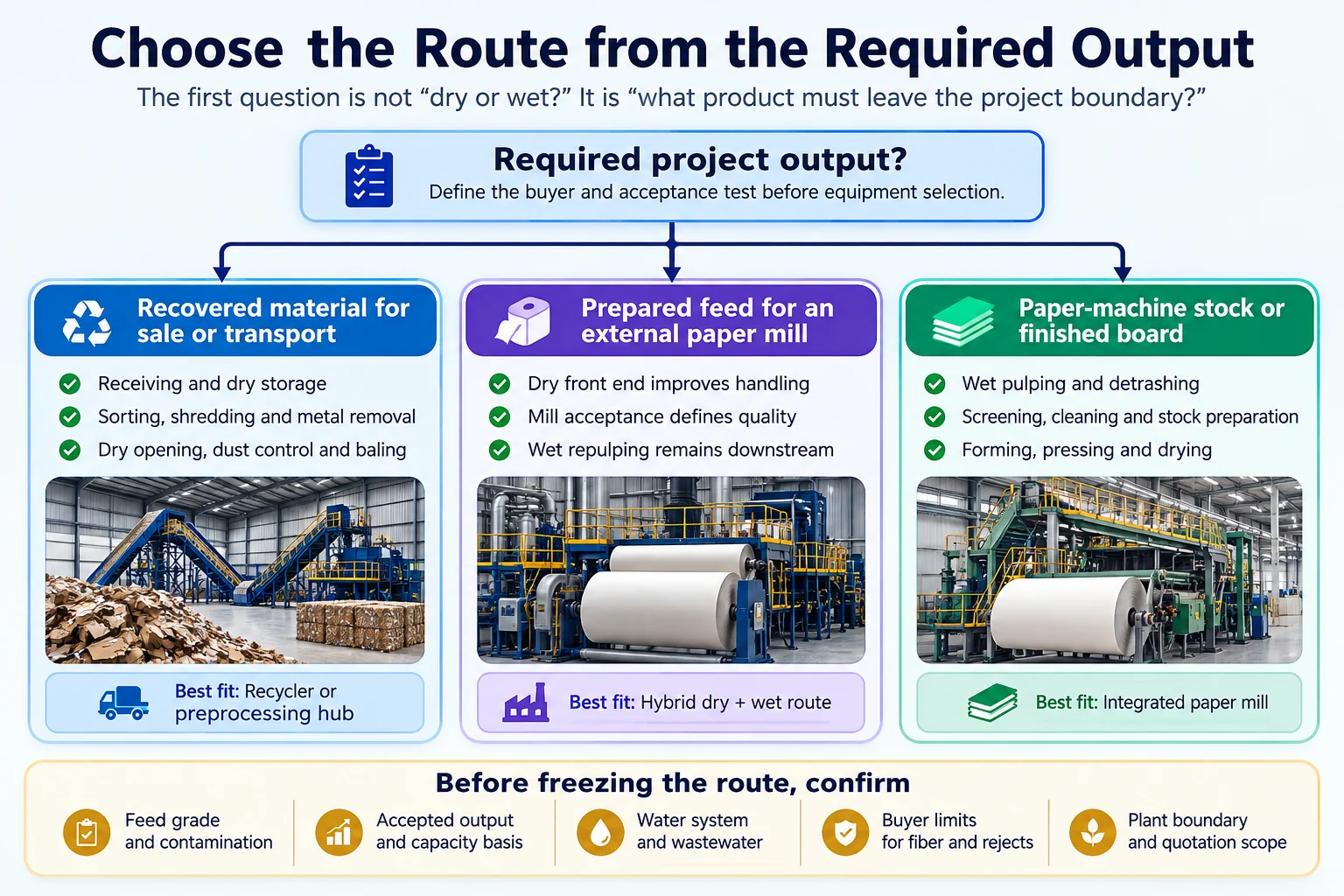
One buyer may need a dry plant that opens OCC bales, removes metal, loosens the paper structure and makes a transportable recovered-fiber bale. Another may intend to make linerboard and therefore needs hydrapulping, screening, cleaning, stock preparation and a paper machine. The word pulping is being used for two very different project boundaries.This distinction matters before equipment, capacity or price is discussed. Dry mechanical preparation can be a practical way to process bulky waste cardboard without installing a conventional process-water loop at that site. Wet pulping, however, is the established route for separating recovered paper into fiber slurry and preparing stock for new paper or board. Sometimes the right answer is dry. Sometimes it is wet. Surprisingly often, the correct industrial route uses both in sequence.
The Core Difference Is the Product Leaving the Line
In the YUXI project scope, “dry pulping” is best understood as dry mechanical fiber opening and recovered-paper preparation. It combines receiving, sorting, shredding, metal removal, metered conveying, dry opening, dust control and optional baling. The immediate product is loose or baled fiber-rich material.
The YUXI line shown here is a dry mechanical preparation plant. It improves handling and opens the paper structure, but it is not a complete wet stock-preparation and papermaking system.
Why “Dry Pulping” Needs a Clear Definition
In conventional papermaking language, pulping or repulping recovered paper normally means mixing it with water and mechanical energy to release fibers.Equipment suppliers also use “dry pulping” for systems that mechanically fiberize or open waste paper with little or no process water. The phrase is commercially understandable, but it can create an expectation that the output is equivalent to cleaned wet pulp. That is not always true. A dry opener can separate layers and loosen fiber bundles; it does not automatically remove every adhesive, fine plastic, sand particle or coating that a paper mill must control.For this article, the terms are defined as follows:
Dry pulping / dry preparation: mechanical processing of dry OCC or suitable paper waste without a conventional hydrapulper and process-water loop, producing a fiber-rich recovered material.
Wet pulping / paper-mill stock preparation: water-based disintegration of recovered paper into fiber slurry, followed by screening, cleaning and stock conditioning for papermaking.
The broader industrial cardboard recycling process explains the full chain from collection to new board. This page focuses only on choosing and comparing the dry and wet processing routes.
How the Two Cardboard Processing Routes Differ
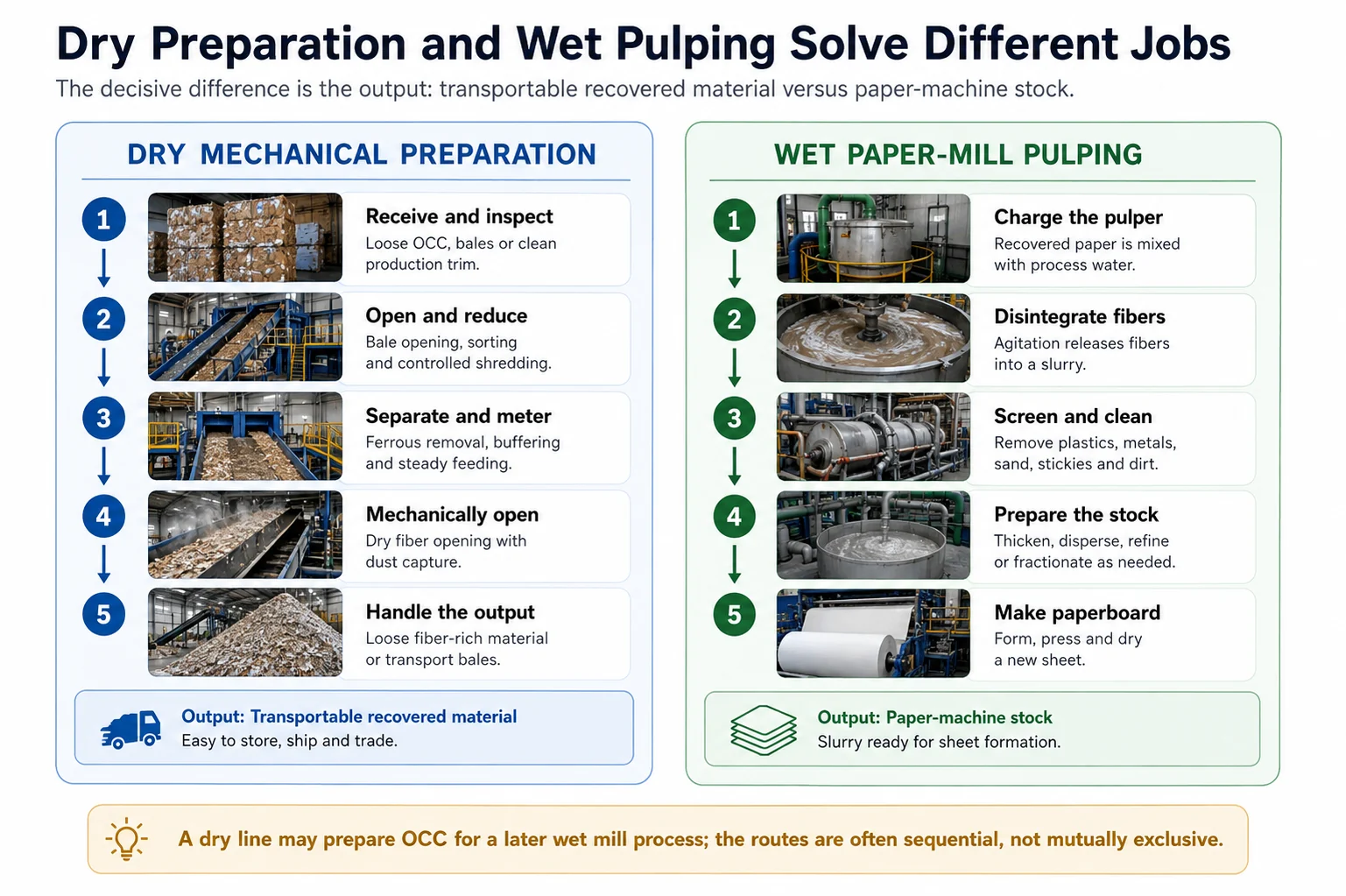
Dry preparation ends with a transportable recovered material. Wet pulping continues through fiber-slurry cleaning and papermaking.
Typical dry preparation sequence
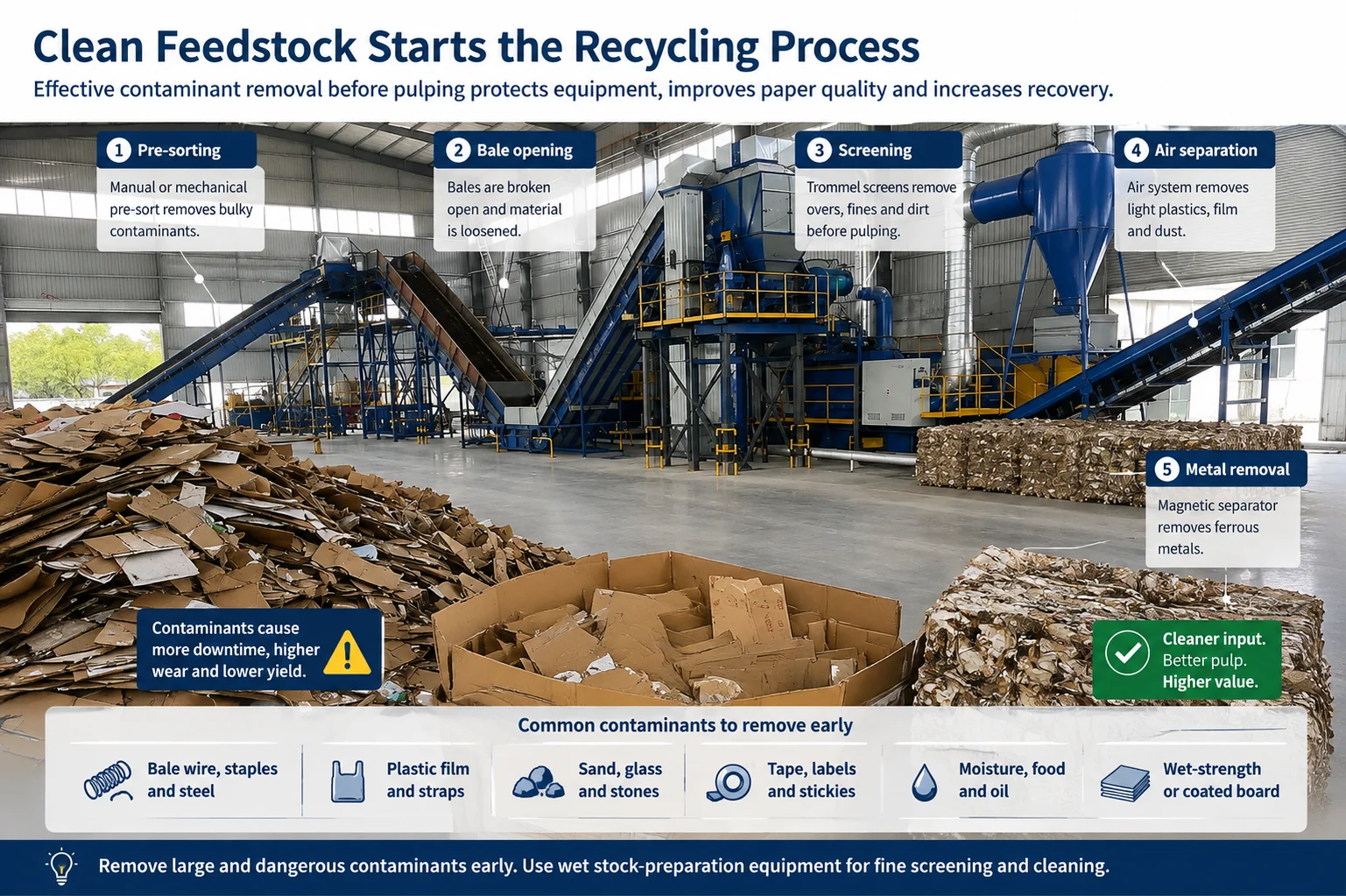
A dry line starts with how the OCC physically arrives. Loose boxes need controlled feeding because their bulk density is low and their shape is irregular. Wired bales need safe unloading, wire management, bale opening and inspection. Large plastic, rope, foam, wood and other obvious outthrows should be removed before rotating equipment.Primary shredding then reduces bulky sheets and bundles into a more manageable feed. Ferrous separation has better access after the material is opened. A buffer or metering conveyor evens out the surges before the dry fiber opener, which mechanically loosens the paper structure. Enclosures, pickup hoods, ducting and dust collection are part of the process—not cosmetic accessories. The material may leave loose or enter an automatic baler.The complete module list varies with the feed. The existing cardboard recycling plant equipment guide separates core machines from options such as bale opening, light-reject separation and automatic baling.
Typical wet pulping sequence
At a paper mill, recovered paper is charged to a pulper or drum pulper with water. Mechanical action releases fibers while heavy and coarse contaminants are removed through traps, ragger systems or detrashing equipment. The pulp then moves through coarse screens, cleaners and fine screens. Depending on the furnish and product, the mill may fractionate long and short fibers, disperse stickies, refine selected fractions, thicken stock and blend it with other fiber sources.Voith describes OCC stock preparation as a multi-stage process in which contaminants such as adhesives, metals, sand and plastics should be removed as early as practical.[1] Valmet similarly lists pulping, screening, cleaning, thickening, dispersing and refining within recycled-fiber lines.[2] These are not minor add-ons to a dry shredder. They are a different process system built around a pumpable fiber suspension.
Dry Pulping vs Wet Pulping: Side-by-Side Comparison
Decision point
Dry mechanical preparation
Wet paper-mill pulping
Primary purpose
Reduce bulk, stabilize feeding, remove obvious contaminants, mechanically open paper and prepare material for storage, transport or downstream use.
Disintegrate recovered paper into fiber slurry, clean and condition the stock, then feed papermaking operations.
Typical feed
Dry OCC bales, loose cartons, kraft trim and selected paper waste with controlled contamination.
Recovered-paper bales or dry-prepared feed matched to the mill furnish and product recipe.
Water system
No conventional wet pulper or full process-water loop inside the dry-line boundary.
Water is central to pulping, stock transport, screening, cleaning and sheet formation.
Usable fiber yield, stock cleanliness, consistency, drainage, stickies, ash, strength potential and final sheet properties.
Site profile
More compatible with recycling or preprocessing sites that lack paper-mill water and effluent infrastructure.
Normally part of a mill with substantial water, drainage, treatment, pumping, process control and papermaking infrastructure.
Commercial boundary
Sells or transfers prepared recovered material.
Produces stock for paper manufacturing or finished paperboard when integrated with the paper machine.
The table makes one purchasing mistake obvious: a dry line and a wet stock-preparation line should not be compared only by price per ton of nominal input. They do not deliver the same product. The accepted output and included plant boundary must be normalized first.
Water Use: Reduction at One Site Is Not Elimination Across the Full Chain
The dry route has a clear site-level advantage: it does not require a conventional hydrapulper, pulp chests, stock pumps and a complete process-water circuit in the dry preparation plant. That can reduce utility complexity and avoid installing a wet effluent system for that preprocessing operation. It can also simplify winterization, corrosion management and wet housekeeping.However, claims such as “zero water cardboard recycling” need context. When the final goal is new paperboard, water normally enters later at the receiving mill. A dry plant can move or reduce the water requirement within the supply chain; it does not prove that the full paper-recycling lifecycle is water-free.Wet systems also differ from one another. The correct project question is therefore not “Does wet pulping use water?” It clearly does. The useful questions are:
How much fresh water and recirculated process water does the proposed system require at the stated production basis?
What enters the wastewater or sludge stream?
How are rejects dewatered, stored and disposed of?
Which equipment and civil works are included in the supplier’s water balance?
Does the site already have a mill water system, or would it be built from zero?
Contaminants Decide Whether Dry Preparation Is Enough
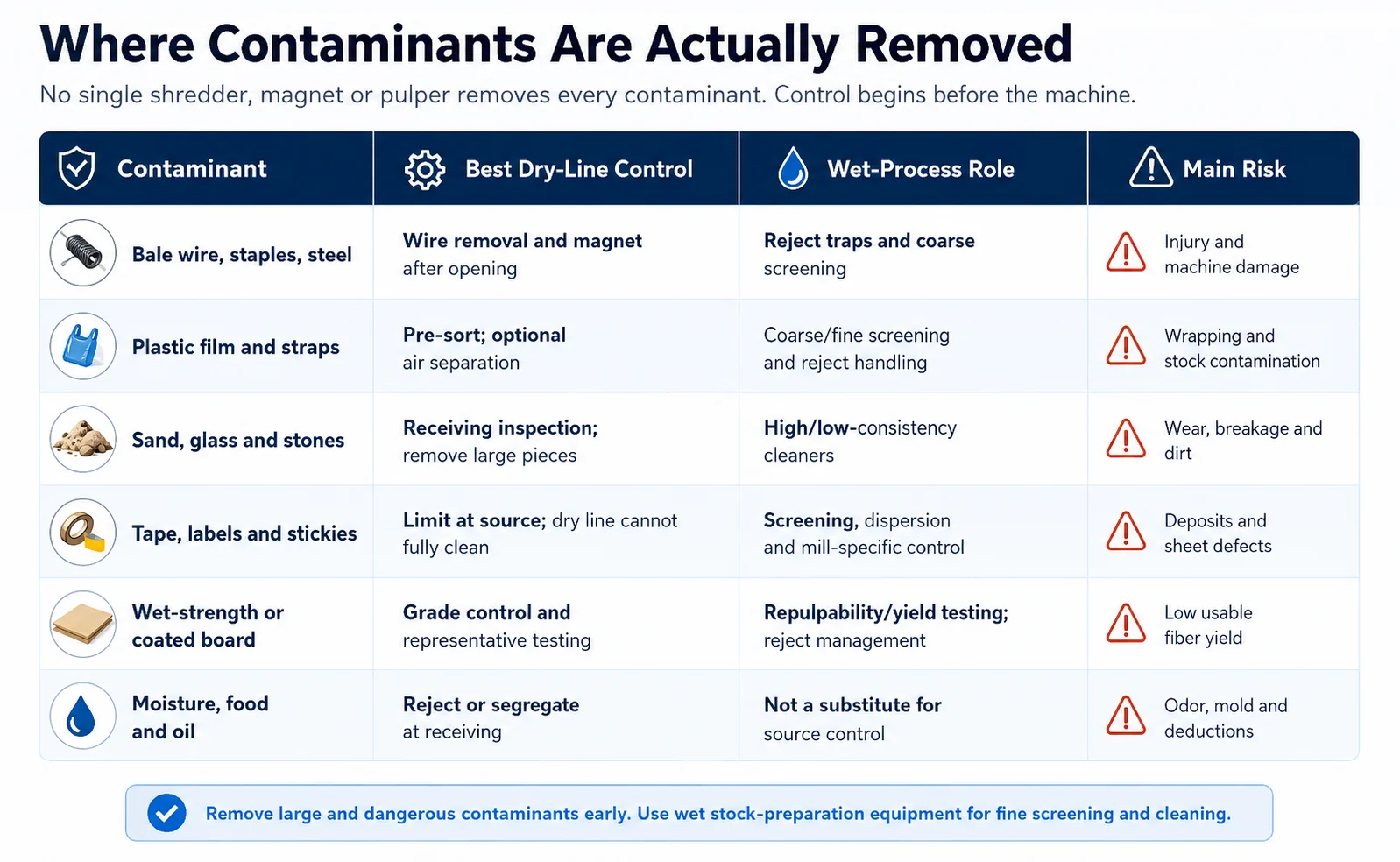
Clean warehouse OCC is forgiving. Mixed commercial bales are not. A load may contain bale wire, staples, plastic stretch film, foam, wood, glass, sand, food residue, labels, hot-melt adhesive, waxed board and wet-strength packaging. Each contaminant has a different best control point.Good process design removes hazards and obvious outthrows early, then assigns fine fiber-stock cleaning to the wet system.Dry lines are effective when the contamination can be seen, exposed or separated by a specific physical property. Operators can remove rope and film during bale opening. A magnet can capture ferrous pieces after shredding exposes them. Air classification may remove part of a light fraction. Dust collection captures suspended fines when the pickup points and ducting are correctly designed.That is not the same as paper-mill stock cleaning. Pressure screens separate particles by geometry and slot size. Hydrocyclone cleaners use density and centrifugal effects to remove heavy or light contaminants. Some materials challenge both routes. Wet-strength additives, barrier coatings and laminated constructions may resist normal repulping or create excessive rejects. A recent repulpability study emphasizes usable fiber yield and reject generation as critical variables in recycled-paper economics.[3] This is why the OCC grades and quality guide treats material description, outthrows, prohibitive materials and moisture as commercial specifications—not just housekeeping notes.In practice, the cheapest contaminant to remove is often the one rejected before it enters the line. No amount of downstream equipment makes food-soaked, oil-contaminated or heavily laminated board equivalent to clean OCC.
Fiber Quality: Opened Material Is Not the Same as Clean Stock
A dry fiber opener applies mechanical action to loosen layers, separate bundles and create a more uniform recovered material. The output may look soft and fibrous. That appearance can be misleading. Paper-machine stock is evaluated in water, where the mill measures fiber release, screen rejects, cleanliness, drainage, fines, stickies and strength potential.Dry over-processing also has a trade-off. More mechanical action can improve the opening, but it may produce extra fines and dust or shorten the useful fiber. Wet pulping has its own trade-offs: overly aggressive disintegration can break contaminants into smaller pieces that become harder to remove. Good wet systems therefore aim to release fibers while removing contaminants early and gently.Neither route upgrades a poor paper grade by name alone. Shredding mixed paper does not turn it into premium OCC. Wet pulping also does not make every coating disappear. The usable fiber value depends on incoming grade, prior recycling history, moisture, treatment chemistry, contamination and the paper product being made.The acceptance test should match the output:
Dry-line output tests
Wet-stock output tests
Input and accepted-output mass balance
Oven-dry fiber yield and reject mass
Moisture and non-paper content
Coarse/fine screen rejects and stickies
Ferrous removal and visible contamination
Stock consistency, ash and dirt
Particle/fiber-bundle condition and dust
Drainage, freeness and strength potential
Bale density, integrity and buyer acceptance
Paper-machine runnability and final sheet properties
Energy and Cost Comparisons Must Use the Same Project Boundary
Dry preparation systems are often marketed as lower-energy solutions because they avoid water pumping, wet screening and wastewater treatment within that line. Wet-system suppliers may point out that high-consistency pulping, integrated screening and improved fiber recycling are ways to reduce energy or raw materials losses. Both statements can be directionally reasonable. Neither proves the total cost of a specific project.A fair comparison includes:
electricity for receiving, shredding, conveying, dry opening, dust collection and baling;
electricity for pulping, pumps, agitators, screens, cleaners, thickeners and reject treatment;
water supply, recirculation, heating if used, effluent treatment and sludge handling;
wear parts, knives, screen baskets, pulper components, bearings and seals;
labor for wire removal, sorting, cleaning, sampling and reject handling;
fiber loss, outthrow disposal, downtime and saleable-output yield;
transport cost and whether dry preparation changes bale density or logistics;
the value of the actual output—not the value of a cleaner product the quoted line does not make.
We have found that the biggest quotation gap is often not the motor list. It is the missing boundary. One proposal stops at a baled dry product. Another includes stock preparation but excludes the paper machine, civil tanks and wastewater plant. A third includes only the pulper. Their total prices cannot be interpreted until the interfaces are written down.Do not publish or accept a universal “X percent less energy” claim without the feed, output, moisture basis, test duration and included equipment. A clean trim line and a mixed OCC mill are different comparisons.
Equipment, Site and Utility Requirements
Dry preparation site
The dry line needs floor area for unloading, quarantine, loose-cardboard storage or bale stacking, safe wire removal, conveyors, the shredder, magnetic separation, buffer capacity, the fiber opener, dust-control ducting, a collector and finished-bale handling. Clear height matters because conveyors and cyclones can rise above the main machines. Fire protection, housekeeping, access platforms and forklift routes must be designed around the building.Paper dust deserves formal review. OSHA identifies moving machinery, crushing, unexpected startup and combustible materials among paper-recycling hazards, and its combustible-dust guidance includes paper among potentially combustible organic dusts.[4] The solution is not simply “add a fan.” Capture points, enclosure, duct velocity, collector location, ignition control, isolation and local code requirements need project-specific engineering.
Wet pulping site
A wet system adds pulpers, chests, pumps, pipe racks, screens, cleaners, platforms, drains and reject dewatering. Tanks and foundations introduce structural loads. Process areas need drainage and spill management. Instrumentation must measure level, consistency, flow and pressure across a continuous stock system. Maintenance access must account for screen baskets, rotors, pumps and valves.The wet line also relies on downstream storage and paper-machine demand. A pulper that can process more OCC than the screening system accepts simply moves the bottleneck. The same is true in a dry line when the shredder outruns the fiber opener or baler. Layout should be built around flow and buffer logic, not a row of individually rated machines.
Capacity Is Not Comparable Until Moisture, Yield and Output Are Defined
Cardboard capacity is easy to overstate because the feed is bulky and moisture changes the scale weight. A line may process a high gross input while producing much less accepted dry fiber. Wet systems add another layer: stock flow is often discussed in consistency and oven-dry production, while dry equipment brochures may quote wet input tons per hour.The existing waste cardboard recycling plant capacity guide explains why sustained accepted output is more useful than a short peak. For this comparison, require every supplier to state:
whether capacity is incoming wet mass, oven-dry fiber or accepted product;
the assumed OCC grade, bale form, bulk density, moisture and contamination;
the feeding method and normal operator interventions;
the reject rate and how rejects are weighed;
the run duration and whether cleaning or screen changes are included;
the downstream bottleneck and buffer assumptions;
the final product specification used to declare the test successful.
A dry test with hand-selected cartons does not prove performance on wired commercial OCC bales. A pulper demonstration that shows disintegration does not prove low stickies, high usable fiber yield or paper-machine runnability. The test must reproduce the difficult part of the intended job.
When Dry Pulping Is the Better Fit
Dry mechanical preparation is usually the more logical starting point when the project is a recycling, sorting or preprocessing operation rather than a paper mill. Typical reasons include:
the business sells recovered material to an external mill instead of making paper;
bulky loose boxes or OCC bales need controlled size reduction and denser handling;
the site does not have mill water, effluent treatment or stock-preparation infrastructure;
ferrous contamination and large outthrows need removal before transport or downstream processing;
the buyer accepts a defined dry-prepared material or bale;
the project needs modular expansion without installing a full wet mill at the first stage.
Dry does not mean simple. Low-bulk-density cardboard can bridge, flutter and surge. Bale wire creates stored-energy and entanglement hazards. Mechanical opening generates dust and fines. A successful line still depends on receiving design, metering, interlocks, separation and output handling.
When Wet Pulping Is Essential
Wet pulping is essential when the required output is paper-machine stock or finished containerboard. It is also necessary when the mill must quantify usable fiber yield, remove fine contaminants from the stock, fractionate fibers or condition the furnish for a specific paper grade.Wet processing is the right scope when:
the project includes a paper or paperboard machine;
the output specification is written in stock-quality terms rather than bale quality;
fine plastics, stickies, sand and dirt must be removed from the fiber suspension;
the mill needs blending, refining, dispersion, fractionation or thickening;
water loops, effluent treatment, tanks and mill utilities already exist or are part of the investment;
final paper strength, drainage and runnability are contractual performance points.
The Most Practical Route May Be Dry Preparation Followed by Wet Pulping
The comparison is often presented as either/or. Industrial supply chains are more flexible. A dry preprocessing plant can receive OCC from warehouses, open bales, remove dangerous metal, reduce bulk, meter the feed, capture dust and produce a consistent material for shipment. The paper mill then repulps and cleans it in water.Define the project output first. A hybrid route separates logistics and dry preparation from the paper mill’s wet stock-preparation duty.This arrangement can make sense when the source of recovered cardboard is far from the mill, when several collection hubs feed one mill, or when the mill wants upstream suppliers to deliver a more uniform material. But the mill must approve the output. Dry preparation should not reduce fiber value, create excessive fines or mix grades that the mill needs to keep separate.The commercial agreement should define moisture, grade, prohibitive materials, outthrows, bale dimensions, sampling, claims and rejection procedure. ReMA’s recovered-paper guidelines emphasize written agreement on quality, quantity and packing-unit conditions, along with definitions for moisture, outthrows and prohibitive materials.[5]
Where the YUXI Waste Cardboard Recycling Line Fits
The current YUXI waste cardboard recycling machine and plant is positioned as a dry system for OCC, waste cardboard boxes, cartons, kraft paper and suitable paper-mill waste. Its public scope combines controlled feeding, primary shredding, ferrous removal, dry mechanical fiber opening, dust collection and optional baling.That makes the line relevant when a buyer needs more than a cardboard baler but does not intend to install a conventional wet paper mill. It can prepare bulky feed, expose and remove ferrous pieces, stabilize flow and create a fiber-rich product that is easier to handle or bale.The boundary is equally important. YUXI’s page does not present the dry line as a complete hydrapulping, stock-cleaning and papermaking system. Downstream suitability depends on the incoming grade, moisture, coatings, adhesives, film and the receiving mill’s process. We normally recommend obtaining the buyer’s material acceptance sheet before the dry equipment is finalized.A useful YUXI project review should therefore start with three items: representative material, the required dry output and the downstream user. Machine selection comes after those are understood.
How to Compare Dry and Wet Pulping Quotations
Place the following schedule beside every proposal. Blank cells reveal more than polished brochures.
Quotation item
What must be stated
Plant boundary
First included operation, final included operation and every customer-supplied interface.
Feed basis
OCC grade, loose or baled form, bale wire, moisture, contamination and largest dimensions.
Output definition
Dry bale, loose fiber-rich material, cleaned stock or finished paperboard; include acceptance limits.
Capacity basis
Gross input, accepted dry output or oven-dry fiber; normal rate rather than short peak.
Reject system
Expected reject types, removal points, dewatering, weighing, storage and disposal.
Water scope
Fresh/process water demand, tanks, pumps, piping, drains, wastewater and sludge treatment.
Dust and safety
Enclosures, pickup points, collector scope, guarding, interlocks and required site review.
The winning quotation is not automatically the one with the fewest machines. It is the one whose output, boundary and risk allocation match the business plan.
Define the Output Before Choosing Dry or Wet Pulping
Send YUXI your OCC grade, material photos, loose or baled condition, moisture, contamination, required accepted output, workshop dimensions and downstream buyer requirements. The proposal can then separate the dry preparation scope from any wet paper-mill operations your project still needs.
FAQ
Is dry pulping the same as making paper pulp without water?
Not in the YUXI waste-cardboard line described here. The dry route mechanically opens and prepares OCC into a fiber-rich recovered material without a conventional wet pulper loop. It does not by itself create cleaned paper-machine stock or finished paperboard.
Does a dry cardboard recycling line eliminate water use?
It eliminates the conventional wet pulper and process-water loop inside the dry preparation boundary. If the recovered material is later used to make new paper, the downstream mill will still use water for repulping, stock cleaning and sheet formation. The correct claim is reduced or deferred water demand at the preprocessing site, not universal elimination across the full recycling chain.
Which process removes tape, labels and plastic film better?
Large film, straps and visible contaminants should be removed before shredding in either route. A dry line can pre-sort, magnetically separate ferrous material and use optional dry separation, but fine tape, labels, stickies and small plastic fragments normally require wet screening, cleaning and mill-specific reject control.
Can dry-prepared OCC go directly into a paper machine?
Normally no. Paper machines require controlled fiber stock with defined consistency, cleanliness, drainage and furnish properties. Dry-prepared output may be a useful feedstock, but the receiving mill decides whether additional repulping, screening, cleaning, refining or blending is required.
Is wet pulping always more expensive than dry pulping?
Not as a universal rule. A wet line has additional pulping, pumping, screening, cleaning, water-treatment and stock-preparation systems, but the comparison changes with the required output. A dry line cannot be credited with producing paper-machine stock if it only makes transportable recovered material. Compare projects on the same output specification and plant boundary.
When is a hybrid dry and wet route the best choice?
A hybrid route is often practical when bulky or contaminated OCC needs receiving, opening, size reduction, metal removal, metering and baling before it reaches a paper mill. The dry plant improves handling and logistics; the mill still performs wet repulping and stock cleaning.
What information is needed to compare the two routes?
Provide the incoming paper grade and form, bale data, moisture, contaminants, required sustained output, downstream buyer or paper product, water and wastewater availability, workshop constraints, operating hours, reject limits and the exact project boundary.
References
Voith, BlueLine OCC Process, multi-stage OCC stock preparation and early contaminant removal.
David focuses on industrial shredding and recycling equipment,including material evaluation,shredder selection,process configuration,and recycling line planning.
Speak To Our Shredder Machine Expert
Get in touch with our nice team today to get a price estimate for a shredder machine.

 English



 Fast Delivery
 Reliable
 Certified
 Experienced