





A complete equipment list can still produce an incomplete plant. We have seen quotations that include the shredder, magnet and baler, yet leave the material transfers between them as vague arrows. On paper, every major machine is present. In the workshop, the line waits for a loader, overfills a chute or stops while operators pull film from a transfer point.
That is why cardboard recycling plant equipment should be listed by function, not simply by machine name. Every stage must receive material, perform one defined job and hand the material to the next stage at a rate it can accept.
Equipment map at a glance: A dry industrial OCC preparation line commonly includes a receiving conveyor, bale-opening and pre-sorting equipment when required, a double shaft shredder, magnetic separation, buffer and metered conveying, a dry fiber opener, dust collection, optional light-reject separation, discharge handling and an automatic baler. PLC controls, interlocks, guarding, access platforms and maintenance space are part of the working system even though they are not always shown as process machines.
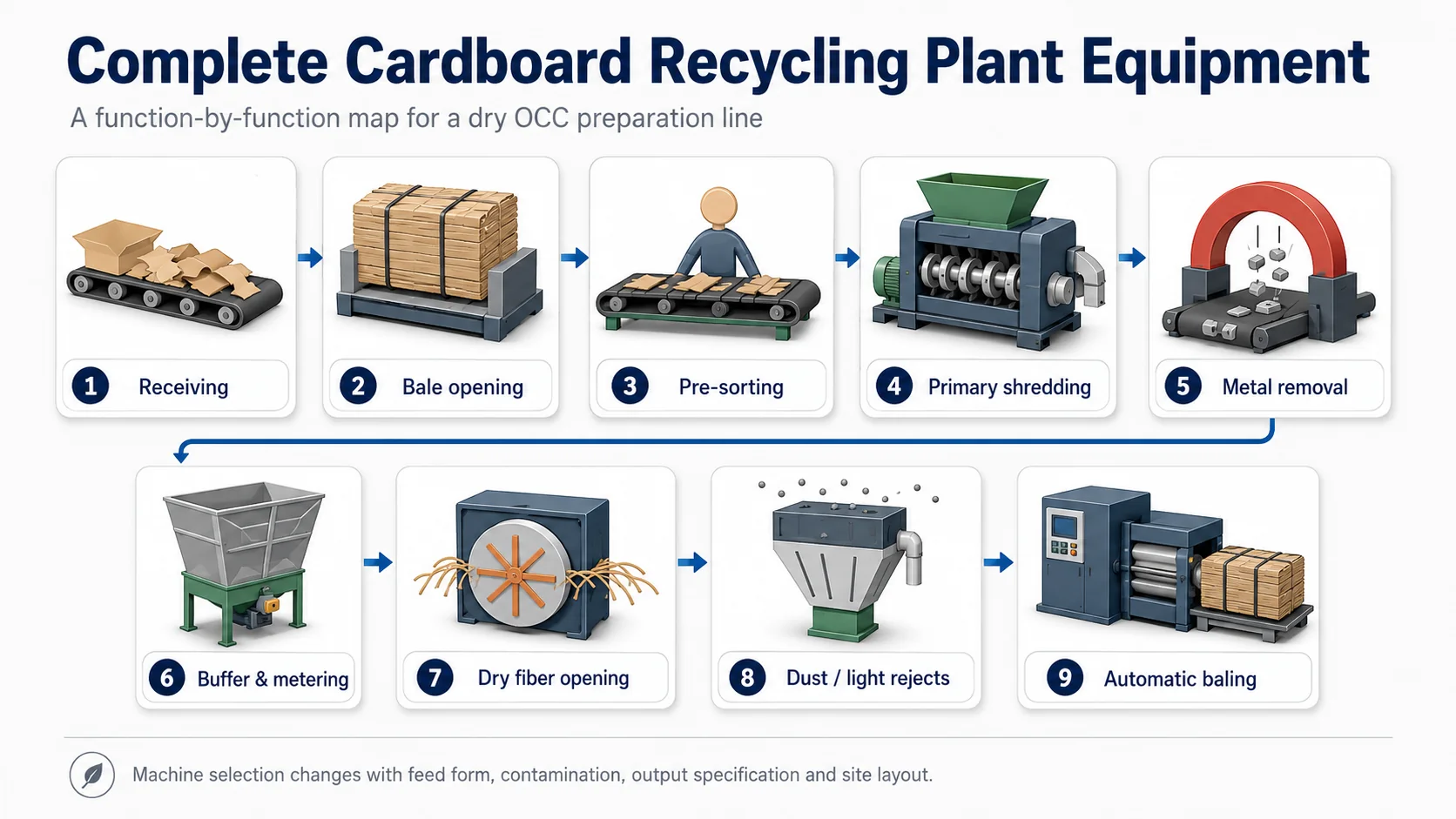
Complete Cardboard Recycling Plant Equipment List
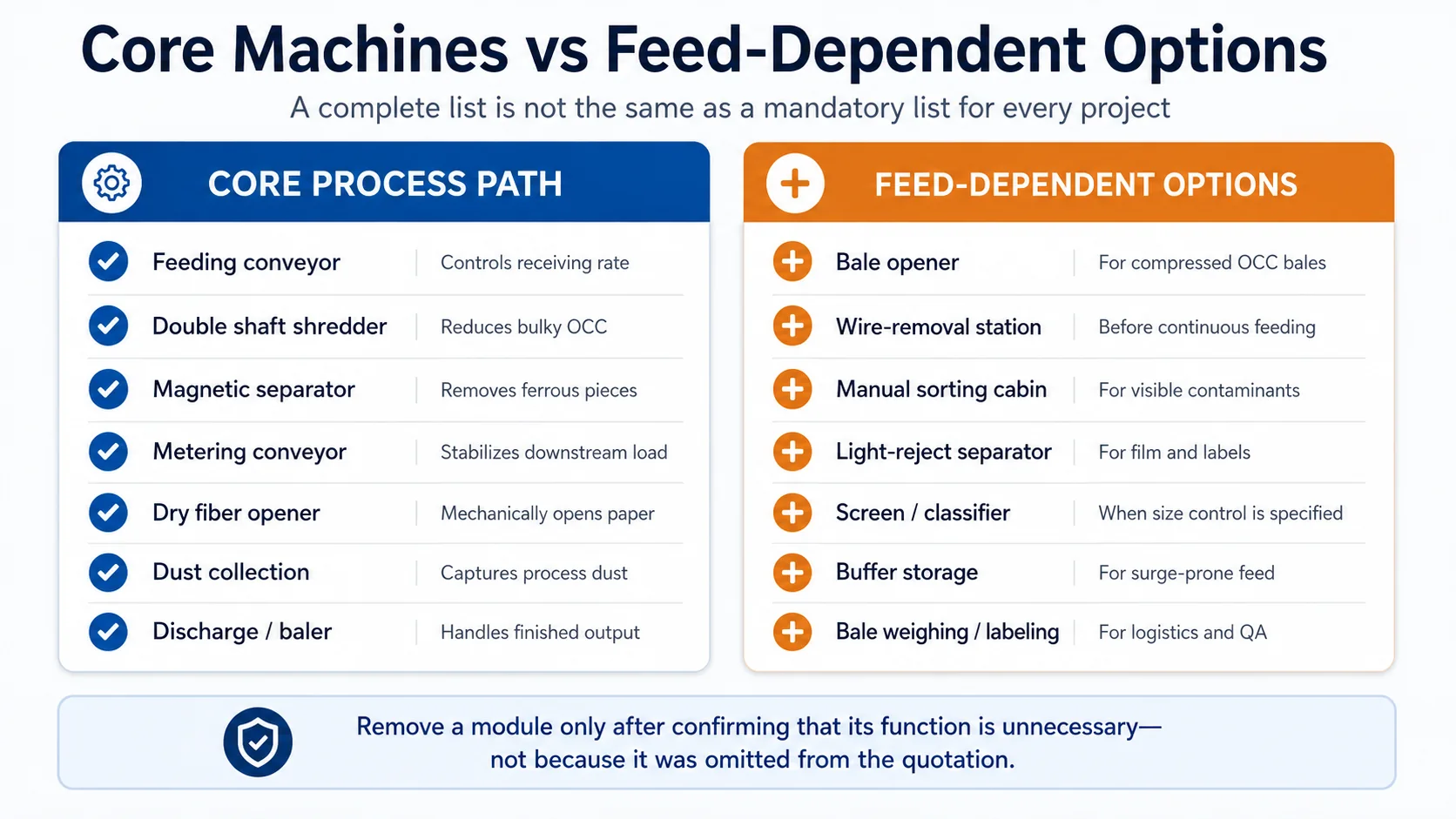
A project may not need every module. Still, the review should consider every function. Removing a machine after a feed audit is good engineering. Discovering after installation that nobody owned that function is not.
| Equipment or system | Main function | Usually required when | What it cannot solve alone |
|---|---|---|---|
| Receiving or feeding conveyor | Accepts loose boxes or opened-bale material and controls the loading rate | Continuous industrial operation is required | Does not remove contamination or prevent every surge without suitable hopper geometry and controls |
| Bale staging and wire-removal area | Provides a safe place to position compressed OCC and remove wire or straps | Feed arrives in tied bales | Does not break apart the complete bale or meter it continuously |
| Bale opener / breaker | Loosens compressed sheets and releases material for inspection and conveying | Dense bales would otherwise enter as large blocks | Does not guarantee contaminant removal |
| Pre-sorting conveyor or cabin | Exposes the feed so operators or automated devices can remove large unwanted items | Feed quality varies or contains film, wood, metal, glass or non-paper packaging | Does not identify every hidden or bonded contaminant |
| Double shaft shredder | Tears bulky OCC, sheets and boxes into a more manageable intermediate size | The downstream opener needs a steadier, smaller feed | Does not make clean fiber from contaminated cardboard |
| Magnetic separator | Removes ferrous wire, staples and steel pieces after material is opened | Metal is present or could damage downstream equipment | Does not remove aluminum, plastic film, glass or stainless material |
| Buffer hopper / storage bin | Separates upstream surges from downstream demand | Bale release or loader feeding is uneven | Does not increase the capacity of the slowest downstream stage |
| Metering conveyor | Feeds the next machine at a controlled, repeatable rate | The fiber opener or separator is sensitive to overfeeding | Does not correct an undersized receiving or discharge section |
| Dry fiber opener / fiberizer | Mechanically loosens and opens shredded paper into a fiber-rich form | The output requirement is more than simple shredded cardboard | Does not replace wet repulping, screening and cleaning at a paper mill |
| Light-reject separator | Uses air or density differences to separate some film, labels and light non-paper material | The feed contains a measurable light fraction | Does not create a perfect paper grade from heavily mixed waste |
| Screen or classifier | Controls oversize, fines or a defined material fraction | The buyer specifies particle condition or the process needs recirculation | Does not improve chemical suitability or fiber strength |
| Dust collection system | Captures airborne paper fines at enclosed machines and transfer points | Shredding, opening and conveying generate dust | A collector cannot compensate for poor hoods, open chutes or unbalanced ducting |
| Discharge conveyor / collection bin | Moves prepared material away from the process and provides surge capacity | Loose output is stored or sent to a baler | Does not define product quality by itself |
| Automatic horizontal baler | Compresses prepared material into dense, stackable bales | Storage, transport or buyer requirements favor baled output | Does not clean, grade or dry the material |
| Bale conveyor, weighing and labeling | Moves finished bales and records logistics or quality data | Output is traded, stored or shipped systematically | Does not correct inconsistent feed quality |
| PLC, HMI, sensors and interlocks | Coordinates machine starts, stops, levels, overloads and emergency responses | Multiple machines operate as one connected line | Automation cannot remove a physical bottleneck |
| Platforms, guards and service access | Supports safe operation, inspection, cleaning and maintenance | Always part of an industrial installation | Does not replace site-specific risk assessment, procedures or training |
1. Receiving Conveyor, Bale Staging and Bale Opener
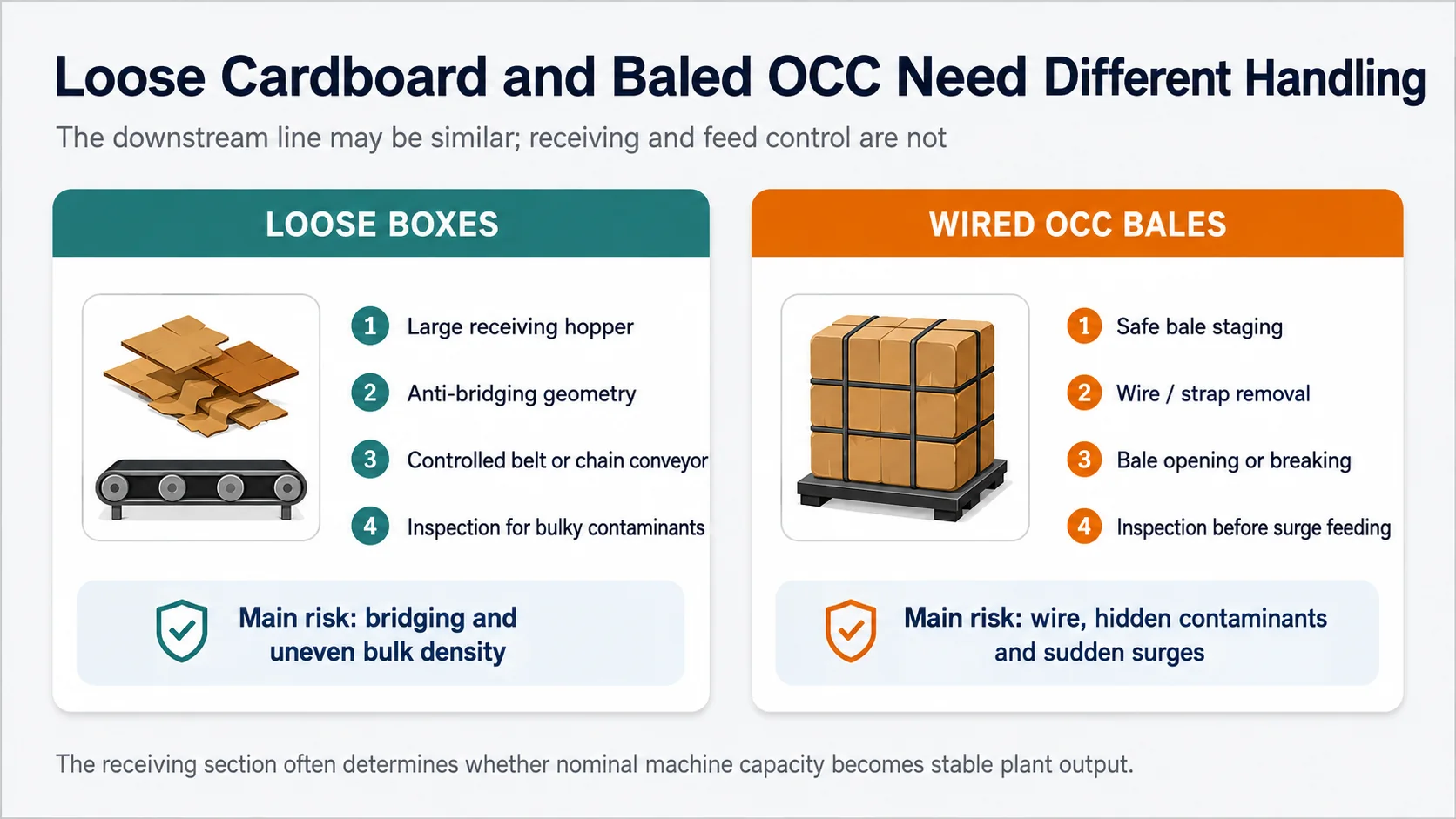
The first machine is often treated as a simple conveyor. In practice, it is the plant’s throttle. Loose flattened boxes have low and variable bulk density. Folded cartons can bridge above a narrow belt, then collapse into a sudden slug. Baled OCC behaves differently: it arrives as dense blocks held by wire or strap and may hide moisture or foreign material in the center.
For loose cardboard, the receiving system normally needs enough hopper volume, sidewalls and geometry to avoid bridging. A chain conveyor can tolerate rough loading; a belt conveyor may provide a cleaner transfer for prepared material. The correct choice depends on the largest piece, loader bucket, drop height and required feed rate—not on the word cardboard.
For baled OCC, the front end should include a defined unloading and staging area. Wire or straps must be removed under an approved procedure before they can wrap around shafts or enter the next machine. A bale opener then separates compressed layers so the material can be inspected and metered. Sometimes buyers ask the shredder to “open the bale.” It may physically tear the block, but that does not make direct bale feeding a good receiving plan.
2. Pre-Sorting Conveyor and Contamination Removal
Pre-sorting is not glamorous equipment. It is also one of the cheapest places to remove a problem. A piece of wood removed on a slow inspection conveyor costs much less than the same piece after it damages a rotor, blocks a chute or becomes fragmented through the product.
The inspection section should expose material rather than bury it in a deep bed. Belt width, speed, lighting, working height and reject chutes matter. The team needs enough time to identify bale wire, rope, plastic film, foam, glass, stones, wet bundles, food waste and non-paper packaging.
The OCC cardboard grade guide explains why brown appearance is not a complete quality specification. ReMA’s Grade 11 OCC description covers corrugated containers with test-liner or kraft liners and sets limits for prohibitive materials and combined outthrows plus prohibitives.[3] A machine list cannot compensate for a feed contract that never defines what is acceptable.
Manual sorting can be supplemented with sensors or automated sorting in larger facilities, but the function remains the same: remove material that should not enter the dry paper path. We normally recommend defining the expected contaminant by type and weight percentage before deciding whether a sorting cabin, light separator or additional screen belongs in the line.
3. Double Shaft Shredder for Primary Size Reduction
The shredder reduces bulky, irregular OCC to a more manageable intermediate size. Two slow-speed shafts pull material into the cutting chamber and tear it rather than relying on a high-speed fine cut. That grabbing action is useful for opened boxes, layered sheets and irregular paper waste that would otherwise feed unevenly.
In this plant, the shredder is a preparation stage. Its job is not to create final paper pulp. Its job is to reduce volume, open folded structures, expose hidden metal and create a steadier feed for downstream separation and fiber opening. The YUXI double shaft shredder page describes the same broad role in recycling systems: rough size reduction before downstream separation, baling or further processing.
Shredder selection should consider the largest box or sheet, the condition of bale-opened material, required intermediate size, cutter geometry, chamber width, drive protection and foreign-object risk. Motor power alone tells very little. A wide chamber that accepts the feed without constant pre-cutting may be more useful than a high installed motor on a narrow opening.
What the shredder should achieve
Reliable bite, controlled intermediate size, stable discharge, overload recovery and access for inspection and maintenance.
What the shredder should not be asked to achieve
Moisture removal, paper grading, film separation, finished wet pulp or guaranteed buyer acceptance from undefined mixed waste.
4. Magnetic Separator for Ferrous Protection
Staples are small. Bale wire is not. Both can enter the plant with OCC, and neither should be ignored. After primary shredding, hidden ferrous pieces are more exposed and the material bed is thinner, which makes magnetic separation more effective.
An overband magnet can lift ferrous material from a conveyor. A magnetic head pulley or drum may be used where the transfer arrangement makes sense. The correct type depends on burden depth, belt width, material speed, distance to the magnet and the size of the expected metal.
Magnetic separation protects the fiber opener and reduces steel contamination in the output. However, it does not remove aluminum foil, many stainless steels, glass, stones or plastic. This is a recurring specification mistake: the quotation says “metal separator,” and the buyer assumes all metal has been solved. The machine name must state the separation principle.
5. Buffer Hopper and Metering Conveyor
Surprisingly, this quiet section often determines whether the expensive machines run well. The receiving conveyor may release a large volume when an OCC bale opens. The shredder may discharge in pulses. The fiber opener usually performs better with a controlled, relatively even feed.
A buffer hopper temporarily stores material between those behaviors. Level sensors tell the controls when to slow or stop the upstream conveyor. A metering conveyor then withdraws material at the rate the next machine can accept. Without that separation, every disturbance moves through the line: the opener overloads, dust rises, the discharge fills and the operator begins managing production by pressing stop and start.
The buffer needs enough usable volume for the real bulk density. A hopper sized from tonnes alone can be misleading because opened cardboard occupies a large volume. Wall angle, agitators, live-bottom devices and discharge width may be more important than the steel shell capacity shown on a drawing.
6. Dry Fiber Opener or Fiberizer
The dry fiber opener is the stage that distinguishes this line from a simple shred-and-bale system. It mechanically loosens the paper structure and produces a more open, fiber-rich material. The exact machine design and output condition depend on the feed and the buyer’s downstream use.
This stage needs a controlled input size and feed rate. Oversized bundles can overload it. Excess metal accelerates damage. Wet cardboard changes mass, friction and opening behavior. Plastic film may wrap or pass into the output unless it is removed before or after the opener.
The separate cardboard recycling process guide explains the full path from collection through dry preparation and later mill repulping. The important boundary here is simple: mechanical dry opening is not the same as making a water-based pulp slurry. AF&PA’s mill process includes water, pulping and subsequent screening and cleaning.[2]
Buyer question: Do not ask only, “Does the line include a fiber opener?” Ask what feed size enters it, what the output looks like, how rejects leave, where dust is captured and how the output will be sampled by the downstream user.
7. Light-Reject Separation, Screening and Dust Collection
Light-reject separator
Film, labels and light flexible contamination may be separated using air velocity and density differences. The separator can be useful after material has been opened enough for the paper and film to behave differently. It is not a universal purity machine. Wet film, laminated board and tightly bonded composites may not separate cleanly.
Screen or classifier
A screen can remove oversize or fines, or create a recycle loop back to the opener. It belongs in the machine list when the output specification requires a controlled fraction. Adding a screen without a clear product requirement can create unnecessary recirculation and dust.
Dust collection system
Paper fines are generated at shredders, openers, screens and transfer points. Effective dust control combines enclosures, pickup hoods, duct routing, air volume, filtration and safe discharge. Buying a large collector does not guarantee a clean workshop when the transfer chutes remain open or the pickup velocity is poorly distributed.
OSHA identifies unexpected machine startup, crushing, combustible materials and combustible dust among paper-recycling hazards.[4] Dust characteristics and required controls are site-specific, so the plant design should include a formal hazard review, housekeeping plan and applicable fire-protection and electrical requirements. A product article cannot replace that engineering work.
In practice, dust equipment must be drawn into the layout from the beginning. Long duct runs, tight elbows and limited filter access are difficult to fix after the process line has occupied the building.
8. Discharge Handling and Automatic Baler
Prepared material can remain loose or enter a baler. Loose discharge may suit an adjacent process or short internal transfer. For storage and long-distance transport, dense bales are usually easier to handle, sample and stack.
The automatic horizontal baler receives the loose fiber-rich material, compacts it and ties the finished bale. The machine should be selected from the required bale dimensions, density range, hourly mass, tying method, wire consumption, feed opening and discharge logistics. It should not be selected as an afterthought from the shredder rating.
The baler cycles. The upstream line flows. A surge bin or controlled feed between them may be needed so that one baler cycle does not stop the fiber opener. Bale conveyor length, forklift access, weighing, labeling and finished-product storage also belong in the output equipment list.
The cardboard recycling machine price guide discusses why the baler, controls and site scope can change total cost significantly. Here, the key equipment point is that the line is not complete until the finished material has a defined route out of the process.
9. PLC Controls, Sensors, Guarding and Plant Infrastructure
These items are sometimes placed under “electrical accessories.” They should be reviewed as production equipment.
PLC and HMI
The PLC coordinates the line. It should stop upstream feeding when a downstream level is high, manage shredder overload and reversal logic, start dust collection before material reaches the pickup points and present clear alarms to the operator. The HMI should show the reason for a stop, not only that a stop occurred.
Process sensors
Typical devices include belt speed switches, blockage sensors, high-level and low-level switches, motor-current monitoring, bearing-temperature monitoring where appropriate, door interlocks, bale-length controls and dust-system pressure monitoring. The machine list should state which sensors are included and what action each one triggers.
Guarding and emergency systems
Shredders, conveyors, rotating shafts and balers create nip, crush and entanglement hazards. OSHA requires control of hazardous energy during servicing and maintenance and describes lockout/tagout practices for preventing unexpected startup.[5] Machine guards, interlocked access, pull-cord or emergency-stop devices and safe access must be designed for the installed line, then supported by procedures and training.
Platforms, chutes and service space
Operators need access to inspect belts, remove rejects, change filters and service cutters without improvising ladders or dismantling adjacent equipment. A layout that fits every machine but leaves no maintenance clearance is not a workable layout.
Which Equipment Is Included in Different Plant Configurations?
The phrase “complete line” should always be followed by a configuration. The table below shows typical functional differences. It is not a fixed YUXI model table and should not be used as a performance guarantee.
| Configuration | Typical feed | Likely equipment scope | Main limitation |
|---|---|---|---|
| Simple baling system | Clean loose boxes from one source | Feeding area, conveyor or manual loading, vertical or horizontal baler, bale handling | Compacts material but does not create dry-opened fiber |
| Loose OCC dry preparation line | Flattened boxes and corrugated sheets | Receiving conveyor, sorting, shredder, magnet, metering, fiber opener, dust collection, discharge or baler | Still depends on feed quality and downstream acceptance |
| Baled OCC dry preparation line | Wired or strapped commercial OCC bales | Bale staging, wire removal, bale opener, sorting, conveyor, shredder, magnet, buffer, fiber opener, dust control and baling | Front-end labor and hidden bale contamination must be managed |
| Variable mixed-paper preparation | Selected mixed paper with film and other light rejects | Stronger pre-sorting, bale opening, primary reduction, magnet, optional screen and air separation, dust collection and flexible reject handling | Heavily coated, wet or composite material may remain unsuitable |
The related waste cardboard recycling machine selection guide owns the broader buying decision. For this equipment article, the practical rule is narrower: match every included machine to a material or output requirement, and make every excluded function explicit.
How to Balance the Complete Equipment Line
A plant’s useful capacity is not the largest number printed beside one machine. It is the accepted output that the complete line can sustain after rejects, stops and normal operating tasks.
Planning framework:
Accepted output rate = gross feed rate × (1 − reject fraction) × operating availability
Accepted output rate = gross feed rate × (1 − reject fraction) × operating availability
For example, a hypothetical line fed at 3 tonnes per hour, with 8% rejected material and 85% operating availability, would produce about 2.35 tonnes per hour of accepted output. The calculation is simple. Defining the three inputs honestly is the difficult part.
Line balancing should review:
- receiving volume per loader cycle or bale;
- shredder sustained output on the actual OCC condition;
- magnet burden depth and belt speed;
- buffer usable volume at opened-cardboard bulk density;
- metering accuracy and fiber-opener load;
- dust-system capacity at simultaneous pickup points;
- baler cycle, feed opening and finished-bale handling;
- time for wire removal, reject clearing, filter service and normal maintenance.
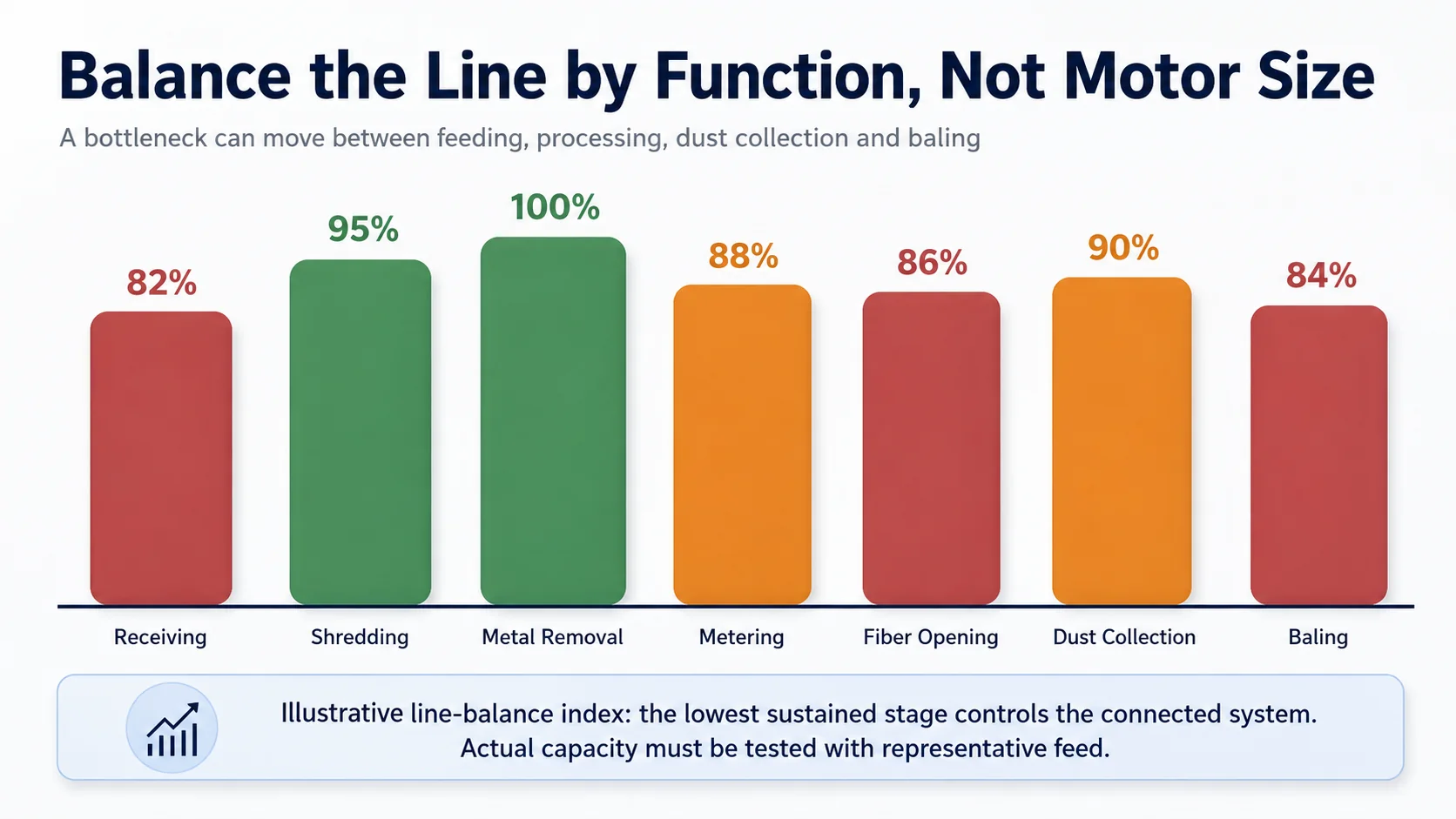
We have found that buyers often compare the shredder and fiber opener carefully, then accept generic conveyor widths. That is backwards when the feed is low-density OCC. Conveyors and hoppers carry volume, not only mass. A small change in how boxes are flattened or how a bale breaks apart can change the volumetric load dramatically.
How to Write the Equipment List into a Quotation
A quotation should let another engineer reconstruct the process boundary. A line item such as “conveyor × 5” is not enough.
| For every machine, specify | Why it matters |
|---|---|
| Machine name and process function | Prevents two suppliers from using the same name for different jobs |
| Quantity and position in the flow | Shows whether transfers and recirculation routes are included |
| Feed description and maximum piece or bale condition | Connects equipment selection to the actual material |
| Capacity basis and accepted-output definition | Separates a peak demonstration from sustained saleable output |
| Working width, opening and key dimensions | Checks physical compatibility between stages |
| Drive, speed control and overload protection | Clarifies operating flexibility and electrical scope |
| Materials, wear parts and maintenance access | Supports lifecycle and service planning |
| Sensors, interlocks and control actions | Defines how the connected line responds to faults |
| Guards, platforms, chutes and dust connections | Prevents essential installation items from becoming change orders |
| Included spares, documentation, FAT and support | Defines what happens after the equipment is built |
Common omissions to catch
Look for missing wire-removal tools, reject chutes, access platforms, belt cleaners, dust ducting, rotary valves, compressed-air requirements, baling wire, transformer scope, cables outside the control cabinet, foundations, lifting points, commissioning material and finished-bale handling.
Build the Machine List Around Your Material
The most useful equipment list begins with material photos, several opened bales, the largest normal and abnormal objects, moisture and contamination, daily volume, required accepted output, workshop dimensions and the downstream buyer’s specification. From there, YUXI can determine which receiving, shredding, separation, dry-opening, dust-control and baling modules belong in the line.
Get a Cardboard Recycling Plant Equipment Proposal
Send your feed photos, loose or baled condition, expected throughput, workshop dimensions and required output. We will map the machines, transfers and optional modules as one connected process.
Cardboard Recycling Plant Equipment FAQs
What equipment is needed for a cardboard recycling plant?
A dry industrial line commonly needs receiving and conveying, pre-sorting, a primary shredder, magnetic separation, buffering and metering, dry fiber opening, dust collection, discharge handling and optional automatic baling. Baled OCC may also need wire removal and a bale opener.
Is a cardboard baler a complete recycling plant?
No. A baler compresses loose cardboard into dense bales. It does not necessarily open OCC bales, reduce bulky material, remove metal, mechanically open fiber or collect process dust. A baler can be the correct complete solution for a simple source-separated operation, but it is one module in a dry preparation line.
Does every OCC line need a shredder?
No. Clean flattened boxes going directly to a suitable baler may not need shredding. A shredder becomes useful when bulky, folded or irregular material must be reduced before separation, metering, dry fiber opening or controlled baling.
When is a bale opener required?
A bale opener is normally considered when compressed OCC arrives in dense blocks that cannot be inspected or fed continuously. Loose boxes and production trim may use a simpler receiving section. Bale dimensions, wire, density and contamination should be reviewed before selection.
What is the difference between a shredder and a dry fiber opener?
The shredder performs primary size reduction and opens bulky structures. The dry fiber opener applies a later mechanical action to loosen the shredded paper into a more open, fiber-rich form. Neither machine is a wet pulper.
Why is a buffer hopper important?
It separates uneven upstream discharge from the steady feed required downstream. The buffer absorbs surges from bale opening or shredding, while a metering conveyor withdraws material at a controlled rate.
What safety systems should be included?
The installed line may require guards, interlocked access, emergency stops, pull cords, overload protection, lockout points, safe platforms, dust controls and fire-protection measures. Requirements depend on the equipment, dust characteristics, site and local jurisdiction and must be confirmed by a project-specific risk assessment.
How should equipment capacity be compared?
Compare sustained accepted output on representative feed. State whether the material is loose or baled, moisture and contamination, operating duration, rejects, normal interventions, output condition and the capacity of conveyors, dust collection and baling—not only the main shredder.
References
- U.S. Environmental Protection Agency, “The U.S. Recycling System,” collection, processing and remanufacturing framework.
- American Forest & Paper Association, “Paper Recycling Process,” MRF sorting and baling followed by paper-mill pulping, screening and paper formation.
- Recycled Materials Association, “Old Corrugated Containers (OCC),” recovered-paper grade description and contamination limits.
- U.S. Occupational Safety and Health Administration, “Green Job Hazards—Recycling: Paper,” machine, crushing, unexpected-startup and combustible-dust hazards.
- U.S. Occupational Safety and Health Administration, “Control of Hazardous Energy (Lockout/Tagout),” practices and procedures for preventing hazardous energy release during servicing.
- U.S. Occupational Safety and Health Administration, “Machine Guarding Standards,” applicable machine-guarding requirements and resources.