





A buyer asks for a cardboard recycling machine price and receives three answers: one for a vertical baler, one for a shredder, and one for a full line with conveyors, metal removal, dry fiber opening, dust collection and automatic baling. The prices can be separated by an order of magnitude, yet every supplier may insist that it quoted a “cardboard recycling machine.”
The problem is not always the price. It is the boundary of the quotation.
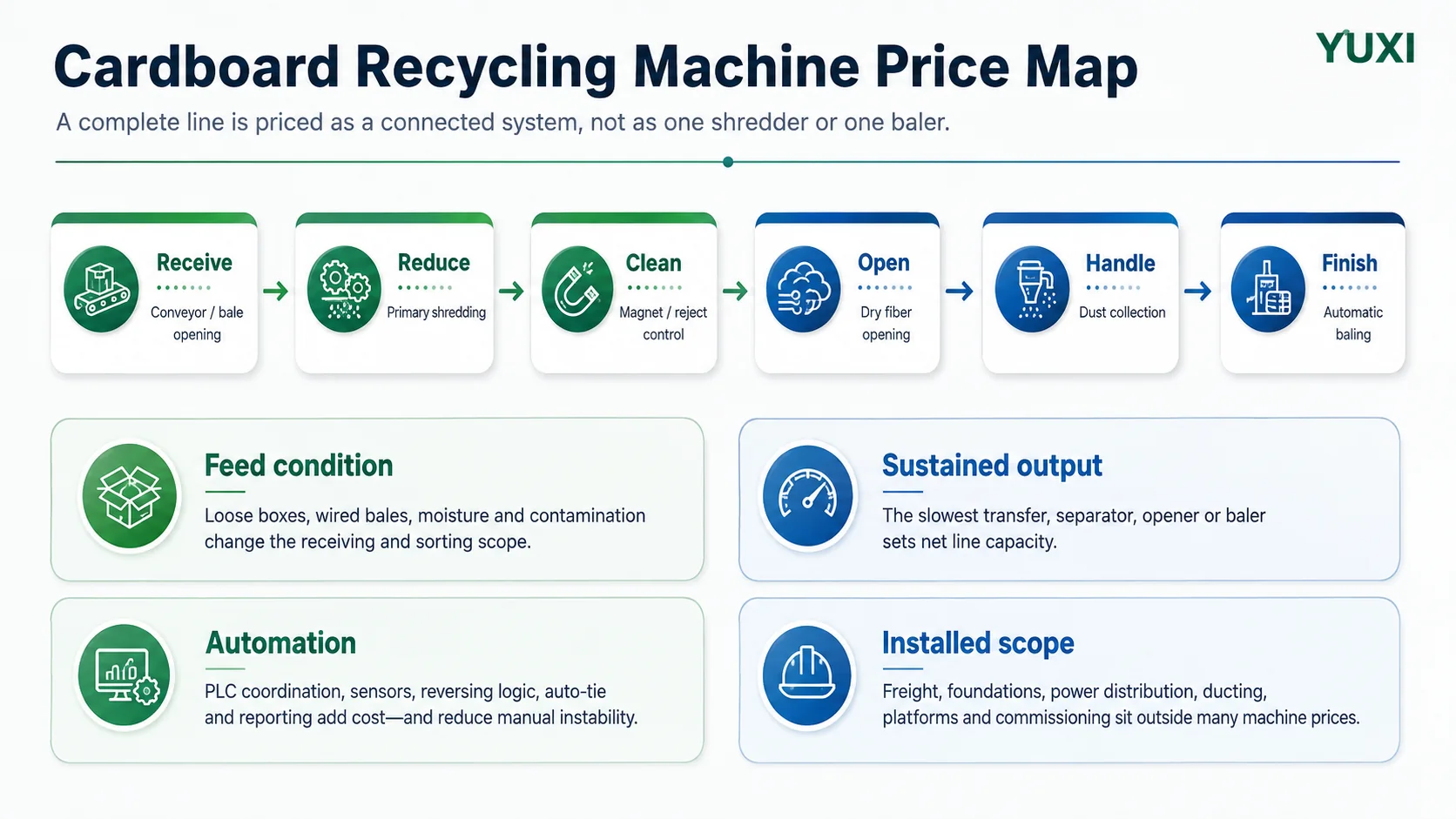
The complete dry waste-cardboard preparation line is designed around old corrugated containers, waste boxes, kraft paper and suitable paper-mill waste. It is not a small packaging shredder, and it is not a wet pulping and paper-making mill. The line may include receiving, primary shredding, ferrous removal, metered transfer, dry fiber opening, dust collection and final baling. Each of those functions changes the budget.
Before You Compare Prices: A quoted “cardboard recycling machine” may refer to a baler, a standalone shredder, or a complete OCC processing line. A meaningful comparison should define the feed material, required output, processing capacity, included equipment, automation level, dust and safety systems, delivery terms, installation support, and expected operating cost. A low equipment-only price is not the same as the installed cost of a complete recycling line.
Why Cardboard Recycling Machine Prices Online Conflict
Search results combine at least four different investments. A retailer may need a compact vertical baler. A distribution center may need a conveyor-fed horizontal baler. A recycler may need a primary shredder before baling. A plant producing a mechanically opened fiber-rich material needs a connected process line.
These categories should not be compared by headline price. A public baler guide updated in 2024 placed new vertical balers around US$10,000–25,000 and noted that horizontal balers start at a higher level depending on size and specification.[6] That is useful as a reference for baler equipment. It does not include a bale opener, primary shredder, magnetic separator, dry fiber opener, dust collector, process controls or the integration work required by a complete line.
Important price boundary: A low online price may be real for the machine shown. It becomes misleading when the buyer assumes that the price covers the entire material path from incoming OCC to accepted finished output.
The same confusion appears at the other end of the market. Some pages called “cardboard recycling plant cost” describe wet stock preparation, pulpers, screening, cleaning, paper machines, presses and dryers. Those are paper-mill projects. YUXI’s current solution is a dry preparation system that produces loose or baled fiber-rich recovered material for downstream evaluation. The industrial cardboard recycling process guide explains where dry preparation ends and wet paper-mill processing begins.
Start with the Complete Line Scope, Not the Main Machine
The current YUXI waste cardboard recycling machine and plant is modular. The exact equipment list changes with the way cardboard arrives and the way the recovered material must leave. That means the price is built from functions, not copied from one fixed model sheet.
| Process function | Typical equipment | Why it changes price |
|---|---|---|
| Receiving | Chain or belt conveyor, loading hopper, platforms | Loader feeding, manual feeding and dense bales need different widths, heights and guarding. |
| Bale opening and inspection | Bale opener, wire-removal area, pre-sort conveyor | Compressed OCC creates surges and can hide wire, film, wood or wet material. |
| Primary size reduction | Double shaft shredder, drive and discharge conveyor | Chamber size, cutters, torque, feed geometry and overload control are material-dependent. |
| Ferrous protection | Magnetic separator and metal discharge | Staples and wire fragments should be removed before sensitive downstream stages. |
| Feed stabilization | Buffer bin, metering conveyor, level sensors | A steady bed depth can be more valuable than a larger nominal shredder. |
| Dry fiber opening | Mechanical dry opener and related transfer | This is the key difference between simple shredding and a fiber-preparation line. |
| Dust and reject handling | Enclosures, pickup hoods, fan, filters, reject conveyor | Air volume, duct length, pickup locations and reject composition must be engineered together. |
| Final handling | Loose discharge or automatic horizontal baler | Bale size, density, tying method and throughput can make the baler a major cost item. |
Quotation gaps often appear between machines rather than inside them. A conveyor is too narrow for the shredder discharge. The dry opener is rated for steady feed, but no buffer is included. The dust collector is listed, yet the ducting and enclosures are excluded. These are not cosmetic details. They determine whether the installed plant reaches the output used in the financial model.
Cost Factor 1: Loose Boxes, OCC Bales and Contamination
Clean, flattened warehouse boxes are the least complicated feed. They are light and bulky, so hopper geometry and controlled conveying still matter, but the receiving section can remain relatively simple.
Compressed OCC bales change the front end. The plant needs safe unloading, wire or strap removal, controlled opening and an inspection route before continuous feeding. If the bales contain wet board, plastic film, foam, wood, glass or other paper grades, sorting and reject handling become more important. The separate guide to OCC cardboard grades and quality standards explains why a bale’s trade name is not enough to define the material inside it.
| Feed condition | Likely cost effect | Reason |
|---|---|---|
| Loose, dry, source-separated boxes | Lower front-end complexity | Basic inspection and metered conveying may be sufficient. |
| Flattened sheets and clean converting trim | Potentially simpler separation | Feed is consistent, although long sheets can still bridge or feed unevenly. |
| Wired OCC bales | Higher receiving and safety cost | Wire removal, opening, inspection and surge control are required. |
| Mixed commercial paper | Higher sorting and reject cost | More non-corrugated paper, film and non-paper contamination may be present. |
| Wet, food-soiled or coated material | Testing and possible process changes | Moisture affects weight, flow, storage, fiber opening and saleable output. |
Sometimes a buyer tries to save money by removing the pre-sort section. That can work for a controlled factory stream. It is a poor saving when incoming commercial bales are variable. The cost does not disappear; it returns as cutter damage, jam clearing, reject disposal, lower fiber value or downtime.
Cost Factor 2: Sustained Capacity and Line Balance
Capacity is usually the first number in an inquiry and one of the easiest numbers to misunderstand. A three-tonne-per-hour shredder does not create a three-tonne-per-hour plant when the baler, transfer conveyor or dry opener can only accept two.
A useful quotation states the basis of the capacity:
- gross input or accepted output;
- loose or baled feed;
- material grade, moisture and contamination;
- loading method and number of operators;
- allowed stops and run duration;
- reject rate and output condition;
- normal operating availability.
Accepted output per shift = gross feed rate × scheduled run hours × operating availability × accepted-material yield
This formula is simple, but it prevents a common purchasing error. A machine may show an impressive peak on hand-selected dry boxes while the commercial line loses time to wire removal, bridging, filter cleaning and baler cycles. Price should be compared against the accepted output that can be sustained with representative feed.
Higher capacity usually requires wider conveyors, larger drives, more filter area and a faster baler. The increase is not always linear. Crossing from one machine size to the next may also require a larger transformer, heavier foundations, more clear height or a different building layout. That is why the waste cardboard recycling machine selection guide recommends defining the full material path before selecting individual machines.
Cost Factor 3: Which Modules Are Included?
A complete line can be deliberately simplified. The important word is deliberately. A module should be removed because the feed and output specification make it unnecessary, not because it was forgotten in the quotation.
Core modules
Receiving conveyor, primary shredder, ferrous removal, metered transfer, dry fiber opening and discharge handling form the main process path for the current YUXI concept.
Feed-dependent options
Bale opening, manual sorting, buffer storage, light-reject separation and additional magnets depend on incoming material condition.
Output-dependent options
Automatic baling, bale conveyors, weighing, labeling and finished-product storage depend on the downstream buyer and logistics.
The baler deserves special attention. Its price changes with press force, chamber, bale dimensions, throughput, tying method and automation. A manually tied closed-door baler and a continuous auto-tie horizontal baler are different investments. When the finished bale is the saleable product, the baler should be sized from the required bale specification—not added at the end as a generic accessory.
Cost Factor 4: Automation, Controls and Labor
Automation is more than a touchscreen. A connected line needs machines to react to one another. The receiving conveyor should slow when the buffer is full. The upstream shredder should stop before a downstream jam becomes a packed chute. Reversing logic should distinguish a temporary overload from a persistent foreign object. Dust collection should start before material reaches the pickup points.
Typical control-cost items include:
- PLC and HMI hardware;
- variable-frequency drives for controlled conveying;
- level, speed, belt-drift and blockage sensors;
- current or torque monitoring;
- interlocks and emergency-stop circuits;
- remote diagnostics and production data;
- cabling, field junction boxes and installation labor.
More automation raises the equipment price. It can also reduce the labor and variability needed to operate a multi-stage line. The correct decision is not “automatic is better.” It is whether the labor saved, feeding stability and fault response justify the added control scope at the buyer’s production volume.
Cost Factor 5: Dust Control, Machine Safety and Compliance
Paper recycling equipment brings moving conveyors, shredders, balers, stored combustible material and paper dust into one work area. OSHA’s paper-recycling guidance highlights machinery, unexpected startup, crushing, baler-door hazards and combustible dust among the risks that must be addressed.[4]
Paper dust is also listed by OSHA among materials that can present a combustible-dust hazard when the conditions are present.[5] A dust collector therefore cannot be priced only by fan motor power. A workable system needs pickup hoods, enclosures, duct routing, filter selection, safe discharge, housekeeping access and a site-specific hazard review.
| Safety or environmental item | Possible budget impact | Quotation question |
|---|---|---|
| Machine guards and interlocks | Doors, fences, switches and control integration | Which access points are guarded and what stops when a guard opens? |
| Emergency stops | Pull cords, buttons, safety relays and cable routing | Is the full conveyor route covered? |
| Dust collection | Hoods, ducting, fan, filters, structure and discharge | Which pickup points and air volumes are included? |
| Fire protection | Detection, isolation, suppression or local code work | Which items are supplier scope and which require a local specialist? |
| Noise and housekeeping | Enclosures, access platforms and cleaning points | Can the plant be cleaned and maintained without entering danger zones? |
Local regulations vary. The equipment supplier can provide machine information and a proposed dust layout, but the final facility design, permitting and fire-protection strategy need review by qualified local professionals.
Cost Factor 6: Freight, Foundations, Utilities and Installation
An EXW or FOB equipment price is not the installed project cost. This is especially important for export projects, where the machinery may cross several commercial boundaries before it produces the first bale.
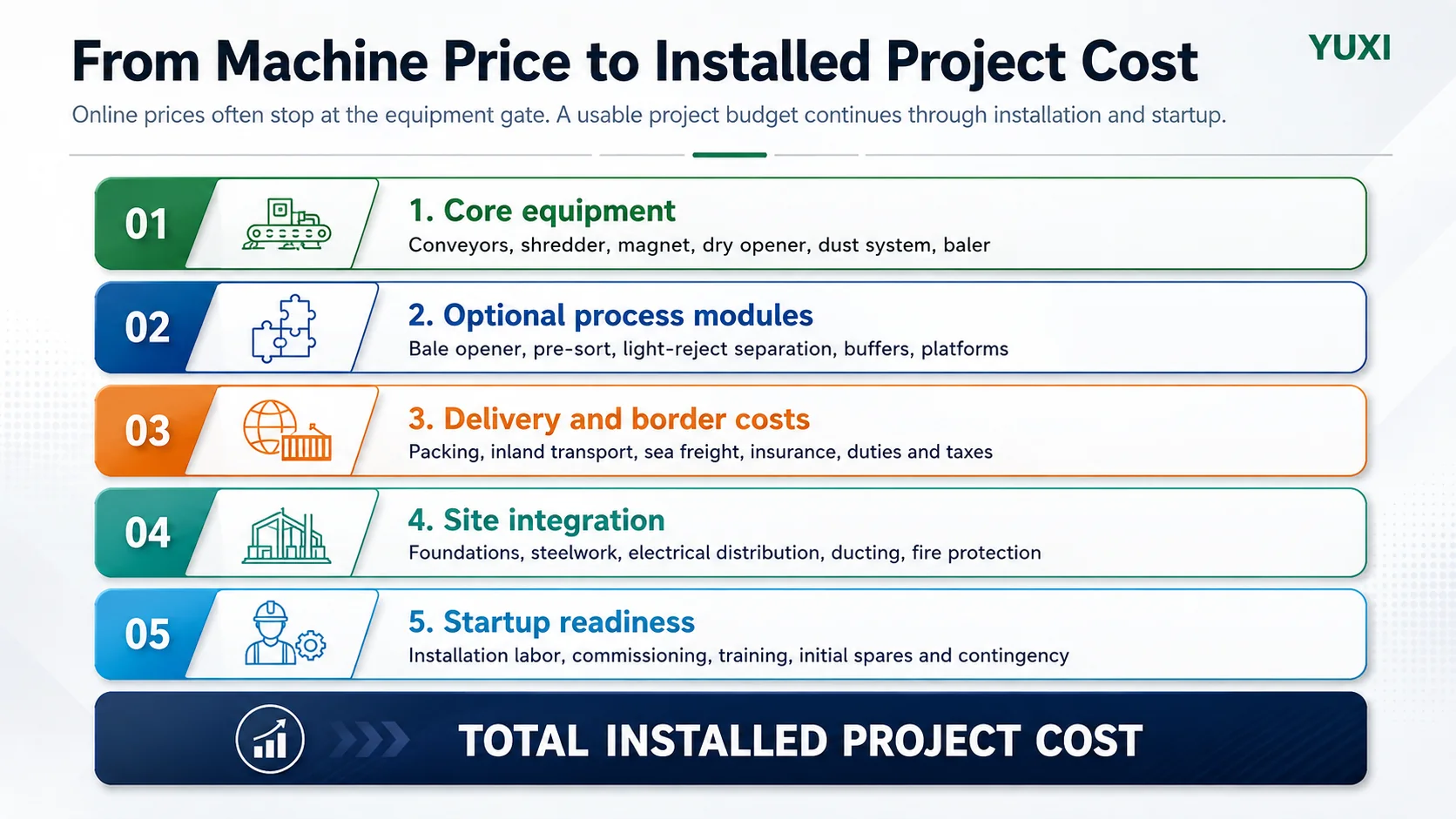
| Cost layer | Common items | Why it is missed |
|---|---|---|
| Export packing and transport | Crating, container loading, inland haulage, sea freight, insurance | The seller and buyer may use different delivery terms. |
| Border and destination charges | Duty, tax, customs, port handling and local delivery | These depend on destination and importer status. |
| Civil work | Foundations, pits, floor reinforcement, anchors and drainage | Usually completed by a local contractor. |
| Electrical integration | Transformer, switchgear, cabling, trays, lighting and grounding | The machine quotation may stop at the control cabinet. |
| Dust and utility connections | Duct supports, compressed air, filter discharge and fire systems | Field routing cannot be finalized without the building. |
| Installation and startup | Cranes, rigging, labor, travel, commissioning and training | Supplier supervision and full turnkey labor are not the same service. |
| Initial readiness | Spare cutters, bearings, filters, lubricants, wire and test material | Production can be delayed even after mechanical completion. |
On many projects, civil, electrical and installation costs are more sensitive to the site than to the equipment country of origin. A compact building with limited headroom may require extra transfer conveyors and steelwork. A greenfield building can be arranged around the process, but it adds construction cost. Both can be correct; they simply need different budgets.
Price Should Be Compared by Configuration Type
A useful early budget discussion groups projects by what they actually do. The relative scope below is not a price list. It is a way to stop a baler-only quotation from being compared with a complete dry preparation line.
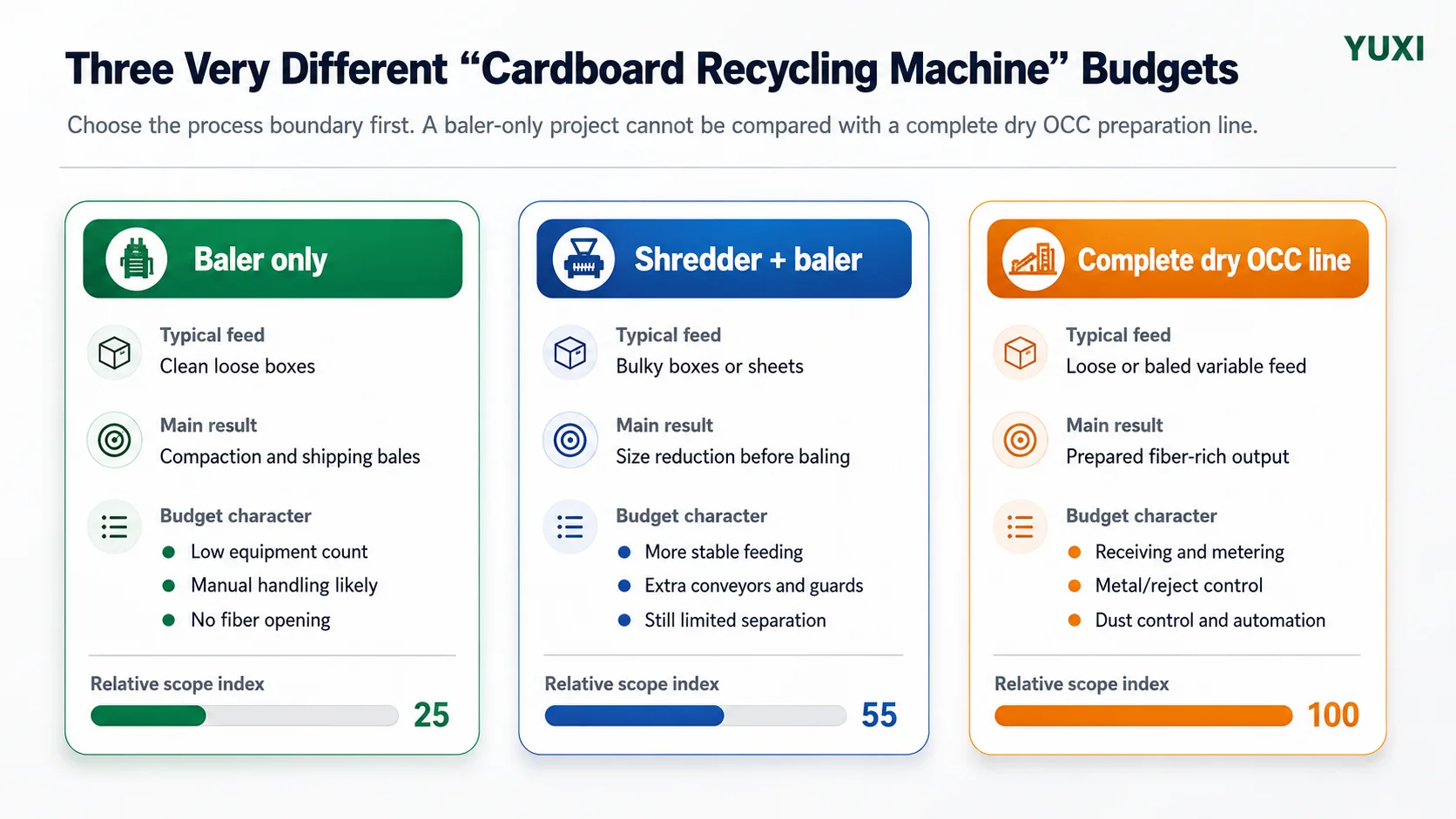
| Configuration | Best fit | Usually included | Main limitation |
|---|---|---|---|
| Baler only | Clean source-separated boxes that only need volume reduction | Manual or conveyor feed and a vertical or horizontal baler | No primary size reduction, dry opening or meaningful contaminant control. |
| Shredder and baler system | Bulky boxes or sheets that do not feed a baler consistently | Feed conveyor, shredder, transfer conveyor and baler | May still lack metal removal, buffers, reject separation and dust engineering. |
| Complete dry OCC preparation line | Industrial loose or baled feed requiring a prepared fiber-rich output | Receiving, shredding, metal removal, metering, dry opening, dust control and baling | Higher capital and integration requirement; feed and buyer specification must justify the added process. |
For clean cardboard that already meets a buyer’s bale specification, the cheapest correct solution may be a baler. For variable OCC bales that must become a more uniform, fiber-rich feed, the cheapest machine list can be the most expensive operating decision.
Use a Complete Cost Formula Before Approving the Budget
Total installed project cost = core equipment + optional modules + packing and freight + duties and destination charges + civil work + electrical and utilities + installation and commissioning + initial spares + contingency
Every term should have an owner. Mark it as supplier scope, buyer scope, local-contractor scope or excluded. Do not leave blank cells in a scope matrix; blank is where later variation orders start.
A second formula is useful for the quotation itself:
Comparable equipment price = quoted equipment price adjusted to the same delivery term, module list, automation level, warranty, spares and commissioning scope
Suppose Supplier A is 15% cheaper but excludes the automatic baler, ducting, platforms and startup supervision. Supplier B includes those items. The totals are not comparable until the missing scope is priced and added to Supplier A. This sounds obvious. In practice, it is one of the most common reasons a project’s approved budget changes after the purchase order.
Purchase Price Is Only One Part of Total Cost of Ownership
A cardboard recycling line earns or saves money through accepted output. The most useful operating metric is therefore cost per accepted tonne, not electricity per gross tonne fed.
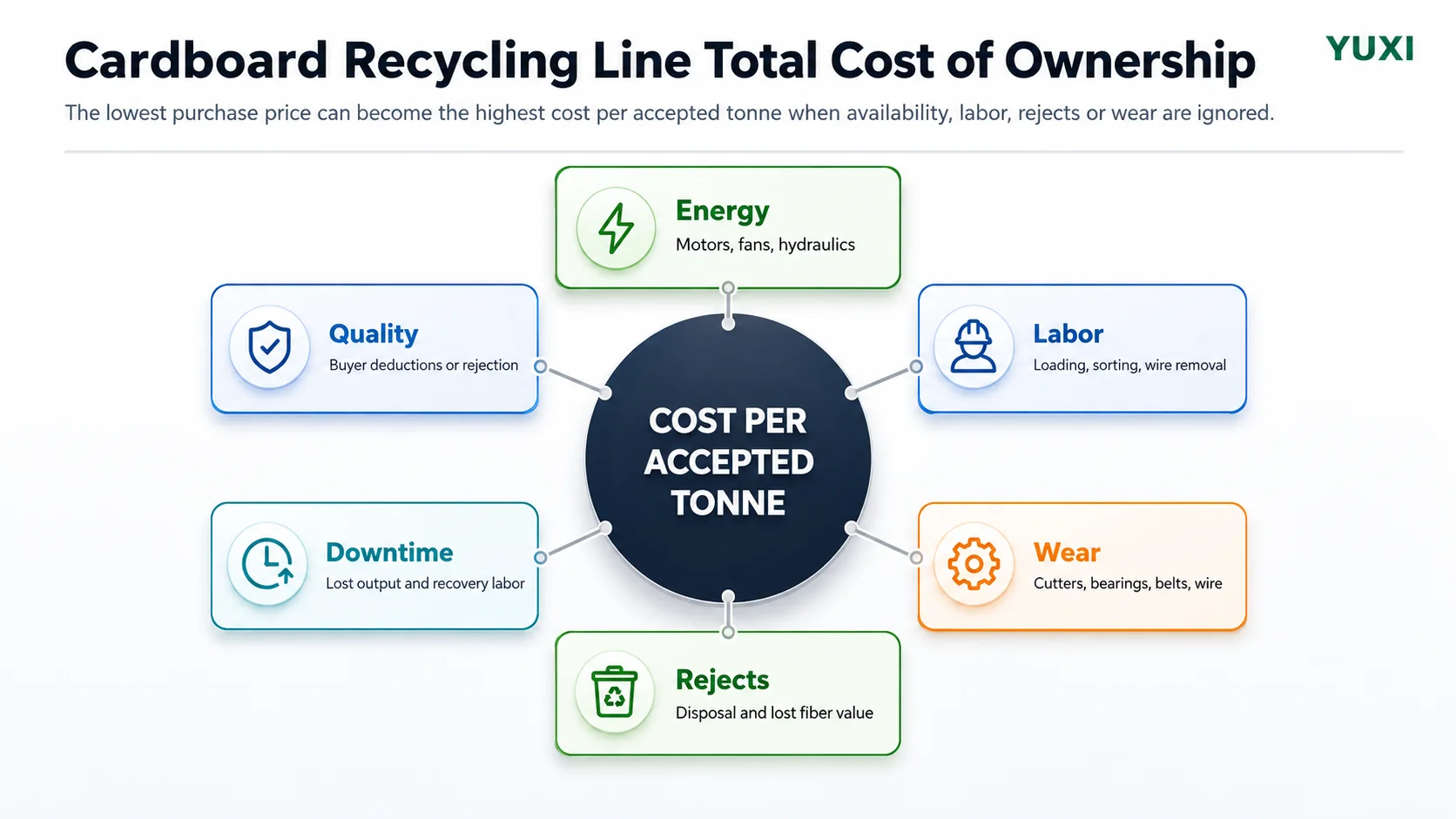
Annual processing cost per accepted tonne = (energy + labor + consumables + wear + maintenance + reject disposal + downtime cost) ÷ annual accepted output
Energy
List the installed power, but model the expected load of each drive and the operating schedule. Conveyors, shredders, fans, hydraulic balers and dust equipment do not all draw full nameplate power continuously.
Labor
Include unloading, wire removal, sorting, control-room operation, bale handling, cleaning and maintenance. A “one-operator line” may still need a loader driver and workers at the receiving or sorting section.
Wear and consumables
Budget for cutter maintenance, bearings, belts, lubrication, filter media, baling wire or strapping and routine sensors. Ask for recommended quantities and replacement intervals based on the intended feed—not a clean-cardboard demonstration.
Rejects and quality
Plastic, wire, wet material and other rejects cost money to handle and dispose of. Poor output quality can also create buyer deductions or rejected loads. EPA describes recycling as collection, processing and remanufacturing; the prepared material still needs a viable downstream user.[1]
Downtime
Downtime is often the largest hidden cost. Include the lost contribution from stopped production, labor used to clear the fault and the time needed to restart and stabilize the line. A slightly more expensive conveyor or buffer can be economical when it prevents repeated surges into the dry opener or baler.
How to Compare Cardboard Recycling Line Quotations
Put every quotation into the same comparison sheet. Use one row for every machine, option, service and exclusion. Then normalize the commercial terms.
| Comparison item | What to record | Red flag |
|---|---|---|
| Feed definition | Photos, grade, bale size, wire, moisture and contamination | Capacity is stated without a feed basis. |
| Output definition | Accepted product, bale size, density, reject limit and sampling | “Recycled fiber” is used without a buyer specification. |
| Capacity basis | Gross or accepted rate, run time, availability and test method | A short peak is presented as sustained plant output. |
| Equipment scope | Every conveyor, chute, platform, magnet, fan, filter and baler | “Complete line” is written without an itemized list. |
| Control scope | PLC, VFDs, sensors, safety circuits, cabling and remote support | Cabinet is included but field devices and cable are not. |
| Delivery terms | EXW, FOB, CIF or other agreed Incoterm and destination | Different quotations use different delivery points. |
| Installation | Drawings, supervision, full labor, travel, cranes and commissioning | “Installation included” does not describe who supplies labor and tools. |
| Warranty and spares | Duration, covered items, response process and initial spare package | Wear parts and failure parts are not distinguished. |
| Acceptance test | Representative material, sample mass, duration, stops and measurements | Only a no-load video or selected boxes are offered. |
Surprisingly, the most detailed quotation is not always the most expensive. It may simply expose costs that another quotation leaves for the buyer to discover later.
How to Reduce Cost Without Underbuying the Line
Remove modules only when the feed justifies it
Clean factory trim may not need the same pre-sort and reject system as mixed commercial OCC. Document the source control that makes the simpler line possible.
Phase optional automation
A project can reserve I/O, space and conveyor connections for later weighing, reporting or additional separation. This works when the first phase remains safe and functional by itself.
Design the building and line together
Early layout work can reduce transfer length, steel platforms and complex duct routing. A poor building fit is expensive to solve after equipment is ordered.
Test the real feed before final sizing
A representative test can prevent both oversizing and undersizing. It also reveals wire, film, moisture and feeding behavior that photos may hide.
Protect the bottleneck
Spending slightly more on a buffer, sensor or access platform can protect a high-value downstream machine and reduce stoppages. We normally recommend evaluating savings by cost per accepted tonne, not by deleting the highest-priced line item.
A practical rule: Do not ask, “Which item can we remove?” Ask, “Which process function can the material or downstream buyer prove we do not need?”
Information Needed for an Accurate Cardboard Recycling Machine Price
A supplier can prepare a much more useful budget when the inquiry includes:
- photos and short videos of normal and worst-case material;
- paper grade and source;
- loose or baled condition, bale dimensions, density and wire;
- moisture, film, tape, metal, wood, food and other contamination;
- required gross feed and accepted output per hour or day;
- operating hours and shifts;
- required output condition, bale size and downstream use;
- workshop length, width, clear height and floor information;
- power supply, loading method and forklift or loader routes;
- destination port and preferred delivery term;
- required installation, commissioning and training support.
Pictures are useful, but a weighed sample and a written downstream specification are better. The machine price becomes more accurate when the supplier knows what can be rejected, what must be recovered and how the plant will be judged during acceptance.
Need a Price Based on Your Actual Cardboard Feed?
Send YUXI material photos, loose or baled condition, contamination, required accepted output, workshop dimensions, power supply and destination. The quotation can then separate core equipment, optional modules, delivery scope and installation responsibilities.
Cardboard Recycling Machine Price FAQ
How much does a cardboard recycling machine cost?
The price depends first on what the seller means by the machine. A small baler, an industrial horizontal baler, a shredder-plus-baler system and a complete dry OCC preparation line are different projects. A complete line should be quoted after the feed form, contamination, sustained accepted output, required modules, automation, site and delivery scope are defined.
Why can two cardboard recycling line quotations differ so much?
The quotations may include different process boundaries. One may stop at the shredder, while another includes receiving conveyors, bale opening, magnetic separation, dry fiber opening, dust collection, automatic baling, controls, platforms, commissioning and spare parts. Compare an equipment list and scope matrix, not only the total price.
Is a cardboard baler price a useful estimate for a complete recycling plant?
Only as the price of one module. A baler compacts material, but it does not necessarily open dense OCC bales, reduce bulky boxes, remove metal, meter the feed, mechanically open fiber or collect process dust. Those functions add equipment, controls and site-integration cost.
Does higher capacity always mean a proportionally higher price?
No. Capacity can require wider machines, larger drives and a bigger baler, but the cost relationship is not perfectly linear. A project may need a major step change in conveyor width, dust volume, electrical supply or structure when it crosses a practical machine size.
What costs are commonly excluded from an equipment quotation?
Common exclusions include sea freight, inland transport, insurance, duties and taxes, foundations, building changes, electrical cabling, transformers, compressed air, ducting, fire protection, cranes, installation labor, local permits, production material for testing and working capital.
What operating costs should be included?
Include electricity, labor, baling wire or strapping, cutter and bearing wear, lubrication, dust filters, planned maintenance, reject disposal, quality deductions and downtime. Divide these costs by accepted saleable output, not by gross material fed.
What information is needed for an accurate YUXI quotation?
Provide material photos and videos, loose or baled condition, bale dimensions and wire, moisture and contamination, hourly or daily volume, required accepted output, operating hours, downstream use, workshop dimensions, power supply, loading method, destination port and the level of installation support required.
References and Source Notes
- U.S. Environmental Protection Agency, “The U.S. Recycling System.” Used for the collection, processing and remanufacturing boundary.
- American Forest & Paper Association, “Paper Recycling Process.” Used to distinguish MRF sorting and baling from paper-mill wet pulping and papermaking.
- American Forest & Paper Association, “Paper & Cardboard Recycling.” Used for current U.S. paper and cardboard recovery context.
- Occupational Safety and Health Administration, “Green Job Hazards: Recycling—Paper.” Used for machinery, crushing, baler and combustible-material safety context.
- Occupational Safety and Health Administration, “Combustible Dust: An Explosion Hazard.” Used for the dust-hazard boundary and need for site-specific assessment.
- Recycling.com, “How Much Does a Cardboard Baler Cost?,” updated February 8, 2024. Used only as a public baler-category price reference, not as a complete-line quotation.