A cardboard line can look busy and still miss its production target. The shredder is running, conveyors are moving, and the baler keeps cycling. Yet the shift total is lower than the number in the quotation. Usually, the arithmetic is not the first problem. The capacity number was never defined precisely enough.We have seen “3 t/h” used to describe at least four different things: a short peak entering one machine, the average feed during uninterrupted running, total gross material handled in an eight-hour shift, and accepted fiber-rich output after wire, film, wet paper and other rejects are removed. Those numbers may all be valid. They are not interchangeable.Capacity becomes useful only when the feed condition, measurement point, productive time and required output are written beside the t/h figure.
What a Cardboard Plant Capacity Number Must Tell You
Waste cardboard recycling plant capacity is the stable mass of a defined feed that the complete agreed line can process per unit of net productive time while producing the required output. A defensible figure states whether the feed is loose or baled, the OCC grade and moisture condition, where material is weighed, which process stages are running, what interruptions are included, and whether the result is gross feed or accepted product.In practical purchasing terms, the best number is not the highest catalog t/h. It is a repeatable continuous rate supported by representative material, a complete-line test boundary and a shift-output calculation.
Start by Defining Which Capacity You Mean
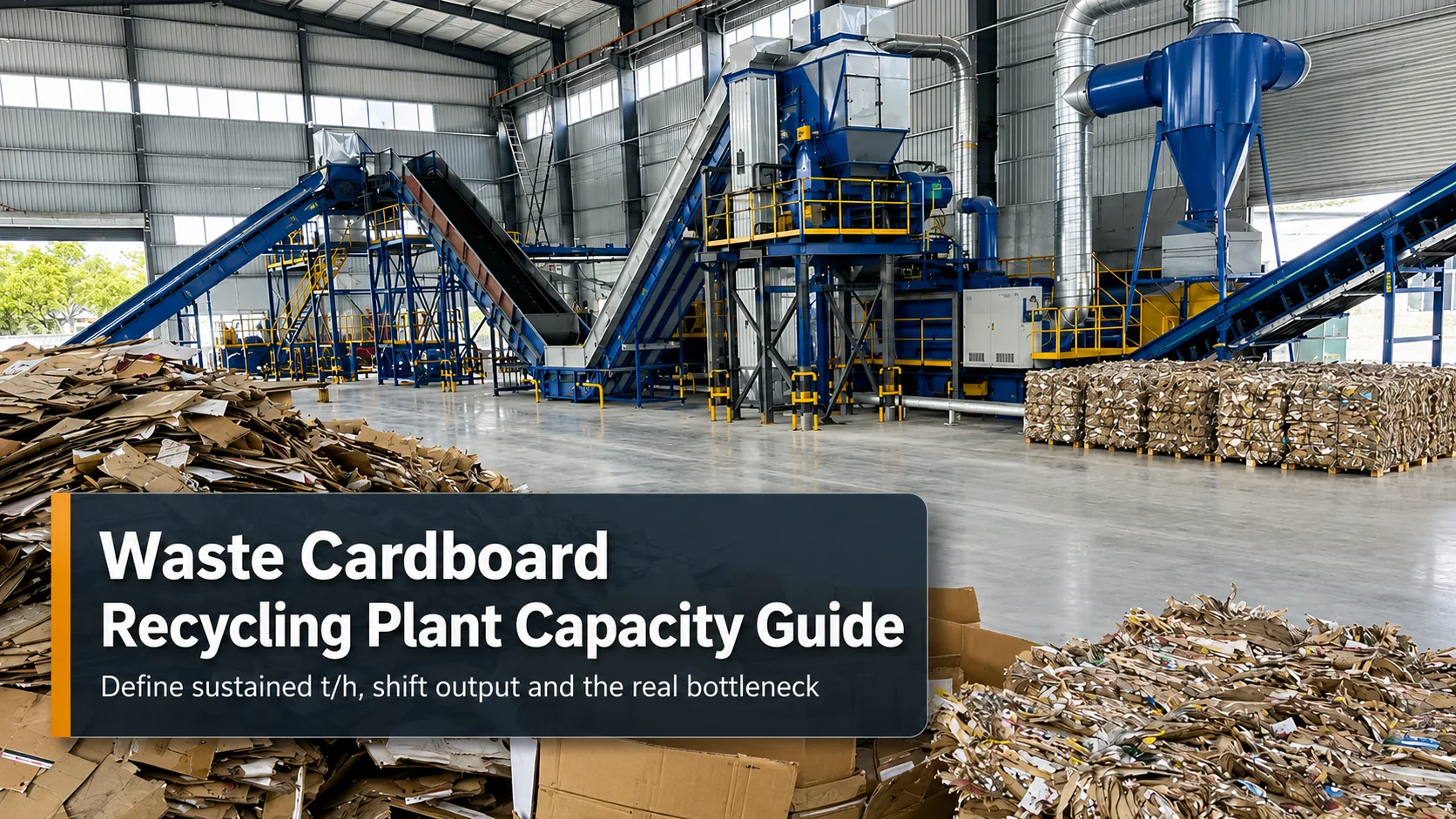
The public YUXI waste cardboard recycling plant is a connected dry preparation system: receiving, controlled feeding, primary shredding, ferrous removal, metering, mechanical fiber opening, dust collection and optional baling. A capacity statement for that system should not be borrowed from one isolated machine.
Capacity term
What it measures
How to use it
Nominal or catalog capacity
A design reference under assumed or stated conditions.
Useful for shortlisting. It is not an acceptance guarantee unless the material and test boundary are attached.
Peak feed rate
The highest short-duration rate entering a machine before bridging, overload, backup or quality loss requires a reduction.
Useful for surge design. Weak for production planning.
Machine throughput
Mass entering or leaving one shredder, opener or baler during a defined run.
Shows what that machine did. It does not prove the connected line can sustain the same rate.
Continuous line throughput
Stable average gross feed while all agreed stages operate normally.
The strongest base figure for sizing a complete line.
Shift input
Total gross feed processed during scheduled hours after ordinary loading, inspection, cleaning and adjustments.
Use for labor, loader duty, storage, utilities and daily planning.
Accepted output
Material meeting the agreed output condition after rejects and losses.
Use for downstream sales, baling and business projections.
The wording matters because OCC is not a single uniform substance. Recovered-paper specifications distinguish grades and place limits on outthrows and prohibitive materials. The incoming stream can also contain water, tape, film, bale wire, boxboard and other material that occupies equipment but may not become accepted output.[1]There is another boundary worth stating. This dry line mechanically opens cardboard into a fiber-rich form; it is not a conventional paper-mill repulping system. AF&PA describes mill recycling as a later water-based pulping, screening and cleaning process.[2] The output requirement therefore needs to describe the dry prepared material, not promise finished paper pulp.
Four Calculations Make the Capacity Discussion Clearer
None of the formulas is difficult. What takes judgment is choosing honest inputs and keeping the measurement boundaries visible.
Record the full test duration and net productive runtime separately. A supplier should not hide long blockages by reporting only the minutes when material was moving. At the same time, a genuine capacity test may reasonably exclude a planned meal break or unrelated site interruption. The rule must be agreed before the clock starts.
2. Productive utilization Productive utilization (%) = productive operating time ÷ scheduled time × 100
Utilization is not a fixed industry percentage. It changes with feed preparation, wire removal, operator skill, housekeeping, filter service, blade condition, changeovers, forklift traffic and the amount of abnormal material. We normally model a conservative, expected and improved case rather than forcing one optimistic percentage into the business plan.
The accepted-output yield comes from a mass balance, not from appearance. Weigh the qualified output and the important reject streams. When gross feed includes wet paper or non-paper contamination, a high incoming t/h can coexist with disappointing commercial output.
Mass flow and volume flow are different constraints
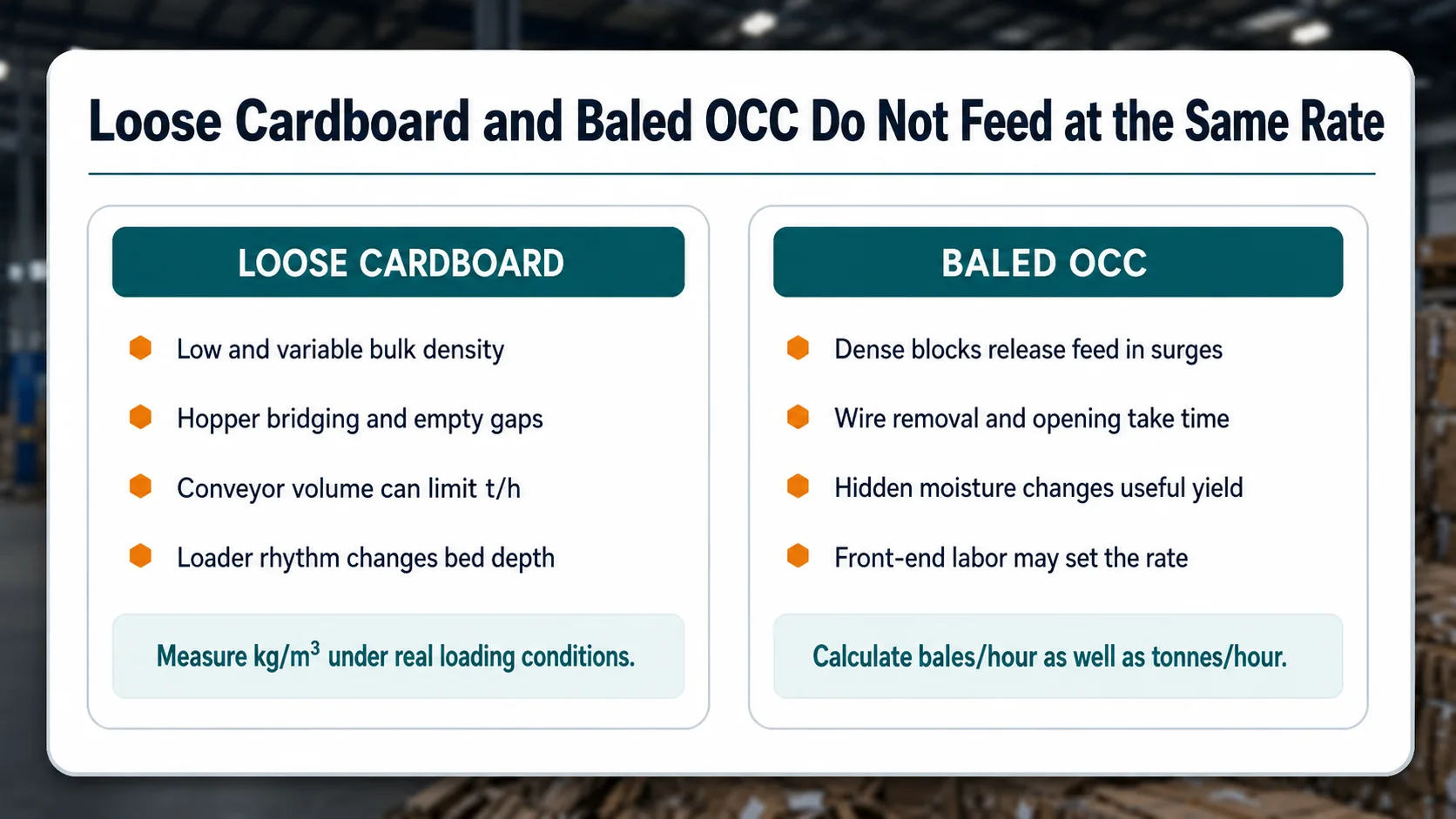
Loose cardboard is bulky. A receiving conveyor, hopper and shredder opening are filled by volume before the project target is discussed in tonnes.
Required volumetric feed (m³/h) = target mass flow (kg/h) ÷ loose bulk density (kg/m³)
This is why a line processing flattened warehouse OCC may reach its volumetric limit while the motor still looks lightly loaded. More installed power does not enlarge a narrow hopper or stop large boxes from bridging.
For baled OCC, calculate bales per hour too
Bales per hour = target feed rate (kg/h) ÷ average bale mass (kg)
A nominal 4,000 kg/h target with 620 kg bales requires about 6.5 bales per hour—roughly one bale every nine minutes. That front end must unload, stage, remove wire, open, inspect and meter material at that rhythm. In practice, this simple conversion often exposes a labor or bale-opening problem before the machine list is finalized.Loose boxes are normally volume-limited; compressed OCC adds bale staging, wire removal, opening and inspection. A supplier should state which condition supports the quoted capacity.
Loose Cardboard and Baled OCC Need Different Capacity Assumptions
Loose boxes: the front end may fill before the main machine is loaded
Loose flattened boxes have low and variable bulk density. Large sheets overlap, folded cartons spring open, and irregular loading creates alternating deep beds and empty belt. Sometimes the line stops because a bridge forms above the shredder; sometimes it runs below target because the loader cannot maintain a consistent burden.For a useful density check, fill a container of known volume using the same loader, drop height and preparation method planned for production. Weigh the contents and repeat the test across several normal batches. Do not stamp the boxes down unless that compaction will genuinely occur in the plant.
Baled OCC: the dense block is only the beginning
Compressed bales appear easier to quantify because each unit has a known mass. However, they create a different production rhythm. A bale may hide wet layers, wood, plastic or tightly wound wire. When it opens, material can arrive as a sudden slug rather than an even stream.One customer discussion can illustrate the problem. The requested hourly tonnage looked modest on paper, but the site planned manual wire removal with no dedicated staging lane. Once the target was converted into bales per hour, the team realized that the operator would have less than ten minutes to receive, inspect and release each bale while also managing rejects. The process needed a better front-end layout, not a larger shredder.The related OCC cardboard grade guide explains why source and contamination matter. For capacity work, the key lesson is that one average bale weight does not describe the condition inside the bale.
Why the Same Cardboard Line Produces Different t/h
Moisture adds weight and usually removes predictability
Wet cardboard can make a gross t/h number look better because water crosses the scale with the paper. That is not the same as useful fiber output. Moisture also changes friction, bridging, tearing, dust behavior and mechanical opening. Excessively wet material may be unsuitable for a dry preparation route.Record moisture at receiving and during the capacity test. Where the downstream buyer evaluates material on a moisture-sensitive basis, consider reporting both as-received mass and a dry-equivalent or contract-adjusted figure. The correct method belongs in the supply agreement; the important point is not to count water as invisible production.
Contamination consumes capacity twice
Film, foam, wood, glass, stones, metal and non-recyclable packaging occupy conveyors and chambers on the way in. Then they require sorting, separation, reject transport and disposal on the way out. Heavy contamination can also trigger stops or damage.That is why capacity and quality cannot be separated. ReMA’s recovered-paper guidelines are transaction guidelines rather than a universal plant recipe, but they demonstrate the commercial importance of defining outthrows and prohibitive materials.[1]
Required output changes the work inside the line
Coarse volume reduction is a different job from controlled dry fiber opening. A line that only tears boxes before baling may run at a higher mass rate than a line that must produce a more open, uniform fiber-rich condition and remove a defined light-reject fraction.The industrial cardboard recycling process article owns the full process explanation. Here, the capacity rule is narrower: every additional output requirement must be matched to residence time, separation duty, recirculation and reject handling.
Largest pieces create more trouble than average pieces
An average box size sounds tidy but hides the item that bridges the hopper. Ask for the largest normal sheet, the largest abnormal object likely to arrive, and the percentage of feed near those limits. Long folded cardboard can span an opening; tightly compacted layers can enter as a block; roll cores and production trim behave differently again.
Stable feeding usually beats aggressive feeding
A surge produces an impressive momentary t/h. Then the fiber opener overloads, the dust pickup loses capture, or the discharge bin fills. The operator slows the line and the shift total falls.We have found that a load-responsive feeder and adequate buffer are often more valuable than a faster fixed conveyor. The goal is not to keep every upstream motor at maximum current. It is to keep the slowest downstream stage inside a stable operating window.
Maintenance condition changes the number over time
Worn cutters, slipping belts, blocked filters, leaking ducts, misadjusted sensors and a baler waiting for wire all reduce useful production. A factory test on new equipment is only one part of the capacity story. The planned maintenance interval, access and spare-parts strategy decide how much of that performance remains available after months of operation.
Complete-Line Capacity Is the Lowest Stable Stage
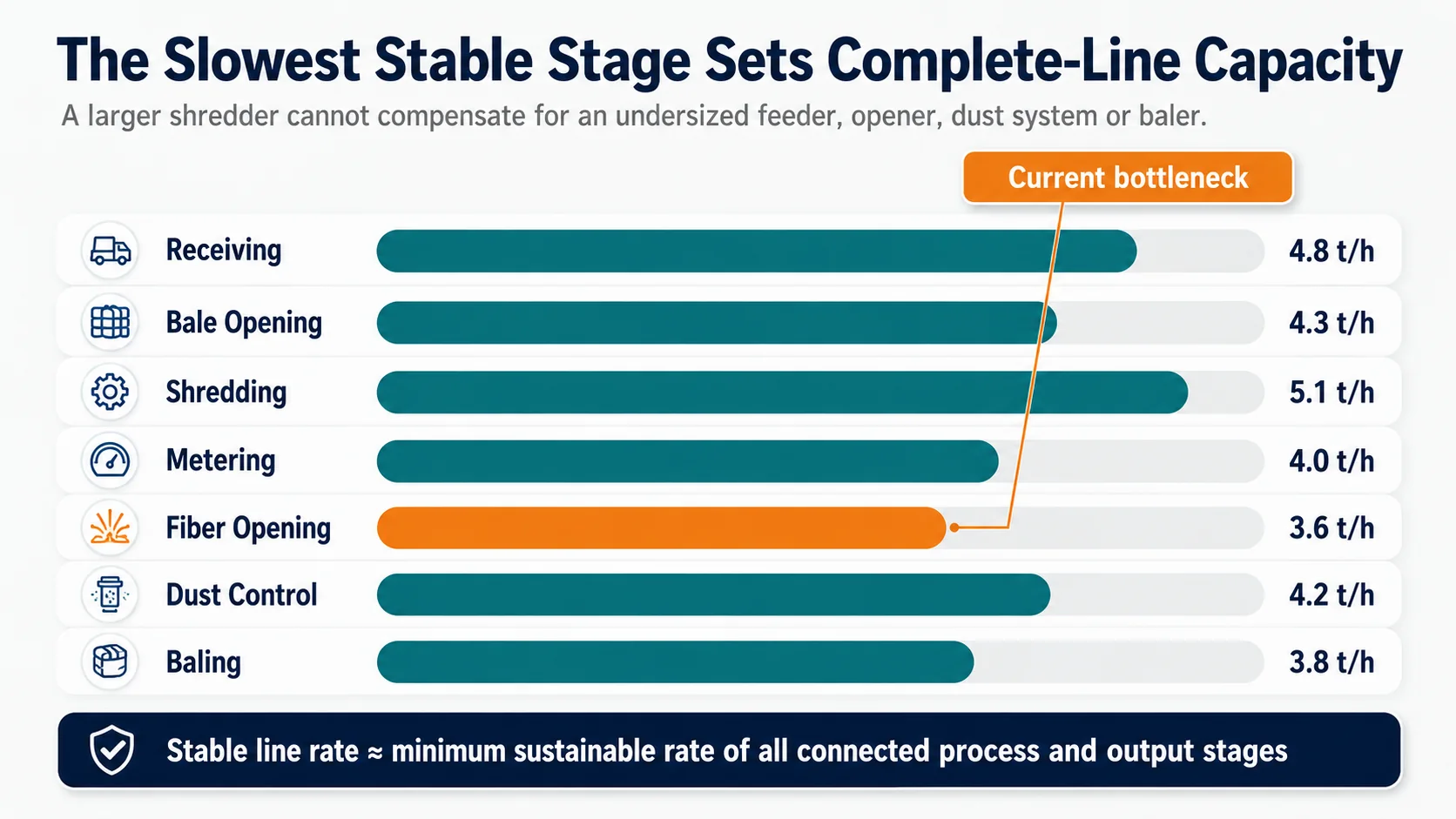
A connected line behaves like a chain. The fastest machine does not set output. The lowest sustainable rate—while quality, dust capture and safe operation remain acceptable—sets the line rate.
Stable complete-line capacity ≈ minimum sustainable capacity of all connected stages
The word sustainable matters. A fiber opener may accept a heavy surge for thirty seconds, but not continuously. A baler may make one fast cycle, then wait for tying or bale discharge. A dust system may keep the workshop clean at a moderate rate but lose capture when the feed is doubled.The example shows why increasing one machine’s speed can simply move the bottleneck downstream.The detailed cardboard recycling plant equipment list maps each module by function. A capacity review uses the same sequence but asks a different question at every stage: can this function sustain the target rate on the actual material?
Capacity Questions for Every Stage
Stage
Capacity question
Evidence to request
Receiving and loader interface
Can the site unload, stage and supply material without long empty periods or unsafe traffic conflicts?
Truck or bale arrival pattern, loader cycle, floor storage, hopper volume and live loading observation.
Wire removal and bale opening
Can bales be released, inspected and metered at the required bales per hour?
Average and maximum bale mass, wire procedure, labor allocation, opener test and reject route.
Pre-sorting
Can operators see and remove the expected contaminants at the target belt burden?
Belt width and speed, bed depth, staffing, lighting, reject chutes and quality samples.
Primary shredder
Can it accept the largest normal feed and deliver a stable intermediate size without repeated reversals or bridging?
Representative test, chamber load, reversals, stoppages, output size and foreign-object observations. The double shaft shredder should be evaluated as one preparation stage, not the whole plant.
Magnetic removal and transfer
Is the burden depth thin enough for ferrous removal, and can chutes discharge without wrapping or backup?
Belt loading, metal capture, carryover inspection, chute geometry and cleaning time.
Buffer and metering
Can the buffer absorb upstream surges and feed the opener evenly?
Usable volume at actual bulk density, level trends, withdrawal rate and evidence of bridging.
Dry fiber opening
Can the opener achieve the agreed output condition at the target continuous feed?
Input size, output sample, motor load, rejected material, dust generation and sustained runtime.
Dust collection
Can extraction maintain capture at every simultaneous pickup point?
Air-system design, pressure trend, filter loading, bin discharge and housekeeping observations.
Baler and output handling
Can the baler, bale conveyor, weighing and forklift route remove product as fast as it arrives?
Cycle time, tying delays, bale mass, discharge time, finished storage and transport plan.
Paper recycling equipment introduces moving-part, crushing, unexpected-startup and combustible-dust hazards. OSHA specifically highlights those hazards for paper recycling operations.[3] Capacity must never depend on bypassed guards, unsafe jam clearing or uncontrolled dust accumulation. A test that reaches the target only by ignoring normal safety controls has failed.
Illustrative Shift-Output Calculation
The following is a planning example, not a published YUXI capacity rating and not a quotation.
Planning item
Assumption or calculation
Result
Tested continuous gross feed
12 tonnes processed in 3.0 net productive hours
4.0 t/h
Scheduled shift
8 hours
8 h
Expected productive utilization
82% after normal loading, sorting, cleaning and adjustments
6.56 productive h
Estimated gross shift input
4.0 t/h × 8 h × 82%
26.24 t/shift
Accepted-output yield
92% after ferrous and other rejects in the representative test
92%
Estimated accepted output
26.24 t × 92%
24.14 t/shift
The plant is still a “4 t/h line” when continuous gross feed is the defined boundary. But a manager ordering storage, trucks or baling wire should plan around approximately 24.1 tonnes of accepted output per shift under these assumptions—not 32 tonnes. Both numbers belong in the project file.On one export discussion, the buyer focused on annual tonnage but had not separated scheduled hours from productive hours. A two-shift plan looked comfortable until weekends, filter service, cutter inspection and bale handling were added. The line itself did not need to become dramatically larger; the operating calendar needed to become honest.
This calculation is more useful than choosing “small,” “medium” or “large” from an undefined sales table. It connects the equipment target to the plant’s actual working calendar and output contract.
How to Verify a Cardboard Plant Capacity Claim
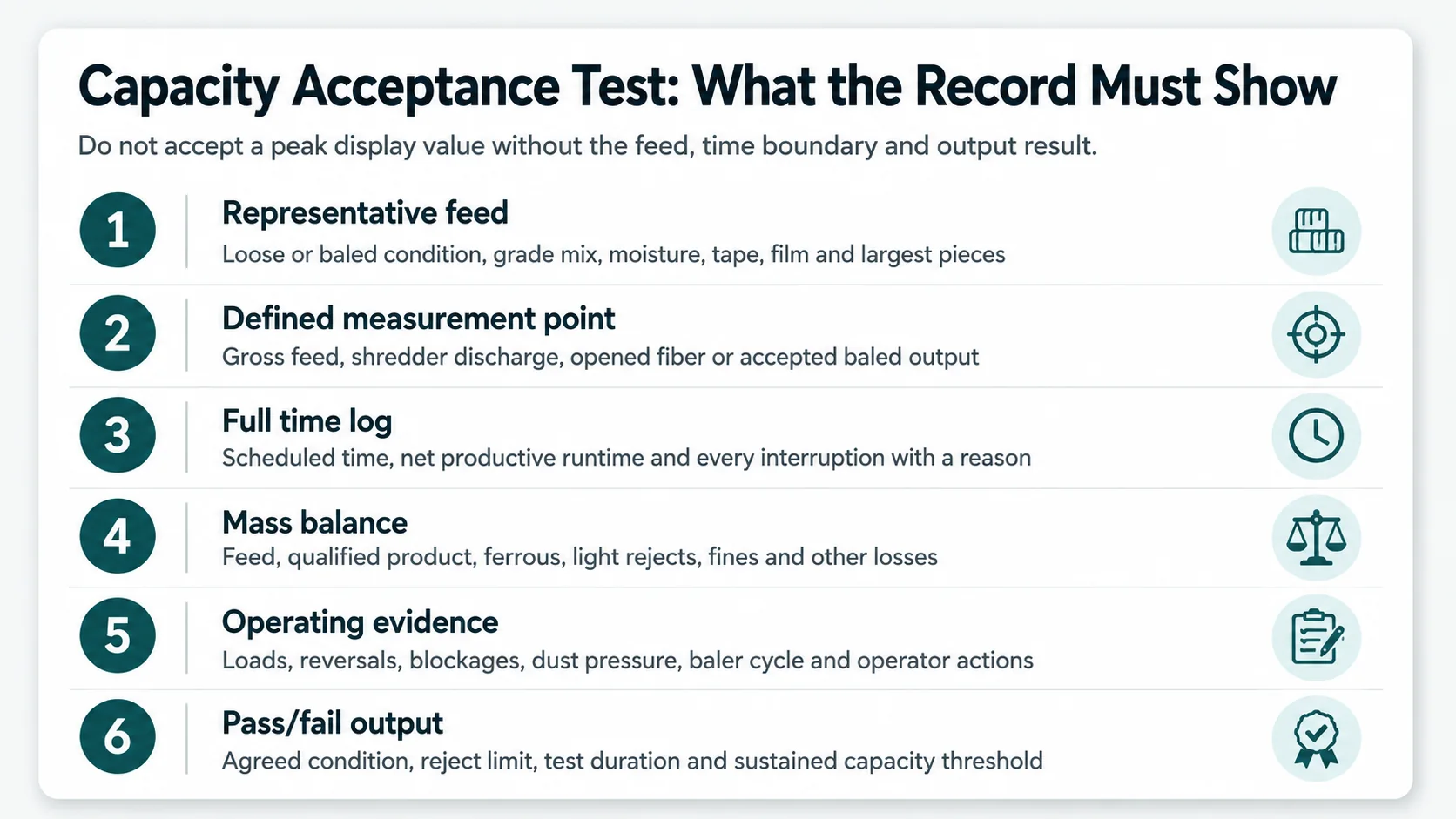
The strongest approach is a written material-test and acceptance plan agreed before the purchase order. It can be short. It cannot be vague.
Use representative feed. Include the normal mix, moisture variation, tape and film, largest boxes, typical bale density and realistic contamination. A clean demonstration batch shows potential, not normal production.
Define the measurement point. State whether the claim is gross feed, shredder discharge, opened fiber, baler feed or qualified baled output.
Run the agreed process route. Testing the shredder alone does not prove that metering, fiber opening, dust collection and baling can sustain the same rate.
Record gross and net time. Log the full duration, productive runtime and each pause with a reason. Keep operator interventions visible.
Weigh the important streams. Feed, accepted output, ferrous, light rejects, fines and abnormal material should form a traceable mass balance.
Agree the output condition. Use samples, photographs and measurable reject or moisture limits where appropriate. “Good fiber” is not a test criterion.
Record operating condition. Note motor load, reversals, blockages, buffer level, dust-system pressure, baler cycle and cleaning actions.
Keep normal safety controls active. Guards, interlocks, dust controls and hazardous-energy procedures remain part of the test.
A useful acceptance record links representative feed, time, mass balance and output quality. The highest number shown on an HMI is not enough.The broader waste cardboard recycling machine selection guide covers supplier evidence, FAT scope and quotation review. For this article, the capacity-specific requirement is simple: the test conditions must reproduce the commercial duty closely enough that the result can be used for shift planning.
Capacity Data to Send with an RFQ
A supplier can propose a more defensible line when the inquiry includes measurable material and operating data. We normally recommend one capacity sheet containing the following fields.
Data field
What to provide
Why it changes capacity
Feed categories
OCC grade or source, loose boxes, opened bales, kraft trim, selected mixed paper and percentage range.
Different sources have different density, contamination and handling behavior.
Feed condition
Loose, flattened, folded, wired bale, strapped bale or production trim.
Sets the receiving, opening, labor and metering duty.
Dimensions and bale data
Largest normal piece, bale L × W × H, average and maximum bale mass.
Controls hopper, conveyor, opener and chamber compatibility.
Loose bulk density
Measured kg/m³ and the container/loading method used.
Converts target tonnes into required conveyor and buffer volume.
Moisture and contamination
Normal and worst-case moisture; wire, tape, film, wood, foam, glass and other rejects.
Changes flow, wear, gross-to-accepted yield and separation duty.
Required output
Loose shredded material, mechanically opened fiber-rich material, baled output, reject limits and downstream use.
Determines process depth and the stage that may become limiting.
Capacity boundary
Required continuous gross feed, accepted output per shift, or both.
Prevents suppliers from quoting different measurement points.
Operating calendar
Hours per shift, shifts per day, days per year and maintenance windows.
Connects tested t/h to annual production.
Site and handling
Loader or forklift method, workshop dimensions, finished-bale route, voltage and available utilities.
Physical handling and output logistics can limit productive time.
Acceptance method
Sample size, test duration, weighing method, output criteria and pass/fail threshold.
Turns an estimate into a verifiable project condition.
Capacity also changes project cost. A higher rate can require wider conveyors, a larger buffer, more dust pickup, faster reject removal, a higher-duty baler, additional storage and stronger site utilities. The cardboard recycling machine price guide explains those scope effects without treating t/h as a price list.
Capacity Buying Mistakes We See Most Often
Comparing motor power instead of the complete duty
A larger motor can provide load margin. It does not define hopper volume, bale-opening labor, fiber output, dust capture or baler discharge. Compare the same feed and output requirement.
Using a short peak as the eight-hour average
Short peaks help size surge capacity. They do not include wire removal, sorting, filter service, reject handling or normal interruptions. Ask for the time log.
Quoting loose cardboard and testing prepared sheets
Pre-cut, hand-fed sheets remove the volumetric and bridging problems that may dominate the real plant. The test must represent how material arrives.
Counting water and contamination as production
Gross weight should remain visible, but the business case also needs accepted output. Use moisture records and a mass balance.
Sizing the shredder first and transfers later
A generic conveyor width can become the project bottleneck. For low-density OCC, receiving and metering deserve the same attention as the main machine.
Ignoring the baler cycle
The upstream process is continuous; a baler works in cycles. Without enough surge capacity, tying and bale discharge can stop the fiber opener.
Leaving dust collection outside the capacity discussion
Paper dust is a process and safety issue. OSHA lists combustible dust among paper-recycling hazards, and it should be assessed by qualified site-specific engineering.[3] A line rate that overwhelms the designed capture system is not an acceptable rate.
Get a Capacity Review Based on Your OCC Feed
Send material photos or video, loose or baled condition, average bale mass, moisture and contamination, target continuous t/h, required shift output, workshop dimensions and downstream use. YUXI can map the capacity basis across receiving, shredding, dry fiber opening, dust control and baling.
Waste Cardboard Recycling Plant Capacity FAQ
What does waste cardboard recycling plant capacity mean?
It should mean a measured mass flow for a defined cardboard feed, process route, output condition and time boundary. Buyers should distinguish peak machine feed, continuous line throughput, shift input and accepted output.
Is shredder capacity the same as complete-line capacity?
No. Receiving, bale opening, metering, fiber opening, dust collection, reject handling, baling or finished-product logistics may set the complete-line rate.
How do I calculate cardboard plant output per shift?
Multiply tested continuous throughput by scheduled shift hours and expected productive utilization. To estimate accepted output, multiply again by the measured accepted-output yield.
Why can loose cardboard reduce t/h?
Loose boxes have low bulk density and occupy substantial conveyor and hopper volume. Large sheets can bridge, while irregular loader feeding creates surges and empty gaps. The line may be volume-limited before it is power-limited.
Why does wet cardboard change the capacity result?
Water increases gross weight but can reduce feeding stability and dry fiber-opening performance. Record moisture and avoid treating wet tonnes as equivalent to useful dry fiber or accepted product.
How long should a capacity test run?
There is no universal duration. It should be long enough to include normal line behavior—several bale releases or loader cycles, steady downstream operation, baler cycles and realistic operator interventions. Define the duration and pass/fail rule in writing before the test.
What information does YUXI need to size a line?
Provide feed source and proportions, photos or video, loose or baled condition, largest dimensions, bale mass, bulk density if known, moisture, contaminants, required continuous rate, shift target, output condition, working calendar, handling method, site dimensions and power supply.
American Forest & Paper Association, Paper Recycling Process, MRF sorting followed by paper-mill pulping, screening and cleaning.
U.S. Occupational Safety and Health Administration, Green Job Hazards—Recycling: Paper, machinery, crushing, unexpected-startup and combustible-dust hazards.
David focuses on industrial shredding and recycling equipment,including material evaluation,shredder selection,process configuration,and recycling line planning.
Speak To Our Shredder Machine Expert
Get in touch with our nice team today to get a price estimate for a shredder machine.

 English



 Fast Delivery
 Reliable
 Certified
 Experienced