Industrial Shredder & Recycling Systems Manufacturer - YUXI

 English

 English
 Fast Delivery
 Reliable
 Certified
 ExperiencedEnglishEnglishFast DeliveryReliableCertifiedExperienced
For buyers looking at industrial shredders, the first question should not be which brand has the biggest name or the highest motor rating. What matters is whether the machine is designed for your actual feedstock and operating conditions. A single-shaft shredder used for plastic purgings, a low-speed twin-shaft shredder for bulky scrap, and a mobile pre-shredder for mixed waste solve very different problems. At YUXI, we normally start with the material, feed size, required output and downstream process before discussing machine size or power. Otherwise, even a detailed comparison table can lead to the wrong equipment choice.
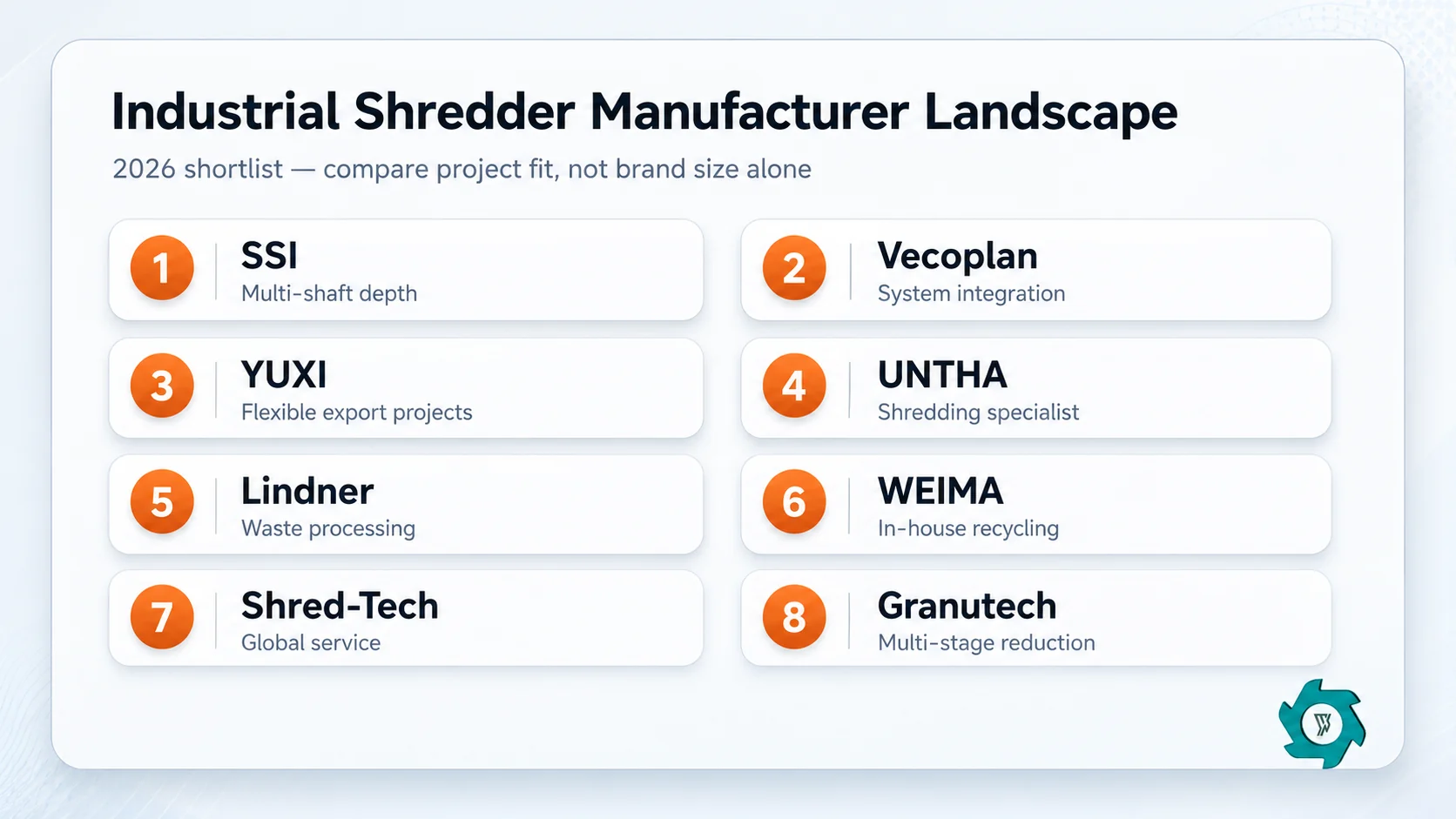
There is no single “best” industrial shredder company for every waste stream. That is the first point to keep straight. A supplier that is excellent at RDF preparation may not be the first call for compact in-house plastic recycling. A manufacturer known for low-speed rotary shears may be overkill when the real need is a screen-controlled single-shaft machine beside an extrusion line.
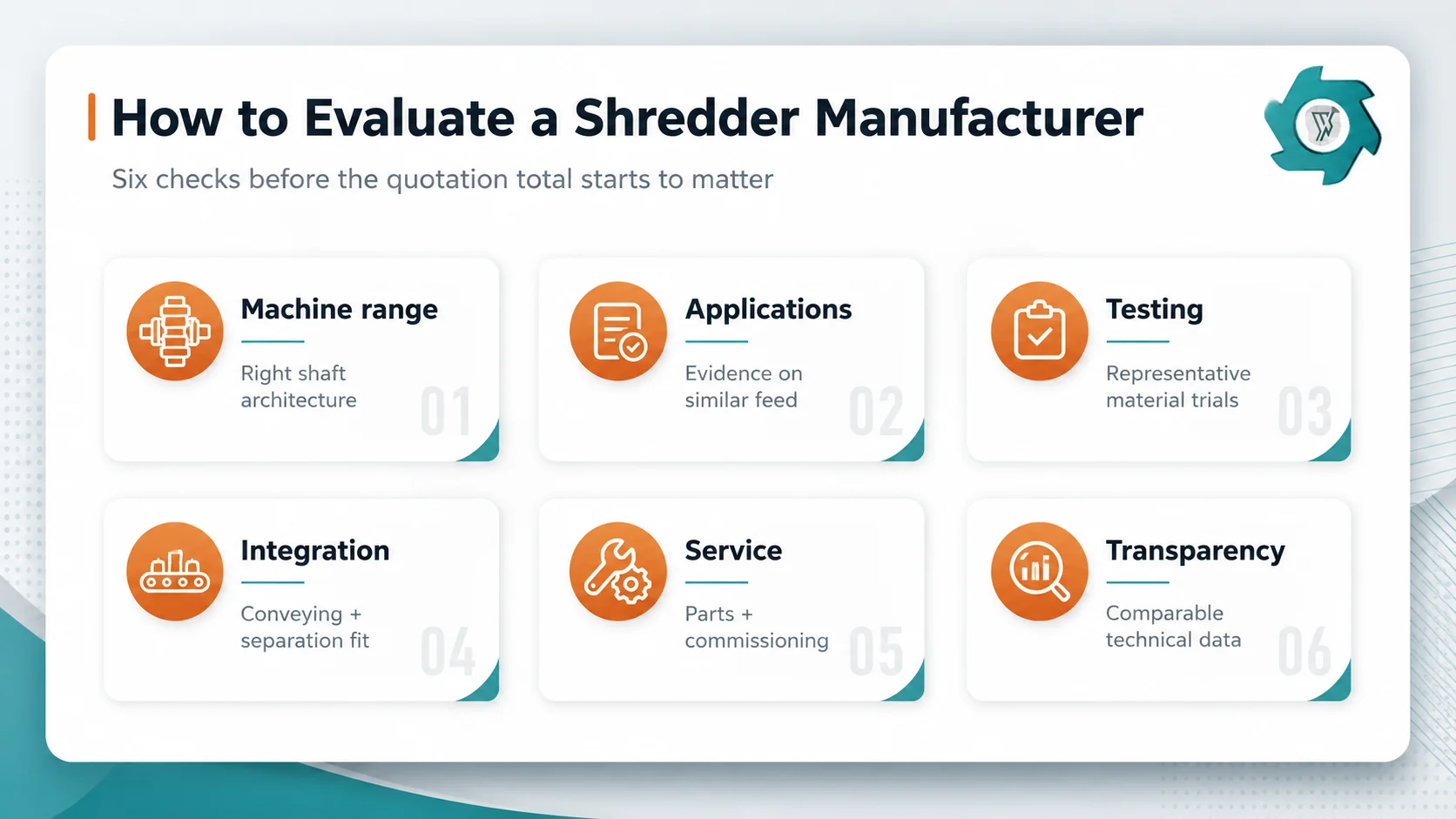
For this list, six things carried the most weight: real shredder range, application depth, engineering and testing, downstream integration, service capability, and how clearly the supplier explains the limits of a configuration. Public information matters here. If a buyer cannot tell whether a machine is intended for rough opening, controlled sizing or secondary reduction before sending an inquiry, the comparison is already harder than it needs to be.
| Evaluation area | What we looked for | Why buyers should care |
|---|---|---|
| Machine range | Single-, dual-, three- or four-shaft platforms, primary shredders, secondary units, mobile options or complementary size reduction. | A broader range reduces the risk of forcing every material into the same cutting architecture. |
| Application depth | Evidence across plastics, metal, tires, wood, RDF/SRF, e-waste, paper, biomass or mixed industrial waste. | Feed geometry and contamination are usually more important than the name of the material. |
| Engineering and testing | Application review, material trials, configuration choices and measurable acceptance criteria. | Testing exposes bridging, wrapping, excessive reversals and discharge bottlenecks before installation. |
| System integration | Conveying, screening, separation, granulation, storage or full recycling-line capability. | The shredder can be mechanically correct and still be the wrong machine for the line around it. |
| Service model | Commissioning, training, spare parts, remote support, field service or regional operations. | Wear parts and troubleshooting become operating costs after the purchase order is forgotten. |
| Technical transparency | Clear machine roles, realistic application claims and enough data to compare proposals. | Buyers need like-for-like quotations, not maximum brochure numbers measured under different conditions. |
| Rank | Manufacturer | Base | Notable range | Best fit |
|---|---|---|---|---|
| 1 | SSI Shredding Systems | United States | 1-, 2-, 3- and 4-shaft shredders; primary reducers | Heavy-duty engineered and mixed industrial applications |
| 2 | Vecoplan | Germany | Industrial shredders plus material handling and processing systems | Waste, RDF, plastics, wood and integrated processing |
| 3 | YUXI Machinery | China | Single-, double-, four-shaft, plastic and hydraulic shredders; recycling systems | Export projects needing flexible configuration and line integration |
| 4 | UNTHA | Austria | Compact to high-performance industrial shredders | Waste, recyclables, wood, plastics and alternative fuels |
| 5 | Lindner Recyclingtech | Austria | Stationary and mobile shredders; recycling-system solutions | RDF/SRF, waste wood, plastics and continuous waste processing |
| 6 | WEIMA | Germany | Single- and multi-shaft shredders, granulators and compaction equipment | In-house recycling, plastics, wood, paper and industrial waste |
| 7 | Shred-Tech | Canada | Industrial shredders, slow-speed shredders and mobile shredding equipment | Metal, tires, e-waste, paper and specialized destruction duties |
| 8 | Granutech-Saturn Systems | United States | Single-, dual- and quad-shaft shredders plus downstream grinding | Tires, e-scrap, metals and multi-stage recycling systems |
United States · Multi-shaft specialist · Heavy-duty engineered systems
SSI remains one of the clearest reference points for industrial low-speed shredding. Its current product range includes one-, two-, three- and four-shaft shredders as well as primary reducers. That breadth is important because the cutting chamber can be selected around the job instead of asking one platform to behave like several different machines.[1]
For difficult mixed feed, metal-bearing waste, product destruction or large primary-reduction duties, SSI is often the brand other proposals are compared against. The machines are not positioned as light general-purpose equipment, and that is part of the appeal: the buyer is usually entering an engineered discussion about torque, cutter arrangement, chamber geometry and downstream duty.
Unusually broad multi-shaft architecture, deep low-speed rotary-shear specialization and a product range that lets the application determine the shaft arrangement. SSI is especially strong when the material is awkward enough that a standard catalogue answer is risky.
Best fit: heavy-duty recycling, waste processing and destruction projects where application engineering matters more than buying a standard machine quickly.
Germany · Shredding + material handling · Waste, RDF, plastics and wood
Vecoplan sits high on this list because it approaches shredding as part of material processing rather than an isolated cutting chamber. Its industrial shredder portfolio is widely used in waste-to-energy, plastics, paper and wood applications, with conveying and processing equipment around the size-reduction stage.[2]
That becomes useful when the question is not simply “can the shredder cut it?” but “what happens to the material thirty seconds later?” A shredder feeding a separator, storage bunker or secondary reduction stage has to deliver a flow the rest of the plant can accept. Vecoplan has a mature systems background for exactly that sort of conversation.
Strong integration of shredding with conveying, storage and downstream processing. Vecoplan is a useful benchmark when line stability, not just cutter performance, determines whether the project succeeds.
Best fit: waste, RDF/SRF, plastics and wood projects that need a mature European system supplier rather than only a stand-alone shredder.
China · Broad shredder range · Export recycling projects
The company covers single-shaft, double-shaft, four-shaft, plastic and hydraulic shredder configurations, and then connects these machines with recycling systems for metal waste, plastics, tires, paper, RDF/MSW and other industrial waste streams.[3]
For overseas buyers, that range can simplify early-stage project work. A material that arrives as bulky containers may first need rough twin-shaft opening, while a later stage may need controlled sizing. Another inquiry may be better served by a single-shaft screen machine from the start. YUXI can discuss those alternatives under one project scope instead of treating the first machine named in the inquiry as fixed.
There is also a practical purchasing angle. Chinese equipment is often evaluated on price first, which can be a mistake in both directions. A low quotation is not useful if the chamber, cutter, reducer or discharge arrangement is wrong. At the same time, dismissing an export-oriented supplier before comparing the full technical boundary can remove a viable option. The sensible approach is to normalize the RFQ and ask for drawings, material-test evidence, wear-part details, control logic and the exact equipment included.
Flexible selection across several shredder architectures, factory-direct project communication and the ability to combine shredding with broader recycling-line equipment. YUXI is strongest when an overseas buyer wants to compare configuration and total line scope alongside capital cost.
Best fit: export projects that need a single-, double-, four-shaft or hydraulic option configured around material behavior, target output and downstream separation or recycling.
Austria · Shredding specialist · More than five decades in the field
Its current range spans compact units through high-performance systems for waste processing, recycling, wood and alternative-fuel applications.[4]
The attraction is specialization. Buyers comparing long operating hours, maintenance access, drive concepts and cutter behavior are dealing with a manufacturer whose core identity is shredding rather than a broad catalogue in which shredders are a minor category. That does not make every UNTHA proposal automatically right, but it makes the company a strong technical benchmark.
Deep specialization in industrial shredding, long application history and a wide range from smaller recycling duties to continuous waste and fuel-preparation systems.
Best fit: processors that value proven shredder engineering and want to compare long-term operating behavior, maintenance and drive options carefully.
Austria · Stationary + mobile · Waste and plastics systems
Lindner combines stationary and mobile shredders with system solutions for plastics recycling and substitute-fuel production. Its portfolio is particularly relevant where primary shredding, secondary sizing and the next processing stage have to work as one continuous flow.[5]
In practice, this is where many projects become more complicated than the first RFQ suggests. A primary shredder can show impressive throughput and still overload a screen or secondary machine. Lindner’s range reflects the reality that particle size, recirculation and downstream loading need to be considered together.
Strong process-level experience in waste, RDF/SRF, plastics and waste wood, with both stationary and mobile options and a clear focus on continuous system performance.
Best fit: waste processors, alternative-fuel producers and plastics recyclers where the shredder is one stage in a larger engineered line.
Germany · Large installed base · In-house and industrial recycling
WEIMA publishes a broad range of single-shaft and multi-shaft shredders, granulators and compaction equipment for plastics, wood, paper, metal and industrial waste. The company states that more than 40,000 machines have been placed on the market, a useful indicator of how widely its equipment has been applied.[6][7]
WEIMA is particularly visible in in-house recycling and production scrap, where operators want a machine that can sit beside manufacturing equipment and run predictably. That is a different duty from opening demolition waste or tearing apart heavy mixed scrap, and WEIMA’s product positioning makes that distinction fairly clear.
Large installed base, broad material coverage and strong single-shaft experience for controlled feeding and repeatable size reduction. The range also extends into compaction where volume reduction is part of the same waste-handling problem.
Best fit: plastics, wood, paper, biomass and production-waste applications where controlled material flow and established reference applications matter.
Canada · Industrial + mobile shredding · International service footprint
Shred-Tech has built industrial shredders since 1978 and today combines stationary industrial equipment with slow-speed shredders, mobile shredding trucks and related collection systems. The company lists manufacturing and service operations in Canada, the United States, the United Kingdom/Europe and Thailand.[8][9]
That wider footprint is the reason Shred-Tech remains relevant in a global shortlist. Its application material covers metals, tires, e-waste, paper, batteries and other specialized duties. It is not only a waste-reduction brand; it also has long experience in destruction and mobile shredding markets.
Broad international service presence, strong industrial and mobile shredding experience, and useful application depth in metal, tires, e-waste, paper and secure destruction.
Best fit: buyers who value regional service coverage or need specialized industrial, mobile or destruction-oriented shredding equipment.
United States · Saturn shredders · Multi-stage size reduction
Granutech-Saturn Systems offers Saturn single-, dual- and quad-shaft shredders together with grinders, granulators and other downstream size-reduction equipment. That combination makes the company especially relevant when shredding is only the first reduction step.[10]
Tire recycling is the obvious example. Rough shredding, secondary size reduction, steel liberation and granulation are different jobs, even when one line performs all of them. A supplier that understands the stages can discuss where each machine should stop working rather than making one shredder do unnecessary recirculation.
Strong multi-stage size-reduction portfolio and long experience in tires, rubber, e-scrap and industrial recycling. Saturn is a useful comparison point when downstream grinding or granulation is already part of the project.
Best fit: tire, e-scrap, metal and other recycling projects that need more than one size-reduction stage.
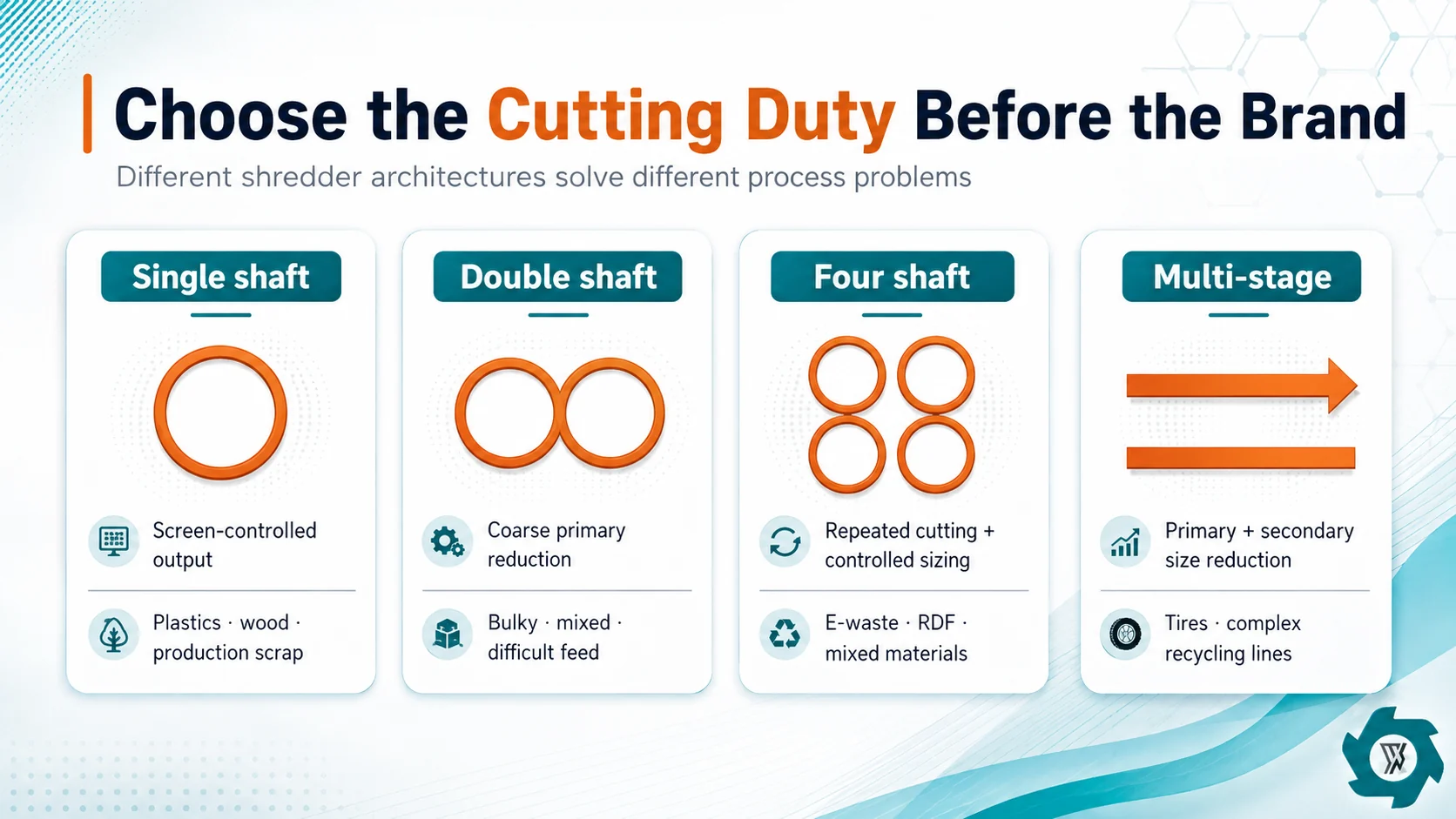
Brand comes after duty. That sounds obvious, yet RFQs often arrive in the opposite order: “We need a 90 kW shredder,” or “quote a double-shaft machine for plastic.” Those descriptions leave out the details that change the machine.
A thin HDPE drum behaves nothing like a dense purge lump. “Metal scrap” might mean empty cans, appliance shells, aluminum profiles or thick mixed sections. Even a simple capacity target is incomplete unless the required discharge size is stated. A machine making rough 150 mm pieces is not doing the same work as a screen-controlled shredder holding material until it passes a much smaller opening.
For a deeper machine-level comparison, our four-shaft vs double-shaft shredder guide explains when rough primary reduction and controlled recirculating sizing become different jobs. If the project leans toward a pusher-fed screen machine, the industrial single-shaft shredder buying guide covers rotor, screen and feeding questions in more detail.
| Process objective | Typical machine direction | Questions that matter |
|---|---|---|
| Controlled reduction of plastics, wood or production scrap | Screen-controlled single-shaft shredder | Rotor design, screen opening, pusher behavior, wrapping, sustained throughput and discharge method. |
| Open bulky or mixed feed before sorting | Low-speed double-shaft or primary shredder | Cutter geometry, shaft torque, reversal logic, unshreddable protection, maximum feed and next sizing stage. |
| Tighter one-machine sizing of mixed material | Four-shaft or recirculating multi-shaft system | Screen arrangement, recirculation load, cutter access, fines and realistic capacity at the final size. |
| RDF/SRF preparation | Primary + secondary shredding with screening/separation | Input composition, moisture, fuel specification, ferrous protection, screen strategy and net line capacity. |
| Tire recycling | Primary tire shredder plus downstream separation/granulation | Tire mix, bead handling, steel liberation, cutter wear, recirculation and product-size target. |
| Metal scrap pre-processing | Heavy-duty shear shredder or dedicated metal system | Section thickness, hollow vs solid feed, sealed-container policy, tramp material and downstream separation. |
Hydraulics deserve one extra line in the RFQ because the word can describe different functions. On some single-shaft machines the hydraulic circuit drives the pusher while the rotor remains electric. On other heavy-duty machines hydraulics may be part of the cutter-shaft drive. Our hydraulic single-shaft vs double-shaft comparison shows why “hydraulic shredder” is not a complete machine specification.
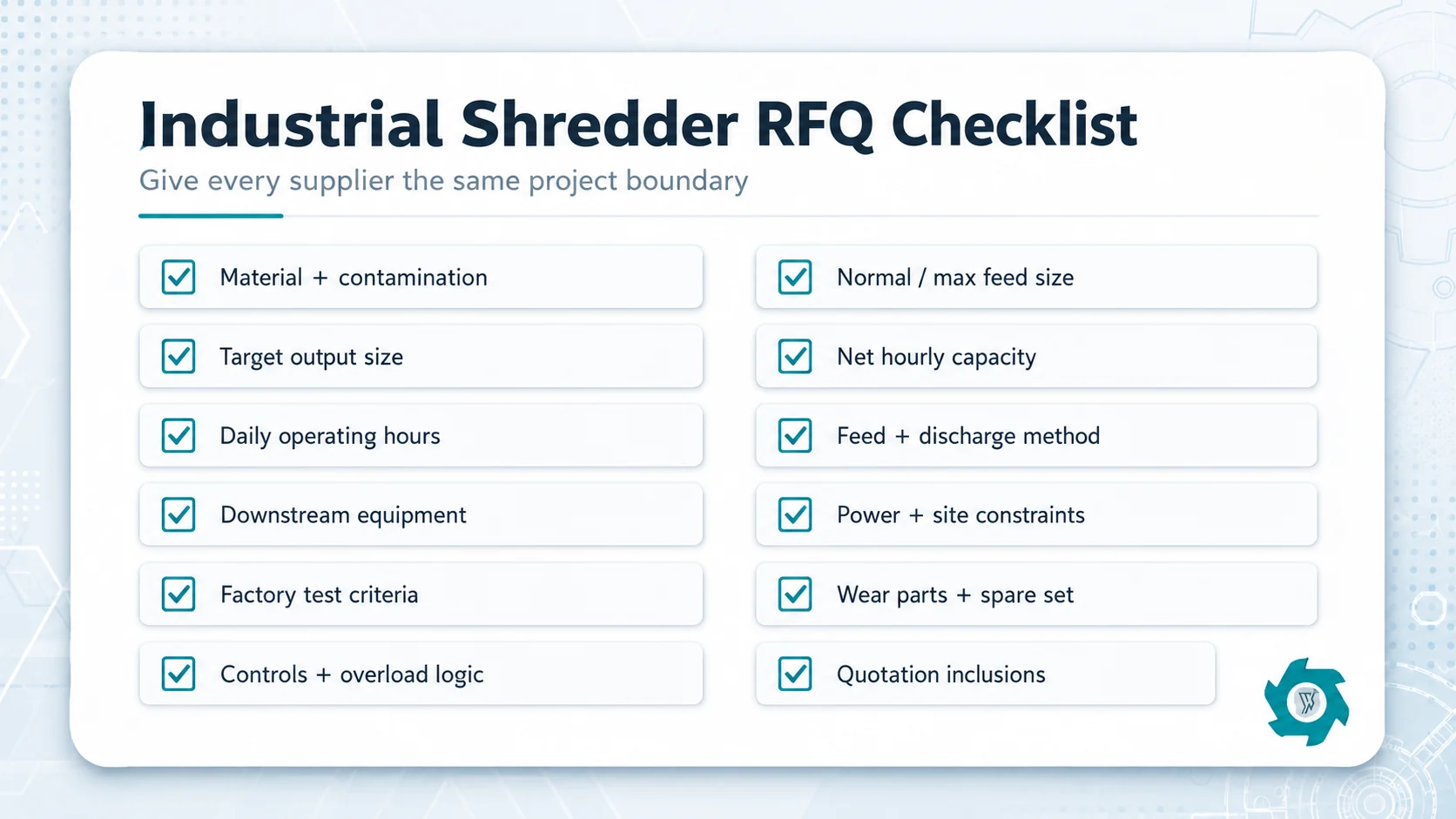
The RFQ becomes the useful document. We normally recommend sending the same project sheet to every manufacturer and asking each supplier to state assumptions rather than silently filling in gaps.
At minimum, put the material composition, normal and maximum feed dimensions, target output size, net hourly capacity and daily operating hours on the same page. Then add contamination, feed method, discharge method, downstream equipment, site voltage/frequency and any space restriction. If the material arrives in bales, bundles, drums or long pieces, say so. Geometry changes feeding more than many buyers expect.
The quotation boundary also needs to be visible. One supplier may quote the shredder only. Another may include a conveyor, magnetic separator, screen, spare cutters, commissioning and electrical cabinet. Comparing the totals without normalizing that scope produces a false price gap.
Motor power is easy to quote and easy to compare, which is exactly why it gets too much attention. Two machines with similar installed power can have different shaft speed, torque multiplication, chamber width, cutter thickness, screen load, hydraulic behavior and control logic. They can also be asked to make very different output sizes.
The more useful number is net production at the required product condition. Ask how throughput is measured, what feed is used, what screens or cutter arrangements are installed, how much material is being recirculated, and whether conveyors or separators are limiting the line. Without those conditions, the headline capacity cannot be treated as a guarantee.
A cutter set is not an accessory. It is part of the operating economics. Ask the supplier for cutter material, usable edges, sharpening or rebuilding policy, estimated change procedure, lead time and the recommended spare set for the first operating year. The same applies to counter knives, screens, seals and bearings where relevant.
Sometimes the more expensive machine is cheaper to own because maintenance access is better or the cutter can be serviced without dismantling half the line. Sometimes it is not. The point is to price the maintenance event, not just the purchase order.
A short video of a shredder eating clean material is not an acceptance test. It is useful evidence that the machine runs, nothing more. A representative test should answer the questions that could stop production at your site.
Bring or ship material that reflects the awkward part of the feed, not only the easiest pieces. If film wraps, include film. If drums arrive nested, test nested drums. If wood contains nails, state the contamination. For mixed waste, the composition should resemble the actual stream closely enough to expose bridging, reversals and uneven discharge.
Then agree on what will be measured: average net throughput over a meaningful interval, largest output pieces, oversize percentage where applicable, amperage or hydraulic load trend, reversal frequency, visible wrapping, temperature behavior and any manual intervention. The machine does not have to look effortless. It has to behave predictably.
For high-duty rotary-shear work and difficult mixed applications, SSI is a strong engineering benchmark. Vecoplan deserves attention when conveying and processing around the shredder are just as important as the shredder itself. YUXI is an option for overseas buyers who want multiple shaft architectures and recycling-line integration under a factory-direct project scope.
UNTHA and Lindner remain strong European references for dedicated shredding and waste-processing systems. WEIMA is particularly relevant for in-house recycling and controlled single-shaft duties. Shred-Tech adds a broad international service footprint and specialized industrial/mobile experience, while Granutech-Saturn is especially useful when shredding leads into further grinding or granulation.
The shortlist should still move with the job. That is the useful conclusion. Define the material, the target product and the next machine in the line first. Then compare manufacturers that can explain why their cutting architecture fits those conditions.
Send material photos or video, maximum feed size, target output, required net capacity and the downstream process. YUXI can prepare a configuration for comparison with your other shortlisted suppliers.
Normalize the same material, feed size, target output, net capacity, operating hours and quotation boundary across every supplier. Then compare cutter and shaft design, drive system, wear parts, overload logic, service, testing and downstream integration.
Neither is generally better. A single-shaft shredder is usually preferred when screen-controlled output sizing is important, while a double-shaft shredder is commonly used for rough primary reduction of bulky or difficult feed. Some projects require both stages.
Send representative material photos or video, normal and maximum feed dimensions, contamination details, target output size, required net capacity, daily working hours, feeding method, discharge method, downstream equipment, on-site power supply and any acceptance test requirements.
No. A lower purchase price can be offset by lower net throughput, high tool wear, difficult maintenance, additional conveyors or screens, unplanned downtime, or weak spare-parts support. Compare the complete operating boundary rather than machine price alone.

Get in touch with our nice team today to get a price estimate for a shredder machine.
Contact Us