Two quotations can both say “hydraulic shredder” and still describe machines that behave very differently on the floor. One has a pusher slowly bringing material toward a single rotor and a screen deciding when the pieces can leave. The other has two cutter shafts pulling the feed down between them and sending a much rougher product to the next machine.That difference matters more than the word hydraulic. In a single-shaft machine, hydraulics may mainly control the pusher; the cutting rotor can have a separate drive. In a hydraulic double-shaft machine, hydraulic motors can be part of the cutter-shaft drive itself. The current YUXI hydraulic shredder page makes that distinction and positions the two structures for different jobs rather than treating one as a larger version of the other.Start by identifying what the hydraulics actually operate. The pusher circuit and the cutter-shaft drive are separate questions.
Which Configuration Fits the Job?
If the project needs a tighter, screen-controlled discharge, the single-shaft route deserves the first look. The pusher keeps awkward material in contact with the rotor, while oversize pieces stay in the chamber for another cut. That is useful when the next step wants a more predictable feed size.If the first problem is simply getting a drum, tire, appliance shell or mixed bulky item opened, the double-shaft route usually makes more sense. Two counter-rotating shafts grip the material themselves. The output is normally coarser, but that can be exactly what a primary shredder is supposed to produce.
First, Separate Shaft Count from Hydraulic Drive
The most common buying mistake in this comparison is assuming that “hydraulic single-shaft” and “hydraulic double-shaft” describe the same power path with a different number of rotors. They may not.A typical single-shaft machine has one cutting rotor, fixed counter knives, a material pusher and a perforated screen. Manufacturers such as Vecoplan describe the same basic single-rotor concept with a hydraulic ram feeding material into the rotor and screens controlling the discharged particle size.[1] The hydraulic cylinder is therefore doing a feeding job. Whether the rotor itself is hydraulic, electric or another arrangement has to be checked separately.A hydraulic twin-shaft pre-shredder is a different architecture. WEIMA’s current twin-shaft machines, for example, use two shafts for active material feeding and offer hydraulic drive for coarse, heterogeneous waste streams.[2] On YUXI’s public hydraulic double-shaft description, an electric motor drives the pump, pressurized oil feeds hydraulic motors, and reduction units transmit torque to the two cutter shafts.This is why an RFQ should have two separate lines: cutting structure and drive arrangement. “Hydraulic, 90 kW” is not enough to tell you either one.
Hydraulic Single-Shaft vs Double-Shaft Shredder: Side by Side
Point to compare
Hydraulic single-shaft
Hydraulic double-shaft
Main cutting structure
One rotor with moving knives working against fixed counter knives
Two counter-rotating shafts with staggered or intermeshing cutter discs
How material reaches the cutters
Hydraulic pusher or ram advances material toward the rotor
Cutter hooks on the two shafts actively grip and draw material inward
What “hydraulic” usually refers to
At minimum the pusher; rotor drive is model-specific
On a hydraulic-drive design, hydraulic motors turn the cutter shafts
Output control
Screen retains oversize material for repeated cutting
Rough output is mainly influenced by cutter width, tooth profile, spacing and repeated gripping
Typical process role
Controlled size reduction, often before granulation, sorting, storage or reuse
Primary opening, pre-shredding and volume reduction before separation or a second reduction stage
Bulky hollow items
Can work, but hopper geometry and pusher contact are important
Usually comfortable territory when cutter hooks can catch the item
Very uniform output requirement
Usually the better starting point
Usually needs downstream screening or secondary reduction
Feed bridging
Pusher settings and hopper design directly affect it
Self-feeding shafts reduce dependence on a ram, although awkward material can still bridge above the cutters
Cutter discs, spacers/cleaners, shafts and chamber wear areas
Hydraulic maintenance
Pusher circuit, and possibly rotor drive if hydraulic
Main shaft-drive circuit, hydraulic motors, cooling, filtration and controls
Main selection risk
Screen restriction, wrapping, pusher pressure and excessive residence time
Hidden hard objects, rough output variation, cutter loading and repeated shock events
The last row is worth paying attention to. A single-shaft machine can be overloaded by trying to force too much material through too small a screen. A double-shaft machine can be overloaded because the cutters have grabbed something that should never have entered the chamber. Different problem, different diagnostic trail.
The Feeding System Changes How the Machine Takes the First Bite
Single-shaft shredders have a deliberate feed cycle. Material lands in the chamber, but gravity alone may not keep it against the rotor. The pusher moves it forward, then backs off or pauses when rotor load rises. UNTHA describes load-dependent hydraulic pushers on its single-shaft systems for the same reason: the ram has to feed, not simply press forward at one fixed speed.[3]That arrangement is useful for low-density or awkward feed. Film, woven sacks, plastic parts, wood offcuts and paper-mill rejects can sit high in a hopper without putting much mass into the cutting circle. A controlled pusher keeps bringing the material back to the rotor.A double-shaft shredder takes a more direct approach. The hooks on both shafts become the feeder. When they catch an edge, the material is pulled into the center and torn between the cutters. For drums, tires, appliance shells and other hollow shapes, that self-gripping action can save a lot of argument with the feed.
What we look for during a test: not only whether the machine eventually swallows the item, but how many times the operator has to reposition it. A machine that needs regular manual help at the hopper is telling you something about the feed geometry.
The Screen Is the Biggest Difference in Output Behavior
A single-shaft screen turns the cutting chamber into a recirculation loop. A fragment can be cut, move around the chamber, meet the rotor again and repeat that process until its geometry lets it pass the opening. The selected screen therefore affects more than nominal particle size. It changes residence time, rotor loading, heat and throughput.That can be a major advantage when the next machine wants a controlled feed. A granulator, washing line, air separator or storage system is usually easier to feed when the oversize tail is limited.A conventional double-shaft primary shredder often has a more open discharge. The cutters decide the first reduction, but there is no promise that every piece will be held until it reaches one screen opening. One object may tear into compact blocks; another may leave as a long strip. For primary opening, that is not necessarily a defect.Problems start when a buyer asks a primary double-shaft shredder to produce a final, narrow particle size without allowing for a screen or a second stage. The better process can be double-shaft opening first, controlled sizing second. Trying to make the first machine do both jobs may reduce capacity and increase wear.
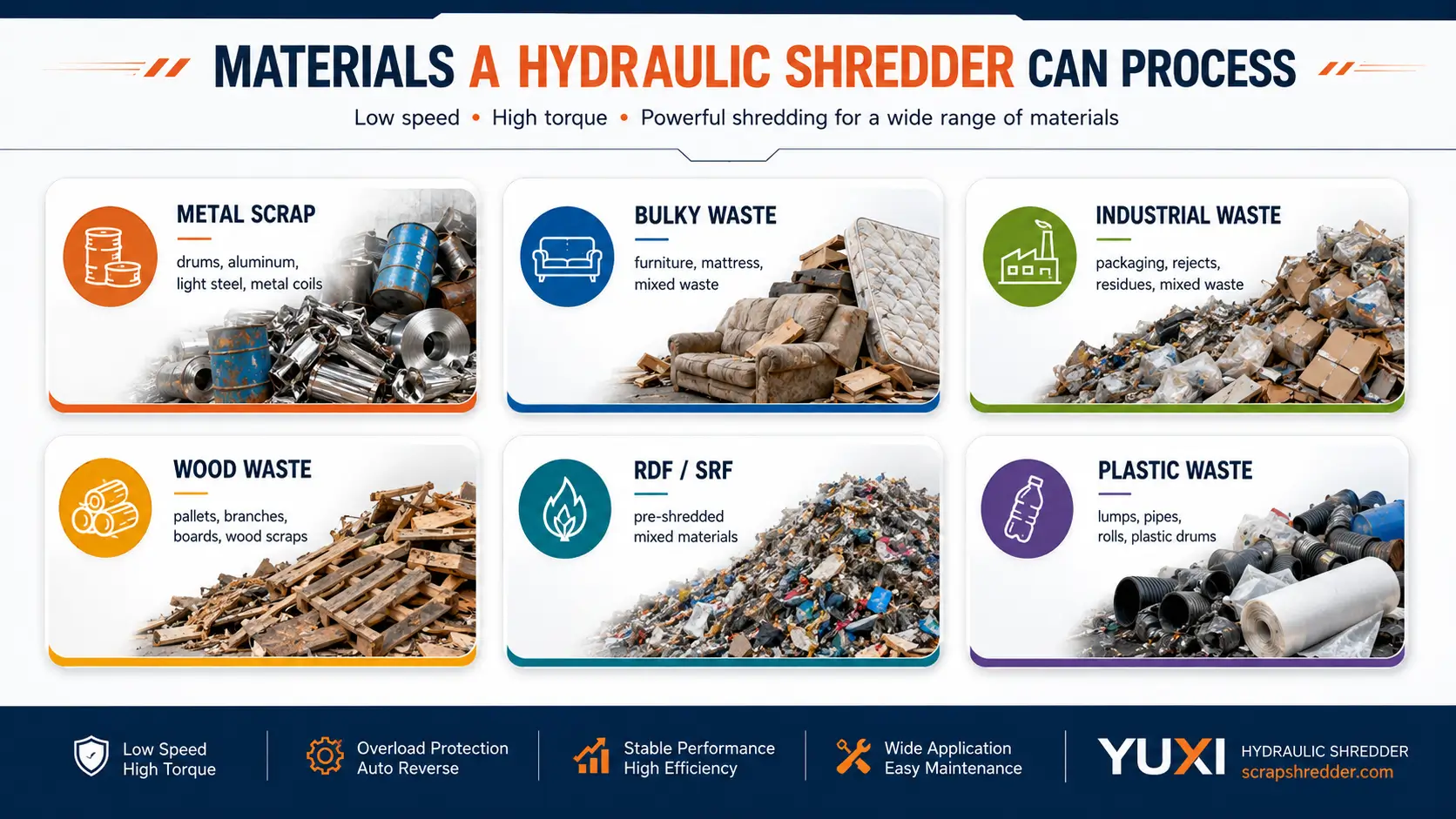
The material name is only the first filter. Shape, contamination, target output and downstream process decide which shaft structure fits.
Material Fit: The Same Waste Stream Can Need Either Machine
Feed condition
Usually start with
Why
Whole plastic drums, IBC inner tanks, large hollow molded parts
Double-shaft for opening; single-shaft if tighter output is the real requirement
Large hollow items need a reliable first bite, but some plastic lines later need screened material
Dense plastic lumps, purgings and prepared rigid scrap
Single-shaft often deserves the first test
Pusher plus screen can hold the material for controlled reduction; cutter and rotor design still matter
Wood offcuts and pallets
Depends on contamination and product target
Single-shaft suits controlled chips; double-shaft can open bulky or mixed pallet streams before sorting
The first job is normally gripping, collapsing and opening resistant hollow material
Passenger and truck tires
Double-shaft for primary opening
Two shafts can grip the elastic carcass and reduce it before steel separation or secondary rubber processing
Textiles, film and wrapping-prone industrial waste
Test both
A pusher can stabilize light feed, while a two-shaft machine may open bulky mixed items; wrapping behavior can dominate the result
Paper-mill rejects and RDF/SRF feed
Process-dependent
Moisture, wire, textiles, density variation and final fuel sizing can make a two-stage line more sensible than a one-machine answer
“Plastic = single shaft” and “metal = double shaft” are easy rules to remember, but they fail on real plants. A thin plastic drum behaves more like a bulky container than a dense plastic purge. A clean bundle of prepared sheet metal behaves differently from an appliance shell with trapped material inside.
Capacity Has to Be Compared at the Same Output Boundary
A double-shaft pre-shredder can appear extremely productive because material leaves as soon as the cutters have opened and reduced it enough to fall through. A screen-controlled single-shaft machine may spend more time recutting the same mass before it discharges. Comparing only tonnes per hour can therefore be misleading.Ask what the tonnage actually represents. If the double-shaft machine makes 150 mm-plus rough pieces and the single-shaft machine makes a much smaller screened product, the two capacity numbers are measuring different work.The line position makes the comparison fairer:
Process objective
Useful machine role
Open bulky feed before magnets, manual sorting or a second shredder
Double-shaft primary shredder
Produce a controlled feed for a granulator or downstream classifier
Single-shaft screen-controlled shredder
Handle very bulky feed and still finish at a narrow size
Two-stage system: double-shaft pre-shredder plus single-shaft/secondary size reduction
Reduce already prepared, consistent material in one stage
Single-shaft may avoid unnecessary pre-shredding
Overload Behavior Is Different Because the Load Enters Differently
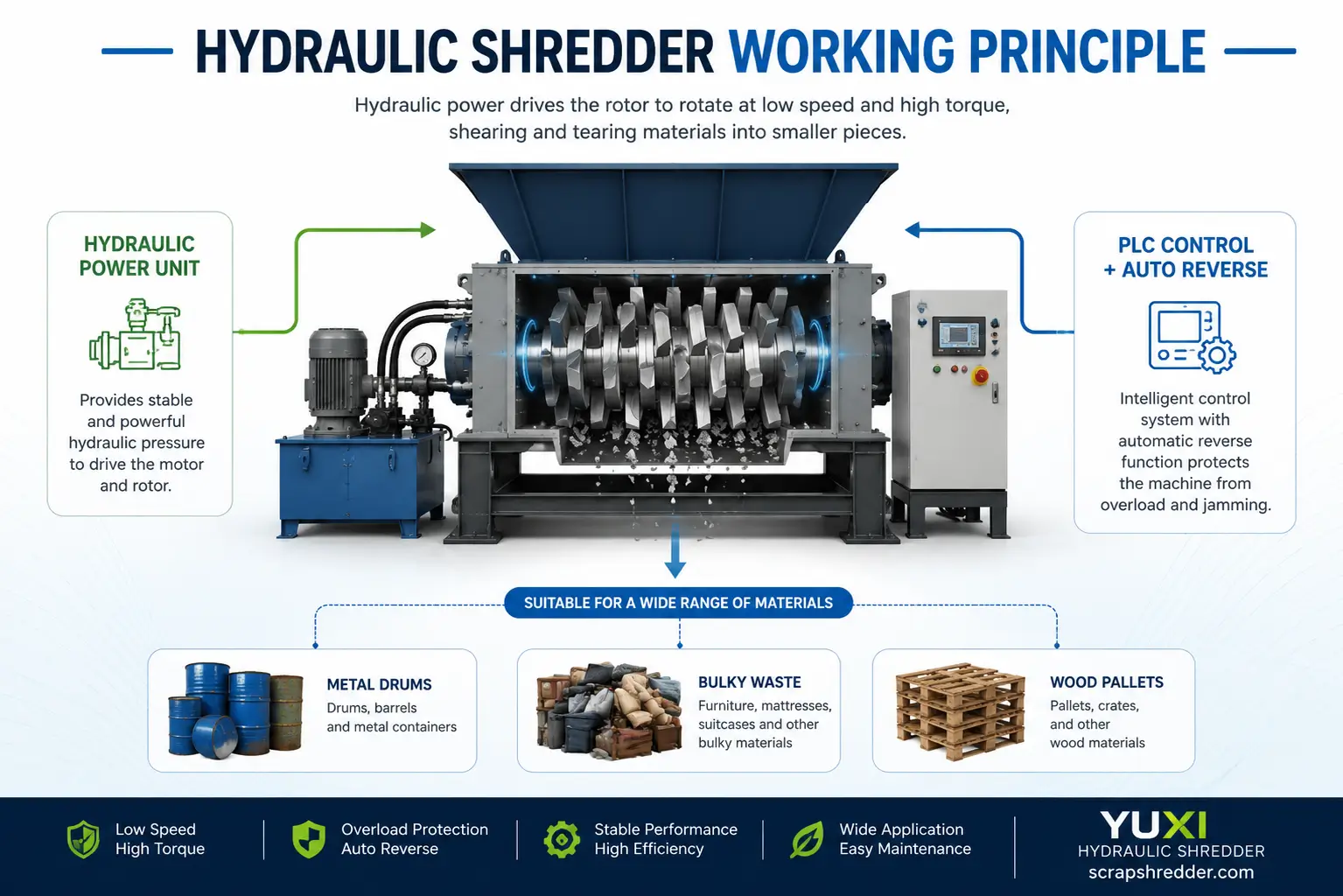
On a pusher-fed single-shaft machine, overload control is often a conversation between the rotor and the pusher. The rotor sees a heavy bite, the control system reduces feed pressure or retracts the pusher, the rotor clears the cut, and feeding resumes. If a screen is too restrictive or a knife edge is dull, that cycle can repeat until capacity falls noticeably.On a hydraulic double-shaft machine, the load is already between two active cutter shafts. System pressure and shaft speed can be used to detect a difficult bite. The controls can stop, reverse and restart the shafts; WEIMA’s hydraulic-drive description specifically highlights stopping, starting and reversing under demanding load as a feature of that architecture.[4]Automatic reverse is useful on both machines. It is not free capacity. Every reverse consumes time, creates another load cycle and changes the material’s position. During commissioning we would rather see a repeatable throughput with occasional controlled reversals than a dramatic video in which the machine backs out every few seconds.For a deeper look at the hydraulic circuit and recovery cycle, the separate hydraulic shredder working-principle guide covers the pusher, shaft-drive and overload logic without repeating this configuration decision.
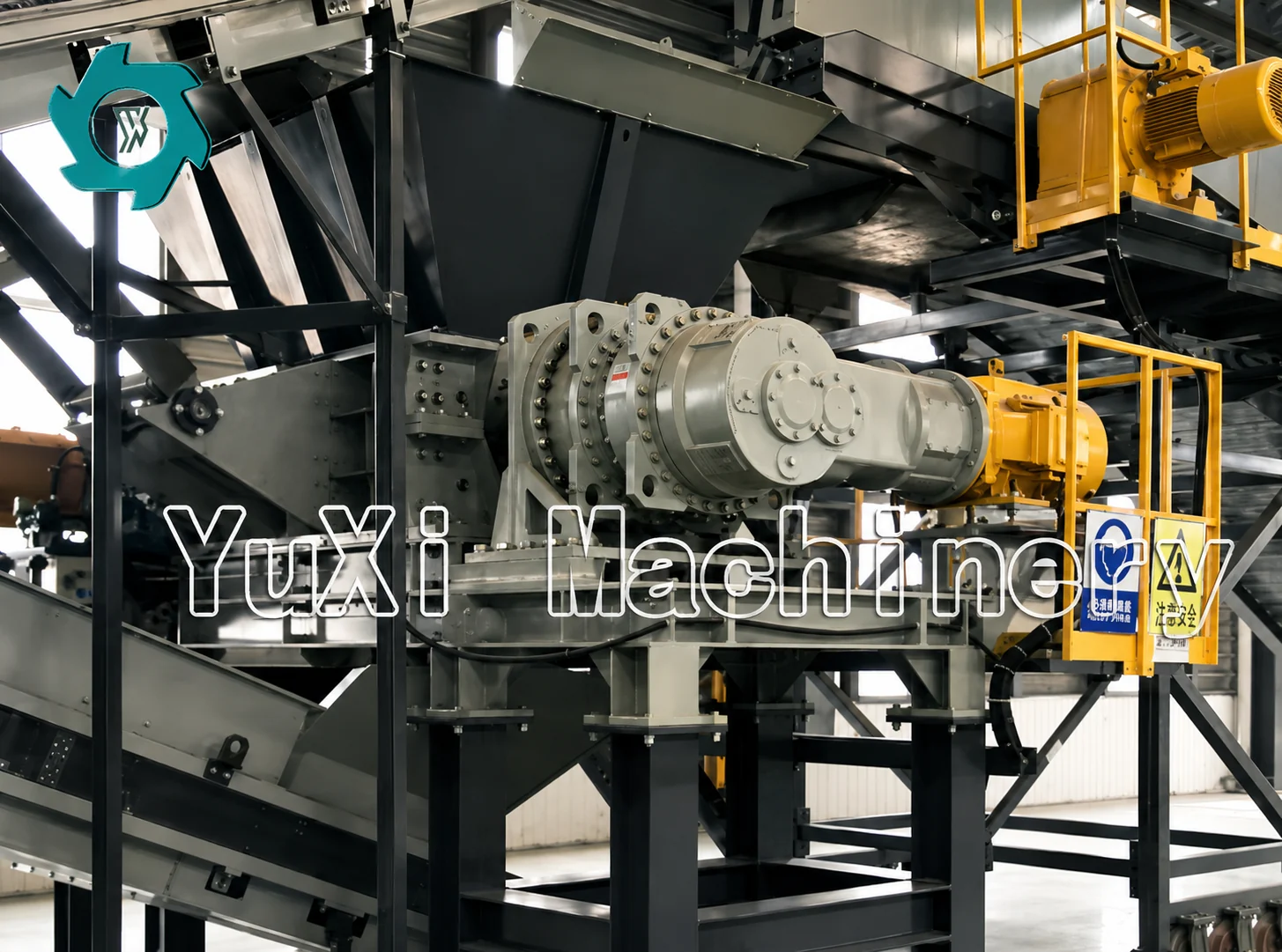
Once the shredder becomes part of a line, feeding surges and downstream stops can matter as much as the cutter chamber itself.
Maintenance: One Machine Adds a Screen and Pusher; the Other Adds a Second Cutting Shaft
Both machines need routine cutter inspection, bearing checks, lubrication where specified, guarding checks and a clean working area. Their additional maintenance work is different.
Single-shaft maintenance tends to concentrate on the feed-and-screen loop
The pusher has hydraulic cylinders, guides or wear surfaces, seals and control settings. The screen takes abrasion and impact from material that stays in the chamber. Rotor knives and counter knives also have to maintain the model-specific cutting relationship. If throughput slowly falls while the pusher cycles more often, inspect the screen, cutting edges and feed settings together rather than replacing one part blindly.
Double-shaft maintenance follows the cutter stack and hydraulic main drive
Two shafts mean more cutter discs, spacers or cleaning components and a larger interaction zone between the cutters. On a hydraulic shaft drive, oil cleanliness, filters, hoses, pumps, motors, valves and cooling become production-critical. ISO 4413 covers general rules and safety requirements for hydraulic fluid-power systems used on machinery, which is a useful reminder that the hydraulic power unit is part of the machine system, not a bolt-on accessory.[5]
Buyer check: ask for the maintenance points on the exact quoted arrangement. A machine described as “hydraulic single-shaft” may have only an auxiliary pusher circuit, while the double-shaft quotation may include a full hydraulic cutter-drive power pack. Their oil volume, filtration and cooler duties can be very different.
What Should Be on the Quotation Before You Compare Price?
Price comparison gets much easier when each supplier is forced to describe the same work. We would ask for the following information in writing:
single-shaft or double-shaft cutting structure, with a chamber drawing;
exact feed mechanism and hopper opening;
what the hydraulic system operates: pusher, rotor, cutter shafts, inspection door or several functions;
normal rotor or shaft speed under the stated feed;
screen opening and usable screen area for a single-shaft machine;
cutter width, hook profile, material and arrangement for a double-shaft machine;
hydraulic pump/motor arrangement, normal pressure and flow where the cutter drive is hydraulic;
reservoir, filtration and oil-cooling arrangement for the expected ambient temperature and shift length;
PLC overload threshold, reverse time, retry logic and alarm conditions;
capacity stated against a defined feed, target output and test duration;
spare cutters, screen, seals, filters and other commissioning spares included in the offer;
downstream conveyor, separator, secondary shredder or screen included—or explicitly excluded—from the scope.
If the drive architecture is still undecided, the separate hydraulic vs electric shredder duty-cycle guide is the better place to compare loaded starts, reversals, heat and energy. Shaft count and drive type are related decisions, but they should not be collapsed into one.
A Material Test Should Prove the Machine’s Role, Not Just That It Can Shred
Almost any impressive shredder video can prove that a machine can damage an object. That is not the same as proving a production specification.For this comparison, a useful test records the same feed and then measures different things for each machine:
Test item
Single-shaft question
Double-shaft question
Feeding
Does the pusher keep the rotor loaded without constant retract/advance cycling?
Do the cutter hooks grip the material without operator repositioning?
Output
What fraction passes the selected screen, and is the output suitable downstream?
Is the rough discharge open enough and small enough for the next process?
Capacity
Net accepted tonnes after screen-controlled cutting
Net pre-shredded tonnes at the agreed rough output condition
Overload
Pusher pauses/retractions, rotor reversals and time lost
Shaft reversals, pressure peaks, difficult pieces and time lost
Thermal behavior
Hydraulic pusher system and rotor-drive temperature where relevant
Hydraulic oil and cooler behavior during a sustained loaded run
Do not judge the two machines by the same particle-size expectation unless the process specification is genuinely the same. If the double-shaft machine is being bought as a pre-shredder, the correct acceptance question is whether its output feeds the next stage reliably.
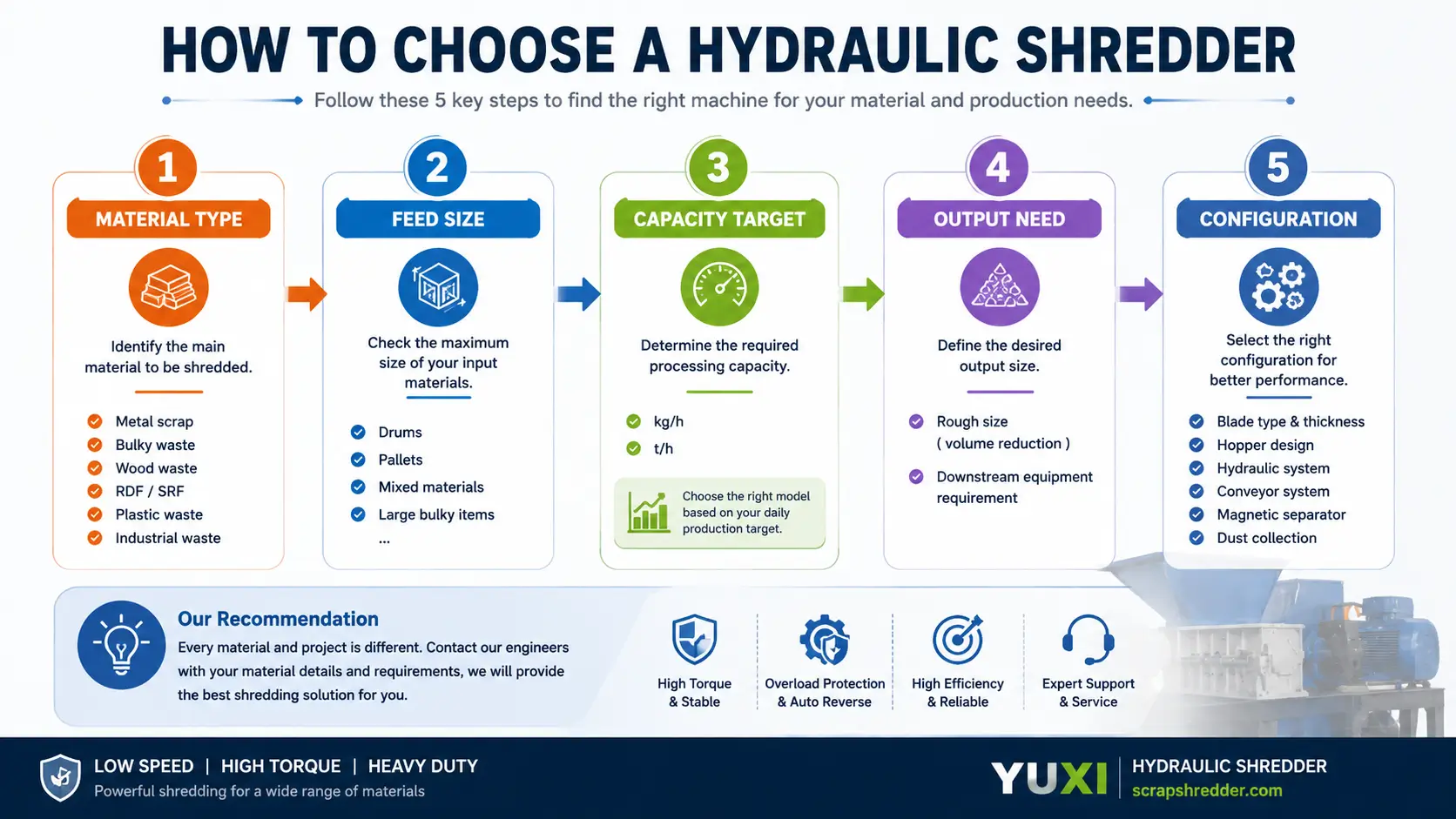
Material type is step one. Feed size, net capacity, target output and configuration determine the final choice.
Safety: Both Structures Have Serious Nip Points, and Hydraulics Add Stored Energy
Single- and double-shaft shredders both contain rotating cutting parts and in-running nip hazards. OSHA’s general machine-guarding requirement calls for guarding against hazards including points of operation, ingoing nip points and rotating parts.[6] The exact guarding, interlocks, hopper geometry and access procedure have to be designed for the installed machine and site.Hydraulics add another issue during service: stored pressure. OSHA’s lockout/tagout standard explicitly includes hydraulic energy among the energy sources that must be controlled when unexpected energization, startup or release of stored energy could injure workers.[7] Stopping the HMI is not an isolation procedure.That matters when opening a screen, removing a jam, entering a chamber or working around a pusher. Follow the selected machine manual and the site’s energy-control procedure; verify electrical, hydraulic, mechanical and gravity energy before access.
How We Would Frame a YUXI Single-Shaft vs Double-Shaft Project
We would not start the conversation with “which hydraulic shredder is stronger?” The more useful opening is: what change does the material need before the next machine?If the answer is “I need pieces held in the chamber until they are below a chosen size,” we would investigate a single-shaft screen-controlled configuration. If the answer is “I need to open drums, tires, appliances or mixed bulky waste so the line can handle it,” we would start with the double-shaft pre-shredding route.Then the details come in: maximum feed dimensions, the worst object expected in a normal batch, contamination, bulk density, target net throughput, working hours and downstream equipment. The broader hydraulic shredder selection guide covers those project inputs. For the cutting mechanics of the twin-shaft chamber itself, see how a double-shaft shredder works.For a YUXI quotation, the final document should state the power path clearly. On a single-shaft proposal, confirm whether hydraulics operate only the pusher or also the rotor. On a hydraulic double-shaft proposal, confirm the pump and hydraulic-motor arrangement, working pressure and flow, reduction path, cooling, filtration and PLC reverse logic. That makes the two quotations comparable for the job they are actually being asked to do.
Compare the Two Configurations Around Your Material
Send material photos or video, maximum feed size, target output, required net capacity and the next process in the line. YUXI can check whether the project needs screen-controlled single-shaft cutting, hydraulic double-shaft pre-shredding or a two-stage arrangement.
FAQ
Does a hydraulic single-shaft shredder always have a hydraulically driven rotor?
No. Depending on the machine,the hydraulic system may operate the pusher, the rotor drive, or both. The quotation should separate the pusher circuit from the cutter-rotor drive.
Which type gives a more uniform output size?
A single-shaft shredder normally gives tighter size control because a screen retains oversize pieces for further cutting. A standard double-shaft primary shredder usually produces a rougher discharge controlled more by cutter geometry and material behavior.
Which is better for metal drums, appliances or tires?
For bulky, irregular and resistant feed such as drums, prepared appliance shells and many tire applications, a double-shaft machine is often the stronger starting point because the two shafts actively grip and open the material. Right suitability still depends on dimensions, contaminants, cutter design and downstream requirements.
Which is more suitable for plastics, wood or paper-mill waste?
If the process needs screen-controlled output, a single-shaft machine is often attractive for plastics, wood and selected industrial or paper-mill waste. If the same feed arrives very bulky, mixed or difficult to grip, a double-shaft pre-shredder may be useful before the finer stage.
Can both machines use automatic reverse?
Yes, depending on the controls. A single-shaft machine can coordinate rotor load with pusher movement and reversal. A hydraulic double-shaft machine can use pressure, speed or load signals to stop and reverse the cutter shafts. Repeated reversing should be treated as operating data, not as proof of capacity.
What should I send before asking for a quotation?
Send material photos or video, normal and maximum feed dimensions, bulk density where relevant, contaminants, target output, required net capacity, loading method, hours per shift and the downstream process. For hydraulic machines, also ask the supplier to state which functions are hydraulically driven and provide the pressure, flow, cooling and filtration arrangement.
Sources
Vecoplan, Alternative Fuel Feedstock Prep — single-shaft rotary shredder concept with hydraulic ram and screen-controlled output.
WEIMA, Twin-Shaft Shredder — twin-shaft pre-shredding role and hydraulic-drive application for bulky and mixed waste.
International Organization for Standardization, ISO 4413:2010 — general rules and safety requirements for hydraulic fluid-power systems and components used on machinery.
David focuses on industrial shredding and recycling equipment,including material evaluation,shredder selection,process configuration,and recycling line planning.
Speak To Our Shredder Machine Expert
Get in touch with our nice team today to get a price estimate for a shredder machine.

 English



 Fast Delivery
 Reliable
 Certified
 Experienced