A drive comparison gets useful only after the shredder is loaded. On an empty factory floor, both a hydraulic machine and an electric machine can start, turn and reverse. The difference appears when a drum folds across the cutters, a tire catches on one hook, a bale arrives denser than the last one, or the operator asks the machine to restart with material still sitting in the chamber.That is why hydraulic shredder vs electric shredder is mainly a duty-cycle question. The buyer needs to know how often the machine runs loaded, how sharply resistance changes, how frequently it reverses, how much time it spends at steady load and what the plant can maintain. A hydraulic drive is not a universal heavy-duty upgrade. An electric drive is not automatically a light-duty option.The useful comparison is not “strong versus efficient.” It is how each drive reacts to the actual load pattern, then what that reaction costs in energy, heat, maintenance and downtime.
Which Drive Is Better for Your Operating Pattern?
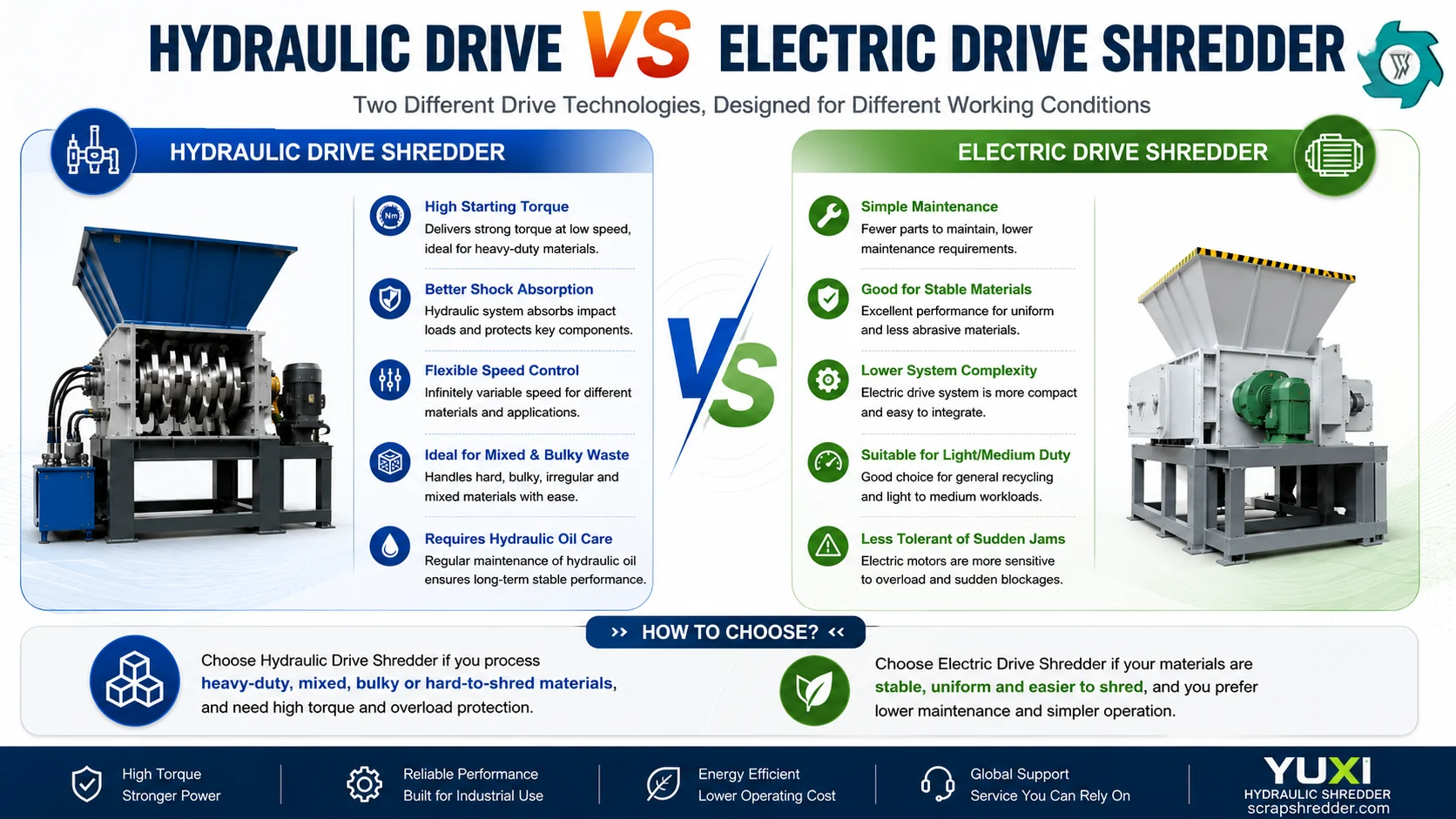
Heavy material changes the picture. When a shredder is often restarted with material still packed in the chamber, or the rotor has to reverse again and again to clear a difficult bite, hydraulic drive can make more sense. This is especially true with bulky, uneven feed where the load on the shaft can change suddenly.A line running fairly uniform material is a different case. If the rotor spends most of the shift cutting at a stable load, an electric motor and reducer are usually easier to work with. The inverter and motor protection still need to match the actual load, but there is often less reason to add a hydraulic drive system.
Selection rule: compare the load trace, not the badge on the power unit. The same material can favor different drives when one plant meter-feeds it steadily and another drops irregular loader buckets into the hopper.
First, Define What “Hydraulic” and “Electric” Mean
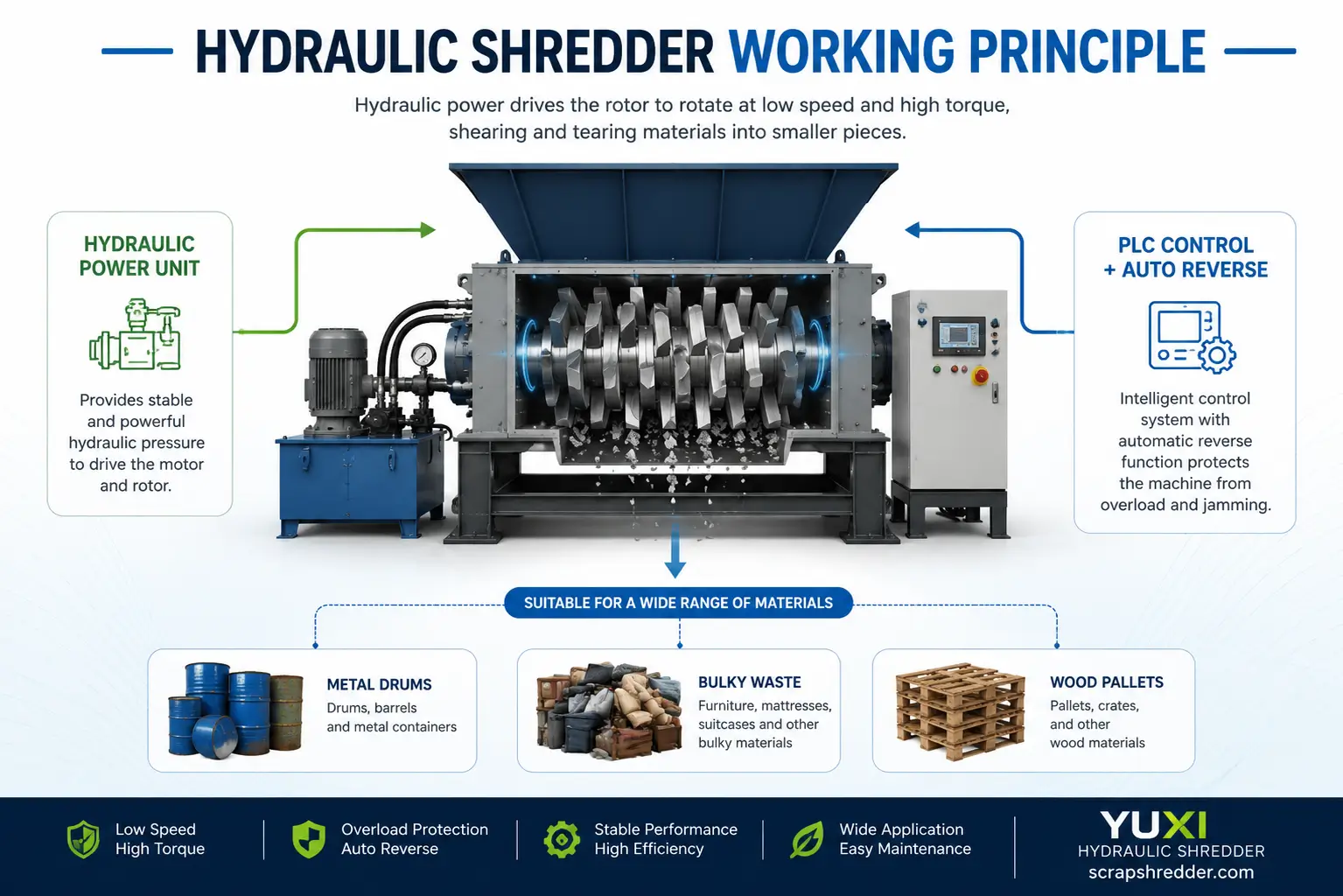
There is an easy source of confusion in this topic. A shredder can contain hydraulics without using a hydraulic motor to turn the cutter shaft. Many single-shaft machines use a hydraulic ram or pusher to move material toward an electrically driven rotor. That is a different comparison from a twin-shaft machine in which hydraulic motors actually drive the cutting shafts.The current YUXI hydraulic shredder page makes this distinction explicitly. Its single-shaft configuration can use hydraulics for feeding, the rotor drive, or both depending on the model; its hydraulic double-shaft arrangement uses an electric motor to power a pump, then hydraulic motors transmit torque through reduction units to the cutter shafts.This article compares cutter-shaft drive systems:
Drive path
Typical power path
Do not confuse it with
Hydraulic cutter-shaft drive
Electric motor → hydraulic pump/control circuit → hydraulic motor → reduction/shaft
A hydraulic pusher that only feeds an electrically driven rotor
Electric cutter-shaft drive
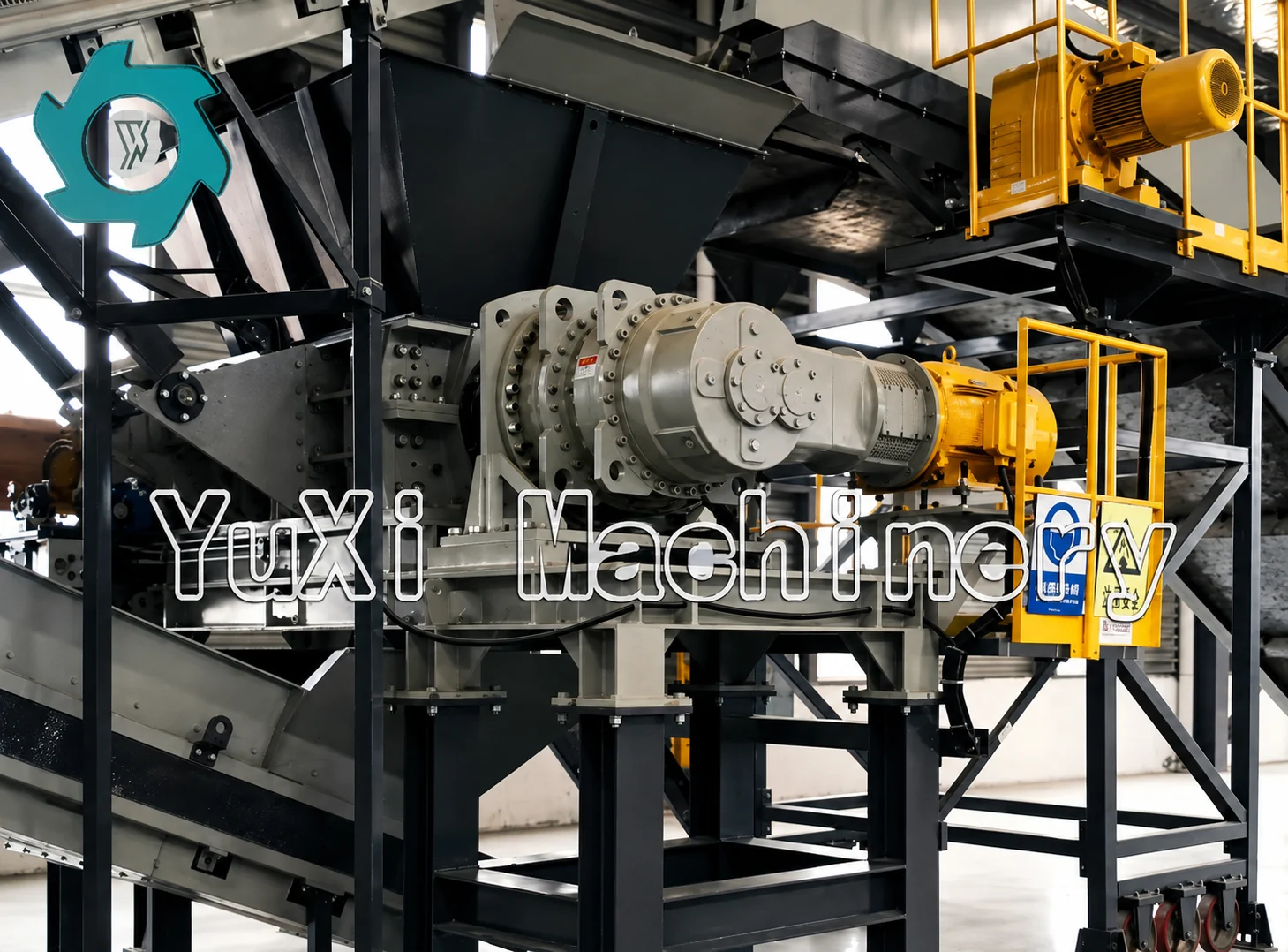
Electric motor → inverter/controls → gearbox, belt/coupling or direct-drive arrangement → shaft
A machine with no hydraulics at all; it may still use a hydraulic pusher or service function
Keeping those two paths separate prevents a bad quotation comparison. “Hydraulic system included” is not enough information. The supplier should draw the complete power path from the electrical supply to the cutter shaft.
Duty Cycle Is the Load Pattern, Not Just Hours per Day
Buyers often write “16 hours per day” on an RFQ and assume they have defined continuous duty. They have not. Sixteen hours of evenly metered plastic scrap is mechanically different from sixteen hours of mixed bulky waste with loader surges, stalled pieces and repeated reversals.For shredder selection, the useful duty profile includes at least these observations:
Duty-cycle item
What to record
Why it matters to the drive
Loaded run time
Minutes per shift with material actually engaged in the cutters
Separates productive load from idle motor hours
Loaded starts
How often the machine must start with material already in the chamber
Shows whether restart torque is routine or exceptional
Automatic reversals
Normal reversals per hour and the reason for them
Reversing frequency affects thermal load, cycle time and controls
Resistance variation
Whether feed is uniform, batched, springy, dense, reinforced or contaminated
Determines how sharply shaft torque changes
Idle/low-load time
Minutes running with little or no productive cutting
Changes the energy-per-ton result
Temperature trend
Hydraulic oil/cooler temperature or motor/reducer/VFD temperature during the full run
Short demonstrations can hide thermal limits
Net production
Accepted output mass divided by productive operating time
Connects drive behavior to plant output rather than peak nameplate data
There is no universal reversal count or load percentage at which hydraulic becomes “better.” The boundary depends on motor size, hydraulic displacement, reducer ratio, shaft speed, cooling, control settings and the actual feed. The point of recording the duty is to let two suppliers size against the same problem.
Hydraulic Drive vs Electric Drive: What Changes in Practice?
Selection point
Hydraulic cutter-shaft drive
Electric cutter-shaft drive
Loaded start / zero-speed torque
Can be a strong fit where full-load starting and reversing are normal; hydraulic motor torque is tied to pressure and displacement
Depends on motor, inverter, reducer and control strategy; modern high-torque electric designs can also be built for difficult starts
Speed control
Flow and displacement can be used to vary shaft speed within the circuit design
VFD or synchronous-drive control can vary motor speed; gearbox ratio still shapes shaft torque and speed
Overload response
Pressure controls and relief protection can limit hydraulic load; PLC can stop/reverse on defined conditions
Current/torque monitoring, inverter protection and PLC logic can stop/reverse; allowable repeated events are design-specific
Energy path
Includes pump, valves, fluid flow, hydraulic motor and cooling; losses appear partly as heat
Usually a shorter conversion path through motor/drive and mechanical transmission, though motor, inverter and gearbox losses remain
Heat management
Oil temperature, viscosity, filtration and cooler sizing are core design items
Motor, VFD cabinet and gearbox thermal limits still matter, especially at low speed or high ambient temperature
Maintenance focus
Oil, filters, hoses, seals, pumps, valves, hydraulic motors, cooler plus mechanical cutting parts
Motor, inverter, gearbox, coupling/belt or direct-drive components plus mechanical cutting parts
Leak / fluid management
Hydraulic oil condition and leakage control are part of normal ownership
No cutter-drive hydraulic fluid if the main drive is fully electric, although auxiliary hydraulics may remain
Best comparison metric
Accepted tons per shift, kWh per accepted ton, reversal time, temperature stability, maintenance hours and downtime under the same feed
Notice what is missing from the table: “hydraulic = strong” and “electric = efficient.” Both are too broad. A poorly sized hydraulic circuit can run hot and waste energy. A poorly geared electric drive can trip or reverse constantly. The system details decide the outcome.
Loaded Starts and Low-Speed Torque Are Where Hydraulic Earns Attention
A shredder load is rarely smooth. The cutters can slow almost to a crawl when they catch a dense section, then load up again as soon as the shaft reverses and comes back into the material. In many cases, that second bite is harder on the drive than normal forward running.
RFQ question: ask for the shaft torque-versus-speed envelope and the allowed loaded-start/reverse sequence. Motor kW alone does not tell you what torque reaches the cutters at 0 rpm, at normal shaft speed or during a controlled reverse.
In a hydraulic cutter-shaft drive, the power unit, control circuit, hydraulic motor and cooling system are part of the main drive. Their ratings have to be evaluated as a system.
Overload and Reversing: The Protection Philosophy Is Different
Both drive types can be protected. They simply sense and manage the event differently.
Hydraulic drive
Pressure is available as a direct signal of hydraulic load. Relief valves and pressure controls can limit the circuit, while the PLC can use pressure, speed and temperature conditions to command a stop or reverse. This can make the system tolerant of changing resistance when the circuit and controls are designed around that duty.
Electric drive
An electric shredder can use motor current, estimated torque, shaft-speed feedback and inverter protection to detect a stall or overload. The controller can then stop and reverse the motor. The important question is not whether reverse exists; it is how frequently the complete motor/inverter/reducer system is allowed to perform that sequence without overheating or overstressing the mechanical transmission.Frequent reversal is still lost production. If either machine spends a large part of the shift reversing, the first response should be to inspect feed size, batch loading, cutter geometry, screen restriction, worn knives and downstream blockage. A more expensive drive does not turn a bad feed condition into good process design.
For Long Shifts, Compare kWh per Accepted Ton and Heat Rejection
Electric-drive advocates often have a reasonable starting argument: there can be fewer energy-conversion stages between the electrical supply and the cutter shaft. Hydraulic systems convert mechanical power into fluid power and back into rotary mechanical power. Parker’s hydraulic cooler documentation describes the energy that the system does not use productively as heat that the cooler must remove.[1]That is a real design consideration, but it is not a license to publish a universal efficiency penalty. Pump type, displacement control, hydraulic motor efficiency, operating pressure, shaft speed, cooler demand and time spent unloaded all change the result. Electric systems also have motor, inverter, reducer and auxiliary losses.The U.S. Department of Energy’s motor-system sourcebook recommends evaluating the complete motor and drive system rather than treating motor nameplate efficiency as the whole plant result.[2] That same discipline works well for shredders.
Measure during a representative run
Why it is better than installed kW
Total kWh for the shredder drive and its required cooling/auxiliaries
Includes the energy actually consumed by the chosen architecture
Accepted tons during the same period
Prevents a low-energy but low-output run from looking efficient
kWh per accepted ton
Normalizes energy against useful production
Temperature after thermal stabilization
Shows whether the machine can keep the same rate through a long shift
Reversal and idle minutes
Explains why two tests with the same machine can have different energy intensity
If one supplier quotes lower installed power but the machine reverses twice as often, the lower motor number may not produce the lower operating cost. The material test has to carry both numbers: energy and accepted output.
Maintenance Cost Follows the Drive Architecture
Hydraulic ownership is not just “change the oil.” Oil cleanliness and temperature affect pumps, valves, motors and seals. Filters, hoses, fittings, reservoir condition and cooler performance enter the maintenance plan. In a hot plant, a cooler that is marginal during the factory test may become the real production limit after several hours.Electric ownership is not maintenance-free either. The reducer, coupling or belt system, motor bearings, inverter and electrical cabinet all need attention.For procurement, compare maintenance by task and downtime rather than by component count:
Hydraulic troubleshooting, contamination control, pump/motor/valve service
VFD diagnostics, motor testing, gearbox or coupling service
Critical spares
Filters, seals, hoses, selected valves/sensors, hydraulic pump or motor strategy
Drive fans/modules as appropriate, sensors, coupling/belts, motor/reducer strategy
Site question
Can the local team keep the hydraulic fluid clean and diagnose pressure/temperature problems?
Can the local team support the inverter, motor and reducer brands in the quoted configuration?
A familiar system can be the better system. A plant with strong hydraulic maintenance may accept more fluid-power hardware to gain the loaded-response behavior it needs. Another plant may prefer electric drive because local motor and VFD support is faster.
Material Names Help Only When They Predict the Load Pattern
It is tempting to make a material list—metal for hydraulic, plastic for electric—but that breaks down quickly. Empty plastic drums can create abrupt engagement. Prepared light steel can feed steadily. Tire bales and loose passenger tires do not create the same loading pattern.
Piece-to-piece resistance and shock events can vary widely; confirm exclusions and cutter design
Whole tires or irregular rubber feed
Hydraulic is often worth testing
Elastic feed can grip, release and re-engage; measure reversal frequency and temperature
Clean, metered plastic production scrap
Electric often starts with an economic advantage
Uniform feed reduces the value of extreme load-response capability; screen and pusher behavior may matter more
Wood offcuts or pallets with controlled feeding
Electric is a strong starting point
Nails, batch size and hopper bridging can still introduce shocks
RDF/SRF or mixed industrial waste
Compare both
Composition changes by shift; the correct answer depends on contaminants, pretreatment and feed metering
Wet paper-mill rejects / pulper ropes
Compare both, with strong emphasis on material testing
Wrapping, wire, moisture and irregular density can dominate the duty more than the drive label
The drive should be selected after the feed envelope is defined. If the supplier only asks for the material name, the duty cycle is still unknown.
A shredder drive has to fit the complete line. Feeding surges, downstream stops and restart logic can create a very different duty from the nominal hourly throughput.
Normalize the Quotations Before Comparing Drive Type
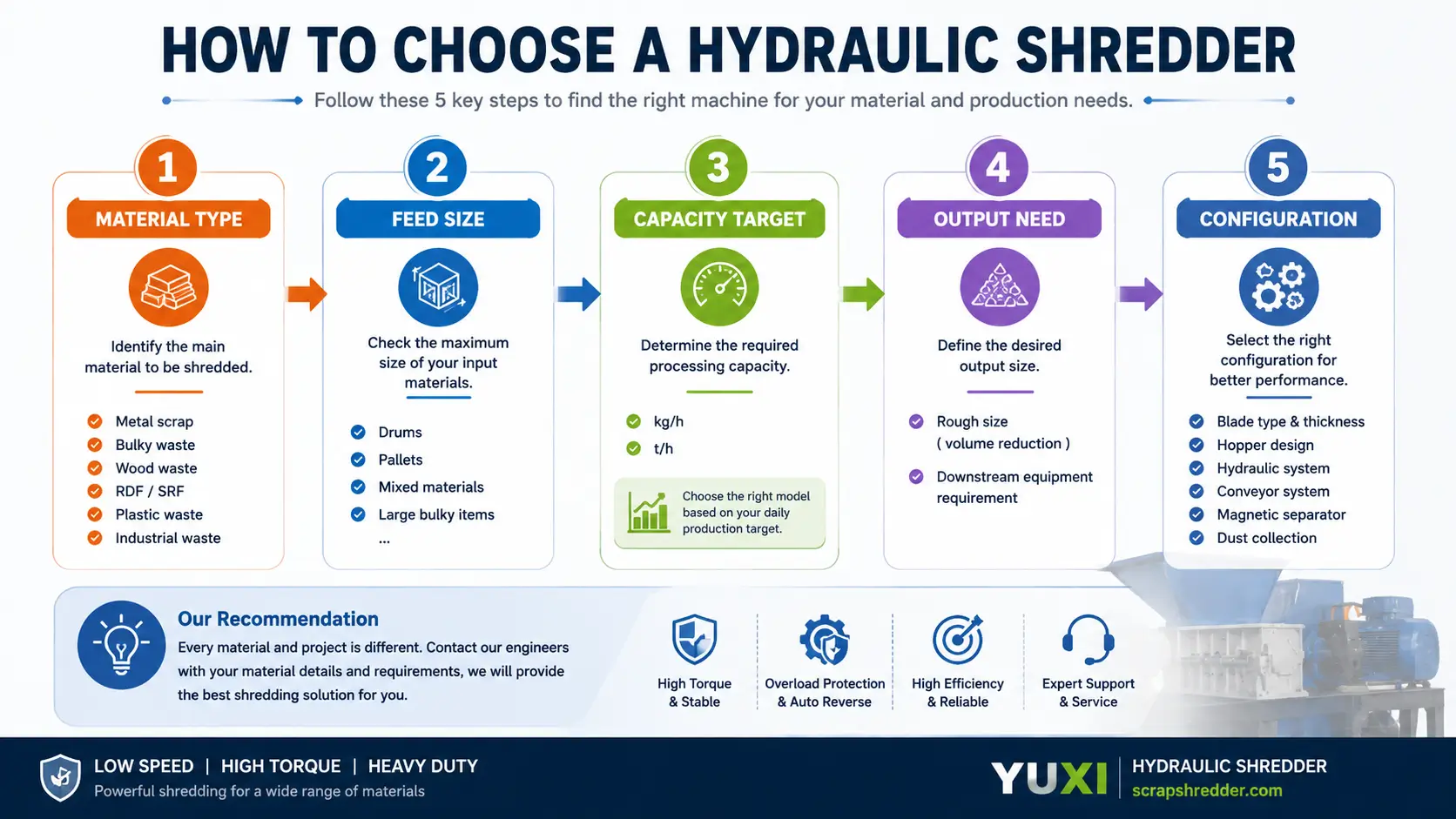
Two suppliers can both quote a “heavy-duty 110 kW shredder” while offering completely different torque, shaft speed and overload behavior. The comparison sheet should force both proposals onto the same engineering basis.Request these items in writing:
complete power path from incoming electricity to the cutter shaft;
normal shaft-speed range under the specified material;
continuous and peak shaft torque or the data needed to establish it;
allowed starting and reversing conditions with material in the chamber;
normal operating pressure and relief setting for hydraulic drives;
motor, inverter, reducer and protection arrangement for electric drives;
hydraulic reservoir, filtration and cooler sizing, including design ambient temperature;
motor/VFD/reducer thermal limits and cabinet cooling basis for electric drives;
control sequence after a stall: stop time, reverse time, forward retry and maximum retry logic;
guaranteed capacity test material, output condition and test duration;
energy measurement boundary—main drive only or drive plus cooling and auxiliaries;
recommended maintenance intervals, spare parts and service response path.
Then compare total installed cost and operating cost under the same duty. Do not give one supplier credit for excluding a cooler, conveyor or control cabinet that the other supplier included.
A Representative Material Test Settles More Than a Pros-and-Cons List
The most useful drive comparison is a warm, loaded machine processing the material the plant will actually receive. A short empty run proves rotation direction and basic function. It does not prove duty-cycle fit.A practical factory acceptance test should record:
Test item
Record
Feed
Total mass, normal and maximum piece dimensions, difficult inclusions, moisture and loading method
Output
Net accepted mass, oversize or recirculation condition, downstream suitability
Drive behavior
Normal shaft speed, loaded starts if part of the agreed operating method, automatic reversals and stop events
Energy
Total kWh within the agreed measurement boundary and kWh per accepted ton
Thermal behavior
Hydraulic oil/cooler temperature or motor, reducer and VFD temperatures after a sustained run
Interventions
Manual feed correction, jam clearing, foreign-object removal and downtime
Safety and controls
Interlocks, emergency stops, alarms and lockout points demonstrated according to the manufacturer procedure
Safety boundary: do not create an intentional jam just to prove reversing torque unless the manufacturer has a written, engineered test procedure for it. OSHA’s scrap-metal recycling guidance includes a fatal incident involving jam removal at a scrap-metal shredder and also identifies moving machinery and unexpected startup as important hazards.[3]
The decision is stronger when both machines are judged on accepted tons, energy, reversals and temperature. A hydraulic drive that uses more energy but finishes the same shift with fewer production stops may still be the better economic choice. An electric drive that produces the same accepted tonnage with a simpler service burden may be the better one. The result is project-specific.
How This Applies to YUXI Hydraulic Shredder Projects
YUXI’s public hydraulic-shredder information already sets a useful boundary: hydraulic drive should not be presented as universally stronger or more energy-efficient, and selection should consider feed variation, starting load, shock frequency, duty cycle, maintenance conditions and operating cost.On a YUXI double-shaft hydraulic shredder, we would look beyond the motor power listed on the quotation. The hydraulic circuit matters just as much: pump and motor selection, operating pressure and flow, the reduction arrangement, oil cooling and filtration, and what the PLC does when the shafts stall or reverse.Single-shaft machines need one extra check. A hydraulic cylinder is often used for the pusher, while the cutting rotor may still be electrically driven. So the word “hydraulic” on its own does not tell you how the rotor is powered.If the project is still deciding between shaft count, output control and feeding method, use the hydraulic shredder selection guide for the broader machine decision. This article should remain narrower: once the cutting architecture is plausible, which drive path best fits the actual working cycle?Drive selection comes after the material, feed envelope, output requirement and machine architecture are clear.
Information to send before requesting a drive recommendation: material photos/video, maximum piece size and weight, bulk density where relevant, contamination, loading method, target output, net capacity, hours per shift, expected loaded starts, likely reversal frequency, site ambient temperature, voltage and downstream equipment.
Compare the Drive Around Your Real Feed
Send the material, loading method, target output, daily operating schedule and difficult feed conditions. YUXI can review whether a hydraulic cutter drive, electric drive or a different shredder configuration better matches the project.
Hydraulic vs Electric Shredder FAQ
Is a hydraulic shredder stronger than an electric shredder?
Not automatically. A hydraulic cutter-shaft drive can be very useful when the machine must start, stop or reverse under heavy load, while modern electric drives can also provide high torque with suitable motors, reducers and controls. Compare the torque-speed envelope and the real material test rather than the drive label.
Does a hydraulic shredder always use more electricity?
No universal percentage applies. Hydraulic systems add pump, motor, valve and cooling losses, while electric systems also have motor, inverter and gearbox losses. Measure kWh per accepted ton under the same material, output requirement and operating period.
Can an electric shredder reverse when it jams?
Yes, if the drive and controls are designed for that operating sequence. Electric machines can use current or torque monitoring with PLC or inverter control to stop and reverse. The allowed reversing frequency, thermal limits and restart conditions should be confirmed for the quoted machine.
Which drive is better for continuous operation?
Stable continuous feed often makes an electric drive attractive because the power path and maintenance scope can be simpler. Continuous operation with frequent shock loads, loaded restarts or repeated reversals may justify a hydraulic drive. The better choice depends on the actual load trace, not the number of scheduled hours.
What duty-cycle data should I send to a shredder supplier?
Send operating hours per shift, normal and maximum feed, loading method, expected surges, difficult objects, target output, downstream limits and whether loaded restarts are common. During testing, record net throughput, reversals, energy, temperatures, alarms and operator interventions.
Does a hydraulic pusher mean the shredder rotor is hydraulically driven?
No. A single-shaft shredder may use a hydraulic pusher while the cutting rotor is driven by an electric motor and reducer. The quotation should state separately how the material feeder and cutter shaft are powered.
Sources
Parker Hannifin, Industrial and Mobile Coolers — hydraulic heat balance, lost energy and oil-temperature management.
U.S. Occupational Safety and Health Administration, Recycling: Scrap Metal Recycling — shredder guarding, hazardous energy and jam-clearing safety context.
David focuses on industrial shredding and recycling equipment,including material evaluation,shredder selection,process configuration,and recycling line planning.
Speak To Our Shredder Machine Expert
Get in touch with our nice team today to get a price estimate for a shredder machine.

 English



 Fast Delivery
 Reliable
 Certified
 Experienced