A radiator shredder machine is easy to overspecify. The feed looks metallic and difficult, so it is tempting to move straight from a twin-shaft design to four shafts, a smaller screen, or a hammer mill. In practice, those are three different decisions. The first is about gripping and opening bulky radiator scrap. The second is about controlling the size of what leaves the shredder. The third is about whether the material needs impact-based liberation before separation.
Start with the condition required after shredding
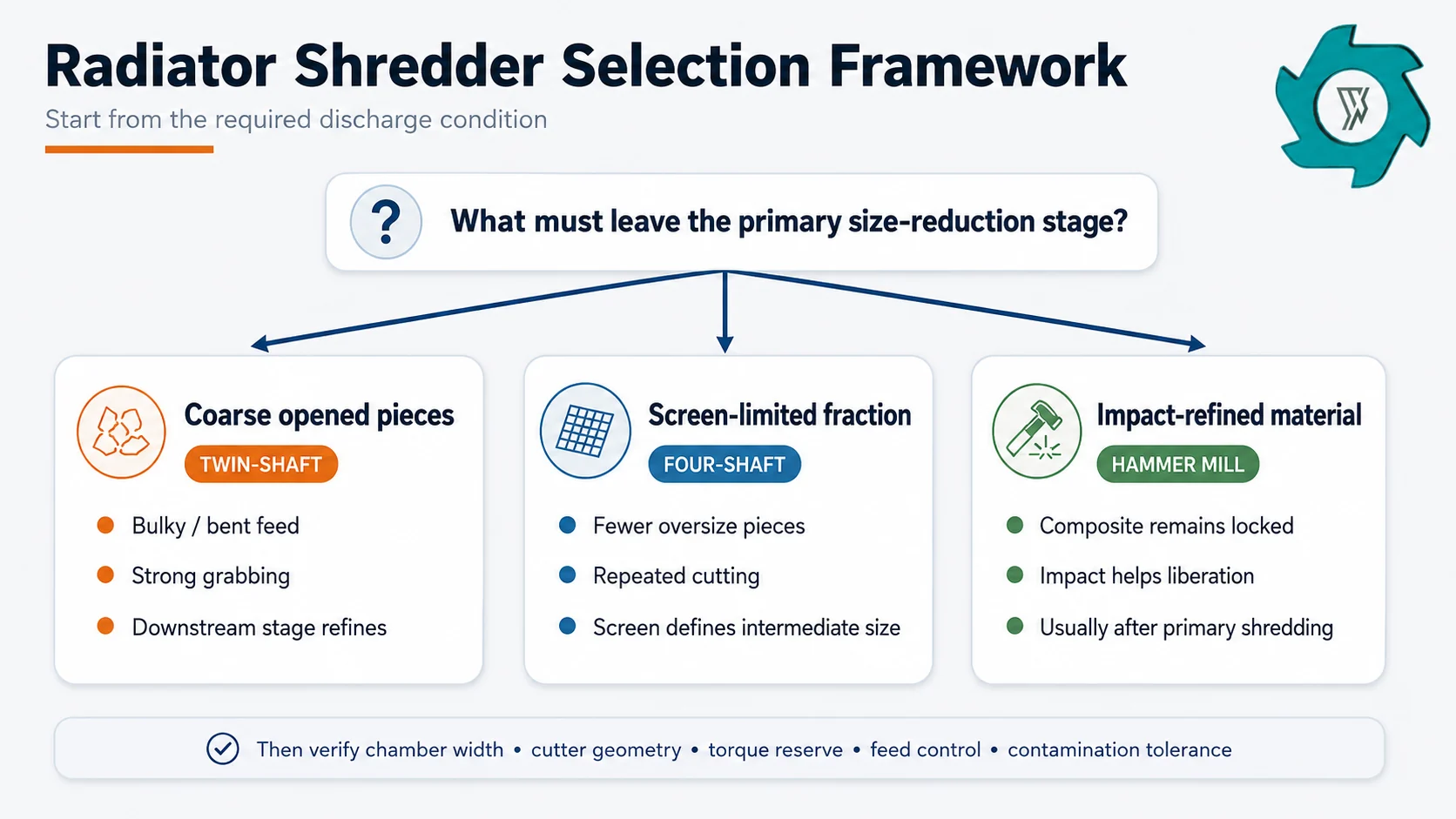
Two buyers can both ask for a “radiator shredder” and need completely different machines. One is feeding whole car radiators into a secondary crusher. The other wants a relatively controlled intermediate fraction because the next conveyor, screen, or separator is sensitive to long pieces. If both requests are reduced to tons per hour and motor power, the comparison is already weak.The useful first question is simpler: what condition must the radiator be in when it leaves the shredder? Coarse opened pieces, a screen-limited fraction, and impact-refined material are not the same product.
Process need
Twin-shaft shredder
Four-shaft shredder
Hammer mill / impact stage
Open whole or bent radiators
Usually the first choice
Possible, but not automatically necessary
Usually not the first choice for bulky feed
Accept irregular feed geometry
Strong fit when chamber and cutters are matched
Strong fit, with repeated cutting
Better after feed has been reduced to a manageable size
Control oversize discharge
Limited; output is normally rougher
Main advantage when a screen is used
Can refine further, but by impact rather than slow-speed shearing
Prepare feed for secondary crushing
Very common role
Useful where tighter intermediate sizing matters
May itself be the secondary refining stage
Increase metal liberation
Primarily opens and tears; not a final liberation device
More recutting, but still mainly shear-based
Selected when impact is needed to open bonded or layered material further
Feed geometry decides more than the material name
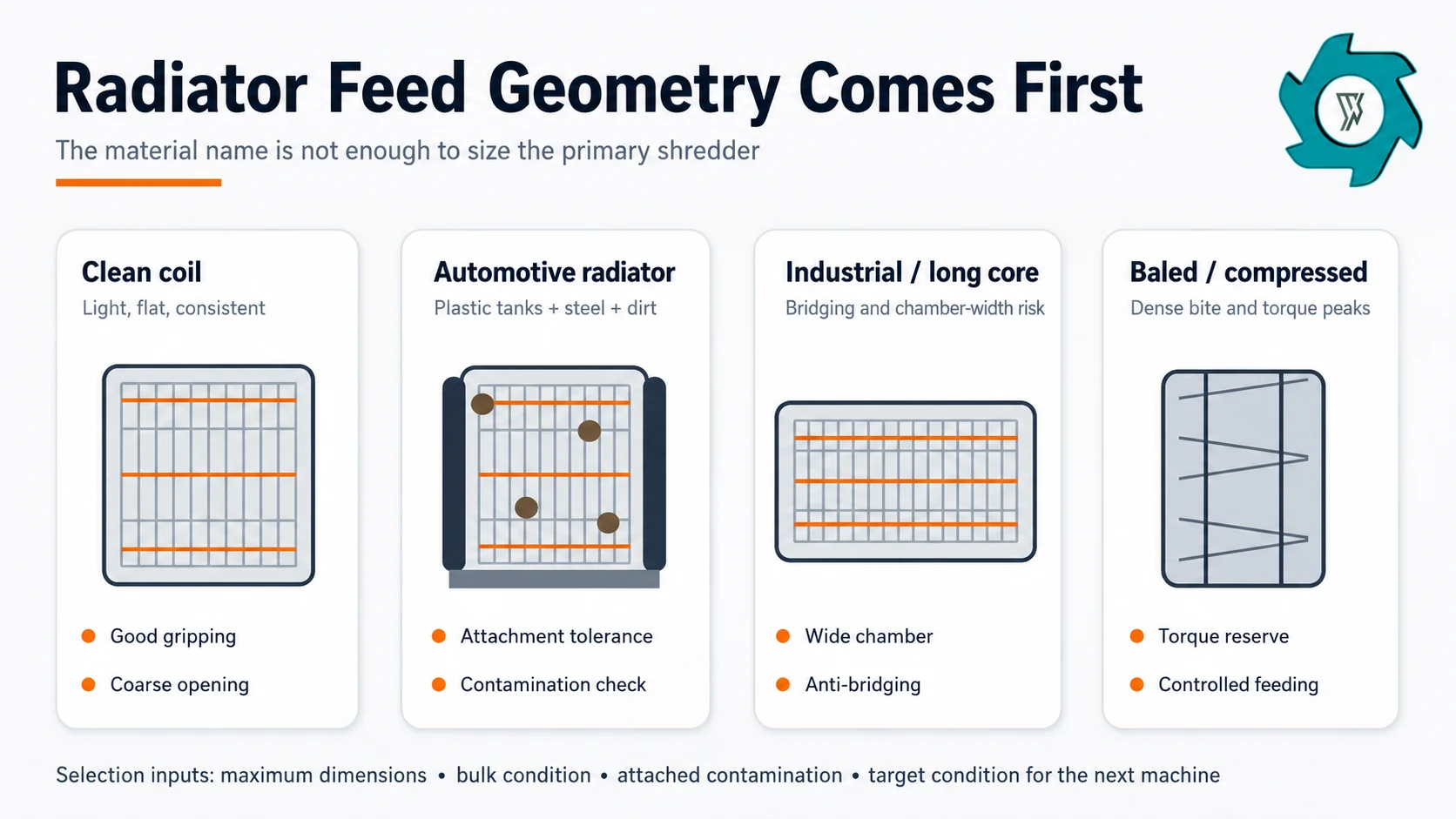
“Scrap radiator” describes a material family, not a stable feed shape. A clean rectangular air-conditioning coil behaves differently from a crushed automotive radiator with plastic tanks still attached. A long industrial heat exchanger can bridge across a hopper even when its metal thickness is modest. A baled load creates another problem: the machine sees a dense compressed mass rather than individual light cores.Radiator geometry changes how the shredder must grip, accept and meter the feed.This is why nominal weight per hour can mislead. Radiators are often light for their volume. The shredder may run out of effective chamber volume or struggle with bridging before the drive reaches the tonnage that looked reasonable on paper. Conversely, a compacted or steel-heavy load can create sharp torque peaks even though the hopper appears only partly full.During selection, we would separate the feed into at least four descriptions: maximum outside dimensions, shape, bulk condition, and attached contamination. Photos taken from the top and side of a typical load are often more useful than a single material name.
When a twin-shaft radiator shredder is the practical default
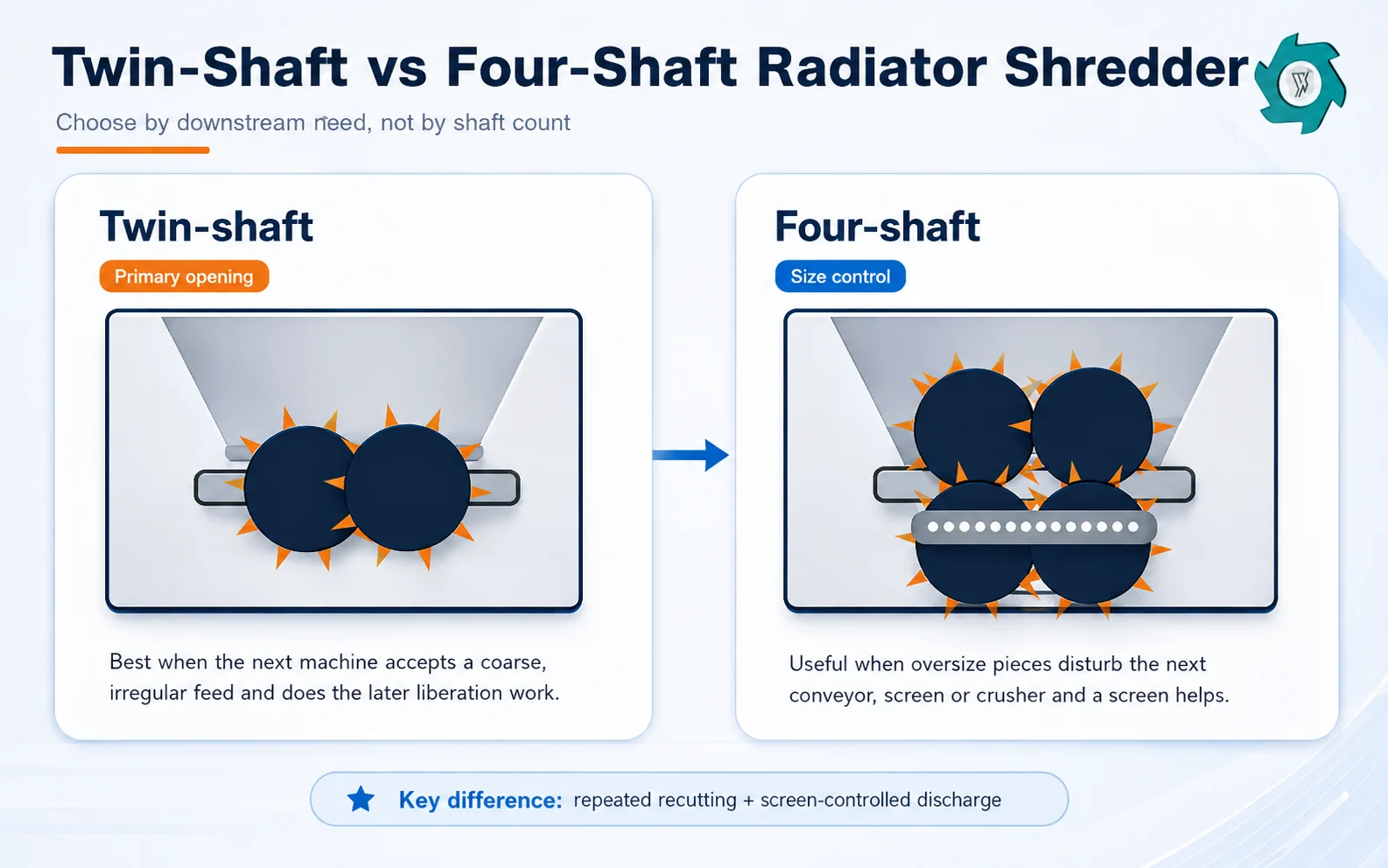
A double-shaft shredder uses two counter-rotating cutter shafts to grip, shear, and tear bulky material. For radiator recycling, that rough action is often exactly what is needed at the front of the line. The shredder does not have to finish the separation job. It has to turn awkward objects into a stable feed that the next machine can accept.Twin-shaft shredding prioritizes coarse primary opening; four-shaft shredding adds repeated cutting and screen-controlled sizing.That distinction matters. In a complete copper aluminum radiator recycling line, a secondary crusher or impact stage may already be responsible for opening the copper-aluminum structure. Forcing the primary shredder to make a very small and uniform product can add wear and reduce throughput without improving the final result.
Twin-shaft usually fits these conditions
Whole, bent, flattened, or mixed radiator scrap must first be opened and reduced in volume.
The next machine can tolerate a coarse, somewhat irregular feed.
The plant wants strong grabbing action and low-speed torque rather than fine sizing in one step.
The process includes a separate crusher, refiner, hammer mill, or other downstream liberation stage.
Feed may contain moderate amounts of plastic tanks, clips, thin frames, or other attachments that first need to be broken apart.
There is also a maintenance argument. A simpler primary size-reduction task is easier to diagnose. If output becomes too large, the cause may be worn cutter edges, poor material grip, insufficient bite, or a feed-control problem. When one machine is simultaneously expected to accept bulky feed, make a narrow size fraction, and partially liberate metals, it becomes harder to tell which parameter is actually limiting the line.
When four shafts add real value
A four-shaft shredder should not be treated as a simple “heavier” version of a twin-shaft machine. The useful difference is repeated cutting and, on many designs, screen-controlled discharge. Oversize material stays in the chamber until it is small enough to pass the selected opening.
Four-shaft shredding becomes more attractive when:
Long strips or oversize pieces leaving a twin-shaft shredder repeatedly disturb the next conveyor, screen, or crusher.
The downstream machine has a fairly narrow feed-opening requirement.
The operator needs a more repeatable intermediate size because the line handles several radiator shapes in the same shift.
A screen-controlled discharge can remove a separate sizing step without forcing the final liberation duty onto the shredder.
Smaller screen openings mean more material circulates inside the chamber. That repeated cutting may improve size control, but it also increases residence time, cutter work, and sensitivity to contaminants. In other words, “smaller screen” is not a free upgrade. It should solve a downstream problem that has been identified first.
When a hammer mill is actually needed
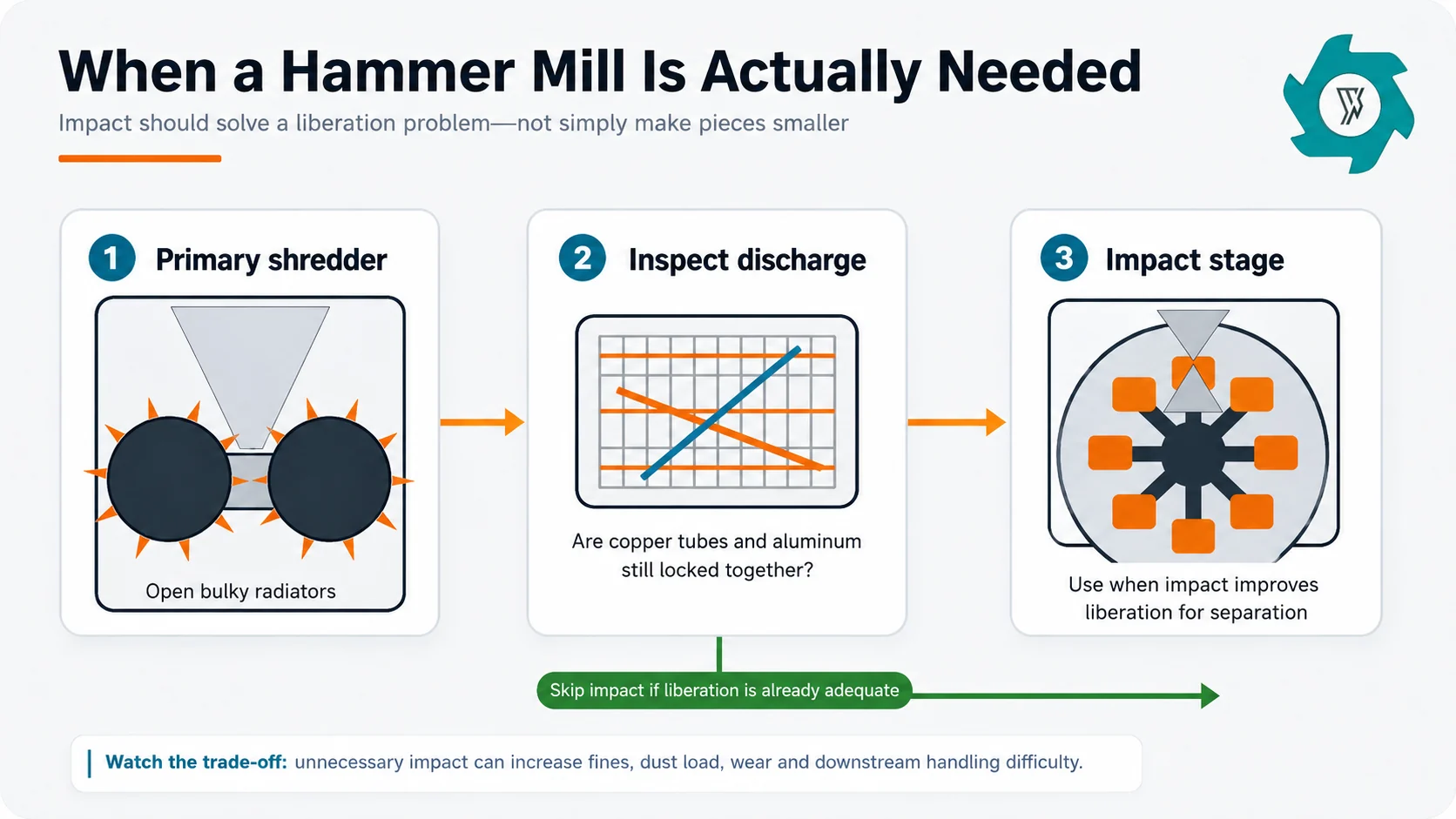
The point at which a hammer mill enters the design is often misunderstood. A twin-shaft or four-shaft shredder works mainly by slow-speed shearing and tearing. A hammer mill relies on impact. That change in mechanism is useful when the process goal changes from making bulky radiators manageable to opening or refining the material so later separators can work effectively.A hammer mill should be evaluated when primary shredding leaves copper and aluminum materially locked together.
Signals that justify evaluating an impact stage
One sign is persistent composite material after primary shredding: copper tubes and aluminum fin packages remain locked together even though the pieces are small enough to feed the next machine. Another is when magnetic or density separation performs inconsistently because the feed contains large laminated or folded assemblies rather than individual metal-rich particles.However, those symptoms should be confirmed with samples. Over-processing can create its own problem. Very fine metal and light fragments are harder to manage, increase dust collection load, and can blur the density difference that the final separator relies on. A hammer mill is therefore a liberation decision, not an automatic third step after every shredder.
Cutter thickness and hook profile should follow the radiator, not a catalog default
Radiator cores present a strange combination: thin fins, hollow tubes, folds, side plates, occasional steel, and sometimes plastic end tanks. The machine needs enough hook to catch the flat structure, but an extremely aggressive tooth is not automatically better. Too much bite on a dense or steel-heavy section can produce abrupt load peaks. Too little bite leaves flat cores skating or rotating above the cutters.Cutter thickness also affects the character of the discharge. Wider cutters generally make a coarser bite and can be attractive for robust pre-shredding. Narrower cutter arrangements can produce smaller strips, but the correct choice depends on shaft strength, material thickness, target throughput, and what the downstream machine can accept. It is more useful to specify a desired feed condition for the next stage than to request a cutter thickness by itself.
Questions worth resolving before cutter selection
Are radiators mostly loose cores, complete automotive units, HVAC coils, or mixed loads?
What is the thickest steel frame or side plate expected in normal operation?
Are long tubes or manifolds likely to wrap, bridge, or pass through without being opened?
Does the next crusher want chunks, strips, or a maximum oversize limit?
Will the plant deliberately reject heavy foreign objects before shredding, or must the shredder tolerate a wider contamination window?
Chamber width: match the opening to the feed, not only the rated capacity
A radiator that fits by weight can still be a poor fit geometrically. If large cores repeatedly land across the chamber and bridge, the operator will compensate by pushing, repositioning, or overloading the feed conveyor. None of those is a good long-term control strategy.For loose radiators, the chamber should accept the normal feed with enough clearance for irregular orientation. For very large industrial coils, pre-cutting or a wider machine may be more sensible than expecting the cutters to drag an object into an opening that is only marginally large enough. Baled material needs separate evaluation because bale width, density, strapping, and spring-back all influence how it enters the shafts.This is one reason a material test is valuable. It reveals whether the machine has a power problem or a feeding problem. Those two failures can look similar on an ammeter, but the fix is different.
Torque reserve and automatic reverse: protection should be predictable
Radiator feed is not uniform enough to assume a steady cutting load. A thin core can be followed immediately by a steel bracket, compressed corner, manifold, or foreign object. The drive therefore needs usable torque reserve and control logic that reacts before a jam becomes a manual cleaning job.Automatic reverse is useful, but the reverse sequence should not become the normal way the machine processes every difficult piece. Frequent reversing is a symptom. It may indicate excessive feed rate, unsuitable hook geometry, a chamber that is too full, unexpected steel content, or a shredder being asked to make a finer product than it was selected for.
Do not let the primary shredder steal the secondary crusher’s job
This is the most common design mistake in the comparison. Buyers see that smaller pieces are easier to separate and conclude that the first shredder should make the smallest possible discharge. But radiator recovery depends on controlled liberation, not just particle-size reduction.If the downstream crusher or hammer mill is designed to open the copper-aluminum bond, the primary shredder should deliver a feed that enters that machine reliably. Making the first stage finer than necessary can reduce throughput and increase wear without creating a cleaner final copper or aluminum fraction.The interface should therefore be written down as a specification: maximum piece dimension, acceptable long-piece content, expected metal/plastic mixture, and whether steel attachments remain. That specification is more useful than a vague request for “small output.”
Typical configurations for different radiator feeds
Feed situation
Practical starting configuration
Why
Whole and deformed car radiators with plastic and light steel attachments
A useful quotation can be built from a short technical package. It does not need a forty-page specification, but it should describe the feed well enough that the supplier is not guessing.Start with the required discharge condition, then choose twin-shaft, four-shaft, or a downstream hammer mill accordingly.
Representative feed photos: show typical material and the worst normal pieces, not only clean sample cores.
Maximum dimensions: length, width, thickness, and approximate largest steel attachments.
Feed condition: loose, flattened, baled, pre-cut, wet, oily, or mixed with plastic tanks and hoses.
Throughput target: state the normal operating target and whether short peak loads are expected.
Downstream interface: identify the next machine and its acceptable feed condition.
Output requirement: specify maximum oversize or required degree of opening rather than asking only for a nominal millimeter size.
Site data: voltage/frequency, feeding method, discharge height, space limits, and dust-control expectations.
That information makes the twin-shaft versus four-shaft decision much easier. It also shows whether a hammer mill belongs in the line at all. In many projects, the correct answer is not a more complicated shredder. It is a clearer division of work between pre-shredding and secondary liberation.
Match the Shredder to Your Actual Radiator Feed
Send representative feed photos, maximum radiator dimensions, attached steel or plastic, target throughput, and the condition required by your downstream crusher or separator. YUXI can review whether a twin-shaft, four-shaft, or shredder-plus-hammer-mill arrangement is the better starting point.
Radiator shredder machine FAQ
When is a four-shaft radiator shredder a better choice?
A four-shaft shredder becomes more attractive when the downstream process benefits from fewer oversize pieces and a more controlled intermediate particle size. Screen-controlled discharge can be useful, but the extra recutting also increases residence time and makes screen selection important.
Does a four-shaft shredder replace a hammer mill?
Not automatically. Four-shaft shredding is mainly a controlled shearing and sizing step. A hammer mill uses impact energy and may be selected when the process needs more aggressive opening or liberation before magnetic, gravity, air, or other downstream separation.
What information is needed to select a radiator shredder machine?
Useful RFQ information includes representative feed photos, maximum radiator dimensions, whether material is loose or baled, the percentage of steel frames and plastic tanks, contamination such as oil or coolant residue, target throughput, available power, and the required condition of material entering the next machine.
Should radiator shredder selection be based on motor power?
No. Motor power alone does not tell you how well the shredder will grip flat radiator cores, handle steel attachments, recover from bridging, or prepare material for the downstream crusher. Cutter width, shaft and gearbox design, overload logic, feed control, and the required discharge condition should be reviewed together.
David focuses on industrial shredding and recycling equipment,including material evaluation,shredder selection,process configuration,and recycling line planning.
Speak To Our Shredder Machine Expert
Get in touch with our nice team today to get a price estimate for a shredder machine.

 English



 Fast Delivery
 Reliable
 Certified
 Experienced