A hydraulic shredder quotation can look precise and still leave the buyer guessing. The sheet may show installed power, chamber size and a final price down to the last dollar, but it may not say what the hydraulic system actually drives, which cutter package is included, how long the machine is expected to run under load, or where the supplier’s responsibility ends.That is where price comparisons go wrong. A lower number can describe a smaller machine, a simpler hydraulic circuit, fewer wear parts, no discharge equipment, no material test, or a quotation that stops at the factory gate. A higher number may include things the first supplier has left for the buyer to purchase later. Before asking whether one hydraulic shredder is expensive, make sure both quotations are describing the same job.Machine price only becomes meaningful after the feed, cutting duty, hydraulic architecture and quotation boundary have been fixed.
What Should You Budget for a Hydraulic Shredder?
There is no defensible universal price for an industrial hydraulic shredder. Public supplier guides illustrate why. ENERPAT currently describes general industrial shredder pricing from about US$10,000 to US$100,000 or higher, while ZAECO publishes a much wider general industrial range: roughly US$15,000 for compact equipment through US$300,000+ for heavy-duty machines, with complete multi-stage systems extending higher.[1][2]
Start by Asking What the Price Actually Covers
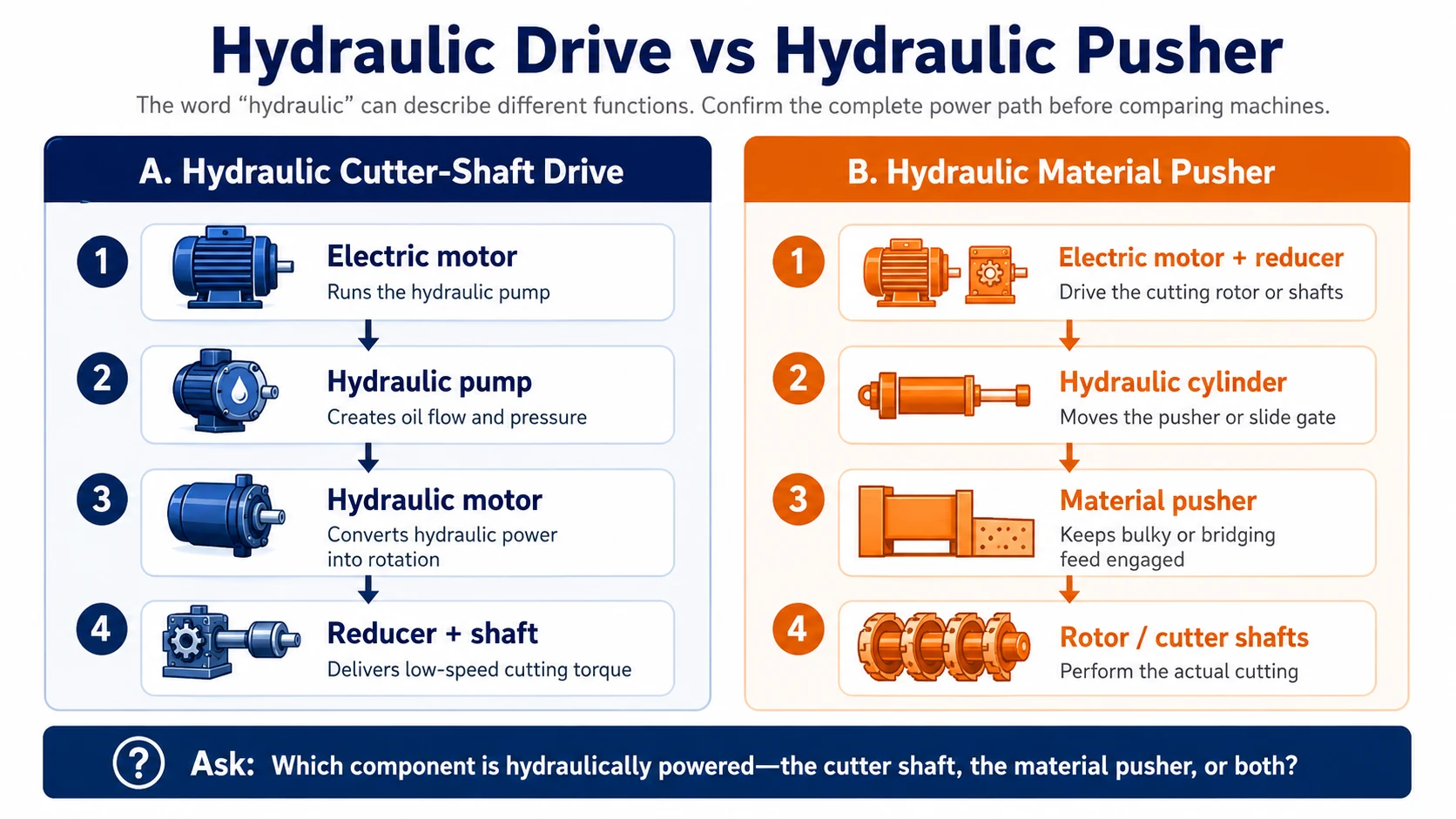
“Hydraulic shredder” can describe more than one power arrangement. A single-shaft machine may use a hydraulic cylinder to move the material pusher while an electric motor and reducer turn the rotor. A double-shaft design may use hydraulic motors as the main cutter-shaft drive. Some projects use hydraulics for both feeding and cutting. Those arrangements do not carry the same component list or the same maintenance burden.If that distinction is still unclear, the hydraulic shredder working-principle guide separates the pusher circuit from the cutter-shaft power path. For price comparison, that distinction is the first line of the bid sheet.Two suppliers can both write “hydraulic shredder” while quoting different functions.
Quotation item
What must be stated
Why it changes price
Cutting architecture
Single shaft, double shaft, screen-controlled or open/coarse discharge
Changes shafts, cutters, chamber, bearings, feeding and discharge design
Hydraulic function
Pusher only, cutter-shaft drive, or both
Changes pump, motor/cylinder, valve, reservoir, cooling and control scope
Machine boundary
Shredder only or shredder plus feeder, conveyor, separator and controls
Auxiliary equipment can become a major part of project CapEx
Testing boundary
No-load test, sample run or agreed material/FAT test
Representative testing takes material, factory time, labor and documentation
Delivery boundary
Factory price, packed/export price, port delivery, site delivery or installed scope
Freight, packing, duties, local lifting and installation can sit outside the machine price
If one supplier quotes a standalone shredder and another quotes a feeder, discharge conveyor, magnet and spare cutter set, the second price should not be “corrected downward” to make the first one look competitive. The scopes need to be separated line by line.
Single-Shaft and Double-Shaft Hydraulic Machines Do Not Cost the Same for the Same Reason
The shaft count is not a simple size upgrade. The machines solve different jobs. A single-shaft configuration normally combines one rotor, fixed counter knives, a hydraulic pusher and a screen. A double-shaft primary shredder uses two cutter shafts to grip and open bulky material, usually with rougher discharge. The detailed selection boundary is covered in the hydraulic single-shaft vs double-shaft comparison.From a cost standpoint, a single-shaft machine can become expensive when the project demands a wide rotor, heavy pusher structure, a small screen opening, thick wear liners and enough drive/cooling capacity to hold difficult material in the chamber for repeated cutting. The buyer is paying for controlled retention and sizing, not simply for one shaft.A hydraulic double-shaft machine puts more of the budget into two shaft assemblies, cutter stacks, bearings, side walls, combs or cleaning fingers, hydraulic motors and reduction components sized for coarse primary shredding. If each shaft has independent drive/control capability, that can add hydraulic and PLC scope but may also improve the machine’s ability to respond to uneven loading.
Project requirement
Typical cost effect
Reason
Tighter screen-controlled output
Medium to high
More residence time, screen structure, pusher control, cutter work and possible cooling demand
Large bulky feed opening
Medium to high
Larger hopper, chamber, frame and shaft/rotor support structure
High shock-load tolerance
High
Heavier shafts, cutters, bearings, frame and drive protection may be required
Two independently controlled cutter shafts
Medium to high
Hydraulic-motor, valve, sensor and PLC arrangement becomes more complex
Very coarse opening only
Potentially lower than precision sizing
May avoid screen-controlled recirculation and some secondary sizing requirements
The Hydraulic Power Unit Is a Cost Center, Not an Accessory
On a cutter-shaft hydraulic machine, the power unit is part of the main drive. A buyer should expect the quotation to identify the pump arrangement, hydraulic motors, normal working pressure and flow, reservoir, valves, filtration, cooling and the control signals used for overload response. Listing only “hydraulic station: included” is too vague for a serious comparison.ISO 4413 treats hydraulic systems as complete machinery systems with requirements around safety, reliable operation, maintenance, energy efficiency and environmental considerations.[3] Bosch Rexroth makes a similarly practical point on fluid condition: hydraulic-fluid quality and cleanliness directly affect operational safety, efficiency and service life.[4] That is why filtration and cooling should not be treated as decorative add-ons.
Pump and hydraulic-motor arrangement
More flow, larger displacement or multiple pump/motor circuits usually mean more hardware and higher fabrication cost. The useful question is whether that hardware is necessary for the required shaft torque, speed and response. A machine sized for occasional batch work and one expected to run long shifts on shock-loaded material should not automatically carry the same power unit.
Cooling
Heat is a design output of the hydraulic system. The cooler has to reject enough heat at the site’s ambient condition to keep the fluid and components inside the intended operating range. Rexroth’s hydraulic power-unit documentation includes dedicated circulation, filtration and cooling functions, which is exactly the kind of subsystem a buyer should identify in the quotation.[5]
Filtration and oil-condition monitoring
A cheaper quote can omit clogging indicators, temperature sensing, convenient filter access or an adequately specified return/offline filtration arrangement. The machine may still run during a short factory demonstration. The difference often appears later, when oil temperature rises, contamination increases or filter service becomes a production stop.
Cutters, Shafts and the Cutting Chamber Can Move the Price More Than the Control Screen
Buyers sometimes spend an hour comparing PLC brands and one minute on cutter geometry. For a shredder, that priority is backwards. The cutter stack, rotor or shafts, bearing arrangement, wear plates and chamber structure are where the material load actually enters the machine.Cost rises when the feed requires larger shaft diameter, more cutters, thicker cutter discs, a more aggressive hook geometry, special heat treatment, replaceable liners, stronger combs or a chamber designed for high single-piece weight. Harder or more abrasive material may justify a different cutter grade, but a harder number on a material certificate is not the same thing as lower cost per ton.The better procurement questions are practical:
What cutter material and heat-treatment process are supplied?
What is the cutter thickness and hook/tooth profile?
Can individual cutters be replaced, or must a full stack be removed?
What wear parts protect the chamber walls and comb areas?
What lifting tools are needed during cutter service?
Can cutters be rebuilt or reground, and what dimensional limit applies?
What spare cutter quantity is included in the base quote?
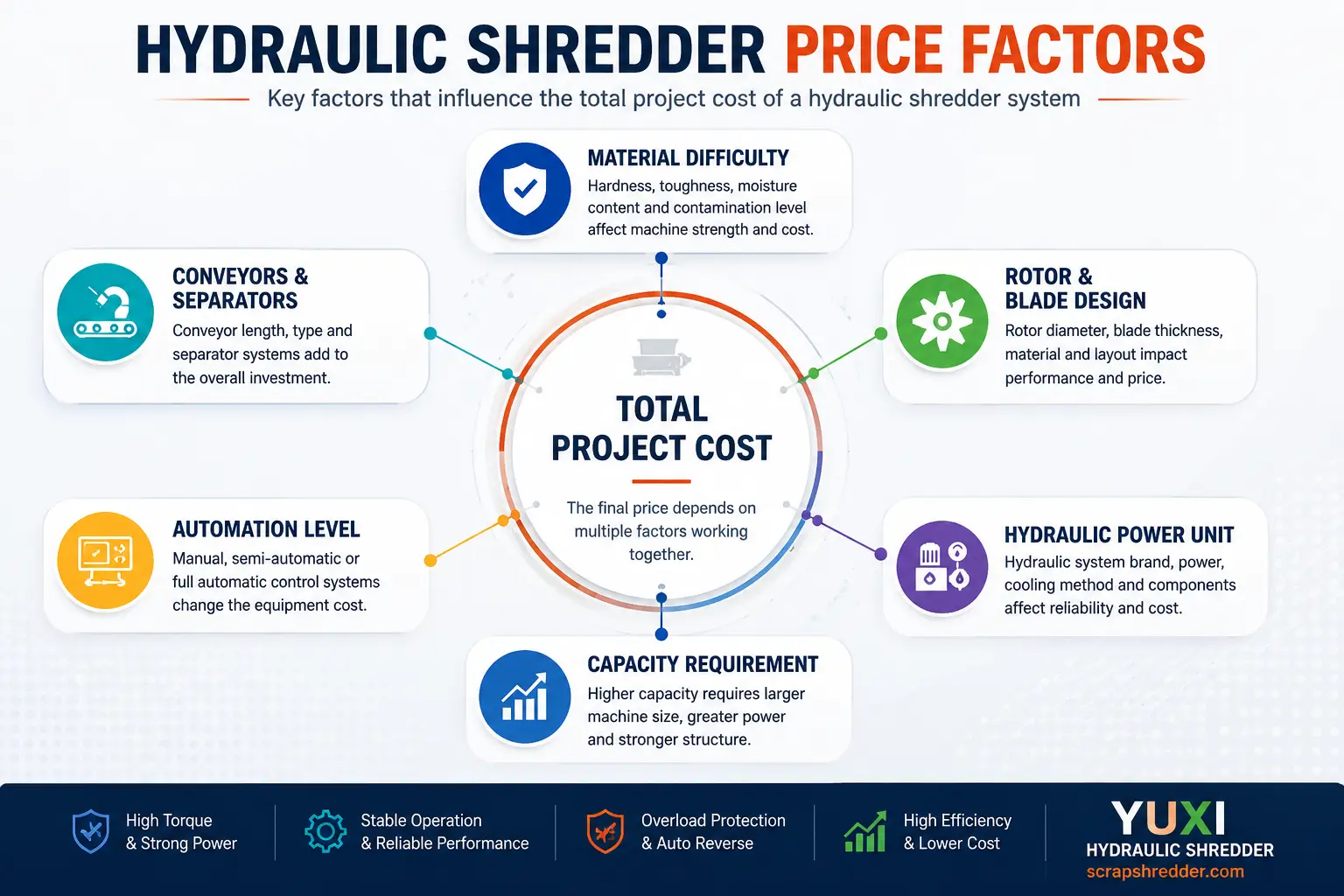
Price is built by several systems at once. A supplier that changes one item—capacity, cutter duty or hydraulic architecture—may have to change several others with it.
Capacity Changes Price Only After Capacity Has Been Defined Properly
“Five tons per hour” is not enough to size a shredder. Five tons per hour of loose plastic drums is not the same chamber loading as five tons per hour of dense prepared metal. A single-shaft machine holding material behind a small screen can also show a very different output from the same rotor working behind a larger screen.The larger cost step usually appears when the required sustained throughput forces a larger chamber, stronger frame, larger hydraulic power unit, more cooling, more feeding equipment or a second stage. A short peak number may not require the same hardware as a guaranteed net production rate through an eight- or sixteen-hour operating window.For procurement, capacity should be written together with:
Capacity input
What to define
Material
Normal feed, difficult feed, dimensions, bulk density or piece weight, moisture and contaminants
Measurement point
Gross feed into the shredder, shredder discharge, screened accepted output or complete-line product
Run time
Short demonstration, one-hour steady test, shift output or another agreed period
Operating losses
Reversals, normal feed interruptions, screen recirculation, operator intervention and downstream stops
Output condition
Rough opened material, maximum size, screen size, oversize allowance or downstream acceptance requirement
If the real duty cycle is still undecided, compare the hydraulic vs electric shredder duty-cycle guide before paying for a hydraulic drive simply because the material looks difficult. Hydraulic drive can be valuable for loaded starts, reversing and rapidly changing resistance, but it is not a universal upgrade for every long-running stationary duty.
Controls Can Be Cheap to Add on Paper and Expensive to Discover Missing Later
A basic PLC can start, stop and reverse a shredder. The cost begins to move when the buyer wants more sensors, independent shaft logic, operating recipes, pressure/temperature trends, remote diagnostics, interlocks with feeders and conveyors, or plant-level communication.
Control option
What it adds
When it is worth considering
Pressure and temperature display
Sensors, HMI tags and alarm logic
Useful on long-shift hydraulic duty and during FAT troubleshooting
Independent shaft reversing
Additional valve/control logic and possibly separate drive elements
Useful when twin-shaft loading is uneven or material reorientation matters
Adjustable reversal recipes
PLC/HMI programming
Useful when the same machine processes several defined materials
Filter/clogging alarm
Indicator/sensor and PLC input
Useful where preventive maintenance is preferred to fixed interval replacement
Remote support access
Communications hardware, network configuration and support policy
Useful for overseas projects where local troubleshooting may be limited
Line interlocks
Signals between feeder, shredder, conveyors and downstream equipment
Essential when a downstream stop must prevent continued feeding
A control package should be priced by function, not by logo.
Standalone Shredder Price and Complete-Line Price Are Different Budgets
A hydraulic shredder is often the first major machine in a process, not the complete process. Feed conveyors, grab loading, discharge conveyors, magnetic separation, screening, secondary shredding, dust control, baling and material storage can move the project total well beyond the standalone shredder price.This is one reason generic online price ranges are difficult to use. A US$100,000 “shredder project” might mean a single machine in one article and a machine plus auxiliary equipment in another. The buyer needs a scope matrix.
Width, speed, sidewalls, metal construction, sensors and interlock
Discharge conveyor
Often optional
Length, incline, belt type, support frame and discharge height
Magnetic separator
Project-specific
Magnet type, burden depth, suspension height and support structure
Screen/recirculation
Architecture-specific
Screen size, oversize return and effect on guaranteed throughput
Dust/fire controls
Usually site/process-specific
Dust extraction, spark/fire strategy, local compliance and system boundary
Secondary machine
Separate equipment
Crusher, granulator, secondary shredder, baler or sorting system
When a supplier says “turnkey,” ask what that word means in the quotation. It may include mechanical equipment and electrical control but exclude foundations, local cable, crane hire, compressed air, water piping, dust ducting, fire protection or commissioning travel.
Seven Costs Commonly Missing From the First Machine Price
The first commercial offer is often designed to establish whether the project is viable. That is normal. The problem appears when excluded items are not made visible before purchase approval.
Freight and export packing. A factory price is not a delivered-site price. Confirm packing, container loading, inland transport, ocean freight and insurance boundary.
Import duties, taxes and customs handling. These depend on destination and classification and are usually outside the equipment maker’s control.
Foundation and civil work. The machine may need anchor design, reinforced concrete, pits, platforms or guards supplied locally.
Electrical infrastructure. Main incoming cable, transformer, switchgear outside the machine panel and plant distribution may be excluded.
Hydraulic oil and operating consumables. Export machines are not always shipped filled with the final operating oil. Confirm oil grade, fill quantity and who supplies it.
Installation and commissioning labor. A quotation may include remote guidance, one supervisor, or no site labor at all. Travel, visa, accommodation and local technicians may be separate.
Initial spare parts and lifting/service tools. A machine can be delivered complete and still be difficult to maintain if the plant has no spare filters, seals, cutters, hoses or required lifting fixtures.
Do not hide site costs inside an assumed percentage. A foundation, transformer or long discharge conveyor can be small on one project and substantial on another. Put each interface on the scope sheet instead.
Purchase Price Is Only One Line in Hydraulic Shredder Cost
Total cost of ownership is easy to mention and easy to misuse. It should not become a spreadsheet full of guessed percentages. For a shredder, start with costs the plant can actually observe or quote.
Cost category
Data to request
Useful comparison metric
Cutters and wear parts
Price, expected service route, regrinding/rebuild limits, replacement labor
Wear-part cost per accepted ton
Hydraulic service
Oil volume, filter types, hose/seal strategy, pump/motor service path
Annual consumables + planned maintenance hours
Energy
Drive and cooler/auxiliary kWh during representative test
kWh per accepted ton
Downtime
Time to access chamber, change cutters/screens, clear a non-shreddable object
Lost production hours per service event
Spare-part logistics
Recommended stock, normal lead time, emergency shipping option
Days of production exposed to a critical spare
Operator workload
Feeding, jam clearing, cleaning, inspection and adjustment tasks
Labor hours per shift or per ton
Oil condition is especially relevant on a hydraulic drive. Rexroth notes that fluid cleanliness is important to system safety, efficiency and service life.[4] A cheaper power unit that is difficult to keep clean or cool can move cost from the purchase order into maintenance.The same logic applies to cutters. If a low-cost cutter set needs frequent service and the chamber takes half a shift to open, purchase price is no longer the useful comparison. The production planner feels downtime, not the price of the original blade invoice.
How to Compare Two Hydraulic Shredder Quotations Without Fooling Yourself
Put both offers into one normalized table and leave blanks where a supplier has not answered. Do not fill those blanks with assumptions. Missing information is itself a procurement finding.
Comparison line
Supplier A
Supplier B
Buyer decision
Machine architecture
State exact design
State exact design
Same job?
Hydraulics drive
Pusher / shaft / both
Pusher / shaft / both
Same power path?
Feed definition
Material + dimensions + contaminants
Material + dimensions + contaminants
Same test feed?
Output definition
Screen / max size / rough output
Screen / max size / rough output
Same acceptance boundary?
Guaranteed capacity
Net rate + test duration
Net rate + test duration
Measured the same way?
Hydraulic unit
Pump, motors, pressure/flow, cooling, filtration
Same fields
Comparable duty rating?
Cutter package
Material, geometry, quantity, spare set
Same fields
Comparable wear scope?
Controls
Sensors, HMI, reverse logic, interlocks
Same fields
Same automation level?
Auxiliary equipment
List included items
List included items
Same line boundary?
FAT and documents
Test, drawings, manuals, schematics
Same fields
Same acceptance support?
Commercial boundary
Packing, freight, installation, warranty, spares
Same fields
Same delivered scope?
Only after those rows line up should the two final prices sit next to each other. This simple step often explains a large quote gap without any argument about whether one supplier is “too expensive.”
Hydraulic Shredder RFQ Checklist
A useful RFQ is short enough for a supplier to answer and detailed enough to prevent guesswork. The broader hydraulic shredder selection guide covers machine selection in more depth. For price comparison, the following fields are the ones we would freeze before requesting the final commercial offer.
1. Material
Material name and process source
Representative photos and video
Normal feed dimensions and maximum occasional dimensions
Single-piece weight or loose bulk density where relevant
Moisture, temperature and contamination
Known non-shreddables and items that must be excluded
2. Required production
Required net throughput, not only peak throughput
Operating hours per shift and shifts per day
Target output or downstream maximum feed size
Expected oversize allowance if a rough primary shred is acceptable
How capacity will be measured during acceptance
3. Machine and hydraulic scope
Single-shaft or double-shaft architecture proposed
Which functions are hydraulic: pusher, cutter shafts or both
Pump type/quantity, hydraulic-motor quantity, normal pressure and flow
Reservoir, filtration, cooler and temperature/level monitoring
Cutter material, thickness/profile, shaft arrangement and wear liners
PLC/HMI, reversal logic, alarms, interlocks and optional remote support
4. Line and site interfaces
Feeding method: manual, conveyor, grab, loader or crane
Required feed and discharge conveyor dimensions
Downstream magnet, screen, secondary shredder, crusher, baler or sorting stage
Site voltage/frequency and available electrical capacity
Maximum ambient temperature, indoor/outdoor location and elevation if material
Foundation, platform, guarding, dust/fire and utility boundaries
5. Commercial and acceptance scope
Price basis and exactly what equipment is included
Export packing and freight boundary
Lead time and quotation validity
Recommended commissioning and two-year spare-parts list, priced separately
Warranty scope and excluded wear parts
Installation/commissioning responsibility
Material-test and FAT procedure
Drawings, electrical/hydraulic schematics, manuals and spare-parts documentation supplied before shipment
Use the Material Test and FAT to Protect the Price You Agreed
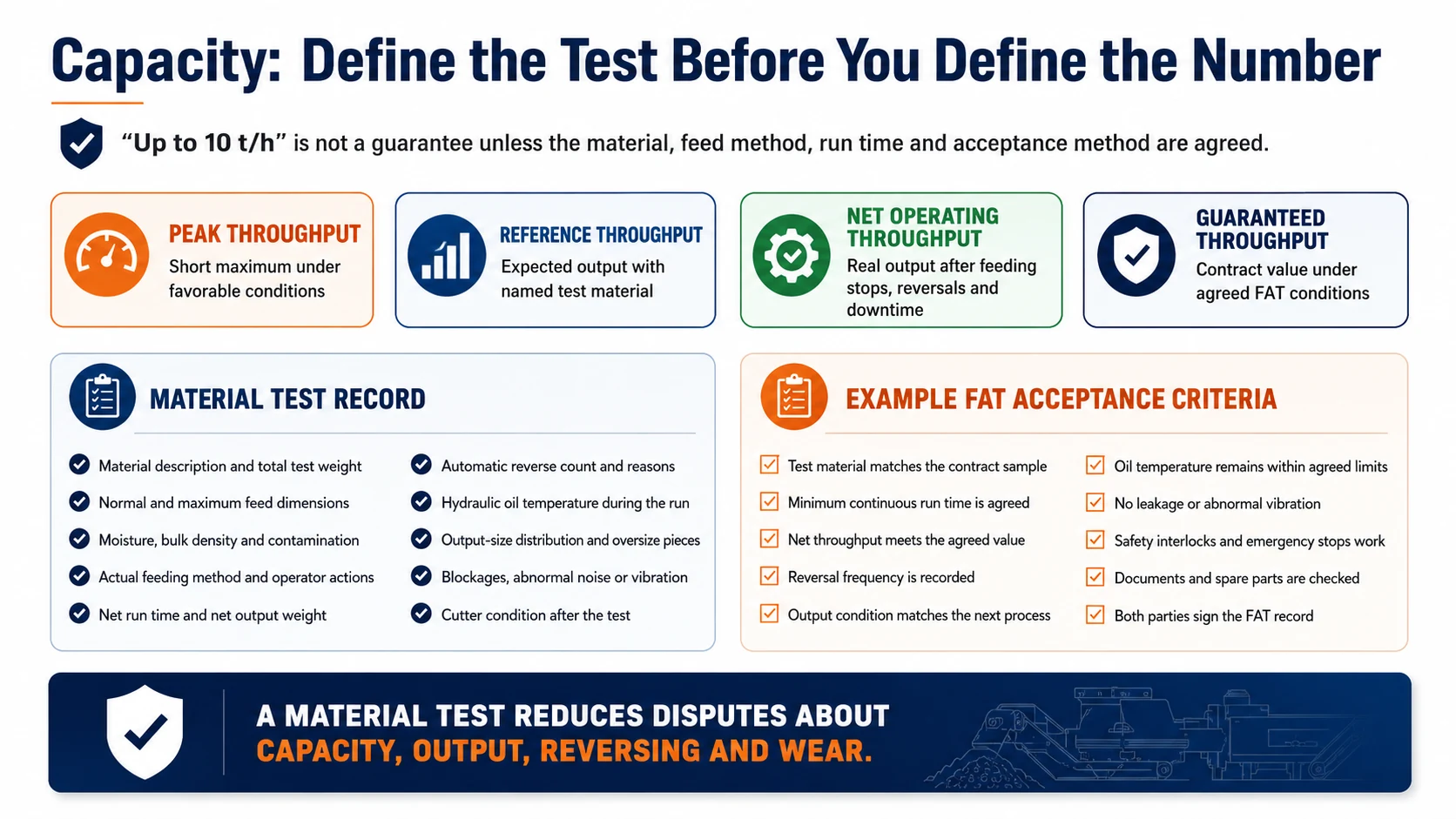
A technically complete quotation still needs an acceptance method. Otherwise a buyer can pay for a machine sized around a stated capacity and later discover that the number came from a short, easy demonstration with different feed.Define the test material and acceptance method before the final price is locked. The test should connect the purchased configuration to net output, temperature stability, reversals and supplied documents.The FAT does not need to become a laboratory project. It should answer the commercial questions that justify the purchase:
Does the test material match the agreed material profile?
Is net throughput measured over a meaningful run period?
Does the output condition match the downstream requirement?
How often does the machine reverse, and why?
Does hydraulic-oil temperature stabilize inside the agreed operating limit?
Are there leaks, abnormal vibration or recurring alarms?
Do emergency stops, guards and interlocks function as specified?
Are the agreed drawings, manuals, spare parts and test records complete?
For servicing and jam clearing, the acceptance and training plan also has to recognize stored hydraulic energy. OSHA’s lockout/tagout standard covers servicing where unexpected startup or release of stored energy could injure workers, including hydraulic energy sources.[6] A hydraulic machine should therefore be handed over with an isolation procedure that matches the actual circuit rather than a generic “switch off main power” instruction.
How We Would Frame a YUXI Hydraulic Shredder Quotation
For a YUXI project, the first commercial question should not be “what is the cheapest hydraulic shredder?” It should be “what machine and scope are we pricing?” We would separate the quotation into the cutting machine, hydraulic system, cutters/wear parts, control package, auxiliaries, test/documentation scope and delivery boundary.For a single-shaft project, the offer should state clearly whether hydraulics operate only the material pusher or also the cutting rotor. The screen size, pusher control, cutter specification and target output then become part of the price logic. For a hydraulic double-shaft project, the pump and hydraulic-motor arrangement, working pressure/flow, reduction path, cooling, filtration and reversal logic should be visible in the technical section rather than hidden behind a single installed-power number.Then we would price the project around the real material: normal pieces, the difficult pieces that still count as normal feed, required net throughput and what the next machine can accept. That produces a quotation that can be compared later without rewriting the project assumptions.
Request a Hydraulic Shredder Quotation You Can Compare
Send material photos or video, maximum feed size, required net capacity, target output, working hours and the downstream process. YUXI can return a machine configuration and quotation scope built around those conditions rather than a generic price range.
FAQ
Why can two hydraulic shredder quotations be far apart?
The suppliers may not be quoting the same machine or scope. One quote may include hydraulic cutter-shaft drive, cooling, filtration, controls, conveyors, spare cutters and FAT support, while another may cover only the shredder body or a machine where hydraulics operate the pusher rather than the cutter shafts.
Does a larger hydraulic power unit always mean a more expensive or better shredder?
Larger hydraulic power units usually increase component and manufacturing costs, but a larger unit is not automatically better. Pump type, working pressure and flow rate, hydraulic motor displacement, cooling, filtration, reduction ratio and duty cycle must match the cutting load.
What should be included in a hydraulic shredder RFQ?
Include material photos or video, normal and maximum feed size, piece weight or bulk density where relevant, contaminants, target output, required net throughput, operating hours, loading method, downstream process, voltage and site conditions. Ask the supplier to state the complete power path, cutter specification, hydraulic unit, controls, included auxiliaries, exclusions, spare parts and FAT criteria.
Should I compare purchase price or total cost of ownership?
Use both. Purchase price matters, but cutters, filters, oil, cooling, hoses, seals, energy, maintenance labor, downtime and spare-part lead time can change the long-term cost. Compare those items against accepted tons of output rather than against machine price alone.
Is hydraulic drive always worth the extra cost?
No. Hydraulic cutter-shaft drive is most valuable when the real duty involves heavy loaded starts, frequent controlled reversals, sharp resistance changes or shock-loaded primary reduction. Stable material may be handled more economically by a suitable electric-drive machine.
U.S. Occupational Safety and Health Administration, “Control of Hazardous Energy (Lockout/Tagout),” including electrical, mechanical and hydraulic energy during servicing and maintenance.
David focuses on industrial shredding and recycling equipment,including material evaluation,shredder selection,process configuration,and recycling line planning.
Speak To Our Shredder Machine Expert
Get in touch with our nice team today to get a price estimate for a shredder machine.

 English



 Fast Delivery
 Reliable
 Certified
 Experienced