The outside of an OCC bale can be almost useless as a quality certificate. Clean brown sheets may cover a wet core. Plastic film may be folded into the middle. A bale sold as double-sorted OCC may contain enough boxboard or waxed cases to fail the buyer’s grade, even though the visible face looks excellent.That is why an OCC bale specification needs more than a grade name. It should state the material definition, moisture limit, contamination categories, bale condition, sampling method and what happens when the load misses the target. Without those clauses, the argument starts after the truck is already at the mill.
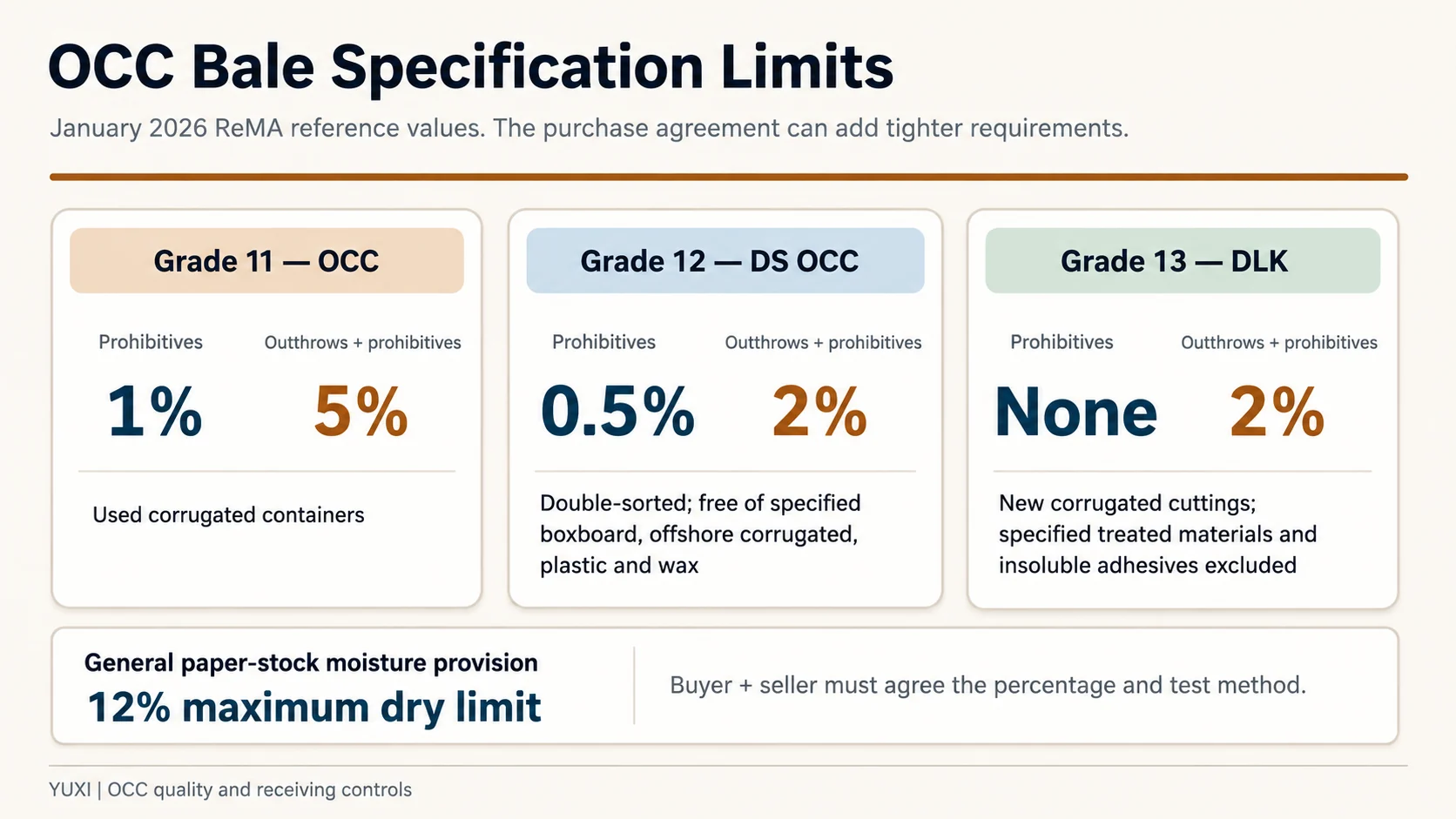
What determines whether an OCC bale is accepted? Under the January 2026 ReMA paper-stock provisions, paper is to be packed dry with 12% as the maximum dry limit unless buyer and seller agree otherwise. Grade 11 OCC allows up to 1% prohibitive materials and 5% combined outthrows plus prohibitives; Grade 12 double-sorted OCC tightens those limits to 0.5% and 2%; Grade 13 DLK permits no prohibitives and no more than 2% combined. Those numbers are a trading baseline, not the complete contract. The parties still need to agree the moisture test, sampling procedure, bale requirements and commercial response to nonconforming material.[1]
An OCC Grade Is the Starting Point, Not the Whole Contract
The grade answers one question: what type of recovered paper is being traded? It does not automatically answer how moisture will be measured, how many bales will be sampled, whether a broken bale can be unloaded, who pays disposal cost, or whether a load just over the limit is deducted, downgraded or rejected.ReMA’s specifications are deliberately written as a common language. The current paper-stock provisions also say that specific requirements should be discussed during buyer–seller negotiations. In other words, writing “OCC #11” on a purchase order is not the end of the specification. It is the heading.We have found that the difficult disputes usually sit in one of four gaps:
the declared grade is clear, but the buyer’s prohibited-item list is not;
both parties know the moisture limit, but they use different instruments or calculation bases;
a sample fails, but the contract never states how that sample represents the load;
the quality result is accepted, yet nobody agreed whether the remedy is a weight deduction, regrade, disposal charge or full rejection.
A complete bale specification therefore connects six items: grade, moisture, unwanted materials, bale condition, sampling and disposition. Each clause should use the same units and the same load boundary.
OCC Grade 11, DS OCC Grade 12 and DLK Grade 13
The January 2026 ReMA specifications define the following North American paper-stock grades.[1]
Grade
Material description
Prohibitive materials
Outthrows + prohibitives
What the specification must still clarify
11 — Old Corrugated Containers (OCC)
Corrugated containers with test-liner or kraft liners.
1% maximum
5% maximum
Buyer-specific excluded materials, moisture method, bale construction, sampling and remedy.
12 — Double-Sorted Old Corrugated (DS OCC)
Double-sorted corrugated containers from supermarket, industrial or commercial sources, specially sorted free of boxboard, offshore corrugated, plastic and wax.
0.5% maximum
2% maximum
How “free of” is verified, source traceability, inspection depth and treatment of hidden material.
13 — New Double-Lined Kraft Corrugated Cuttings (DLK)
New corrugated cuttings with test-liner or kraft liners. Treated medium or liners, insoluble adhesives, butt rolls, slabbed or hogged medium are not acceptable.
None permitted
2% maximum
Pre-consumer source, converting process, adhesive/coating exclusions, bale and claim rules.
Why “cleaner brown cardboard” is not a grade definition
Grade 12 is not Grade 11 with a better-looking outer layer. Its source and sorting description are tighter, and the numerical tolerances are lower. Likewise, DLK is not simply “premium OCC.” It is new converting scrap with its own exclusions. A warehouse cannot relabel used boxes as DLK because the material looks clean.There is also an important mathematical point. The prohibitive limit sits inside the combined limit, not beside it. A Grade 11 sample containing 1.4% prohibitives and 2% outthrows has only 3.4% combined unwanted material, but it still fails the 1% prohibitive limit. Diluting a dangerous or equipment-damaging item into a larger clean sample is not a valid fix.The same logic applies to the material description. A Grade 12 load can be under the numerical combined limit and still fail if it contains a category that the grade says should be absent. This is one reason buyers should record both composition and weight percentage.
Moisture: Specify the Basis, Method and Sampling Plan
Moisture affects more than sale weight. Wet corrugated board is weaker, harder to handle, more likely to deform or break a bale, and can introduce odour, mould and storage problems. In a processing line it also changes bulk flow, dust behaviour, opening performance and the ratio between as-received tonnes and usable dry fiber.ReMA’s January 2026 paper-stock provision uses 12% as the maximum dry limit. It also requires buyer and seller to agree the moisture percentage and test method before shipment. When excess moisture is confirmed, the buyer may request a weight adjustment and, if settlement cannot be reached, may reject the shipment.[1]That wording is often shortened online to “OCC moisture: 12% max.” The shortcut leaves out the most important operating sentence: agree how it will be tested.
A useful moisture clause answers seven questions
Question
What should be written
Why it matters
What is the limit?
Maximum percentage and whether a warning or conditional-acceptance band exists.
A single limit does not explain what happens near it.
What is the calculation basis?
Wet basis, air-dried basis or the exact referenced method.
The same sample can produce different reported percentages under different bases.
Which method controls?
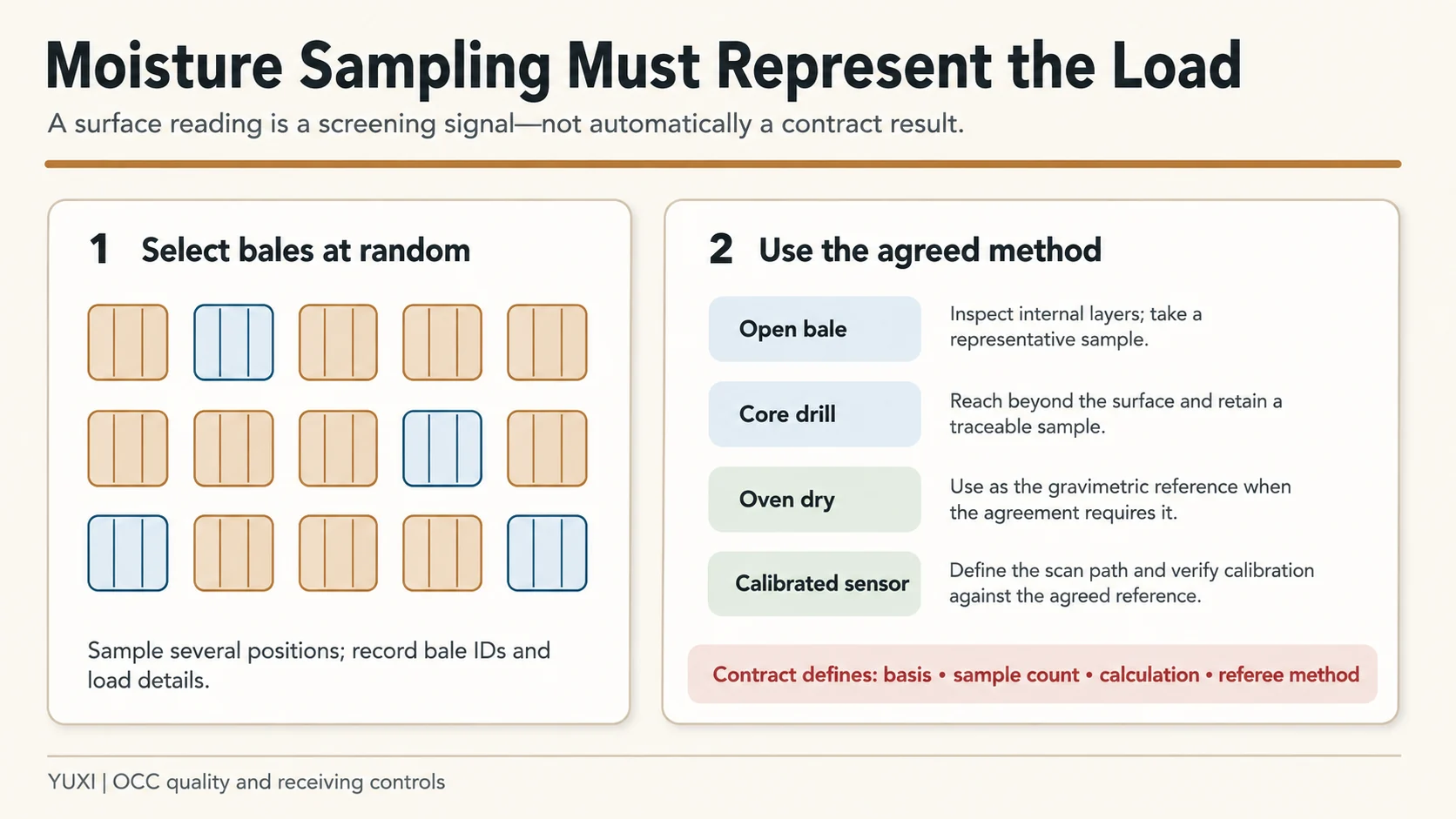
Open-bale oven dry, core sample, calibrated sensor, full-load microwave system or another named method.
A handheld screening result may not equal the contractual result.
How are bales selected?
Random selection, minimum number, locations and treatment of visibly wet bales.
Outer bales and easy-to-reach faces may not represent the load.
Where is the sample taken?
Surface, core, several depths or opened layers.
Rain exposure and deliberate wetting can be highly localized.
How is equipment controlled?
Calibration frequency, reference material and record retention.
Two unverified instruments can create a dispute rather than settle one.
What is the referee method?
The method used when the first result is challenged.
A dispute needs a pre-agreed route, not a new test invented after unloading.
Representative selection and a named test method are part of the commercial specification, not laboratory details to decide after a claim.CEPI’s paper-for-recycling quality-control guidance illustrates a more detailed approach. It describes the EN 643 natural-moisture reference of 10% on an air-dried-weight basis, calls for random bale selection, and lists open-bale sampling with oven drying, core drilling with oven drying, and calibrated technical devices such as electromagnetic, NIR and microwave systems. It also says buyer and seller should agree the sampling and testing method.[2]This does not mean every OCC contract should replace 12% with 10%. It shows why geography and buyer matter. A North American ReMA reference, a European EN 643 contract and an individual mill specification can use different limits and procedures.Individual mills may be tighter still. A published Kruger OCC #11 specification, for example, states 8% maximum humidity with a ±2% notation and adds its own contamination and bale-handling conditions.[3] That document is a mill-specific example, not a universal OCC rule.
Common mistake: Do not automatically deduct “measured moisture minus allowed moisture” from gross load weight unless the contract defines that calculation and basis. The technically correct adjustment can depend on whether the result is reported on wet, dry or air-dried weight and how the representative load value is calculated.
Separate Outthrows, Prohibitives and Zero-Tolerance Material
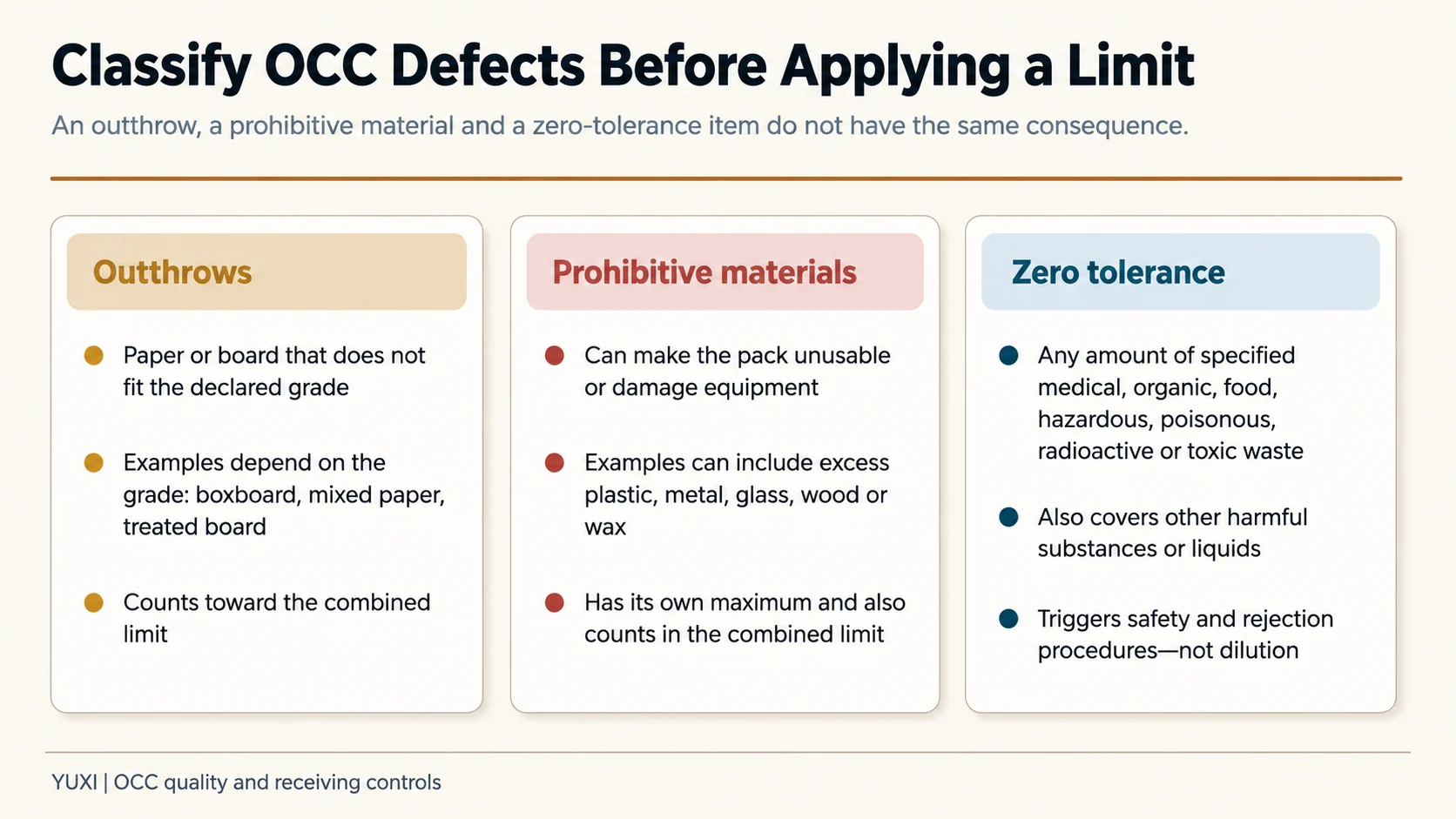
The word contamination is convenient in conversation and dangerous in a purchase order. It can describe wrong-grade paper, non-paper material, a substance that damages machinery, or material that creates a safety and environmental problem. Those are not equivalent failures.ReMA uses three distinct concepts:[1]
Outthrows are papers that make the pack undesirable and unsuitable for use as the specified grade.
Prohibitive materials are materials that, above the allowed amount, make the pack unacceptable or unusable as the grade, or may damage equipment.
Zero-tolerance material includes any amount of specified medical, organic, food, hazardous, poisonous, radioactive or toxic waste and other harmful substances or liquids.
Classification matters because each category can have a different limit, safety response and commercial consequence.
Outthrows are usually grade mismatches
Boxboard in standard OCC may be acceptable only within the combined tolerance. In DS OCC, the grade description specifically calls for material sorted free of boxboard. Mixed office paper, newspapers, certain treated paperboard, tubes or composite packs may also become outthrows depending on the declared grade and buyer.One mill may classify an item differently from another because its stock-preparation system, final paper product and local disposal cost differ. The contract should therefore contain a material list rather than relying on photographs of “good” and “bad” bales alone.
Prohibitives can affect both fiber quality and machinery
Common buyer lists address plastic film, straps, loose metal, glass, wood, rubber, waxed board, poly-coated board and wet-strength paper. The exact list and allowed amounts vary. Kruger’s published OCC #11 sheet, for example, excludes several of those categories while making an exception for normal staple closures on corrugated boxes.[3]That exception is a good reminder: “metal is prohibited” can be too vague. A paper mill may tolerate ordinary box staples that its screening system removes, while refusing loose metal parts, banding, wire bundles or objects likely to damage conveyors, pulpers and screens. Write the distinction.
Zero tolerance is not a percentage game
A pesticide container, medical waste or leaking harmful liquid should not be treated as a few grams of ordinary outthrow to be averaged into a large sample. The first response is site safety, isolation and escalation under the buyer’s procedure. Commercial disposition comes after the hazard is controlled.In practice, the receiving specification should state who has authority to stop unloading, how the load is isolated, what photographs and documents are collected, and which local regulatory or emergency requirements apply. Industry grade guidance does not replace those site rules.
Bale Construction and Load Requirements Are Buyer-Specific
A bale can meet fiber-composition limits and still be unsafe or uneconomic to receive. Broken wires, unstable geometry, excessive size, low density or incompatible banding can prevent safe unloading and storage. This is why bale construction belongs in the same specification as grade and moisture.CEPI’s quality-control guidance recommends right-angled, well-pressed bales with parallel wires and gives general European examples for bale dimensions and mass. Kruger’s published sheet gives different loading details: a minimum 300 kg bale, an indicated best weight of 800 kg, tight steel wires, and no plastic banding, shrink wrap or pallets.[2][3]Those numbers should not be copied into every RFQ. The correct requirement depends on the baler, forklift or clamp truck, trailer, container, warehouse stack, mill receiving system and local transport limits.
Bale clause
Examples of what to define
Receiving risk if omitted
Mass and dimensions
Minimum, target and maximum bale mass; length, width and height tolerances.
Incompatible handling, low payload, unstable stacking or blocked receiving equipment.
Binding
Steel wire count and arrangement, permitted banding, no loose or broken ties.
Bale release, worker exposure, wire wrapping and equipment damage.
Density and shape
Minimum density where required, squared faces, limited expansion after ties are cut.
Poor truck utilization, difficult opening and surge feeding.
Identification
Supplier, grade, bale or lot number, date and traceability mark.
No defensible link between sample, claim and source.
Trailer condition
Clean, dry, free of odour, residues, pests and water ingress.
Good bales can become nonconforming during transport.
Load pattern
Count, orientation, blocking and safe unloading sequence.
Falling bales, trapped loads and unloading delays.
A Defensible OCC Bale Receiving Inspection
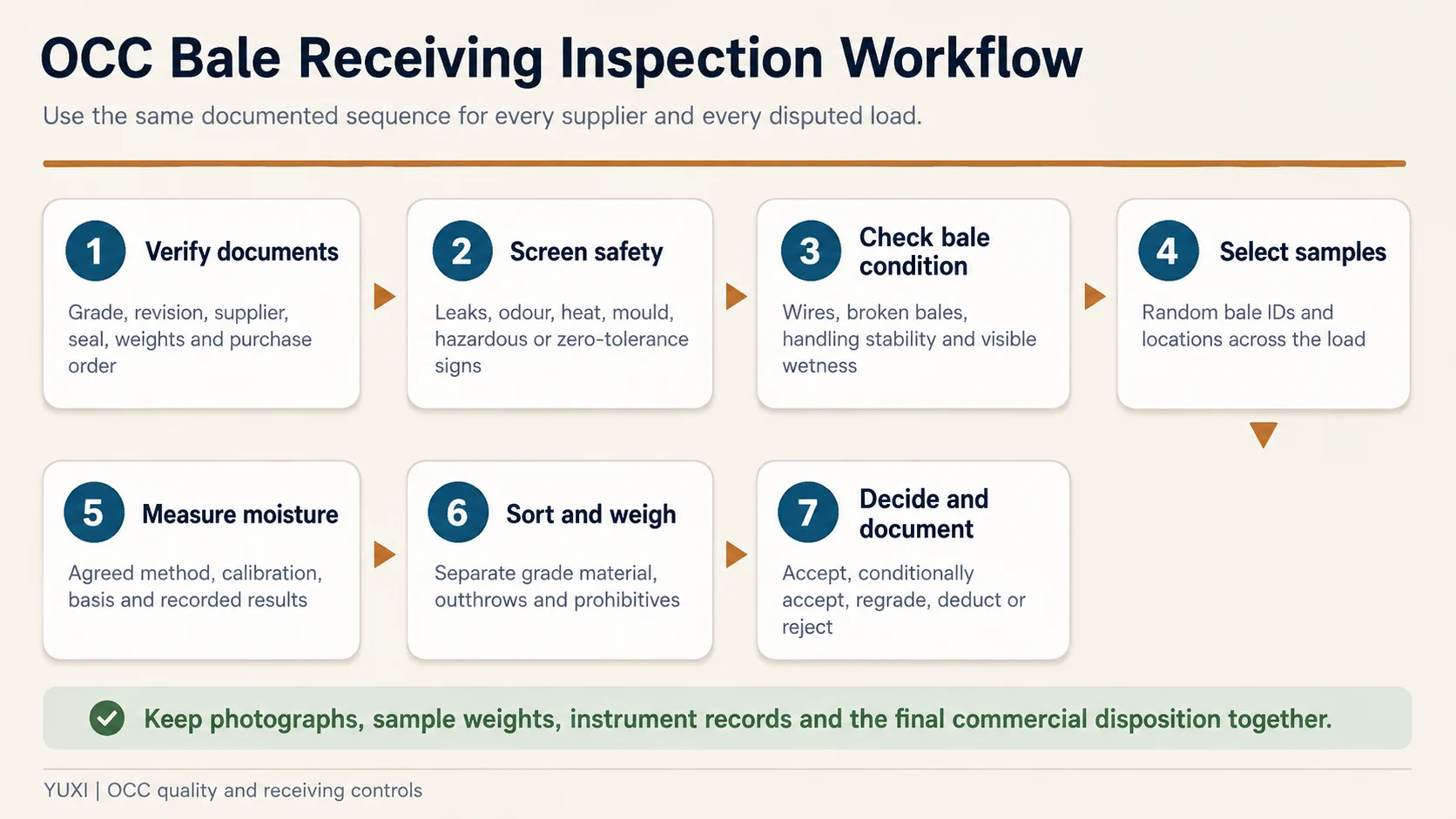
Consistency is more important than theatrical inspection. Opening one suspicious bale in front of a supplier may reveal a problem, but it does not create a repeatable quality system. A receiving team needs a standard path that applies to routine loads as well as disputes.A repeatable sequence links the physical sample to the purchase order, supplier, instrument record and final disposition.
Verify the delivery documents before unloading. Confirm supplier, contract number, grade and revision, trailer or container ID, seal where used, declared weight, bale count and required origin information.
Conduct a safety and condition screen. Check for leakage, chemical odour, heat, smoke, biological decay, mould, insects, loose wires, shifted bales and signs of zero-tolerance material. Stop and escalate where site procedure requires it.
Inspect presentation and visible quality. Record broken bales, wet faces, mud, snow or standing water, mixed bale types, foreign objects and whether the load can be safely handled.
Select the sample according to the written plan. Randomize bale selection across accessible positions and record every bale or location sampled. Do not substitute the cleanest reachable bale.
Measure moisture using the agreed method. Record instrument ID, calibration status, sample location, individual values, calculation and any oven-dry or referee result.
Sort and weigh composition samples. Separate grade-compliant corrugated material, outthrows and prohibitives. Photograph unusual items and retain samples where the claim procedure requires it.
Issue one documented disposition. Accept, accept with remarks, conditionally accept, adjust weight, regrade, partially reject or reject the load. Link the decision to the contract clause and communicate it within the agreed time.
CEPI guidance similarly separates a general visual control from more objective moisture and unwanted-material measurements, and recommends documenting results by load, grade and supplier.[2] The objective is not merely to win claims. The records reveal whether a supplier’s quality is stable and whether corrective action works.
Visual inspection is useful, but it has limits
Experienced inspectors can detect soaked outer bales, unusual odour, plastic-rich faces and poor bale construction quickly. They cannot see every wet core or hidden layer. Visual findings should therefore trigger the next step defined in the plan rather than being converted into an improvised percentage.Sometimes the opposite happens: a modern sensor produces thousands of readings, and the team assumes volume of data equals contractual certainty. It does not. The device still needs a documented scan path, calibration, threshold, data-retention rule and referee method.
Accept, Deduct, Regrade or Reject?
A quality result is not a commercial decision until the contract says what the result means. Four responses are common:
Disposition
When it may fit
What must be pre-agreed
Accept
All measured criteria meet the specification and the load is safe and correctly documented.
Normal receiving sign-off and record retention.
Conditional acceptance or weight adjustment
Excess moisture or recoverable unwanted material is within an agreed settlement range.
Calculation basis, transport/disposal treatment, evidence and approval authority.
Regrade
The material is usable by the buyer but does not meet the declared grade.
Alternative grade, price, weight deduction, disposal cost and supplier notification.
Reject
Material is unsafe, unusable, over the agreed maximum, wrong for the mill, or no settlement is reached.
Ownership, storage, return freight, demurrage, claim timing and evidence.
ReMA’s provisions describe claim and rejection procedures and give the buyer rights concerning excess moisture, while CEPI guidance describes acceptance, conditional acceptance and refusal and says buyer and seller should agree whether excess unwanted material leads to refusal or regrading.[1][2]The specification should also distinguish a routine quality claim from a zero-tolerance or safety event. A slightly high moisture result may be settled commercially. A leaking hazardous container needs a different chain of control.
The Bale Specification Should Shape the Recycling Line
The YUXI waste cardboard recycling machine and plant is a dry mechanical preparation system that can combine controlled feeding, bale opening and sorting, primary shredding, magnetic removal, metered conveying, dry fiber opening, dust collection and baling. It is not a wet paper-making system, and it does not make a poor incoming grade compliant by name alone.Incoming bale quality changes the line in practical ways:
Wire and bale integrity affect staging, safe tie removal, bale opening and the size of the receiving buffer.
Moisture range affects mass-flow calculations, conveyor behaviour, dust loading, opening performance and the relationship between received and saleable tonnes.
Plastic film and tape influence manual pre-sorting, wrapping risk and whether light-reject separation is justified.
Metal affects upstream inspection and magnetic-removal duty, but a magnet does not solve glass, wood, plastic or coatings.
Waxed, laminated and wet-strength material may require source rejection or buyer testing rather than more aggressive shredding.
Target grade determines how much source control, inspection and sorting is required before the baler.
Engineering principle: Put the buyer’s accepted bale or fiber specification at the end of the process flow, then work backward. A line should be designed to produce and verify a saleable output from a defined feed—not simply to move a stated number of wet incoming tonnes through a shredder.
OCC Bale Purchase Specification Checklist
The following structure can be adapted into an RFQ, purchase order or supplier approval document. It is not a substitute for legal, regulatory or site-safety review, but it prevents the most common technical gaps.
Clause
Information to include
1. Grade and revision
ReMA Grade 11, 12 or 13, EN 643 code, or buyer mill grade; publication date/revision; any additions or exclusions.
2. Source and composition
Permitted generating sources; corrugated type; allowed other papers; excluded coated, waxed, wet-strength, composite or offshore material.
3. Moisture
Maximum, conditional range, calculation basis, sampling locations, test method, calibration and referee method.
4. Outthrows
Definition, examples, maximum and how the category is sorted and weighed.
5. Prohibitives
Definition, buyer-specific list, standalone maximum and inclusion in the combined limit.
6. Zero tolerance
Named materials, stop-work and isolation procedure, notification and rejection responsibility.
7. Bale construction
Mass, dimensions, density, wire or banding, shape, broken-bale rule and identification.
8. Load and transport
Payload, trailer/container condition, weather protection, load pattern, seal and delivery documentation.
9. Sampling
Randomization, number of bales or sample mass, sample locations, witness rights and retained samples.
Photographs, instrument readings, calibration, sort weights, scale tickets, lot traceability and retention period.
12. Change control
Supplier process changes, new sources, updated test method and specification revision approval.
Before approving a supplier, run the procedure on several normal loads—not only a prepared sample. A specification that cannot be executed at the receiving dock is not yet finished.
Configure the OCC Line Around the Bale Specification
Send YUXI the incoming grade, bale dimensions and wire, moisture range, contamination audit, downstream buyer specification, required sustained accepted output and workshop information. The process review can then define receiving, sorting, shredding, metal removal, dry fiber opening, dust control and final baling around one measurable material boundary.
OCC Bale Specification FAQs
What is the maximum moisture content for OCC bales?
The January 2026 ReMA paper-stock provisions use 12% as the maximum dry limit, but buyer and seller are expected to agree the moisture percentage and test method in the purchase or shipping agreement. A mill, export contract or regional standard may set a different limit.
What is the difference between an outthrow and a prohibitive material?
An outthrow is paper or board that makes the pack undesirable or unsuitable for the declared grade. A prohibitive material can make the pack unacceptable or unusable, or may damage equipment. Prohibitives have their own limit and are also included in the combined outthrows-plus-prohibitives limit.
How do OCC Grade 11 and DS OCC Grade 12 differ?
ReMA Grade 11 is standard old corrugated containers and permits up to 1% prohibitives and 5% combined outthrows plus prohibitives. Grade 12 is double-sorted commercial OCC, has a more restrictive material description, and permits up to 0.5% prohibitives and 2% combined.
Are tape, labels and staples allowed in OCC bales?
Normal box closures may be tolerated by some mills, but that is not a universal permission. Excess tape, plastic labels, straps, loose metal and bale wire can affect the grade, equipment and reject cost. The receiving buyer's written list controls.
How should moisture in an OCC bale be tested?
Use the method named in the contract. A defensible plan identifies how bales are selected, where samples are taken, whether bales are opened or core-drilled, which calibrated device or oven-dry method is used, the calculation basis and the referee method for disputes.
Can one wet bale cause a whole load to be rejected?
It can trigger additional testing, conditional acceptance or rejection, but the final disposition should follow the agreed sampling and claim procedure. A visibly soaked or unsafe bale should not be averaged away without checking whether the contract permits that treatment.
Is there one universal OCC bale weight or dimension?
No. Bale mass, dimensions, density, wire arrangement and truck payload are buyer- and site-specific. Regional guidance and individual mills publish examples, but the purchase specification and safe handling system must define the actual requirement.
Can shredding upgrade ordinary OCC into DS OCC?
Not by itself. Grade 12 depends on source, sorting and removal of specified unwanted materials. Shredding changes size and can expose hidden contamination, but it can also distribute contaminants through the material. Grade control starts before the shredder and is verified after processing.
References
Recycled Materials Association (ReMA), “ReMA’s ISRI Specifications, January 2026,” Guidelines for Paper Stock: moisture provisions, grade definitions, OCC 11, DS OCC 12 and DLK 13 limits, claims and commercial practices.
Confederation of European Paper Industries (CEPI), “Paper for Recycling Quality Control Guidelines,” EN 643 quality-control framework, bale condition, moisture sampling and unwanted-material inspection.
American Forest & Paper Association, “The Paper Recycling Process,” mill pulping, screening, cleaning and paper formation after recovered paper collection and baling.
David focuses on industrial shredding and recycling equipment,including material evaluation,shredder selection,process configuration,and recycling line planning.
Speak To Our Shredder Machine Expert
Get in touch with our nice team today to get a price estimate for a shredder machine.

 English



 Fast Delivery
 Reliable
 Certified
 Experienced