Hydraulic Shredder for Bulky & Mixed Industrial Waste
A hydraulic shredder for bulky and mixed industrial waste is usually considered when the feed is too inconsistent to treat like a clean production scrap stream. A pallet arrives flat, then the next load contains flexible packaging, a hollow plastic container, textile strips and a heavy metal inclusion. The material name has not changed much on the purchase order. The load on the cutter shafts has. A heavy-duty shredder is only one part of the system. Bulky and mixed waste projects also depend on how material reaches the chamber and what must happen after the first cut.
Why bulky and mixed waste is a different shredding problem
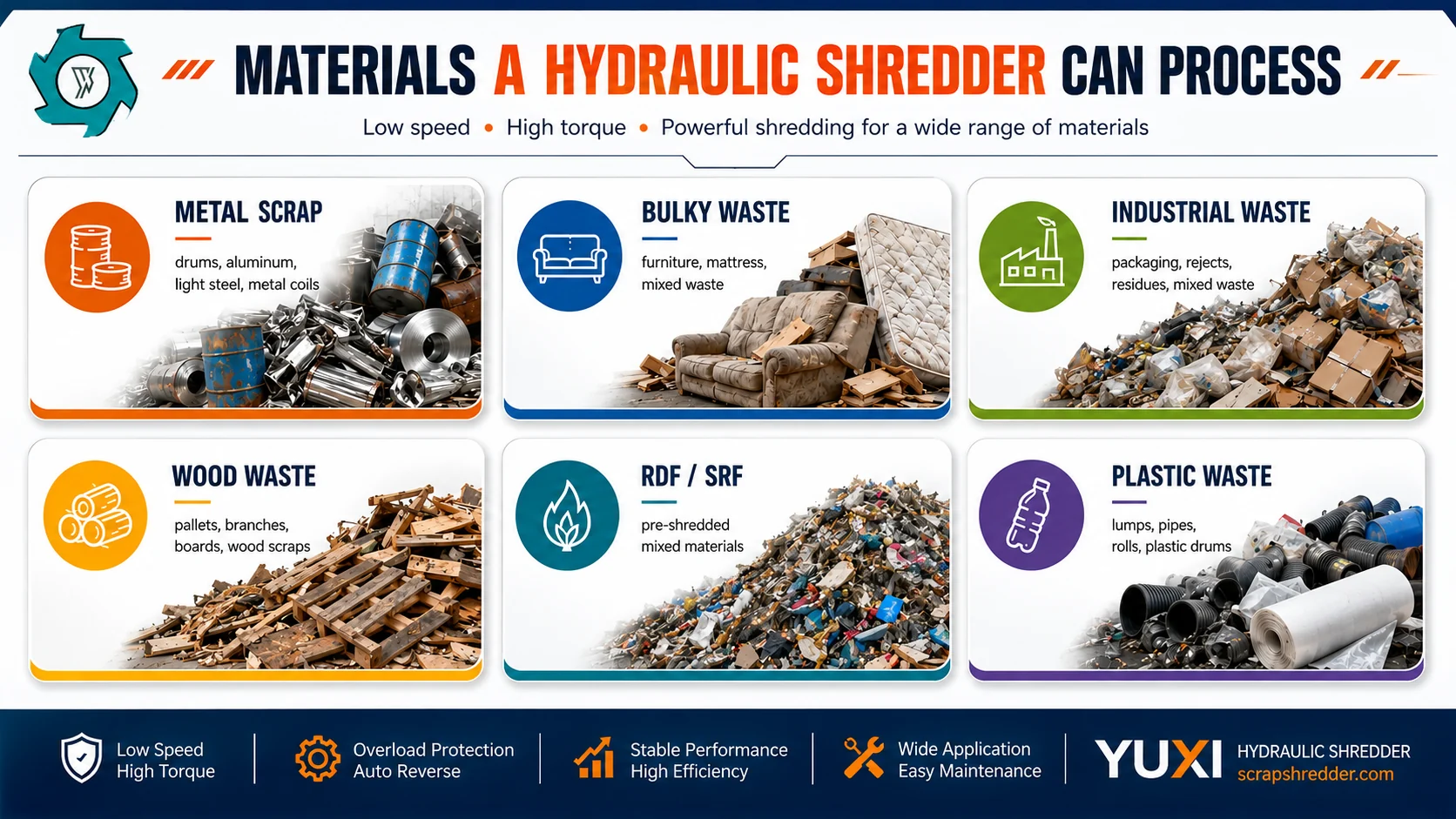
“Industrial waste” sounds like a material category. On the plant floor it is often a collection of behaviors. Some pieces are rigid, some spring back, some bridge over the hopper, some wrap around a shaft, and some collapse only after the cutters have already taken a heavy bite. That is why two facilities can both call their feed “mixed factory waste” and need quite different machines. Bulky waste adds a second problem: volume does not tell you mass. A hopper can look full of furniture foam, plastic shells or packaging while the actual tonnage is modest. The next batch may contain dense timber, metal frames or compacted rejects and demand much more torque per bite. EPA terminology treats bulky waste as items large enough to need special collection, with appliances and furniture as common examples.[1] Shredder manufacturers serving this market likewise describe the job as volume reduction, opening material for recovery, or preparing feed for downstream recycling and fuel production.[2]
Start with the waste stream, not the drive system
Buyers sometimes start the conversation with “hydraulic or electric?” We normally move that question later. First decide what the shredder is expected to do to the waste. Is it opening large items so a sorting line can see what is inside? Is it reducing volume before transport? Is it feeding a magnet, screen or secondary shredder? Or does the output need to stay below a defined size? The answer separates primary reduction from controlled sizing. If the main job is to grab large, irregular pieces and tear them open, a double-shaft rotary shear is usually the structure to evaluate first. If the feed needs a pusher and the output must repeatedly recirculate until it passes a screen, a single-shaft layout may make more sense. The detailed trade-off is covered in our hydraulic single-shaft vs double-shaft shredder guide. The phrase “mixed waste” can hide very different cutting loads. The harder question is which materials occur together and which one controls the machine design.
What changes when several waste types enter the same chamber?
A clean pallet line is fairly easy to describe. A mixed bulky-waste line is not. The machine may see one or more of the following changes within minutes:
Hollow to dense: drums and containers collapse suddenly, while a dense timber block or metal section can hold the shaft at high resistance.
Rigid to flexible: molded plastics may fracture cleanly; film, textile, straps and rope-like material can stretch and wrap.
Dry to wet: moisture changes friction, weight, screen behavior and downstream separation.
Clean to contaminated: sand, glass, stones, nails, wire and unreported metal raise wear and shock loading.
Loose to compacted: baled or nested material can enter the chamber as a much larger instantaneous load than its average feed rate suggests.
Surprisingly, the “small percentage” material can dictate the whole specification. Ten percent of long textile or wire may determine whether the shafts wrap. A few thick steel objects can set the cutter and shaft requirement. One oversize item may force a larger hopper even when most of the stream is small. This is why a representative material video is often more useful than a neat list of material names.
Where hydraulic drive can help
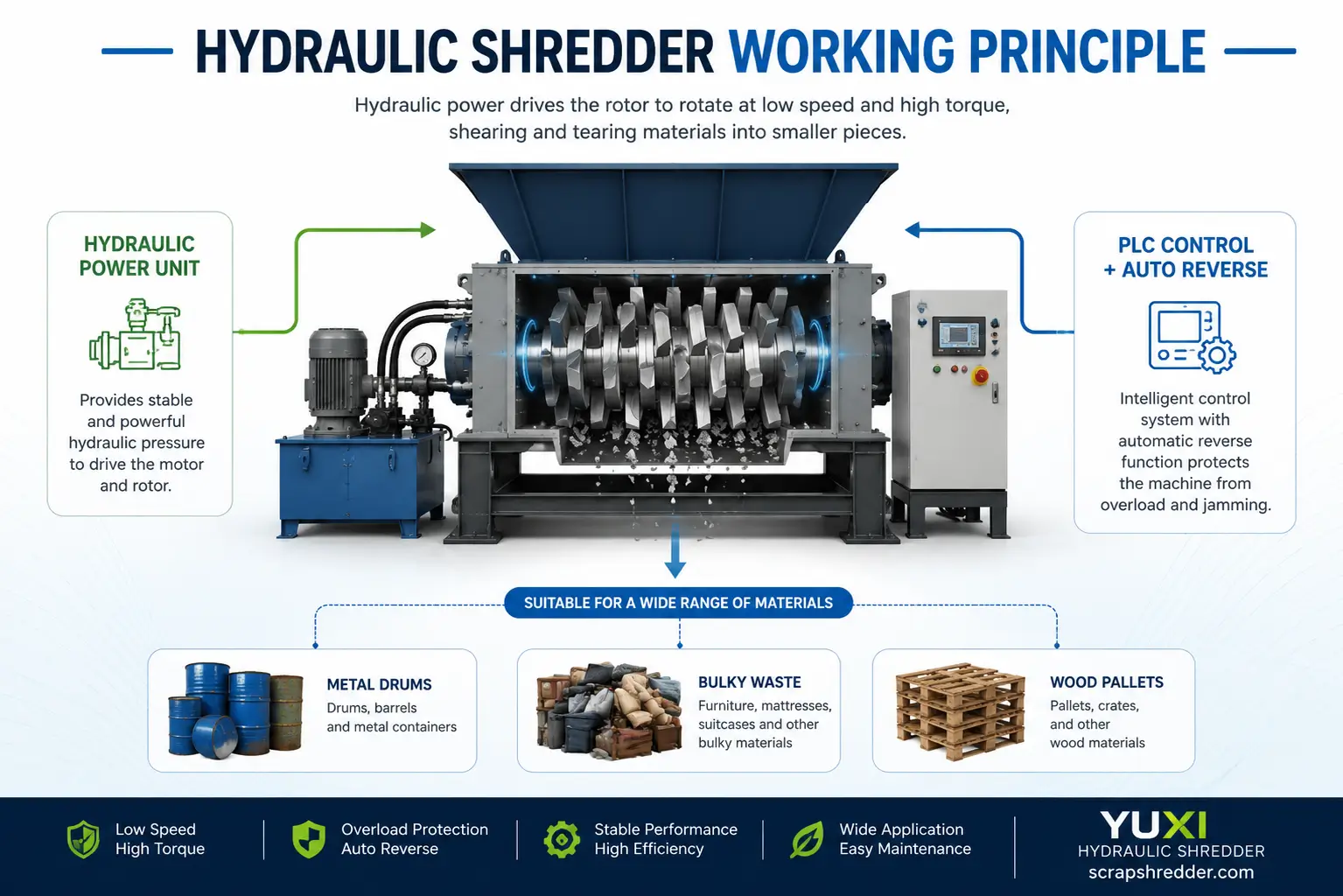
In a hydraulic cutter-shaft drive, an electric motor normally powers a hydraulic pump; oil flow drives hydraulic motors, which transmit torque through the selected reduction arrangement. Pressure and flow can then be managed as the cutting resistance changes. The practical value is not that hydraulics create unlimited force. They give the control system another way to manage low-speed starting, stopping, reversing and load variation. For a bulky mixed stream, that can be useful when the shaft repeatedly meets a piece it cannot take in one bite. The PLC can stop the forward rotation, reverse to release or reorient the material and try again. Pressure relief limits hydraulic load. Those functions protect the drive, but they should not be mistaken for capacity. A machine that spends much of the shift reversing is telling you something about the feed, cutter geometry or loading method. If you need the power-path details, see how a hydraulic shredder works. Hydraulic pressure control and PLC reversing manage overload events; they do not replace correct cutter selection or feed control.
Double-shaft or single-shaft for bulky mixed waste?
There is no useful answer based only on the word “bulky.” We look at the job the first machine must perform.
Project need
Hydraulic double-shaft
Hydraulic single-shaft
Primary opening of large irregular items
Usually a strong fit because two shafts actively grip and pull material
Possible, but pusher and rotor engagement must be checked carefully
Rough volume reduction
Common objective; output is relatively coarse and irregular
Can reduce volume, but screen control changes residence time
Defined maximum output size
Usually needs a second stage if a narrow size limit is required
Screen gives more direct control of oversize
Light, hollow or bridging feed
Depends on cutter grip and hopper geometry
Hydraulic pusher can keep feed engaged with the rotor
High share of drums, appliances or bulky scrap
Often evaluated first
Model-specific and dependent on chamber/cutter design
Plastic, wood or selected factory rejects needing controlled sizing
Useful as a first-stage opener
Often more suitable when screen-controlled discharge is required
A two-stage line is worth considering when the project wants both aggressive opening and a tighter final size. Trying to force a primary double-shaft machine to make a uniformly small product can sacrifice throughput and wear life. Doing the opposite—feeding very large mixed objects directly into a fine-sizing machine—can create the same problem from the other direction.
Feed opening and loading method can make or break the project
A generous hopper helps, but hopper volume alone is not a feeding system. Long furniture pieces can lie across an opening. Film and textiles can form a mat. A wheel loader can deliver one bucket that is much heavier than the average material flow assumed in the quotation. For loose bulky material, grab or loader feeding is common. The operator still needs an agreed maximum batch. If the line uses a conveyor, the belt width, speed and start-stop logic should meter the chamber rather than continuously pushing material into a stalled shredder. Single-shaft machines add another variable: pusher force and timing. More pusher pressure is not always more production; it can simply force the rotor into a heavier bite and increase reversals.
Define output by the next process
“Shred it smaller” is not a usable specification. If the output is going to a magnetic separator, screen, air separator, baler or secondary shredder, the first-stage discharge should be defined by what that equipment can accept. For double-shaft primary shredding, cutter width, hook shape, shaft spacing and the material itself influence the rough output. Irregular strips and torn pieces are normal. A single-shaft screen gives more size control, but smaller openings can increase residence time, recutting, heat and wear. Wet or flexible material may also restrict the screen. Commercial and industrial waste is often processed further into alternative fuel or a recoverable material stream. UNTHA, for example, describes C&I shredding as part of preparing a more homogeneous feed for thermal use, while its bulky-waste applications emphasize opening material for recovery and RDF/SRF production.[3] The important word is part. Shredding alone does not create a finished RDF/SRF specification; separation, screening, drying and secondary size reduction may still be required.
Capacity needs a test condition, not just tons per hour
Mixed waste makes capacity claims especially easy to misread. A machine can process a large volume of light material and still record modest tonnage. The same chamber can slow sharply on denser, more resistant pieces. If the quoted capacity came from a different material, it is only a reference. We normally recommend defining capacity with at least these conditions: the normal waste mix, bulk density range, maximum item size, loading method, cutter arrangement, target discharge, normal shift length and how stoppages or reversals are counted. If capacity is commercially critical, include those conditions in a material test or FAT.
Capacity input
Why it matters in mixed waste
Bulk density
Changes the mass delivered by the same hopper or loader volume
Composition by frequency or percentage
Shows whether flexible, metal or dense pieces are occasional or continuous
Maximum single-piece size and weight
Controls chamber acceptance and shock loading
Required output
Finer sizing can reduce net rate and raise recutting
Reversal frequency
High reversal frequency reduces net throughput and signals difficult engagement
Downstream bottleneck
The shredder cannot sustain useful output if conveyors or separators cannot clear the discharge
Mixed waste changes wear planning
Wear does not follow a material label either. A stream described as plastics may carry sand. Waste wood may contain nails and wire. Factory residues may include glass or metal inserts. These contaminants can affect cutter edges, combs, screens, chamber liners, bearings and seals long before the nominal base material would. Before purchasing, ask how the cutter stack is serviced, whether individual wear parts can be replaced, how foreign objects are removed, what lifting equipment is needed and which spares should be kept locally. For the hydraulic power unit, review oil grade, reservoir access, filtration, cooler sizing, temperature alarms and hose routing. A machine that survives the material but takes an entire shift to clear a bad object is still an expensive machine to operate.
Hydraulic is not automatically the right drive
Some mixed-waste RFQs use “hydraulic” as shorthand for “heavy duty.” That is not enough. If the feed has already been well sorted, is metered evenly and spends long periods in steady cutting, an electric motor and reducer may offer a simpler power path and maintenance routine. Hydraulic drive earns its place when its load response solves a real operating problem. The comparison should include start-under-load behavior, reversal frequency, oil and filter service, cooling, electrical controls, reducer service, operating hours and local maintenance skills. Our separate hydraulic vs electric shredder duty-cycle guide covers that decision in detail.
Safety: mixed waste needs defined exclusions
The more varied the feed, the more important it becomes to say what must not enter the shredder. Pressurized cylinders, sealed vessels, batteries, flammable liquids, reactive chemicals and unknown hazardous items should not be treated as ordinary mixed industrial waste. Appliances can also require depollution before size reduction. In the United States, hazardous-waste management is governed under RCRA, which covers hazardous waste from generation through treatment and disposal.[4] Maintenance is another risk point. OSHA recycling guidance stresses lockout/tagout to prevent unexpected startup or release of stored energy during service and maintenance.[5] That is particularly relevant around hydraulic equipment because pressure can remain in a circuit after rotation has stopped. Guarding, access control and a written jam-clearing procedure belong in the project scope, not in an afterthought after commissioning.
A practical way to classify your waste before asking for a quote
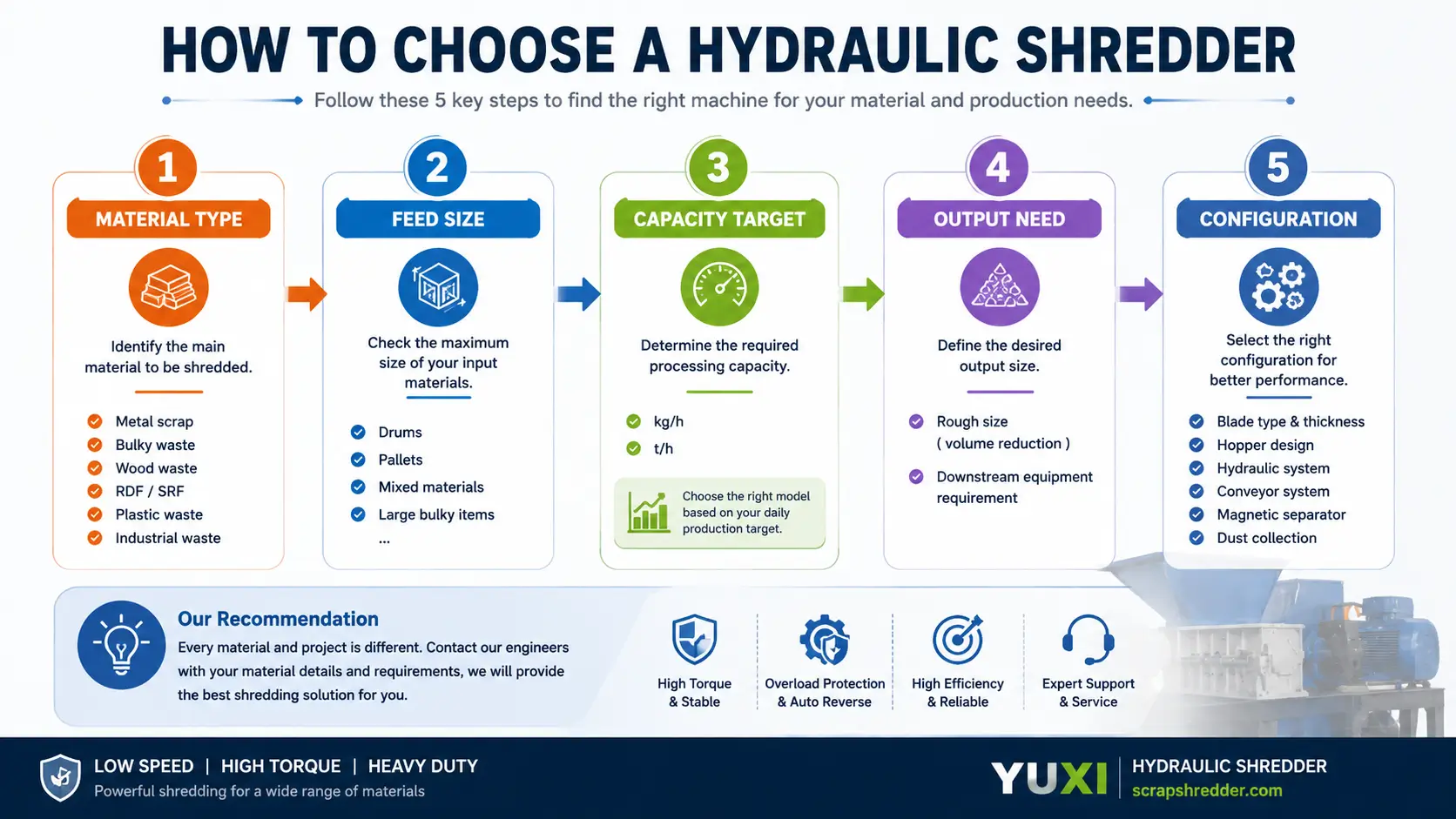
Instead of sending a long catalog of everything the plant might process, divide the feed into three groups. The first is the normal stream: what the shredder sees most of the day. The second is the difficult but accepted stream: the largest, densest, longest or most wrapping-prone pieces that still need to be processed. The third is the excluded stream: items that must be removed for safety or because they exceed the machine design. This simple classification gives the supplier something useful to design around. It also keeps a rare, extreme object from quietly becoming an assumed part of the capacity guarantee. Machine selection works best when material type, maximum feed size, capacity target, output requirement and configuration are defined together.
What YUXI needs to size a bulky or mixed-waste shredder
A useful RFQ does not need to be complicated. It does need to show the real material. Photos taken from several batches are better than one clean sample. A short loading video can reveal bridging, nesting and flexible material that a still photo misses.
Normal material composition and the approximate share or frequency of each major component
Photos or video of the normal feed and the worst accepted pieces
Normal and maximum length, width, thickness or diameter
Approximate bulk density and moisture condition
Known metal, sand, glass, wire or other contaminants
Loading method: conveyor, grab, wheel loader or manual/prepared feed
Required net capacity and operating hours per shift
Required rough or screen-controlled output
Downstream equipment and its maximum acceptable feed size
Items that will be excluded before shredding
From there, the selection can move to chamber size, single- or double-shaft structure, cutter geometry, hydraulic power unit, cooling, filtration, controls and downstream integration. If the project is still at an early stage, the hydraulic shredder selection guide gives a broader RFQ framework. When budget comparison begins, use the hydraulic shredder price guide to separate machine cost from complete-line cost.
When a hydraulic shredder is a sensible starting point
A hydraulic shredder deserves serious evaluation when the feed is really difficult: large items arrive irregularly, the resistance changes sharply, and the shaft must be restarted or reversed frequently under load. The first goal is reliable opening, not producing a uniform single-pass product. It is less compelling when the plant has already converted the waste into a clean, predictable and evenly metered feed. In that situation, an electric-drive machine may be easier to justify. The point is not to prefer one technology. It is to match the machine to the behavior of the waste that operators will actually load at 3 p.m. on an ordinary production day—not the easiest sample shown during a sales test.
Send YUXI Your Bulky or Mixed Waste Sample
Share material photos or video, the largest accepted pieces, known contaminants, target capacity and required output. YUXI can review whether a hydraulic single-shaft, hydraulic double-shaft or another shredder configuration fits the duty before a model is quoted.
FAQ
Is a hydraulic shredder better for all mixed industrial waste?
No. Hydraulic drive is most useful when the feed creates changing resistance, frequent heavy starts, shock loads or repeated reversals. A stable, well-sorted waste stream may be handled more simply by an electric-drive shredder. The decision should be based on the real feed and duty cycle, not the word ‘mixed’ alone.
Should bulky waste use a single-shaft or double-shaft hydraulic shredder?
A double-shaft machine is usually the first option to evaluate when the job is coarse opening and volume reduction of large, irregular items. A single-shaft machine becomes more attractive when bulky material also needs a hydraulic pusher and screen-controlled output. The downstream process should decide which objective matters more.
Can one hydraulic shredder handle furniture, drums, plastics and textiles together?
Possibly, but only after the difficult items in the mix are defined. Long textiles can wrap, hollow drums can collapse suddenly, metal pieces can create shock loads, and dense inclusions can exceed the cutter design. A supplier should review the normal mix, worst-case pieces and excluded objects before confirming the machine.
Does automatic reverse prevent shredder jams?
Automatic reverse helps the cutters release or reorient difficult material, but it does not eliminate the cause of a bad feed condition. Frequent reversing can indicate oversized objects, worn cutters, excessive batch feeding, wrapping, a restricted screen or a downstream blockage.
How should capacity be specified for mixed industrial waste?
Specify the normal material composition, bulk density, maximum piece size, loading method, target output and operating hours. Ask for net throughput under an agreed test condition rather than relying on a peak tons-per-hour figure from a different material.
What should be sent to YUXI before requesting a quotation?
Send recent photos or video of the waste, the percentage or frequency of the main material types, normal and maximum item dimensions, approximate bulk density, known contaminants, required capacity, desired output and the equipment that follows the shredder. Also identify pressurized, flammable, reactive or otherwise excluded items.
David focuses on industrial shredding and recycling equipment,including material evaluation,shredder selection,process configuration,and recycling line planning.
Speak To Our Shredder Machine Expert
Get in touch with our nice team today to get a price estimate for a shredder machine.

 English



 Fast Delivery
 Reliable
 Certified
 Experienced