A steel drum looks like easy shredder feed. It is hollow, relatively light for its volume, and once the cutters get hold of it the shell collapses quickly. That first impression is useful only up to a point. A clean open-head drum is one job. A tight-head drum with a closure ring is another. Two drums nested together can behave like a much thicker piece, while a loader bucket containing drums, angle iron and one solid shaft is no longer a “drum project” at all. That is why a hydraulic shredder for metal scrap should be specified from the worst credible feed, not from the easiest photo in the RFQ. The current YUXI hydraulic shredder range includes double-shaft arrangements for rough opening and primary reduction, while single-shaft configurations are used when controlled feeding and screened discharge matter more. The useful question here is narrower: what metal can enter the machine, in what condition, and what has to change when the feed gets heavier?Hydraulic drive, cutter geometry and feed condition have to be evaluated together when the material includes steel drums and bulky scrap.
Where a Hydraulic Shredder Fits in Metal Scrap Recycling
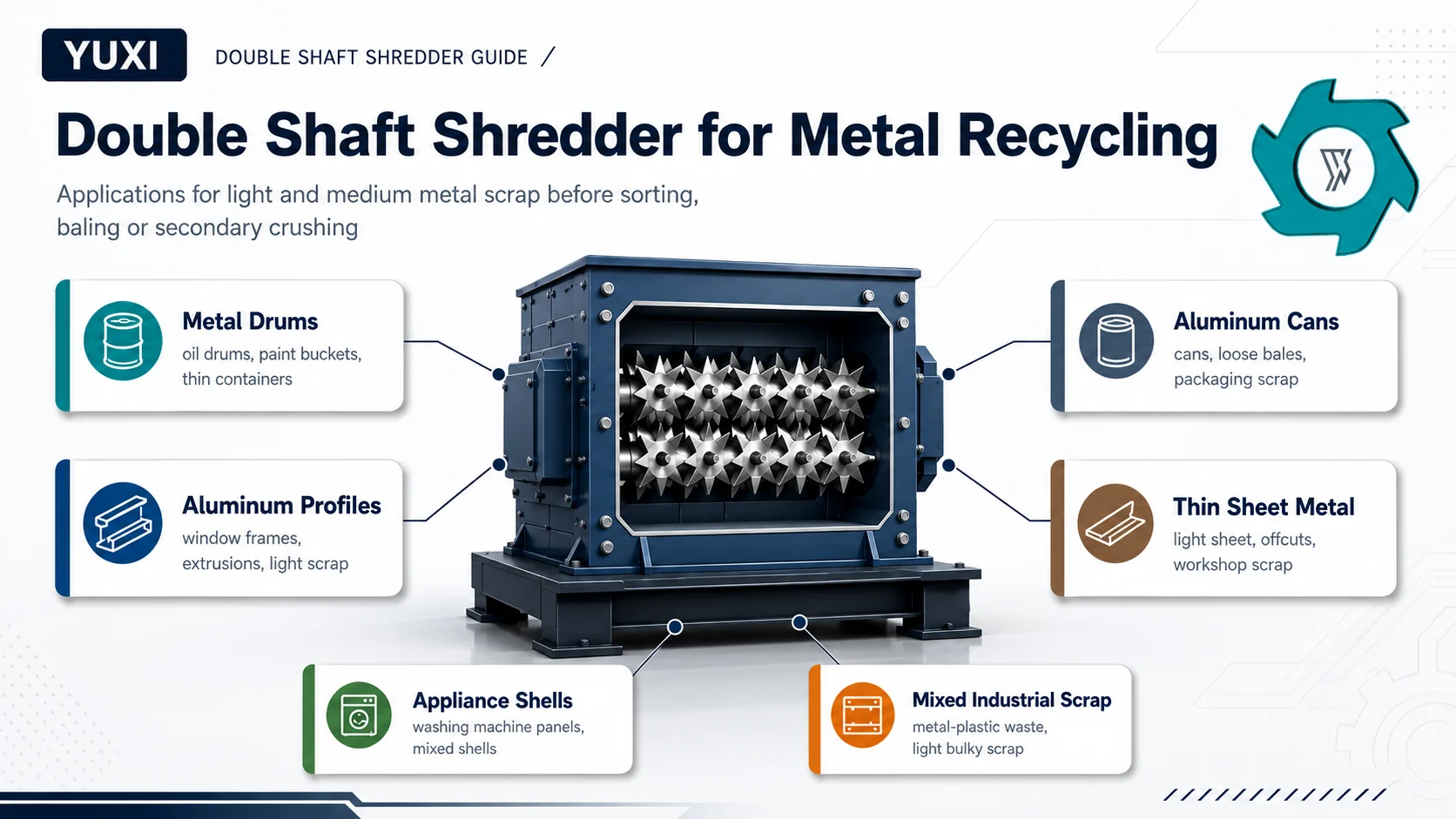
For light and medium scrap, a low-speed shredder is usually a preparation machine. It opens, tears and reduces bulky objects so the next step can work with a more manageable burden. Steel drums, paint pails, appliance shells, light sheet, aluminum profiles and similar scrap all fall into that broad category when their thickness and contamination stay within the machine design. Do not read “metal shredder” as “anything made from metal.” Heavy castings, solid tool steel, bearing blocks, axles and thick structural sections can demand a very different torque level and cutter geometry. The same warning applies to pressure vessels and gas cylinders for a different reason: they are a safety problem before they are a size-reduction problem. For plants handling a mixed stream of drums, cans, profiles and appliance shells, the double-shaft shredder for metal recycling guide gives the broader application picture.
Practical distinction: a double-shaft primary shredder is normally chosen to open and reduce bulky metal. It should not be sold as a precision sizing machine. SSI, for example, shows its Dual-Shear M85 processing steel drums, while its published M85 specifications describe output as strips that commonly follow cutter width rather than a tight screened particle specification.[1]
The Feed Limit Is Not One Number
Buyers often ask for “maximum feed size” as if a single length in millimeters settles the matter. It does not. A shredder can have enough room for an object and still be unable to bite it reliably. The opposite also happens: a long thin piece may be easy to cut once it reaches the shafts, yet awkward to load because it bridges across the hopper. We normally separate the feed limit into several checks. First is the geometric envelope: will the piece physically enter the hopper and reach the active cutting zone without striking guards or sitting permanently across the opening? Second is the section or wall thickness. A hollow drum shell and a solid bar with the same outside diameter place completely different loads on the cutters. Then comes single-piece weight, because dropping a heavy object into the chamber creates a shock event that is not visible in a simple dimension table. Material form matters just as much. Hollow, springy and folded scrap can flatten, rotate or bridge. Nested drums are a good example. The outer dimensions hardly change, but several walls can arrive at one cutter bite. A compacted bale is similar: its size may look acceptable, while the local density and hidden contents push the load beyond what the quotation assumed. Feed size is only one selection input. Material form, capacity target, output requirement and machine configuration still have to be checked together. There is a useful industry lesson here. SSI publishes the infeed opening and the active cutting zone as separate values on its hydraulic PRI-MAX primary reducers.[2] That is the right way to read a quotation. A large top hopper does not automatically mean every object that fits through the top is approved for continuous cutting.
A better feed-limit line in the quotation
Instead of accepting “feed size: 1,500 mm,” ask for a statement that names the material and its condition. For example: cleaned steel drums, maximum outside dimensions, maximum wall or folded-section thickness, maximum piece weight, whether nested drums are allowed, the permitted batch size and the loading method. For mixed scrap, add the largest solid section that may appear occasionally. That sounds more tedious than a single number. It is also much harder to misunderstand after the machine arrives.
Steel Drums: What Is Normal Feed and What Needs Separate Handling?
North American industrial steel drums are commonly sold in 55-gallon formats, while international large steel drums cover a range of liter capacities and construction options. Manufacturers offer open-head and tight-head designs, different wall thicknesses, linings, fittings and reinforcing details.[3] In other words, “55-gallon drum” identifies the container class better than it defines the cutting load. For shredder selection, the useful description is more physical: open or closed head, lid ring present or removed, number of rolling hoops, wall thickness if known, liner or residue, whether the drum is crushed beforehand, and whether drums arrive singly or nested. Those details affect how the first cutter tooth gets a purchase and what happens after the shell folds.
Drum condition
Engineering view
What should be confirmed
Clean, empty steel drum; single piece
Common primary-shredding duty
Outside size, wall construction, closure, cutter bite and loading rate
Open-head drum with lid/ring hardware
Usually workable with the right cutter layout
Ring, bolt and folded edge behavior during the test
Several drums nested together
Needs explicit review
Combined wall layers, local thickness and whether separation is required first
Partly flattened or compacted drums
Can be harder than loose drums
Density, folded seams, batch weight and cutter loading
Drum with unknown liquid or chemical residue
Do not treat as ordinary feed
Site-approved emptying, cleaning, identification and depollution procedure
Bulging, pressurized or sealed container of uncertain history
Exclude from normal shredder feed
Hazard assessment and separate handling before any size reduction
The last two rows are not matters of motor power. OSHA specifically addresses pressurized drums and containers in hazardous-waste operations, including bulging or swelling containers, and requires the pressure condition to be assessed before movement.[4] EPA guidance also notes that used drums can retain residues and discusses cleaning and regulatory empty-container requirements.[5] A recycling plant should build those checks into receiving and preparation rather than expecting the shredder to “take care of it.”
Feed exclusion: sealed gas cylinders, pressure vessels, unknown chemical drums, drums with flammable residue and other containers with uncertain stored energy should not be accepted as routine shredder feed. Automatic reverse protects the machine from overload; it does not make a hazardous container safe.
A Practical Metal Scrap Compatibility Map
Metal scrap that looks similar in a pile can demand very different cutter and shaft loading once it reaches the chamber. Sometimes the hardest item in the load is not the one that represents most of the tonnage. Ten easy drums do not compensate for one solid piece that repeatedly stalls the shafts. For that reason, a useful material profile separates the normal stream from the occasional difficult object.
Material
Typical fit for hydraulic primary shredding
Main limit to review
Clean steel drums and paint pails
Good candidate
Closures, folded seams, residues, nested feed
Aluminum cans and light packaging scrap
Good candidate
Low bulk density and stable metering
Appliance shells and prepared cabinets
Good candidate after depollution
Remaining motors, compressors, counterweights or dense parts
Thin sheet offcuts
Usually suitable
Spring-back, long pieces and bridging
Aluminum profiles and light sections
Often suitable
Length, section size, bunching and cutter hook profile
Long pipe, tube or angle
Project-specific
Maximum length, orientation, section thickness and feeder control
Dense compressed metal bales
Project-specific
Bale density, wire, hidden contents and whether pre-opening is required
Heavy castings, engine blocks, large solid shafts
Usually outside a normal drum/light-scrap duty
Solid cross-section, alloy/hardness and required primary-reduction system
This is also where procurement descriptions can get misleading. “Mixed metal scrap” tells the supplier almost nothing about the hardest object. A better RFQ names the normal 80–90% of the stream and then separately lists the largest, thickest and heaviest exceptions.
Cutter, Shaft and Chamber Configuration for Drums and Light Scrap
Whole drums usually favor a machine that can catch a large hollow object without relying on gravity to present it perfectly. That is one reason double-shaft shredders are widely used for this duty. Two counter-rotating shafts can pull the shell inward from more than one point and keep working as the drum changes shape. If you are still choosing between architectures, the hydraulic single-shaft vs double-shaft shredder comparison covers the broader decision. For whole steel drums and bulky light scrap, however, we would normally evaluate a double-shaft primary layout first unless the downstream process demands a screen-controlled product.
Cutter thickness is an output decision and a strength decision
Thin cutters can make narrower strips, but that does not mean “thinner is better.” A drum wall may be light, yet closure rings, folded seams, nested shells and occasional heavier metal concentrate the load in a small area. The cutter stack has to survive that local loading. Thicker cutters generally push the output coarser, which may be perfectly acceptable if the next stage is a magnet, baler or hammer mill. SSI’s published M85 data is a useful reference point. The manufacturer describes output as strips commonly following cutter widths in the 25–76 mm range, and separately demonstrates the M85 processing steel drums.[1] That does not set a universal drum-shredding specification. It simply illustrates the normal relationship between cutter geometry and coarse two-shaft output.
Hook profile decides whether the cutter actually gets a bite
A very strong shaft is not useful if the cutter teeth keep skating across the drum shell. More aggressive hooks can improve gripping, but they also change the instantaneous load when several teeth engage. The profile should be selected together with cutter thickness, shaft speed and the actual feed shape.
Clear chamber opening matters more than the outer housing dimension
The quotation should show the active cutter width, clear chamber length, hopper throat and any narrowing caused by liners, guards or fixed combs. A brochure drawing that lists only machine footprint is not enough for feed approval.
Comb plates and cleaning fingers should match folded sheet behavior
Metal shells can wrap partway around a cutter or carry folded pieces upward. Replaceable combs or cleaning fingers help strip material from the cutter stack and create extra shearing points. Their service access matters. On a metal line, wear parts that are difficult to reach can turn a short inspection into a long shutdown.
Feeding Method Can Change the Real Limit
A drum that is easy to process one at a time may behave badly when a loader drops six at once. The difference is not theoretical. A large batch can fill the cutting zone faster than the shafts can establish stable bites, causing repeated reversals and making the machine look underpowered even though the real problem is feed control. SSI uses the term bridging for material spanning over the cutters and specifically notes that drums and large boxes can need a hydraulic ram in some applications.[6] On other lines, the better answer is not a ram at all; it is a wider hopper, a grab operator with a defined batch size or a metering conveyor. The feeder should solve the actual behavior of the scrap, not simply add another hydraulic component. For drums and appliance shells, a grab or loader is common. The RFQ should therefore define more than “loader feeding.” State the bucket or grapple size, typical number of pieces per load, maximum drop height if relevant to the design, and whether the operator can meter individual difficult objects. Long profiles may need a different approach because they can lie across the hopper even when their cross-section is easy to cut.
One purchasing mistake we see repeatedly: a factory test is run with hand-fed individual pieces, while the production line is later operated with large loader batches. Both tests use the same material, but they are not the same duty.
What the Hydraulic System Should Be Configured Around
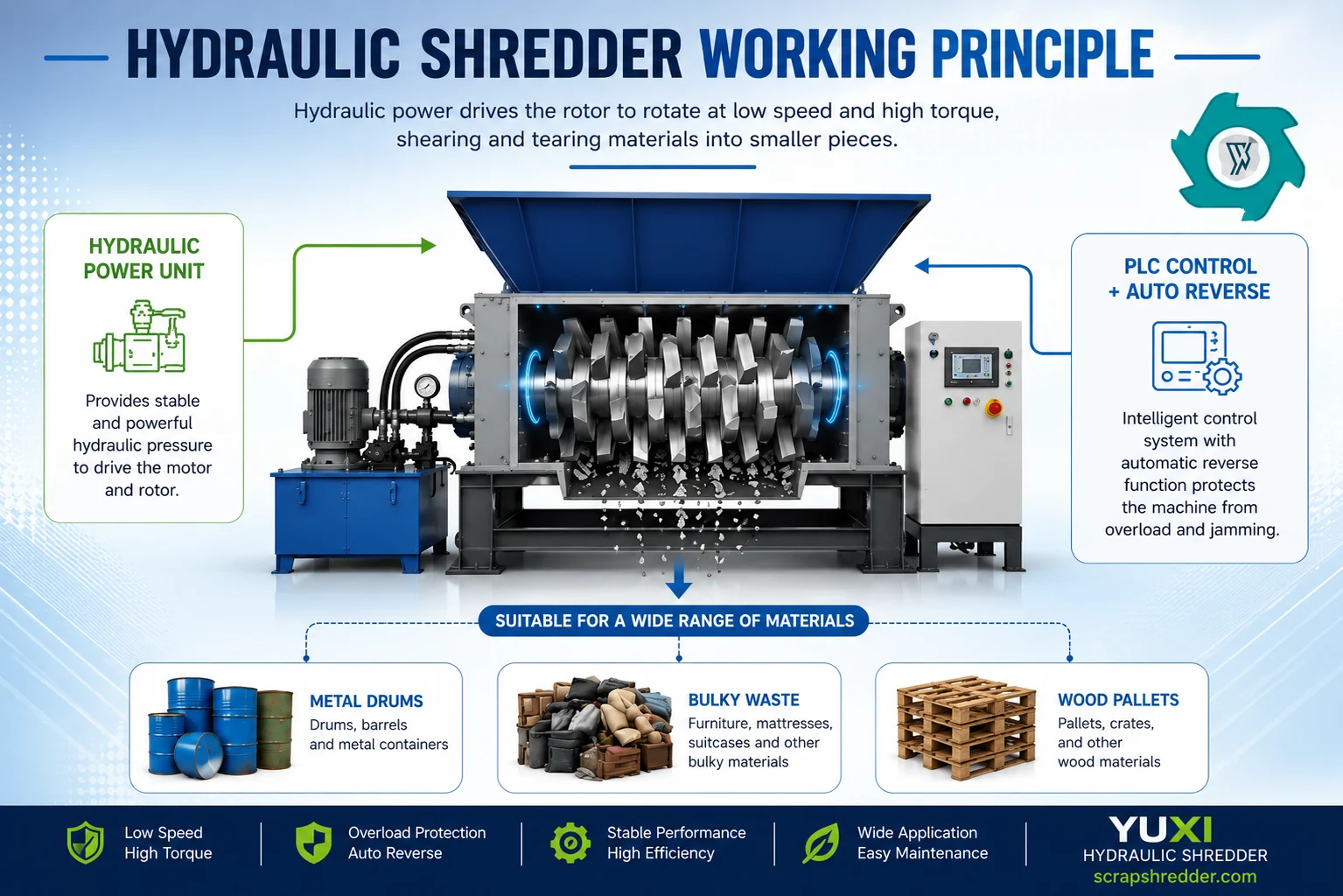
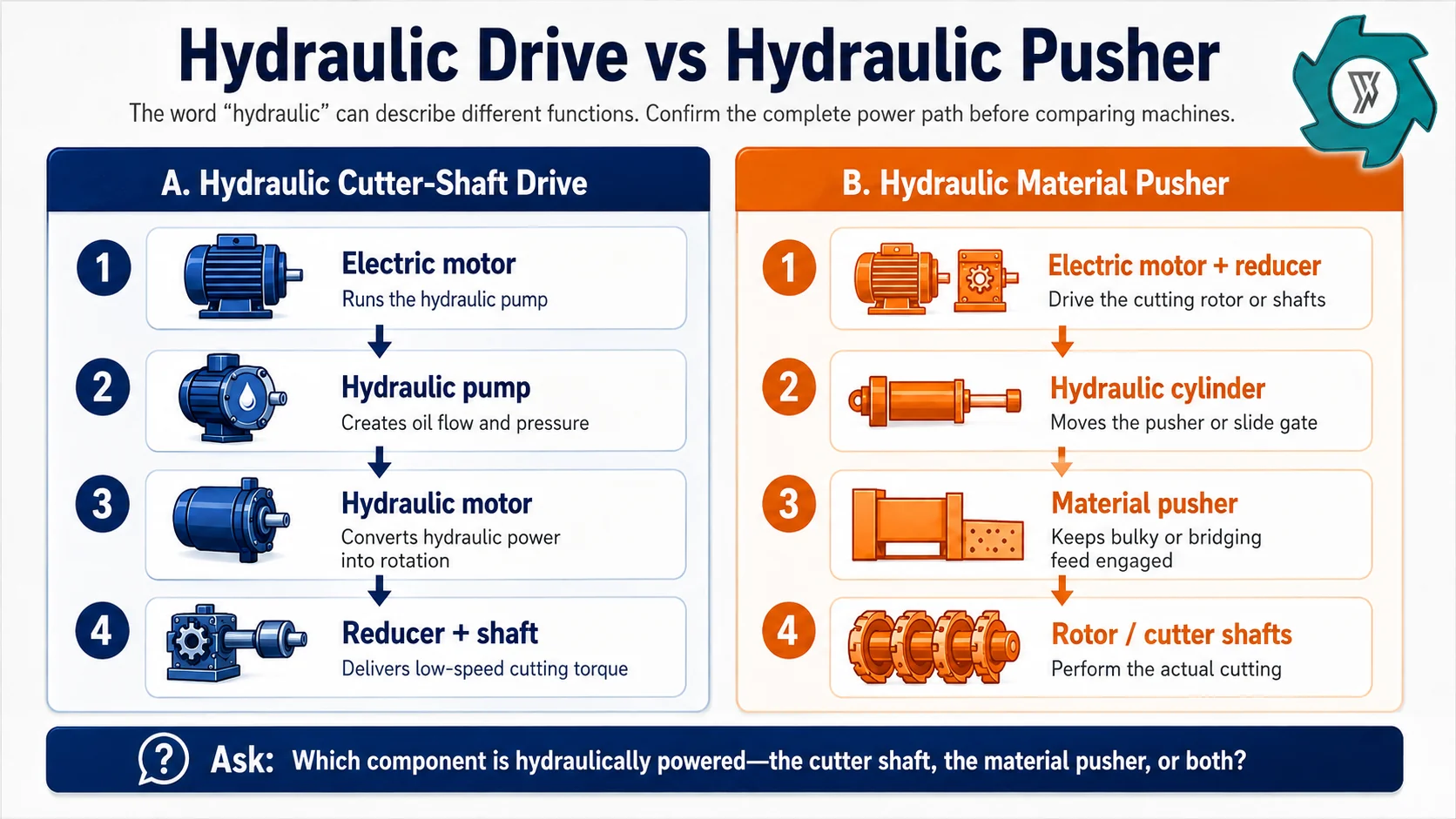
Hydraulics are useful when the load changes sharply, the shafts need controlled low-speed response or the machine must recover from difficult bites. They are not a substitute for correct cutters or feed limits. If a shredder reverses every few seconds, adding more pressure is rarely the first fix. The hydraulic vs electric shredder duty-cycle guide goes into the drive comparison in detail. For a metal-scrap RFQ, the hydraulic section should at least state the pump arrangement, hydraulic motor arrangement, normal working pressure and flow range, reduction path, shaft-speed range, cooling, filtration and the PLC overload/reverse logic. There is a useful benchmark in the market: SSI’s PRI-MAX PR2200 is published as a hydraulic two-shaft primary reducer with independently driven bi-directional shafts, load-sensing hydraulics and a separately stated infeed opening and active cutting zone.[2] The point is not to copy that machine. The point is that a serious hydraulic quotation should describe the drive architecture and feed geometry with similar clarity. Cooling becomes important on long shifts. Reversing, pressure spikes and frequent high-load operation turn lost energy into heat. The quotation should state the design ambient temperature and what happens when oil temperature crosses the alarm threshold. A short factory demonstration may never reach thermal equilibrium, so this is easy to miss until production starts. The word hydraulic can refer to the cutter-shaft drive, the material pusher, or both. The quotation should identify the actual power path.
Do Not Specify the Shredder Without the Next Machine
A drum can be “successfully shredded” and still create the wrong product for the line. If the goal is simply volume reduction before baling or transport, coarse strips may be fine. If the next step is a hammer mill, the primary shredder only needs to make pieces that the mill can accept steadily. If the line uses magnetic and non-ferrous separation, the burden depth and piece shape also start to matter. This is why a double-shaft machine should not be forced to make a small uniform product just because a buyer has written “50 mm output” in the inquiry. On coarse twin-shaft shredders, actual pieces are influenced by cutter width, tooth arrangement and how the scrap folds. If a narrow maximum size is essential, a second reduction stage may be the more stable layout. UNTHA’s ZR2400 is another useful primary-source example of this distinction: the manufacturer presents it as a two-shaft pre-shredder for rough reduction and publishes a coarse fraction target rather than a precision final product.[7] For steel drums, that mindset is usually the right one—open and reduce first, then let the downstream machine do the job it was designed to do.
Use a Material Test to Set the Feed Limit in Writing
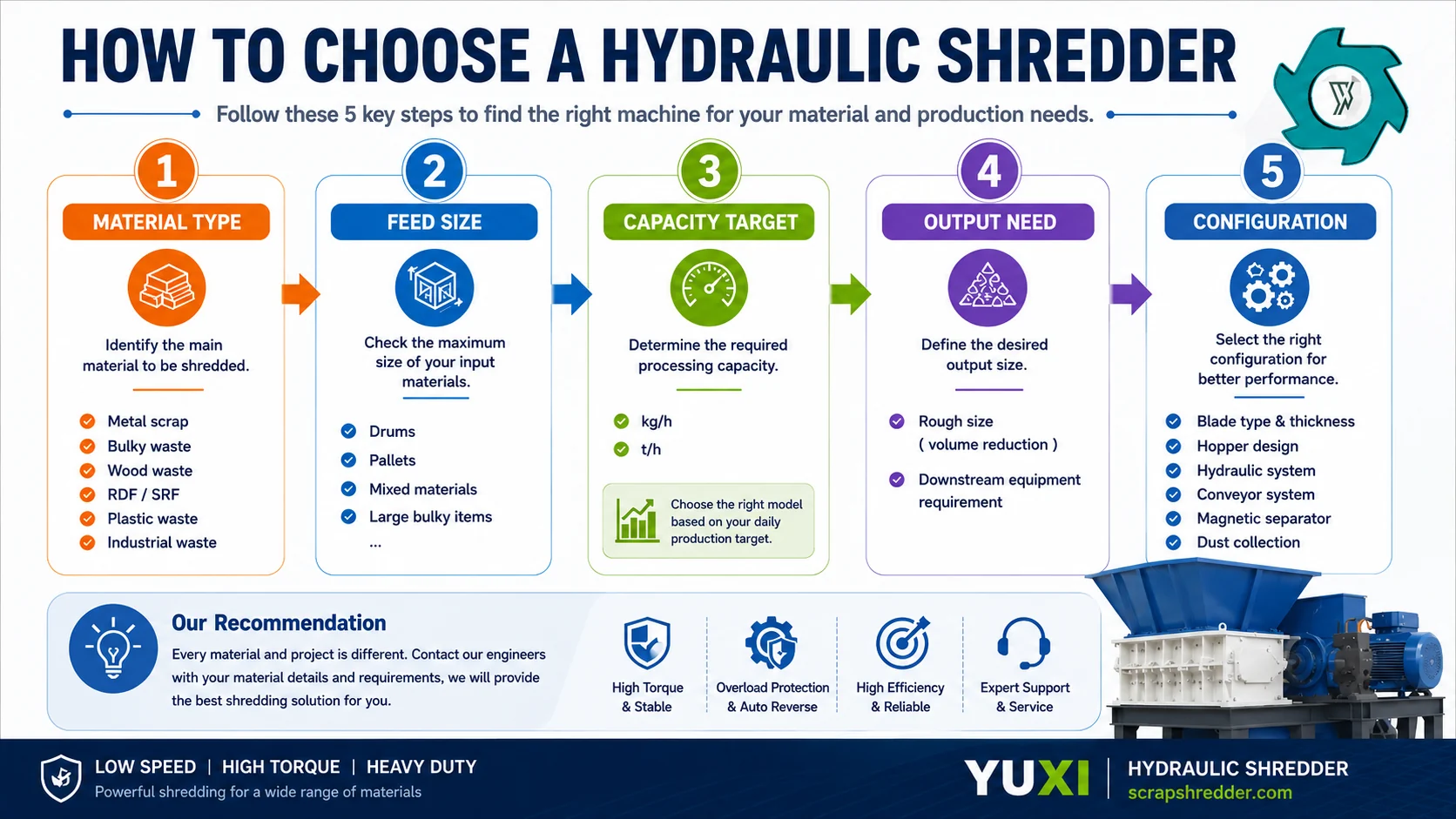
For a repeatable stream of clean drums, selection can be straightforward. Mixed metal is where assumptions start to hurt. We normally recommend that the test lot include not only the average material but also a few of the pieces most likely to cause a stoppage: the thicker closure, the folded drum, the longest profile and the heaviest permitted solid section. Unsafe or prohibited items obviously do not belong in a shredder test. The test should record the condition of the feed and the behavior of the machine, not just total tons. Pay attention to how the material is loaded, the frequency of shaft reversal, whether it needs to be manually repositioned, the oil temperature after continuous operation, and whether the discharged material meets the requirements of the next process. For a broader pre-purchase checklist, use how to choose the right hydraulic shredder. When the machine layout is fixed and the project moves to commercial comparison, the hydraulic shredder price and RFQ guide helps normalize what each supplier has actually included.
RFQ information that makes a metal-scrap quotation useful
Photos and video of normal feed and the difficult 10–20% of the stream.
Maximum outside dimensions, not only average dimensions.
Wall thickness for drums and sheet; cross-section for profiles, bars and structural scrap.
Typical and maximum single-piece weight.
Whether drums are open-head or tight-head, loose, flattened or nested.
Known coatings, liners, oils, liquids or other contamination, plus explicit prohibited items.
Loading method and normal batch size.
Required net throughput, shift length and expected operating pattern.
Acceptable output condition and the maximum feed accepted by the next machine.
Site voltage, ambient temperature, space limits and maintenance/lifting access.
A useful capacity guarantee should then be tied to that material description. “5 t/h on steel drums” is incomplete if one test used loose empty drums and the real plant feeds compacted mixed metal by wheel loader. Define the feed, test duration, allowed operator intervention and how net output is weighed.
Check Your Metal Scrap Before Choosing the Shredder
Send YUXI material photos or video, maximum dimensions, wall or section thickness, loading method, target capacity and downstream process. The engineering team can review whether the stream fits a hydraulic double-shaft shredder, needs pretreatment, or should use a different primary-reduction configuration.
Hydraulic Shredder for Metal Scrap FAQ
Can a hydraulic shredder process steel drums?
Yes. A correctly configured hydraulic double-shaft shredder can be a good fit for cleaned, depressurized steel drums when the drum dimensions, wall construction, closures and feeding method are within the machine’s approved feed envelope. Sealed, pressurized or contaminated drums require separate handling before shredding.
What is the maximum steel drum size a hydraulic shredder can accept?
There is no universal maximum drum size. The usable limit depends on hopper geometry, clear cutting-chamber opening, cutter diameter and hook profile, available shaft torque, whether drums arrive whole or nested, and the loading method. The quotation should state the approved maximum dimensions and single-piece condition for the proposed machine.
Can sealed or chemical drums go directly into a shredder?
They should not be treated as ordinary shredder feed. Unknown residues, flammable contents, pressure and bulging containers create hazards that strength or automatic reversing cannot solve. Establish an appropriate inspection, emptying, cleaning and depollution process under the rules that apply at the site before material reaches the shredder.
Is a single-shaft or double-shaft hydraulic shredder better for metal drums?
For whole or bulky drums that mainly need opening and volume reduction, a double-shaft machine is usually the first configuration to evaluate because two shafts can actively grip and tear the container. A single-shaft machine becomes more relevant when screen-controlled output is important and the feed has already been prepared for that cutting system.
What cutter thickness should be used for steel drums?
Cutter thickness should not be selected from the material name alone. Drum wall thickness, closures, folded seams, nested feed, desired strip size, shaft torque and the presence of heavier metal in the same stream all matter. A representative material test is a better basis than copying a cutter thickness from another project.
What information should be sent before requesting a metal scrap shredder quotation?
Send photos and video of normal and difficult feed, maximum dimensions, wall or section thickness, typical and maximum single-piece weight, whether material is hollow or solid, contamination and exclusions, loading method, required net throughput, acceptable output condition and downstream equipment.
SSI Shredding Systems — PRI-MAX PR2200. Manufacturer specifications for hydraulic drive, infeed opening, active cutting zone and independently driven shafts.
U.S. OSHA — 29 CFR 1910.120. Drum and container handling requirements, including pressurized or bulging containers in covered hazardous-waste operations.
David focuses on industrial shredding and recycling equipment,including material evaluation,shredder selection,process configuration,and recycling line planning.
Speak To Our Shredder Machine Expert
Get in touch with our nice team today to get a price estimate for a shredder machine.

 English



 Fast Delivery
 Reliable
 Certified
 Experienced