Hydraulic Shredder Manufacturer Guide: 12 Questions to Ask
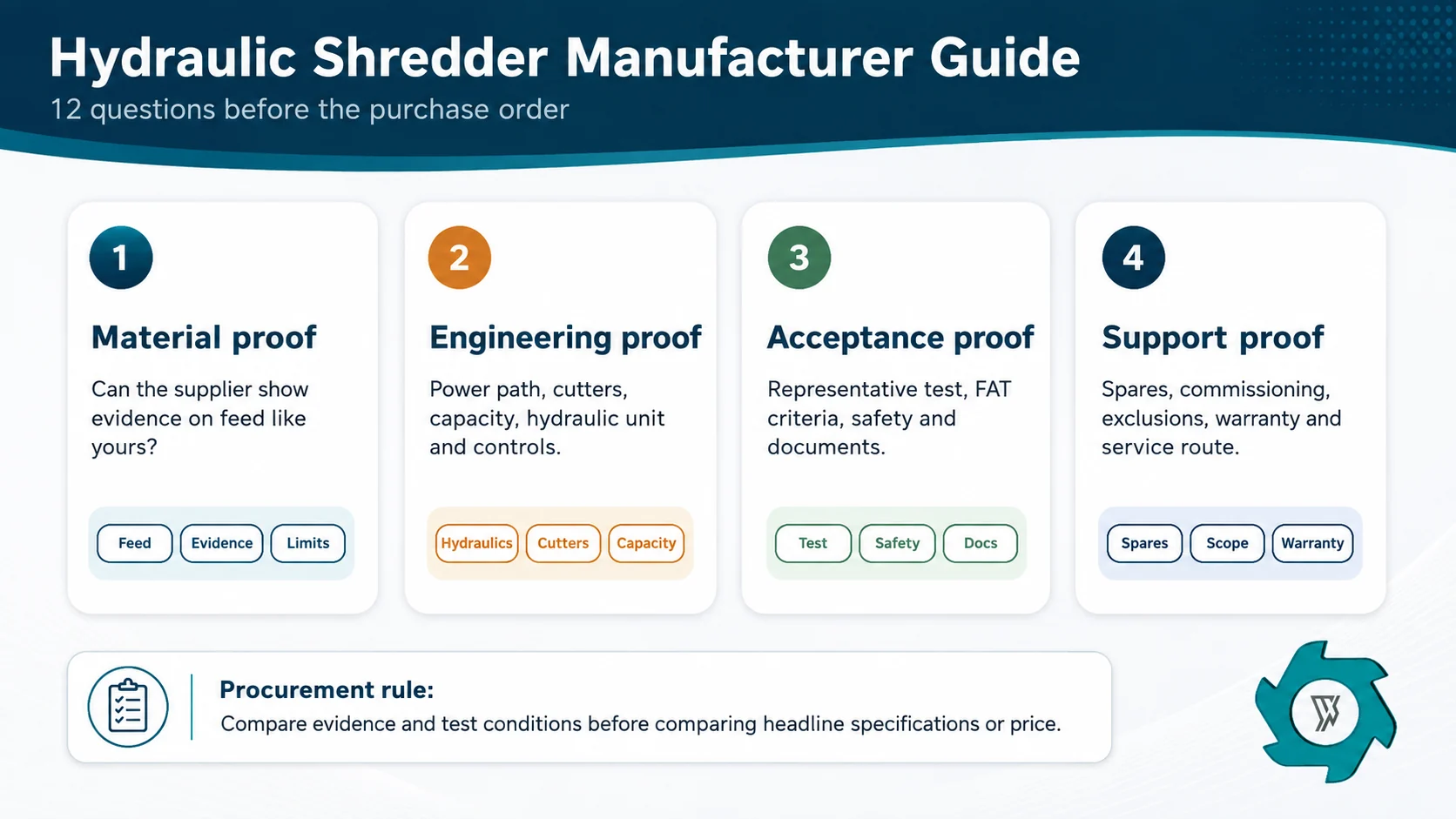
A polished quotation can make two hydraulic shredder suppliers look almost identical. They rarely are. The difference usually shows up later—in the feed they assumed, the way overloads are handled, the parts they expect you to keep on the shelf, or the simple question nobody asked before the purchase order: what exactly was the quoted capacity based on?A useful manufacturer comparison moves from material proof to engineering, acceptance testing and post-delivery support.
1. First Question: Where Does the Hydraulic Power Actually Go?
Sometimes the hydraulic circuit only moves a pusher. Sometimes it drives the cutter shafts. In other designs it supports several functions.That distinction changes the questions that follow. If a hydraulic motor drives the shaft, we want to see the pump, motor, reduction path and normal operating range as one system. If hydraulics only move the pusher, the rotor drive still needs its own specification. The hydraulic shredder working-principle guide goes deeper into those two arrangements.
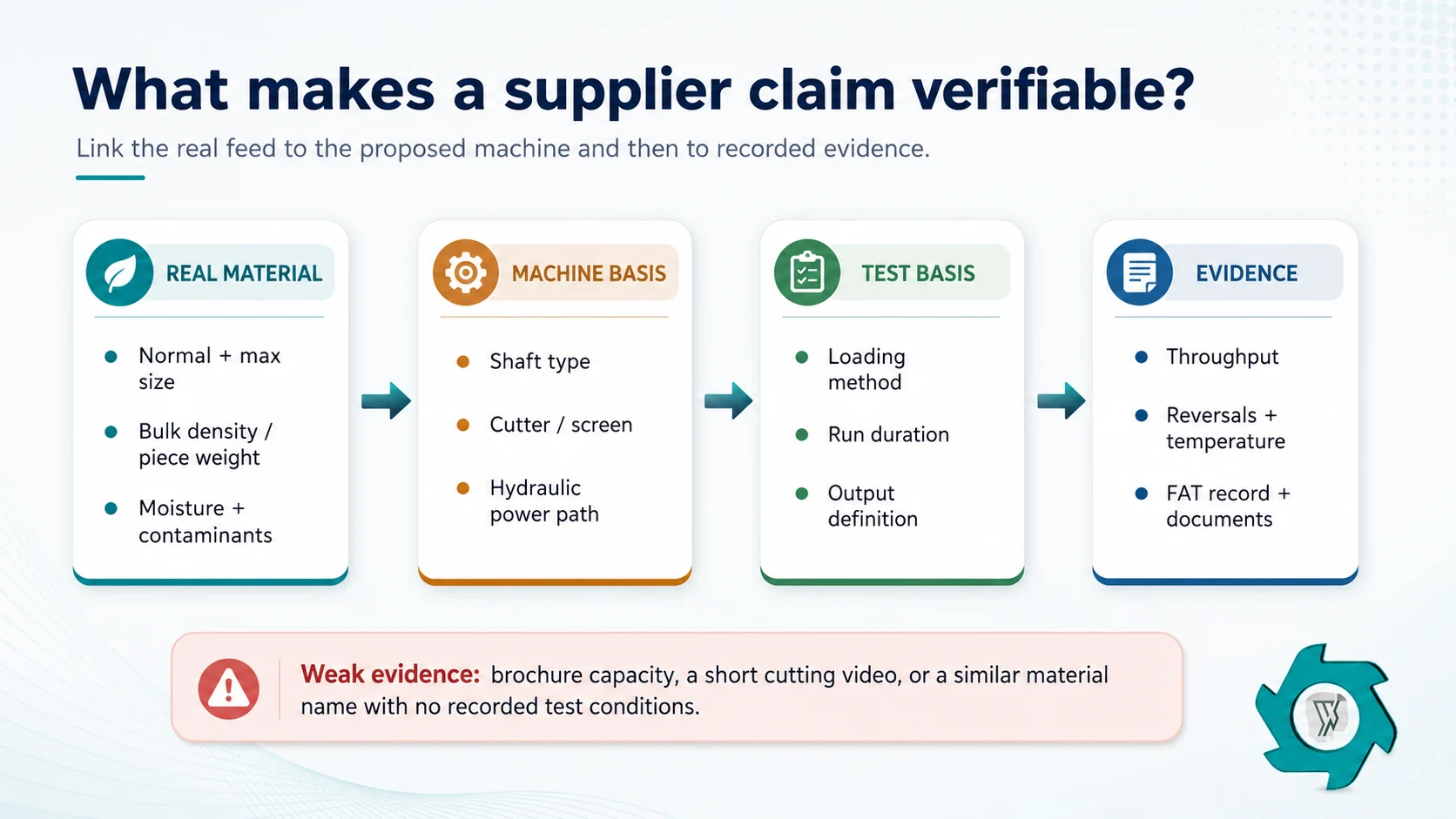
Manufacturer claims become more useful when each one is tied to a material condition, a machine configuration and a piece of evidence.
2. Have You Actually Run Material Close to Ours?
“We have many customers in recycling” is useful background. It is not proof that the proposed machine will like your feed.What we look for is similarity. Similar material form. Similar maximum dimensions. Similar contamination. Similar output objective. A video of clean plastic drums does not answer much for a project feeding wet paper-mill rejects with wire, nor does a photo of a twin-shaft machine beside scrap prove how it behaves under a sustained load.We’ve tested machines where a short, clean demonstration looked effortless. The more useful part came when the feed became less polite. That is why representative material matters most on mixed waste, reinforced rubber, wrapped material and feeds with occasional hard inclusions. If shipping a sample is practical, we normally recommend it.And if a previous customer reference is offered, ask what was different. That question is often more valuable than asking whether the earlier project was “successful.” A 20% difference in bulk density or a different downstream screen can change the whole duty.
3. That Capacity Number—What Is It Really Based On?
Capacity causes more bad comparisons than almost any other line in a shredder quotation. Franklin Miller notes that throughput is affected by physical size, weight, bulk density, feed quantity and cutting-chamber size.[1] In practice, the list gets longer: cutter geometry, screen opening, feeding rhythm, automatic reversals and downstream stops all have a say.So when we see “5 t/h,” we do not immediately ask whether 6 t/h is possible. We first ask where the five came from. Was it a peak? A short timed run? A catalogue reference? Net accepted output? Gross material tipped into the hopper?
Capacity field
What to freeze in writing
Feed basis
Material, normal and maximum size, piece weight or bulk density, moisture and contamination
Loading
Conveyor, grab, wheel loader, batch size and operator intervention
Output basis
Rough shred, maximum size, screen opening, oversize allowance or downstream acceptance limit
Run period
Timed test duration and treatment of normal stops/reversals
Measurement point
Gross input, shredder discharge or accepted product
Sometimes the most useful answer is not a guarantee. A supplier may say, “For this material we can only give a reference range until we test it.” That isn’t always a weakness. A cautious range with a clear basis can be more credible than a very precise number attached to vague feed conditions.The broader hydraulic shredder selection guide explains how feed shape, required output and duty should be fixed before final model selection.
4. Why This Cutter Layout, Not Another One?
This is where we want the manufacturer to reason from the material backward. “Alloy steel blade” is not much of an answer. What matters is why the hook profile, cutter thickness, rotor arrangement, counter knife, screen or shaft spacing fits the feed.For a single-shaft machine, we would talk about the rotor, fixed knives, screen and pusher behavior as one cutting system. For a double-shaft machine, we care about cutter thickness, hook geometry, spacer or cleaning arrangement, shaft support and how the cutter stack comes apart for service.Buyers sometimes ask which design is stronger. That isn’t always the useful question. A screen-controlled single-shaft shredder and a coarse-opening double-shaft shredder may both be heavy machines, but they solve different problems. The single-shaft vs double-shaft hydraulic shredder comparison separates those roles in more detail.One small question often opens up the maintenance story: what happens when one cutter is damaged? Can it be reground, rebuilt or changed individually? Does the whole stack need to come off? We’ve found that answers here tell you much more about future downtime than a generic “wear-resistant blade” claim.
5. The Hydraulic Unit Deserves More Attention Than It Usually Gets
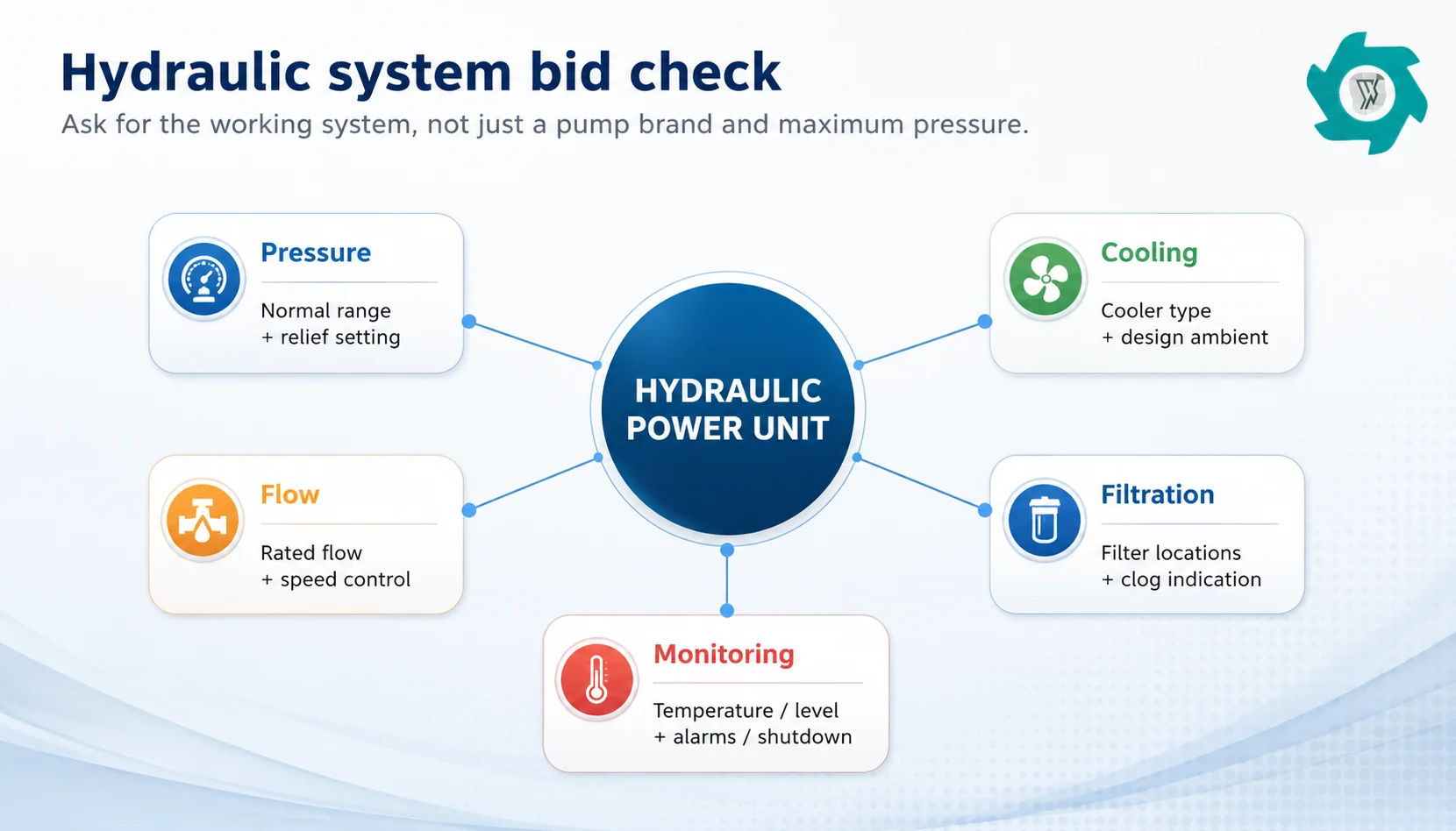
On a hydraulic cutter drive, the power unit is not an accessory sitting beside the machine. It is part of the drive itself. ISO 4413 sets general rules and safety requirements for hydraulic fluid-power systems used on machinery.[2] That is one reason we prefer a hydraulic discussion that goes beyond maximum pressure.Normal working pressure and flow tell us more. So do pump type, motor quantity and displacement, reservoir volume, filter location, clogging indication, oil grade and cooler arrangement. None of those items is especially glamorous. They become very interesting after eight hours of production.Temperature is a good example. Parker notes that fluid temperature affects hydraulic performance and component life; excessive heat reduces lubricating effectiveness, while cold oil can become too viscous for proper circulation.[3] Surprisingly, cooler sizing is still easy to overlook when the machine is tested for only a short period in a comfortable workshop.Evaluate the hydraulic power unit as a system: pressure and flow define the working range, while cooling, filtration and alarms help keep that range stable.
6. What Happens When the Easy Feed Stops Being Easy?
Every shredder looks better when the feed arrives evenly and nothing awkward enters the chamber. Production is not always like that.We want the overload sequence explained in plain language. What signal is being watched? Does the feeder pause first? How long does the shaft reverse? How many restart attempts are allowed before the PLC stops trying? Can the operator see why the machine stopped, or only a generic fault?Automatic reverse is useful, but it is not a badge of unlimited power. We’ve found that repeated reversals can point to a different problem altogether: a cutter that is too aggressive, pusher pressure that is too high, an undersized screen, batch feeding that is too heavy, or simply material that should have been excluded from the duty.During a test we would rather count reversals and note the reason than celebrate the fact that the pile eventually disappeared. Also ask what remains pressurized after shutdown. Stored hydraulic energy matters when somebody opens a guard or clears a jam.
7. Will This Shredder Behave Properly in the Rest of Our Line?
A standalone shredder can run perfectly and still make the plant frustrating to operate. We’ve seen projects where the machine choice was reasonable but the site planning was not: discharge clearance was tight, the control cabinet had a poor view of the hopper, or maintenance access was treated as spare space instead of a requirement. Foundation space, conveyor clearance and service access deserve attention before the machine arrives, not after installation starts.In practice, we often start with the machine after the shredder and work backward. What size can the next conveyor, magnet, crusher, screen or baler actually accept? What happens when that machine stops? If the answer is “the operator will notice,” the control boundary probably needs more work.In practice, a recycling line works as a chain rather than a collection of standalone machines. Primary shredding prepares the feed for the next crushing or separation stage. The shredder only has to do its job, but that job must be defined by what comes next.This is also where two quotations that look far apart in price can suddenly become much closer. One may include conveyors, interlocks, supports and control integration. The other may stop at the machine flange.
8. What Does the Factory Actually Control?
“Manufacturer” can mean several things. Some companies machine and assemble most critical parts themselves. Others use specialist subcontractors for machining, heat treatment or hydraulic components. That is not automatically a problem. The question is whether somebody is controlling the drawings, tolerances, records and final assembly.When we walk through a factory—or review a live video—we pay more attention to the unpolished areas. Cutter machining. Shaft seats. Welded chamber alignment. Hydraulic-pipe routing. The power unit before the covers go on. The inside of the control cabinet.We’ve found that suppliers who are comfortable showing how a critical part is checked are usually easier to work with later when a replacement part has to match the original machine.
9. What Will Maintenance Look Like Six Months After Startup?
Maintenance intervals sound tidy in a manual. The actual job may involve a heavy cover, awkward bolts, a screen that needs lifting space, or a filter hidden behind another assembly. So we prefer to talk through one maintenance task from start to finish.How is the cutting chamber opened? What has to be isolated? Which parts need a crane or chain block? Can hoses and sensors be reached without dismantling something unrelated? A supplier that has assembled and serviced its own machines should be able to answer without turning the conversation back to “easy maintenance.”Then comes the less exciting part: stock. We normally recommend separating cheap fast-moving spares from long-lead components. A seal kit may cost little; the problem is discovering that the exact seal, valve or sensor is not locally available after the machine has stopped.
Spare category
What to ask
Cutters / knives
Unit price, expected service basis, regrinding/rebuild route and lead time
Seals / bearings
Standard sizes or machine-specific items; local sourcing options
Filters / hoses
Exact specification, local equivalent and recommended stock
Hydraulic components
Pump/motor/valve model, repair route and replacement lead time
Sensors / controls
Part numbers, backup files, passwords/access policy and remote support procedure
For export projects, the lead-time column matters almost as much as the price column. That is one of the places where a slightly more expensive quotation can still be the lower-risk buy.
10. Which Safety and Compliance Documents Will We Actually Receive?
A CE mark, an ISO certificate and a machine risk assessment are not interchangeable. They answer different questions. ISO 12100 provides the general methodology for machinery risk assessment and risk reduction.[4] In the United States, OSHA 29 CFR 1910.212 covers general machine guarding, while 29 CFR 1910.147 addresses control of hazardous energy during servicing and maintenance.[5][6]We would want the supplier to provide the relevant safety documentation: guarding and interlock details, emergency-stop arrangements, isolation points, electrical and hydraulic schematics, manuals, and the conformity documents required for the destination market. “CE available” is too vague if nobody can say which documents actually arrive with the machine.There is also a timing issue for EU projects. Regulation (EU) 2023/1230 is scheduled to apply from 20 January 2027, replacing the current Machinery Directive framework.[7] A machine ordered in 2026 but placed on the EU market in 2027 needs that route discussed before the specification is frozen, not after the crate is ready.
Compliance note: destination requirements vary. Buyers, importers, integrators and manufacturers may have different responsibilities. Regard the quotation as the starting point of the project-specific compliance review, not the legal advice.
11. Can the FAT Reproduce the Job We Are Buying the Machine For?
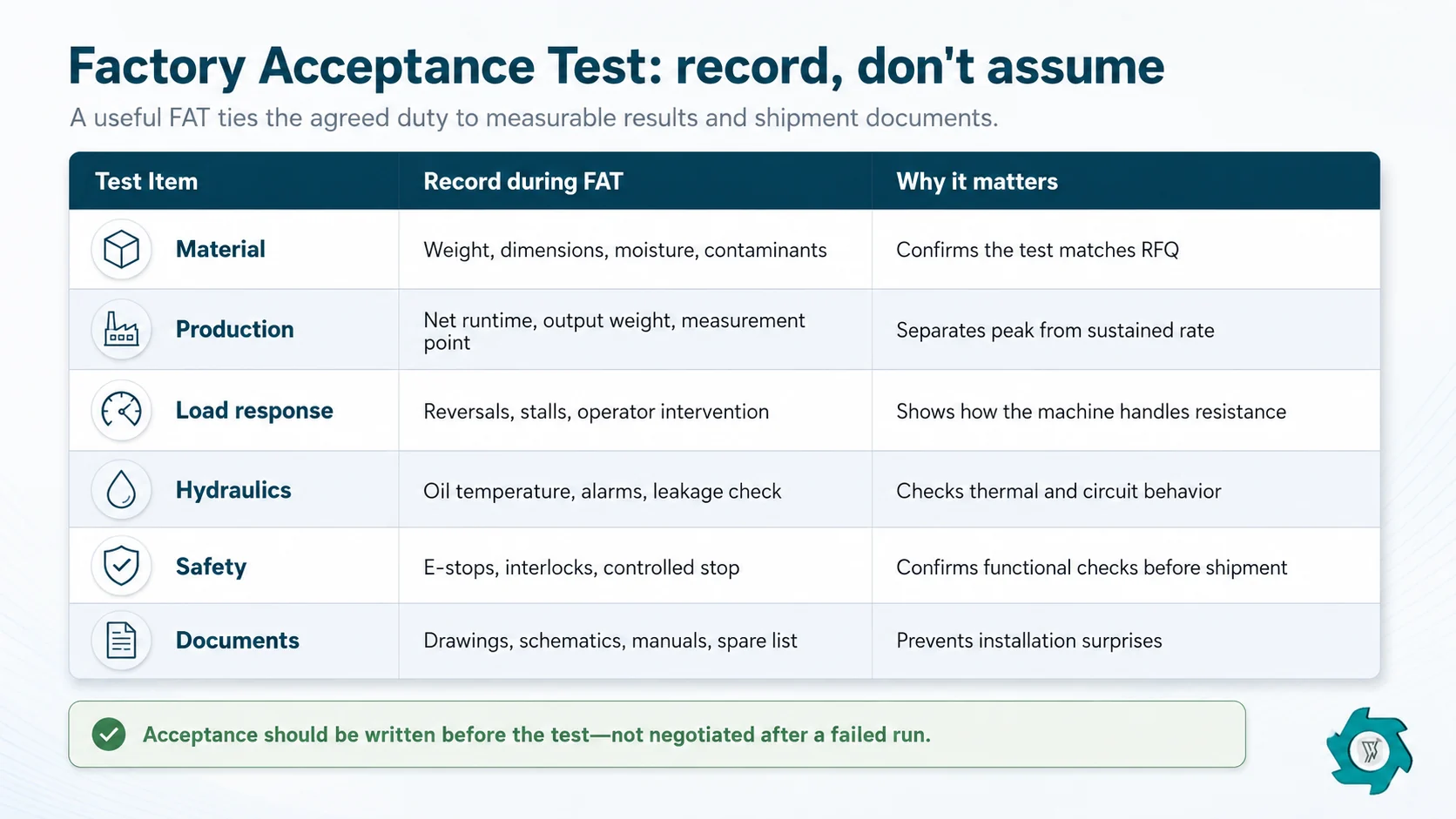
A factory acceptance test should make the quotation harder to argue about later. If it only proves that the shafts rotate and the PLC turns on, it has not done much.We like the test basis agreed before the material reaches the factory: what is being fed, how much, for how long, by what method, and where the result will be weighed. Then the awkward events count too—reversals, manual intervention, oil-temperature rise, leaks, alarms and abnormal vibration.We’ve found that short videos encourage everybody to watch the discharge pile and forget the machine. The FAT is where you should watch both. How often did it reverse? Did the feeder have to be nursed? Did oil temperature stabilize? Did the operator bypass the normal loading method to keep the run smooth?A useful FAT has a written basis and a record of results. “Machine ran successfully” is not an acceptance criterion.
FAT item
Record
Test material
Description, photos, total weight, normal/max dimensions, moisture and contaminants
Production
Net run time, output weight, measurement point and accepted output condition
Load response
Automatic reversals, manual interventions, stalls and restart behavior
Hydraulics
Oil temperature trend, pressure alarms, cooler operation and visible leakage check
Safety
Emergency stops, guards/interlocks and controlled shutdown behavior
Documents
GA/foundation drawings, hydraulic/electrical schematics, manuals, spare list and test record
One practical point: inspect the document pack before shipment. Missing schematics are much easier to chase down while the machine is still in the factory than after the site electrician has started commissioning.p>On one published YUXI export
12. Where Does the Supplier’s Responsibility Stop?
This is the commercial question that usually exposes technical assumptions. Export packing may be included while freight is not. Foundation drawings may be included while anchor bolts are not. Commissioning may mean remote video support, or it may include an engineer on site. The word “turnkey” does not settle any of this.On overseas projects, we’ve found that small scope gaps create some of the longest email threads: who supplies site cable, who fills the hydraulic oil, who provides lifting gear, who aligns the conveyor, who changes PLC parameters after the first loaded run. None of those items is difficult when responsibility is clear.Read the warranty the same way. When does it start? What is treated as a wear part? What evidence is needed for a claim? Will the supplier ship a replacement first or wait for the failed component to return? For a machine thousands of kilometers away, process matters.If the price comparison is still being normalized, the hydraulic shredder price and RFQ guide provides a separate checklist for scope, exclusions and lifecycle cost.
One sentence to add to the RFQ: “Please list all items required for the quoted machine to meet the agreed test duty that are not included in your price.” It is a simple way to surface hidden scope before the purchase order.
How We Would Compare Two Shortlisted Suppliers
We still use a scorecard, but not because a weighted total can choose a shredder for us. It cannot. Its job is to stop one attractive number—usually price or quoted throughput—from dominating the meeting.
Evaluation area
Suggested weight
Evidence to request
Material understanding and relevant proof
15%
Material review, comparable tests, feed exclusions and project differences
Capacity definition and sizing logic
15%
Test basis, measurement point, output definition and duty assumptions
Hydraulic engineering
15%
Power path, pressure/flow, pumps/motors, cooling, filtration and schematic
Cutting system and serviceability
10%
Cutter/shaft/chamber specification, wear strategy and maintenance access
Controls and overload behavior
10%
Reverse logic, alarms, interlocks, adjustability and diagnostic functions
FAT and acceptance method
15%
Written test plan, material, duration, recorded results and document pack
Safety and destination documentation
10%
Guarding, LOTO/isolation provisions, manuals and conformity route
Spares, commissioning and after-sales support
5%
Spare list, lead times, remote/on-site support and training scope
Commercial clarity
5%
Included scope, exclusions, Incoterm/delivery boundary and warranty
The weights should move with the project. A remote site may put far more weight on spares and diagnostics. A regulated facility may push safety documentation and integration higher. In our experience, the useful discipline is not the percentage itself; it is forcing a note, drawing, test record or quotation clause beside every score.
Red Flags We Would Not Ignore
A precise capacity with a vague material description is the obvious one. So is a supplier that talks about “the hydraulic system” but cannot say whether it drives the shaft, the pusher or both. We also become cautious when only maximum pressure is quoted, because maximum is not the same as a normal operating point.Some warning signs are quieter. “High-alloy cutter” with no grade or treatment route. A test video with no feed weight or run time. “Turnkey” with no exclusions. “24/7 support” with no named spare-parts route.None of these automatically disqualifies a manufacturer. Sometimes the quotation is simply immature. But each one deserves a second question before the purchase order, not after it.
If You Send YUXI an RFQ, Make It Difficult to Answer Vaguely
YUXI’s current hydraulic-shredder information covers both single-shaft and hydraulic double-shaft arrangements, material assessment, project-specific cutter/chamber configuration, hydraulic power-unit design, line integration and spare-parts planning. The best way to evaluate those claims is not to ask for a generic catalogue. Send enough project detail that the answer has to become specific.In practice, material photos or video are a good start, but we would also include the normal and maximum piece size, bulk density or piece weight where it matters, known contaminants, target output, required net throughput, operating hours, loading method, downstream equipment, ambient temperature, voltage/frequency and destination country.Then ask for one joined-up reply: proposed shaft type, full power path, cutter arrangement, hydraulic pressure/flow basis, cooling and filtration, overload logic, quotation boundary, FAT method and recommended spares. If any of those fields is still “to be confirmed,” at least everybody knows what remains open.
Compare the Machine Before You Compare the Price
Send your material, feed size, target output, capacity and site conditions. YUXI can prepare a model-specific hydraulic shredder proposal with the power path, cutting configuration, hydraulic unit, test basis and quotation scope stated for comparison.
FAQ
How do I verify a hydraulic shredder manufacturer before ordering?
We usually start with model-specific quotations that are difficult to forge or misunderstand,on-site factory or machine inspections,drawings,hydraulic and electrical documents,representative test bases,legal seller identity,clear payment and warranty terms,and evidence of designated service contacts.For larger orders,on-site or third-party factory inspection is still worthwhile.
Should I send my own material for a shredder test?
Usually yes when the feed is mixed, awkward or expensive to get wrong. A useful test is agreed in advance—sample condition, maximum size, moisture or contaminants, loading method, test duration, output target and measurement point. Otherwise even a genuine test video can be difficult to interpret.
What technical information should a hydraulic shredder quotation include?
We would expect the cutting architecture, chamber size, cutter or rotor arrangement, hydraulic power path, pump and motor or cylinder details, normal pressure and flow, cooling, filtration, overload logic, capacity basis, output definition, wear parts, utilities, included auxiliaries and exclusions. The point is not to make the quote longer; it is to make two quotes comparable.
Does CE or ISO certification prove that a hydraulic shredder is suitable for my material?
No. Those documents may be important for quality system,safety or market access,but they do not prove that the tool configuration will handle your actual feed at the claimed throughput.Material fit still needs an engineering review and, where the duty is uncertain, representative testing.
What is the biggest red flag when comparing shredder manufacturers?
A confident capacity and price attached to an undefined feed is one of the biggest. We are equally cautious when the supplier will not define the hydraulic power path, output condition or quotation boundary. A low price is not automatically suspicious; an unmeasurable promise is.
How should I compare two hydraulic shredder manufacturers fairly?
Give both suppliers the same material profile and the same RFQ. Then compare the same things: architecture, hydraulic circuit, cutters, capacity basis, output condition, controls, safety documents, FAT method, spare parts, delivery boundary, commissioning and warranty. We would score the evidence and exclusions, not just the brochure numbers.
David focuses on industrial shredding and recycling equipment,including material evaluation,shredder selection,process configuration,and recycling line planning.
Speak To Our Shredder Machine Expert
Get in touch with our nice team today to get a price estimate for a shredder machine.

 English



 Fast Delivery
 Reliable
 Certified
 Experienced