Industrial Shredder & Recycling Systems Manufacturer - YUXI

 English

 English
 Fast Delivery
 Reliable
 Certified
 ExperiencedEnglishEnglishFast DeliveryReliableCertifiedExperienced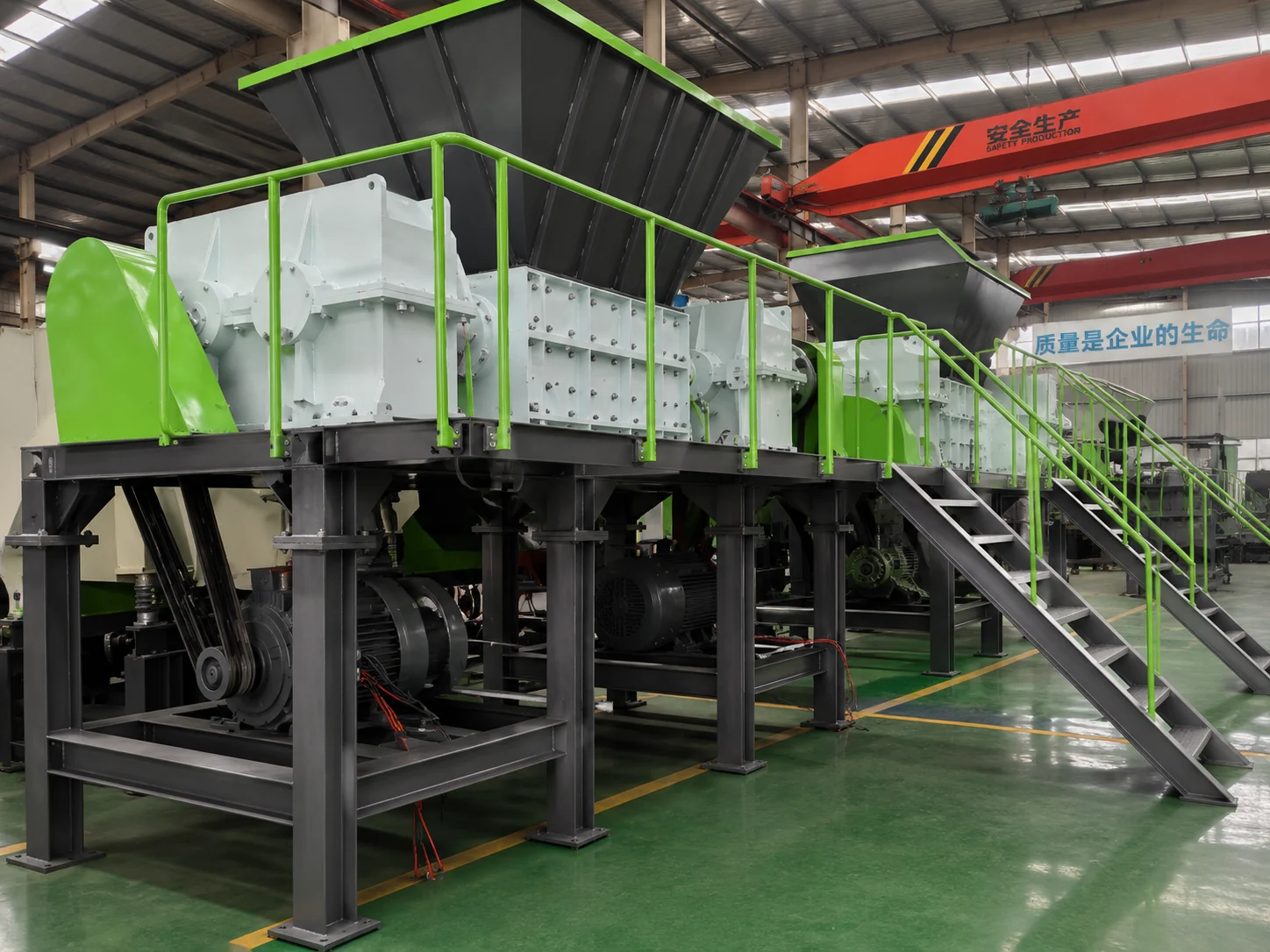
| Criterion | What matters | Why buyers should care |
|---|---|---|
| Two-shaft product depth | Current dedicated twin- or dual-shaft models, not only a generic “industrial shredder” claim. | A manufacturer with several duty classes can choose the mechanism around the project instead of forcing one standard machine into every application. |
| Application evidence | Published use with bulky waste, tires, metal, plastics, wood, MSW, cable or other difficult streams. | Material behavior changes bite, shock load, wrapping, wear and discharge. Broad claims need application-specific evidence. |
| Drive and protection | Electric or hydraulic options, reversing logic, shock protection, torque management and contamination tolerance. | The drive system determines how the machine reacts when the feed stops behaving like the brochure sample. |
| Maintenance design | Cutting-table access, cutter change, bearing protection, cleaning access and wear-part planning. | Serviceability often matters more to annual output than a small difference in nominal hourly capacity. |
| Line integration | Conveyors, magnets, screening, secondary size reduction, controls and project engineering. | A shredder is frequently the first stage of a larger process. Interface responsibility should be clear before installation. |
| Commercial fit | Project engineering, documentation, service route, export support and total landed cost. | The cheapest machine can become expensive when commissioning, electrical adaptation, freight or critical spares were excluded. |
SSI is a natural benchmark for industrial two-shaft shredding because the company maintains a broad Dual-Shear product family rather than one token model. Its current M-series machines are described as low-speed, high-torque two-shaft rotary shears, with product pages covering drive configurations, application-specific hoppers, direct drive, cleaning fingers, cutter systems and protection features.[1]
Why it stands out: SSI is particularly strong when the material is difficult enough that cutter geometry, drive protection and project-specific engineering matter more than buying a standard frame size. Buyers handling mixed industrial waste, product destruction, tires, metals or bulky material can compare several duty classes within the same manufacturer.
Buyer watch-out: custom engineering is valuable, but it can also increase capital cost and lead time. A small facility processing predictable hollow plastic or cardboard may not need the same severe-duty platform as a plant processing contaminated, high-shock material.
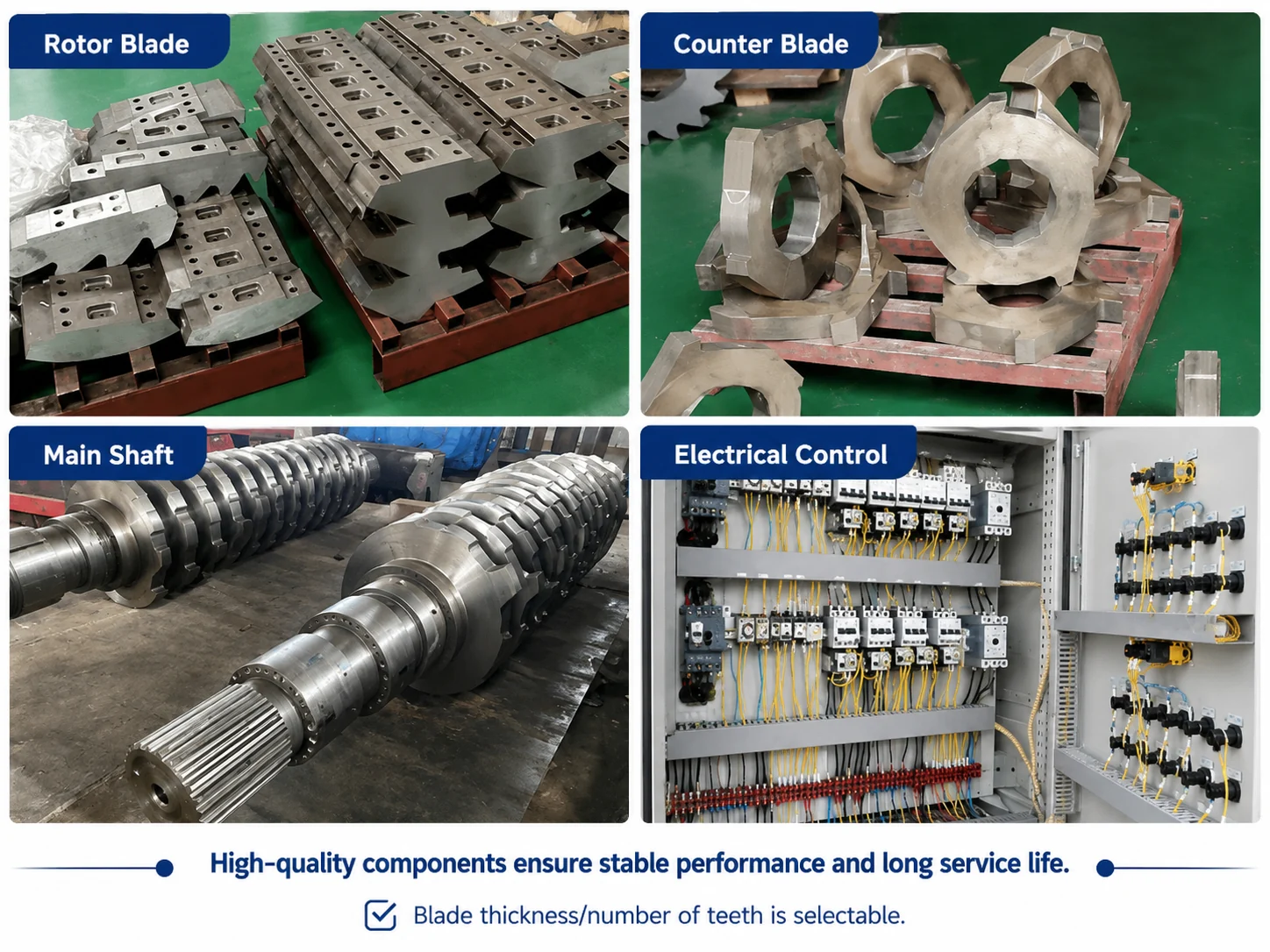
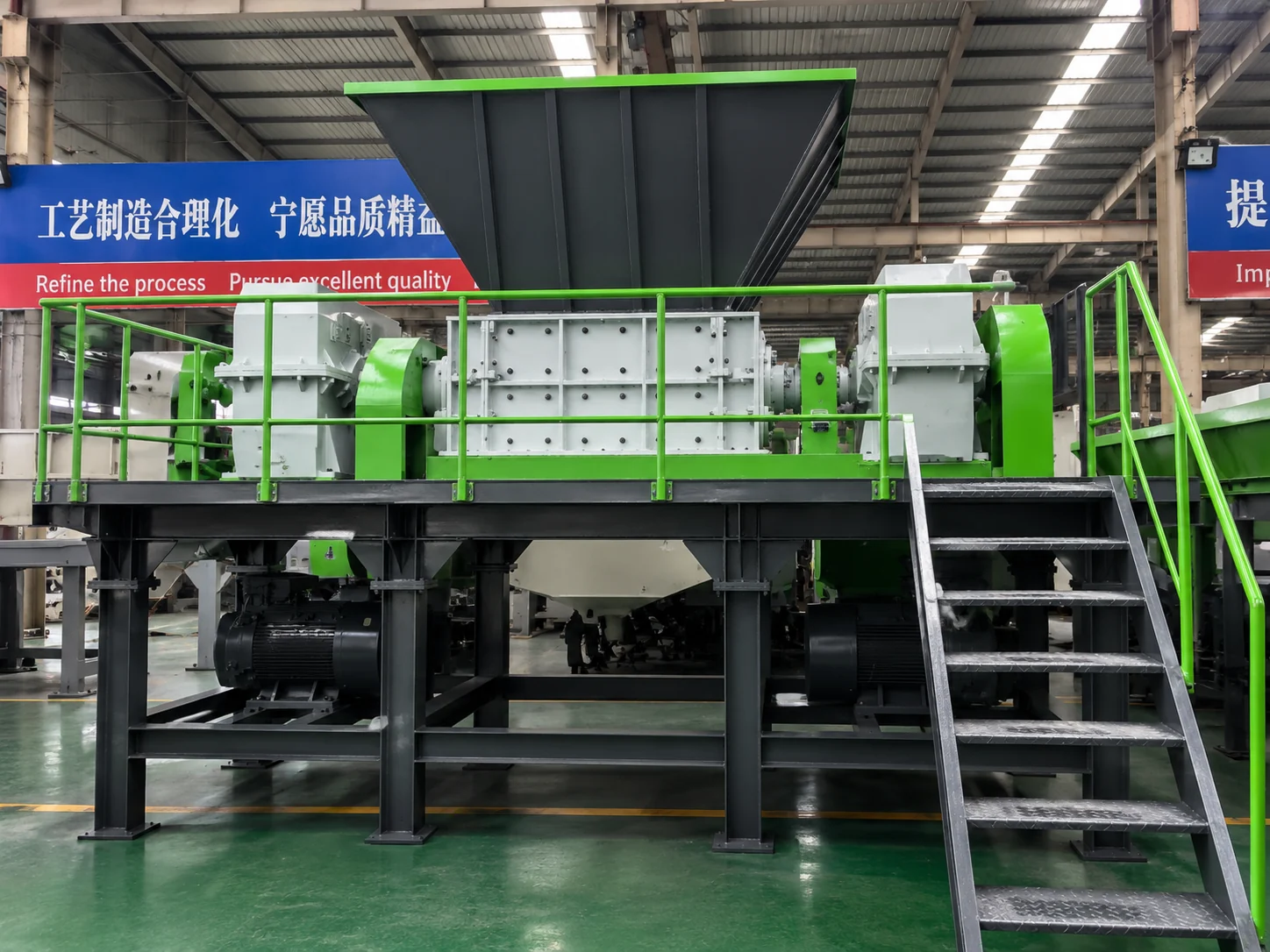
YUXI’s current double shaft shredder range publishes nine YXS models, from the YXS-600 through YXS-2600, with reference motor configurations from 15×2 kW to 160×2 kW.
Why it stands out: the range is easy to place inside a complete recycling system. YUXI supplies multiple shredder types and downstream recycling equipment, so the discussion can extend from the two-shaft chamber to conveyors, magnets, secondary crushing, granulation or separation instead of ending at the machine discharge. For buyers sourcing internationally, factory-direct configuration and a wide model ladder can also make budget scaling easier.
Buyer watch-out: do not select from the capacity column alone. The published range is a reference, and actual output will change with material density, feed geometry, cutter setup, contamination and downstream restriction. Buyers should also define commissioning scope, local electrical work and critical-spares lead time in the contract.
UNTHA’s current ZR series is a dedicated two-shaft pre-shredder platform for rough reduction of high-volume waste and recyclables. The ZR2400 public page lists 2 × 132 kW drive power and describes use for C&D waste, municipal solid waste, bulky waste, wood waste and metal scrap, with emphasis on energy efficiency, contamination resistance, cutting-table access and continuous operation.[2]
Why it stands out: UNTHA is strong where plant uptime and lifecycle operating logic are central. The company publishes not only product specifications but also application references and maintenance-oriented design details, which makes it easier for a technical buyer to ask specific questions.
Buyer watch-out: the ZR is a serious pre-shredder. It can be excessive for a modest-volume facility that only needs to reduce plastic drums, pallets or light production waste. Match the duty before comparing price.
Lindner’s Urraco family is one of the more visible twin-shaft pre-shredder platforms in waste and recycling. Current Urraco pages describe slow-speed twin-shaft cutting systems, hydraulic drive, configurable shaft pairs, mobile chassis options and applications including C&I waste, MSW, waste wood, railroad ties and light scrap. The Urraco 5000 page publishes a 355 kW electric drive and states throughput capability up to 100 t/h for its defined application context.[3]
Why it stands out: Lindner is particularly attractive when the machine has to move around a yard or between working locations while still operating as a heavy pre-shredder. The company also puts unusual emphasis on shaft exchange and maintenance access.
Buyer watch-out: a mobile platform carries chassis, hydraulic, engine or mobility-related cost that a fixed production line may not need. If the shredder will never move after commissioning, compare a stationary alternative on equal battery limits.
WEIMA’s M8.28 is a current twin-shaft pre-shredder designed for high-volume waste flows. The manufacturer emphasizes counter-rotating shafts, hydraulic drive, a removable cutting table, wear protection and handling of heterogeneous waste before downstream processing.[4]
Why it stands out: WEIMA is a useful benchmark for buyers who value process reliability and maintainability and want a supplier with a broader industrial shredding background beyond only two-shaft machines. The M8.28 is clearly positioned as a primary shredder, which reduces category confusion.
Buyer watch-out: the twin-shaft offering is more concentrated than SSI’s broad Dual-Shear ladder. A buyer needing several stationary two-shaft sizes should confirm whether the M8.28 duty and scale actually match the project rather than choosing the brand first.
Granutech-Saturn publishes a long-running dual-shaft shredder range for tires, wire and cable, bale breaking, plastics, metals, e-scrap and bulky waste. The current page lists electric or hydraulic drive choices, custom blade widths, automatic reversing and multiple standard chamber sizes.[5]
Why it stands out: Saturn is a strong comparison point when the project needs a rugged rotary shear that can be configured around challenging recyclable material rather than municipal waste alone. Its cutter and blade service ecosystem is also relevant for buyers thinking beyond the initial purchase.
Buyer watch-out: older installed-base reputation should not replace a current project review. Ask which current drive, cutter and control package is being quoted and how it differs from legacy Saturn machines in the field.
FOR REC publishes a dedicated family of primary double-shaft shredders. Its current overview covers TB and TBS machines for volumetric reduction and roughing, plus the TX platform for end-of-life tires, with emphasis on high torque, low rotational speed and application-specific cutting systems.[6]
Why it stands out: FOR REC is useful when the buyer wants the twin-shaft stage engineered together with a broader recycling process. The dedicated tire platform also shows a good principle: similar shaft counts do not mean identical cutter systems.
Buyer watch-out: verify whether the quoted machine is intended mainly for volume reduction or for a more defined downstream fraction. The same supplier offers several architectures, and output expectations should be written before model selection.
Genox publishes dedicated double-shaft products and complete recycling systems. Its current W Series page describes two rotors, V-cutting geometry, hardened DC53 knives, adjustable counter knives and wear-resistant options, with published W1000 and W1200 model data.[7]
Why it stands out: Genox is one of the more visible Chinese recycling-equipment suppliers for buyers who want shredding, granulation and line integration from one manufacturer. That can simplify interfaces between the first and second size-reduction stages.
Buyer watch-out: a broad catalogue makes exact configuration control more important. Confirm the model revision, cutter material, electrical components, test basis, manufacturing location, commissioning route and included spare parts on the signed quotation.
Shred-Tech’s current ST-1200 product is a dual-shaft industrial shredder aimed at severe-duty applications. The manufacturer publishes a large cutting chamber, two-drive configuration and use with tires, metal scrap and industrial waste, with job-specific conveyance and installation options.[8]
Why it stands out: Shred-Tech has a long industrial-shredding identity and is a credible candidate where material destruction, custom conveying and severe mechanical duty are central to the project.
Buyer watch-out: verify which current model family best matches the material. Shred-Tech also sells other shaft configurations, so a familiar brand name should not substitute for selecting the correct cutting mechanism.
Pronar’s current recycling range includes two-shaft slow-speed machines such as the MRW 2.85, MRW 2.65 and larger MRW 2.1010. Public specifications for the MRW 2.85 show two synchronized shafts, a 310 kW engine, mobile chassis and applications including municipal waste, construction waste, pallets, roots and bulky material.[9]
Why it stands out: Pronar deserves consideration when mobility and material flexibility are more important than integrating a fixed shredder into a tightly coupled production line.
Buyer watch-out: a mobile slow-speed shredder and a stationary electric rotary shear solve overlapping but not identical problems. Include fuel, transport, site movement and downstream feeding in the comparison.
| Rank | Manufacturer | Base | Strongest fit | Main watch-out |
|---|---|---|---|---|
| 1 | SSI Shredding Systems | USA | Custom heavy-duty stationary two-shaft rotary shears | Custom scope may be more machine and budget than simple feed requires |
| 2 | YUXI Machinery | China | Broad stationary range, export value and complete-line integration | Normalize commissioning, spares and reference capacity to the real feed |
| 3 | UNTHA | Austria | Continuous pre-shredding, waste, C&I, wood and alternative fuels | High-duty platform may be excessive for smaller clean streams |
| 4 | Lindner | Austria | Mobile and semi-mobile high-throughput pre-shredding | Do not pay for mobility if the machine will be permanently fixed |
| 5 | WEIMA | Germany | Large heterogeneous waste with maintainable cutting table | Current twin-shaft range is more focused than broad rotary-shear families |
| 6 | Granutech-Saturn | USA | Tires, wire, metals, e-scrap and contaminated material | Clarify current configuration versus legacy Saturn equipment |
| 7 | FOR REC | Italy | Recycling systems and tire-specific two-shaft reduction | Define whether the target is rough volume reduction or a tighter fraction |
| 8 | Genox | China | Export recycling systems with shredding plus granulation | Audit exact model, component list and regional service arrangement |
| 9 | Shred-Tech | Canada | Severe-duty industrial shredding and product destruction | Confirm the correct shaft architecture within the wider product range |
| 10 | Pronar | Poland | Mobile slow-speed shredding of bulky waste, wood and mixed streams | Include transport, fuel and mobile operating model in lifecycle cost |
| Project duty | Manufacturers to put on the first shortlist | What should decide the final choice |
|---|---|---|
| Mixed industrial waste / difficult stationary duty | SSI, YUXI, UNTHA, Genox | Contamination tolerance, shaft/cutter strength, reversing behavior, maintenance access and line interfaces |
| Mobile MSW / bulky waste / wood | Lindner, Pronar, WEIMA, UNTHA | Mobility, hydraulic architecture, fuel or electrical supply, hopper handling, non-shreddable response and discharge |
| Tires | Granutech-Saturn, FOR REC, SSI, YUXI | Tire size, steel content, cutter life, target chip size, recirculation and the next tire-recycling stage |
| Light metal, drums and mixed scrap | SSI, YUXI, Granutech-Saturn, Lindner | Maximum metal thickness, hidden dense pieces, torque margin, cutter toughness and downstream separation |
| Plastic drums, pallets and bulky rigid plastic | YUXI, Genox, SSI, WEIMA | Feed opening, bite geometry, anti-bridging behavior and whether a granulator follows |
| Complete recycling line from shredder through separation | YUXI, Genox, FOR REC, UNTHA | Responsibility for conveyors, controls, separators, secondary size reduction, FAT and commissioning |
| FAT item | What to record | Why it matters |
|---|---|---|
| Input condition | Material list, piece dimensions, sample mass, contamination and loading method | Prevents an easy test sample from becoming the basis for a difficult production guarantee |
| Sustained run | Start/end time, mass processed, idle time, reversals and clearing events | Shows whether quoted throughput survives normal operating interruptions |
| Drive behavior | Current or hydraulic pressure trends, reversals, stalls and overheating indicators | Reveals whether the machine is continuously operating near protection limits |
| Discharge | Oversize pieces, long strips, wrapping, bridging and downstream feed behavior | The shredder only succeeds if the next process can accept its output |
| Inspection after run | Cutter edge, loose hardware, abnormal vibration, leaks, chamber buildup and access time | Short tests can still reveal poor access or an obvious material-machine mismatch |
| Published YUXI model | Motor power | Published reference capacity | Published product-size range |
|---|---|---|---|
| YXS-600 | 15 × 2 kW | 2–3 t/h | 3–10 cm |
| YXS-800 | 22 × 2 kW | 3–5 t/h | 3–10 cm |
| YXS-1000 | 37 × 2 kW | 5–8 t/h | 3–10 cm |
| YXS-1200 | 45 × 2 kW | 6–10 t/h | 3–10 cm |
| YXS-1400 | 55 × 2 kW | 8–12 t/h | 3–10 cm |
| YXS-1600 | 75 × 2 kW | 12–18 t/h | 3–10 cm |
| YXS-2000 | 90 × 2 kW | 16–22 t/h | 3–10 cm |
| YXS-2200 | 132 × 2 kW | 20–26 t/h | 3–10 cm |
| YXS-2600 | 160 × 2 kW | 25–60 t/h | 3–10 cm |
There is no universal best manufacturer. SSI is a strong heavy-duty engineering benchmark; UNTHA and Lindner are strong in demanding waste pre-shredding; YUXI is attractive for factory-direct stationary systems and complete-line integration; and other suppliers on this list cover different mobile, tire, industrial and recycling niches. The best choice depends on the exact duty.
Compare the real feed envelope, cutter and shaft design, torque path, protection logic, maintenance access, line interfaces, representative test data, electrical and safety documentation, commissioning, spare parts and service route. A motor-power comparison by itself is weak.
Choose stationary when the shredder will be permanently integrated into a recycling line. Choose mobile when the machine must move between piles, yards or sites. Mobility affects drive, chassis, transport, fuel or electrical design and lifecycle cost.
Use representative feed and a sustained test. Record sample mass, run time, loading interruptions, automatic reversals, jams, drive load and accepted discharge. Do not treat a short video with easy material as a guaranteed hourly production test.
Send material photos or video, maximum feeding size, expected output size, required capacity, working hours and downstream process. YUXI can recommend a standard YXS model or a project-specific double shaft shredder and recycling-line configuration.

Get in touch with our nice team today to get a price estimate for a shredder machine.
Contact Us