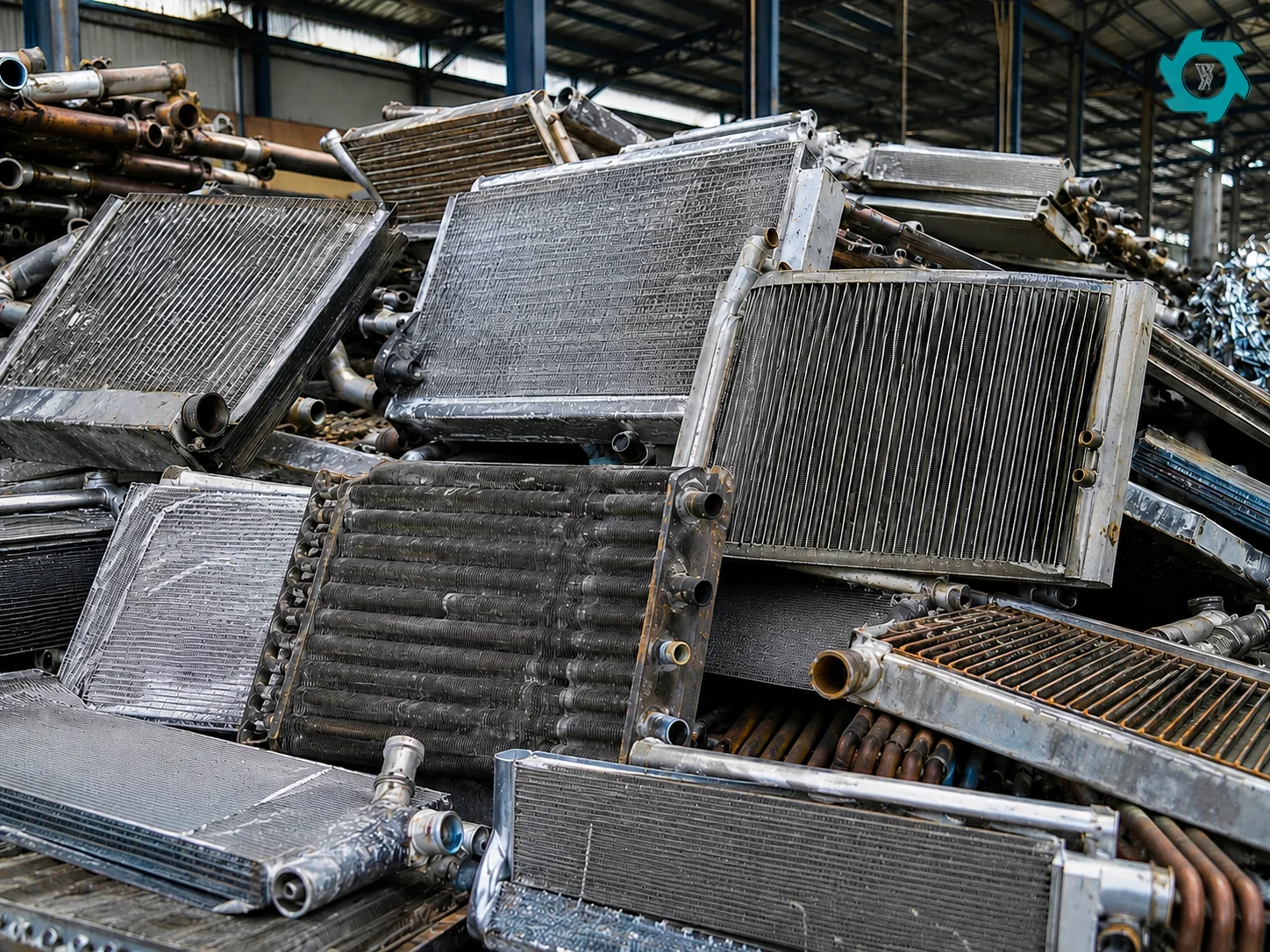
Industrial radiators are not simply larger car radiators. Generator cooling packs, mining-equipment radiators, stationary engine coolers and process heat exchangers can arrive with deeper cores, rigid guards, steel support frames, large header connections and awkward shapes. For a recycling plant, those features change the front end first—and they often decide whether the rest of the line can run steadily. Industrial radiator scrap can vary widely in depth, frame rigidity, pipe projections and overall shape. Those differences affect feeding before they affect separation.
Industrial radiator scrap is a geometry problem before it is a metal problem
Heavy-duty cooling equipment covers a much wider construction range than a typical passenger-car radiator. A large radiator can be light for its volume. Another unit of similar outside dimensions may carry a much heavier guard, shroud or support structure. One may flex as it enters the chamber; another stays rigid and bridges across the hopper. Long pipe stubs can catch on sidewalls. A fan ring or guard can make the apparent width much larger than the core itself.
Engineering point: “Fits through the feed opening” is not the same as “feeds reliably.” Effective acceptance depends on orientation, rigidity, diagonal dimension, protrusions and how the first cutter bite develops.
Define oversize with an envelope, not a single maximum length
For industrial radiator recycling, maximum length is only one number. A useful feed record includes length, width and depth, but it should also show the features that change handling. We normally ask for a photo with a tape measure or forklift tine for scale, then a second close-up of the frame and header connections.
Feed detail
Why it matters
What to record
Overall envelope
Sets the basic conveyor, hopper and chamber opening requirement.
Maximum L × W × H of normal feed, not only average size.
Diagonal / entry orientation
A long rigid unit may enter diagonally and occupy more effective width than expected.
How the operator or loader will present the radiator.
Frame rigidity
Rigid frames resist folding and can bridge where a thin coil would collapse.
Thin sheet frame, channel frame, heavy welded structure or guard.
Protruding pipes and fittings
Long connections can snag on hopper walls or create uneven first bites.
Longest projection beyond the core or tank.
Unit weight
Changes impact load and feeding equipment, even when outside dimensions look similar.
Typical and maximum approximate piece weight.
Batch mix
The worst normal pieces may govern uptime even if they are a minority of the tonnage.
Share of large, framed, dirty and easier prepared units.
Sometimes pre-cutting a few extreme units is cheaper than designing the whole line around them. That is not a universal rule. If oversized cooling packs make up most of the incoming business, manual trimming can become the real bottleneck and a larger front end may be justified. If they appear only occasionally, a separate preparation route can keep the main line simpler.
Choose direct feed, pre-dismantling or a separate oversize route
The decision is easier when the plant separates “normal industrial radiator” from “special feed.” Trying to make one machine accept every object in the yard often pushes cost, wear and risk upward without improving saleable-metal output.
Feed condition
Likely front-end choice
Main reason
Large core with manageable thin frame
Direct metered feed after inspection and drainage
Frame can be opened during primary size reduction and removed later.
Rigid guard or fan shroud that adds major volume
Remove bulky low-value attachment first when labor economics support it
Avoid sizing conveyors and chamber around material that contributes little recoverable metal.
Heavy welded support frame or thick crossmember
Pre-dismantle or cut frame before the normal radiator line
Downstream magnetic separation does not reduce the upstream mechanical shock.
Occasional extreme oversize unit
Separate preparation bay
Protects main-line uptime without overbuilding every stage.
Oversize units are the normal feed
Engineer the front end around the worst normal geometry
Repeated manual cutting would otherwise become a permanent production step.
Steel frames need two decisions, not one
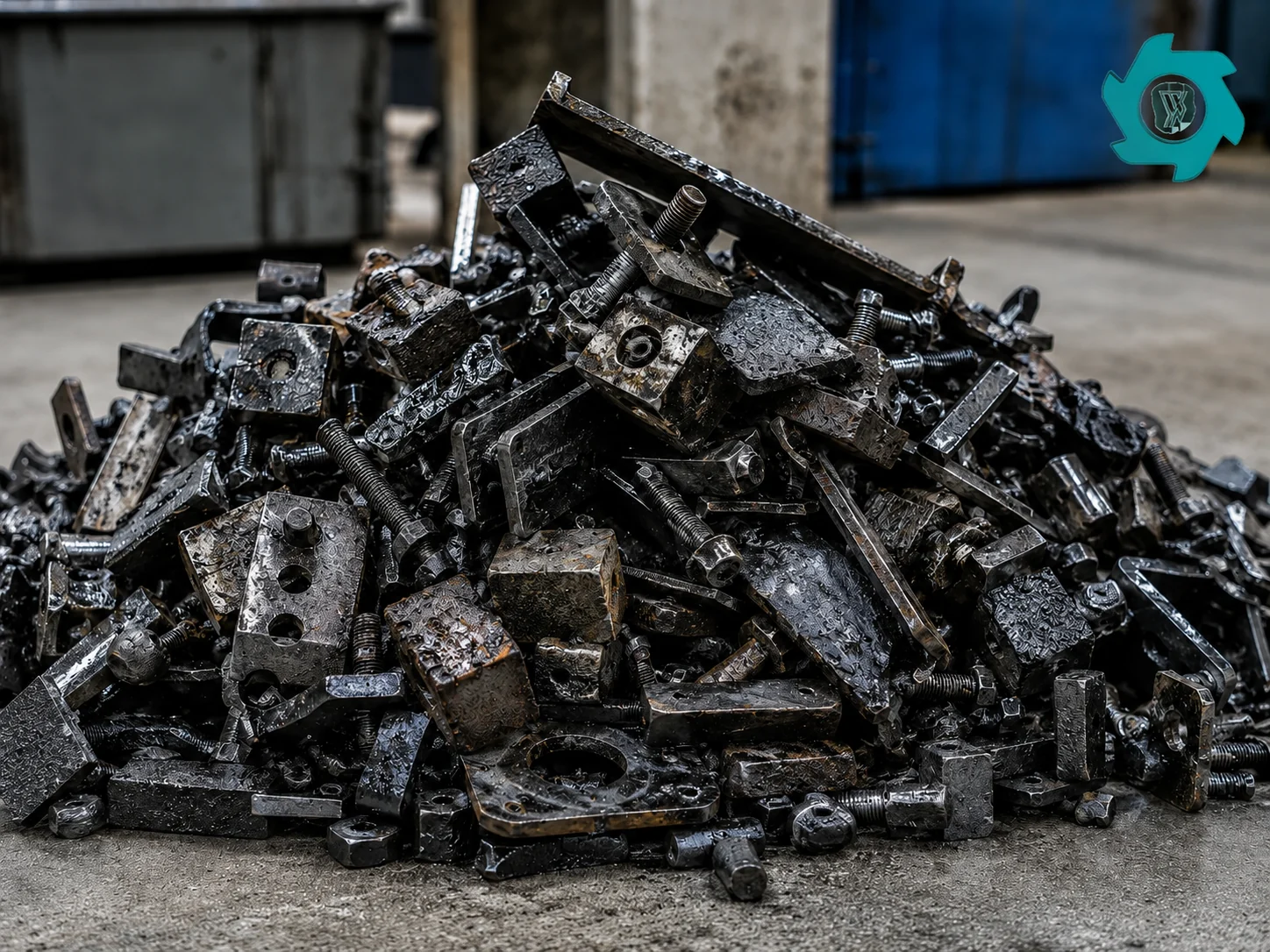
Steel around an industrial radiator is often discussed as if the magnet solves it. The magnet only solves the ferrous-separation problem after the steel has been released into a form the magnetic stage can capture. It does not decide whether the original frame is acceptable to the shredder. Thin support strips, clips and normal radiator framing may be reasonable feed for a properly configured primary shredder. Heavy structural members are different. A thick crossmember can dominate the first cut, trigger repeated reversals or force the operator to stop and reposition the load. That is why we separate two questions during feed review:
Is this steel object mechanically acceptable at the front end?
Once liberated, can the ferrous section remove it cleanly enough for downstream processing?
The first question is about chamber size, cutter geometry, shaft loading, feed presentation and protection logic. The second is about liberation, magnet position, burden depth and the amount of ferrous material entering at one time. A general radiator shredder machine comparison can help when the front-end machine type is still open, but industrial feed should still be tested as its own duty. Liberated brackets, bolts and frame pieces can leave as a ferrous fraction. Heavy structural steel still needs an upstream acceptance rule.
Steel percentage alone can hide the real problem
A batch with more steel spread across thin frames can sometimes behave more smoothly than one with less steel concentrated in a few heavy structural pieces. Average composition does not describe shock loading. The same is true for magnetic separation: a steady ferrous stream is easier to manage than sudden slugs of thick steel pieces.
Continuous operation starts with stable feeding, not maximum motor power
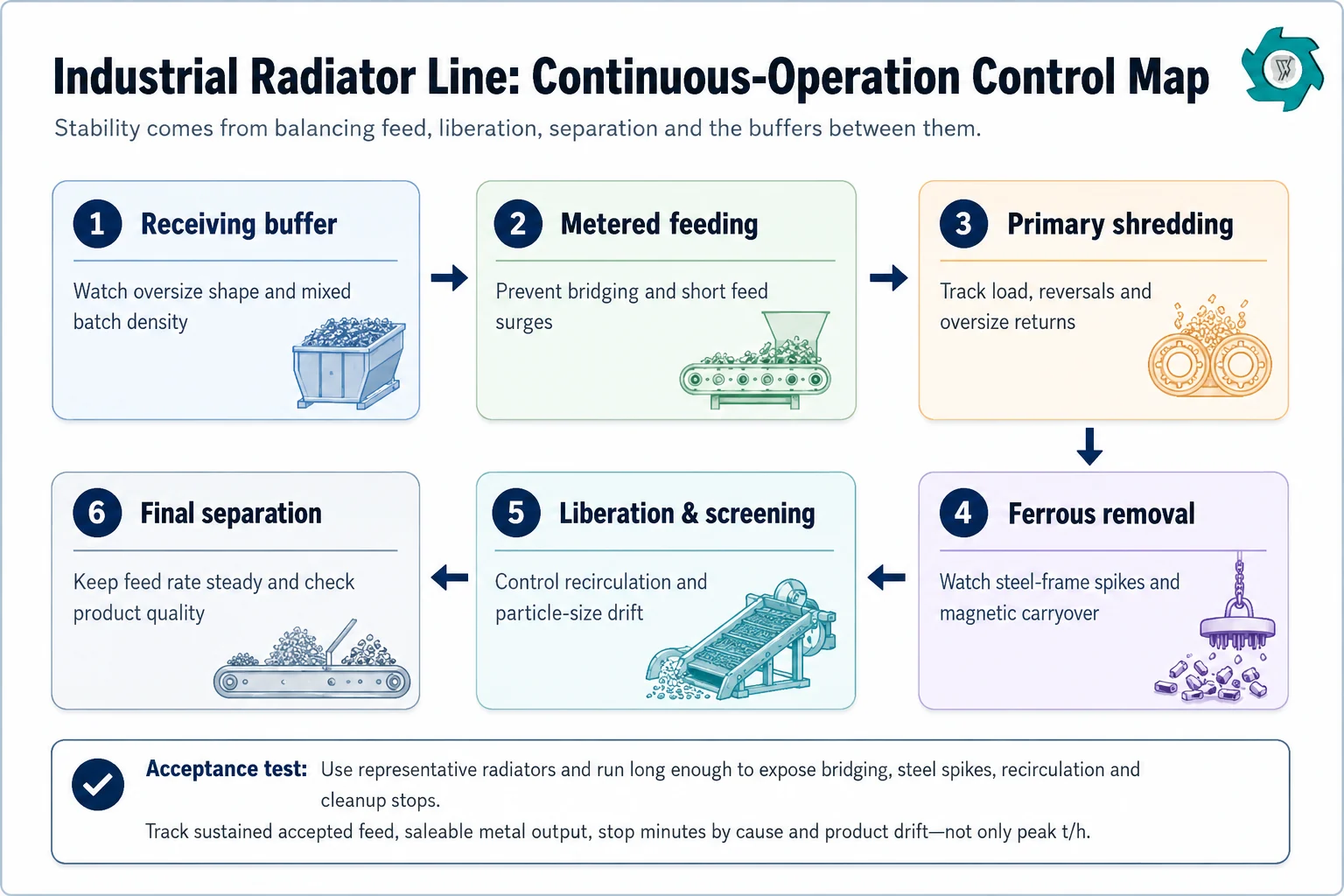
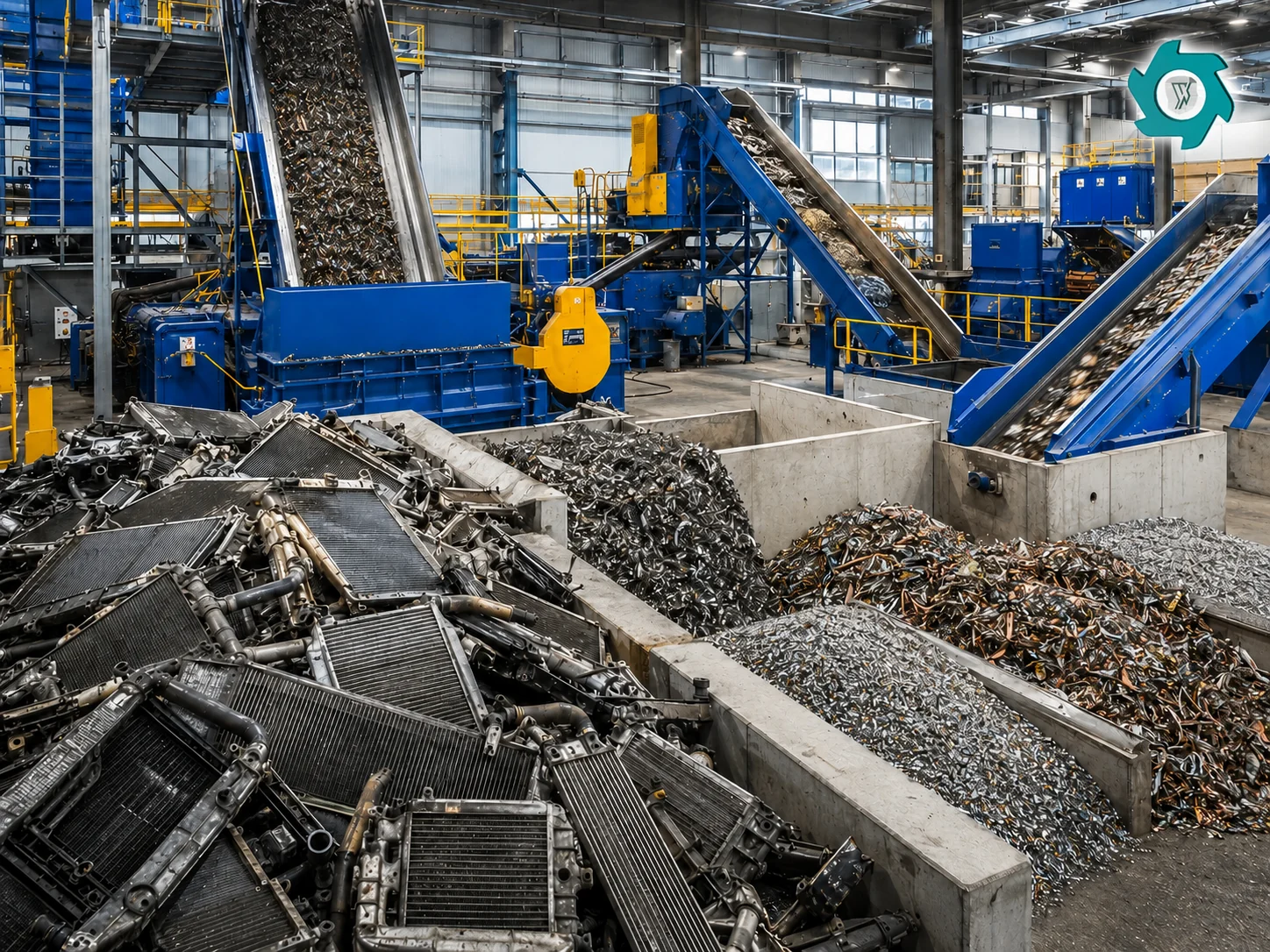
On a complete copper-aluminum radiator recycling line, capacity is passed from one machine to the next. The shredder may have enough torque, yet the plant still stops because long radiators bridge on the infeed. Or the front end may run easily while a surge of steel and mixed fines overloads the next separation stage. A line can also look productive for ten minutes, then spend the next twenty clearing a hopper or recirculating unliberated material. That is why “continuous operation” should be treated as a line-control problem. Feed buffering, metering, interlocks and access for short planned cleanups are just as important as the main crusher nameplate. Stable throughput depends on the slowest stage and the buffers around it. A sustained test exposes problems that a short peak-capacity run misses.
1. Keep a receiving buffer without creating a mixed-scrap surprise
A buffer helps the loader maintain feed while trucks unload or operators inspect the next batch. But the buffer should not become a place where several very different radiator types are blended without control. If one pile contains compact generator cores and the next contains tall cooling packages with heavy guards, the process settings may need to change.
2. Meter the infeed so the shredder can take a repeatable bite
Industrial radiators are often bulky enough that volumetric surges matter more than their weight suggests. Feeding two large cooling packs together can fill the chamber even when the hourly tonnage is still below target. A controllable conveyor or loader routine should create space between awkward units instead of chasing a visually “full” belt.
3. Use load and reversal data as a feed diagnostic
Automatic reverse is useful protection, but frequent reversals are also information. If the reversal count rises sharply on one supplier’s material, check frame thickness, unit orientation and hidden attachments before simply changing the PLC limits. Reversal frequency is often a better early warning than average motor current alone.
4. Watch ferrous removal as a process signal
A sudden increase in the magnetic fraction means more than “we recovered more steel.” It may show that the incoming mix changed, a batch contains heavier frames, or more ferrous material is being liberated early. That change can also affect the mass flow arriving at screening and final separation.
5. Control recirculation instead of letting it become a hidden second feed
Return flow is useful when copper and aluminum remain attached, but an uncontrolled recycle loop consumes capacity without appearing on the weighbridge. If a significant share of the stream circles back, the secondary crusher is effectively processing more material than the gross incoming tonnage suggests. Track the return rate. When it rises, ask whether the cause is feed construction, worn parts, screen condition or a separator setting—not simply whether the motor can handle it.
6. Protect final separation from feed-rate swings
Air and gravity separation work best when particle-size distribution and feed rate stay reasonably stable. Large surges can change bed depth and aerodynamic behavior; long starvation periods create another operating condition entirely. The goal is not perfectly constant feed, but a range narrow enough that operators are not retuning the separator every few minutes. A complete line needs coordinated feeding, size reduction, ferrous removal, recirculation control and final separation. One fast machine does not guarantee high shift output.
Measure sustained throughput, not the best five minutes
A factory test that starts every motor and processes a few easy radiators proves very little about industrial duty. Representative material should include the awkward normal pieces, not only trimmed cores. The run also needs enough time for recirculation, magnetic load, dust accumulation and routine operator intervention to appear.
Sustained accepted feedGross material that actually enters the line over the measured run, excluding rejected special pieces.
Saleable non-ferrous outputCopper-rich, aluminum-rich or agreed concentrate produced over the same period.
Stop minutes by causeSeparate bridging, overload, cleanup, magnet/ferrous issues, downstream blockage and maintenance.
Recirculation rateMaterial returned for additional liberation as a share of main process flow.
Ferrous fraction trendUseful for spotting frame-heavy batches and changes in incoming construction.
Product-quality driftCheck whether copper, aluminum and light fractions stay consistent as the run continues.
For mixed radiator businesses, we also like to separate gross feed from recoverable non-ferrous yield. Moving more steel frame through the line can raise gross tonnes per hour while adding little to the copper-aluminum product. That issue is discussed from the feed-grade side in the clean vs dirty ACR scrap guide. Industrial projects add a second layer: the attachment can be not only “dirty,” but mechanically heavy.
Build planned maintenance into the continuous-operation target
Continuous operation should not mean “never stop the line.” A plant that refuses short planned checks can trade ten minutes of inspection for a much longer unplanned stop later. Industrial radiator scrap brings bent metal, abrasive dirt, steel attachments and occasional foreign objects; the front end needs easy access for inspection and wear checks. Maintenance planning should include safe access to cutters and screens, magnet and conveyor inspection, removal of wrapped or bridged material, dust-system checks and a clear lockout procedure. OSHA machine-guarding guidance emphasizes guarding danger areas and preventing access to moving hazards. Clearing conveyor debris with equipment energized is not an acceptable shortcut.
Drain fluids and keep fine aluminum dust in the safety discussion
Industrial cooling units can retain coolant, oil or other service fluids. Free liquid should be drained and managed separately before mechanical processing. U.S. EPA guidance for used antifreeze warns against pouring it on the ground or into sewers and notes that used coolant can contain contaminants picked up during service. Dust control matters as well. Radiator fins and surface deposits can create fines during crushing, and finely divided aluminum is combustible. NIOSH notes that finely divided aluminum dust is easily ignited and may cause explosions. The practical implication is not “add one generic dust collector.” Dust capture, housekeeping, ignition-source control and the complete dust-hazard strategy need to be reviewed as part of the plant design.
When this radiator route is the wrong route
Not every industrial heat exchanger belongs in a radiator recycling line. Shell-and-tube exchangers with thick steel shells, heavy pressure vessels, very large cast headers or unrelated structural assemblies may need dismantling, torch or shear preparation, or a different scrap-metal process before copper recovery. The same is true for complete cooling packages that still contain fans, motors, pumps or sealed components. The front-end rule is simple: if the recoverable radiator core is only one part of a much heavier machine assembly, separate the assembly problem from the core-recycling problem. Doing that early usually produces a clearer quotation and a safer material test.
Industrial radiator RFQ: what to send before machine selection
A short but specific material pack is more useful than a long equipment wish list. For an industrial radiator project, include:
photos of the normal feed and the worst normal pieces;
maximum length, width and depth, including guards and pipe projections;
typical and maximum approximate unit weight;
frame construction and the thickest steel members expected;
whether fans, shrouds, motors, hoses or other assemblies remain attached;
whether coolant, oil or free liquid has already been drained;
estimated mix of copper-aluminum, all-aluminum and other heat exchangers;
required sustained hourly output and planned hours per shift;
target product: separated copper/aluminum, concentrate, ferrous fraction and reject expectations;
available floor area, loader/forklift method, power supply and existing downstream equipment.
Configure the Line Around Your Industrial Radiator Feed
Send YUXI photos, maximum radiator dimensions, steel-frame details, expected shift throughput and the products you want to recover. We can review whether the normal feed should go directly to the line or needs a separate oversize preparation step.
FAQ
Can a radiator recycling line process complete industrial radiators?
Sometimes. Complete units can be suitable when their dimensions, frame construction, attached components and weight fall inside the agreed feed envelope. Very heavy frames, guards, fan assemblies, sealed components or structural steel may need removal first.
Should steel frames be removed before shredding?
Not every steel attachment needs manual removal. Thin frames, clips and brackets may be liberated during primary size reduction and removed magnetically. Heavy crossmembers, thick support structures and unrelated structural steel should be evaluated separately.
What makes an industrial radiator oversize for recycling?
Oversize is mainly a geometry and handling problem. Maximum length, width, thickness, protruding pipes, rigidity, diagonal entry and the way a radiator sits on the conveyor all matter. A unit can fit the nominal opening and still bridge or feed poorly.
How should continuous radiator recycling capacity be measured?
Use sustained accepted feed over a representative run, then track saleable metal output, stop minutes by cause, recirculation, ferrous load and product-quality drift. A short peak throughput figure can hide interruptions.
Why can steel-rich radiator batches reduce uptime?
Steel-rich batches can raise primary cutting load, increase reversal frequency, overload the ferrous-removal stage and change the mass flow reaching later separators. The main issue is often variability rather than steel alone.
What should I send for an industrial radiator recycling quotation?
Send photos of normal and worst-case radiators, maximum dimensions, approximate unit weight, frame and guard construction, fluid condition, expected mix, required sustained throughput, shift length, target products and available site space.
David focuses on industrial shredding and recycling equipment,including material evaluation,shredder selection,process configuration,and recycling line planning.
Speak To Our Shredder Machine Expert
Get in touch with our nice team today to get a price estimate for a shredder machine.

 English



 Fast Delivery
 Reliable
 Certified
 Experienced