A rooftop condenser, an AHU evaporator coil and a shell-and-tube chiller exchanger may all arrive under the label “HVAC coil scrap.” Mechanically, however, they are very different feeds. The recycling route should be chosen from the construction of the heat exchanger, not from the equipment name printed on the job sheet.
In practice: copper-tube/aluminum-fin coils are the most natural fit for copper-aluminum liberation. All-aluminum microchannel coils should normally be kept separate. Large chiller shells need dismantling before they are treated like radiator feed. Refrigerant recovery and pressure safety come before any shredding or crushing decision.
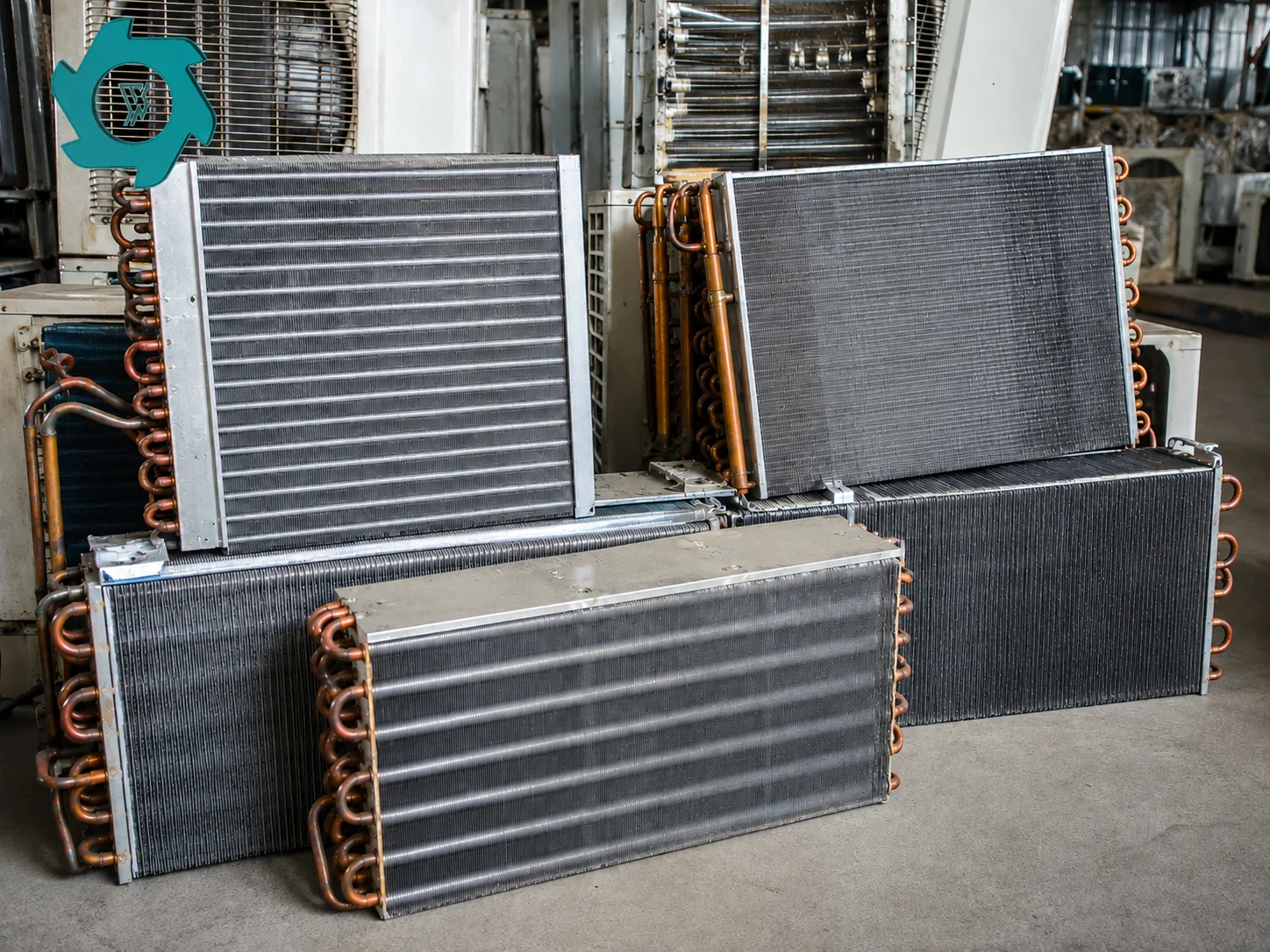
This is the point that matters most for commercial HVAC recyclers. A mixed load can contain excellent copper-aluminum material, but it can also contain galvanized frames, steel shells, fan motors, plastic drain pans, distributors, coated fins, oil residue and completely different heat-exchanger designs. If they are all fed as one “radiator” grade, the first problem is usually not whether the crusher can break them. The problem is whether the output still has a clean, saleable separation path.Commercial condenser and evaporator coils often look similar from a distance, but frame content, tube layout, residue and metal construction can change the recycling route.
Start with the coil construction, not the HVAC label
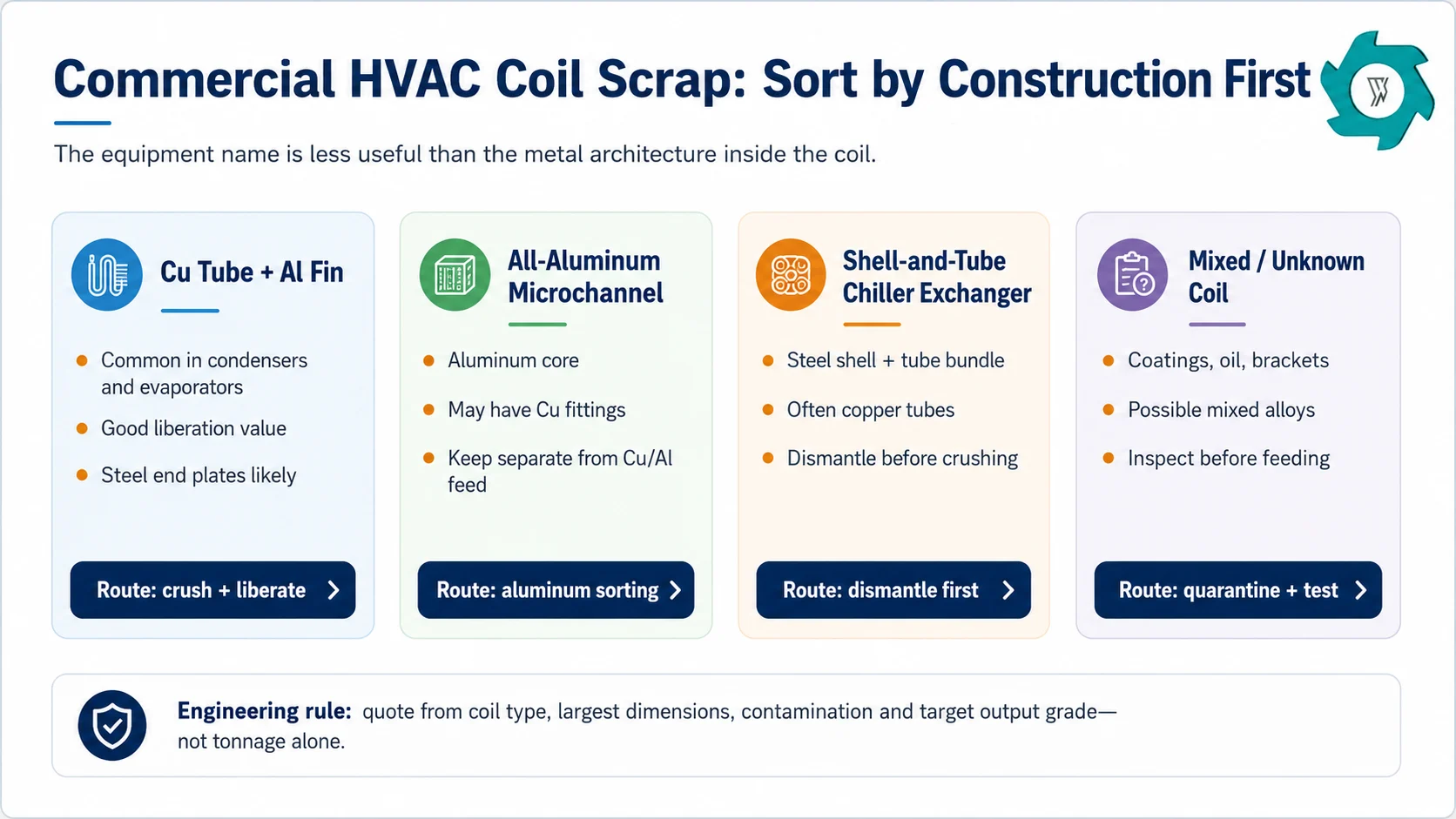
Commercial HVAC equipment uses several heat-exchanger architectures. Some are ideal copper-aluminum feed. Others are mostly aluminum, or are pressure-vessel assemblies that should be dismantled first. That distinction prevents one of the more expensive sorting mistakes in this material stream: mixing high-copper fin-and-tube coils with feed that has little or no copper in the core.
HVAC scrap type
Common construction
What changes the recycling route
Practical handling
Air-cooled condenser coil
Often copper tubes with aluminum fins; some newer designs are all-aluminum microchannel
Steel end plates, fan shrouds, microchannel construction, protective coatings
Sort by core construction before size reduction
Evaporator / DX coil
Copper tubes and aluminum fins are common; distributors and headers add copper and brass pieces
Oil residue, drain-pan parts, insulation, steel casing and distributor geometry
Remove bulky non-core attachments and control residue
Chilled-water / hot-water coil
Often fin-and-tube construction
Water-side scale, corrosion, glycol residue, heavy frames and header size
Evaluate contamination and largest header pieces before crushing
Air-cooled chiller condenser
May use fin-and-tube or aluminum microchannel coils
The condenser architecture may differ from the evaporator in the same machine
Separate coil banks from compressor, fans and chassis first
Water-cooled chiller evaporator / condenser
Shell-and-tube designs commonly combine a carbon-steel shell with copper tube bundles
Pressure-vessel shell, water boxes, tube sheets, refrigerant/oil history
Dismantle into shell, heads and tube bundle before fine metal recovery
A construction-first sort keeps copper-rich fin-and-tube coils, all-aluminum microchannel cores and shell-and-tube chiller exchangers from being treated as one feed.
Refrigerant recovery has to happen before mechanical recycling
Commercial HVAC recycling is not the same as collecting a pile of already stripped copper-aluminum radiators. Condensers, evaporators and chillers may still be part of a refrigerant circuit when they are removed from a building. In the United States, EPA Section 608 rules prohibit intentional venting of regulated refrigerants during disposal, and equipment such as central air conditioners and chillers that is normally dismantled on site must have refrigerant recovered in accordance with the applicable servicing requirements before disposal.For a recycling plant, the useful operating rule is simple: the shredding line should receive a mechanically safe, depressurized material stream with refrigerant recovery already addressed. Do not use the shredder as a way to “open” an unidentified sealed circuit. Also separate compressors, receivers and other closed pressure components from the coil feed unless the project has a specific, reviewed pretreatment route for them.
U.S. compliance note: refrigerant handling requirements depend on the appliance and activity. EPA guidance should be checked for the current rule, equipment and recordkeeping obligations. A scrap processor should not assume that a sticker alone proves compliant recovery.
Condenser coil recycling: watch the frame and the core
Commercial condenser coils can be attractive feed because large rooftop and packaged units often contain substantial heat-transfer surface. Yet they also arrive with some of the worst “extra hardware” in the HVAC coil stream: galvanized end plates, fan guards, sheet-metal frames, brackets, motors, sensor wiring and sometimes complete fan sections.We have found that the first sorting decision is usually visual. If the core is conventional copper tube with aluminum fins, the goal is to remove enough ferrous and bulky contamination for the crushing and liberation stages to work consistently. If the core is all-aluminum microchannel, mixing it into a copper-aluminum stream can reduce the copper concentration of the final heavy fraction and complicate the buyer’s grade.That does not mean every steel side plate must be removed by hand before a complete line. A magnetic stage can remove ferrous material after size reduction. The trade-off is wear and unnecessary mass through the crusher. If the steel frames are thick, easy to cut off and represent a meaningful share of the weight, simple dismantling can be cheaper than asking every downstream machine to process them.
Evaporator coil recycling: contamination is often the real issue
Evaporator and DX coils tend to bring a different set of problems. Their copper distributors and return bends can increase copper value, but the coil may also be connected to drain pans, insulation, filters, control parts and oil-bearing refrigerant circuits. On older or poorly stored coils, dirt and corrosion can be more important than the frame itself.A clean evaporator bank with copper tubes and aluminum fins is usually straightforward after it is safely removed from the system. A greasy coil packed with insulation scraps is not. Fine dirt, oil and degraded coatings can travel into dust collection and separation stages, where they affect airflow, screen performance and the apparent cleanliness of aluminum fines.Sometimes the correct answer is not more crushing. It is better incoming sorting. If one supplier regularly sends clean, cut coil cores and another sends complete AHU sections, treating them as two receiving grades makes line control easier and gives purchasing staff a clearer basis for price.
Chiller coil recycling needs its own decision path
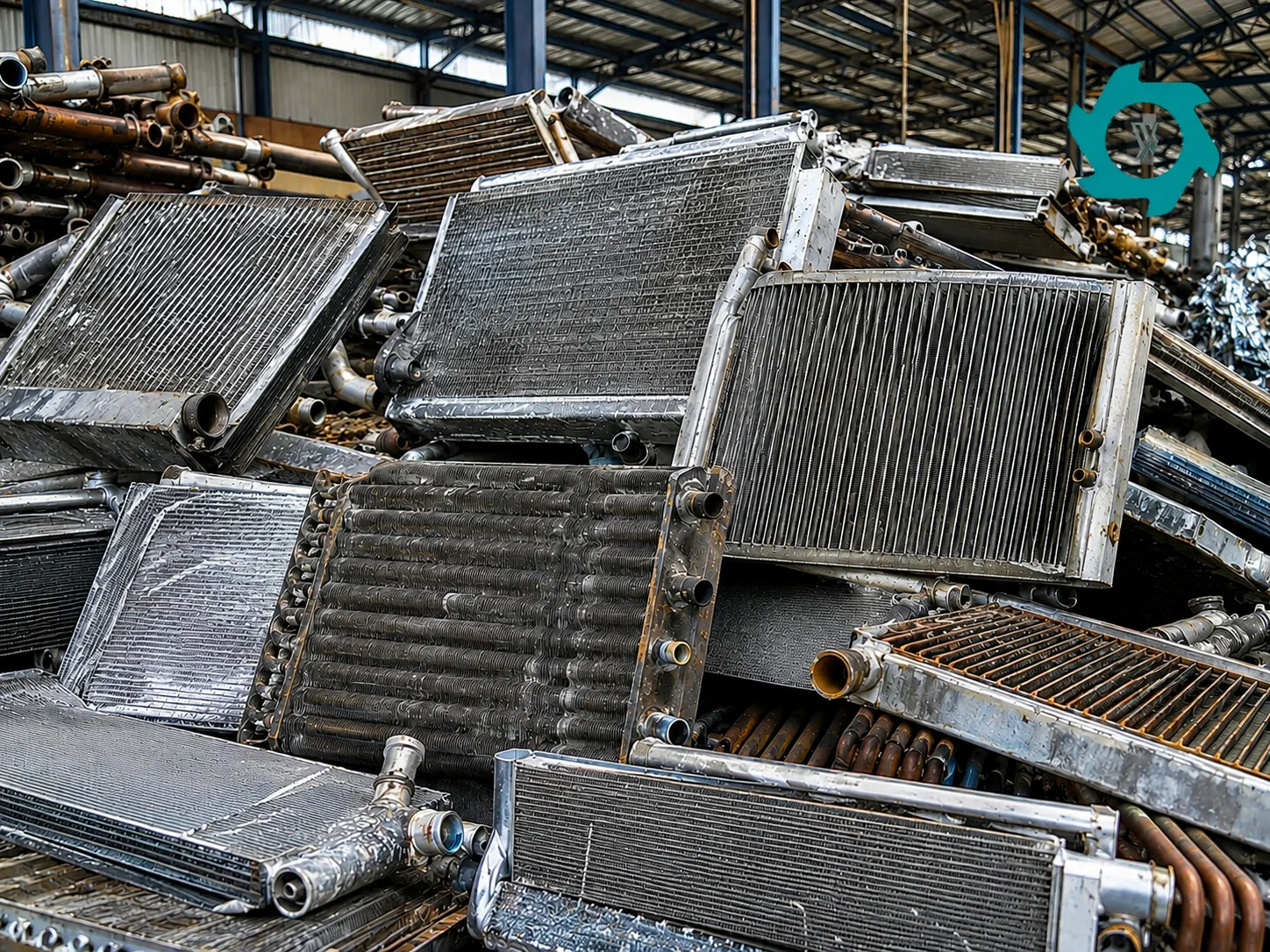
With chillers, “coil” does not always mean a finned coil. On an air-cooled chiller, the condenser may look much like a large HVAC coil, but the evaporator can be a shell-and-tube heat exchanger. Water-cooled chillers often use shell-and-tube units on both sides. That usually means a heavy steel shell around a copper tube bundle. You can see this kind of construction in some Carrier water-cooled chillers and Trane process chiller designs.A complete shell-and-tube exchanger is not a normal radiator feed. It is heavy, rigid and designed as a pressure vessel. The steel shell, heads, tube sheets and internal copper bundle should be evaluated as a dismantling job first. Depending on the design, the value may be in recovering the copper tubes cleanly rather than reducing the entire assembly through a radiator crusher.Mixed heat-exchanger scrap should be sorted by actual construction. Similar-looking units can contain different combinations of copper, aluminum, steel and other attachments.
Where a complete copper-aluminum recycling line makes sense
For facilities receiving a steady volume of copper-tube/aluminum-fin commercial coils, a complete copper aluminum radiator recycling line becomes useful when manual stripping no longer matches the feed shape, labor cost or required throughput. The line can combine primary size reduction, ferrous removal, controlled crushing and secondary separation so that copper and aluminum are recovered as cleaner fractions instead of being sold as a mixed core.The key is to keep the line’s job narrow enough. It should not become the default destination for every object removed from an HVAC plant room. Compressors, sealed vessels, motors, massive steel bases and shell-and-tube bodies usually need other handling. The more disciplined the receiving sort, the more stable the radiator line becomes.When bulky coil banks need a rough opening step before the crusher, a double shaft shredder for metal recycling can be used as the front end in a correctly matched line. Its role is pre-shredding and material opening. It does not replace the finer liberation stage needed to release copper tubes from aluminum fins.
How we would route four common HVAC coil loads
Clean rooftop condenser cores. Confirm copper-tube/aluminum-fin construction, remove easy heavy frames and fan hardware, then feed a controlled size-reduction and liberation route. This is the simplest commercial HVAC coil case.
Mixed AHU evaporator coils. Separate drain pans, filters, insulation and large casing pieces. Check for oil and wet debris. If the cores are consistent, they can then join the copper-aluminum stream.
Air-cooled chiller coil banks. Dismantle the chiller into coil banks, compressors, fans, steel structure and controls. Then identify whether the condenser banks are fin-and-tube or all-aluminum microchannel before deciding the metal route.
Water-cooled chiller exchangers. Treat shell-and-tube evaporators and condensers as dismantling feed first. Recover the tube bundle, shell and heads as separate material classes before deciding whether any fraction needs additional crushing.
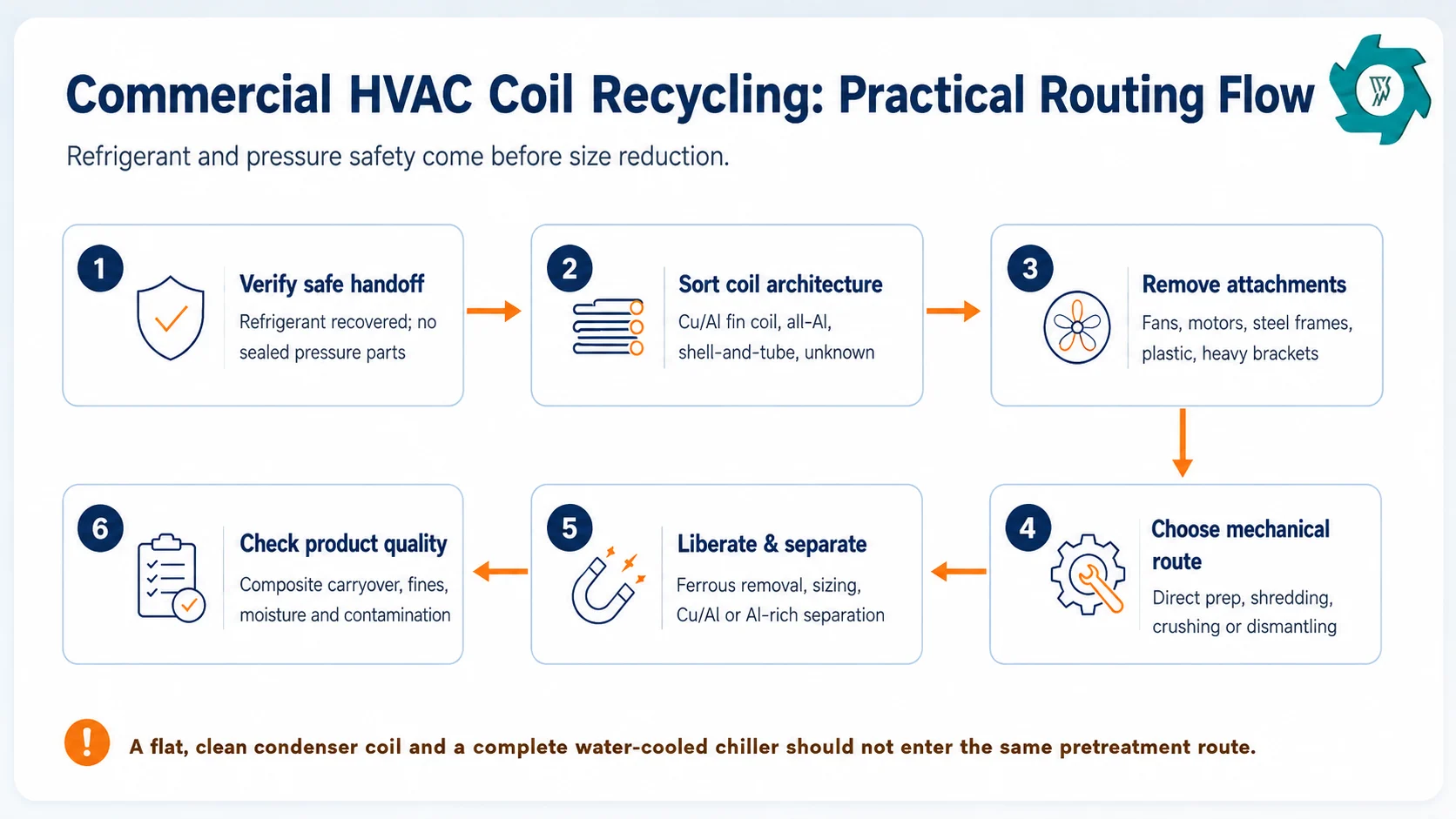
The process should move from safe handoff and construction sorting to attachment removal, mechanical routing, liberation and final quality control.
Feed preparation changes both capacity and metal quality
Commercial HVAC coils are light for their volume. A line quoted only in tons per hour can therefore look oversized or undersized once the real coil dimensions are seen. A 1.5-meter-long coil bank can bridge at the hopper even when its weight is modest. Thin fins can also create a large volume of light material after crushing, which changes conveyor loading, dust extraction and air separation behavior.
Feed question
Why it matters
What percentage is conventional copper-tube/aluminum-fin coil?
Defines how much of the feed actually needs Cu/Al liberation.
Are all-aluminum microchannel coils mixed in?
They can dilute a copper-rich product and may be better sold or processed as an aluminum stream.
What is the longest and tallest coil bank?
Determines hopper opening, feeding method and whether pre-cutting is necessary.
How much steel frame remains?
Affects wear, magnetic load and whether manual dismantling saves operating cost.
Is oil, glycol, water or loose dirt present?
Changes housekeeping, dust collection and product cleanliness.
Are shell-and-tube exchangers included?
They need a separate dismantling decision rather than automatic radiator-line feeding.
Do not chase purity by making everything smaller
More crushing can improve liberation up to a point. After that, it can simply create more fines. Thin aluminum fins are easy to fragment. Copper tubes, brazed joints and headers differ from one another. If the crusher produces a lot of light aluminum dust but copper-aluminum composites still remain, the trouble may be the crushing pattern or feed consistency rather than insufficient crushing power.In our experience, a useful plant trial looks at three things at the same time: composite carryover, fine generation and separator stability. Looking only at one sample of “clean copper” at the end of a short test can hide a poor mass balance. A better test runs a representative mix long enough to show whether the separator stays stable as different coil types pass through.
A practical buying framework for commercial HVAC coil projects
For this feed, equipment selection should be made backward from the receiving specification for the recovered fractions. If the buyer accepts a mixed copper-aluminum product, the plant may not need the same liberation intensity as a processor targeting separate copper-rich and aluminum-rich fractions. If clean all-aluminum microchannel coils already have a good local outlet, putting them through the copper-aluminum circuit may add cost without adding value.Before comparing machines, define the feed into at least three buckets: clean Cu/Al fin coils, dirty or assembled fin coils, and non-standard heat exchangers such as microchannel or shell-and-tube units. Then decide which bucket goes through which route. This simple step usually tells you more than comparing motor power across three quotations.
Information worth sending with an RFQ
Photos of each major coil type, including end views showing tubes and headers.
Largest coil dimensions and typical weight range.
Estimated percentage of steel frames, plastic, motors, insulation and other attachments.
Whether refrigerant has already been recovered and the circuit opened and depressurized before delivery.
Whether all-aluminum microchannel coils and shell-and-tube chiller exchangers are included.
Expected sustained throughput and daily operating hours.
Target copper-rich, aluminum-rich, ferrous and non-metal output requirements.
A representative feed sample for testing if the stream is highly mixed.
Need a Route for Commercial HVAC Coil Scrap?
Send YUXI photos of your condenser, evaporator and chiller coil feed, plus the largest dimensions, contamination level and target output. We can review which material belongs in a copper-aluminum liberation line and which should be dismantled or sorted separately.
Commercial HVAC Coil Recycling FAQ
Can commercial HVAC coils go directly into a radiator recycling line?
Some copper-tube aluminum-fin coils can, after refrigerant recovery and removal of unsuitable attachments. Large shell-and-tube chiller exchangers, sealed pressure parts, all-aluminum microchannel coils and heavily contaminated assemblies should be evaluated separately before feeding.
Are condenser and evaporator coils the same scrap grade?
Not necessarily. Both may use copper tubes and aluminum fins, but steel frames, distributors, coatings, oil residue, plastic, tube diameter and all-aluminum microchannel construction can change the commercial grade and the best recycling route.
How should chiller coils be recycled?
First identify the chiller heat exchanger design. Air-cooled chillers may use finned condenser coils, while water-cooled chillers can contain shell-and-tube evaporators and condensers with steel shells and copper tube bundles. Shell-and-tube units normally need controlled dismantling before metal size reduction.
What information is needed to size an HVAC coil recycling line?
Provide representative coil photos, coil type, largest dimensions, weight range, steel and plastic attachments, oil or coating condition, expected tons per hour, daily operating hours and the required copper-rich and aluminum-rich output quality.
David focuses on industrial shredding and recycling equipment,including material evaluation,shredder selection,process configuration,and recycling line planning.
Speak To Our Shredder Machine Expert
Get in touch with our nice team today to get a price estimate for a shredder machine.

 English



 Fast Delivery
 Reliable
 Certified
 Experienced