Two loads can both be sold as aluminum-copper radiator scrap and still behave very differently in a recycling plant. One may be trimmed HVAC coil with little more than aluminum fins around copper tubing. The next may arrive with steel end plates, plastic pieces, rubber, brass fittings, dust and a few sections that still contain liquid. Calling both loads “ACR” hides the part that matters most to the process: what is attached to the recoverable metal. That difference affects more than scrap-yard pricing. Feed grade changes the amount of manual preparation, the magnetic load, the quantity of light non-metal material, the amount of fines generated during crushing and, eventually, the quality of the copper-rich and aluminum-rich fractions. For a copper aluminum radiator recycling line, the clean-versus-dirty question is therefore an equipment and operating question, not just a trading term. “Clean” and “dirty” describe the amount of attached foreign material, but the exact buyer threshold can differ.
What buyers usually mean by clean ACR
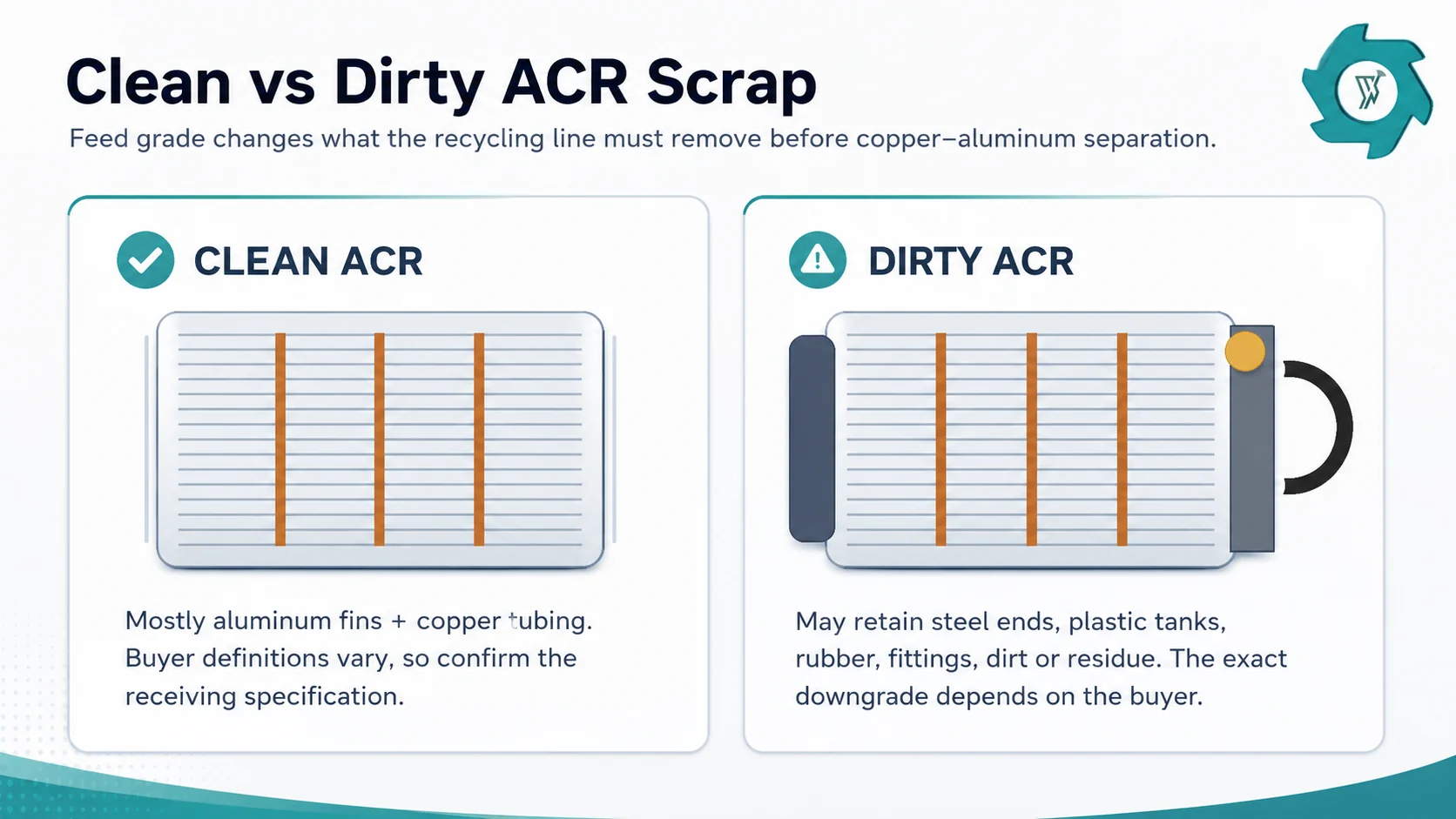
In normal scrap trading, clean ACR is a prepared copper-aluminum heat-exchanger fraction. The value is concentrated in the copper tubes and aluminum fins, so anything that adds weight without adding comparable non-ferrous value tends to reduce the grade. Mid City Scrap, for example, describes clean aluminum-copper radiators as material with the steel support brackets removed so that the remaining unit is essentially aluminum fins and copper tubing. Hostetter’s Salvage uses a broader radiator rule: steel and plastic should be removed, including plastic side tanks. Those examples point in the same direction, but they also show why a recycler should ask for the buyer’s exact receiving specification before setting up a cleaning station. We would not use “clean” as a synonym for chemically pure. A clean ACR bundle can still contain solder, surface oxidation, dust or normal manufacturing materials. The important question is whether the remaining material matches the grade the buyer intends to purchase.
What pushes ACR into a dirty grade?
Dirty ACR usually means the copper-aluminum core still carries material that the downstream buyer does not want in that grade. Steel end plates are the obvious example. Plastic tanks and guards are common on automotive radiators. Rubber hoses, foam, wiring, valves and fittings can also be present depending on where the scrap came from. The word “dirty” can also cover physical contamination rather than attached components. Old coils from demolition work may carry dust, mud, insulation or construction debris. Automotive radiators may contain oily residue. A batch stored outdoors can be wet. Those conditions do not all require the same response, which is why a simple clean/dirty label is not enough for equipment selection.
Contamination
What it changes
Typical process response
Steel ends, clips and brackets
Raises ferrous load and adds non-target weight
Manual removal where practical, then magnetic separation after size reduction
Plastic tanks and guards
Creates a larger light fraction and can increase dust
Pre-dismantling for bulky pieces or downstream non-metal separation
Rubber, foam and insulation
Can behave unpredictably in air or gravity sorting
Pre-sort obvious pieces and control particle-size range before final separation
Brass or mixed fittings
Adds another valuable but different metal fraction
Decide whether to recover separately or allow into a mixed heavy fraction
Dirt, oil and residue
Increases fines, housekeeping and contamination of outputs
Receiving inspection, cleaning where justified and stronger dust/maintenance planning
Free coolant or other liquid
Creates an environmental and handling issue before shredding
Drain and manage separately under applicable local requirements
Feed grade changes the line before the first cutter turns
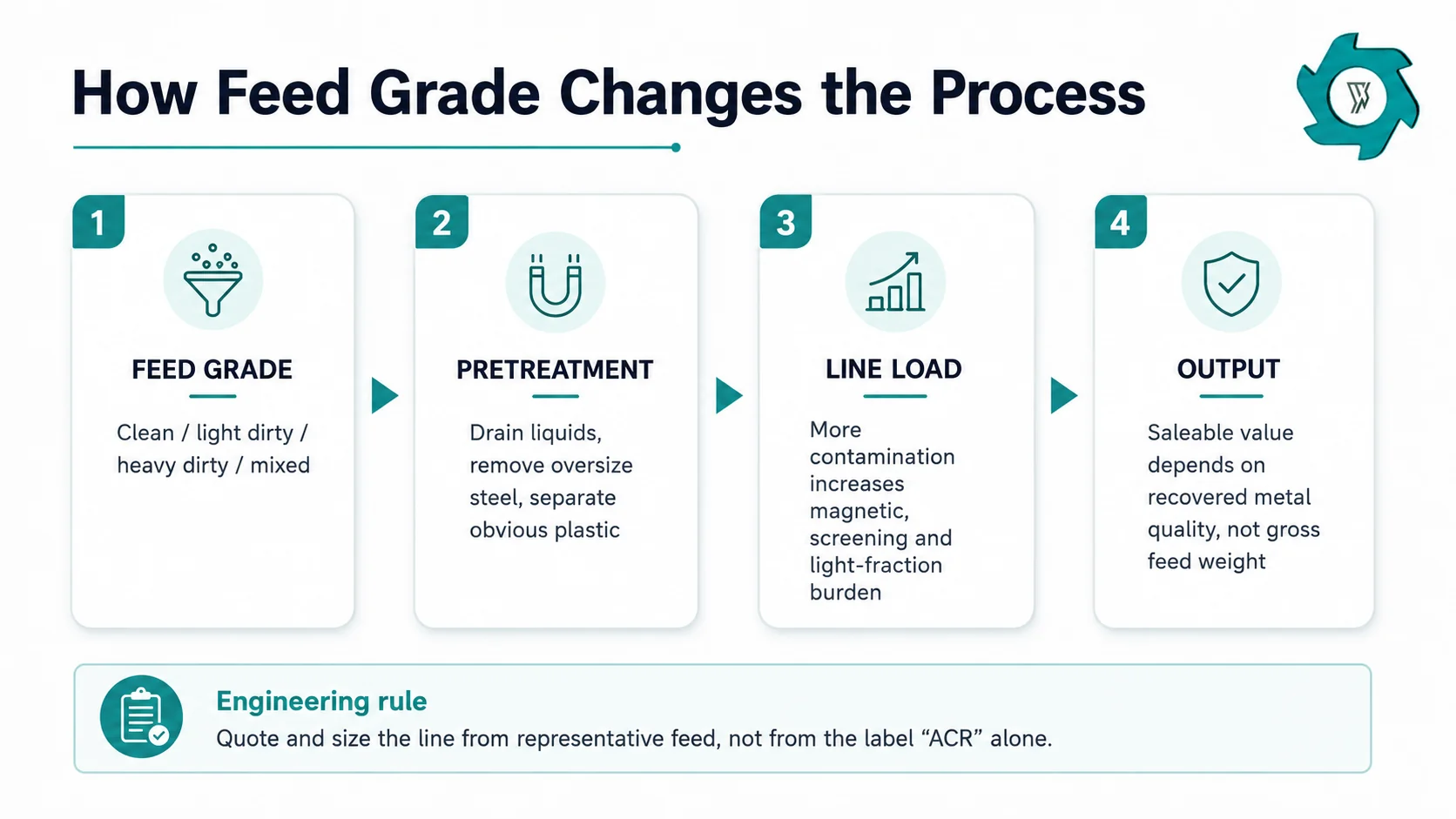
A common purchasing mistake is to assume the same machine can be quoted for “one ton per hour of ACR” regardless of feed condition. Weight alone says very little. A ton of trimmed coil packs and a ton of complete mixed radiators do not occupy the same volume, do not create the same shock load and do not send the same amount of foreign material into downstream separators. Clean, pre-cut coil can often go directly toward controlled size reduction and copper-aluminum liberation. Heavily dirty feed usually needs a more deliberate receiving step. That may mean draining liquid, cutting off very heavy steel assemblies, removing oversize plastic pieces or simply separating several obviously different radiator types before they are blended into a stable feed. Feed grade changes the amount of preparation and separation work required before saleable metal is produced. In practice, the best front-end preparation is not the one that removes every non-metal part by hand. It is the one that removes the pieces that are cheaper to remove before shredding than after shredding. A large plastic side tank is easy to identify while it is still attached. Once it is broken into dozens of fragments, the line has to handle each fragment as part of a much larger light-material stream.
Coolant is not just another “dirty” attachment
Free liquid deserves separate treatment because it is not simply a grade penalty. Used antifreeze can contain regulated constituents, and management requirements vary by jurisdiction. Massachusetts guidance, for example, says used antifreeze should be managed separately and identifies recycling as a preferred route. U.S. EPA guidance also warns against pouring used antifreeze onto the ground or into sewers and discusses keeping it separate from other wastes. For a radiator recycling plant, the practical point is straightforward: drain free coolant or oil before mechanical processing and route it into the appropriate collection system. Do not rely on the shredder, dust collector or separator to solve a liquid-waste problem. This is especially important with mixed automotive radiators, where a visually “dry” pile can still contain individual units with trapped fluid. DENSO’s current radiator information also shows why automotive feed should not be treated as one uniform metal object. Their listed constructions include plastic tanks combined with aluminum or copper cores. That is exactly the kind of mixed-material assembly that can move a load from a simple ACR preparation job to a full dismantling and separation problem.
How dirty feed changes each separation stage
Magnetic separation carries more of the workload
Steel brackets and end pieces are not a serious copper-aluminum separation problem once they are fully liberated and exposed to a properly positioned magnet. The difficulty is getting them to that condition. Long steel strips can stay attached to coil sections after a light first cut, while small clips may become mixed through the entire stream. Dirty ACR therefore increases both the mass and the variability presented to the magnetic stage.
Plastic and rubber increase the light fraction
Plastic is less forgiving because it does not disappear after magnetic separation. Once side tanks, guards or insulation are shredded, they become part of the particle-size distribution. Large pieces may be easy to screen or separate; very small pieces can follow metal fines and make final product cleaning more difficult. This is one reason a dirty feed with high plastic content may justify more careful screening and airflow control than a clean coil feed.
Secondary crushing should be driven by liberation, not by dirt
More contamination does not automatically mean the answer is finer crushing. If copper tubes are still locked inside aluminum fin packs, another liberation stage can help. If copper and aluminum are already free but the stream contains too much plastic dust, additional crushing can make the problem worse. The operator needs to distinguish “still attached metal” from “already liberated but contaminated material.” Where whole or deformed radiators need a robust first reduction stage, a double-shaft shredder used for metal recycling can serve as the front end before magnetic and downstream separation. It should still be selected from the actual radiator geometry and attachments rather than from the word “metal” alone.
Gross tons per hour can hide the real recovery problem
Dirty material can make a throughput number look better than the economics. If a line is measured only by gross feed weight, steel, plastic, rubber, retained liquid and dirt all count toward tons per hour even though they are not the copper-aluminum product the recycler is trying to sell. A more useful plant metric is to track three numbers separately: gross feed, recovered saleable non-ferrous metal and reject/secondary fractions. That simple mass balance makes it easier to see whether a higher gross rate is actually producing more value or merely moving more contamination through the plant.
Useful recovery view: Saleable non-ferrous output ÷ gross incoming feed, tracked together with copper-rich, aluminum-rich, ferrous and light/reject fractions.
We normally prefer a short controlled production test using representative feed to a single catalogue capacity figure. The test should include the normal dirty pieces, not only the easiest trimmed samples. Otherwise the quotation may be technically correct for a feed that rarely appears in day-to-day production.
When is manual cleaning worth doing?
There is no automatic answer. Cleaning ACR by hand can improve the selling grade, but it also adds labor, handling and sometimes metal loss. The decision should compare the value gained from the better grade with the cost of the preparation step. We have found that the easiest manual removals are often the first ones to justify themselves: large steel end plates, obvious plastic side tanks, heavy brackets and separate brass fittings. Chasing every small clip or fragment can become expensive, particularly at higher volumes. At that point, it may be more economical to let the recycling line remove the remaining contamination mechanically. A useful break-even calculation is:
Extra value from cleaning = (clean-grade price × clean sale weight) − (dirty-grade price × dirty sale weight) − labor − handling − disposal cost.
Do this with the buyer’s actual prices and actual yield. Do not assume that removing 10% of gross weight produces a 10% increase in payable metal; the removed fraction may include a mix of low-value material and recoverable fittings.
A simple receiving audit catches most grading mistakes
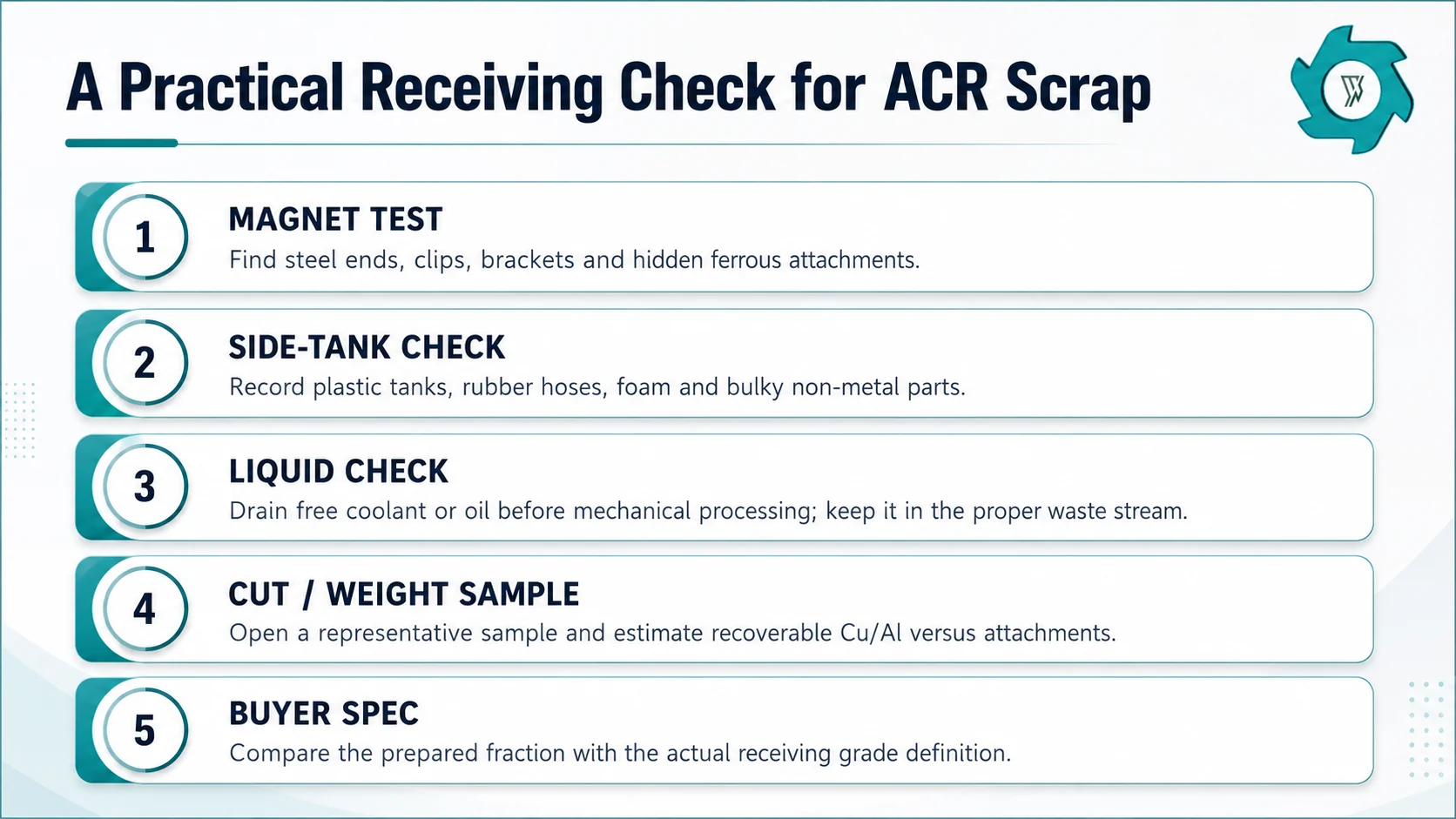
For a new supplier or a new type of radiator scrap, inspect a representative sample before agreeing on plant capacity or a purchase grade. A five-minute walk around the pile helps, but it is not enough. Open a few units. Use a magnet. Record what is actually attached. A receiving audit turns “dirty ACR” from a vague label into measurable feed information. The audit does not need laboratory equipment. A practical version can include the percentage of units with steel ends, percentage with plastic tanks, presence of rubber or wiring, any free liquid, unusually heavy fittings, maximum dimensions and a rough bulk-density observation. A magnet is still one of the most useful tools at receiving because it quickly exposes hidden ferrous attachments. For mixed lots, take photos of the normal material and the worst normal material. That second group matters. A project can run well on the average coil and still lose uptime because one in ten pieces carries a heavy frame or arrives in a shape that bridges the infeed.
Match process depth to the grade you actually receive
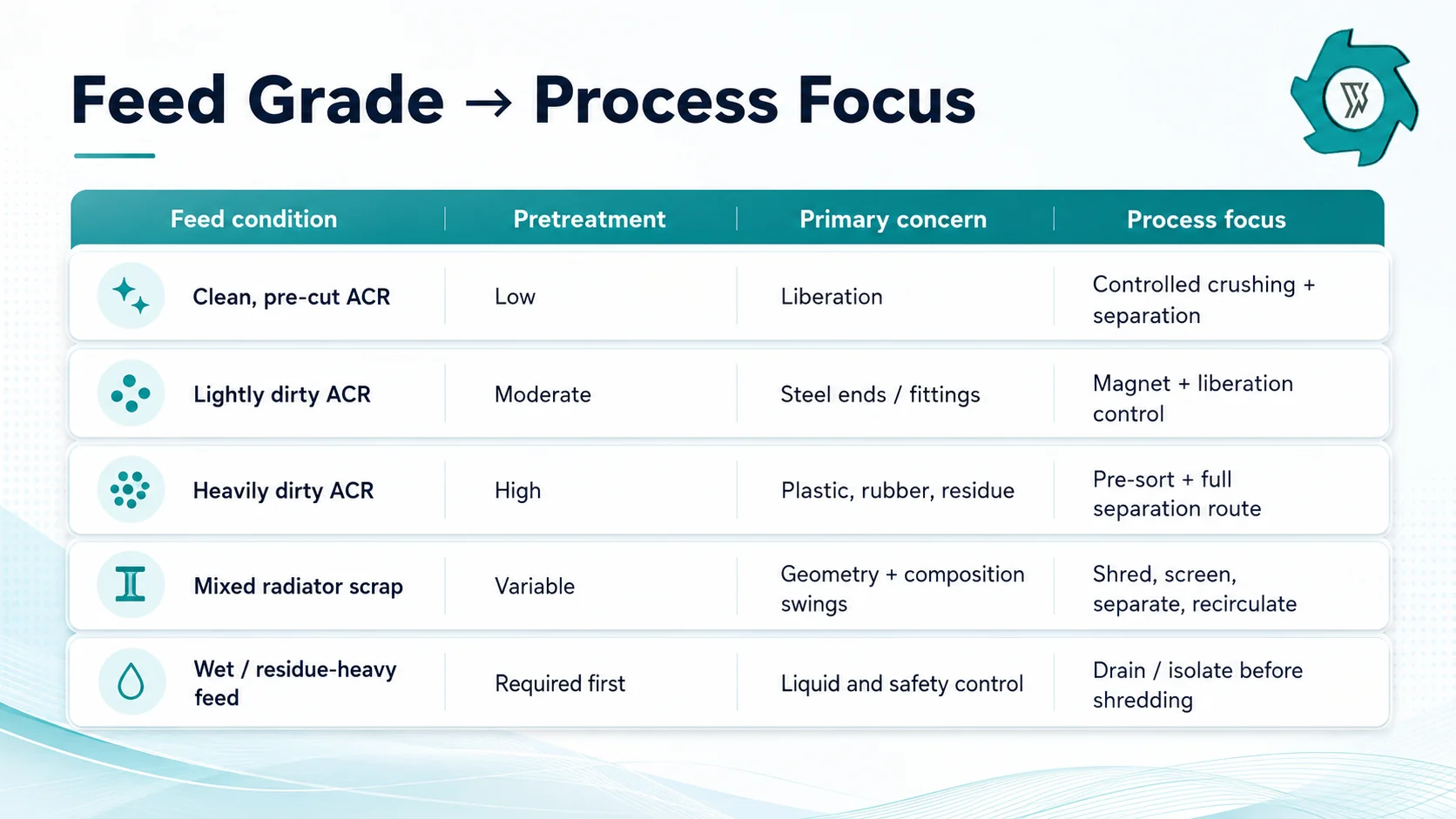
Clean coil feed does not need every stage of a mixed-radiator plant. At the same time, a plant that buys heavily dirty automotive or demolition scrap should not be designed as if every unit arrives trimmed. The process depth needs to follow the contamination load and the final product target. Process depth should rise with feed complexity, but wet or residue-heavy feed still requires separate preparation before shredding. For clean, pre-cut ACR, the main question is usually liberation: how to open the fin-and-tube structure without generating unnecessary fines. Lightly dirty material adds a ferrous-removal problem. Heavily dirty material brings plastic, rubber and residue into the picture. Mixed radiator scrap adds another variable—geometry. Whole car radiators, crushed coils and industrial heat exchangers can behave differently even if their average copper and aluminum percentages look similar on paper.
Four feed grades are more useful than a clean/dirty checkbox
For project discussions, we prefer to break ACR into a few practical feed classes rather than ask only “clean or dirty?” The names can be changed to match the buyer’s own system, but the engineering distinctions are useful.
Prepared clean ACR: mostly copper tubing and aluminum fins, with major steel and plastic parts removed.
Lightly dirty ACR: recognizably ACR but with steel ends, clips or a limited number of fittings still attached.
Mixed radiator scrap: several radiator or heat-exchanger types blended together, often with large swings in size and construction.
This four-level view helps a supplier decide where manual preparation ends and mechanical separation begins. It also improves capacity discussions. A required two tons per hour means more when the quotation states which feed class the number applies to.
What to send before requesting a radiator recycling line quotation
A useful RFQ should make the feed grade visible. Send photos of the pile, close-ups of typical attachments and a few images of the worst normal pieces. Then add maximum dimensions, approximate bulk density if available, expected mix of radiator types, free-liquid condition, required sustained throughput and the final product you plan to sell. If the buyer already has a clean/dirty acceptance sheet, include it. That document can be more valuable than a generic purity target because it tells the equipment supplier where the commercial boundary actually sits. The plant can then be configured around the material that must be removed, rather than around a theoretical definition of clean scrap.
The better question is not “clean or dirty?”
Clean ACR generally gives the line a simpler job: controlled liberation and copper-aluminum separation. Dirty ACR can still be a good feed, but its economics depend on the attachment mix. Steel can be removed magnetically after liberation. Large plastic may be cheaper to remove before shredding. Fines and residue can justify stronger screening, dust control and housekeeping. Free coolant belongs in a separate management stream before the metal-processing line starts. For a new project, do not ask the equipment supplier to guess what “dirty ACR” looks like. Send the material. A short representative feed audit is usually enough to identify the process stages that are genuinely needed and the ones that are not.
Need a Line Configuration for Your ACR Feed?
Send YUXI photos of your clean, dirty or mixed radiator scrap, the largest piece size, expected capacity and target recovered products. We can review the contamination load and suggest a practical preparation and separation route.
FAQ
What is clean ACR scrap?
Clean ACR generally means aluminum-copper radiator or coil material with the main foreign attachments removed. In many scrap-yard definitions, steel ends, brackets and plastic must be removed, but the exact receiving specification varies by buyer.
What makes ACR scrap dirty?
Steel ends, plastic tanks, rubber, fittings, wiring, dirt, oil or other residue can move ACR into a dirty or lower-value grade. Different buyers tolerate different attachments, so the commercial grade should be confirmed before processing.
Does dirty ACR need a different radiator recycling line?
Sometimes. Light contamination may only increase magnetic removal and hand sorting, while heavily mixed feed can justify primary shredding, stronger screening, non-ferrous sorting, secondary liberation and better dust or light-fraction control.
Should coolant be left in automotive radiators before shredding?
No. Free coolant or oil should be drained and managed in the appropriate waste or recycling stream before mechanical processing. Local environmental requirements differ, so the plant should follow the rules that apply at its location.
Is clean ACR always worth more than dirty ACR?
Clean material often receives a better unit price because the buyer receives less foreign material and performs less preparation. The real economic question is whether the added sale value exceeds the labor, handling and yield loss involved in cleaning the scrap.
How should a recycler evaluate a mixed ACR feed before requesting a quotation?
Use representative photos and samples, then record radiator type, largest piece size, steel and plastic attachments, free liquids, dirt or oil, estimated bulk density, required sustained capacity and the target product grade. A short receiving audit is more useful than the label ACR by itself.
David focuses on industrial shredding and recycling equipment,including material evaluation,shredder selection,process configuration,and recycling line planning.
Speak To Our Shredder Machine Expert
Get in touch with our nice team today to get a price estimate for a shredder machine.

 English



 Fast Delivery
 Reliable
 Certified
 Experienced