How to Reduce Aluminum Fines During Shredding & Crushing
A low fines number is useful only when the line still delivers the required liberation, recovery and accepted throughput. The practical goal is not “zero fines.” It is to stop breaking aluminum after the next process has what it needs.
Reduce aluminum fines by removing unnecessary reduction stages, stabilizing the feed, lowering avoidable impact intensity, shortening chamber residence time, opening the discharge constraint where the product allows it, and restoring worn cutters or hammers. Verify one change at a time with a mass-balanced trial.
The broader scrap aluminum recycling line can include primary shredding, secondary crushing, magnetic separation, screening and optional downstream sorting. Each extra transfer or breakage stage needs a reason. If coarse shredding already opens the attachments and creates a stable separator feed, further crushing may convert saleable metal into a difficult fine fraction.
This passage deliberately focuses on fines control. For the separate question of how particle size affects separation and wear, see the aluminum shredder output-size guide.
Define “fines” before changing a setting
Plants often use the word fines for three different things: material passing a specified sieve, light material pulled into dust extraction, and low-value residue collected under conveyors.
Write the definition into the test plan: the sieve opening, whether the sample is dried, the streams sampled, the sampling period, and the denominator.
Fines yield (%) = dry mass passing the agreed sieve ÷ dry mass of feed × 100
Also assay or hand-sort a representative fine sample. Five percent fines containing little aluminum is a different commercial problem from five percent fines rich in recoverable aluminum. Report total fines and aluminum lost to fines separately.
Metric
What it reveals
Common mistake
Fines/feed, dry mass %
How much sub-cutoff material the line creates
Mixing wet and dry batches
Aluminum lost to fines, % of dry feed
How much feed aluminum leaves through the sub-cutoff streams
Reporting aluminum concentration in fines without calculating total metal loss
Accepted t/h
Whether the new setting preserves useful production
Reporting gross feed rate
kWh/accepted tonne
Energy paid for saleable output
Using installed motor power
Oversize/return %
Whether fines were merely traded for recirculation
Leaving return flow outside the test boundary
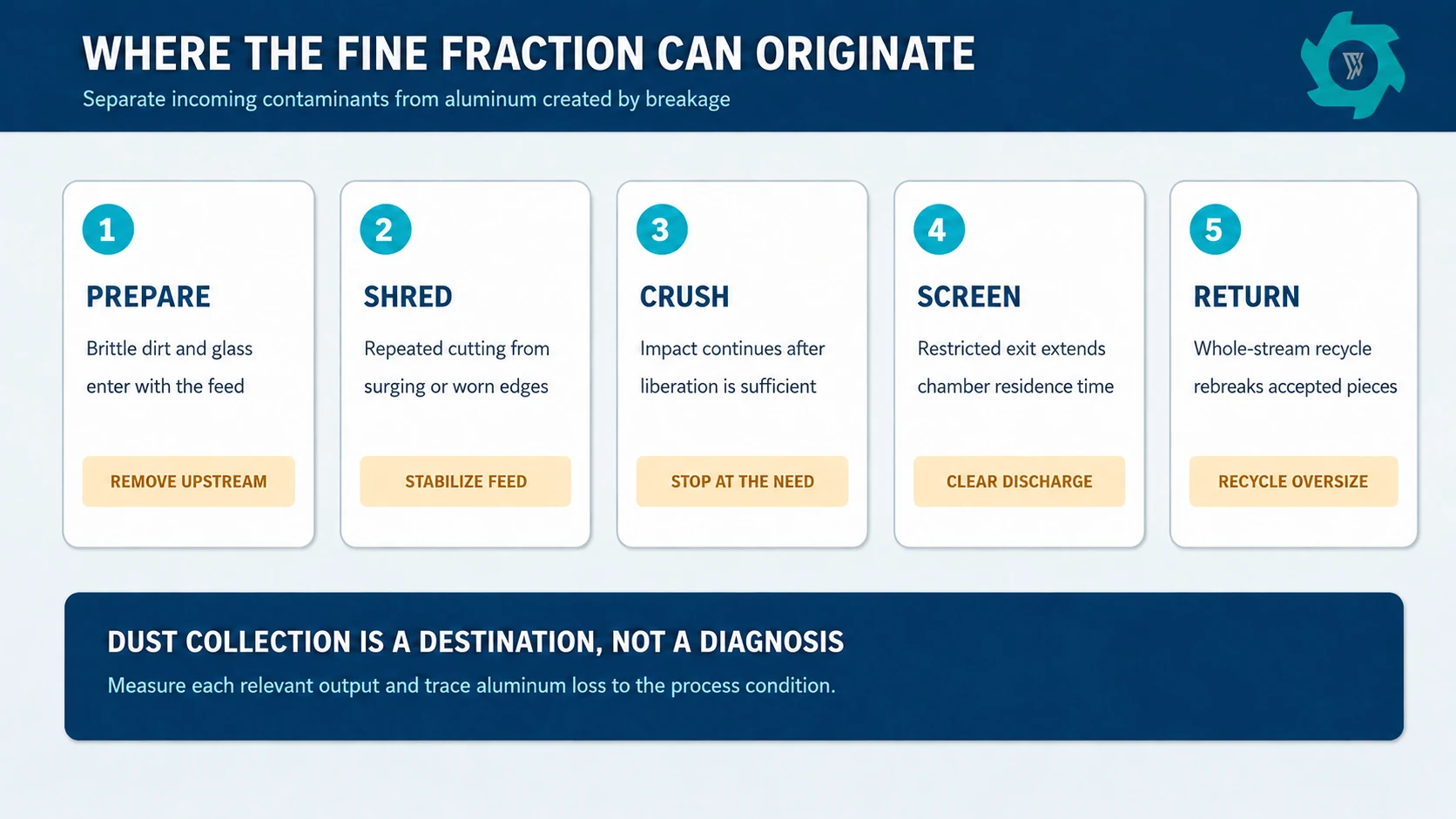
The fine fraction may include contaminants that entered with the feed as well as aluminum created by repeated breakage. A collector bin shows where material ended up, not necessarily where it originated.
Locate the dominant fines mechanism
Too much machine for the required job
A high-speed impact stage is valuable when it releases steel inserts, coatings or attached non-metals that a primary shear cannot open. It becomes destructive when the required liberation has already happened. Before adding secondary crushing, compare the gain in separation or product acceptance with the added fines, energy and wear.
Repeated breakage inside the chamber
A restrictive grate or screen holds acceptable aluminum in the active zone. Pieces that could have left are hit, folded or cut again. A blinded screen, crowded discharge conveyor or excessive return loop creates the same effect from outside the machine: residence time rises even if the nominal opening has not changed.
Unstable feed
Starve-and-surge feeding makes the rotor alternate between air and a deep material bed. The high instantaneous load changes breakage behavior and can force repeated reversals or recirculation. Meter the layer and separate unusually heavy castings, thin sheet and tangled profiles when one setting cannot treat them consistently. The feed-preparation guide covers inspection, segregation and hazard removal before the hopper.
Worn edges and changed clearances
As cutters round over, the machine can rub, bend and rework material instead of making the intended break. Hammer profile, anvil condition, cutter clearance and screen wear all change the approved process. The useful maintenance trigger is not calendar time alone; it is a combined shift in fines, motor-load pattern, temperature, throughput and dimensional inspection. For component-level selection, use the aluminum blade and cutter guide.
Brittle contaminants
Glass, mineral material, oxidized coatings and brittle plastics can dominate the sub-sieve fraction even when the aluminum itself remains coarse. Remove what can be removed upstream and characterize the rest. Otherwise, an operator may slow the machine to solve a “metal fines” problem that is actually caused by incoming dirt.
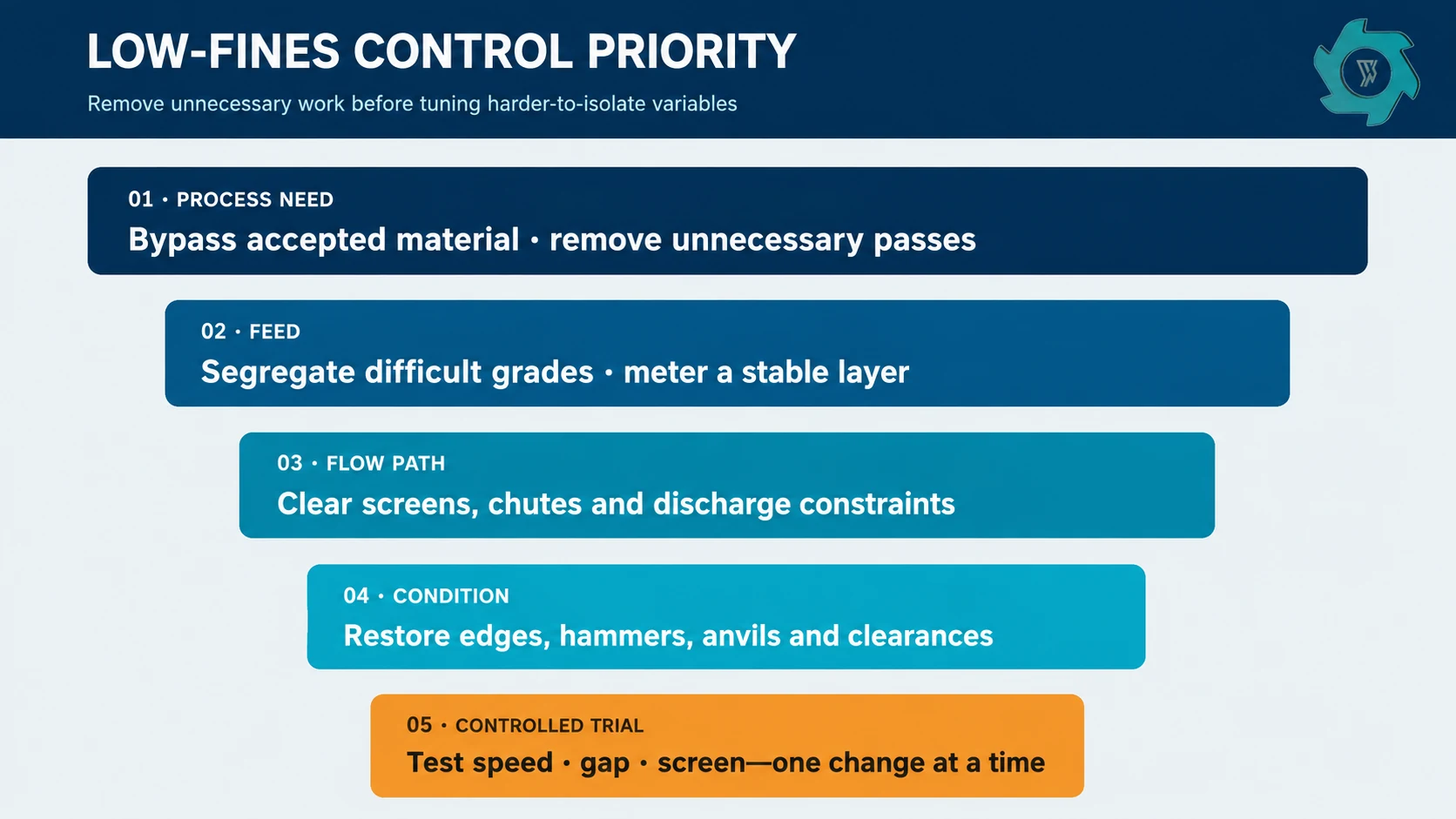
Apply controls in the right order
Start with changes that remove unnecessary work. Setting changes come after the feed, discharge and wear condition are stable.
Remove unnecessary passes
Challenge every crusher pass and return loop. Screen before secondary crushing when a coarse accepted fraction can bypass it. Do not send the entire stream back because one fraction is oversize.
Stabilize preparation and feed rate
Use one defined feed family for the baseline. Control batch composition, maximum piece, attachments and feed depth. A mixed aluminum feed may need routing by behavior rather than one universal recipe.
Clear the discharge path
Check screen open area, blinding, chute buildup, air balance and downstream conveyor capacity. A faster rotor cannot cure a blocked exit.
Restore the approved cutting condition
Inspect cutter edges, hammer profile, anvils, clearances and damaged screen sections. Record the condition so the new baseline is repeatable after the trial team leaves.
Then test speed, gap and screen changes
For high-speed impact equipment, lower impact intensity or a less restrictive sizing surface can reduce repeated breakage, but the direction and magnitude are feed-specific. Published MSW-shredding data show that higher hammermill speed can shift output toward smaller particles, but the direction and magnitude for aluminum depend on feed geometry, alloy condition and machine design.1
Safety boundary: Fine aluminum can be explosible when dispersed in air. Treat dust extraction, isolation, ignition control and housekeeping as an engineered safety system, not as a fines-recovery accessory. OSHA explicitly includes aluminum among materials that may be explosible in finely divided form.2 Have the dust hazard and protection design reviewed by qualified specialists for the actual material and jurisdiction.
Run an A/B trial that survives scrutiny
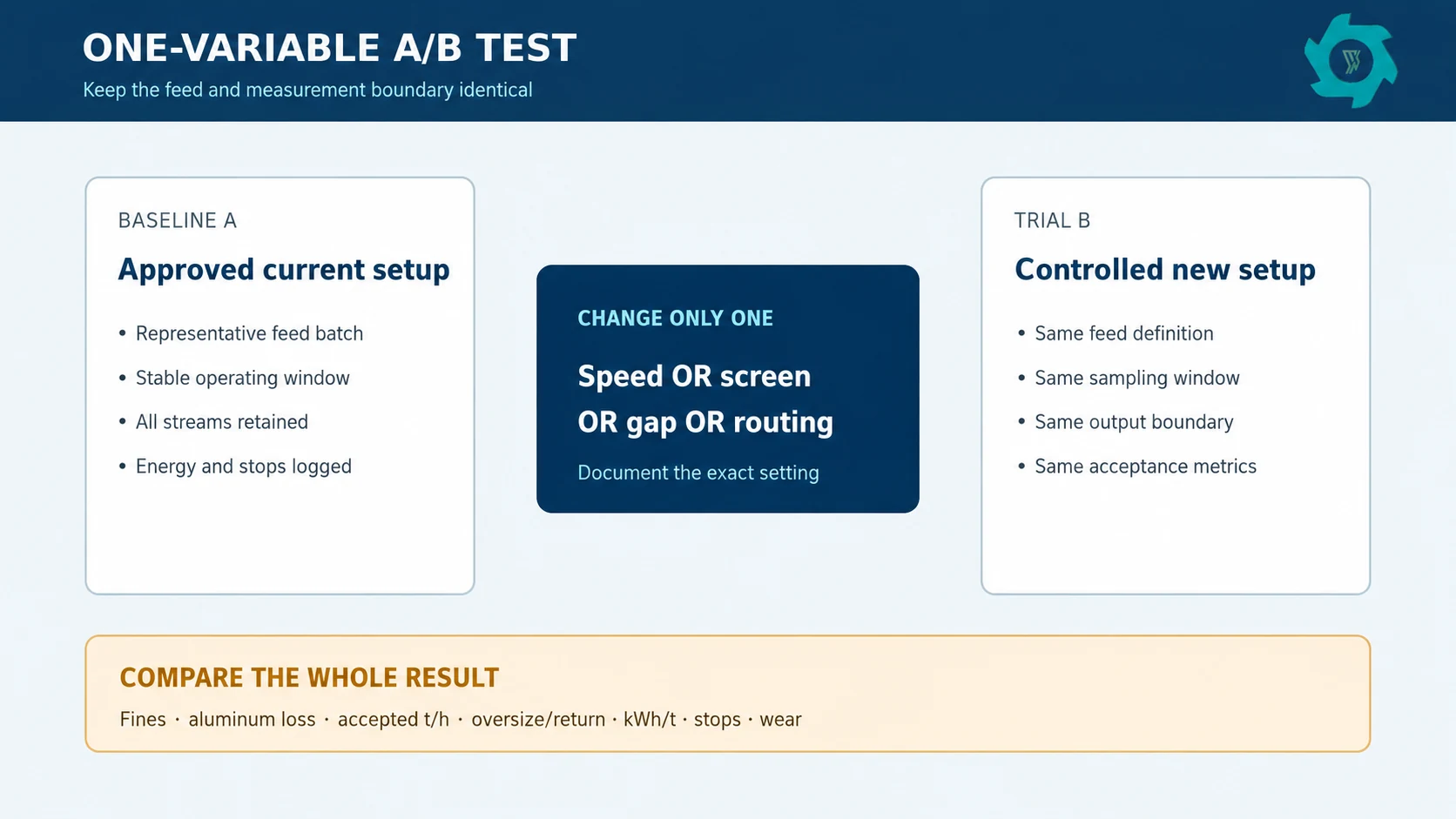
Change one primary variable at a time. A before/after comparison is weak if the feed grade, moisture, operator, screen, recirculation route and sampling period all move together.
Keep the feed and boundary fixed, make one controlled change, and compare the entire output—not a handful from the product belt.
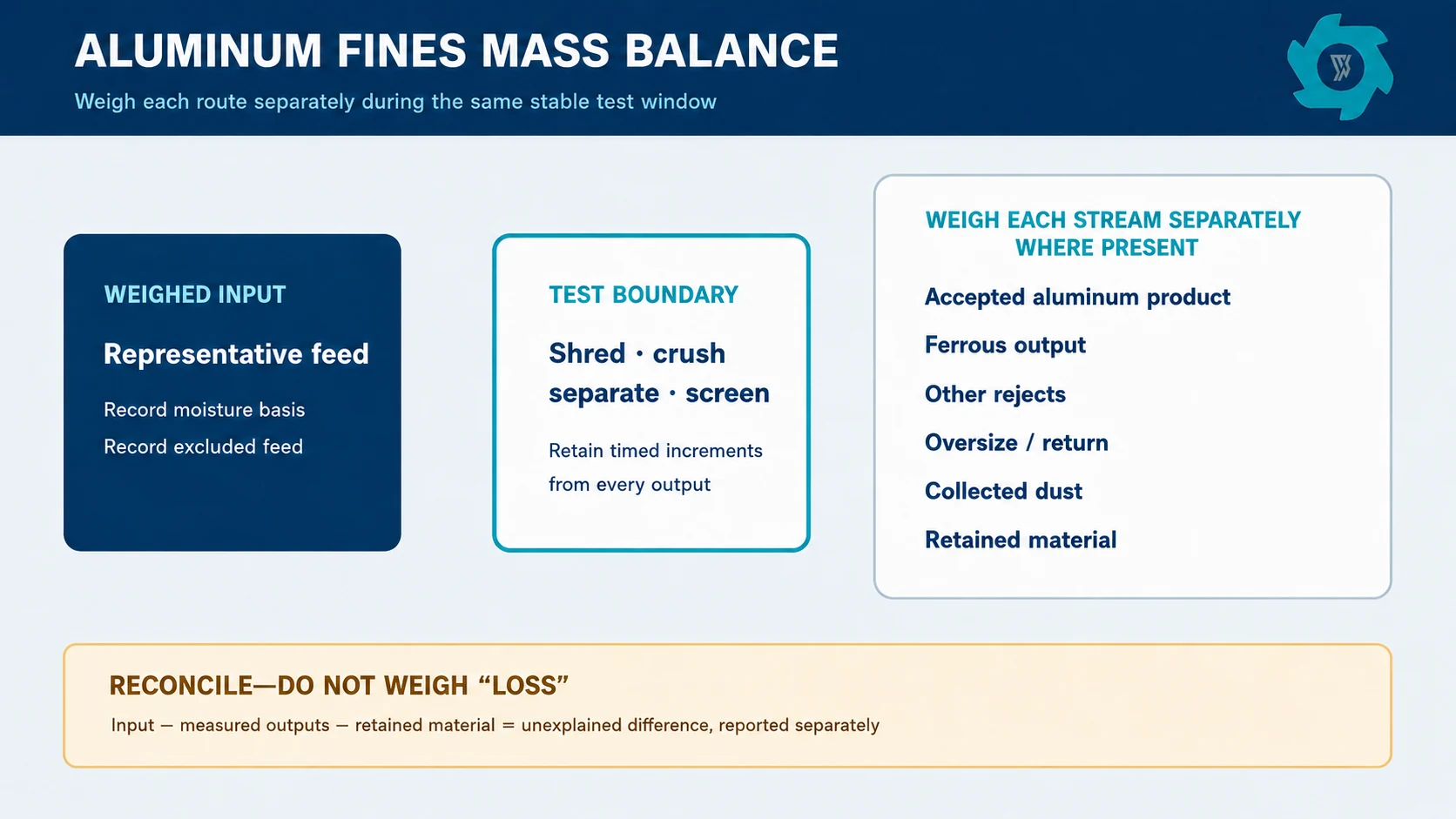
Build enough runtime to pass startup transients and include normal interventions. Record scheduled time, running time, accepted feed, reversals, blockages, screen cleaning, bearing or hydraulic temperature, energy and wear observations. Collect timed increments from every material stream during the same stable window.
Separately weigh every output stream that exists within the agreed test boundary, including accepted aluminum product, ferrous output, other rejects, oversize/return, collected dust and retained material. Sieve the accepted product and every other stream likely to contain aluminum fines. Reconcile any unexplained difference separately; do not bury it inside “losses.”
A low dust-bin weight is not proof of low fines. Every route must remain inside the mass balance.
Accept the change only if…
Watch for this trade-off
Aluminum lost below the cutoff falls
More aluminum remains attached to steel or non-metal
Accepted output stays within buyer or separator limits
Oversize and return load rise
Net accepted t/h is maintained
Gross feed looks high but downtime increases
kWh per accepted tonne improves or remains justified
Lower fines are purchased with much lower production
Wear trend is stable
A short clean-feed trial hides edge damage
Optimize recovered value, not the prettiest size distribution
Suppose a coarser setting reduces sub-sieve mass from 7% to 4%. That appears successful. But if the recovered aluminum fraction loses purity, or the ferrous stream carries more attached aluminum, the plant may have moved loss rather than reduced it.
Convert the trial into money over the same period:
Net value = accepted product value + recoverable by-product value − metal loss − energy − wear − disposal − downtime cost
A good RFQ asks the supplier to state the tested feed, machine sequence, speed or frequency, screen or grate, throughput definition, output streams, fines cutoff, sampling method and guarantee boundary. “Low dust” without these details is not an acceptance criterion.
Need a Low-Fines Aluminum Line Review?
Send representative feed photos, size range, contaminants, current flow sheet, target product, fines cutoff and a recent mass balance. YUXI can use those details to define a test boundary and identify where less breakage may create more recovered value.
Aluminum Fines FAQ
What causes excessive aluminum fines in a shredder or crusher?
The usual causes are unnecessary impact energy, long chamber residence time, a restrictive screen, excessive recirculation, unstable feeding, worn cutting parts, and brittle contamination that is ground along with the aluminum.
Does a larger screen always reduce fines?
A larger opening can reduce repeated breakage, but it may also release pieces before the required liberation or downstream size is reached. Test it against accepted product, oversize, recovery and separator performance.
Should fines be measured by weight or by particle count?
Use mass percentage for production control. Define the cutoff with a sieve, weigh the fine fraction, and report it against dry feed or accepted output. Particle count can support laboratory work but is not a practical plant KPI.
Can dust collection solve an aluminum fines problem?
Dust collection controls airborne material; it does not stop the machine from generating fines. Generation and capture should be measured separately so a stronger collector is not mistaken for a better size-reduction process.
How should a supplier prove a low-fines configuration?
Run representative feed under agreed settings, collect timed increments, weigh every output stream separately, sieve the relevant streams, and reconcile the mass balance. Compare fines, accepted throughput, recovery, energy, stops and wear on the same boundary.
References
Fitzgerald (2009), Columbia University — MSW shredding thesis; general shredding data.
David focuses on industrial shredding and recycling equipment,including material evaluation,shredder selection,process configuration,and recycling line planning.
Speak To Our Shredder Machine Expert
Get in touch with our nice team today to get a price estimate for a shredder machine.

 English



 Fast Delivery
 Reliable
 Certified
 Experienced