Mixed Aluminum Scrap Shredding: Variable Feed Control
Mixed Aluminum Is a Moving Feed Window, Not One Material
A mixed aluminum pile can change while the name on the scale ticket stays the same. One load may be mostly hollow extrusion and light sheet; the next may contain cast housings, steel brackets, rubber, dirt and painted assemblies. If both are fed under one fixed machine setting, the line will alternate between empty running, sudden torque peaks and unstable downstream separation.
Define a feed window, classify each incoming lot, build controlled campaigns and stop material that falls outside the agreed boundary. The wider scrap aluminum recycling line pillar explains the available process routes. This guide stays on the operating problem that appears before and during shredding: how to keep a variable stream measurable.
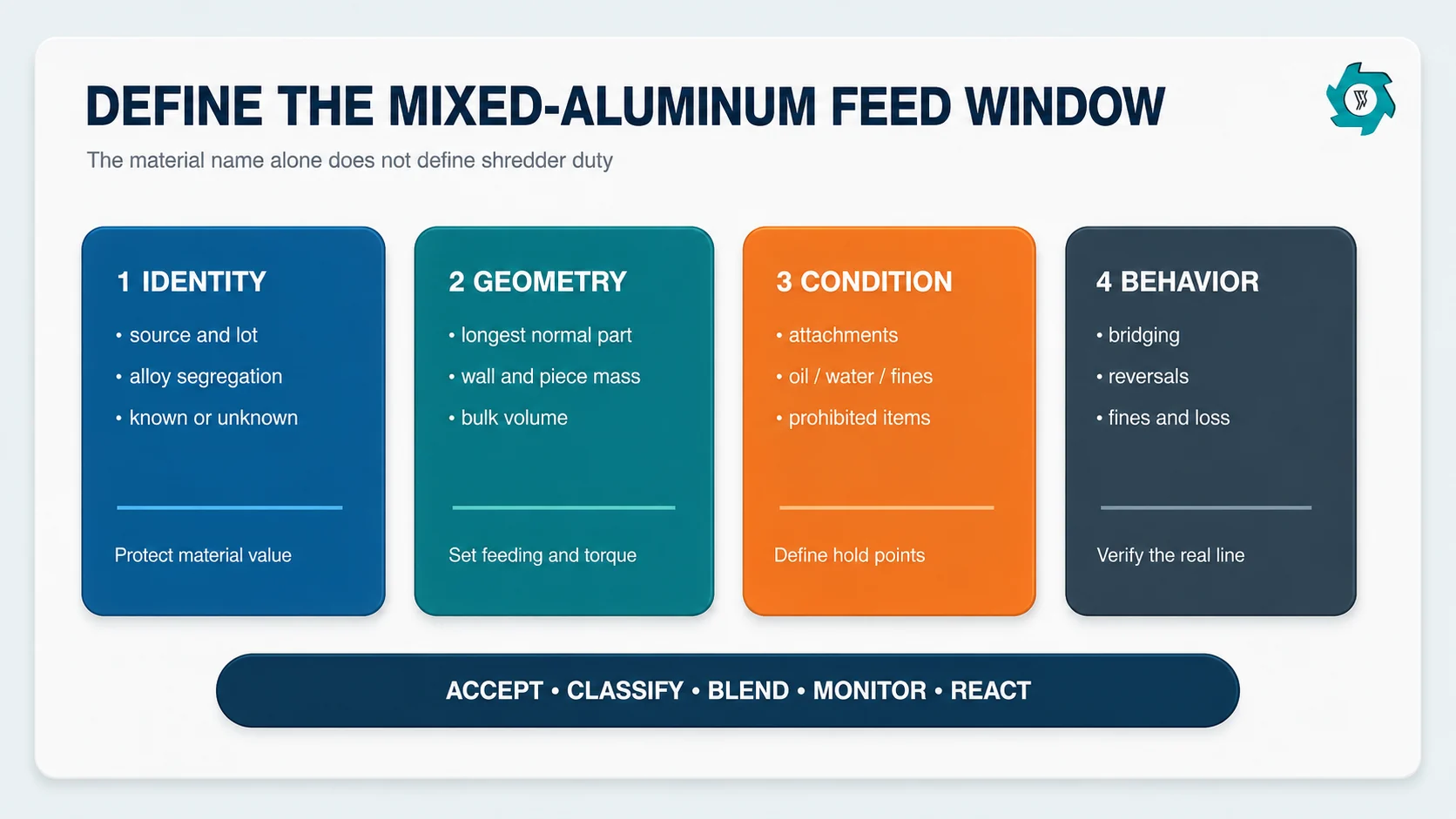
Image 1. A workable feed specification covers more than the word “aluminum.” Each incoming lot must fit the agreed identity, geometry, contamination and behavior window.
Start With a Three-Layer Lot Code
A short lot code makes the important differences visible before the material reaches the hopper. Use three layers and keep the photos or inspection notes behind the code.
Layer
Example classes
What it controls
Primary form
P = profiles; S = sheet; C = cast; A = assemblies; M = mixed
Hopper opening, bridging risk, cutter engagement and bulk-volume rate
Attachment level
0 = loose/clean; 1 = light fittings; 2 = recurring attached steel or non-metal; H = hold
Pre-picking, liberation duty, magnet load and residue volume
Condition
D = dry; W = wet; O = oily; F = fines-rich; U = unknown
Storage, fire and dust review, housekeeping and whether the lot can enter the dry line
A load marked P1-D is operationally different from C2-O, even if both are bought as mixed aluminum. The code is not a universal grade standard. It is an internal control that connects receiving, blending, operating settings, sampling and supplier feedback.
Set a minimum inspection record for every lot: source, gross and net mass, dominant forms, largest recurring dimensions, estimated attachment level, visible liquids or sealed objects, fines condition and representative photos. Use a separate “unknown” route when the receiver cannot confidently assign a class. Uncertainty should be visible rather than averaged into a normal campaign.
Turn “Variable Feed” Into a Measurable Envelope
Photographs help, but the equipment supplier and plant team also need a numeric envelope. Review enough receiving records to describe the middle of the stream and its recurring extremes. For each variable, report the median, the 90th percentile and the largest recurring value. Do not use a single maximum caused by a prohibited object; keep abnormal rejects in a separate log.
Variable
Useful record
How it changes the project
Longest piece
Median, P90 and largest recurring length
Hopper opening, bridge formation, loading method and need for pre-cutting
Piece mass / thick section
P90 piece mass plus recurring heavy examples
Cutter engagement, torque peaks, reversal frequency and drive protection
Loose bulk density
Range by lot class, measured with the same container
Conveyor volumetric capacity, bin residence time and loader cycle rate
Attached ferrous
Mass percentage and the form of attachment
Liberation duty, magnetic output rate and product-value risk
Non-metal / fines
Mass percentage, moisture condition and size band
Screen load, residue handling, dust review and aluminum-loss checks
P90 means 90 percent of recorded observations are at or below that value. It is useful for describing a recurring upper range, but it is not automatically a machine limit. Final limits still need representative testing. The point is to stop one “average piece” from hiding a long tail of difficult material.
Practical spreadsheet layout: one row per incoming lot; columns for source, lot code, net mass, dominant form, P90 length estimate, heaviest recurring piece, ferrous percentage, non-metal percentage, moisture condition, disposition and campaign ID. After several weeks, filter by supplier and lot code. The source of instability usually becomes easier to see.
Decide What Must Stop Before It Reaches the Shredder
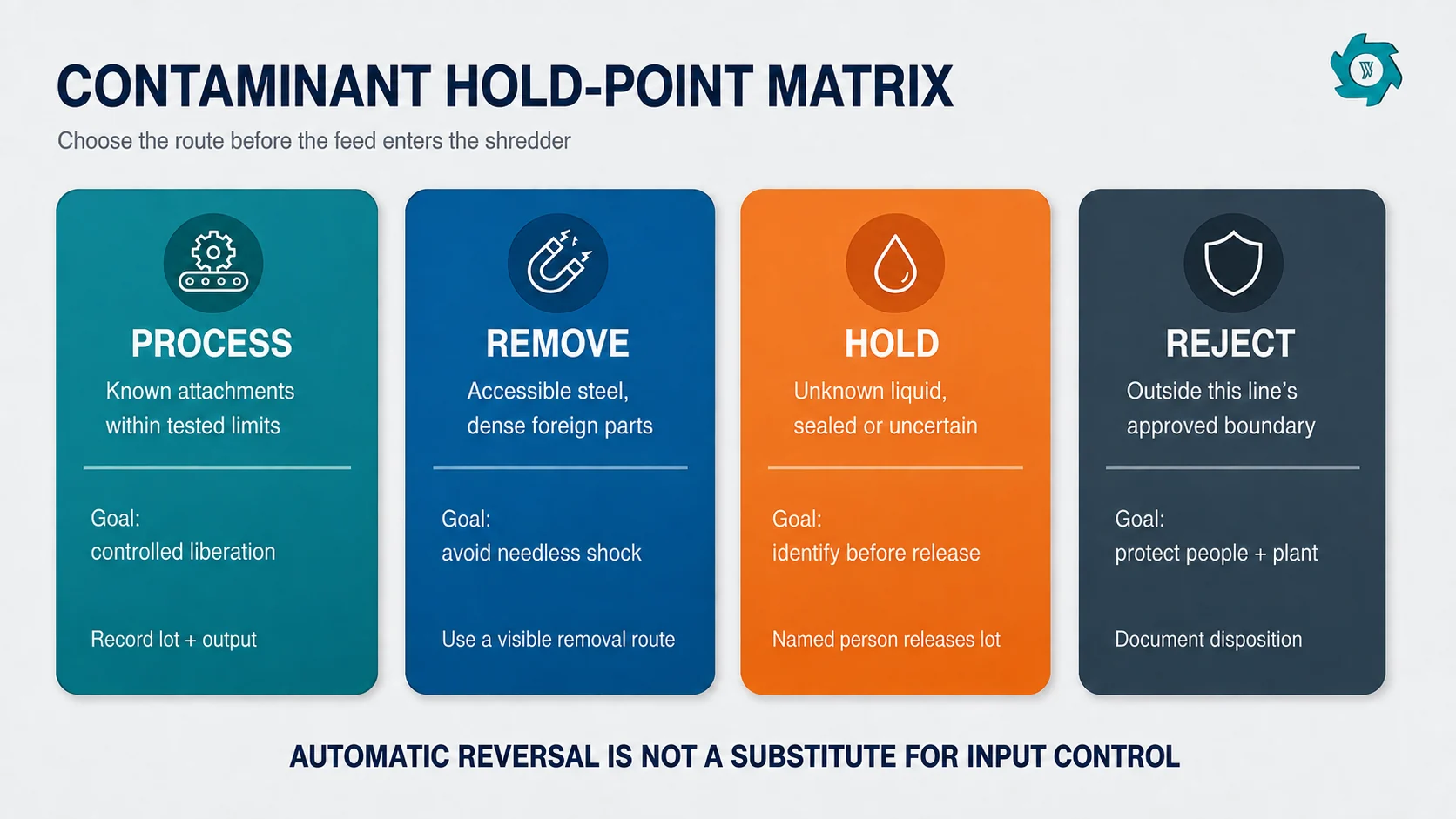
EPA describes secondary-aluminum pretreatment as sorting and processing used to separate aluminum from other metals, dirt, oil, plastics and paint.1 EPA’s secondary-aluminum material also treats preprocessing and furnace operations as distinct parts of the production boundary.2 That does not mean every contaminant should be sent through size reduction. Some items should be removed; others require a controlled process; a third group should stop the lot until its identity is known.
Observed condition
Normal disposition
Reason
Loose bolts, brackets and accessible fittings
Remove upstream when practical
Avoids needless shock load and reduces the burden on downstream magnets.
Recurring steel or plastic attachments
Process only within the tested liberation window
The shredder must open the interface without creating an unnecessary fine fraction.
Sealed cylinders, pressurized parts or closed containers
Stop and isolate
Reversal and overload protection do not make an unknown sealed item safe.
Free liquid, unknown residue or incompatible chemical
Hold for identification and site procedure
A dry mechanical line is not a default treatment route for unknown liquids.
Large dense ferrous object
Remove or route elsewhere
The occasional abnormal object should not define normal shredder duty.
Dry fine aluminum or fines-rich sweepings
Keep out unless the system is specifically assessed
Finely divided aluminum can present a combustible-dust hazard.3
Put the decision where the material is visible: receiving bay, sorting floor or controlled feed station. A prohibited-item list hidden in the manual will not protect the line. Mark the quarantine area, define who releases a held lot and record the disposition so the same supplier problem can be tracked.
Convert contamination percentage into equipment load
For illustration, a 5 t/h campaign containing 6% attached ferrous creates a theoretical 300 kg/h ferrous load after complete release. The magnet, discharge conveyor, collection bin and operator access must be able to handle that stream. If the same campaign contains 4% non-metal residue, another 200 kg/h must leave through the residue route. These are planning loads, not guaranteed separation results; incomplete liberation changes where the mass reports.
This calculation exposes a common specification gap. A buyer may define only aluminum throughput while leaving the reject systems sized by guesswork. Record peak contaminant load by campaign as well as the daily average. A short dirty lot can fill a small ferrous bin even when the shift-average percentage looks modest.
Image 2. The contaminant decision is made before shredding: process within the proven window, remove, hold for identification or reject from this route.
Build Feed Campaigns Instead of Randomly Emptying Bins
A nominal 5 t/h target says little about the way the hopper is loaded. Five tonnes of thin sheet occupies a different volume from five tonnes of cast housings. If a loader alternates between those extremes, hourly tonnage may look acceptable while current, reversals and separator bed depth swing continuously.
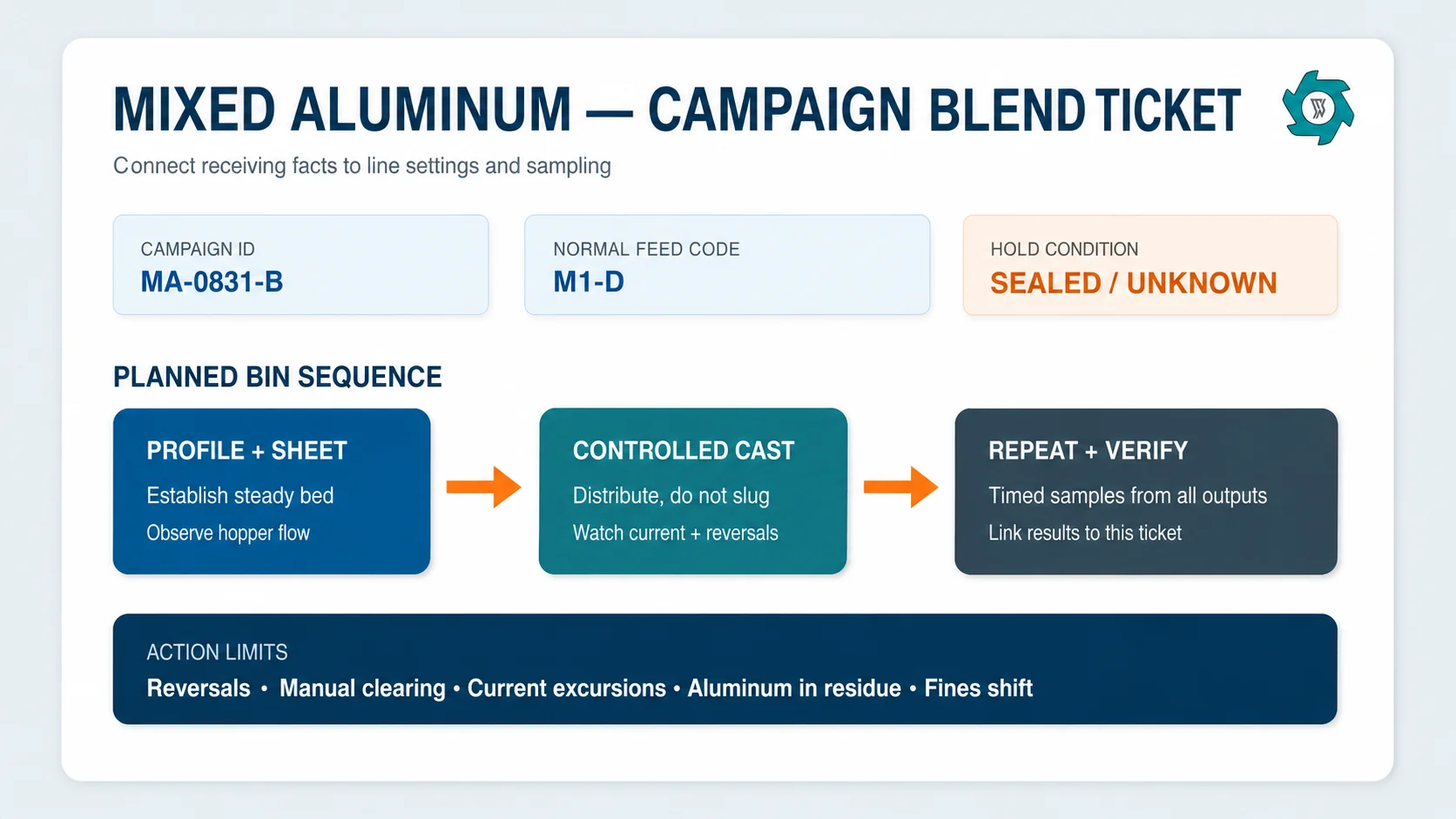
A blend ticket states the target share of primary forms, the allowed attachment class, the maximum recurring piece, the condition code and the order in which bins are introduced. The objective is not perfect laboratory blending. It is to prevent several difficult bins from entering as one unplanned slug.
Example control logic: if dense castings are a recurring minority, distribute their bins through the campaign rather than placing the entire cast fraction on one belt section. If long profiles are the dominant feed, use their real length distribution when checking hopper behavior. The separate aluminum profile feeding guide covers bridging controls in detail.
Track both mass share and volume share. Mass determines production accounting; volume often determines whether the conveyor and hopper can deliver a steady bed. For irregular mixed scrap, a short timed loader trial can reveal how many bucket drops per minute create a stable motor load. Keep that loading pattern with the campaign record.
A blend calculation that operators can check
Suppose a 20 t campaign is approved at 60% profile/sheet skeletons, 25% light sheet and 15% recurring cast pieces. The planned masses are 12 t, 5 t and 3 t. Divide each planned mass by the average net mass of its source bins to estimate the number of bins, then distribute the 3 t cast fraction through the campaign.
Add two boundary rules to the ticket. First, cap the number of consecutive difficult bins. Second, define the maximum deviation from the planned share that an operator may accept without supervisor review. If the available inventory cannot make the approved blend, create a new campaign record.
Image 3. A blend ticket connects receiving data to the operating campaign. It records what may enter, how it is distributed and which observations trigger a change.
Set the Shredding Target by Function
Primary shredding should solve a stated problem: make long pieces feedable, open attached materials for separation or create a size that the next machine can accept. A double shaft shredder can provide coarse, high-torque size reduction for bulky material, but the machine still needs an agreed maximum size, wall thickness, dense-part limit and contamination boundary.
Do not make the output smaller just to make it look uniform. More reduction can increase surface area, wear and fines. It may also move good aluminum into a fraction that is harder to recover. The useful endpoint is the coarsest product that feeds the next step reliably and exposes the attachments that must be separated.
Known-alloy internal returns are a special case. Their chemistry may already be controlled, so mixing them into yard scrap can destroy traceability. If bulky sprues or reject castings need handling improvement, keep them in a segregated return campaign. The foundry return guide explains why flow and furnace charging—not generic liberation—normally set that duty.
Watch Feed Behavior, Not Only the Hourly Average
Record motor current, reversals, time running empty, feed interruptions and manual clearing. Repeated no-load periods followed by a sharp peak often point to bridging or loader surges. Peaks linked to one lot class point toward a difficult geometry, an unremoved dense item or an attachment level outside the proven window.
Use two throughput numbers:
Gross feed rate: all mass entering the controlled test period.
Accepted aluminum rate: saleable or downstream-approved aluminum output after accounting for ferrous, residue, fines and held product.
A plant can raise gross feed while accepted output falls. That happens when the line is overloaded, liberation worsens, a separator receives an unstable bed or good aluminum is rejected with residue. Daily production should therefore be compared by feed class and blend, not as one undifferentiated monthly average.
In an illustrative shift, a line runs at 6 t/h when material is moving, spends 82% of scheduled time running and sends 78% of input mass to the accepted aluminum product. Effective accepted output is 6 × 0.82 × 0.78 = 3.84 t/h of scheduled time. The remaining mass is not automatically “loss”; it includes ferrous and other correctly removed fractions. Aluminum found inside those reject streams is the recoverable-metal loss that needs separate measurement.
Low runtime utilization points toward feeding, clearing, maintenance or downstream blockage. Low accepted-product yield may be a genuinely dirty feed, a tighter product specification or excessive rejection. Low aluminum recovery inside the mass balance points toward liberation, sizing or separator control.
Sample Every Output Stream and Close the Balance
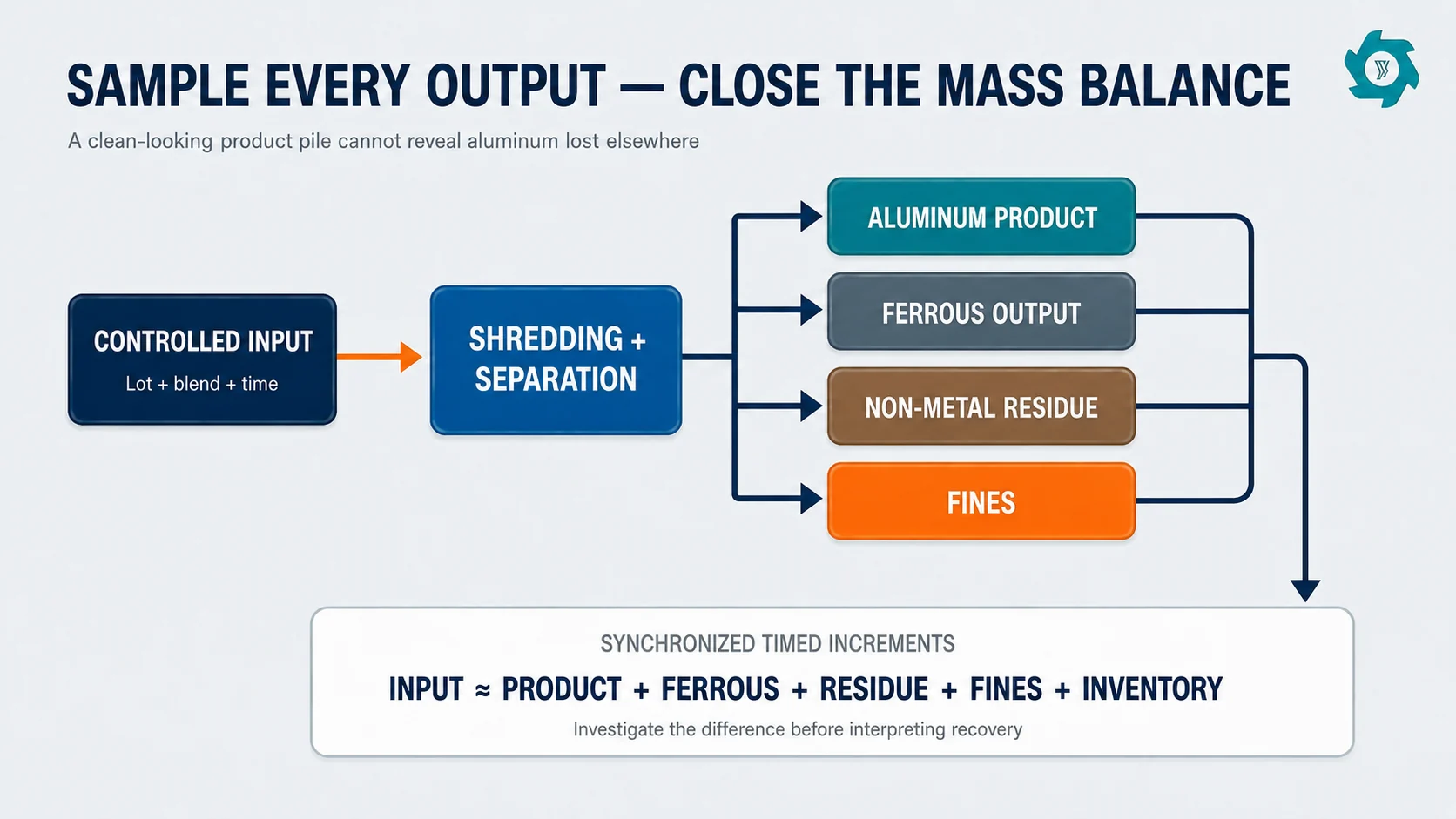
The clean product is only one part of the result. At a fixed sampling interval, collect timed increments from aluminum product, ferrous output, non-metal residue and fines. Combine increments into a campaign composite, then inspect or test each stream with a method appropriate to the contract.
Input mass ≈ accepted aluminum + ferrous + non-metal residue + fines + retained process inventory + measured sampling/handling difference.
If the balance does not close within the site’s agreed tolerance, do not immediately claim a separation problem. First check material left in conveyors, bins, screens and magnets; moisture change; scale timing; and whether samples were returned or retained. Then compare aluminum content in each reject stream.
Use a synchronized sampling clock
Choose a fixed interval after the line reaches stable flow—for example, an increment from every active output at the same scheduled time. Do not collect the product sample during steady operation and the residue sample only after a blockage. Those samples describe different process states. Mark each increment with campaign ID, clock time, operating condition and any intervention in the preceding interval.
Keep start-up, stable running and shutdown clean-out samples separate. Start-up material may include old inventory from conveyors or bins; shutdown clean-out can concentrate fines. Combining them without labels can make a stable campaign look worse or better than it was.
Build a Commissioning Baseline Before Setting Alarms
Generic alarm numbers are rarely useful for a mixed stream. During commissioning, establish a baseline for each approved campaign class. Run long enough for hopper level, conveyors, screens and separators to stabilize. Then record at least the following by time block:
gross and accepted tons;
runtime, idle time and reason-coded stoppage minutes;
reversals and manual-clear events;
median and peak motor load during stable feed;
ferrous, residue and fines mass;
aluminum found in each reject stream;
screen cleaning, magnet cleaning and bin-change events.
Set a warning band from repeatable baseline behavior, then confirm it with new campaigns. A sustained shift—such as reversals rising across three comparable campaigns—provides stronger evidence that the feed, cutter condition or loading practice changed.
Use reason codes instead of a single “downtime” field. At minimum separate upstream starvation, hopper bridge, shredder reversal/stall, magnet or screen cleaning, downstream full bin, planned inspection and unrelated site stop. Otherwise a feed problem can be misreported as shredder unreliability, or a downstream bottleneck can be hidden inside a plant-wide availability figure.
Image 4. Take synchronized increments from every output. Product quality and metal recovery cannot be judged from the aluminum pile alone.
Create Control Limits That Operators Can Act On
A control limit must lead to a defined response. Choose a small number of observations that can be measured reliably: reversals per accepted ton, manual-clear events per hour, maximum current excursions, aluminum found in residue, ferrous carryover in product, screen blinding time and unplanned stoppage minutes.
Signal
First check
Possible action
Reversals rise after a new bin
Lot code, dense items, maximum piece and loader pattern
Pause that bin, inspect and reclassify before changing machine settings.
Current is stable but residue loss rises
Particle-size spread, attachment liberation and separator bed depth
Correct metering or screening; evaluate whether more liberation is actually needed.
Ferrous output suddenly increases
Supplier lot and upstream attachment level
Segregate the campaign and decide whether pre-picking is economical.
Fines fraction increases
Fragile/light feed share, excessive recirculation and cutter/screen condition
Reduce avoidable over-processing and review the target size.
Dust deposition changes
Dry fines-rich lot, enclosure, extraction and housekeeping
Stop and follow the site’s dust hazard procedure; do not improvise controls.
OSHA notes that combustible dust hazards depend on material, particle form and operating conditions; a facility-specific assessment is therefore essential.4 EU waste-treatment BAT conclusions likewise emphasize waste pre-acceptance, acceptance, tracking and input control rather than treating all incoming waste as equivalent.5
Use Three Lots in the FAT
Test three disclosed lots separately before any combined demonstration:
Normal lot: the mix expected to occupy most operating hours.
Difficult recurring lot: the shapes or attachments that routinely cause concern, not a freak object that should be rejected upstream.
Boundary lot: material near the agreed maximum size, density or contamination condition.
For each lot, record input and accepted output mass, elapsed and operating time, loader interventions, reversals, stalls, manual clearing, current trend and samples from all outputs.
The FAT should also exercise the abnormal route: detection, stop, isolation, safe access and restart. Confirm that operators can reach inspection points, clean magnets and screens, remove trapped material under the approved isolation procedure and identify which campaign produced each output bin.
Information to Send Before Equipment Selection
lot history by source, mass and dominant aluminum form;
photos of normal, difficult and boundary material, including the bottom of bins;
largest recurring dimensions, wall thickness and unusually dense pieces;
estimated ferrous, plastic/rubber, dirt, moisture, oil and fines fractions;
sealed, pressurized, hazardous and otherwise prohibited items;
required alloy segregation and downstream acceptance specification;
target accepted tons per shift, campaign duration and change frequency;
current loader, conveyor, hopper, separator and discharge constraints;
site requirements for dust, fire, noise, emissions and wastewater interfaces;
the proposed FAT lots and measurement method.
The Aluminum Association notes that scrap separated by chemistry or alloy type retains more value than scrap mixed across alloys and other materials.6 A shredder and magnet can improve physical preparation, but they do not by themselves restore alloy identity after incompatible grades have been blended.
Frequently Asked Questions
Can one shredder process every type of mixed aluminum scrap?
No. A configured machine can cover an agreed feed window, but long profiles, light sheet, dense castings and contaminated assemblies impose different feeding, torque and separation duties. The specification should define the normal mix, boundary lots and prohibited items.
Should contaminated aluminum be shredded to make sorting easier?
Only when size reduction exposes a recoverable attachment or creates the size range required by the next separation step. Sealed containers, hazardous residues and massive foreign parts should be removed or isolated before shredding.
How do you measure performance when the feed composition changes?
Record each lot and blend, then measure accepted tons, operating time, reversals, stoppages and samples from every output stream. Compare performance within defined feed classes instead of averaging unlike campaigns together.
What mixed scrap should be used for a factory acceptance test?
Use three disclosed lots: the normal production mix, a recurring difficult mix and a boundary lot near the agreed feed limit. Keep them identifiable during the test so a favorable average cannot hide poor performance on the difficult fraction.
Define the Feed Window Before Choosing the Line
Send representative lot photos, maximum recurring pieces, attachment and contamination estimates, required output, campaign frequency and the downstream acceptance method. We can review the feed boundary, pre-sorting needs, shredding duty and a realistic FAT plan.
David focuses on industrial shredding and recycling equipment,including material evaluation,shredder selection,process configuration,and recycling line planning.
Speak To Our Shredder Machine Expert
Get in touch with our nice team today to get a price estimate for a shredder machine.

 English



 Fast Delivery
 Reliable
 Certified
 Experienced