Aluminum Foundry Scrap Shredder for Sprues & Runners
A foundry can generate clean aluminum return metal all day and still create a handling problem between the casting cell and the melt furnace. Sprue trees hook together in a bin. Runner networks take up more space than their weight suggests. A rejected housing may be chemically perfect for the next melt but too large for a chute or charge opening. In that situation, the job of a shredder is not to “upgrade” the alloy. It is to make a known return stream easier to move, meter and remelt without losing alloy control.
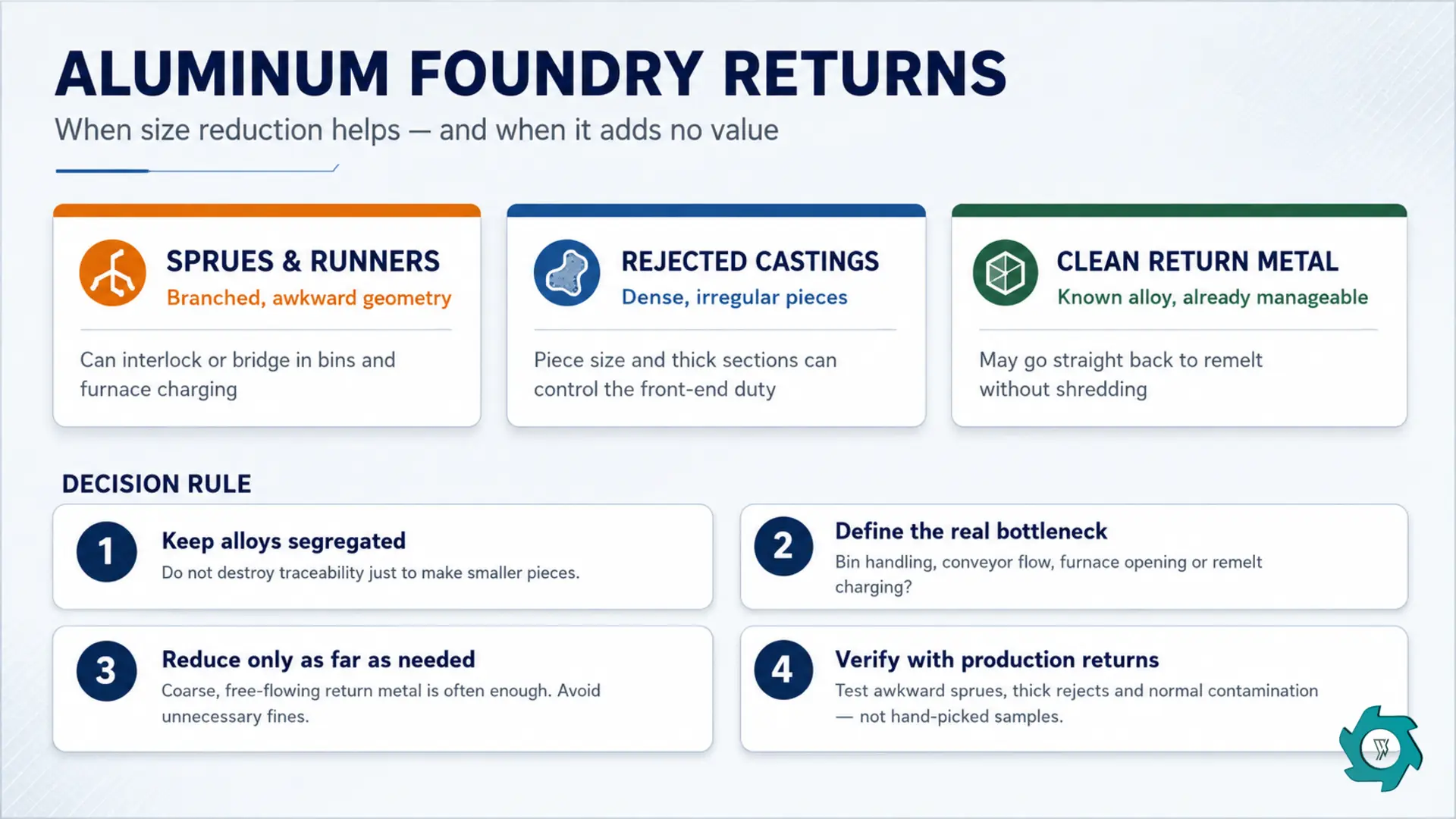
Engineering summary: shred aluminum foundry returns only when their geometry creates a real bottleneck. If sprues, runners and rejects already fit the return system and furnace charge, leave them coarse. If bulky or interlocking pieces disrupt bins, conveyors or charging, use the shortest size-reduction route that turns them into a stable, manageable stream. Keep alloy families segregated and stop before unnecessary fines are created.
Foundry return metal does not automatically need a crusher or shredder. The machine must solve a defined handling or furnace-charging problem.
Why this topic is different from general cast-aluminum recycling
The American Foundry Society defines foundry returns as known-composition metal in the form of gates, sprues, runners, risers and scrapped castings that is returned to the furnace for remelting.[1] That definition sets an important boundary. These materials are not the same as post-consumer cast aluminum collected from vehicles, demolition or mixed scrap yards. Their chemistry is normally controlled by the foundry that generated them.
The main question is whether these bulky or irregular returns can move smoothly through bins, conveyors and furnace-charging equipment. If they cannot, size reduction may turn them into a more manageable stream without unnecessarily breaking down material that is already suitable for remelting.
The current scrap aluminum recycling line pillar also covers many feeds—profiles, wheels, sheet, mixed aluminum and castings. This cluster stays inside one narrow operating zone: production returns created by casting, trimming and inspection.
Sprues, runners and rejected castings do not behave alike
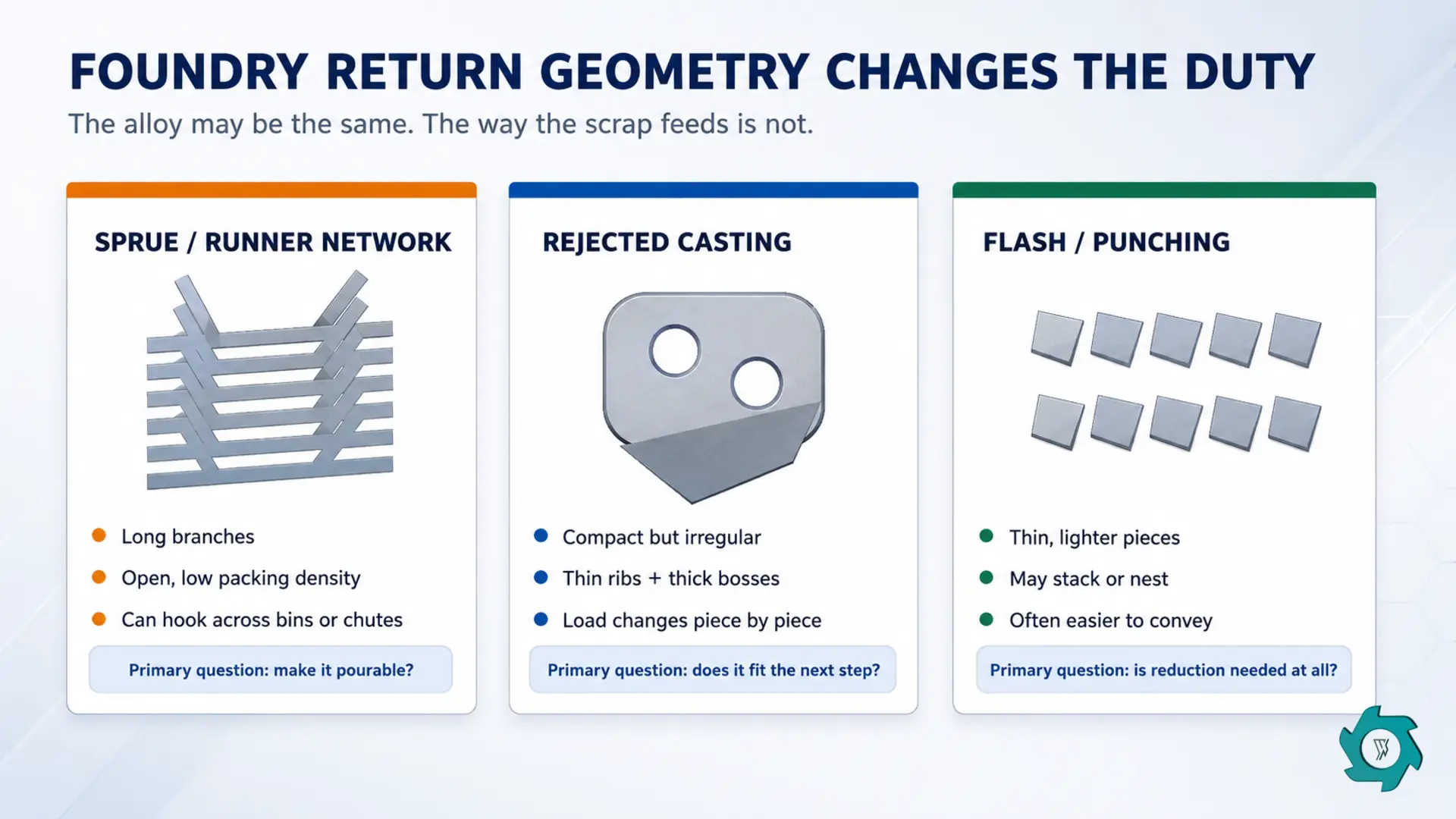
The return stream can share the same alloy and still contain very different shapes. A sprue-and-runner network is open and branched. Its bulk density in a bin may be low, and long arms can catch on the wall, another return tree or the edge of a chute. A rejected casting is usually more compact, but thick bosses, ribs and hollow sections make cutting resistance change from one piece to the next. Flash and punching waste may be lighter and easier to convey, yet thin pieces can stack or nest.
The U.S. Department of Energy describes the gating system as metal that does not become part of the shipped casting and notes that gating is usually removed and remelted.[2] This means the size-reduction target should be defined by the route back to the furnace, not by a generic “final particle size.”
The same alloy can create three different feed behaviors. Geometry is often the first machine-selection variable.
Return type
Typical handling issue
Useful question before adding a shredder
Sprues and runners
Branches hook together, poor packing, bridging at bins or charge openings
Would coarse breakage make the material pourable and easier to meter?
Rejected castings
Large pieces, thick sections, irregular orientation
Is the part too large or awkward for the existing conveyor, bucket or furnace charge system?
Flash / trimming scrap
Thin pieces can stack or nest
Can it already move reliably without another size-reduction stage?
Mixed foundry returns
Geometry and alloy identity may both vary
Should streams be separated before size reduction rather than blended first?
The first objective is usually flow, not liberation
Mixed recycling lines often shred to expose steel, rubber or plastic before separation. Clean foundry returns usually do not need that kind of liberation.
ERDWICH documents light-alloy foundry installations where punching waste and sprue systems are reduced near the casting process so the material becomes easier to transport and return for remelting.[3] A recent foundry-industry article makes the same point from another equipment route: breaking gates and sprues can increase return-metal density and improve furnace charging.[4]
So do not write the specification as “make 50 mm aluminum.” Write the process problem first. For example: the sprue trees bridge in the charge hopper; the rejected housings do not fit the return conveyor; the collection bin fills with air space long before it reaches a useful mass; or operators must repeatedly reposition large returns before the furnace can be charged.
When a shredder is useful — and when it should be left out
Use coarse shredding when bulky returns disrupt the loop
A low-speed primary shredder can make sense when the line receives branched sprues, large reject castings or a changing mix of awkward pieces. Two counter-rotating shafts can pull irregular material inward and produce a rough discharge without requiring the first stage to create a tight particle-size distribution. The public YUXI double shaft shredder page describes that general primary-reduction role; project configuration still has to be matched to the real foundry return.
The value is often visible after the machine rather than inside it: steadier belt loading, fewer pieces hanging in a chute, better use of collection volume and a charge form that the furnace operator can handle without repeated manual repositioning.
Skip shredding when the return is already furnace-ready
Known-alloy production scrap can be easy to over-process. If a return casting already fits the charge bucket, chute and furnace opening, cutting it again consumes power and wear without necessarily increasing its value. The same is true for small sprues or trim pieces that already flow reliably.
There is another reason to stay coarse: surface area. Aggressive reduction creates more fresh surface and more fines. Fine aluminum deserves special attention because OSHA notes that aluminum can become explosible when it is present as sufficiently fine airborne dust.[5] A foundry return system should therefore avoid making small particles unless the process has a clear need for them and the dust-control design is suitable.
Alloy control comes before size reduction
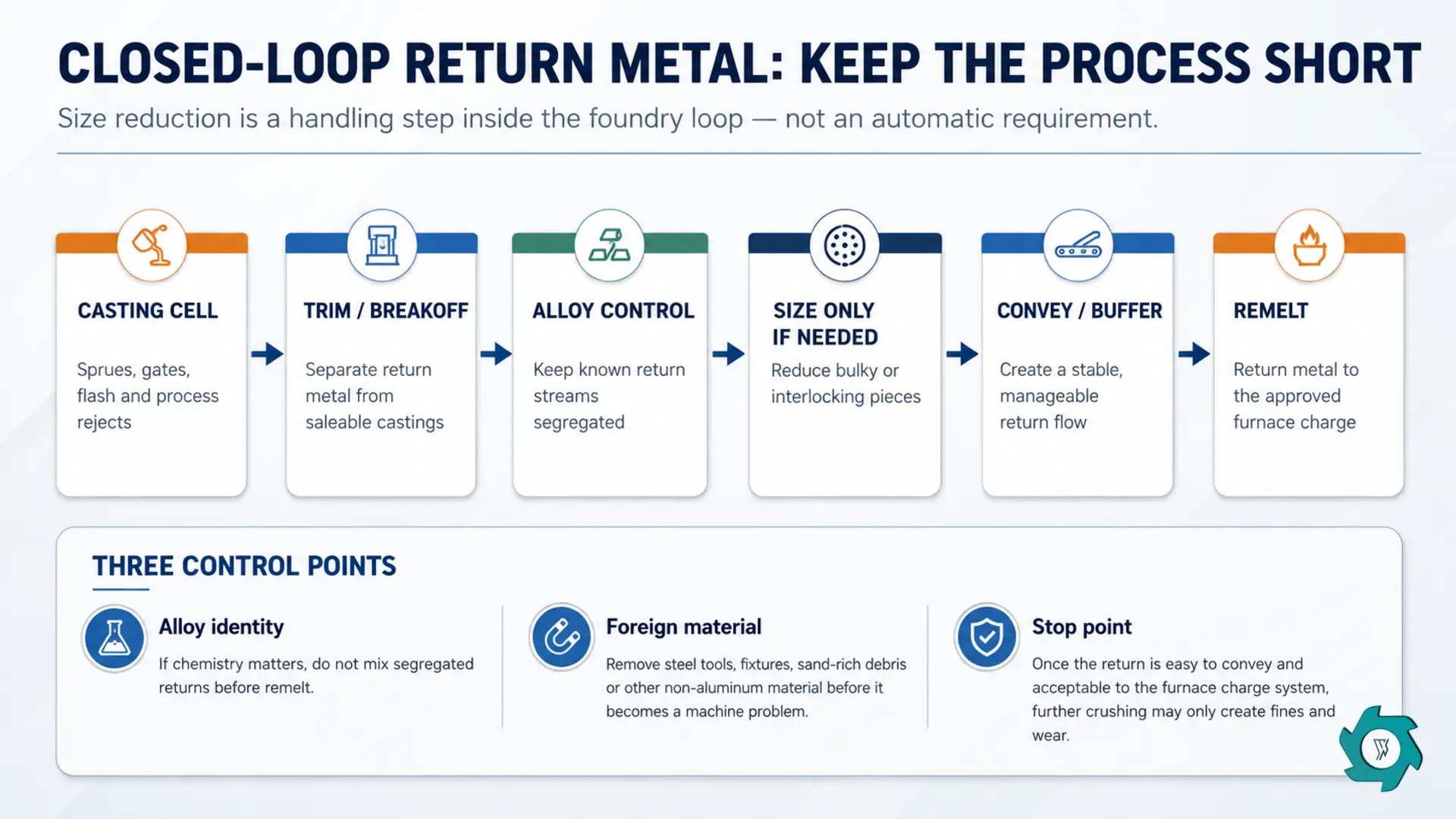
One of the easiest mistakes is to treat all silvery return metal as one feed. That can destroy the value of a controlled loop. If two casting cells run different alloy families, the collection and discharge arrangement should preserve that separation unless the melt practice intentionally blends them.
This sounds like a metallurgy issue rather than a shredder issue, but the layout can either protect or defeat it. One common risk is a single shared hopper or conveyor that makes traceability disappear before the material reaches the furnace. Another is a common buffer bin after shredding. The size-reduction equipment may work perfectly while the material-control system creates the real loss.
Before specifying the shredder, map every return stream: which cell generated it, how operators identify it, where it is stored, whether a batch can wait for its own container, and where the discharge goes. Then decide whether the machine needs separate feed periods, separate bunkers or a cleaning/changeover procedure between alloy campaigns.
A practical closed-loop process for foundry returns
The logic is: remove the casting from the mold, separate the saleable part from its gating, identify rejects, keep return metal in the correct alloy stream, remove obvious foreign material, reduce only the pieces that are too bulky or interlocking, then convey or buffer the metal for the approved remelt charge.
Size reduction belongs inside the return loop only where it removes a handling bottleneck.
Magaldi describes an aluminum foundry case where conveyors collect sprues, gates and rejected castings from multiple high-pressure die-casting machines and move the material toward scrap bins for remelting.[6] The useful lesson is not a specific conveyor brand. It is the process boundary: the handling system can be just as important as the shredder.
Feed preparation: protect the machine from the unusual piece
Foundry returns are often cleaner than yard scrap, but “clean” does not mean risk-free. Maintenance tools, broken fixtures, steel inserts, heavy gating hardware or sand-rich debris can still enter the return stream. A shredder should not be sized around a rare steel object that operators can remove upstream.
Build a simple reject rule before commissioning. Define prohibited items, identify where inspection occurs and make the bad-piece route obvious. If a robot or trim press drops directly into the shredder, include access and isolation procedures for maintenance. If returns arrive in bins, inspect the bottom of the bin too; that is where dense foreign pieces can hide.
For rejected castings, include the largest normal part in the feed specification. The average casting is rarely the piece that determines chamber opening, cutter engagement or drive protection. The same principle applies when selecting a double shaft shredder for metal recycling: maximum dimensions, wall thickness, piece shape and contamination usually matter more than the material name alone.Include the largest recurring or difficult-to-handle parts in both machine selection and the FAT.
Do not judge capacity from the shredder alone
The return loop has to keep pace with the rate at which the casting cells generate scrap and the rate at which the melt department can accept it. A very large shredder that runs in short bursts may be fine if the buffer system is designed for batch operation. A smaller machine may be better if it can sit close to the casting cell and discharge continuously.
Measure the full route: collection, loading, shredder feed, discharge conveyor, buffer/bin exchange and furnace charging. A bottleneck at any one of those points can make the shredder appear undersized. It can also create the opposite problem—a shredder that produces material faster than the conveyor or bin system can clear it.
Observation
Likely first check
Why it matters
Shredder idles with a full upstream bin
Bridge or poor metering at the feed point
Installed power will not fix a material-flow problem.
Repeated reversals on one return type
Piece geometry, thick sections, foreign material
A small share of difficult pieces can control the whole duty.
Discharge piles up under the machine
Conveyor or buffer capacity
Net plant output is limited downstream.
Return metal is smaller but no easier to charge
Output target was defined by size, not handling function
The machine changed the material without solving the bottleneck.
FAT: prove the handling result with real production returns
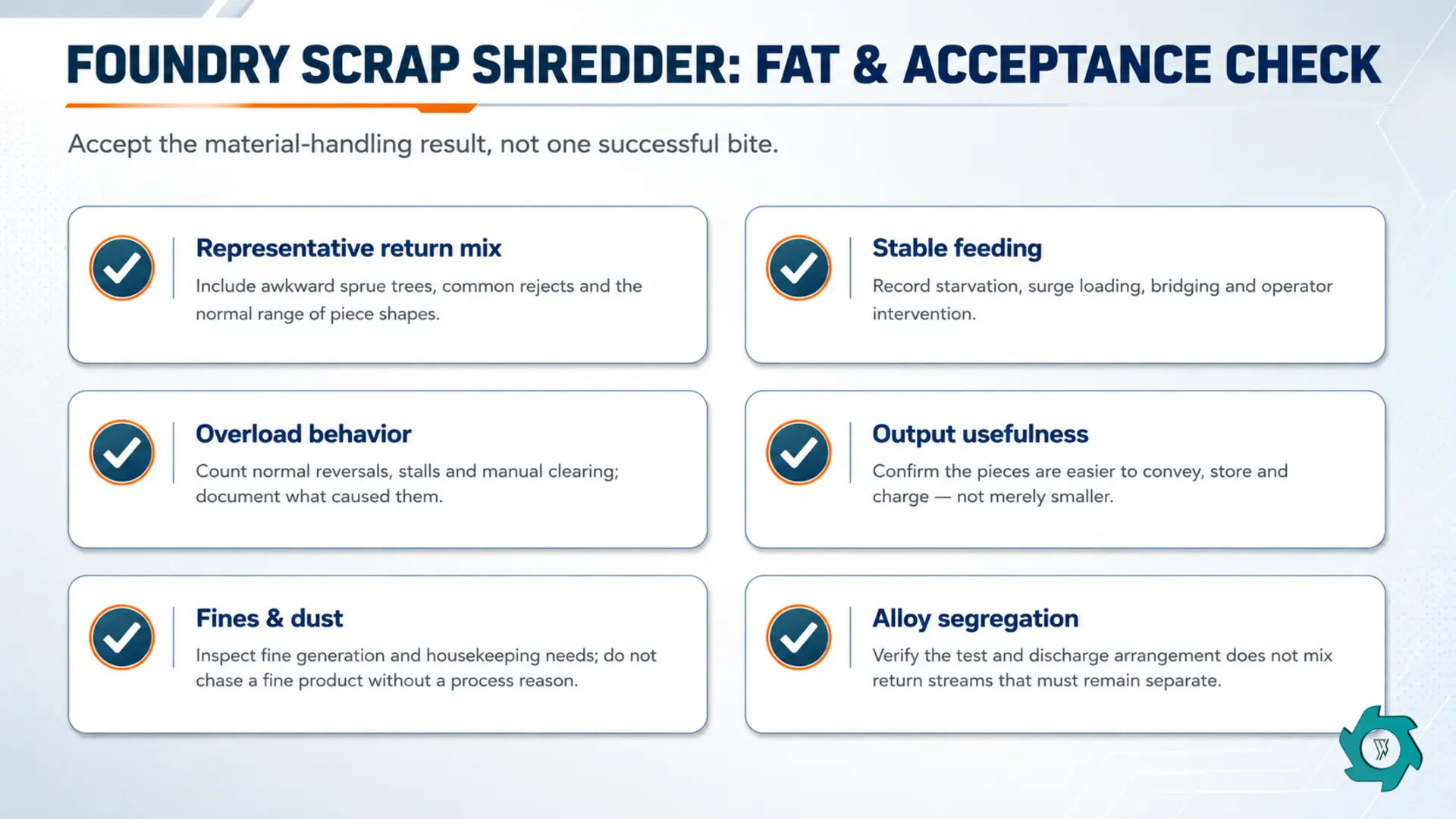
The FAT should use a representative mix and include the parts operators complain about: an awkward sprue tree, a thick rejected housing, the normal flash fraction and any recurring hard-to-feed shape.
Record input mass and elapsed time, but also record how the machine got there. Count reversals, stalls, manual clearing and feed interruptions. Watch the hopper and discharge. If the supplier reaches the throughput figure by hand-positioning every piece, the test did not reproduce the intended factory operation.
For foundry returns, the acceptance question is whether the material moves through the real loop more reliably after size reduction.
Then evaluate the output by function. Does it flow through the planned chute? Can the conveyor carry it without snagging? Does the bin hold a useful mass? Can the furnace charge system accept it without bridging? Has the test created an unnecessary fine fraction? If alloy segregation is part of the project, verify that the feed and discharge arrangement preserves it.
Common mistakes in foundry return projects
1. Treating foundry return scrap like mixed yard aluminum
Clean internal returns usually do not need a full liberation-and-sorting circuit. Adding machines because they appear in a general aluminum recycling line can increase cost without improving the return loop.
2. Specifying discharge size before defining the furnace interface
The furnace, charge bucket, elevator, conveyor and buffer system should determine how small the metal needs to become. “Smaller” is not automatically “better.”
3. Mixing alloys because everything goes through one shredder
A common machine does not justify a common material stream. Preserve the metallurgical identity required by the melt recipe.
4. Ignoring the largest recurring reject
One thick casting that appears every few minutes can cause more reversals than a large volume of easy sprues. Include it in selection and FAT.
5. Chasing high throughput while the return conveyor is the bottleneck
Balance the whole route. A machine that outruns the discharge system simply moves the queue from one place to another.
What to send for a foundry return shredder review
photos of sprues, runners, gates, flash and rejected castings;
largest normal dimensions and the piece mass of unusually heavy rejects;
alloy families and whether they must remain segregated;
how returns are removed from the casting or trim cell;
current bin, chute, conveyor and furnace-charge constraints;
return generation rate by shift, not only a desired shredder capacity;
prohibited or occasional foreign material;
target discharge condition: pourable, conveyor-friendly, charge-bucket friendly or another defined requirement;
available footprint, loading height, power supply and maintenance access.
Need a Foundry Return Size-Reduction Review?
Send representative photos or video of the sprues, runner systems and rejected castings, plus the largest pieces, alloy-separation requirement, return rate and furnace-charging method. We can review whether the project needs coarse shredding, a different handling step, or no additional size reduction at all.
Frequently Asked Questions
What is aluminum foundry return scrap?
Foundry returns are known-composition metal generated inside casting operations, including gates, sprues, runners, risers and scrapped castings that are sent back for remelting.
Do sprues and runners always need to be shredded before remelting?
No. If the return pieces already fit the foundry’s bins, conveyors and furnace charging system, extra size reduction may add wear and fines without solving a real problem. Shredding is useful when bulky or interlocking geometry creates a handling or charging bottleneck.
Is a double shaft shredder suitable for rejected aluminum castings?
A low-speed double shaft shredder can be a useful primary reduction option for bulky or irregular cast returns, but the final cutter, drive and chamber selection must be based on representative piece size, wall thickness, contamination and the required discharge condition.
Should different aluminum foundry alloys be mixed before shredding?
Not when alloy identity matters to the melt recipe or product specification. Keep known return streams segregated through collection, size reduction, buffering and remelt unless the foundry’s metallurgical procedure intentionally blends them.
What should be tested during a foundry-scrap shredder FAT?
Use representative sprues, runners and rejected castings. Record stable throughput, feeding interruptions, reversals, jams, manual clearing, output handling, fines generation and whether the discharge actually fits the plant’s conveyor, storage and furnace-charging requirements.
David focuses on industrial shredding and recycling equipment,including material evaluation,shredder selection,process configuration,and recycling line planning.
Speak To Our Shredder Machine Expert
Get in touch with our nice team today to get a price estimate for a shredder machine.

 English



 Fast Delivery
 Reliable
 Certified
 Experienced