Aluminum Foil & Light-Gauge Scrap: Shred, Bale or Densify?
Aluminum foil is light enough to make a recycling line look busy before it is moving much metal. A hopper can be full, an air line can be loaded and operators can spend the whole shift chasing loose trim while the scale still shows modest mass throughput. That is why foil and very light-gauge scrap should not be treated as a thinner version of ordinary sheet. The first engineering problem is often material flow and density, not cutting power.
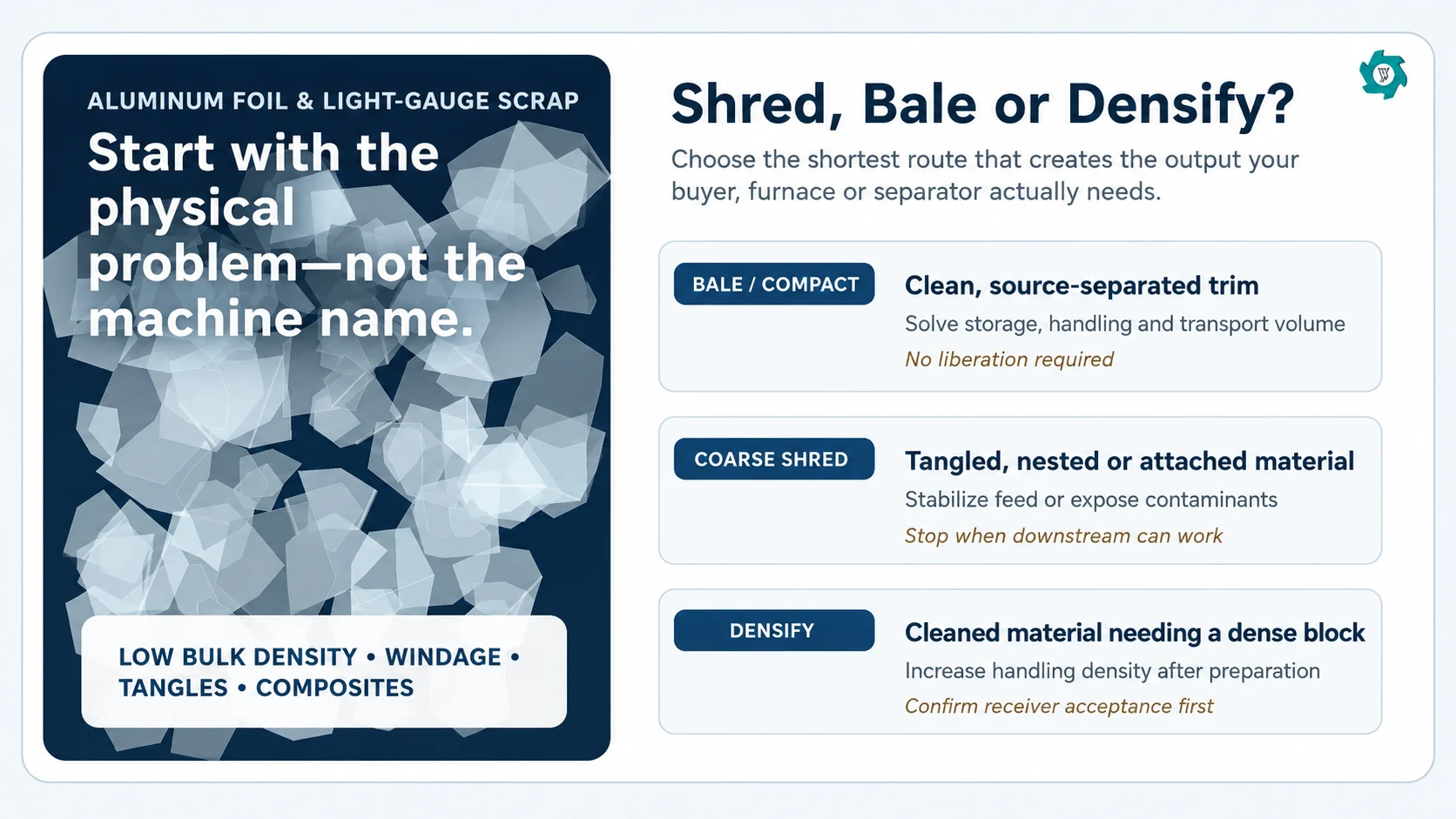
Selection rule:bale or compact clean foil when occupied volume is the main problem; use a coarse shredder when long, tangled or composite pieces prevent stable feeding or need to be opened for separation; choose densification after the material is clean enough when the project needs a smaller, denser package and the receiver accepts it.
Start with the change the material still needs: more stable geometry, less occupied volume, or a denser final package.
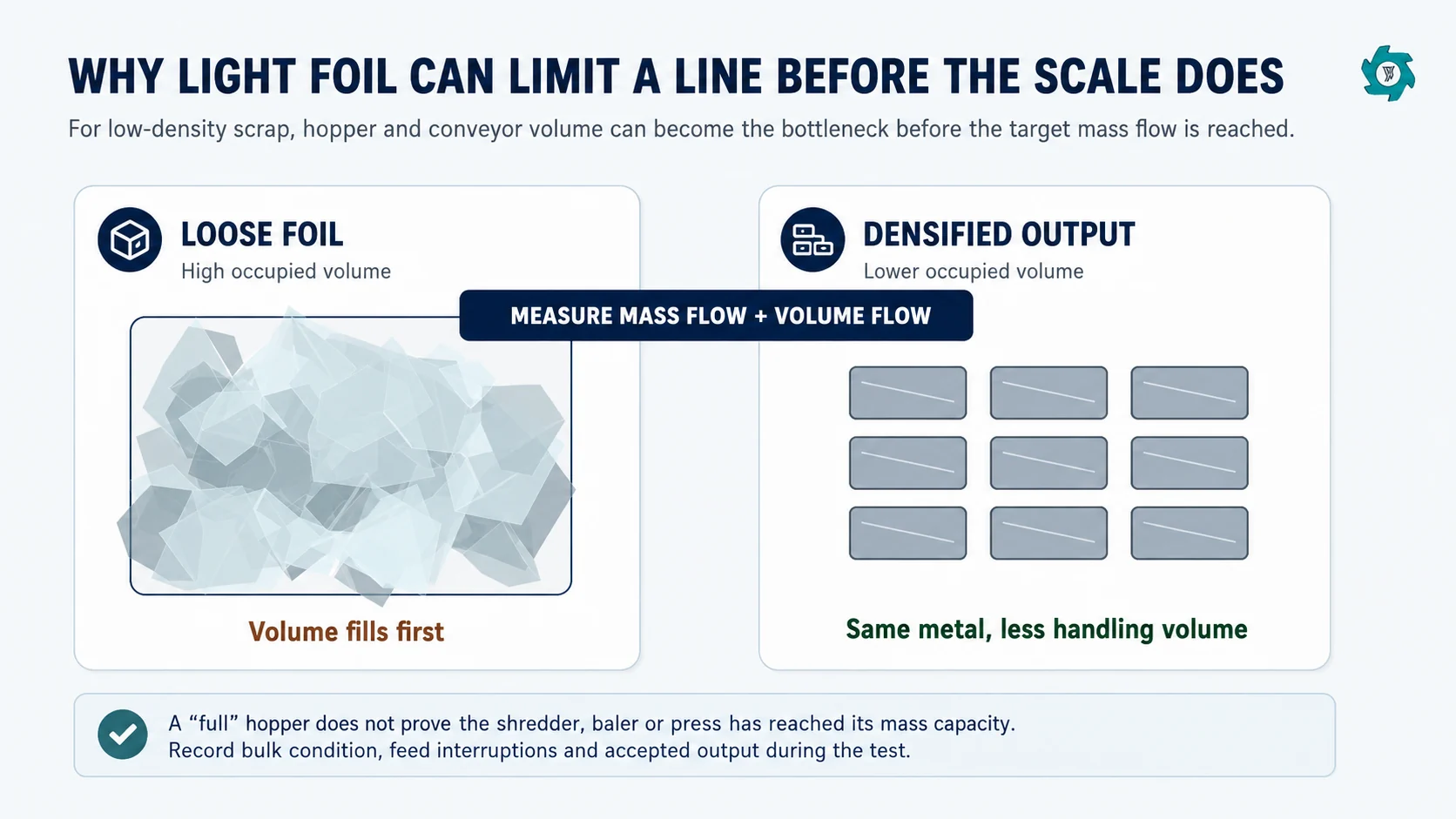
Foil and light-gauge scrap are usually volume-limited before they are weight-limited
The current scrap aluminum recycling line treats foil and light-gauge scrap as a distinct feed category for a reason. The pillar identifies low-density material as a controlled-feeding and dust problem and notes that light sheet and foil may reach the bulk-volume limit of a hopper before a target weight rate is achieved.
A request that says only “2 tons per hour of aluminum” is incomplete for very light material. Two tonnes of compact cast scrap and two tonnes of loose foil do not ask the receiving equipment to move the same occupied volume. A foil line may be restricted by how fast trim can be collected, how much air is required to transport it, how reliably a separator can drop the material out of that air stream, how much buffer volume is available, or how quickly a press can accept the loose charge. None of those limits is described by shredder motor power.
This is also why a successful test should record both the mass entering the line and the physical condition of that mass. If a supplier knows the bulk density, a known container volume and net mass can be used to describe the feed. If the material is too irregular for one reliable density number, video, container dimensions, strip geometry and actual loading time are still more useful than a bare tonnage target.
Low-density foil can fill the handling system before it reaches the desired mass rate. Measure the volume problem as well as the tonnes.
First separate clean production trim from mixed or laminated foil
Clean edge trim from a converter, rejected unlaminated rolls, food-container stamping trim, painted light sheet, aluminum-plastic laminate and unknown post-consumer foil can all look thin and flexible while requiring very different treatment.
One commercial receiver, U.S. Granules, currently lists both laminated foil and clean unlaminated foil and accepts those materials in roll, baled and slab forms.[1] That is a useful reminder that a receiver may care about material composition and package form without requiring the generator to shred everything first.
Laminated material deserves its own boundary. The International Aluminium Institute summarizes a Fraunhofer study on recovering both aluminum and polymers from aluminum-polyethylene laminate packaging using an advanced separation process.[2] When it comes to plant design, a baler can compress a laminate and a shredder can make it smaller, but neither action by itself separates the polymer layer from the aluminum. If the value problem is composition rather than size, the downstream recovery route must be defined first.
Incoming material
Main problem to solve
First route to evaluate
Reason to add shredding
Clean converter or rolling trim
Loose volume, collection, storage
Direct collection + baling/compaction
Only if strips tangle or cannot be metered reliably
Long or nested light-gauge strips
Bridging, wrapping, unstable feed
Controlled feed; coarse shred if needed
Make geometry manageable, not unnecessarily fine
Mixed light sheet with steel attachments
Expose ferrous contamination
Pre-sort, then coarse shred + magnetic removal if required
Size preparation may help a specific process, but shredding does not perform separation
Unknown or mixed post-consumer light scrap
Composition and contamination uncertainty
Inspection and sorting first
After the recovery target and reject route are known
When direct baling or compaction is the shortest route
If the alloy/source is controlled, the material is dry enough for the agreed receiver, and there are no attachments to liberate, the commercial problem may be nothing more than making the scrap easier to move. In that case, cutting every piece before compressing it adds another drive, another wear point and another transfer without necessarily changing the saleable metal.
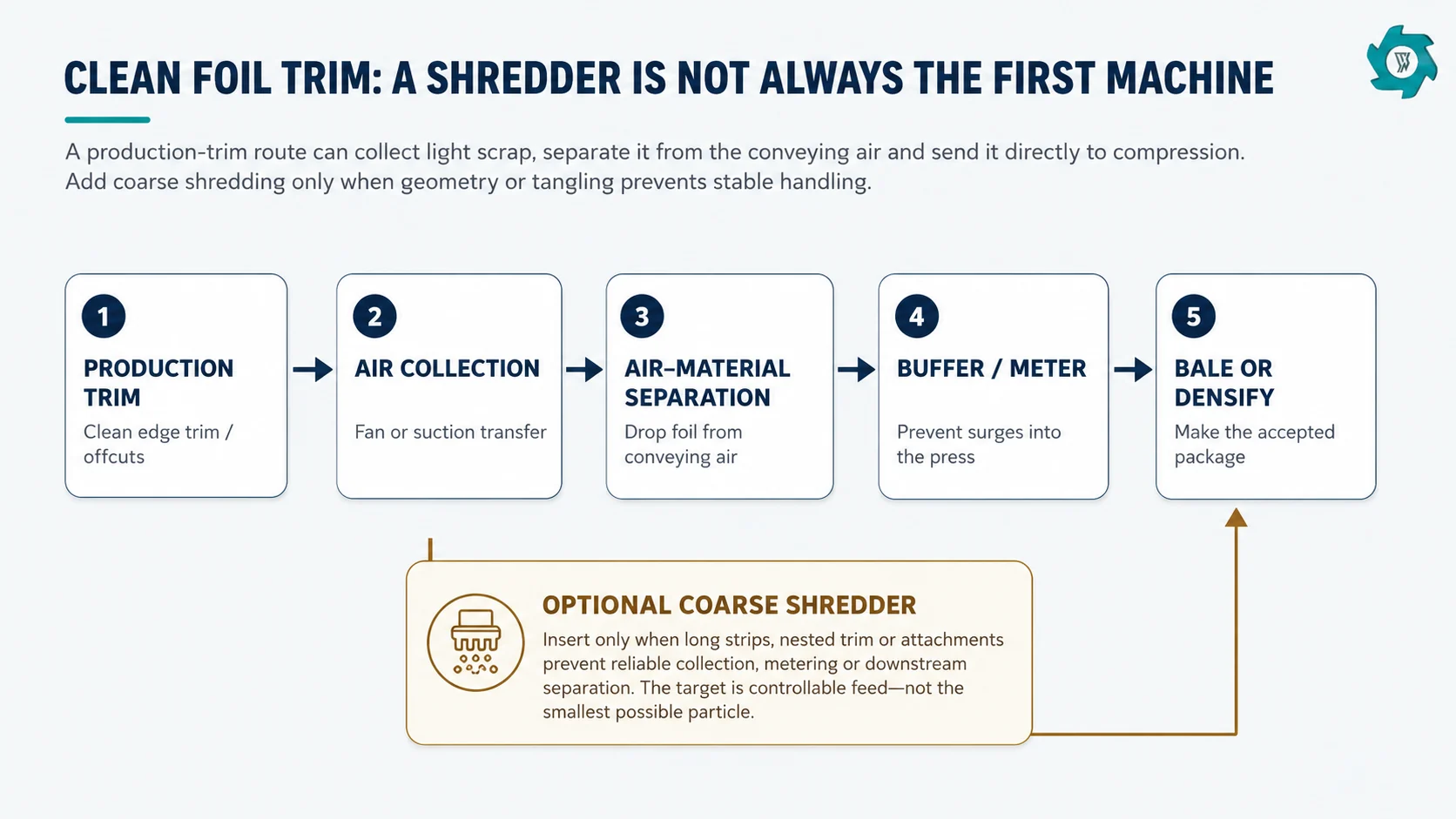
Current foil-compaction systems in the market illustrate a useful process architecture: production trimmings can be moved through a fan pipeline, separated from the conveying air, and hydraulically compressed into bales.[3]
The most important interface is usually between the production machine and the press. Lightweight trim can blow away from an open conveyor, build a nest in a chute or arrive at the compactor in pulses. A well-designed collection system therefore has to control air, separate material from air, buffer short surges and feed the press at a rate it can cycle.
For clean production trim, collection and metering can be more important than cutting. Shredding is an optional geometry-control step, not a compulsory first stage.
Direct compression is strongest when
the scrap comes from a known, controlled production source;
there is no unresolved steel, plastic, paper or other attachment to expose;
the strips or pieces can be collected and fed without repeated bridging or wrapping;
the receiver accepts the resulting bale, slab or other compacted form;
the goal is storage, transport, security or furnace/receiver handling rather than downstream sorting.
Compression can also hide a poor feed. Once foreign material is trapped inside a dense package, visual inspection is harder and reopening the bale adds work. If contamination is still uncertain, sort and verify the stream before pressing it.
When a coarse shredder earns its place
Foil is thin, but thin does not mean easy to feed. Continuous strips can wrap around shafts or idlers. Trim can interlock into springy nests. Large pieces of light-gauge sheet can bridge across a hopper while the cutting chamber runs nearly empty underneath. In those cases, the shredder’s value is not “more power.” It is converting a troublesome geometry into a repeatable one.
A low-speed double-shaft shredder for metal recycling can be evaluated for coarse primary reduction when the feed needs tearing and opening before another stage. The stopping point matters. If a coarse pass makes the material feed steadily into a magnet, screen, baler or compactor, continuing to make smaller particles may only increase fines and air-handling load.
A fine particle target should exist because the next operation needs it—not because “smaller” sounds more processed. For very light aluminum, decreasing piece size can actually create a looser, more mobile fraction that still needs compression before it becomes a dense package.
Field check: If the hopper looks full while cutter load repeatedly drops, the problem may be bridging or rafting above the cutting zone. If cutter load is stable but the baler or air separator is constantly starved, the bottleneck may be upstream collection or metering.
What “densify” should mean in a quotation
Densifier, compactor, briquetter and baler are not consistently used as strict machine categories across the market. Two suppliers can use different words for equipment that produces similar packages, or use the same word for machines that deliver very different output. The RFQ should therefore define the physical result instead of relying on the label.
For foil and light-gauge scrap, densification normally belongs after the material has reached the required cleanliness. It is a handling step, not a substitute for magnetic separation, delamination or alloy sorting. This is also where the route differs from machining chips and turnings: chips may require drainage, drying or dedicated briquetting logic, while clean foil trim can follow a collection-and-compression route without being treated as swarf.
Shredding does not automatically create density
This is the most common conceptual mistake in light-scrap projects. Shredding reduces piece dimensions. Densification reduces occupied volume by applying compression. Those actions can support each other, but they are not the same.
Imagine long springy trim that refuses to enter a press evenly. A coarse shredder may turn it into shorter pieces and improve press filling. That can indirectly improve final bale consistency. But the shredded material leaving the cutter can still be fluffy.
A clean loose trim stream may compact perfectly without ever passing through a shredder. That is why a process drawing should label the job of each machine: collect, open, separate, meter, compress.
Fines and dust are a process boundary, not a housekeeping footnote
Very thin aluminum does not need to become powder to create a dust-control question. Cutting, abrasion, coatings and accumulated contamination can all create fines. OSHA notes that finely divided combustible materials can become explosible under the right conditions and specifically includes aluminum among metals that can present this hazard in dust form.[4]
A real aluminum-dust incident investigated by the U.S. Chemical Safety and Hazard Investigation Board involved accumulated aluminum dust at a cast-wheel plant and resulted in fatal and serious injuries.[5] The incident was not a foil-baling line, so it should not be used to claim that every foil process has the same risk. It does show why a project that intentionally creates finer aluminum needs a proper combustible-dust assessment, suitable collection design, housekeeping and site-specific safeguards.
Use a route matrix instead of asking for one “foil recycling machine”
Route A — Clean trimProduction source → controlled collection → air/material separation if pneumatic → buffer → bale or densify. Keep the alloy/source segregated.
Route B — Tangled light scrapControlled collection → coarse shredding only as needed → buffer → bale/densify or downstream sorter. Watch wrapping and bridging.
Route C — Mixed / attached materialInspect and pre-sort → shred only if liberation is required → remove exposed contaminants → verify cleanliness → optional final densification.
Composite foil should sit outside these simple routes until the downstream recovery technology is known. The same applies to specialty streams with coatings, residues or process-specific hazards.
Capacity should be accepted at the final useful output
A shredder supplier may report mass through the cutting chamber. A baler supplier may report machine cycles. A pneumatic collection supplier may describe air volume. None of those values alone proves that the installed line will make the required accepted package throughout a shift.
Freeze the measurement point before comparing quotations. If the business sells compacted clean foil, capacity should be based on accepted bales or blocks leaving the line after normal interruptions. If the project produces a shredded fraction for separation, measure the material that reaches the agreed downstream condition. Record downtime for bridging, material rearrangement, fan or separator imbalance, press waiting, jam clearing and housekeeping rather than quietly removing it from the test.
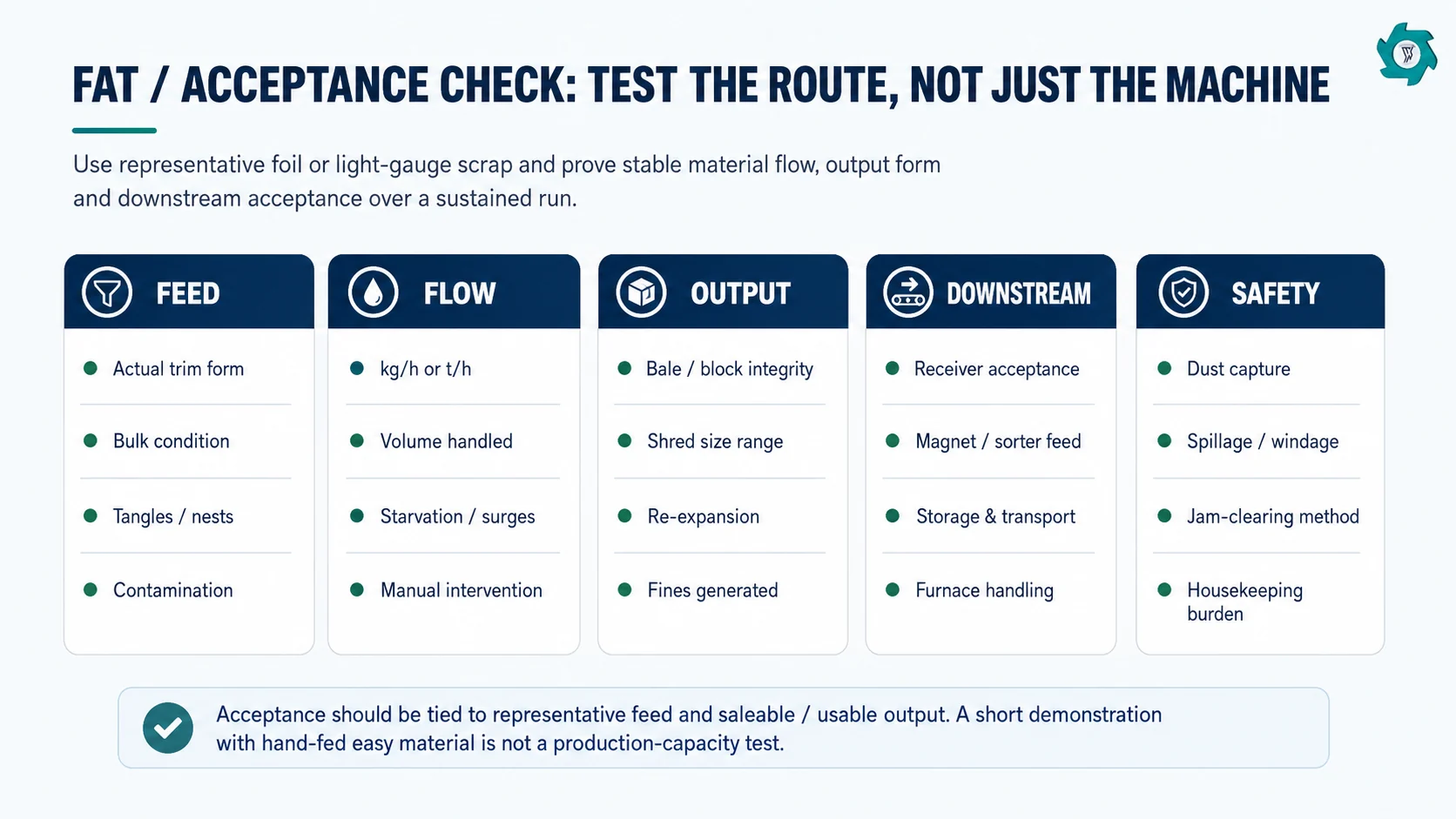
A useful FAT proves the complete material route on representative scrap: feed, flow, output, downstream acceptance and safety controls.
For foil, add volumetric observations to the FAT
record how the representative feed was supplied: loose trim, rolls, compacted material, nests or mixed pieces;
record a practical bulk-density or container-volume basis where possible;
measure sustained mass flow over normal operating time, not only a short peak;
count starvation events, bridging, wrapping, reversals and manual material rearrangement;
inspect whether a bale or block re-expands, breaks or becomes difficult to handle after discharge;
sample contaminants and fines instead of judging output only by appearance;
confirm that the next receiver, furnace or separator accepts the output form created by the test.
Common mistakes that make a light-scrap line expensive
1. Specifying only tons per hour
Mass capacity without feed volume, strip geometry and collection method hides the main bottleneck of light material.
2. Assuming a shredder is a densifier
Shorter pieces can feed a press better, but size reduction does not replace compression. Define what density or package form is required after the shredder.
3. Densifying before contamination is understood
Compression can bury steel, plastic, paper or mixed foil layers inside a uniform-looking package. Verify the grade first.
4. Choosing by press force alone
Press force matters, but so do chamber fill, feed consistency, cycle sequence, output ejection and how quickly loose foil can be delivered to the chamber.
5. Using finer shredding to fix unstable feeding
If the upstream collection system surges or a chute bridges, finer cutting may move the problem rather than solve it. Correct the transfer and metering logic first.
6. Treating clean foil and laminate as the same feed
They may share thickness and appearance but not the same recovery route. Composition should be confirmed before the mechanical line is fixed.
What to send in an RFQ
Photos are useful, but video of the trim being generated, collected and loaded often reveals more about windage, strip length and nesting. Include the following where available:
source of the scrap and whether it is clean production trim, rejected rolls, containers, mixed light sheet or post-consumer material;
alloy or material description if known, plus coatings, laminates, paper/plastic layers, steel clips and other contamination;
normal and maximum strip width, length, piece size and thickness range if known;
current package: loose, roll, bag, bin, bale, slab or other form;
bulk density, or the net mass normally held by a known bin/container volume;
moisture, oil or other residues that can affect handling or receiver acceptance;
required accepted output per hour or shift and daily operating hours;
whether the plant needs only compression, liberation for separation, or a defined furnace/receiver package;
current collection method, available ducting or conveyor arrangement, workshop height and maintenance access;
site power and dust-control boundary, plus the destination country’s applicable safety requirements.
Configure the Foil Route Around the Actual Feed
Send YUXI representative foil or light-gauge scrap photos/video, the way the trim is generated and collected, normal piece or strip geometry, contamination, required accepted output and the final buyer or furnace form. The engineering review can then decide whether the project needs direct compaction, coarse shredding before compression, or a wider separation route.
Aluminum Foil Scrap Equipment FAQ
Should clean aluminum foil scrap be shredded before baling?
Usually not. If the foil is clean, source-separated and already acceptable to the receiver, direct collection and compression can solve the handling problem with fewer process steps. Shredding becomes useful when geometry, tangling or attached material prevents stable feeding or separation.
What is the difference between baling and densifying aluminum foil scrap?
Both reduce occupied volume, but the equipment and final package can differ.Different suppliers may use different terms for balers, compactors, and briquetting machines. When selecting equipment, focus on the type of finished product it produces, the achievable density, the feed materials it can handle, and whether the final product meets downstream buyer requirements, rather than judging the equipment by its name alone.
Why can aluminum foil have low tons per hour even when the hopper looks full?
Loose foil has low bulk density, so the line may reach its volumetric feeding limit before it reaches the desired mass flow. Hopper volume, air transport, conveyors, buffering and press cycle all need to be checked together.
When does foil scrap need a shredder?
A coarse shredder can help when long strips, nested trim, mixed light-gauge pieces or attached contaminants cause unstable feeding or must be opened before separation. It should stop once the downstream process can handle the material; finer output is not automatically better.
Can laminated aluminum foil be baled and recycled like clean foil?
It can be compacted for handling if the receiver accepts that form, but baling does not separate the aluminum from polymer layers. Laminated foil is a different recovery problem and should be routed according to the downstream recycler's process and acceptance specification.
What should be included in a foil-scrap equipment test?
Use representative feed and record the incoming bulk condition, sustained mass flow, volumetric feeding behavior, interruptions, output package or particle condition, contamination, fines and dust, and whether the final material is accepted by the next process.
David focuses on industrial shredding and recycling equipment,including material evaluation,shredder selection,process configuration,and recycling line planning.
Speak To Our Shredder Machine Expert
Get in touch with our nice team today to get a price estimate for a shredder machine.

 English



 Fast Delivery
 Reliable
 Certified
 Experienced